
Gorgo remains one of my favorite movies. It's a hoot of an old-fashioned monster movie that oddly enough tugs at the heartstrings amidst all the incalculable death and mayhem. In fact, one of the very first VHS movies I ever bought was a cheap version of Gorgo and it's been that muddy dark version I've known the movie from ever since. Earlier this year I picked up a nifty volume by Bill Cooke which offers up a tasty essay on the background and production of the movie. We also get a copy of the shooting script as well as the press book for the film, though that requires a magnifying glass to enjoy. And then there's the novelization.
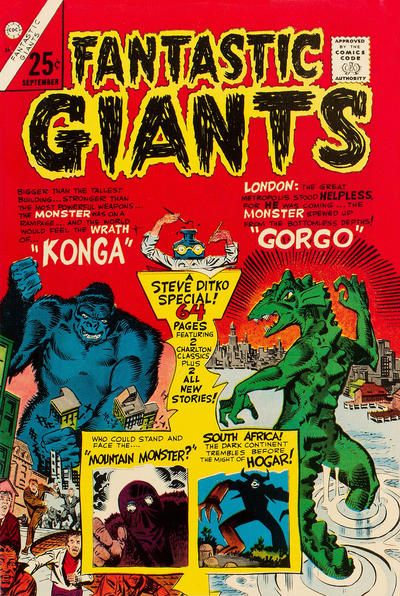
I first chanced across the Gorgo tale in the reprint of the first issue in the awesome Fantastic Giants special which featured not only the adaptation of the Gorgo movie by Joe Gill and Steve Ditko, but it also included an adaptation of Konga by the same team as well as a few more recent Ditko tales. The Gorgo adaptation is a brisk retelling of the movie story with some additional scenes featuring an octopus and a killer whale, which while in the screenplay did not make the final cut of the film.
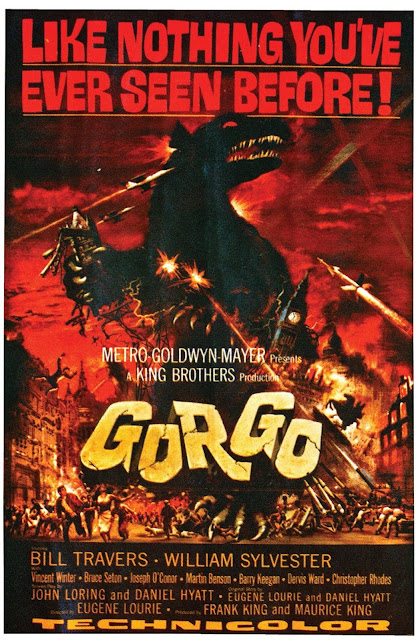
If you don't know the general story of Gorgo either as a film or as the comics story adapted by Joe Gill and Steve Ditko for Charlton Comics way back in 1961, it's a classic tale of giant monster terror. Two likeable but tough-minded salvage divers find themselves stranded off Nara Island and after some bother about treasure and such find that a monster called "Ogra" by the little boy who attaches himself to them might make a pretty good penny for them back in civilization. They capture the critter, bigger than several elephants and haul him back to London where he's put on display for all to see. There's some angst about what's right and all that, but before anything really can happen, Gorgo's mother who is ten times his size shows up looking for her baby and crushes Nara Island before heading off the London to get back her boy. The British military has no chance, and she demolishes lots of landmarks like the Tower Bridge, Big Ben, and more. People die like crazy in this one as debris falls on crowd after crowd. Eventually she gets to her baby, frees him and they walk off into the sea and the movie is over just like that. It's a spectacle!

The Monarch Books (a Charlton brand) novelization of the Gorgo saga by Carson Bingham (the pen name of Bruce Cassiday) is much different from the movie. The story is told from the point of view of Sam Slade and his partnership with Joe Ryan is much more tempestuous than in the film. They first joined forces in the Korean War and later as gun runners for the Cuban revolution. Both are rough and tumble, but Joe is much more imposing and dangerous than in the film. The biggest change is the addition of Moira, the sister of Sean, the kid from the film. We get some exceedingly sexy scenes between her and Sam as he is smitten immediately. (She has a very difficult time keeping her clothes on.) She's presented early in the book almost as a mystical figure, mysterious and strangely aloof. But the description of their lovemaking is very salacious in the spirit of that era. I'd imagine more than a few kids had eye-popping moments as they awaited the monster to emerge. The attack on Nara Island by Gorgo's mother is much more impressive in the novel though there is a limitation to the descriptions of the destruction of London as we are hampered by seeing only through Sam's eyes. I'm very glad I finally got to read this little gem.

Gorgo was promoted with great vigor by the King Brothers. After securing the services of Eugene Lourie who was working on his third giant monster movie in a row after The Beast from 20,000 Fathoms and The Behemoth, the producers wrought more than a few changes to the story. But everyone knew a new monster was on the block with scuds of money going into the advertising, not the least of which was getting Gorgo a cover on Famous Monsters of Filmland, rendered by the great Basil Gogos.
And then there's
Waiting for Gorgo. This 2010 short film is a hoot. Imagine how the British military might have responded to the threat of giant monsters long ago. They might set up a Department of Monsters and Over-Sized Animals or DMOA for short. They might staff it well at first but over the decades, things might fall off. To learn more, check out the link below.
Ditko Monsters - Gorgo was released from Yoe Books in 2013. It's a handsome volume featuring the misadventures of the movie monster
Gorgo and his mother as they attempt to live life and co-exist with modern man, who often seems to want to kill them both, though lacks any real means to do so. Of course, the comic series by Joe Gill and Steve Ditko is based on the movie
Gorgo by director Eugene Lourie, a fabulous romp about giant monsters tramping through London. In the comic Gorgo goes to New York. The initial adventures of Gorgo find him in situations similar to what is found in London, but soon the stories get a broader feel and humor is injected into the series.
To read the stories contained within the Yoe Book collection follow the links below. Although other artists than Ditko drew Gorgo stories over time, only those stories are of interest here.
Go
here to read this issue.
Go
here to read this issue.
Go
here to read this issue.
Go
here to read this issue.
Go
here to read this issue.
Go
here to read this issue.
Go
here to read this issue.
Go
here to read this issue.
Go
here to read this issue.
Go
here to read this issue.
Go
here to read this issue.
PS Artbooks has also reprinted the Charlton
Gorgo series in four volumes which include all the stories in addition to the Ditko ones. I have most of these in some form or other, but I have to confess I crave these four volumes. I'm becoming something of a
Gorgo completist I fear. But there are worse things to be.