Showing posts with label George Tuska. Show all posts

Tuesday, October 21, 2025

Lost Marvels - Tower Of Shadows!


In the summer of 1969 Marvel decided to spread its wings and attempt to return to making magical mystery comics as they had done less than a decade before. The supernatural was popular again, so much so that the Comics Code had done little when DC brought forth a truly scary The House of Mystery under Joe Orlando's editorial control. DC was onto something and Marvel wanted a taste. To that end they announced two new titles -- Tower of Shadows and Chamber of Darkness. Fantagraphics attempted to reprint Tower of Shadows but is only able to do so in an incomplete form. For some reason two stories based on H.P. Lovecraft stories were not able to be reprinted, much to the detriment of this otherwise handsome volume.  
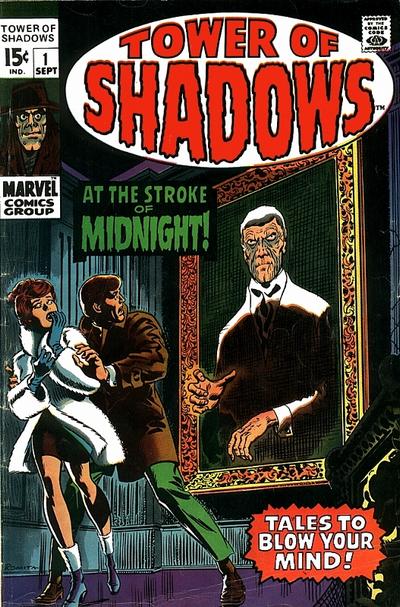

"At the Stroke of Midnight!" by Jim Steranko is the first and the best story in the series. Steranko was at his very best, offering up a haunted house story that fragmented time for the characters and the reader as well.  "From the Brink!" by Johnny Craig gives us a dandy tale of a man who is seeking to root out fake mediums and then he finds a real one. "A Time to Die!" by Stan Lee and John Buscema and Don Heck is a tale of a mad scientist and his even madder assistant and what happens when the former discovers the secret of immorality.  Cover by John Romita, replacing one by Jim Steranko which Stan Lee rightly deemed in my eyes as less effective. 
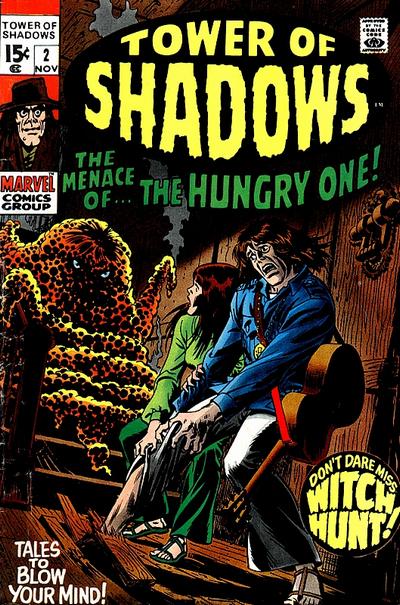

"Witch Hunt!" by Roy Thomas, Don Heck and Dan Adkins tells the tragic story of a man looking for witches but gets surprised when he finds something else. "Look Out, Wyatt -- Automation's Gonna Get Your Job!" by Gary Friedrich, John Buscema and John Verpoorten is a story set in a mine where men fear machines will take their jobs, but one man finds that fear ends up threatening them even more. "One Hungers" by Neal Adams and Dan Adkins has a few hippies uncover a voracious menace from across time.  Cover by John Romita for the Adams story. 
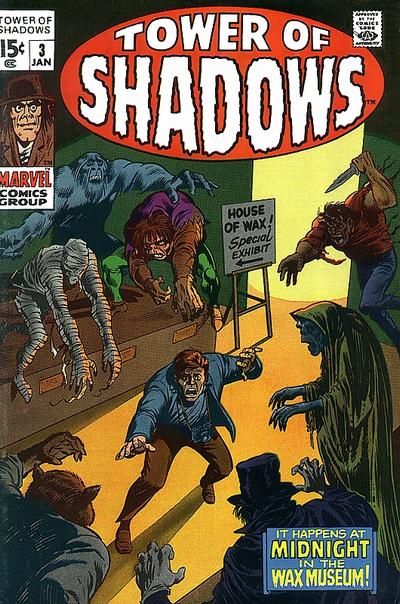

"The Moving Finger Writhes...!" by Len Wein, Gene Colan and Mike Esposito is the story of a man who is a failure until he finds a special book which lets him glimpse the future, but what's there is both wonderful and terrible. "Midnight in the Wax Museum!" by Gary Friedrich, George Tuska and Marie Severin features a reporter who wakes up one day and discovers a house has appeared from nowhere and then he finds aliens. "The Terrible Old Man!" by Roy Thomas and Barry Windsor-Smith finished this issue but sadly is not in this collection. Cover by Marie Severin for the Friedrich and Tuska tale. 
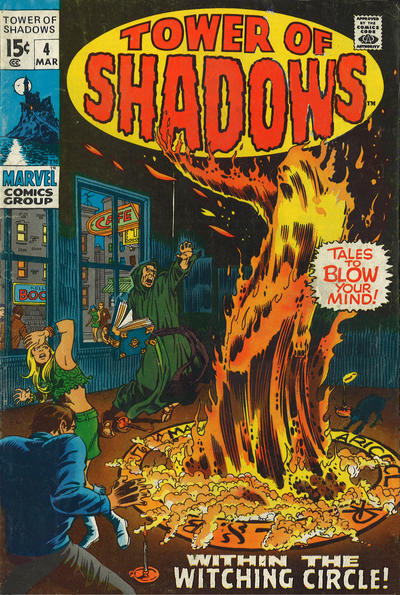

"Evil is a Baaaaad Scene!" by Allyn Brodsky and Don Heck has two hippies seeking cheap thrills but find more than they bargained for when they let an evil mystic cast spells in their apartment. "One Little Indian!" by Marv Wolfman, Gene Colan and Dan Adkins tells the story of a cruel man who is cursed and is warned to avoid Indians, which he tries to do. "To Sneak -- Perchance to Dream!" by Tom Sutton is a sequel to a Chamber of Darkness story in which two spies occupy a living house in order to blow up a plutonium plant. Cover by Marie Severin and Herb Trimpe for the Brodsky and Heck tale. 
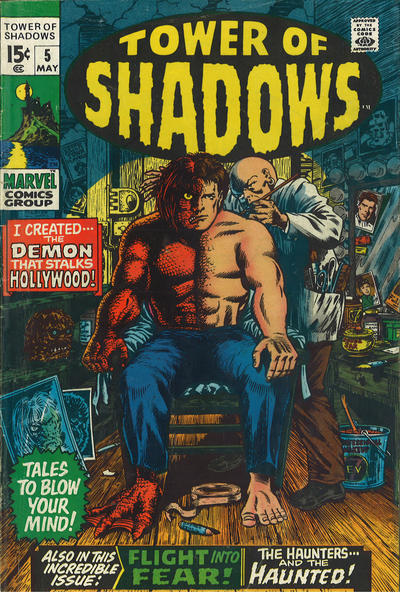

"The Demon that Devoured Hollywood!" by Roy Thomas, Barry Windsor-Smith and Dan Adkins is about a famous horror film actor famous for his make-ups, but who has a terrible secret which ultimately destroys him. "Flight into Fear!" by Wally Wood tells of a lame young man who falls asleep on a gargoyle and before you know it finds himself a giant in a land of people needing a sword-wielding hero. "Time Out!" by Gerry Conway and Syd Shores gives us the story of a desperate couple who find themselves locked in a haunted house, and they lose something but gain something as well. Cover by Barry Windsor-Smith and Bill Everett for the Thomass-Windsor-Smith story. 
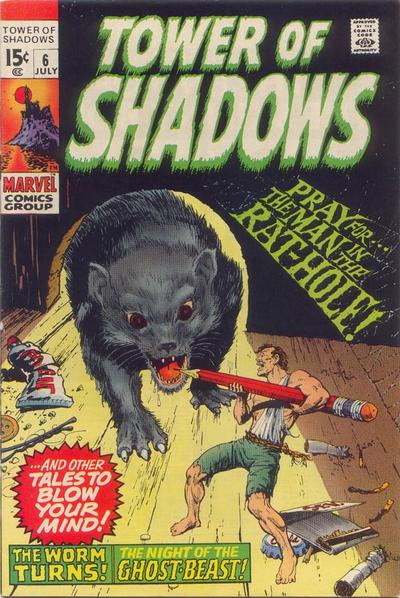

"The Ghost-Beast!" by Wally Wood is another sword and sorcery story in which a character named Beowulf fights a deadly monster, but it turns out he is a menace as well. "Contact!" by Tom Sutton is a two-page bit of fun about a power-hungry old man who makes contact with aliens, much to his regret. "The Scream from Beyond!" by Steve Skeates, Gene Colan, and Dan Adkins tells the story of an evil man who causes crashes to record the sounds, but who finds a sound he doesn't want. Cover by Marie Severin for a reprint story "Man in the Rat Hole!" by Stan Lee and Steve Ditko. (Not in this collection.)
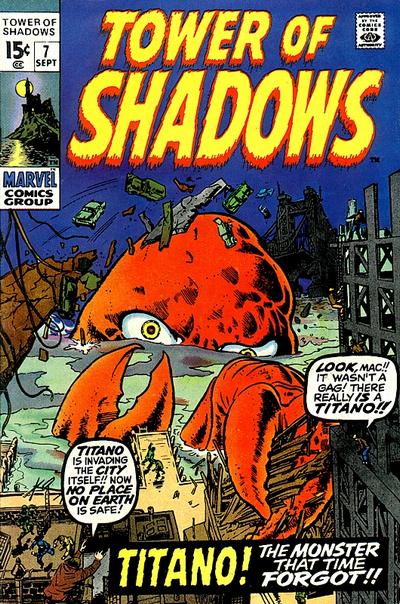

"The Scream of Things" by Allyn Brodsky, Barry Windsor-Smith, and Vince Colletta is about a researcher and an evil girl who find more than they can handle in a cursed mansion. "Of Swords and Sorcery!" by Wally Wood is another sword and sorcery effort, this one filled with an evil sorcerer, an elf, and a transformed dwarf in addition to the usual hero and damsel in distress. Cover by Jack Kirby, Steve Ditko and Marie Severin for the reprint story "I Was Trapped by Titano, the Monster the Time Forgot!" (Not in this collection.)


"Sanctuary!" by Wally Wood is yet another sword and sorcery tale about a man who would be king and seeks a crown in a forbidden place. Cover by Berni Wrightson for the Wood tale. The rest of the issue is comprised of reprints featuring artwork by Steve Ditko and Don Heck. (Not included in this collection.)


"Pickman's Model" by Roy Thomas and Tom Palmer. Cover by Berni Wrightson. The balance of the issue was filled with work drawn by Don Heck and Jack Kirby. Only Wrightson's cover is included in this collection. 


This one-short King-Size Special cover by John Romita is included as well. 


Here is Jim Steranko's rejected cover for the debut issue of Tower of Shadows. It's an awesome piece of artwork, but I have to agree with Lee that Romita's was likely to sell more books. 


With both Tower of Shadows and Chamber of Darkness, Marvel wanted to tap into that EC horror host vibe as both Warren and DC had done. To that end they created Digger, above seen in a distinctive outfit by Steranko. 


John Buscema renders him in his more traditional look for the third story in the first issue. Buscema's version is less offbeat but creepier. 


Digger shared hosting duties with the official host of Chamber of Darkness, one Headstone P. Gravely. Both Digger and Gravely show up in the early issues of Tower of Shadows, but soon Marvel lets them fade away in favor of letting the artists introduce their own tales. I hated to see the hosts go, but using the real talent was actually quite in keeping with Marvel's general trend of promoting that talent for the fans. 


Tower of Shadows changed its title to Creatures on the Loose and became a home to more vintage monster stories from the Atlas days and sword and sorcery, specifically Marvel's first King Kull story by Berni Wrightson, and later Gullivar of Mars by Gil Kane and Thongor of Lemuria by a host of talents. Man-Wolf finished off the series. But for all that, I never forgot Tower of Shadows and really enjoyed this chance to tumble into its pages again. 

Rip Off

Thursday, July 3, 2025

The Quality of Freedom!


DC snatched up the vintage Quality Comics heroes and more than a bit of fun with them. They became the Freedom Fighters. How they got there is one of my favorite stories in all of comicdom. What we commonly call Quality Comics rose from the ashes of Centaur Publications, and the machinations are complex but not uncommon in an era where hucksters hoped to make a quick buck in a medium which was exploding in popularity. But the main guy behind Quality Comics was a chap known as Busy Arnold and he seems to be a businessman who valued his employees by and large and honored contracts. 

(The First Quality Comic - 1937)

Quality really made its mark when Arnold made a deal with Will Eisner who quit his gig with Jerry Iger and went to work with Arnold. 

(Doll Man -- Quality's First Super-Hero)

It was here that he created such characters as The Ray, Black Condor, Doll Man, Lady Luck, Blackhawk, and his most famous creation of all -- The Spirit. Such was the relationship between Arnold and Eisner that Eisner allowed the creation of Midnight by Lou Fine for Quality in case WWII did something to Spirit sales. 

(Will Eisner)

But nothing lasts forever, and eventually Arnold and Eisner go their separate ways. The comic book industry gets torpedoed by likes of Frederic Wertham, and eventually Quality closes shop in 1956. Much of their material was sold to DC who continued the highly successful Blackhawk series.

(Among the Last Quality Comics - 1956)

Eventually DC tried out Plastic Man as well. Then in the pages of Justice League of America Len Wein, Dick Dillin, and Dick Giordano brought back the Quality heroes with gusto. 


By the time of Justice League of America #107, the general template of the Justice League and Justice Society crossovers had been set. The two teams would meet and the added value from year to year would be new heroes. This time the heroes of Earths One and Two would meet the Quality heroes on Earth-X. DC had control of these heroes since they had bought out Quality Comics some many years before. Len Wein had wanted the name to be Earth-Swastika, but editor Julie Schwartz kiboshed that idea for obvious reasons.


The story really began with the previous two issues of Justice League in which both Elongated Man and Red Tornado were inducted into the League. The Tornado had survived the end of the last JLofA-JSofA adventure and been stranded on Earth-1 where he was found by his creator T.O.Morrow who promptly gave the android hero a new face and tried to use him to destroy the League which had welcomed the android hero into their ranks. Morrow's plan failed, but the Red Tornado now had the distinction along with Black Canary of being a member of both the League and the Society.


"Crisis On Earth-X" was written by Len Wein and drawn by Dick Dillin and Dick Giordano. The comic featured another outstanding Nick Cardy cover. The action begins with both the Justice League and the Justice Society trying to synchronize two transporter devices with which they hope to be able travel between the Earths at any time of the year. Despite Red Tornado's pleading to be allowed to return to his Earth, the League sends Green Arrow, Elongated Man, and Batman into the machine. Likewise, the Society sends Sandman, Dr. Fate, and Superman into their device. But Red Tornado stows away in the device causing the transporters to malfunction and the seven heroes to vanish. They end up on another Earth entirely, one that seems to have Nazis in control. They battle the Nazis who have super-scientific devices and are saved from defeat by the intervention of Uncle Sam, the Human Bomb, Phantom Lady, the Ray, the Black Condor, and Doll Man. Uncle Sam reveals that on this Earth World War II lasted far longer due to the untimely death of the President, and that eventually the Nazis won taking control of the globe. They maintain power with mind control devices to which Uncle Sam and his freedom fighters are immune. Dr. Fate uses his magic to detect the locations of the hidden mind control devices, and the heroes divide into teams and Uncle Sam sends the teams away to destroy the devices. Red Tornado is left behind. Batman, Dr. Fate, Ray, and Human Bomb are sent to Paris where the mind control device seems to be in the Eiffel Tower. The quartet battle their way to the top and find the machine which is sentient and defends itself with specially constructed foes for each of the heroes. The heroes prevail but then are taken over directly by the machine. They are able to destroy the machine though by combining their powers and relying on their reflexes. Meanwhile the heroes of Earths One and Two search for their disappeared comrades.
 

"Thirteen Against the Earth!" under another great Cardy cover is again by the Wein, Dillin and Giordano team. Uncle Sam breaks the fourth wall and brings the reader up to date on the events of the last issue. Superman, Doll Man, Green Arrow, and Phantom Lady arrive in Japan, the former Axis power which was also defeated by the Nazis, to find the second mind-control machine. It is hidden in plain sight and Superman detects it and reveals it. The machine threatens to destroy Japan if the heroes attack it, but Superman is undeterred landing a ferocious punch. Immediately Japan suffers a massive earthquake, and Superman flies off to alleviate the problem. Meanwhile the other heroes work together to get Doll Man inside the machine where he disables it. Elongated Man, Sandman, Black Condor, and Uncle Sam arrive at Mount Rushmore where Hitler's face has been added to the monument. The heroes fight their way to another machine only to discover that it's an illusion. They deduce the machine must be inside the Hitler head and Uncle Sam aided by Elongated Man delivers a massive punch to Hitler's stony ediface destroying the machine. The heroes are them reassembled but discover that the mind control has not diminished despite the destruction of the three machines. In fact, the heroes of Earths One and Two are taken over by the mind control and attack the heroes of Earth-X. Red Tornado detects the source of the mind control and follows the trail into orbit where he finds a huge Nazi satellite "manned" by an android Hitler. It turns out the Nazis had actually been defeated by their own mind control machines some years before and that the machines have ruled Earth-X since. Red Tornado attacks and succeeds in causing the satellite to fall out of orbit and crash into the ocean. He rescues a bit of equipment the machines used to communicate, and the heroes are able to contact Earths One and Two to arrange rescue. The leave Earth-X free of its oppressors and they leave behind some truly quality freedom fighters.


The Freedom Fighters proved to be pretty popular and even got their own series several years later. It was a quirky series and brought the heroes to Earth-1 and made them fugitives, an attempt I guess to recreate their underground guerrilla warrior role from the crossover. I enjoyed it, but after a few years the series was cancelled. This crossover itself is one of my absolute faves. The artwork by Dillin and Giordano is outstanding, with Giordano giving Dillin's storytelling some real drama. In the years before internet and archives and whatnot, getting to see these vintage heroes was an awesome treat. While I adore the modern era with access to old comics easy to get hold of, part of me yearns for those sweet days when such glimpses were exceedingly precious because they were so rare. 

The Freedom Fighters went on to get their own series, one which lasted a few years and was caught up in the end in DC's notorious implosion. Here's a cover gallery. 


The book might have died, but there was no killing these Quality characters. 


A few years later Roy Thomas developed an origin story of sorts for the Freedom Fighters in the pages of All-Star Squadron. This comic was Roy's attempt to organize and to some extent sanitize DC's often chaotic Golden Age era. 


Alas, his hard work was largely undone by Crisis on Infinite Earths. The arrival of Harbinger was the end of classic DC take on those vintage Quality heroes. 

Look for more posts on the Quality heroes as July rumbles along. For more about these comics, I highly recommend Twomorrow's Quality Companion. (See the cover at the top of this post.) It has a wide array of features and traces the rise and fall of the company and its many talents. It even includes many full-color comic stories from Quality's heyday. 

Rip Off

Saturday, April 26, 2025

Invincible Iron Man Day!


George Tuska was born on this date in 1916. Tuska was an important artist at Marvel and many companies before that during the Golden Age of Comics. Tuska was one of the reliable workhorses that were required to keep comics on the racks. He was the mainstay artist on Iron Man in those years when I paid attention to the title. 


George Tuska is a pro's pro, one of those rock-solid talents who inform the field in a way which makes waves well beyond their time. As it turns out Tuska's time was pretty large, as he had a career which sprawled from the Golden Age well into the late Bronze Age and well beyond on the comic strip derived from the Justice League and Superman comics. And always his stuff was there, just like it had been before. I first encountered Tuska on Iron Man, and he remains to my eye the best artist the title ever had. I know there many Bob Layton lovers among us, and I pay proper heed to how Layton was able to redefine the look and bring a shiny gloss, but no single artist in my opinion ever drew armor which looked heavier or more like metal. It wasn't shiny, but it had an angularity and heft which didn't communicate fabric, but something else. Tuska drew great thugs, baddies who carried "heaters" and hung out with "dames". If I had to choose one artist to draw my adaptation of The Maltese Falcon, I'd get Tuska.


In my own imagination, when I think of Iron Man the first image was something from the long rich tapestry created by George Tuska.


Above is my first Iron Man comic and my introduction to both Tuska and writer Archie Goodwin. 


Rip Off