Showing posts with label Fantasy Movies. Show all posts

Tuesday, October 15, 2024

Labyrinth!


The Jim Henson operation was riding high in 1986 when Labyrinth hit the big screens. This was actually their second big fantasy film (if you don't count The Muppets), following the critical acclaim of The Dark Crystal. This time Jim Henson wanted to blend puppets and people in a believable way in an unbelievable story. We have a modern fairy tale with many of the classic elements, a story about a young woman coming into her adulthood and resisting the rigors of that adulthood. That friction creates stress in her home and eventually danger for her baby half-brother, a child she loves yet also resents. 

The young woman is portrayed by Jennifer Connelly in a very early role. The late and great David Bowie is the star of this vehicle, lending his peculiar talents to a role as the Goblin King. Other than the baby brother played by artists Brian Froud's young son, the rest of the cast are puppets of various and sundry kind. I like much if not most of the movie a great deal, but it gets too cute by half in places. 


The Labyrinth is a failed opportunity. That failure was due to the fact that movies like this need to make money and to do that they need a happy ending. While one could have logically given Labyrinth a satisfying ending, it wasn't what one might have deemed necessarily happy. The young girl has an exotic experience in which she must learn to put away her childhood and grasp the powers and responsibilities of adulthood. She has been resistant for a host of reasons, not the least of which is unresolved grief for her mother, and jealousy of her little brother. She feels shoved out of the warm tidy nest and wants to stay. But that cannot be, and through trial and tribulation she learns better. 


That's a pretty good solution to a fairy tale narrative, but it doesn't ring with huzzahs. To get that Henson sticks on an abominable ending which to some degree undermines the hard-won lessons of the film. He wanted everyone to smile as they left the theater, and he should have trusted his work to simply fulfill them. Because of this last-minute lack of confidence in his narrative and in his audience, he allows the story to feel incomplete. 

Rip Off

Monday, October 14, 2024

The Dark Crystal!


The Dark Crystal from 1982 is a darn good fantasy movie from the folks who gave us The Muppets. That technology is used for good to tell the story of a strange world which has been dominated for a millennia by an evil species called the "Skekis" and an equally good species called the "Mystics". A great crystal powers the system and now it's time for a great convergence in the heavens and things are about to change. The agent of that change will be a "Gelfling" named Jen who along with his love Kira quest to find the "Shard", a broken off piece of the titular crystal. The movie then is a quest with our little heroes trying to live long enough in a very strange world to keep it from ending. 


My impression is that Jim Henson wanted to do something a bit edgier after more than a few years of The Muppet Show and well over a decade on Sesame Street. You can't be scary in those places, only gleeful and hopeful. This is a darker story with a potentially less happy ending. To get the look he wanted, Henson turned to Brian Froud, a British artist who was very comfortable with fantasy of a darker sort. Henson both performed and directed this movie, sharing duties with Frank Oz who did likewise. 


If the movie can be faulted on any front, it's that it's a bit spare on story. Jen is given his mission at the very beginning, finds the Shard almost immediately, meets Kira pretty soon thereafter and then it's just waiting for the finale. A few more red herrings might've beefed it up a bit, but I guess for a movie like this, such diversions were extremely labor intensive. One fun character in the movie is Aughra, a crone who monitors the heavens and has possession of the Shard. Things really pop when she shows up, the characterization of her by Frank Oz is delightful. 


The movie did well enough in the marketplace and is fondly remembered. It didn't generate a sequel though talk of such has been ongoing for decades. A prequel was eventually produced for NexFlix. There have been novels and comics, so The Dark Crystal hasn't been forgotten. In fact, it might be said it struck a chord. But Henson and company were not done with fantasy films, but that would have to wait a few more years with a little project called Labyrinth. More on that tomorrow. 

Rip Off

Sunday, May 26, 2024

The Extended Lord Of The Rings!


It's pretty impossible to express the excitement I was filled with anticipating the film version of The Lord of the Rings. Rumors had rumbled for decades that someone was going to do this eventually. But properly, we all wanted it done correctly, with a sufficient budge and with proper attention to the elaborate text. Tolkien himself had resisted film versions of the saga, especially when Disney considered the project. Apparently, Tolkien had a low opinion of Disney's efforts in regard to fairy tales. 


Writing up reviews for these movies at this date is difficult. So much of that world has been seen, that it's hard to remember how it was to enter Hobbiton for the first time or visit The Prancing Pony alongside four naive Hobbits about to enter a wild dangerous world. The Fellowship of the Ring remains my favorite to this day. In this story we are introduced to the vistas of Middle-Earth as reimagined by director Jackson and the small army of talents New Zealand brought to the task The movies showcase the splendid territories of New Zealand. The story starts small in Hobbiton as we meet our heroes who soon enough are forced to enter the larger and more dangerous world with murderous Dark Riders on their trail. The company of Frodo, Sam, Merry, and Pippin is a spritely gang, and the addition of Strider gives the story a heft and seriousness it previously was missing. 

The action is beautifully paced in this movie with respites between action scenes, scenes still grounded in reality and not having yet fallen victim to overwhelming CG elements. Just as in the novel the world continues to expand for us as we go to Rivendell and then beyond and ultimately the tragic mines of Moria. It is only in Moria that the creators lose their way a bit with the special effects getting a bit large and subjecting our heroes to impossible stresses. But it's a near thing still, not yet the cacophony we will endure some years later. 

I was struck watching it this time how much I'd forgotten how central Frodo is to the proceedings. As portrayed by Elijah Wood his gentle nature gives the movie a pleasantness it might otherwise lack. Ian McKellan's first turn as Gandalf is magnificent and his demise gives this first movie an emotional high it is never ever really able to match in subsequent films despite the ever-increasing stakes. I'd never noticed Viggo Mortensen before his turn as Strider, but he's become a favorite actor in the years since. I was especially struck by Sean Bean's performance this time, a part often overcome by braying. He gave it an emotional value which makes you genuinely mourn for a man who despite his mistakes clearly wanted what was best for his father and his people. 

This first foray into Middle-Earth was and is magnificent and holds up well after more than two decades. The battles had not swollen to engulf the warriors and we can still feel the potency of the battles. Jackson and his team do a grand job of getting the important bits in, creating a big movie from an even bigger story. I mourn the loss of Tom Bombadil, but it's easy to see why we have no time for him or the Barrow-Wight as well. 

But it was a darn good start. 


I remember waiting for The Two Towers to show up the following year. I was extremely eager to see the next installment of this epic movie series, a series I'd never imagined I'd see in my lifetime. With the second movie, we know most all our characters, though we will meet plenty of new ones as well. But what we'll really get a grand look at is the sprawling landscapes of New Zealand, even more so than the first film. What makes these films so much better than the trio of The Hobbit movies is that the CG has not yet overwhelmed the project. We are still watching people move across sweeping landscapes, real places which makes the fantasy feel more vital and alive. But we do see the beginning of the end of this in this movie as well. 

The fellowship has broken up and we follow three plot threads though The Two Towers and that's always made it a less coherent story by necessity. Merry and Pippin are kidnapped by Orcs and then find their way into Fangorn Forest and into the care of the Ent Treebeard. Aragorn, Legolas and Gimli pursue to save them until a revived Gandalf redirects them. Frodo and Sam are joined by Gollum who begins to lead them to their destination. At the time much was made of the Gollum character and how it was done technically and that's a warning sign. I'm of the opinion that no movie should be about how it's made rather than what it's about. But things are still fine as we are dealing with real people behind these characters, they have not lost their connection with humanity. We are still concerned with Gollum's moral choices and not so much how they made him so fishy. 

The highlight of this movie is the introduction of the Riders of Rohan and the culture found at Edoras and later at Helm's Deep. These are human places occupied by humans. The crews built real places for the characters to stand in, vast edifices which I know are surrounded by movie magic, but it remains invisible for the most part and doesn't call attention to itself. 

Legolas and Gimli are a lot of fun with their banter, and Legolas as superhero begins to assert himself. He was a nimble and deft fighter in the first movie and in this one he's Captain America, doing clearly impossible things. The Battle at Helm's Deep is the best battle of this kind that Jackson will ever stage. In the next movie the action will grow too large with the human connection being lost. The balance is on a knife edge but works, and that's in no small part due to the darkness and rain. 

Very entertaining stuff, and that's darn hard for a middle part of a trilogy to be since resolution is never on the table. 


The Return of the King brings the trilogy to a conclusion adapting, more or less, Tolkien's third novel. This is finale and in this one sadly the spectacle begins to swallow the story a bit. Nonetheless it's a rousing movie with the various plot threads finding their way either to Minas Tirith to defend against the hordes from Mordor or to Mount Doom where Frodo and Sam work relentlessly to get shed of the One Ring for all time. 

The transformation of Gollum is complete, and he is an utter villain as he leads the doughty pair into the clutches of the spider Shelob. Aragorn must walk to his own death of sorts to gather a ghostly force which will it's hoped will help defend against the deadly forces Sauron has launched at greatest city in Gondor. Legolas and Gimli help him out. Merry becomes a helper to King Theoden while Pippin finds his way to become a soldier for Gondor in service of the duplicitous Denethor. There's this and more as we follow Arwen's choice and Faramir's sacrifice, while Gandalf tries to save them all. 

The siege of Gondor is a spectacle for sure, filled with wild action sequences. And that's the lovely poison which is beginning to be felt, the action is overwhelming the character development to some degree. A major sticking point for me in the third entry is that it fails to pay off Saruman's story in any meaningful way. We get a few scenes, but they feel meager. Since we won't get a scouring of the Shire and Saruman's comeuppance in that, he needs a stronger send off. I also was very much disappointed in the ghostly army that Aragorn brings to save the day. They look like something from a science fiction giant monster movie. Here was Jackson's time to shine, to how ghosts battling Orcs for all the marbles, and we instead get a strange rambling blob. 

But having said all that, the movie is still a success and has emotional power. I enjoy it every time, and every time it makes me weep just a little. 


Making all three movies at one time was a brilliant stroke, though a heavy lift indeed for all concerned. Jackson is able to give each movie its flavor and still make them a coherent whole. With another studio in another time, I can imagine each installment getting its own director. But Jackson perceived that which is obvious really, there is not a trilogy of books which make up The Lord of the Rings but rather a very long novel which was divided up into three parts for reasons both logistical and economics. And he approached this movie adaptation in the same way. 

What makes these three movies successful is that Jackson and his team were charged with taking a mammoth tale and whitling it down to its necessary elements to translate the story to the screen and at the same time give it some modern flavor to make more than palatable to folks not already devoted to the late Professor's works, and they did just that. And they used the technology at hand to place real people in unreal places. What makes The Hobbit so relatively unsuccessful in the final analysis is just the opposite, a small work ballooned to giant-size while armed with all the CG money could buy, depending on animated characters too much of the time. 

Rip Off

Saturday, May 25, 2024

The Animated Lord Of The Rings!


J.R.R. Tolkien's The Lord of the Rings had touched off a renaissance for fantasy literature. Publishers were agog to get something onto the racks that smacked of fantasy, whether it was in the vein of high fantasy as is Tolkien's classic or of a more blood-handed quality such as the works of Robert E. Howard, there was an absolute hunger for such stuff. But how to bring The Lord of the Rings to the big screen. 


It seemed too large a tale for the cinema, at least the cinema of the 70's which had seen the collapse of the studio system and the rise of independent filmmakers. Star Wars had pointed the way forward for movies, and multiple installments of epic stories seemed viable. So, it was decided to make The Lord of the Rings into a movie after all in 1978. Peter Beagle, author of The Last Unicorn was brought in to revise the screenplay by Chris Conkling. Animation was the format the format selected, and the director would be Ralph Bakshi. 
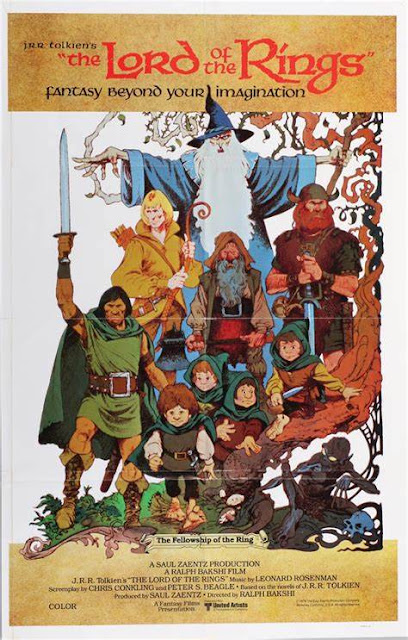

Ralph Bakshi was a wild card. He was a veteran animator, having risen up in Terrytoons and had gained some cache with is creation of The Mighty Heroes and other projects. He'd broken into cinema with Fritz the Cat which brought Robert Crumb's feline avatar to a public ready for the adult nature of the storytelling. Bakshi knew how to get an animated feature made and delivered, and outside the Disney studios he was nearly the only game in town. Artist Mike Ploog's work showed up a lot in the designs. He'd worked with Bakshi on Wizards, a science fiction fantasy which had the misfortune to debut the same week as Star Wars. British actors were brought on to do the voices. It was an epic effort to bring an epic story to the screen, and it was originally intended to be the first of two parts. Alas, we never go that sequel, at least not by the Bakshi team. 
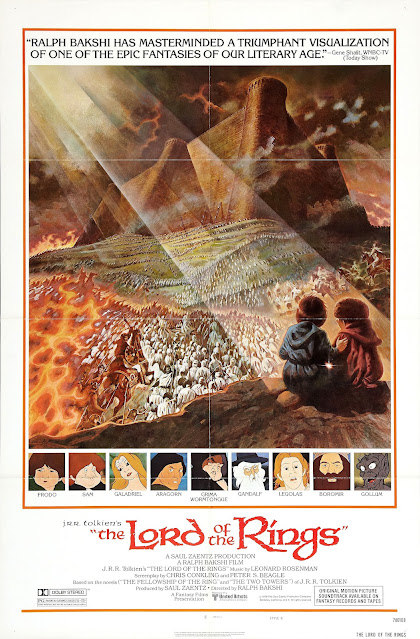

The movie is criticized today and was criticized at the time for the extensive use of rotoscoping to make the animation work, and the to give the work a greater sense of reality. Rotoscoping is looked down upon despite being one of the earliest techniques in animation and was used extensively by the Fleischer Studios in the 30's. That said, there more than a few sequences in the movie which don't really work. The rotoscoping doesn't always blend with the traditional animation and creates a jarring effect on the viewer. This movie unlike Wizards which used much the same styles required an approach which didn't take the viewer out of the movie. Here is an interview with Bakshi talking about the film. 
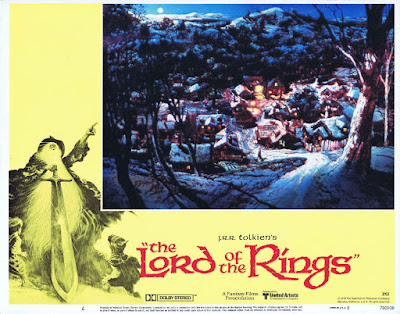

I give the movie high marks for its realization of the Shire and the bucolic regions adjacent to it. There are some gorgeous scenes with our characters moving through them. As the movie goes along and we get further away, that kind of thing diminishes. The Black Riders are also effectively realized in some places. They are favorites of mine, truly frightening creations.  Less successful is Sam Gamgee who comes across as a goofball. Frodo is okay but he and the other Hobbits look like they are about thirteen. The battle at the end of the movie is the low point, with the Orcs poorly realized and the sense of animation minimized. The strength of this production are the outstanding background paintings which successfully create a compelling world, not unlike the masterful backgrounds in the classic King Kong almost become a character. The movie ends abruptly with Gollum leading Frodo and Sam into Shelob's clutches and the heroes successful at Helm's Deep. 
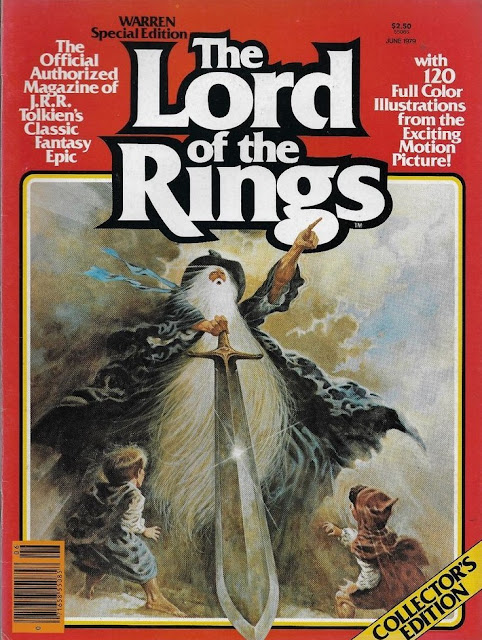

Despite a potent advertising program, the movie failed to live up to expectations in theaters. The sequel was cancelled, and Tolkien fans were left hanging with only half the story told. That is until the Rankin-Bass operation stepped in. They'd brought The Hobbit to the screen some few years before and now they'd wrap up Tolkien's greater epic in the bargain. But it wasn't part of a plan necessarily. 
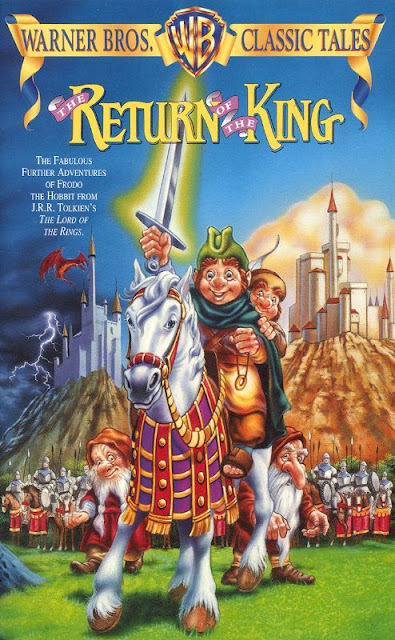

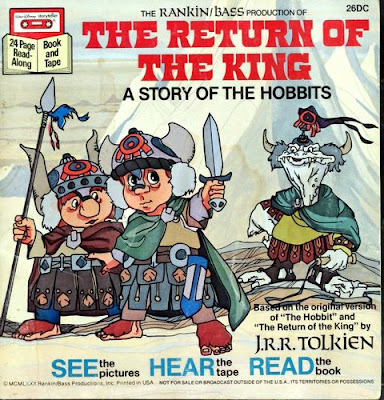
The Return of the King from 1980 has the Rankin-Bass operation picking up the story just about where Bakshi's movie had left off more or less with Frodo and Sam having survived Shelob but Frodo having been captured by Orcs. It is important to note that the production was not intended as a sequel to the Bakshi film. It's merely a fluke that the Rankin-Bass outfit started the story just about where Bakshi left off. The original title was Frodo -The Hobbit II, but better heads prevailed. The style shifted back to the Arthur Rackham inspired character designs, and the ambition was singular, to finish the story. Like The Hobbit before the Tolkien estate did not approve of this little outing and filed suit, but a deal was cut.  
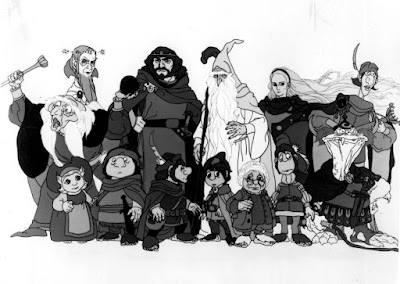

Joining veterans from The Hobbit such as Orson Bean (Frodo this time), John Huston (still Gandalf), and Brother Theodore (Gollum again) were Theodore Bikel (Aragorn), Roddy McDowell (Sam Gamgee), Casey Kasem (Merry Meriadoc), and others such as veterans John Stephenson and Don Messick among others. This 1980 production was done for television by the same Japanese outfit that had don The Hobbit


People bicker about it. Consider it a weak addition to the Tolkien world, and the Tolkien Estate even tried to stop its production. But for my part, I cherish it, for all its flaws for giving the story an ending it otherwise would not have. I rather liked The Hobbit and I like this one, though it has a harder path to walk. Despite the decision to only adapt the last novel for the sake of time, there still seems to be a terrible feeling of padding in the beginning of the story.  For Tolkien fans today it might seem a weak offering, but for us then it was a triumph if only a small one. The epic saga had been transformed into a story which walked and talked, if imperfectly. 


Two decades later, a New Zealand director would take on the story again, this time armed with new-fangled computer technology and people eager to do a greater justice to J.R.R. Tolkien's great story. But we'll get to that tomorrow. But first a song. 

Frodo of the Nine Fingers 

Music by Maury Laws
Lyrics by Jules Bass
Sung by Glenn Yarbrough

When Bilbo found that shiny ring
In Gollum's cave of gloom,
He never thought that it would turn
Into a ring of doom.

The Dragon Smaug, the Spiders too, 
The Goblish, the Evin-King,
They came to know the power of
The Hobbit and his ring. 

Frodo of the Nine Fingers
And the ring of doom.
It started with a Hobbit in
Gollum's cave of gloom.

The power of the ring, it grew,
And Gandalf sat in thought.
He knew that it must be destroyed
In fires where it was wrought. 

For is in evil hands it fell,
The earth would know its end.
No force of arms would win the day,
No army could contend. 

Frodo of the Nine Fingers
And the ring of the doom
Accepted a heavy burden
For the fires to consume.

Frodo of the Nine Fingers
And the ring of doom.
Why does he have nine fingers?
Where is the ring of doom?

We know of course. If you'd like to enjoy Ralph Bakshi's version of The Lord of the Rings, then check out this Internet Archive link. To see The Return of the King by the Rankin-Bass outfit check this Internet Achive link. 

Rip Off 

Sunday, May 19, 2024

The Extended Hobbit!


Below are three review I wrote over the years for the three installments of The Hobbit as directed by Peter Jackson. I've tweaked them a bit for the sake of some consistency, but for the most part I've left them as they were originally presented. When my opinion has changed, I've indicated. 


December 2012 - An Unexpected Journey

I went to see The Hobbit - An Unexpected Journey yesterday morning. Usually Sunday morn is a dandy time to catch flicks as it offers quiet reasonably empty theaters. Not yesterday. Despite a 10 AM start, there and the fact I went to the mundane 2-D presentation, there were still over a one hundred folks enjoying the latest trip to Hobbiton and beyond with me.

I have to confess going this time was more a chore than a joy. I was giddy to see the first of the Peter Jackson adaptations over a decade ago, going opening night and braving giant crowds. This time, I mostly wanted to see it before reviews spoiled it. I've not been happy since I learned there are going to be three of these things. I fear we're going to see a trio of bloated narratives, dragging in all manner of off the rack material. A scrupulous adaptation of the Tolkien classic would make for two reasonably sized flicks and would add nicely to what the New Zealanders have already accomplished.

Hobbiton is beautifully rendered, and it was scrumptious to visit this exceedingly cool mythical hamlet again. The scenes of the group tramping across the countryside astride their ponies were beautifully done, really communicating the essence of Tolkien for me. The balance between the unusual and the beautifully mundane is perfectly balanced in these scenes. Riddles in the Dark is outstanding, precisely true to Tolkien as I remember it at least. I'm not a huge Gollum fan in these movies, finding him at times very tedious, but he works here as well as he ever has. The technology supports the performance here wonderfully. Likewise with the Wargs which look really menacing.

It's not the filmmakers' fault, but thirteen dwarves are a challenge for anyone. It is a downright "avalanche" of dwarves. There's no doubt in my mind that if Tolkien's book was not so beloved, a typical adaptation would lower the number of dwarves to six or seven at best. But stuck with the original mob, Jackson and company try to make them distinctive, though we fail to get proper introductions to many. At least they are visually distinctive. It's almost impossible though to keep track.

Unfortunately for this movie and I fear for the franchise, the development of "performance-capture" has "captured" this movie. For me the triumph of the earlier movies was that it made the world of Tolkien's Middle Earth real. It grounded the fantasy into a place and time, adding some blood and thunder to the proceedings. But that alas is lost in this tale which all too quickly reduces itself to a video game as animated figures cavort and crawl across the screen. The action is sweeping and dashes along spritely, almost too quickly to process. The damage the heroes suffer is epic and alas cartoonish. The realism of the early epics is lost, much to detriment of the heart of the project. The scene with Gandalf, Saruman, Elrond, and Galadriel in the middle of the movie seems downright quaint as we have four normal sized people in a regular real-world room talking. This scene actually jars a bit since so much of the movie before and even more so after is overwrought with special effects. They're exquisitely done I'm sure, but they undermine the reality of the experience for me.

All in all, I'd give first Hobbit movie a middling to low grade. It's got some very strong stuff. A good Bilbo, a great Gandalf, some few interesting dwarves, and some beautiful countryside. But the movie is its own worst enemy ironically since it is technology that is sundering the essence of Middle Earth, the very thing Tolkien moaned about so vehemently in his lifetime. 


December 2013 - The Desolation of Smaug

I was a bit underwhelmed by the first installment of Peter Jackson's epic adaptation of J.R.R. Tolkien's The Hobbit, a yarn about the eponymous wandering Hobbit and thirteen dwarves seeking ancient treasure.  Not because it wasn't impressive, but because to my weary eye it came across as more of an animated event than a real- life movie. So, I didn't rush out to see the second installment this past holiday season. I thought I'd wait for the inevitable DVD and just watch it then. That's a far cry from the burning enthusiasm I had for the original Jackson film trilogy which I anticipated with a ripe eagerness.

But with time on my hands and nice warming temperatures and a dry day, I thought I'd take it in at the local discount cinema. With soda and popcorn (each costing more than my ticket) in hand I settled into the well-used theater alongside a few others and watched what surprisingly turned out to be a rousing movie event. The computer-generated elements were surely in evidence, but somehow seemed less apparent to my eye and so failed to draw me out of the adventure which picked up where last year's first installment left off.

Bilbo Baggins and his dwarf companions encounter Beorn the shape-changer, enter the horrible Mirkwood forest and confront the rather grim elves within, and make their way to Laketown, the domain of men at the foot of the Misty Mountain where Smaug came to drive the dwarves out generations before. They raid the dark halls and wake the dragon, a dangerous thing to do.

For a movie which lasts nearly three hours I found time flying by remarkably swiftly and was actually startled when the story ended, leaving me hanging for many months before I can discover the end. Of course, we all know how it will end, but how we'll get there is the challenge Jackson has before him. He's created a rousing thrill-ride with this installment, less dependent on its Tolkien source material, but which does a goodly job of linking this tale to the earlier trilogy.

Good show indeed. I'm eager to see the end now, very eager indeed.


December 2014 - The Battle of the Five Armies

Well, that took long enough. Last week I went to see The Hobbit - The Battle of The Five Armies. It was a long and visually rich film experience, but alas not one that succeeds as it ought. For the first time, I saw one of these new-fangled 3-D movies and frankly while it's a neat curiosity the texture of the movie seemed more like the flatness often translated on video tape; the luster of film was lost and along with it some of the essence of movie magic.

Anyone curious enough to read this review will be familiar with the story and likely the film series which began a few years ago with The Hobbit - An Unexpected Journey which re-introduced us to the realms of Middle Earth as first designed by J.R.R. Tolkien so many decades ago. We meet a youthful Bilbo Baggins who is drawn into a wild and weird adventure by the wizard Gandalf as he joins a company of dwarves who want to reclaim their lost kingdom from the deadly dragon Smaug. In the second film The Hobbit - The Desolation of Smaug we finally get to the Misty Mountain and Bilbo meets the charming but deadly Smaug and the dwarves, led by the quixotic royal heir Thorin Oakenshield fight hard to reclaim their kingdom deep inside the mountain, but in the end, they unleash the dragon who flies to destroy the nearby human settlement of Lake Town.

The Hobbit - The Battle of the Five Armies begins with the struggle to bring down Smaug. I'm not ruining too much by saying this happens before the credits have properly finished rolling and that of course points glaringly to the greatest deficiency in this film series...it's just plain too long.

In a somewhat disdainful attempt to extract as much money from Tolkien fans as possible the decision was made rather late in the production to make the movie into three parts deviating from the original scheme to do only two movies. Given the source material, two seems ample and sadly if the original plan had been followed, I don't doubt we'd have had two very tight films which resonated strongly in the imagination. Alas what we have now are three movies with a host of virtues, but which tumble along with overlong and somewhat vapid action sequences which only serve to weary the viewer and drain the characters of their verisimilitude. No dwarf and no human could survive the falls these characters take over the course of the three movies, and that's a pity in the sense we lose interest in their physical fates.

In my earlier reviews of the first two movies, I decried the tendency for the action sequences to have a video game feel and regrettably this third one has even more of that sense. One fatal flaw in this concoction is the utter failure in creating a villain with which the audience can have any connection. Azog is a cartoon from the get-go a creature right out of a superhero comic who feels out of place in Middle Earth and is rendered so heavily that we can hardly ever detect any real human behind the portrayal.

The core of this final film is the fate of Thorin Oakenshield, who has been set up as the Aragorn equivalent in this story. The fact his fate is far less rosy than that which falls to the former Strider is thoroughly expected, but the road there is less emotionally involving than I anticipated. The sequence where he throws off the maddening avarice which threatens his soul doesn't work at all for me and seems a bit too weird. Allowing the actor to showcase the changes on his face without the hindrance of fancy digital visions would've served the story much better.

It's all so tiring in the final analysis. 


And Now for General Comments

And that seems to me to be the nut. For all the blather, most of it I'm sure exceedingly earnest, the director and his team do not trust the source material. In an effort to mostly recreate the highly successful Lord of the Rings trilogy nearly beat for beat they constantly overheat the story elements of The Hobbit to accommodate that understandable but ultimately self-defeating goal.

We are saddled with a forbidden romance between races which never reaches a boil, we are given a journey through the shadows of a dark goblin-infested realm which becomes a frenetic footrace against the enemy but almost never achieves any sense of true peril, we are given a finale which as promised in the title features five armies, but alas armies so vast and clearly digitized that they lack the ability to draw out our compassion. The sub-plot involving Gol Guldur and the Necromancer and his minions searching for the rings makes perfect sense when the flick is seen as a precursor to the later LoTR, but within the immediate story needs of The Hobbit they become distractions, as spectacular as they are. 

Where the movies most often succeed is in those elements of the story which are demanded by the source material and cannot by and large be tampered with. The encounter by Bilbo with Gollum is tense and properly paced, and his later verbal joust with Smaug is the highlight of all three movies. Sadly, the Hobbit himself gets lost in this last movie, despite several attempts to glue him into the proceedings. But in that respect at least it remains true to the novel in which as I recall Bilbo likewise disappears from the narrative as the battles rage, though for a far shorter time.

So ultimately The Hobbit trilogy stands as a remarkable fantasy adventure, with some really fabulous sequences which properly invigorate the creation of Tolkien, but which sadly trade on those creations to do more than they are capable of and remain valid to the spirit of Tolkien. I find I like these movies better on DVD than in the theater where the visual spectacle bewilders as I try to maintain focus on the story. 

It's a shame the movies weren't better, but they are fine and entertaining, nonetheless. Maybe in a few years Jackson will re-cut the movies and make them into a super-tight two-parter which will allow the story to shine even brighter.

Rip Off

Saturday, May 18, 2024

The Animated Hobbit!


The Greatest Adventure or The Ballad of The Hobbit

Music by Maury Laws
Lyrics by Jules Bass
Sung by Glenn Yarbrough

The greatest adventure is what lies ahead.
Today and tomorrow are yet to be said.
The chances, the changes are all your s to make.
The mold of your life is in your hands to breaks. 

The greatest adventure is there if you're bold.
Let go of the moment that life makes you hold.
To measure the meaning can make you delay;
It's time to stop thinkin' and wasting the day.

The man who's a dreamer and never takes leave
Who thinks of the world that is just make-believe
Will never know passion, will never know pain.
Who sits by the window will one day see rain. 

The greatest adventure is what lies ahead.
Today and tomorrow are yet to be said.
The chances, the changes are all yours to make. 
The mold of life is in your hands to break.

The greatest adventure is what lies ahead.

I have to confess I have a soft spot in my heart for this gentle tune which wafts its way through the Rankin-Bass production of The Hobbit. This animated version of The Hobbit gets a lot of grief, but I have always rather liked it. The key to appreciating it, is to understand the limitations animation for television (or really anywhere) faced in the 1970's. The costs had forced producers to make all sorts of concessions and there are many in this presentation, but understanding and forgiving that, I have always been entertained by this delightful cartoon. For one thing, the shift to Asia was well underway in animation and Rankin-Bass used seasoned Japanese talent to animate this special. The animation is somewhat better than the Saturday morning TV of the time, but the real strength of this show is the distinctive and memorable character design. 


These are some of my favorite versions of Tolkien's characters. Gandalf is ideal, Smaug is cleverly presented as different kind of dragon with something of a feline head, and Gollum is as animalistic as in any rendition I'm aware of. These are all extreme versions and yet they work. The design of Bilbo and the Dwarves is less quixotic, but they work as well. Bilbo has large child-like eyes, but they are fitted on a bizarre squat frame. The Elves are presented not as ideals of human form but as strange bent creatures of Mirkwood. The Goblins (or Orcs in other places) are outlandish monsters as they should be. The art intentionally evokes the feel of Arthur Rackham, a classic illustrator of fairy tales and fantasy. 

(Arthur Rackham)

The low point of the presentation is the "Battle of the Five Armies" which is presented with some few elements of montage and a very unsatisfying image of dots and dust wiggling around on the screen. I can see the budget for the show drying up before my eyes as I watch this "climatic" scene. It does bring the whole effort down a notch, I have to admit. 
 

But what elevates it up a notch are the fantastic voice performances by Orson Bean as Bilbo, John Huston as Gandalf, Otto Preminger as the Elf King, Richard Boone as Smaug, Hans Conried as Thorin Oakenshield, and Brother Theodore as Gollum. Animation veterans Don Messick, John Stephenson, and Paul Frees are on hand to fill out a cast which sounds great. The key to the success of limited animation shows was the voice acting and The Hobbit hits it out of the park. Richard Boone of Paladin fame is a tremendous Smaug, at once imperious and menacing. Hans Conried stood out to me too this time, his voice was perfect for Thorin who has carry most of the water for the Dwarves, who don't have time to get much distinction. 


Much of this cast (Bean, Huston, and Theodore) will return when Rankin-Bass takes another crack at Tolkien. More on that later. In defense of this show, which is much frowned upon now, it won a Peabody for its screenplay and a Christopher for its message, which was uplifting and hopeful, and competed with Star Wars that year for the Hugo. People who crap on this show today don't know or remember what a dearth of material was available for fans of the fantastic in the 70's. Animation was the only viable way to bring a story like The Hobbit to life on the screen at the time and animation was not yet the province of studios brimming with computers but was made up of individual talents drawing and painting each and every image. 


The show is limited and has to cut out lots of stuff, but frankly with a few exceptions I thought it trimmed effectively and maintained a good momentum. This Hobbit was too short for sure, but that's better than being too long. At least the audience craves more and is not exhausted. More on that tomorrow. 

But before we go, I want to bring up another animated adaptation of The Hobbit. This one is from 1967 and it's only eleven minutes long. Take a look. 


This quaint but bizarre adaptation was developed at the last moment because the producer's option on The Hobbit movie rights were about to lapse, and he needed to generate and show a version of the story to retain them. He made the quickie, showed it for one day in NYC and so was able to hang on for another few years before ultimately relinquishing the rights. This one is far from a diligent adaptation of Tolkien's work, but I must confess it has offbeat charms. The next time we feel that maybe Rankin-Bass could've done better, we need to remember what might have been. 

To listen to little bits and bobs of the soundtrack of The Hobbit by Rankin-Bass check out this Internet Archive link

Rip Off

Monday, May 31, 2021

Movie Knights - Monty Python And The Holy Grail!


This month-long look at movie and comics featuring sword-wielding types such as King Arthur and his cronies would not be complete without a shoutout to the greatest Camelot movie ever made, and that's the funniest flick in the history of flicks -- Monty Python and the Holy Grail. This is the absolute ideal marriage of material and talent, a cretinous bunch of over-educated British louts having a smack at the mightiest of British legends. The Pythons were excellent at pulling the pompous wool out of over-stuffed aspects of society and the hyper-serious considerations concerning the King Arthur legends were ripe for the predations of the Python clan. 


One thing that always bugs me a little when I squander my time watching a movie or reading a book or comic about kings and queens and knights and such is the easy acceptance on the part of all concerned of the absolute correctness of the situation at hand. A king is manifestly right because he is the son of the king before him and the nobility that maintain this hierarchy are showcased without qualm. 


Of course as modern people we know that such a social structure is inherently unfair to the vast majority of mankind and that in our more enlightened times we appear, on the surface at least, to desire structures which are fundamentally fairer and recognize the sameness of people. "Strong Men" come and eventually they go, but most see that dictatorship is not a long term solution to even the most heinous of social breakdowns. It's a patch at best and then of dubious value. For someone to ascend to the throne and ascribe that ascension to the handiwork of a god is outrageous to a truly modern mind. (Not that it doesn't stop some nutter from trying it on, as we've recently learned to our chagrin in my own United States.)


Monty Python and the Holy Grail is infused throughout with a good and proper disdain for royalty and that wisdom informs the smartest gags and bits directly. The whimsical debate between Arthur and the "peasant" Dennis at the beginning always gets a laugh from me and sets up the absurdity of much of the rest of the movie. Later we "nobles" doing all manner of things which people are not supposed to do and assuming it right simply because they have a particular bloodline. But likewise rank stupidity of the common man is set afire time and again as the people are show to possess little true critical thinking power in a universe riddled with superstition. 


Monty Python and the Holy Grail is an excellent movie for our times because it's about our times and not the mythic kingdom of Camelot, but rather the hectic world of modern London and beyond. 

Rip Off

Friday, May 28, 2021

Movie Knights - Excalibur!


I've matured a bit since I first saw it on the big screen in 1981 but Excalibur at that time was a mighty movie which was filled with rough and rugged knights knocking the stuffing out of one another and hot chicks often in mostly nothing at all. A young man does not forget the first time he got see Helen Mirren's boobs. 


The acting in this one was a bomb burst of over-the-top and no one did it better than Nicol Williamson as Merlin who said his lines like no one else and I didn't know that at the time he and Mirren were arch foes which gave their performances an added heat. Lots of faces show up for the first time in this one for me such Liam Neeson and Patrick Stewart, both of course actors who will go on to dominate the pop culture. But through and through this movie is the vision of one man, and that's John Boorman. 


Boorman took Le Morte D'Arthur and hammered out a bold and virile rendition of the Camelot myth. His Uther as played by Gabriel Byrne is an utter villain, a ruthless rapist who is commanded by his passions with no thought of the future. Later the romance of Lancelot and Guinevere will echo this lack of control, though with softer tunes and with a greater sense of shared compassion. Excalibur is a movie that shows man rising up from lustful and violent barbarism and barely making it by the end. It takes the death of King Arthur (Nigel Terry) himself to bring about the transformation, he like Moses having brought his people to a circumstance he cannot and will not be able to share in.  


Excalibur is far from a perfect movie. I've always had a nickname for the Knights of the Round Table as the "Knights of Alcoa", their armor shining so very brightly it reminds me of the aluminum foil. The storytelling is disjointed in places and while I've adapted to that on subsequent viewings it left me a little confused in the beginning. All in all Excalibur is a potent movie that left a firm impression even after forty years. 

Rip Off

Monday, May 24, 2021

Dragonslayer!


This artwork by the late Jeffery Jones is a pretty sweet image for a pretty sweet little 1981 movie.  Dragonslayer was a neat little micro-epic with outstanding special effects, even by today's standards, and an above average story of an apprentice dragonslayer having to fend off not only the monster but an entire village to boot. The movie loses its way a bit in the wildly spectacular ending which while visually compelling is at odds a bit in tone to the rest of the movie. But overall an outstanding effort. 


Here's a sketch Jones made as he constructed the poster.


And here is the final product, one of the more alluring posters from an era when posters were really nifty by and large. 
   

"Vermithrax Pejorative", the dragon remains the best evocation of a dragon on the screen that I've ever seen, and that's saying something given the advances in special effects since that time forty years ago now. Since then of course there have been a host of dragons done with computer graphics and some are quite excellent such as those in Reign of Fire and of course Smaug for The Hobbit trilogy, but somehow with the myriad physical effects and some dandy stop motion, this little movie gave us a dragon that was indeed scary and without uttering a word was vile as well. 

 
Marvel adapted this movie with art by Marie Severin, and the cover above by Earl Norem is effective if not especially opulent.

Rip Off

Wednesday, May 19, 2021

Ator-ible Movie!


Ator or Ator the Fighing Eagle or whatever name it travels under at any given point and time is a derivative piece of barbarian schlock. Clearly meant to jump on the Conan the Barbarian bandwagon getting underway by dint of the John Milius movie starring a future governor of California this movie is awful in a host of ways. 


First and foremost is the plot which rambles on but eventually announces our hero named "Ator" is the son of "Thoron" who we never meet and how he fathered a child is never explained really, but after he is born he is rescued by an enigmatic man named Griba, and is secreted with a peasant family and grows to manhood alongside a lovely girl as his sister whom he lusts after. Yuck to begin with, but when he goes and asks their father for permission to marry his sister his "Pa" is overjoyed and promptly announces it's not incest after all, though I get the impression Ator wasn't much concerned about that to begin with. 


Then no sooner do they get married than the villain sends henchmen to kidnap a bunch of women and Ator's new sister-wife is among the victims. With the village largely dead Ator goes off on a quest to find her and pretty runs into a lovely "Amazon" named "Roon" who becomes his partner eventually, though they never seem to want to shag in any shape or form. (I guess Ator didn't think she was related closely enough to him to be really attractive.) They rumble around and eventually find the Spider-King and defeat him and then we learn that Griba's motives were less than noble. But it all comes out pretty much happy more or less as these stories are wont to do. 


One of the major deficiencies with this movie is the costuming which appears at first to capture a wild look but really just becomes annoying as Ator wears some ensembles that don't really make sense and instead make him appear downright spindly at time. Miles O'Keefe who plays the titular hero look much beefier in his Tarzan the Ape Man debut. The villains all do and preen as you'd expect but little of it comes across as really threatening in the long run. And someone really should've gotten a handle on the wigs, which are often quite ludicrous. It almost comes across as a parody of Conan the Barbarian and not merely a wannabe clone. 


But it made enough money to warrant sequels, three in fact. I've only seen the first one under the inauspicious title Cave Dwellers as part of MST 3000 and it was god awful, worse than its predecessor by a magnitude at least. Ator is not a good movie, but if you want a laugh at a barbarian's expense you could do worse. 

Rip Off