Showing posts with label Dracula. Show all posts

Friday, October 24, 2025

Hollywood Gothic And The Monster Show!


Hollywood Gothic - The Tangled Web of Dracula from Novel to Stage to Screen is a 1990, but updated in the early 2000's. Its sub-title tells up pretty accurately what the late David Skal was up to in this in look at how Bram Stoker's novel was composed and subsequently marketed, first on stage and later in the movie houses across the world. Stoker worked for a famous actor named Henry Irving and wanted his employer to bring the work to the stage but that never happened. Instead, the work was adapted to the stage a few times by various people, many with the authorization of Stoker's widow Florence, who in her time was a renowned beauty courted by not only Stoker, but Oscar Wilde among others. Dracula was a primary source of income for the widow, and she protected the rights with vigor. 


Many pages are dedicated to her battles to end distribution of Nosferatu, the German silent adaptation by F.W Murnau. Ultimately the court order to destroy all the prints of the movie failed thank goodness, or we'd not have arguably the scariest Dracula movie of all time. The other great Dracula movie is the 1931 effort from Universal and the story of how that cash-strapped studio finally put the project together is the core of this book. We follow not only the fortunes but also the misfortunes of the many actors and talents who have appeared in Dracula films. First among these is the bizarre Bela Lugosi who because of his appearance as the vampire became fantastically famous, but he was also trapped in horror roles. 


The book tracks the character as he became grist for others such as Hammer Films with their Christopher Lee offerings as well Frank Langella's take in a later Universal film. Even Marvel's long-running 70's comic version gets a mention. This is a fascinating investigation of the story of Dracula, from print to the silver screen. 


The Monster Show was written by Skal in 1993 and likewise was updated in the early years of this century. This book is a broader investigation of horror movies and how they've become such a staple of the entertainment diet. The title of the book was one considered as an alternate title for the movie Freaks by Tod Browning. Tod Browning is the focus of the early parts of this book as well as the way this director, formerly a carnival performer and explores his fascination with deformity. Deformity was something the world was forced to adapt to when so many soldiers returned from World War I with hideous life-changing war wounds, wounds that once upon a time would have killed them. 


Also of keen interest is Frankenstein, in particular the Universal horror movie starring Boris Karloff. Mad science is featured in horror films, progress run amok some might imagine. Skal tracks not only the Frankenstein films, but other such Island of the Damned and The Wolfman from the classic era. Then he follows the development of the monster movie into the 1950's and the bevy of radioactive monstrosities that rumble across the movie screen in all their giant splendor. 


The development of the "Monster Kid" generation was key with magazines such Famous Monsters of Filmland and the coming of classic monster movies to television.  Films like Night of the Living Dead and The Exorcist helped to define the 60's and 70's just as flicks like It's Alive and sundry slasher films defined the 80's. The human body and the mutilation of same by science or midnight intruder are at the core of what we regard as horror. 

Both of these books are dandy reads, as Skal tries to make some sense of how the world came to become at once bewildered by, entranced by, and even fall in love with monsters. 

Rip Off

Wednesday, October 1, 2025

Monsters Ball!

(The dates for 1975 and 2025 are identical.)


When the Comics Code was amended in the early 70's and the long-standing prohibitions against horror tropes was lifted, the emaciated Code was unable to stop the horde of monsters which shambled forth. Marvel led the way with Dracula, Frankenstein's Monster, and even a Werewolf by Night. Also there was a revamped Ghost Rider and other variations on the classic themes such as Morbius and Man-Wolf. This tome doesn't capture all of the monsters who escaped to the newsstands but it does a worthy job of getting many of them. Eventually the monster rally subsided but for a time in the early Bronze Age, the monsters were well and truly unleashed.


What Decades - Marvel In The '70s really becomes in many ways is a celebration of the lush artwork of Mike Ploog, a talent who drew comics in the style of Will Eisner, and was an assistant to Eisner for time as well. Ploog's distinctive oily lines gave Marvel's "Monsterverse" a different vibe, a somber somewhat more realistic aspect. 

(Neal Adams Cover Art)


(Neal Adams Cover Art)

Gene Colan's work on Tomb of Dracula struck a similar vein and that's what makes the Marvel monsters different than what had come before, a grounded sense of this could really be. The stories didn't happen in fantastic clashes atop the skyscrapers of NYC, but in the back alleys and in the shadows where people had to deal with real death, or at least as close as any comic book story can offer. 


Eventually the monster rally subsided but for a time in the early Bronze Age, the monsters were well and truly unleashed.

Rip Off

Wednesday, October 30, 2024

Halloween Eve By Adams - The Monster Rally!


Count Dracula, the Wolfman, and the Frankenstein Monster are the triad of classic terror. These creatures were brought into the modern imagination by Universal Pictures decades ago. The classic images became part of the pop culture of the 30's and 40's when the movie hit the silver screen. Then in the late 50's and early 60's they were rediscovered by a new generation and the legends continued. New and different versions of the classic monster were created by Hammer Studios as well as others. Reimagining these classic monsters became a normal part of the entertainment industry. And it was into this that the late great Neal Adams created his own versions for Power Records in A Story of Dracula, the Wolfman and Frankenstein. 


He felt the monsters needed to share a story. They had done from time to time over the decades in various films, but Adams did so with gusto. His monsters were different, his Dracula a blonde nobleman with a mustache, as it had been in the original novel. His Frankensten's Monster was completely redesigned, with vague echoes of the classic make-up but different enough to keep Universal's lawyers from getting interested. And finally, his Wolfman was in fact not even a man.


You can enjoy this wild yarn at this YouTube link. If perchance that link is not active you can enjoy the story in two parts at this link and then this one after that. 


And then in the dawn of a new century Adams decided to revive his story and expand and refresh it. 


Neal Adams Monsters is a handsome volume from Vanguard Publishing which represents the classic reimagination of the story. A savage tale with twists and turns and constantly shifting situations which command the reader's attention. 


The story begins as it does in the old Power Records effort, with the nephew of Victor Frankenstein and his love Erica fleeing for their lives from angry villagers, all too ready to eliminate any trace of the Frankenstein legacy. 


He found and compelled to continue his Uncle's work. As we follow along in this beautiful slender volume, it's easy to remember just how important the work of Adams had been to comics and pop culture. 

It seems the vintage Power Records have been re-released by Studio Chikara. To check them out go to this link

Rip Off

Monday, December 12, 2022

Sherlock Holmes - Scarlet In Gaslight!


Where and exactly when I picked up Scarlet in Gaslight I don't recollect. But this masterful story of Sherlock Holmes facing off against Dracula made a huge impression. I first read the story as a collection from Malibu Comics from 1988. This slightly smaller version of the tale does some injustice to Seppo Makinen's elegant and vibrant artwork but the tale remains intact.

There have been many stories written pitting Arthur Conan Doyle's supremely logical consulting detective against Bram Stoker's supremely evil lord of the undead, but in this comics telling Martin Powell gives adds a flavorful dash of humanity to Holmes and oddly enough to Dracula too. Both are rich personalities with specific motivations and particular worldviews. In the case of Holmes, his confrontation with the startling reality of the undead rocks his world of reason and carefully groomed intellect and his mind falls into disorder. In the case of Dracula, his craving for control is frustrated by evil folks who seek use him as a weapon in their battle against a peaceful world. Both of our protagonists overcome their conflicts and that makes this story hum so effectively.


Seppo Makinen's artwork in these stories has a real flavor to it. Unlike so much of the comic art produced in the modern day, there is a real style and whimsy to Makinen's supple lines. The artwork improves as the story progresses, suggesting that Makinen gains his footing a bit through the tale, and by the end he is in full control of the storytelling and the textures. This is a black and white story, produced originally for Malibu's black and white "Eternity Comics" brand in waning days of what we now dub the "Black and White Boom". It's a story best told in black and white, not only to preserve Makinen's lush linework, but to retain the frosty atmosphere the story so successfully develops.


The story has proven a success and has been reprinted a number of times over the intervening years by several publishers.


I most recently read the tale in the Moonstone version of Sherlock Holmes story by Powell and Makinen. There are two volumes in this handsome set despite the rather mundane and uninspired cover artwork. Building on the critical success of Scarlet in Gaslight, the two did several more Holmes stories pitting the detective against some very odd foes. I'll have more to say on those at a later date.

But I give Scarlet in Gaslight my highest recommendation. If you have not yet read this stunning tale of reason versus madness then seek it out and give it a go. It's one of the best stories of Sherlock Holmes not written by Doyle and one of the best stories produced in the comic book format ever.

NOTE: This is a Dojo Revised Classic Post. 

Rip Off

Sunday, October 30, 2022

The Tomb Of Dracula - Volume Four!


The fourth volume of The Tomb of Dracula Essential is different from the three which had preceded it. All of the Bronze Age Tomb of Dracula comics have been collected, so all that is left is a few issues of the The Tomb of Dracula magazine and then stories about Dracula from the copious pages of Dracula Lives. The editors went one step further and arranged those stories not as they appeared but as they occur chronologically in the fictional history of Marvel's Dracula character. We get to see him become a vampire, then consolidate his vampire legions and then we follow him as he tumbles through world history right up until the then modern day. It's a fascinating way to read these stories, produced by a virtual army of great comic book talent. 


But first a few of the later magazines. Dracula's daughter Lilith is front and center in a story from the fifth issue by Roger McKenzie and artists Gene Colan and Tom Palmer. The daughter of Dracula thinks her father is weak and chooses a moment to strike when she imagines she can once and for all end his existence. She is unrelenting in her attacks. The enmity between Lilith and Dracula is powerful stuff, the dark shadow of what such a relationship ought to be. 


Some of the stories of an historical nature are saved for their timely occurrence in the unfolding history of Dracula. But a few modern-day choices showcase the effects of vampirism on regular folks. One woman, a ballerina is bitten and struggles mightily against the transformation. which is robbing her of her soul, the very soul which informs her art, the most important thing in her life. Her struggle is a noble one and elicits even admiration from Dracula himself. 


Above is the debut issue of Dracula Lives with a stellar cover by Boris Vallejo. I'm not going to attempt to details the myriad tales which relate Dracula's history. We follow him through many famous events such as the French Revolution, the Salem Witch Trials, and more. His malign influence is often at the root of things we think we know. We see the origin of the generations-long clash between Dracula and the Van Helsing family. Dracula faces many brave men and women who sometimes win and sometimes lose, but mostly are lucky to live through the encounter. Artistic talents like John Buscema, Syd Shores, Neal Adams, Gene Colan, Steve Gan, Tony DeZuniga, Dick Ayers, Frank Springer, Frank Robbins, and many more offer up art inspired by the world's most famous vampire. Writers such as Roy Thomas, Marv Wolfman, Gerry Conway, Steve Gerber, Doug Moench, and many more create morsels of vampire delight. 

Below is a cover gallery for Dracula Lives! Enjoy!

Jordi Penalva

Neal Adams

Earl Norem

Luis Dominguez

Luis Dominguez

Luis Dominguez

Luis Dominguez

Luis Dominguez

Luis Dominguez

Stephen Fabian 

Ken Bald 

Earl Norem

Gray Morrow

Dracula is arguably the most infamous fictional villain in the world. With countless books and unending films, the saga of his heinous vampire seems never to end. For a time in the 1970's Marvel did an outstanding job of taking what was known and making of it an epic tale worthy of the character. But it's not over, it's never over, because as we know Dracula, King of the Vampires, Lord of the Undead, will always return. 

Rip Off

Sunday, October 23, 2022

The Tomb Of Dracula - Volume Three!


This is my favorite of the three Essential Tomb of Dracula volumes for the very simple reason it features my favorite Dracula story from the lengthy Marvel run. We witnessed Dracula getting married in the last volume and now the consequences of that arrangement bear fruit. Dracula has child and that child proves even more troublesome to him than Lilith. This is one of Marv Wolfman's finest storylines and I include in that estimation his work at DC. Also, the team of Gene Colan and Tom Palmer were in the zone on these issues, the storytelling and draftsmanship was immaculate for the most part. 


Dracula rarely crossed over into the regular Marvel Univers and I consider this a good policy, but his clash with the Silver Surfer was a nice yarn which pitted Marvel's symbolic Christ-figure against their symbolic Satan-figure. I was frankly surprised at how much trouble Drac caused Norrin Radd in this clash. 


I love Marvel's original "Blaxploitation" version of Blade. And anytime he battled the King of Vampires I always imagined there was a small chance he'd actually win, at least for a short time. This battle is not actually between Drac and Blade but with Blade's evil vampire twin. That's too complicated to explain. 


The Golden Demon who strikes out against Dracula in this issue is a prefigure of what is to come for the Vampire Lord. He doesn't know it yet, but he's battling his own son. 


We take a bit of a break from Dracula's travails to follow Hannibal King and a now human Blade as the duo find and battle the vampire who created them both. Deacon Frost was a rare vampire, seemingly impervious to Dracula's powers who had schemes of his own. The Blade-King duo put an end to that. 


The birth of Dracula's son by his human wife Domeni had to be one of the most spectacular events in all of comics, but it blazed by the public almost certainly because no one cared to look. I'll have more to say on this subject at the end of this post. Anyway, in this issue, timed to come out near Christmas we get the birth of Dracula's heir. They even have to move the birth to a barn just in case no one noticed the Christ parallel. It's a great story with Van Helsing's team finding the barn by the light of a flair. 


This issue has the baby's "christening" of sorts, though it's done in a Satanic ritual and he gets a name -- Janus. This issue is mostly about Drac's wife Domeni and he learn a lot about her history and motivations which of course are not what an egotist like Dracula imagines. 


The fifty-sixth issue of Tomb of Dracula is another favorite of mine in that we get a nifty change of pace with an issue all tricked out as if it were the story that Harold H. Harold finally writes, a novel titled The Vampire Conspiracy. Needless to say, Harold is the hero and Harold gets the girl -- his crush Aurora. 


This issue tells the story of a man fated to be reincarnated time and time again. A prophecy says that he will meet Dracula and that Dracula will end his life once and for all. It's an intriguing trip through history as we follow this fellow wander toward his fate. 


Dracula gets some time off, becoming only a background player in a story which features Blade. Blade is helping an old friend and ally rescue his wife from some vampires. 


In this issue the conflict between Dracula who intends to use the Satanic cult for his purposes and Lupeski their leader who has always intended to slay Dracula when the time is ripe, match up with shocking ending when Janus is killed. So is Lupeski by Drac's hand. 


Dracula reflects on his children, especially Lilith who is his bitter enemy now that his son is seemingly dead. But that death might be all that we think as the ending focusing on Domeni suggests. 


The Christ parallels with Janus continue when he is risen from the grave due to Domeni's influence and the baby is then bonded with the Golden Demon who had attacked Dracula nearly a year before. 


Dracula and Janus prepare to face one another again while at the same time Dracula must confront an enemy who can illusions of the past. Harold and Aurora have taken a leave from the book for a time and Rachel Van Helsing and Frank Drake prepare to confront the Count once again. We also surprisingly meet Topaz, the supernatural chick from the pages of Werewolf by Night. 


Janus and Dracula are forced to battle in an illusory arena while the true enemy looks on. The two get the better of the demon but in the end Janus does seem to end Dracula. Dracula has long thought that Janus was an agent of Satan but that's proven to him to wrong when Satan shows up to a direct hand. 


With the help of Topaz Dracula is able to survive his encounter with Satan, but upon his return to Earth discovers that he's no longer a vampire. 


No longer a vampire, Dracula is no longer their king and so the undead turn on their former master. It's all Dracula can do to get out of Boston and hijack a plane to New York City to find Lilith to change him back into a vampire. 


Still a human being, Dracula is followed to NYC by a bounty hunter. Dracula a human finds the complex feelings not to liking at all. Domeni morns for her husband while Lilith plans for his arrival. 


Lilith is in no mood to help her father and tries to kill him now that he is weak. Harold H. Harold has gotten embroiled in the Dracula affair again against his better judgment. 


Van Helsing and Drake hunt the human Dracula down but again are unable to end him. By the end of this somber tale, Satan returns Dracula's vampiric powers now that the vampire has been humbled. He promises Dracula will not be received in neither Heaven nor Hell. 


In the penultimate issue, Dracula gets back to Transylvania but finds his legions of vampires are serving another master named Torgo. Ironically it falls to Dracula to use the cross itself to save a trio of children from the vampire legions. 


In the final issue of Tomb of Dracula we see Dracula confront and defeat Torgo to regain mastery of vampire kind. But in his moment of triumph is longtime enemy Quincy Harker has slipped into his castle and waits with a silver spike and a bomb. After staking Dracula, the bomb demolishes Dracula's castle. The enemies now seemingly gone. We get a happy ending of sorts for Frank and Rachel and Domeni is visited by her son again who undergoes a most happy transformation. But Dracula is not forgotten. 
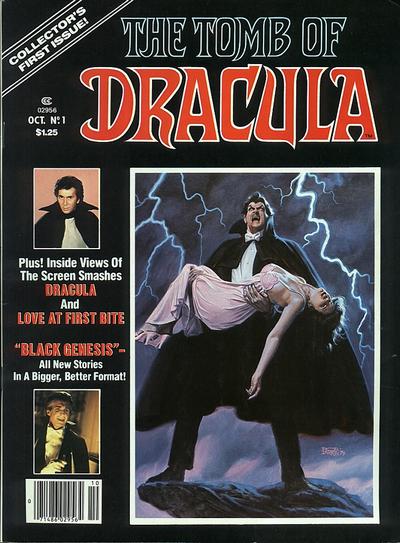

The critically acclaimed color series was no more but The Tomb of Dracula rose from the dead like its namesake, but this time in black and white, moving back into the space created long ago by the cancellation of Dracula Lives. The story though picks right up some time after the seeming demise of our star, a tour group uncovers his grave and a woman with ulterior motives and a magic gem removes the silver spike and up he comes thirsty as all get out. He samples one of the ladies and kills another guy who tries to stop him with a cross. Then he finds the gem is something he's been looking for and leaves with the lady. Later that unlucky tour group is in London recuperating where Dracula finds them again. None of the regular crew are in this issue aside from Inspector Chelm. Colan is inked by Bob McLeod for this issue only and it's a nice effect. 
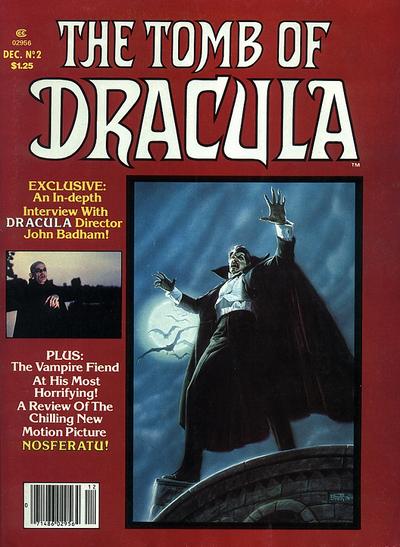

Issue two gives us all a grand surprise when legendary artist Steve Ditko steps in to draw a Dracula story for Wolfman's script. The story is about a man who is slowly becoming part of another dimension and can for a time transport other people there against their will. His sister has been designated by a cult to be the wife of Asmodeus. Dracula really is a small player in this one, showing up time from time and in the end clashing with the other villains. I can't say I'm crazy about Ditko's version of Dracula, which seems very spare. 


The best way to describe this story is that I think Marv Wolfman wanted Dracula to battle Regan McNeil from The Exorcist. It's a hair-raising affair with dynamic art by Colan and Palmer. There's a second story about an artist who loses her singular ability to create beautiful artwork when she is corrupted by Dracula. 


The final story was written by Roger McKenzie while keeping the original art team. A family move into a lighthouse but don't realize that Dracula has already taken up residence there. Dracula becomes quite infatuated with their young daughter. Drac's keen interest in very young girls in the last two issues really ups his creep factor considerably. 
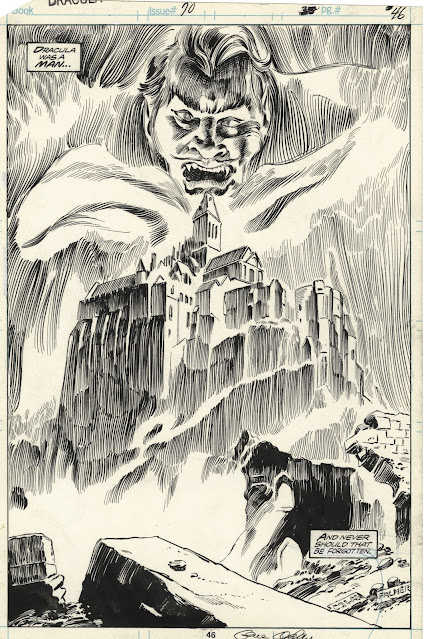

I've always found it remarkable the the color series of Tomb of Dracula did not get more criticism than it did from those forces in our society intent on making sure we all live a pure and noble life as God would have us do. The series offers up a number of blasphemies during its long run, the greatest of which was equating a child born in a Satanic ceremony with Christ himself. Of course, if you read carefully, you know that Christ is in charge all the time, but critics rarely read that closely. This series coming out today would I bet attract much more negative attention in our society which sadly seems to want to become a Christian theocracy despite the limitations of the Constitution. Overall, these are some outstanding stories, worthy of being read so many decades later. 

One more volume to go. 

Rip Off