Showing posts with label Lester Dent. Show all posts

Saturday, October 28, 2023

Wild Adventure Of The Sinister Shadow!


Since reading about this delightful crossover by Will Murray and weirdly Lester Dent (by way of a cache of unpublished materials) of the two most famous Street and Smith pulp heroes, I've been most eager to get my mitts on it and read it though. The Sinister Shadow from Altus Book's TheWild Adventures of Doc Savage imprint is a delight in many ways and easily something any fan of Doc Savage or The Shadow must have. For more from Murray on how it came together check this out.

(Joe DeVito)

The Sinister Shadow begins with Lamont Cranston going to see Doc Savage about the problem he has with The Shadow stealing his identity and (in his mind at least) threatening to kidnap him and extort money. He is in fact kidnapped along with Ham Brooks, one of Doc's five assistants, and that puts Doc and The Shadow both on the trail of a villain who calls himself "The Funeral Director" who has fashioned an elaborate organization of henchman dubbed variously as Morticians, Undertakers, Gravediggers, and Pallbearers. This large gang has made a business of kidnap and ransom of various rich men in the society, so much so that it has drawn the attention of the criminologist George Clarendon.

In this rousing and fast-paced but unusually lengthy pulp adventure, we at different times find Doc and The Shadow battling each other and even working in tandem to bring down the Funeral Director's vile gang. The Shadow's men include Harry Vincent, Clyde Burke, and Cliff Marsland. Doc is helped by Monk Mayfair, Ham Brooks, and Long Tom Roberts. Sadly, neither Renny Renwick nor Johnny Littlejohn show up in this hair-raising war on crime.

(Joe DeVito)

Murray tells the story in precise short sentences and quickly paced paragraphs and the action rarely slows down and almost never stops. We get some very evocative descriptions of the characters, in particular The Shadow. If there is a big complaint about this one it's that the Doc fan gets slighted as The Shadow and his men seem to dominate much of the action. Each hero is showcased though and by the story's end the heroes appear to understand one another better.
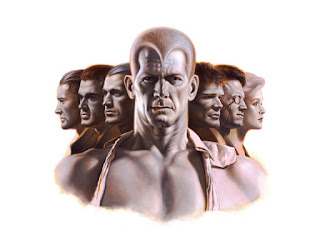


The story, full of action as it is, needed a few more twists and turns. It does do a vivid job of drawing from the early stories of both characters, set as it is relatively early in the careers of both heroes. And we do get some neat switches for the fans. But maybe even more would've been nice. Not as well read in Shadow lore as I am in Doc, I felt most fortunate that I took the time last year to read the first three Shadow novels, they come in handy.


It's a pricey package, but a highly readable one. This wonderful pastiche gets the Dojo's highest recommendation.

Rip Off

Wednesday, September 27, 2023

The Radio Adventures Of Doc Savage!

The Radio Archives collection of The Adventures of Doc Savage is an eight-disk collection, and features two Doc Savage stories adapted for serial radio performance in the 1980's on public radio. The two stories adapted were The Thousand-Headed Man and Fear Cay. First up is the seven-episode saga of Fear Cay proved ideal listening for hurtling down the highways. 


Fear Cay was featured in the eleventh issue of the original Doc Savage run and offers up a cracking tale featuring Doc and all his five aides along with Pat Savage his cousin. These six find themselves confronting a gang of vicious thugs who are trying to get hold of a mysterious prize on a lost island in the Caribbean. There is also a strange old geezer who claims to be 131 years old, and who gets around quite quickly for someone of such age. There's plenty for all the aides to do with Monk, Ham, Renny, Johnny, and Long Tom all getting some decent exposure. The action is spread around well, despite the pacing being rather relentless.


The producers of this program drew pacing inspiration from the classic Republic serial The Adventures of Captain Marvel and it really works. There are some great fights and some ferocious gun play. The characterizations are crisp, and I had very little difficulty telling the players apart, despite there being a large cast of folks to keep track. The plot is classic Doc, with a battle raging in the streets of NYC before shifting to an exotic locale. There is weird mystery and plenty of raw pulp beats to suit any Doc fan.


I frankly didn't expect these to be as good as they are. Many of these later radio shows can be a bit bloodless, clear copies of an art form that once thrived but now is all but gone. This seems to be more than a mere copy, but a true revival done by real pros who are adept at the business of crafting radio drama. The quality made me very eager to dive into the second adaptation. 


That second adaptation is of one of Doc Savage's most famous stories for a host of reasons. This story is an exceedingly popular one, and it was chosen by Murray partially because it was also the story singled out by movie producers back in the 1960's for a proposed Doc Savage movie starring Chuck Conners. The project did not develop ultimately but did result in a Gold Key comics adaptation. I took a look at that comic here.
 

The story from 1937 pits Doc and his assistants against a gang of thugs seeking a mysterious treasure in far-off Asia. There they find a hidden ancient cult which seeks to keep its secrets with the sacrificial deaths of any who happen along. It's a whopping good story, with lots of chances for action and many opportunities for Doc to show off his physical skills.


The radio adaptation is pretty close to the original but does alter the last part of the story somewhat by adding Renny as a partner to Doc as he uncovers the mysteries of some distinctive temples. In the novel Doc prowls alone, but it was decided that giving Doc someone to converse with would make the discoveries seem more natural to the listener and less artificial. It works quite well for me as Renny is a favorite of mine and gets too little attention in the adventures. This adaptation is a bit shorter than "Fear Cay" and I think that helps the pacing a bit. There is no sense that the story lags even a little bit. If you haven't sampled these, I highly recommend them. They are first rate entertainments. There is also a disk with interviews of the creators of the radio dramas about how they came to be made. 


The was once upon a time a Doc Savage radio show way back when Doc was just getting started. It was produced in fifteen minutes episodes. They were broadcast across the nation in the piecemeal way that radio operated in at the time. Sadly, the recordings are lost, but the scripts have been preserved. They were gathered and published several years ago by Moonstone in Doc Savage - The Lost Radio Scripts of Lester Dent. The folks who did the radio show in the 80's briefly considered using some of these, but they found the length insufficient for their needs and I think the creators were anxious to adapt their favorite stories. These stories are curiosities in script form and better than not having them at all for Doc fans. 

For the record both this book and the cover of the radio plays feature artwork by Bob Larkin. Great stuff indeed!

 Rip Off

Saturday, June 25, 2022

Doc Savage - His Apocalyptic Life!


Doc Savage - His Apocalyptic Life is the sequel of sorts to Philip Jose Farmer's Tarzan Alive - A Definitive Biography of Lord Greystoke. The latter work told the life story (up to a point) of the great King of the Jungle popularized by Edgar Rice Burroughs in his extensive series of novels. Lord Greystoke though is only one member of an illustrious family dubbed by Farmer and other modern researchers as the "Wold Newton Family". These are descendants of a curious band of folks who happened to be present in Wold Newton when a meteor dropped and bathed them all in a special ionized radiation which seemed by inference to have a profound effect on their progeny. And Farmer tells the story of Lord Greystoke, the epitome of the savage feral human and in this later work focusing on the crime-fighter Doc Savage he does likewise for the epitome of the modern technological man. 


The subtitle refers to Farmer's opinion that the threats to mankind which required Doc Savage's intervention were of such earth-shaking quality as to earn the term "apocalyptic". Doc Savage is no less than a supremely trained superman who saves the planet on a nigh regular basis -- monthly in fact as revealed by Street and Smith's publication schedule for the popular pulp hero. Farmer spends a good deal of time in the early chapters connecting Savage to the work of writers like William S. Burroughs and Henry Miller, suggesting that the works of these writers share in many respects Savage's apocalyptic framework. The details of Doc's life are explored and a timeline is suggested, one which is often at odds with the sequence of the novels. Then Farmer explores the life and times of Savage's "biographer" Lester Dent who with a few other pulp mavens detailed the stunning events in Savage's life adding in necessary fictional elements where necessary. 


Then Farmer goes to extensive lengths to talk geography and architecture, specifically the location and layout of Doc's skyscaper headquarters in the Empire State Building. It is revealed by Doc had played a seminal part in its construction allowing for his future offices and even an elaborate tube system for quick transportation to the Hidalgo Trading Company, a false business where many of Doc's amazing machines reside. Farmer is meticulous in his examination of the location referring constantly to the "super sagas" for information on how the sites changed over time. Tarzan is a man who is ideal when reduced to his most basic needing only his father's knife to cleave his way to success. Doc Savage in contrast is a man of technological marvels which enhance his own ideal physical gifts. Tarzan and Doc are two sides of a coin, superior in their ways but always perhaps best understood in contrast. As it turns out they are also cousins. 


Also identified as a member of the elaborate Wold Newton clan is Monk Mayfair, Doc's ape-like associate who just so happens to be a famed chemist as well. His rough exterior is contrasted in the tales by his best mate and rival Ham Brooks a dapper lawyer. These two are the primary agents of Doc's "Fabulous Five" but are joined by Renny Renwick an engineer of renown, Long Tom Roberts an electronics wizard, and Johnny Littlejohn an archeologist and geologist of note. These five men are loyal to Doc and often hungry for the adventure they find by association with him. Farmer dedicates a chapter to each of the five men, plucking the "true" from the fictional. Getting special treatment is Doc's cousin Patricia Savage who shares many of Doc's singular physical gifts. One gets the feeling that PJF has a crush on Pat, or at the very least he implies that Doc might. 


Doc Savage - His Apocalyptic Life is a grandly entertaining book for Doc Savage fans or for fans of the Wold Newton Family itself. We get not only what has been described but chronologies of the "super sagas" and expansive family trees to show the connections among the many disparate personalities in the Wold Newton Family. In the Altus edition which I read this time we are treated to a forward titled "Book of Magic" by Win Scott Eckert in which he details how he came across this tome and how it became a linchpin work for his imagination. I identify with much of what Eckert describes as I was discovering many of these same works at the same time such as The Rocketeer by Dave Stevens which treats the reader to some unofficial Doc Savage action. 


When I first read this book by Farmer I'd read only a smattering of the "super sagas" but thanks to Anthony Tollin's reprint program from a few years back I now have read them all. Armed with that detailed knowledge this book by Philip Jose Farmer is even more enjoyable. 

Rip Off
 

Thursday, June 9, 2022

Doc Savage - The Brand Of The Werewolf!


Today I conclude my review of Marvel's original Doc Savage comics run. Doc Savage #7 begins an adaptation of Kenneth (Lester Dent) Robeson's Brand of the Werewolf. The first part is titled "Brand of the Werewolf" and is written by Tony Isabella and drawn by Ross Andru with Frank Springer on inks. The cover is by Rich Buckler. 


The story begins in Canada as we watch a man seemingly transform into a werewolf, who then attacks a car containing Alex Savage, Doc's uncle and Pat Savage's father. Next, we cut to Doc's skyscraper headquarters, and he is getting a call from Pat telling him of the tragic murder of her father. Doc along with Monk, Ham, and Renny head off to Canada. They end up taking a train on which they meet Senor Corto Ovega, his daughter, and a man named El Rabannos. There is an attack on Doc's train compartment using gas. After rescuing his team, Doc then finds the same gas used in the compartment of the Ovjeas. Then the train comes to an abrubt halt because the tracks are blocked by timber, and the Ovejas and El Rabannos leave the train headed into the woods. Doc has his men follow them while he helps get the train tracks cleared. He quickly is under attack by thugs, but dispatches them quickly. Meanwhile Pat and her Indian servants Tiny and her husband Boatface hear howling. Pat goes to search but returns and finds her servants unconscious. She knows what the attackers wanted, a cube with a strange brand of a werewolf. Boatface sees where this is hidden and soon steals it and takes it into the woods for a clandestine meeting with the Werewolf rejects Boatface's attempts to raise the price and who attacks and kills him. Doc and his men get back together in time to see a mysterious plane leaving a remote hanger, one they'd seen from the train. They find Alex Savage's grave and the body of Boatface along with the peculiar clues of pine bark and a ptarmigan feather. Doc heads out across the trail of the killers but finds the trail stops at a ravine with a single rope across it. He takes a balancing pole and starts across when a sniper shoots him, causing him to fall. 


Doc Savage #8 concludes the story and the series run. The story is titled "Werewolf's Lair!" and is written by Tony Isabella and drawn by Rich Buckler. The inks are by both Tom Palmer and Jack Abel who alternate throughout the story. The cover is another Buckler effort inked by Klaus Janson. 


The story picks up with Doc grabbing the rope across the ravine to save his life but then a second shot sends him falling out of sight. The gunman is quite pleased and goes back to camp to encounter the Werewolf. Pat and Tiny have been captured by the thugs but Pat tries to escape with Tiny. They are recaptured when suddenly Doc appears and battles thier captors. The three head off into the woods while Doc explains to Pat what's been going on and explains how a nearly invisible wire had saved his life at the ravine. The trio encounter the Werewolf but Doc quickly dispatches the "monster" revealing him to be a man in an elaborate costume, but more men arrive and they flee. The trio meet up with Monk, Ham, and Renny at Pat's cabin and suddenly Senorita Cere Oveja shows up. She explains that she and her father are descended from Alfredo Leon, a 17th century pirate called "The Werewolf". He apparently had a treasure that he'd hidden in the region and the cube was the only means to discover it. Doc has him men go and find the cube hidden in a ptarmigan nest as he'd suspected by Boatface. Then quickly it's revealed that the cube unfolds to make a map showing the location of the treasure. Then the Werewolf and his gang return, use gas to capture Doc and the team and take to a mine that held the treasure. Doc wakes up tied and it's revealed that El Rabannos is behind the gang. But Doc and his men had been faking and a fight erupts in which the Werewolf and the gang are subdued including the Ovejos who turn out to be part of the scheme. Doc and his men are just able to save the Ovejos and the treasure before the mine collapse killing the remainder of the gang. The story ends with Pat vowing to join Doc's team and the treasure headed to do good works. The story closes with a quote from Doc's Code and that ends the initial run of Marvel's Doc Savage. 

 It's announced in the letters page of this issue (for the record the letters page is titled "What's Up Doc?") that the series is being cancelled due to poor sales. Apparently, the series was being retooled a bit with Tony Isabella scheduled to continue as the regular writer while apparently Rich Buckler was coming on as the new regular artist. Whatever the case, the last issue is a jumbled affair showing that it was produced with a great deal of speed. It's unfortunate that the series goes out on such a low note. Also, I never knew it, but the original pulp tale doesn't have any werewolf in it at all, but for the more visual comics medium a man in a costume looking much like Jack Russel's Werewolf by Night was thought necessary. I don't disagree, as the lack of any werewolf (real or fake) in the pulp was a disappointment for me. Both the original pulp and the Bantam novel covers even show one, but alas not to be. 

Walter Baumhoffer

James Bama

But Doc Savage wasn't quite done at Marvel. Next up are visits with the Friendly Neighborhood Spider-Man and the Ever Lovin' Blue-Eyed Thing!

 Rip Off

Wednesday, June 8, 2022

Doc Savage - The Monsters!


I continue with my review of Marvel's adaptations of Kenneth (Lester Dent) Robeson's Doc Savage novels. Doc Savage #5 begins a two-part adaptation of The Monsters. The title of this story is "The Monsters" and it's adapted by Steve Englehart, scripted by Gardner F. Fox and features artwork by Ross Andru and Tom Palmer. 


The tale begins with a trapper named Bruno Hen under attack by mysterious creatures against which his shotgun is no good. Carl McBride, another trapper finds Hen dying and fulfills his dying request that he take Hen's money and hire Doc Savage to avenger him. Next we see McBride aboard a Ford Tri-Moter heading to NYC and talking up his plan to a beautiful blonde who fills him in on Doc and his aides and how they don't necessarily take jobs for money. There's a mysterious ad in the newspaper saying "The Monsters Are Coming". McBride gets to Doc's skyscraper but when he steps off the elevator a thug guns him down and would have done likewise for Doc Savage but for bulletproof glass. Doc takes the case and orders Monk and Ham to follow the killer, develops clues to Michigan, then reports to the location where Monk and Ham have followed the gunman. It's a giant walled-in estate but a grappling hook later Doc is skipping across the unusual electrical fencing that sits on top of the walled estate from corner to corner. Slipping into the mansion he comes under attack while Monk and Ham work their way toward him. 

Once inside he finds the same blonde who had spoken to McBride, and she reveals herself to be Jean Morris a lion tamer with a special talent for speaking Swahili. Just then a gigantic head breaks through the floor of the mansion and just as quickly disappears, seemingly inside a truck that rushes away from the building. Jean Morris likewise disappears. Doc then goes into the basement and finds Griswold Rock, the owner of the estate who claims he was abducted by criminal genius named Pere Teston. Doc orders Renny to track the truck which Doc has tagged with ultra-violet markers. Renny does, but has his plane shot down. Doc shows up to find the abandoned truck with Renny captive inside. Hearing the ticking of a bomb, he saves Renny but before he can penetrate the mystery in the back of the truck it explodes leaving Doc and his aides to watch a plane escape into the distance.


Doc Savage #6 finishes this story with a story titled "Where Giants Walk!". It's written by Gardner F. Fox, and drawn by the team of Ross Andru and Frank Giacoia. I like Giacoia, but there is a definite loss of atmosphere and mood with the loss of Palmer. 


The story begins dramatically with a giant hand rising out of a lake and grabbing Doc's plane. Doc and his aides have followed the clues to Michigan and they find themselves fighting off many giants. Doc finds Bruno Hen's cabin then is shot at. He chases the gunman and finds his body in a sand bog. They find a note on his body and follow the clues to a deserted mill where they find Griswold Rock who claims he got a telegram from Doc to show up there. The team then go to a hotel to regroup and get word from Renny about the giant who died in the truck. Renny is supposed to come meet Doc, Monk, and Ham, but next morning they get word he has crashed his plane. Rushing out to assist him, Doc and his team come under attack which they repel with their superfirers. Renny shows up later and he and Doc use the Auto-Gyro to head back to town while Monk chases the hoods. Doc finds Ham having suffered an attack and Griswold Rock missing. Monk returns and the team takes the Auto-Gyro to find the ultimate hideout of the criminals only to be waylaid by another plane with Jean Morris inside. The attack results in both planes going into the lake where two giants appear armored with plates of steel. 

Doc and his team along with Morris are captured by the giants and taken to the criminal gang who are hiding underneath a tarpaulin made to look like an island from the air, and then who put them into a deep pit. Doc escapes the pit, finds evidence that can be of use to him in the criminal lab and then returns to captivity. Next morning he tells the giant monsters, criminals in fact who have been changed as part of a criminal scheme, that they cannot be changed back. This causes a riot between the giants and the normal-sized gang and they battle one another. Meanwhile Doc finds the Pere Teston, not a criminal and saves him. One of the giants releases poisonous chlorine into the air but Doc and his team are safe in makeshift air pockets. When they emerge they find everyone in the gang, monster and hood, dead along with their real leader Griswold Rock. This is a pretty decent adaptation of the plot-heavy tale. Thankfully the whole business of some of the monsterous giants being African Mongoloids has been dropped. It's a curious detail from the original story and would've been out of place in this modernized version. Though that then does make Jean Morris's presence pointless. But in the press of the action, that detail doesn't matter all that much. Gardner Fox as the writer certainly gives this tale a real pulp connection, though I have to confess his script didn't seem as tight as Englehart's had been.

Walter Baumhoffer

James Bama

More next time as Doc and his team confront meet up with Werewolves! 

 Rip Off

Monday, June 6, 2022

Doc Savage -The Man Of Bronze!


Marvel adapted the great Doc Savage stories in the early 70's. I well remember the small ad which featured Doc's head announcing the new title alongside other new features like Gunhawks and Man-Thing. Of those three, who would have guessed Man-Thing would have the most staying power, at least in comics. 


But for our purposes here, Doc Savage is the center of attention. Doc Savage #1 begins a two-part adaptation of the first Doc Savage pulp novel, The Man in Bronze by Kenneth (Lester Dent) Robeson. The first part is titled "The Man of Bronze!" and it's plotted by Roy Thomas, scripted by Steve Englehart, and drawn by Ross Andru on pencils and Jim Mooney on inks. The cover is a very muscular and effective image by John Buscema, though the scene doesn't take place in the actual story.


As the story opens it appears that Marvel has decided to update the Doc stories to the then present day of the early 70's (Monk in particular gives a clue to this by his clothing which is very much of the period) and this is verified by a comment in the text page in the second issue. But by then, cooler heads had prevailed and the setting for that second part and all subsequent stories was returned to the original 30's-40's era. The plot is pretty straightforward and familiar for those who've read the novel, a strangely garbed assassin climbs a tower next to Doc's NYC headquarters and takes aim through a window at the Fabulous Five (Monk, Ham, Renny, Long Tom, and Johnny) who are awaiting the arrival of Doc Savage himself. The assassin wants Doc it seems so he waits too. 

Doc appears, fresh from a trip to his secret Fortress of Solitude and we learn that Doc's dad has died of a mysterious disease, then heads to his wall safe and discovers papers giving him provisional possession of territory in Hildalgo in Central America, at which time the assassin fires a laser right at him. But trick glass in the window caused the attack to fail and then the team sets about finding out where the shooter is located. The find him and Doc sends Ham off to get the red tape taken care of for a trip to Hildalgo while the rest go to intercept the assassin. Ham leaves via autogyro, and Doc and the rest leave using a tricked out vintage runabout especially equipped with running boards. Doc and the boys get to the location and Doc begins a daring climb up an uncompleted skyscraper after the assassin, and then by use of his athletic skills and some technology in the form of a blinding mirror Doc captures the culprit. An attempt at hypnotism fails and the villain jumps to his death. Doc and the rest return to headquarters to find the wall safe ransacked and a note on the was saying "Savage: Turn back from your quest, lest the Red Death strike once again.". Needless to say this doesn't work and Doc and the boys make plans immediately to head to Hildalgo to avenge the murder of elder Savage. An epilogue introduces us to a mysterious figure called "the Feathered Serpent". There is a small text piece identifying Doc's aides, a task deemed to complex for the story proper. 


Doc Savage #2 concludes the adaptation of "The Man of Bronze". The story is titled "The Master of the Red Death" and it's written by Steve Englehart and drawn by Ross Andru inked this time by Ernie Chua (Chan). The cover is an outstanding image by Jim Steranko. 


The story picks up as the team has just flown to Hildalgo where they've come under attack by military forces. Their plane is shot down but the team survive uninjured due to air bag technology. They are greeted by Carlos Avispa the President of Hildalgo and Don Rubio Gorro the Secretary of State. Very quickly the team is on its way into the interior to follow Doc's father's map and to find the "Valley of the Vanished" hidden among the mountains of the country. After landing the team is attacked almost immediately by men dressed the same way as the assassin from the first part of the story, but the attack is stopped by King Chaac and his daughter Princess Monja. The leader of the warriors, a guy named Morning Breeze objects though. The natives speak Mayan and turn out to be lost descendants of this once great culture. But apparently for the last twenty years they've been dealing with Doc's father. After 30 days of observation, the King is to make available to Doc a great treasure, if he makes the grade. 

The team are made comfortable, but that night Monk can't rest, and he goes out just in time to see his friends being thrown into a pit by the costumed warriors, the thuds of their bodies sicken him. After the villains leave, he rushes to the pit to discover that Doc had been tricking the villains by saving his aides and throwing rocks to mimic their bodies hitting the bottom of the pit. Later Doc uses simple trickery to convince the superstitious warriors that his men have returned from the dead. We then cut to a meeting between the frustrated Morning Breeze and his leader the mysterious Feathered Serpent who announces it's time to break out the Red Death. Soon a plague marked by red spots rages through the community. Doc uses his considerable medical skills to concoct a cure and races through the community tending to the afflicted all the while being chased by Morning Breeze and his warriors. 

They take refuge in the temple but when the once-ill people begin to announce their cure, Morning Breeze loses his nerve but is gunned down by his boss. Doc and the Feathered Serpent fight, the Serpent falls to his death and is revealed to be Don Rubio. Then it's time the King announces to reward Doc, as clearly he's up to the task his father set for him and so Doc is shown the great gold wealth of the hidden Mayans, much of which is now his to use in his work in the larger world. Doc and the team fly away leaving behind a tearful Monja, but headed smiling into a new adventure. There is a text page with information on the pulp roots of Doc, some stuff about Lester Dent, and chatter about how the mileau of the adventures had been changed. And that closes the first Marvel Comics Doc Savage adventure. 

Walter Baumhoffer

James Bama

More next time. 

 Rip Off

Thursday, June 2, 2022

Doc Savage - The Thousand Headed Man!


This Gold Key comic book story starring Doc Savage by Leo Dorfman and Jack Sparling an adaptation of the vintage pulp The Thousand-Headed Man by Kenneth (Lester Dent) Robeson, one of the early Doc pulp stories. 


The one-shot comic seen at the top of this post was produced by Gold Key in 1966 in conjunction with a planned-but-not-produced film featuring Chuck Connors as Doc. 


The cover is by James Bama. It's a close-up of a full painting he created for the second of the very successful Doc Savage paperbacks from Bantam Books. 


The story is a solid Doc adventure with a mix of urban and jungle action. There's a neat mystery concerning three keys and some ancient treasure and there are villains galore. The mystery begins in London but winds its way in complex form to Cambodia where an ancient cult of cobra worshippers who use versions of the cobra venom to create mists that make folks unconscious. The London part of the story seems pretty much intact, though the notion of the keys is changed substantially in the comics story. They are just keys, but in the pulp original I think they are sticks which function as keys. The mystery here is in what they are composed of which is the same as the pulp. The Cambodian element of the story is very compressed, and I'll have to say the pacing of the story isn't completely successful. The first part seems neatly done, but they have to really run through the more exotic aspects of the story. A plane explosion is relegated to a single panel, and alas isn't at all threatening. 


Jack Sparling isn't a favorite of mine, though he does his typical journeyman job here. I can follow the story most of the time without fail, though the sheer number of Doc's aides seems a bit of a problem for him at times. Doc himself looks like the Bama painted version, but when rendered by Sparling here he looks like a very old man instead of the hard-bitten adventurer that Bama presents. It's nice that Sparling stayed close to the source material, but it doesn't completely work. All in all, this is a fun and diverting comic. Not a completely successful adaptation, but it's unclear if they were adapting the pulp or perhaps a screen treatment, so I'll not condemn the producers here for those flaws necessarily.


The Thousand-Headed Man was also picked by producers as a stirring radio by Will Murray and others in 1985. 

 Rip Off

Saturday, November 7, 2015

The Sinister Shadow!


Since reading about this delightful crossover by Will Murray and weirdly Lester Dent (by way of a cache of unpublished materials) of the two most famous Street and Smith pulp heroes, I've been most eager to get my mitts on it and read it though. The Sinister Shadow from Altus Book's TheWild Adventures of Doc Savage imprint is a delight in many ways and easily something any fan of Doc Savage or The Shadow must have. For more from Murray on how it came together check this out.

Joe DeVito
The Sinister Shadow begins with Lamont Cranston going to see Doc Savage about the problem he has with The Shadow stealing his identity and (in his mind at least) threatening to kidnap him and extort money. He is in fact kidnapped along with Ham Brooks, one of Doc's five assistants, and that puts Doc and The Shadow both on the trail of a villain who calls himself "The Funeral Director" and has fashioned an elaborate organization of henchman dubbed variously as Morticians, Undertakers, Gravediggers, and Pallbearers. This large gang has made a business of kidnap and ransom of various rich men in the society, so much so that it has drawn the attention of the criminologist George Clarendon.

Dave Stevens
In this rousing and fast-paced but unusually lengthy pulp adventure, we at different times find Doc and The Shadow battling each other and even working in tandem to bring down the Funeral Director's vile gang. The Shadow's men include Harry Vincent, Clyde Burke, and Cliff Marsland. Doc is helped by Monk Mayfair, Ham Brooks, and Long Tom Roberts. Sadly neither Renny Renwick nor Johnny Littlejohn show up in this hair-raising war on crime.

Joe DeVito
Murray tells the story in precise short sentences and quickly paced paragraphs and the action rarely slows down and almost never stops. We get some very evocative descriptions of the characters, in particular The Shadow. If there is a big complaint about this one it's that the Doc fan gets slighted as The Shadow and his men seem to dominate much of the action. Each hero is showcased though and by the story's end the heroes appear to understand one another better.


The story, full of action as it is, needed a few more twists and turns. It does do a vivid job of drawing from the early stories of both characters, set as it is relatively early in the careers of both heroes. And we do get some neat switches for the fans. But maybe even more would've been nice. Not as well read in Shadow lore as I am in Doc, I felt most fortunate that I took the time last year to read the first three Shadow novels, they come in handy.


It's a pricey package, but a highly readable one. This one gets the Dojo's highest recommendation.

Rip Off