Showing posts with label Dashiell Hammett. Show all posts

Monday, November 27, 2023

The Mammoth Book Of Best Crime Comics!


The Mammoth Book of Best Crime Comics is a real feast. All in glorious black and white, this anthology brings together crime stories from across the globe and from many decades. I will admit that some of the experimental stories, such as two by Alan Moore that form a beginning and ending for this collection elude me somewhat, but the bulk of the material is totally accessible. The beauty of a collection like this is if you don't much like the story you're reading, you are confident that the next one will strike your fancy. 


Some of the highlights of the collection for me are Jack Cole's "Murder, Morphine and Me!", Will Eisner's "The Spirit: The Portier Fortune", Alex Toth's "The Crushed Gardenia", and Johnny Craig's "The Sewer". There is a large section of the book dedicated to Secret Agent X-9 by Dashiell Hammett and Alex Raymond, and Ms.Tree story "Maternity Leave" by Max Allen Collins and Terry Beatty gets a large hunk as well. There are two stories featuring art by Bernie Krigstein, one dandy tale titled "Lily White Joe" and a later totally strange yarn form the 87th Precinct titled "Blind Man's Bluff". The notes indicated the sheer oddball nature of this yarn drove Krigstein away from comics for good.


Likewise, artist Ed Robbins left the field when his comic strip with Mickey Spillane "From the Files of Mike Hammer" was censored and ultimately cancelled for the bondage scene above. Sanchez Abuli and Jordi Bernet turn in a classic with a Torpedo 36 story called "The Switch". Neil Gaiman and Warren Piere create one of the most depraved comics I've ever read with "The Court". El Borbah created by Charles Burns is a ton of fun, weird and offbeat fun in the story "Love in Vein". Our old friends Joe Simon and Jack Kirby check in with "The Money-Making Machine Swindlers" and Bill Everett turns in a great artistic effort on "The Button". And I've always been a fan of Paul Grist's Kane series represented here with the story "Rat in the House". 

Below are some of the covers for the comics and such in which many of these stories originally appeared. As you can see, it's an eclectic gathering of artistic styles as are the stories themselves. At a cool twenty bucks (when I bought it anyway) this collection is an entertaining bargain.


Rip Off 

Tuesday, July 9, 2019

Secret Agent X-9 Times 2!


Before Alex  Raymond became the icon of comics with the creation of Flash Gordon he worked on another strip with Dashiell Hammett to fashion Secret Agent X-9. Most folks agree this was a work with virtues and flaws and soon enough both Hammett and Raymond were gone. But X-9 held on, changing with the times and creators who took on  the strip over the course of many years.


Two movie serials were made using the character, the second and best was done in 1945 by Universal and starred Lloyd Bridges, Keye Luke and others. On Shadow Island (reminded me of Madripoor) X-9 (Bridges) and his Chinese ally (Luke) joined with several others to forestall the ambitions of Japan as it attempted to spread across the Pacific. At risk is a secret formula which will make water into airplane fuel, so as you might guess this a a doughty task. My favorite character is Solo played by Samuel Hinds, a terse man who spends almost all of the serial seated at the bar, but who is a significant figure when the time is ripe. He never looks up but he always knows what's going on.


In 1937 Universal had made another serial with Secret Agent X-9 and in this earlier film he's pretty much a different person and functions as a cop more than a spy as he tries to recover some stolen jewels for the good of his country. Scott Kolk portrays X-9 and I don't really know what he was going for in the presentation, but it doesn't work very well. He comes across as too jovial by half. Jean Rogers is gorgeous as usual but has almost nothing to do and has just as many clothes on in this serial as she had off in Flash Gordon. The plot is nothing much, just a jumble of antics and some decent fights. My dvd had weird sound issues and was missing a chapter, but I'm pretty sure I got the sense of the story.


Of the two I can only recommend the 1945 version and that's for two reasons, the Sam Hings character and Keye Luke's very rich and adult presentation of an Asian character, not something you could count on.

Rip Off

Friday, February 9, 2018

The Big Book Of The Continental Op!


I knew I was going to pick The Big Book of the Continental Op up the second I stumbled across it in the wilds of the internet. I love the heft and feel of these over-sized Black Lizard volumes and I like them especially well when they are stocked with stories as durable as those of the definitive hard-boiled detective, the nameless dick known as the Continental Op. For a better description of Dashiell Hammett's original detective check out this link. It's better than anything I could cobble together. This volume has all the stories and the original serial versions of the novels, a form of literary detective work I heartily approve of. Can't wait to dig in.

Rip Off

Tuesday, February 9, 2016

Thin Mania!


Recently finished a binge watching the vintage Thin Man movies. These 1930's and 1940's mystery movies are all derived from the work of Dashiell Hammett who wrote the stories on which two of them are based including of course the first one from which the series gets its titles. That aside, the true power of these little epics from MGM is the dynamic acting duo of William Powell and Myrna Loy who appeared together on screen well over a dozen times, six of them as Nick and Nora Charles in these Thin Man movies.


The first movie in the series from 1934, titled simply The Thin Man adapts Hammett's novel of the same name and introduces us to the well-heeled and well-lubricated sleuthing duo of Nick and Nora Charles. Nick Charles (Powell) is a retired private detective who seems to have been quite popular with all sectors of the criminal classes as well as the minions of the law. His wife Nora (Loy) is an heiress and so they lack for nothing, but instead seem to revel in one another and the pleasures of the world, especially drink. They are in New York City among Nick's old pals when the daughter of a former associate (Maureen O'Sullivan) goads Nick into looking into the disappearance of her irascible father, the title Thin Man. When his girlfriend turns up murdered, the old man becomes a suspect in absentia and finding him becomes the focus of the last half of the movie. While on the prowl we are greeted at every turn by old chums of Nick's as he and his lovely wife Nora  (new to this world and fascinated by it) seek the answer to the mystery. The answer is revealed of course in the movie's payoff which involves the classic erudite explanation of all aspects of the mystery as well as a violent reveal of the true culprit.
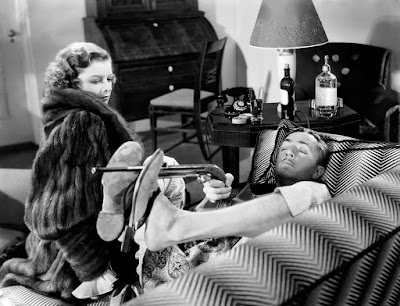

The movie is a top notch entertainment. frothy and briskly paced. Powell, though of questionable handsome looks is charming and witty and even occasionally wise as you can almost see him mentally assemble the loose ends of the plot, even though he projects that he's perplexed. W.S. Van Dyke was a director who by all accounts was fast and wasted little time in fashioning his projects. That energy appears to shine through this movie which trots along with scene after scene of New York at Christmas time as gaggles of memorable faces and voices tumble through the yarn.


Two years later in 1936 due to the incredible success of first film we get Nick and Nora back in After The Thin Man. This one set only days after the first movie uses New Year's Eve and San Francisco as its setting. This time we meet the family of Nora as Nick is picked by the dowager empress of the family to investigate the disappearance of the wastrel who had married Nora's cousin Selma. The stuffiness of the family presented here as an academy of very old and tired folks is a delightful counterpoint to the frolic we encountered in the first movie, though Nick and Nora too do find their way to a few night clubs before it's all said and done. The mystery is pretty decent one, when the lout ends up shot and we have a nice cavalcade of suspects to choose from, with a cast that included the likes of George Zucco, Paul Fix and even Jimmy Stewart. I'm always surprised by the ending of this one.


It would be 1939 before we get another movie in the series, this time title Another Thin Man. William Powell had had quite a bit of tragedy since the last outing, losing his love Carole Lombard and himself facing a cancer scare. When he returned he seemed a bit long in the tooth against the still vivacious Myrna Loy, but their chemistry was undeniable. In a movie derived from Hammett's "The Farewell Murder" the two are again in New York, this time in the wilds of  Long Island as the crotchety old man who managed Nora's wealth comes under threat from an old business partner. This one has some really grim scenes, the darkest and most peculiar of the series with a properly good mystery. Again solid acting from the likes of C.Aubrey Smith and Sheldon Leonard makes this one hum along neatly. Nick and Nora have a baby now, but they keep him pretty much out of everyone's hair most of the time.


W.S. Van Dyke had directed all the Thin Man movies to this point and his final one titled Shadow of The Thin Man was the fourth released in 1941. Nick and Nora have a kid now, a boy and the domesticity weighs upon the light-hearted nature of the series. They become embroiled in a rather ho-hum murder mystery at a California racetrack and despite some solid acting from the likes of Barry Nelson and Donna Reed are not able to elevate this one above its potboiler limits. The fact that they are a for true family now brings a new dynamic to the mix, one which might not have the sparks we've come to expect.


In 1945 came The Thin Man Goes Home and Nick and Nora head back to Nick's rustic hometown of Sycamore Sprints in New England. This new setting does offer some fresh spins on the couple's renowned party nature, though Nick now looks just as comfortable in a hammock drinking cider as he does in a night club slinging Manhattans. The series, now over ten years old is not running on fumes, but the fuel tank is exceedingly low. The mystery here is elaborate and takes some time to get up and running but does deliver as we find Nick's hometown to be filled with all sorts of rather deadly denizens. Still and all, Powell seems far too old to be playing this part of returning scion still seeking his father's approval. Myrna Loy is especially good in this one though, bringing some of the spice the movie needs.


The series wraps up with 1947's Song of The Thin Man which has the duo again back in an urban setting, this time a distinctly older couple in the up and coming world of jazz music. If the intent was to showcase just how far the two had come since their heyday nearly fifteen years before as the pups who pull down the establishment to now becoming rather staid pillars of that establishment, it does a nifty job. Cast against a collection of musical hipsters Nick and Nora feel like old fogies for certain, unable to grok the lingo and casting a gloomy eye on the kids who pursue this lifestyle. Keenan Wynn and Jayne Meadows are among a top-notch cast of characters who give this story a lift, though the mystery seems an especially complicated affair.


I haven't mentioned Asta. Asta is the dog who appears in all of these flicks, with varying degrees of effectiveness. As comedy relief Asta is fine, and in some movies the gags are really funny. But I have to confess the presence of the animal seems weird most of the time and a detective prowling the night dragging along his barking mutt makes little sense. But audiences of the time seemed to love the annoying little fox terrier. 


The Thin Man movies are fun to watch, spirited mysteries with enough twists and turns to keep you involved. But it's the acting which keeps you honed in, from Powell who spouts witty and near-witty dialogue at a drummer's pace with Loy chiming in on cue to keep it spicy. The interplay between them is the heart of this movie, and of course just as any movie is a sliver of time, as these movies keep progressing we see that interplay become more relaxed and less full of vinegar as the pair become increasingly easy with one another. We see their marriage become a seasoned one, with less fire but steeped with ready coals. There's something heartening about that.

Rip Off

Sunday, February 22, 2015

The Stuff That Dreams Are Made Of!


I did not know that Dashiell Hammett's great 1929 detective yarn The Maltese Falcon had been adapted to comic book form until I chanced across this cover of Feature Book #48 from 1946 by the David McKay Comics company. Reports I can find are that the comic itself is pretty weak, but if the cover is any indication, it might have some of the vintage Golden Age energy which percolated up in many of those vintage comics. I'd love to read it sometime.


I consider 1941's The Maltese Falcon directed by John Huston and starring Humphrey Bogart and a delicious ensemble cast of morally bankrupt characters to perhaps be the perfect movie. I can watch it over and over without tiring of it. I compare it to great music which always carries you along with changes of intensity and tempo but never losing you and never wearing you thin. The Maltese Falcon is like that, a story that slithers along with fantastic pace but still is possessed of fascinating quiet scenes and character bits which delight but never fail to further the larger story.


I haven't read the novel is some years. I got a class set many years ago when teaching film as literature was momentarily in vogue in schools, but alas never got the opportunity to teach the book. I've since changed schools and had to leave the novels behind for someone else to perhaps make good use of. It strikes me just now I need to get funding and set up a unit for my current classes.


I bought the dvd above some years ago and have enjoyed it several times since. It's loaded with behind-the-scenes stuff as well as other extras.


Not the least of which are the two earlier 1930's adaptations of the Hammett novel, one titled simply The Maltese Falcon from 1931 and the other Satan Met a Lady from 1936
.

Sam Spade himself had quite a life beyond the novel's ending, even ending up on radio, television and in these delightful Wildroot ads. My dad was a devotee of Wildroot, and the very name of the product evokes great memories.


This is probably my favorite cover for the novel which sadly often gets covers of limited merit (to not suggest it might have actual pulp action in it I guess).


I picked this up a few years ago largely because it had the original story as it ran in serial form in Black Mask magazine in 1929. I've got it set for reading this spring hopefully.

Rip Off