Crisis on Multiple Earths -Countdown to Crisis is the third and (I think) final volume in this latest reprinting of these classic JLA-JSA crossover tales. It includes some of the wildest and most ambitious efforts as the writers and artists had to work overtime in an attempt to top the previous outings. These are some of my favorites.
The 1979 Justice League of America and Justice Society of America crossover was very different in tone and character than any that had preceded it, save perhaps for the the single story about Sandman and Sandy some years before. It was a small story, without any heroes from any other sources coming into play. This story was in many ways a locked-room murder mystery, save that the room was the Justice League satellite.
"The Murderer Among Us: Crisis Above Earth-One!" is written by Gerry Conway and drawn by Dick Dillin and Frank McLaughlin. The cover is by Dillin and inked by Dick Giordano. The story begins with the two teams, the JLofA and JSofA having their semi-official annual meeting on the League satellite to compare notes and threats and whatnot. The new chairperson of the JLofA Zatanna presides over the meeting. After the official matters are settled, the two teams go to the satellite rec room to eat, drink and be merry. Terry Sloane, the hero called Mr.Terrifc the Master of Fair Play tells the two Flashes about his encounter with an old enemy named The Spirit King and says he's been able to track his old enemy. Jay (Flash)Garrick wishes Terry had come to him since he'd also battle the Spirit King, but Sloane a man who had just come out of retirement again is miffed and storms off and says that soon one of the assembled guests will be branded a traitor. Soon after a terrific explosion occurs and the satellite decompresses. The heroes race to mend the problem but Superman finds the savaged and slain body of Mr.Terrific. Zatanna inspects the wreckage mystically for clues. She is struck down and goes into a coma and the two Flashes then search the satellite for intruders but find none. The truth then is evident, that the murderer must be among them.

"I Accuse..." is again by the Conway, Dillin and McLauglin team. Dick Giordano handles the cover art alone this time. After a reprise of last issue's events, the heroes have Dr.Fate and the Green Lanterns work together to seal the heroes within the satellite. Then Batman and the Huntress are assigned as dual detectives to discover which of the assembled heroes murdered Mr.Terrific. There investigation ruffles some feathers, but when Huntress attempts to use the satellite computer to follow up some leads from Earth-2 it explodes and she is seriously burned, but Dr.Fate is largely able to heal those wounds. Then Batman reveals that he knows who the murderer is and indicates it had to be the one hero assembled who had also battled the Spirit King, the Flash of Earth-2. The Spirit King appears ecotplasmically out of the form of Jay Garrick and confesses that indeed he had used the Flash to infiltrate the meeting, but that he'd become corporeal long enough to strangle Mr.Terrific and he'd hoped the heroes would then blame Jay Garrick for the crime. The possessed Flash then races to the transmatter machine the League satellite uses and escapes. The JSofA follows him taking the body of Mr.Terrific back home where the case will be resolved finally. The League then discovers that they are still trapped on the satellite behind the mystical shield, which gets a laugh even at such a critical time.
This was intended to be a crossover of a different kind, a smaller scaled character piece, and I'd have to say it was reasonably successful. The interactions of the heroes are pretty good and while the ultimate mystery was a little less complex than I'd have preferred, it holds up well enough. The artwork is a bit darker this time, giving the story an appropriate mood. I think Dillin's cover for the first half of the story is the best he ever did for the series. Alas they never had him do too many of them. Having the whole story set on the satellite was exceedingly cool indeed, though that the heroes forget to block the transmatter machine is a bonehead move of epic proportion.

Adventure Comics offers an after-the-fact look at Mr.Terrific's funeral with no info on how things were resolved. Sadly this was also the final JSA story of the run and it would be the end of Earth-2 before they'd have their own series again. All in all this was a good change-up in the format, but I'm glad all of the crossovers weren't like this.
We wrap up this whole crossover shebang next time. And tragedy strikes. Be here.
Dick Dillin suddenly passed away at the age of fifty years old while working on this very trilogy. I well remember reading the blurb announcing his passing while waiting in the grocery store to buy the second part of the story.
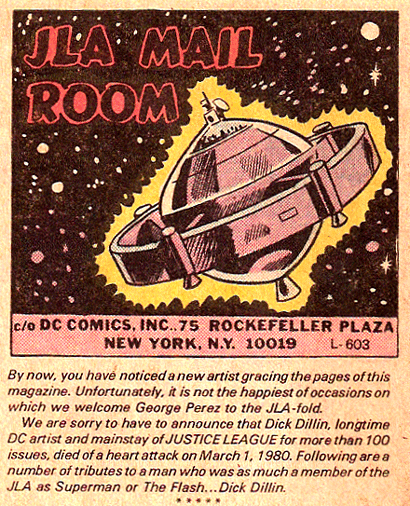
Ironically it was a death that struck me quite hard, in that one of the most reliable things in my world at the time was that Dick Dillin was going to draw the latest JLofA adventures. His loss touched then and still has an effect now that I'm older than he was when he passed away. It's a reminder that our time is always limited, though we go to great pains to forget that most of the time.
This crossover returned to the classic pattern and had the heroes meet up with a new bunch of characters. This time the mined the vast trove of material left behind by Jack "King" Kirby when he unleashed his Fourth World on the world. His rich and evocative worlds of the New Gods changed the way comic book stories were told, and his creation of Darkseid gave the DC universe a villain worthy to take on the whole of their heroic academy. Orion, Metron, and Highfather of the New Gods and Scott Free, Big Barda, and Oberon of Mister Miracle are tapped to appear in this trilogy. Not in evidence are the Forever People, nor does Lightray make an appearance.
"Crisis On New Genesis or Where Have the New Gods Gone?" is written by Gerry Conway and drawn one more time by the great Dick Dillin and Frank McLaughlin. The cover is by Jim Starlin. The story begins briskly as the JSofA and JLofA decide to recognize their annual event by sending representatives to both Earths One and Two. Batman, Superman, Green Lantern and new Leaguer Firestorm head to Earth-2 and Dr.Fate, Huntress, Power Girl, and Wonder Woman head to Earth-1. But neither group gets where they are headed, instead both teams find themselves on New Genesis also called Supertown home of the New Gods. While Superman explains what the place is and how he visited it once, Firestorm brashly heads off to explore and encounters Orion in a foul mood in his more savage state. The combined heroes hear Firestorm's call for help and fly to his aid and attack Orion but the battle is stalled when Metron appears with Mister Miracle, Big Barda, and Oberon ast his side. After Orion uses his Mother Box to regain his calm facade, Metron explains that he brought them there to help the New Gods look for the missing population of New Genesis, and apparently the Injustice Society is involved. The scene shifts to Apokolips home of the deceased Darkseid. Once there Metron divides the heroes into four teams. Batman, Huntress and Mister Miracle head to the Imperial Palace as scouts. Power Girl, Firestorm, and Orion go to investigate a huge building project. Superman, Wonder Woman, and Big Barda go to the orphanage of Granny Goodness. And Green Lantern, Dr.Fate, and Oberon check out a a trooper barracks with an unusually heavy force. As Batman's team skulk through Apokalips backstreets, Miracle explains how Darkseid seemingly was destroyed some time before by his own forces. Oberon is caught by guards only to reveal that Lantern and Fate are disguised as guards and rescue him and infiltrate the barracks. In the lair of Granny Goodness Superman and Wonder Woman follow Barda as they rescue children being abused by Granny's servants and Orion, Power Girl and Firestorm find the missing citizens of New Genesis under the spell of the Fiddler building a vast machine which is revitalizing Darkseid himself.

"Apokalips Now!" is again written by Gerry Conway, but with the sudden death of stalwart artist Dick Dillin, the pencil chores are taken over by George Perez with Frank McLaughlin still on inks, and this team also handle the cover art. The action begins with Power Girl, Firestorm, and Orion attempting to stop the Injustice Society (Fiddler, Shade, and Icicle) from using slaves from New Genesis to revive Darkseid. The defeat Shade and Icicle but Fiddler is able to subdue the heroes and continue to rouse the tyrant. Superman, Wonder Woman and Big Barda follow the girl they rescued from Granny Goodness to a deep hideout where children have gathered to oppose Granny's work. They are led by a girl with fiery red hair named Crimson. Another child named Playto, gifted with vast mental powers reveals how Darkseid had allied himself with the Injustice Society and arranged for them to bring him back to life. Led by Crimson, the trio of heroes go to find and defeat Granny Goodness. Dr.Fate, Green Lantern, and Oberon find Izaya, Highfather of the New Gods in the barracks and free him. Batman, Huntress, and Mister Miracle breach the Imperial Palace and learn that Darkseid's ultimate plan not only calls for his resurrection but the removal of Apokolips itself to the very orbit of Earth-2 meaning the latter's utter destruction.
"Crisis On Apokolips or Darkseid Rising" is by the same creative team of Conway, Perez, and McLauglin. Jim Starlin and Bob Smith handle the cover chores. Metron muses about the action so far and then the scene shifts to a revived Darkseid who coniders the huge block of ice imprisoning his son Orion, Power Girl, and Firestorm, then the tyrant imprisons his former associates the Injustice Society ostensibly for defeating his own flesh and blood. Batman, Huntress, and Mister Miracle see this action and move to free their comrades. Meanwhile Izaya, freed by Dr.Fate, Green Lantern, and Oberon presses the attack to escape the bowels of Armageddo. Superman, Wonder Woman, and Big Barda follow Crimson and the child army to overthrow Granny Goodness. She thinks she has escaped her foes but Barda finds her. Batman's team has since free the captives of Darkseid and Orion rages to press the battle against Darksied. The scouting team continues into the prison and frees the Injustice Society. The battles rage then on all fronts with Orion challenging his evil father but it is Firestorm who uses his own powers to turn Darkseid's Omega Force against himself, defeating the tyrant. Then ray intended to destroy Earth-2 fires but has been sabotaged by Metron and instead strikes Darkseid reducing him again to atoms. The heroes then reflect on the battles and what it will take to rebuild.
This is a pretty good and tightly constructed story. The action gets going right away, and Metron is very effective in getting the teams set up. Once they are established their missions work beautifully to keep the plot moving very well with time still available for bits of character. The elements of the story flow exceedingly well together right up unto the last few pages of part three where things get too cramped. The story seemed to have needed just a few more pages to clarify some of the action, but short of that it's pretty dang good.
Perez is to be commended to coming in and knocking out the second chapter in such record time after the untimely passing of Dillin. Perez is still a pretty fast artist by modern comparisons, but back in the Bronze Age he was incredibly fast. He was the ideal choice to take over the title and he stayed with it for quite some years, though no one has ever come close to challenging Dillin's dozen years on the title.
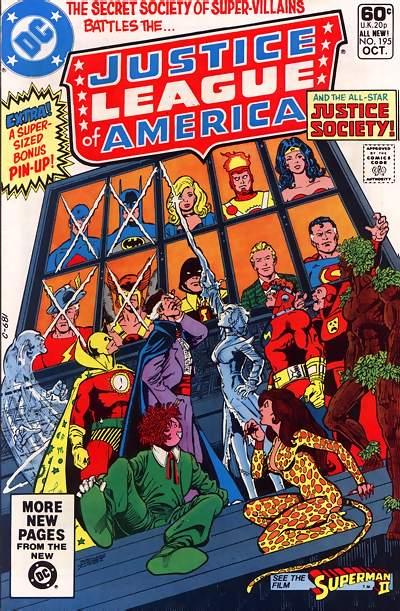
"Targets on Two Worlds" was told by writer Gerry Conway and artist George Perez, who was assisted by inker John Beatty. The editor was Len Wein. The cover art was by George Perez. The Ultra-Humanoid assembles a new Secret Society of Super-Villains comprised of Killer Frost, The Monocle, Brainwave, the Psycho-Pirate, the Floronic Man, the Mist, Ragdoll, the Cheetah and Signalman. Their goal is to eliminate certain heroes from both Earths I and II and so rid one of those Earths of all super-heroes. In this issue Black Canary is defeated by the Mist, the Hawkman is defeated by the Monocle, and Wonder Woman is taken out by the Cheetah.

"Countdown to Crisis" was written by Gerry Conway and illustrated by George Perez and inker Romeo Tanghal. Len Wein was the editor. The cover art was by George Perez and Dick Giordano. The plot to eliminate all heroes on either Earths I or II continues as the Psycho-Pirate defeats Hourman, Signalman captures Batman, Ragdoll blows up the Flash, the Floronic Man gasses the Atom, Brainwave tricks Johnny Thunder, Killer Frost brings down Firestorm, and the Ultra-Humanoid irradiates Superman. The defeated heroes are assembled and sent into limbo setting off a transformation of reality on Earth II.

"Crisis in Limbo" was created by writer Gerry Conway and artists George Perez and Keith Pollard with assist by inker Romeo Tanghal. Len Wein was the editor. The cover art was by George Perez and Mike DeCarlo. The Ultra-Humanoid's plot has eliminated all superheroes from Earth II which infuriates the villains from Earth I since they feel betrayed. They are whisked away back to Earth I by the Ultra-Humanoid but then set about to undo the plan. While the villains of Earth II run wild the villains of Earth I free the captured heroes who promptly kick their butts. Then the ten heroes go to Earth II and mop up the rest of the Secret Society of Super-Villains in short order.
This is another sturdy tale from longtime JLofA scribe Gerry Conway, as Perez cements his reputation as the go-to super-team artist with these issues. Perez took over the book after the untimely demise of Dick Dillin and truth told he continued the reliability and added some Bronze Age zest to the proceedings. Admittedly this is the end of his run on the book, and he needed help to wrap it up. If you like lots of exotic villains and especially giant white apes with super-sized brains, you'll adore this story.
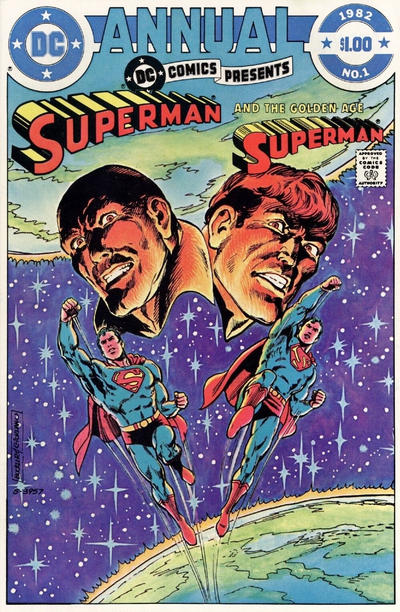
"Crisis on Three Earths!" was written by Marv Wolfman with art from Rich Buckler and inker Dave Hunt. Julius Schwartz was the editor. The cover art was by Rich Buckler and Dick Giordano. The Lex Luthors of Earths I and II combine their evil wits to defeat the Supermen of those worlds. Their plot fails but then they end up on Earth III and enlist the aid of Ultiman, the villainous Superman. This trio seems unstoppable until the noble Alex Luthor of Earth III agrees to help out. Both Earths I and II survive narrowly as the Lex Luthor of Earth II proves to be the evilest Luthor. His scheme fails.
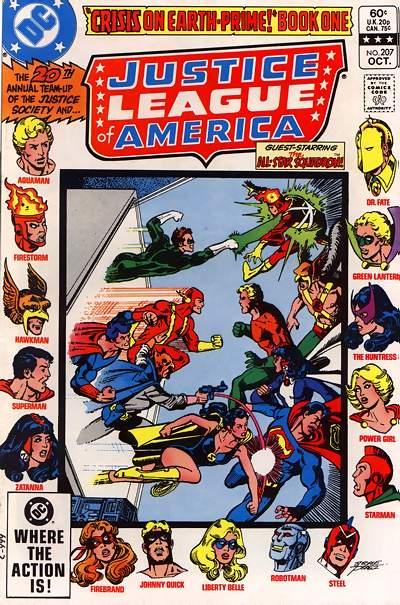
"Crisis on Earth-Prime!" was written by Gerry Conway with plot assist from Roy Thomas. The art is by Don Heck and Romeo Tanghal. Len Wein was the editor. The cover art was by George Perez. One of the most dizzying adventures begins when during the annual reunion of the JLA and JSA the Crime Syndicate suddenly appears. They defeat the JLA while the JSA find themselves in limbo. They escape to Earth-Prime which they discover has suffered nuclear disaster decades before. The JLA end up on Earth II where they find it transformed into a dictatorship ruled by Per Degaton. They travel into the past to 1942 where they encounter the All-Star Squadron.
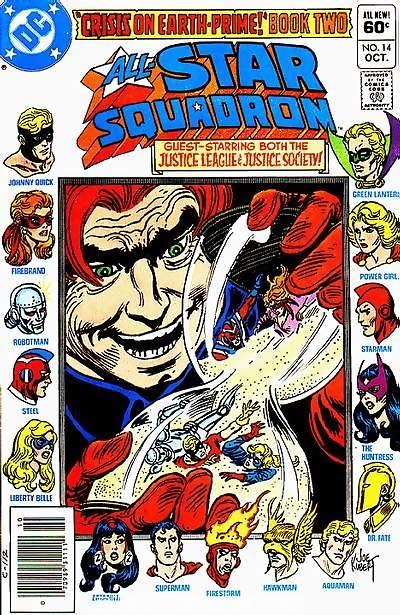
"The Mystery Men of October!" was written by Roy Thomas with plot assist by Gerry Conway. The art was supplied by Adrian Gonzalez and Jerry Ordway. Len Wein was the editor. The cover art was by Joe Kubert. We learn that Per Degaton, a vile little assistant to the time travel expert Professor Zee has learned of his previous attempts to use time to control the world and with this knowledge kills Zee and travels 1982 on Earth II and then to limbo where he recruits the Crime Syndicate to help him steal the nuclear weapons being transported to Cuba by the Soviet Union in 1962. This triggers a nuclear war on Earth Prime. He returns to 1942 on Earth II and uses the nukes to blackmail the leaders of the world both the Allies and the Axis. The All-Star Squadron yet unaware of this threat battle the Magnetic Marauder before encountering the JLA.

"The Bomb-Blast Heard Around the World!" was written by Gerry Conway with plot assist by Roy Thomas. The art was by Don Heck and Sal Trapani. Len Wein was the editor. The cover art was by George Perez. The JLA and the A-SS battle briefly before cooler heads prevail and they compare notes. The assembled heroes go to the White House to consult with FDR when Per Degaton announces to the world his scheme to rule it under nuclear threat. Meanwhile the JSA encounter mutants on Earth Prime and learn that JFK pushed the button and with the USSR waged nuclear war. Back on Earth II in 1942 the JLA and the A-SS witness Per Degaton's detonation of a nuclear bomb to prove his threat. Afterwards they find the unconscious JSA and rescue them.

"Master of Worlds and Time!" was written by Roy Thomas with plot assist by Gerry Conway. The art was by Adrian Gonzalez and Jerry Ordway. Len Wein was the editor. The cover art was by Joe Kubert. While Per Degaton preens, confidant that his plan is perfected, the three superhero teams combine forces to find and eliminate the stolen nukes. Superman, Dr. Fate and Robotman head into orbit to disable a stolen satellite Per Degaton uses to send his threatening messages. They are confronted by Ultiman and barely survive though they are successful. Aquaman, Starman, and Liberty Belle travel to the waters of Japan to uncover hidden nuclear missiles and disable them. Superwoman is on hand to give them a hard time, though they do prevail. Hawkman, Huntress and Johnny Quick travel to the heartland of America to find nukes hidden in grain silos. They are opposed by Power Ring. Again, despite a launch, the trio stop the threat, much to Per Degaton's rage.
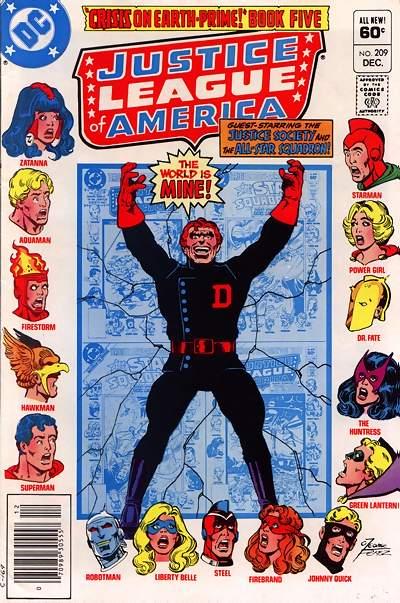
"Let Old Acquaintances Be Forgot..." was written by Gerry Conway with plot assist by Roy Thomas. The art was by Don Heck. Len Wein was the editor. The cover art was by George Perez. In the finale Firestorm, Power Girl and Commander Steel go to Switzerland to find and disable the last batch of nuclear weapons. The come into conflict with the evil Johnny Quick of Earth III. The trio is able after much battle to end Per Degaton's nuclear blackmail. But then it's up to Zatanna, Green Lantern, and Firebrand to use a time machine to travel to Cuba in 1962 and stop the theft of the nukes in the first place. The rest of the heroes in 1942 travel to the future site of the Pentagon where Per Degaton has his hidden lair and confront his forces there along with Owlman. With the stoppage of the theft of the nukes though, the whole adventure unravels and none of the participants remembers anything as they all return to their original timelines.
The five-part time-traveling tale by both Gerry Conway and Roy Thomas which spanned both the Justice League of America and the All-Star Squadron books for one scintillating summer is wild ride. I was reminded of the awesome Avengers-Defenders clash when reading this sprawling tale. The artwork in the JLofA portions of this one is done by the much-underrated Don Heck with inks by Romeo Tanghal, Sal Trapani, and even Heck himself. The A-SS portions of the tale are done by the muscular team of Adrian Gonzales and inker extraordinaire Jerry Ordway. This one is a keeper featuring the Golden Age menace of Per Degaton. The JLA books feature covers by George Perez and the A-SS books get Joe Kubert artwork. It's a pretty awesome assembly of talent on these, and the totally awesome and completely malicious Crime Syndicate to boot.

"Crisis in the Thunderbolt Dimension!" was written by Roy Thomas and Gerry Conway with art by Chuck Patton and Romeo Tanghal. Len Wein was the editor. The cover was by George Perez. The story begins as the two Flashes are defeating a robber in Central City. But then they are attacked by Johnny Thunder's Thunderbolt leaving the Flash of Earth I unconscious. At the JLA satellite the party is started when the Thunderbolt appears and battles the assembled heroes, defeating them all but leaving the JLA members unconscious. The assembled JSA members and Black Canary note that apparently all members save the Canary have been attacked by the Thunderbolt. Further they learn that the villainous Crime Champions are operating as well. They are the Fiddler, Chronos, Dr. Alchemy, the Icicle, the Wizard and Felix Faust. While the JSA go to battle them, Starman takes Canary to the Thunderbolt dimension to find answers. They discover the evil Johnny Thunder of Earth I and in a crystal coffin the bodies of Larry Drake and Black Canary.
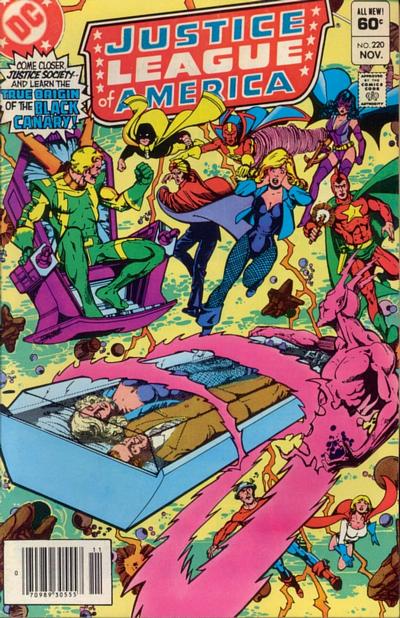
"The Doppelganger Gambit" was written by Roy Thomas with art by Chuck Patton assisted by inks by both Romeo Tanghal and Pablo Marcos. Len Wein was the editor. The cover was by George Perez. Sargon the Sorcerer joins the JSA to battle the Crime Champions. Meanwhile the evil Johnny Thunder explains how he gained control of the Thunderbolt and how decades before that Dinah and Larry Drake had a daughter who thanks to the Wizard had uncontrollable voice powers. They agreed that she must be taken to the Thunderbolt dimension for her safety. Flash and Hourman take on Chronos and the Fiddler at Mexico's Pyramid of the Sun, Huntress and Red Tornado take on Icicle and Dr. Alchemy at the Pyramid of Cheops, and Power Girl and Sargon take on the Wizard and Felix Faust at Stonehenge. Eventually the good Johnny Thunder regains control of the Thunderbolt, and he defeats Johnny's evil counterpart and then frees the JLA to help the JSA mop up the Crime Champions. Finally, Superman reveals that Dinah Drake is the daughter of the original Black Canary and that he and the JSA had kept this secret for years.
This is a handsome story which packs a lot into two issues, maybe a bit too much. The need to explain all this never really made sense to me. Whether Dinah was the mother or the daughter, I never really got why it mattered, save to someone like Roy Thomas who could get wound up about small matters like this. I did like seeing evil Johnny Thunder again, he's a fun character.
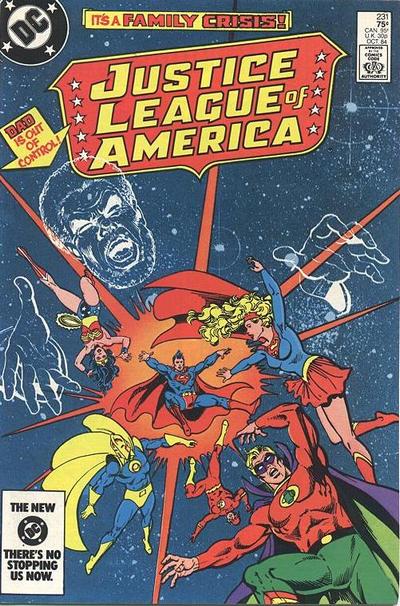
"Family Crisis!" was written by Kurt Busiek and drawn by Alan Kupperberg. Alan Gold was the editor. The cover art was by Chuck Patton and Dick Giordano. Most of the JLA are responding to a threat leaving only late-comers Superman, Wonder Woman, Flash and Supergirl on the Satellite when three strange kids show up and whisk them all to Earth II, where they join Dr. Fate, Green Lantern, Starman, and Dr. Mid-Nite in a battle against flying monkeys. We learn that the three youngsters are part of the Champion family, and their father has been taken over by an alien named the Commander, who has nigh limitless power. The assembled heroes battle the Commander, eventually using magic to capture the residue of his powerful evil and transport it.
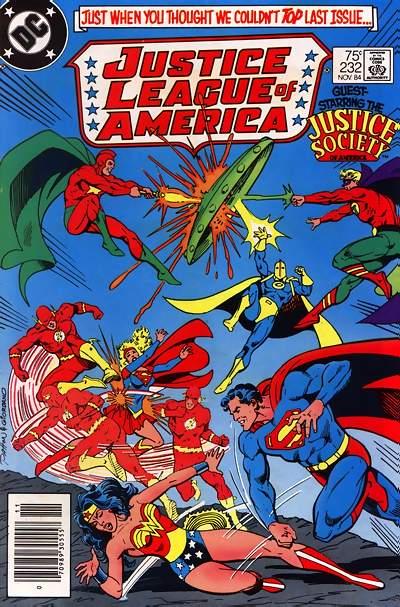
"Battlegrounds!" was written by Kurt Busiek with art by Alan Kupperberg. The editor was Alan Gold. The cover was by Chuck Patton and Dick Giordano. The heroes bring the Commander's evil and bury it at the Pentagon, useful because of its magical shape. Superman, Flash, and Starman are taken over by the Commander and attack the rest of the heroes. Dr. Mid-Nite escapes this fate because of his blindness. It is a furious battle but finally the heroes are able to use their combined wills focused through the Champion family to remove the Commander from their father. But despite being revealed the Commander remains a threat until the JLA, the JSA and the Champion family are able to return him to his own dimension. They receive a small assist when the Monitor takes a peek at the battle. The reunited Champion family announce they will investigate the myriad universes they glimpsed during the battle with the Commander.
And that's a wrap. I can't say this final two-parter was much of a hit with me. I found it wildly confusing, even by JLA-JSA team-up standards. Seeing less nimble and experienced hands try out these kinds of stories shows just how strong the talent had been all those years while these adventures unfolded.
Before I go, I don't want to forget about the final JLofA-JSofA team-up during the Detroit League era (in the midst of the Crisis itself which put an end to these classic meetings) between the team and the JSA proteges Infinity Inc. As you can see by the covers above, these were some pretty dandy stories and I'm curious why they weren't in this final collection in place of the Superman annual yarn.
Rip Off