Showing posts with label Ralph Bakshi. Show all posts

Saturday, May 23, 2026

Spider-Man '67 - Season Two!


It's definitely a change, but I have to say I prefer this second season to the first. The stories were slightly more complex and had a vaguely more adult feel to them. This is especially so of the origin story in the first two episodes of season two. The art on those was pretty good and the story very much like a Spidey comic. I love the backgrounds in this series, the colors are vibrant and intoxicating often making up for admittedly lackluster animation.


Now after that beginning things get strange. But knowing that fantasy masters like Lin Carter on the writing and Gray Morrow on the art design are at the helm I can't be surprised all that much that Spidey spent most of the season out of the city and in some vague jungle/alien setting up to his webs in plants and weird bat-things. One thing I noticed was that many of the stories really threw curveballs, in that Spidey would begin his adventure normally enough with crime and thugs but then there would be a shift and he'd find himself in the future, underground, or on a bizarre island somewhere.

I consider these adventures to be similar to the kinds of adventures that Spidey would have in Marvel Team-Up in which he'd often venture into territories radically different from the classic big city crime story he's rooted in. The MTU Spidey would travel in time, go into space, venture into lost worlds and do all manner of things bizarre by his standards. This second season had that kind of feel to it.


Here a dozen things I learned watching this second season of Spider-Man:

1. The sky is often green and always dramatic as if a storm is about to erupt.

2. Purple gorillas are seen by the criminal set as effective disguises for some reason. Maybe it's a DC thing.

3. Spidey can pilot experimental jet planes and has ready access to them on a whim, and no one misses them when they fly away.

4. Mole Men are ridiculously stupid, getting duped by the same criminal in two episodes. And they like to gong a lot.

5. Giant doors are common in many alien landscapes, as if Kong himself were on the other side.

6. Spidey loves to swing and swing and swing and swing and swing though the city, often attaching his web line to no discernable object.

7. Villains are most often green, the sure sign of villainy in the Bakshiverse.

8. Peter Parker plays baseball.

9. Parker sure hangs out with a lot of different girls, but I'm guessing he's not a FWB (Friend with Benefits), accounting for that gloomy puss he wears most of the time.

10. Manhattan is a remarkably sturdy cityscape and can survive multiple sinkings of various buildings and even detaching from the earth and flying into the sky.

11. Martians look amazingly like ancient gods of Norse and Greco-Roman mythology.

12. The power of flight is achieved by putting a blender on your head.


Ralph Bakshi produced a wacky cartoon, that's so bizarre that I wouldn't mind watching it again in a few years. The stories are at once patterned and unpredictable. Spidey seems mostly trusted by the police, even admired by them save for the last episode when inexplicably he's seen as a baddie and a threat. The villains are cackling madmen, but interesting looking by and large.

Things happen in the Bakshiverse that require no explanation, they just are. And in the context of these stories, I can accept that. You might even dub this season of Spidey stories his "Weird Adventures" and be very close to capturing the feeling they have.

Next time it's Season Three.   

Rip Off

Saturday, May 16, 2026

Spider-Man '67 - Season One!


I have enjoyed again the 1960's Spider-Man TV show. It's a hoot. This cartoon, along with the Hanna-Barbera Fantastic Four and the Marvel Superheroes in syndication were my first windows into the Marvel Universe and the comics in general. I have great fondness for them, despite not having seen most of them for decades.


The first season of Spidey is a pretty formulaic affair. There are plenty of baddies from the comics series. There was Dr. Octopus, Elektro, Sandman, Mysterio, Lizard, Vulture (called Vulture-Man for several episodes), Rhino, Scorpion, Green Goblin and a few others. Notably missing was Chameleon though there was a make-up villain named "Charles Cameo" in a few episodes. Most of the villains got two episodes with a few getting into three. The most fun in that category for me though were the "new" guys they invented. Dr. Noah Boddy ("Nobody" get it) an invisible guy, The Human Fly twins (named "Stan" and "Lee"), some guy named The Phantom, and my personal fave - Parafino, proprietor of a wax museum and fabulous baddie. Also, I assume that the Aussie hunter named "Clivendon" is a stand-in for Kraven the Hunter. This change along with the Chameleon one I don't get, as they originals are perfectly fine characters.

The other side of the coin was pretty thin. Betty Brant starts out as a pretty good character, but as the episodes roll on, she becomes a cypher, merely a friend of Peter Parker's who stands up for him with J. Jonah Jameson. JJJ is in just about every episode and frankly it gets a bit tiresome, as way too many plots revolve around the Daily Bugle or its publisher in some way. JJJ seems to be the mayor of NYC the way the act in this cartoon. Aunt May shows up maybe once or twice at most, though we do see the Parker home many times.

The stories are pretty simple affairs. Spidey becomes aware of a threat usually by chance, intervenes and encounters the villain, we get the title of the episode, then Spidey loses the initial conflict. After that he goes to see Jameson for some reason or other, then fights the baddie again and usually loses. Then in the last battle he wins, typically by throwing webbing over them, a scheme that often doesn't work earlier in the story.


Here are a dozen things I learned watching this cartoon:

1. The streets of NYC are largely deserted save for a few villains, their victims, and at most five cops at any given time. Cop cars show up in threes and most of the cops are of Irish extraction.

2. The Rhino looks hilarious when he runs, picks the lamest hideouts, and his motivations for his crimes are ludicrous. A golden statue? Really!

3. The Green Goblin is a really little guy and wants to master real actual magic for some reason despite his many gimmicks of science.

4. The pictures in the Daily Bugle are not hung all that well and constantly shift when doors are slammed, or maybe that only applies to those featuring Jameson's mug.

5. Spidey's webbing has some really curious properties such as functioning as small motors for no discernable reason. He makes fans and propellers and all sorts of things. I love that he whips up special webbing on a whim.

6. The police really trust Spidey, but I can't really tell why. Maybe that's why he seems to know all sorts of classified stuff he really shouldn't know.

7. NYC has a Conservatory of MOD Music.

8. Dr. Connors has two arms on TV all the time.

9. Spidey spends quite a bit of time at the docks and more time in and around the water than I'd have expected. As a consequence, he fights way too many gators.

10. Giant robots like to eat cars and appear for no reason in the middle of the city.

11. Pluto is inhabited by ice men, perhaps they are time-lost members of Martinex's race.

12. It always bugged me as a kid wondering where exactly Spidey's web lines were attached as he swung through the city, and after watching the full first season, I don't have any more idea about it than I did then.


As always in these stories, if the villains just used their intellects for good they'd make a lot more money than they do with crime. The Phantom could use his shrinking machine to revoltutionize shipping for instance.

The first season was fun, but after the thrill of seeing Spidey actually swinging across the city it gets a bit weak. I love the few shots we get now and again of actual comic art, especially the few images of Ditko Spidey books.

Good fun. Next up is Season Two!

Rip Off

Thursday, January 30, 2025

The Complete Ralph Bakshi Film Festival!


Bakshi's follow-up to Fritz the Cat was Heavy Traffic. (More on Fritz later.) It's a fascinating movie which uses pinball to frame the life of the main character, a man of twenty-four years named Michael. He is a cartoonist, but his work is far from commercial. We get at least two stories, one animated and a frame which is live action. In both the live action and animated parts Michael pursues Carole, a woman who like himself is trying to find a way forward. They want to leave the city and head to California and to do that they resort to crime. 


It's a difficult movie to discuss as many elements of the film are surreal. Clearly there is a autobiographical aspect to the movie, but characters are so broad it would be pointless to push that too far. This is a movie which has wonderful sections, some even calm and soothing, a rarity for a Bakshi project. Apparently, Bakshi and produce Steven Krantz fell out about the profits from Fritz the Cat and at one point Krantz locked Bakshi out and sought another creator such as Chuck Jones. 


His third movie Coonskin is a remarkable movie in many ways, and I can see why someone would be offended by it. But I wasn't and I found this oddball movie which blends live action with some compelling animation to be hard to watch and hard to stop watching at the same time. It stars Scatman Crothers and Barry White (yeah...that Barry White).


The movie is nothing less than Uncle Remus meets Mario Puzo or to put it more bluntly Bre'r Rabbit meets The Godfather. It's ripe with violence and harsh language as we follow a trio of critters (Brother Rabbit, Brother Bear and Preacher Fox) who go to the big city and try to find success in arenas of organized crime. The movie is about loyalty and about the "American Dream". You know that last bit is true because the "American Dream" is literally in the movie in all her voluptuous red, white, blue and blonde glory.


It's a movie about Harlem and black culture but of course it's written and directed by Ralph Bakshi, a white Brooklyn Jew. Bakshi spent many of his critical youthful years in a black community and went to a black school back in the bad old days of segregation. (When America was "great" according to some modern bigots.) This movie felt more like a Spike Lee joint than any film I've seen not by Spike Lee. Whatever you think of it ultimately, it's a fascinating watch and I recommend to the stout of heart.


Hey Good Lookin' was originally made in 1973-1975 or thereabout but wasn't released until 1982 by Warner Brothers. It was a personal film Bakshi paid for and revised as he worked on other projects. The movie somewhat anticipates the wave of nostalgia for the 50's which engulfed pop culture with the advent of things like American Graffiti, Grease, and Happy Days. But these were romanticized and to no small degree sanitized remembrances of a time ruled by ethnic divisions, especially in so-called melting pots like New York City. The story is set in 1953 Brooklyn and our main character of interest is Vinnie, the preening leader of a gang dubbed "The Stompers". We follow Vinnie and his sidekick Crazy Shapiro (the son of a cop). 


There is a burgeoning love affair between Vinnie and a girl named Rozzie who is just coming out of the shadow of her Jewish parents. We follow these three and several other characters as they get into trouble with local black gangs and try to have as much sex as possible. This is a very physical view of that bygone time, filled with an abundance of flesh (if not nudity) in the Bakshi style. There is less of the surreal quality that Bakshi brough to other projects, but there is some. In many ways this is the most normal story of all Bakshi's projects. 


I remember slightly when American Pop hit the market in 1981and I was not interested. I was focused on fantasy at the time and curious works of nostalgia need not apply to my attention. And likely if I'd seen it back in the day, I'd have appreciated it less than I did when I watched it for the first time a week ago. American Pop purports to tell some of the winding tale of American popular music through the lens of four generations of a single family. We follow them from Europe into the slums of New York and across the country all the while listening to parts of music which has entertained some of the masses all that time. Each generation presents us with an eager young man who seeks success in the music business whether that business is on the vaudeville stage or the rock music stage.


This is a show which appears to be done completely with rotoscope and that's not a problem for me. I know animation purists seem to regard rotoscope with disdain, but it was a technique from animation's earliest days and seems an elegant predecessor to the computer animation of our time which uses real life as the template. This movie is at times though a little too realistic, and I'd wish they push the abstraction developed over the movements just a smidge more here and there. The music though is amazing and makes this show work. There are some real surprises in this story of a music family which is mob adjacent. Crime is a part of the legacy here just as much as the music alas. I very much enjoyed it.


Cool World came out in 1992 and it's clear that the movie owes its origin to Who Framed Roger Rabbit? the highly successful movie that blended live and cartoon action. But Bakshi had been doing this for years. This time though the discrete worlds were made distinctive. We follow a tragic WWII soldier named Jack (Brad Pitt) who has just returned home and is in an accident which sweeps him away to "Cool World" where cartoons live actual lives. We jump forward to 1992, the modern society where we encounter Jack Deeds (Gabriel Byrne), a cartoonist who thinks he made up Cool World. 


Jack is in romantic thrall to what he believes is his own creation a voluptuous cartoon named "Holli Would" (Kim Basinger). Holli has schemes of her own which turn out to threaten all reality. Jack has become a cop in Cool World and is bent on stopping her and Deeds. The animated creatures in the movie dubbed "Doodles" have that chaotic insanity inherent in most Bakshi projects but also seem to echo the wilder and somewhat more experimental animation of the 1930's. This is a wild one, but also clearly a project minus the distinctive anarchic voice Bakshi was eager to display in his other films. 


Ralph Bashki's early reputation was first established on his compelling adaptation of Robert Crumb's comic strip Fritz the Cat. The movie is remarkable in a number of ways. I've seen it before, but on the Blu-Ray copy I just acquired the movie was incredibly clear and the animation was fascinating, as Bashki's work often is. The movie is famous for getting an X rating when it was first released into theaters. 


The story is that Crumb was not all that pleased with the movie and felt that Bakshi had been overbearing in his discussions, making Crumb relent to circumstances he regretted. Bakshi was a powerful personality, and I can see how Crumb might've felt overwhelmed, but the movie elevated his character out of all proportion to its impact in comics. Perhaps it lost some of the purity Crumb desired, but how could he not know concessions would be made for another medium. 


Fritz the Cat from 1972 begins with Fritz as a poser of sorts, a college-aged youth who is trying to reject his own white bread upbringing by trying to identify with black culture which he deems much cooler. In the movie cats seem to represent white Americans, while crows represent black Americans. The police are represented by pigs. So, in some ways this movie becomes a self-aware "blaxploitation" flick. 


The other aspect of Fritz's personality is that he's horny and the movie famously has some scenes featuring sex and even an orgy or two. But despite the notorious "X Rating" the movie received, there's little on screen to scandalize most viewers. More is suggested about sexual activity than is shown, and whatever private parts are seen, one must remember these are cats. After Fritz ignites a race riot, he feels it's best he leaves town, and he does, heading West where he hooks up with a terrorist cell. They prove to be his undoing. There seems little chance of a sequel. But there was. 


The Nine Live of Fritz the Cat from 1974 picks up the action with Fritz having not only survived his ordeal in the first movie, but having gotten married, no doubt because he got the girl pregnant. What we get in this movie, which I hasten to point out was not directed by Ralph Bakshi. The movie was able to boast that it did have the same producer in Steve Krantz, and the same lead acting voice for Fritz in Skip Hinnant, as the first film. 


The story is really a frame story with Fritz sitting on his couch listening to his wife hector him for his lack of ambition. As he does this, he smokes a bit of weed and then we enter his inebriated mind to go on his fantastical adventures. During these interludes (or "lives") he dreams up encounters he has an affair with the sister of a friend, he encounters a drunken bum who claims to be God (and just might be), he is whisked back in time to serve as a Nazi alongside the likes of Hitler and his cronies, he has another affair, he travels to the Depression era, he tries to cash a check at a pawn shop, he travels to Mars aboard a rocket ship, he works in the White House where Henry Kissinger is president, and he even encounters the Devil who is not what anyone expected. 


Now of course all of these sundry characters are represented by an array of goofy looking animals such as the aforementioned crows and pigs as well as an array of others. This movie has much the same feel as its predecessor with a blend of live action and animation. The level of crudeness is maintained. Robert Crumb is not credited in any way though in this one. 

These rather entertaining movies, with much more going on than merely sexualizing animated figures. The social commentary is pretty sharp and like many movies of its era speaks to a young culture which is seeking new ways of doing things and rejecting the social expectations of the previous generation. Tragically, it's suggested these hopes for a new way are to be dashed by the fundamental weakness of human (or is it cat) nature. 

Rip Off

Saturday, May 25, 2024

The Animated Lord Of The Rings!


J.R.R. Tolkien's The Lord of the Rings had touched off a renaissance for fantasy literature. Publishers were agog to get something onto the racks that smacked of fantasy, whether it was in the vein of high fantasy as is Tolkien's classic or of a more blood-handed quality such as the works of Robert E. Howard, there was an absolute hunger for such stuff. But how to bring The Lord of the Rings to the big screen. 


It seemed too large a tale for the cinema, at least the cinema of the 70's which had seen the collapse of the studio system and the rise of independent filmmakers. Star Wars had pointed the way forward for movies, and multiple installments of epic stories seemed viable. So, it was decided to make The Lord of the Rings into a movie after all in 1978. Peter Beagle, author of The Last Unicorn was brought in to revise the screenplay by Chris Conkling. Animation was the format the format selected, and the director would be Ralph Bakshi. 
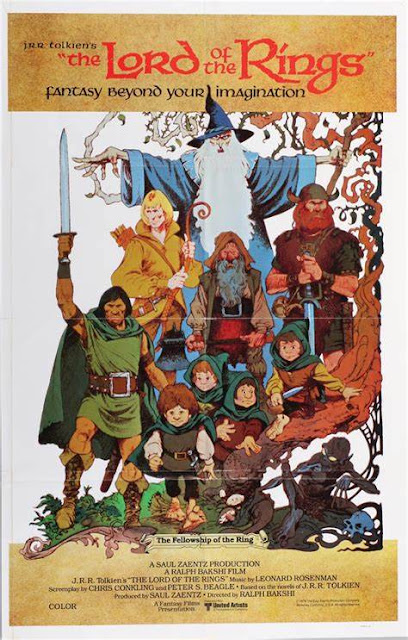

Ralph Bakshi was a wild card. He was a veteran animator, having risen up in Terrytoons and had gained some cache with is creation of The Mighty Heroes and other projects. He'd broken into cinema with Fritz the Cat which brought Robert Crumb's feline avatar to a public ready for the adult nature of the storytelling. Bakshi knew how to get an animated feature made and delivered, and outside the Disney studios he was nearly the only game in town. Artist Mike Ploog's work showed up a lot in the designs. He'd worked with Bakshi on Wizards, a science fiction fantasy which had the misfortune to debut the same week as Star Wars. British actors were brought on to do the voices. It was an epic effort to bring an epic story to the screen, and it was originally intended to be the first of two parts. Alas, we never go that sequel, at least not by the Bakshi team. 
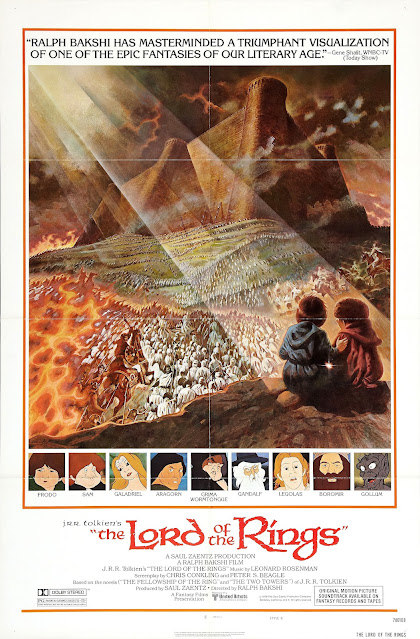

The movie is criticized today and was criticized at the time for the extensive use of rotoscoping to make the animation work, and the to give the work a greater sense of reality. Rotoscoping is looked down upon despite being one of the earliest techniques in animation and was used extensively by the Fleischer Studios in the 30's. That said, there more than a few sequences in the movie which don't really work. The rotoscoping doesn't always blend with the traditional animation and creates a jarring effect on the viewer. This movie unlike Wizards which used much the same styles required an approach which didn't take the viewer out of the movie. Here is an interview with Bakshi talking about the film. 
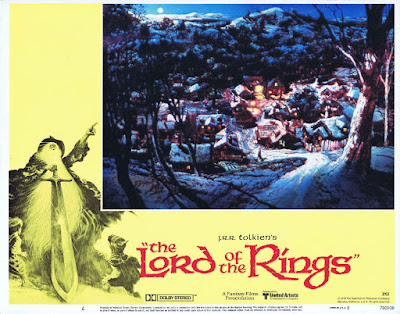

I give the movie high marks for its realization of the Shire and the bucolic regions adjacent to it. There are some gorgeous scenes with our characters moving through them. As the movie goes along and we get further away, that kind of thing diminishes. The Black Riders are also effectively realized in some places. They are favorites of mine, truly frightening creations.  Less successful is Sam Gamgee who comes across as a goofball. Frodo is okay but he and the other Hobbits look like they are about thirteen. The battle at the end of the movie is the low point, with the Orcs poorly realized and the sense of animation minimized. The strength of this production are the outstanding background paintings which successfully create a compelling world, not unlike the masterful backgrounds in the classic King Kong almost become a character. The movie ends abruptly with Gollum leading Frodo and Sam into Shelob's clutches and the heroes successful at Helm's Deep. 
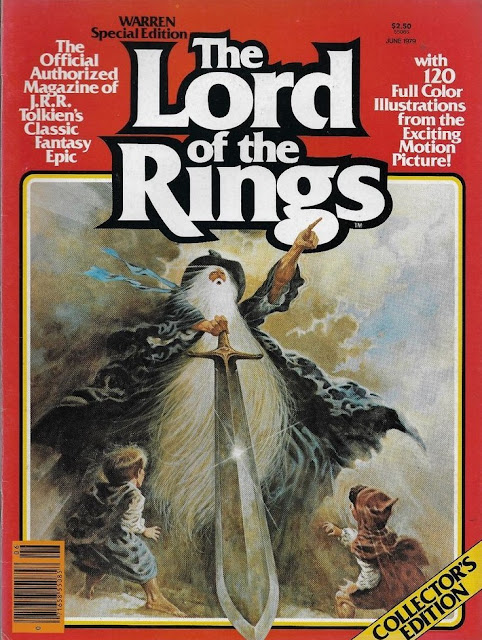

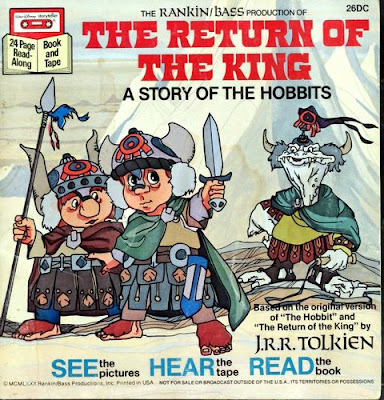
Despite a potent advertising program, the movie failed to live up to expectations in theaters. The sequel was cancelled, and Tolkien fans were left hanging with only half the story told. That is until the Rankin-Bass operation stepped in. They'd brought The Hobbit to the screen some few years before and now they'd wrap up Tolkien's greater epic in the bargain. But it wasn't part of a plan necessarily. 
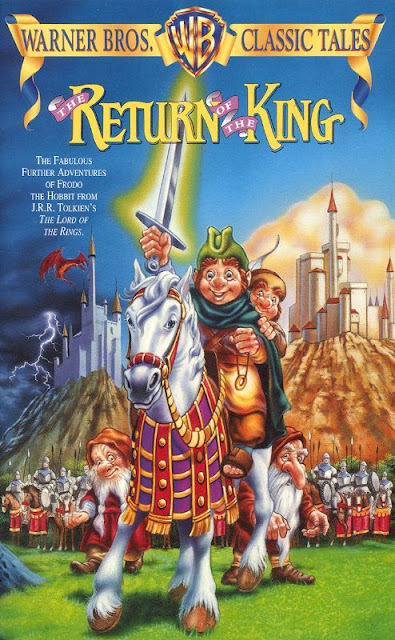

The Return of the King from 1980 has the Rankin-Bass operation picking up the story just about where Bakshi's movie had left off more or less with Frodo and Sam having survived Shelob but Frodo having been captured by Orcs. It is important to note that the production was not intended as a sequel to the Bakshi film. It's merely a fluke that the Rankin-Bass outfit started the story just about where Bakshi left off. The original title was Frodo -The Hobbit II, but better heads prevailed. The style shifted back to the Arthur Rackham inspired character designs, and the ambition was singular, to finish the story. Like The Hobbit before the Tolkien estate did not approve of this little outing and filed suit, but a deal was cut.  
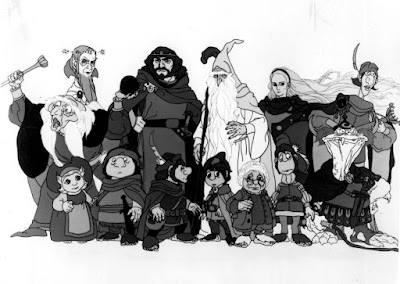

Joining veterans from The Hobbit such as Orson Bean (Frodo this time), John Huston (still Gandalf), and Brother Theodore (Gollum again) were Theodore Bikel (Aragorn), Roddy McDowell (Sam Gamgee), Casey Kasem (Merry Meriadoc), and others such as veterans John Stephenson and Don Messick among others. This 1980 production was done for television by the same Japanese outfit that had don The Hobbit


People bicker about it. Consider it a weak addition to the Tolkien world, and the Tolkien Estate even tried to stop its production. But for my part, I cherish it, for all its flaws for giving the story an ending it otherwise would not have. I rather liked The Hobbit and I like this one, though it has a harder path to walk. Despite the decision to only adapt the last novel for the sake of time, there still seems to be a terrible feeling of padding in the beginning of the story.  For Tolkien fans today it might seem a weak offering, but for us then it was a triumph if only a small one. The epic saga had been transformed into a story which walked and talked, if imperfectly. 


Two decades later, a New Zealand director would take on the story again, this time armed with new-fangled computer technology and people eager to do a greater justice to J.R.R. Tolkien's great story. But we'll get to that tomorrow. But first a song. 

Frodo of the Nine Fingers 

Music by Maury Laws
Lyrics by Jules Bass
Sung by Glenn Yarbrough

When Bilbo found that shiny ring
In Gollum's cave of gloom,
He never thought that it would turn
Into a ring of doom.

The Dragon Smaug, the Spiders too, 
The Goblish, the Evin-King,
They came to know the power of
The Hobbit and his ring. 

Frodo of the Nine Fingers
And the ring of doom.
It started with a Hobbit in
Gollum's cave of gloom.

The power of the ring, it grew,
And Gandalf sat in thought.
He knew that it must be destroyed
In fires where it was wrought. 

For is in evil hands it fell,
The earth would know its end.
No force of arms would win the day,
No army could contend. 

Frodo of the Nine Fingers
And the ring of the doom
Accepted a heavy burden
For the fires to consume.

Frodo of the Nine Fingers
And the ring of doom.
Why does he have nine fingers?
Where is the ring of doom?

We know of course. If you'd like to enjoy Ralph Bakshi's version of The Lord of the Rings, then check out this Internet Archive link. To see The Return of the King by the Rankin-Bass outfit check this Internet Achive link. 

Rip Off 

Tuesday, May 21, 2024

Music Of MiddleEarth!


The soundtrack composed by Leonard Rosenman for the 70's animated The Lord of the Rings is a moody and atmospheric affair. It evokes the film quite effectively. Ralph Bakshi has said that he prefers the sound in his films to be somewhat spare and not overwhelm the animation, but rather service it. This soundtrack does that rather well. No aspect of it stands out. I sometimes get the idea that Bakshi makes virtues out of limitations he faces in making his films, and that's not a negative when I say it. To listen to the soundtrack check out this link


Conversely in the Rankin-Bass The Hobbit the music is very topical and specific songs and motifs underlay every scene and to no small extent define the production. That's as it should be since, The Hobbit is actually a musical in its construction. Sometimes the characters sing the songs (the Dwarves for instance) but often tunes enhance and add details to a scene. This is also true to a lesser extent in the less compelling The Return of the King. Glenn Yarbrough's soulful voice does lend a a nifty folklore quality to the proceedings. To listen to this work check out this link. 


Some of my all-time favorite music is the material Howard Shore composed and directed for the three Peter Jackson films. His music is gorgeous and evokes the people and places and key events of the narrative most effectively. When I first got hold of these recordings soon after the films were first released, I'd listen to them on long drives and it not unlike watching the film which was very much fixed in my memory. I have not had that same experience with the music produced for the later, The Hobbit movies, despite the fact much of it is just as impressive. For The Fellowship of the Ring tracks go to this link. For The Two Towers tracks visit this link. And for The Return of the King music check out this link. 


Rick Wakeman's Songs of Middle Earth is whole other thing entirely. This is music meant to evoke the original Tolkien texts and at the same time be successful purely as music on its own. The movements are based on various locations mentioned in the saga such as the Shire, Lothlorlien, and Rivendell. One oddball mistake was misspelling Minas Tirith as "Minis Truth", which suggested to me someone's handwriting is pretty sloppy. Wakeman's rock roots show through some of the tunes and alas that modernity undermines his intention, if I understand it properly. It's still fun to listen to. To hear it check out this link


The first music I ever purchased related to The Lord of the Rings was The Road Goes Ever On: A Song Cycle. by Donald Swann. These are printed scores intended to encourage a reader of the works to take out the guitar and create their own music for Middle-Earth. Since I don't play, I've only ever read the lyrics, but the idea is a delightful one. 


My copy is the second edition, reprinting the original in the mid-70's when the books found a new fanbase. To hear a lecture and to see the music performed go here

 Rip Off

Thursday, January 25, 2024

Spider-Man 1967 - Season Three!


This is easily the weakest of the Seasons by far. As I said there's very little new here, but a whole lot of vintage stuff often squeezed into tighter timeframes and with little sense a lot of the time. Motivation for crime seems to be an afterthought as villains show up do really offbeat things, but then get captured and we get no background on them at all to explain why they adopted the method they did. That's the interesting part dang it. The first season of the series had been produced by Grantray-Lawrence, the same outfit responsible for the syndicated Marvel Super-Heroes show. But this third season as well as the one before were produced by Krantz Films, the outfit which would later bring us Bakshi's Fritz the Cat movie. 


This Season even reuses one earlier cartoon twice. The episode with the villain the Master Technician is re-worked, and he's made into a "new" villain from Atlantis (they added pointed ears and a fin on his head) who does pretty much the same thing save that instead of NYC getting lifted into the sky it gets dropped into the ocean. Later the "Master Technician" shows up again but renamed the "Radiation Specialist" he repeats his crime from before lifting the NYC skyline again. So essentially, we get the same cartoon three times in three seasons with slight variations.


Here is a list of a half-dozen things I learned watching this season (I cut it in half since the season was so short):

1. Snowmen are inherently angry, so you better not accidently bring them life. They want to kick your ass!

2. Comets have antennae.

3. Despite all aerodynamic principles, biplanes can still outfly jets and even shoot them down with rays and stuff.

4. Peter Parker will give anyone a lift, even villains.

5. Captain Stacey looks completely different, even in the same episode from scene to scene. Sheesh!

6. Mysterio is a hipster who wears glasses and though he lost his pointed ears from the First Season, his skin has gone green for the Third.


This set of cartoons also looked muddier on my DVD set. I assume that had to do with the original source materials as the rest of the disk is fine in that regard. It's only Season Three that has the slight glowing effect in the backgrounds.

I did like the episode culled from the Rocket Robin series, "Revolt from the Fifth Dimension". It was strange and had some great images, though as a Spidey tale it was pretty limited. The Mysterio story was dandy and I think is based on a classic Spidey comic though again Mysterio looks different. Mary Jane shows up but she's Captain Stacey's niece time. There is also a keen interest in the Universal Frankenstein movies, but I'll have more to say on that in a separate post.

One other thing I did notice was there was a lot of mind-gaming in these episodes. Whether it was the Swami (a somewhat pointed racial stereotype for the time) or Mysterio or Infinata of Dementia-5 or the Kingpin with his brainwashing, the human mind was getting twisted a bunch in these episodes. Surely this had nothing to do with the "high times" of that era. 

All in all, I didn't find this Season as much fun, though it had high points. After watching them all now, I have to give the nod to Season Two and despite its endless web-swinging, I still think it's the most compelling in terms of story and art.

Rip Off

Wednesday, January 24, 2024

Spider-Man 1967 - Season Two!


It's definitely a change, but I have to say I prefer this second season to the first. The stories were slightly more complex and had a vaguely more adult feel to them. This is especially so of the origin story in the first two episodes of season two. The art on those was pretty good and the story very much like a Spidey comic. I love the backgrounds in this series, the colors are vibrant and intoxicating often making up for admittedly lackluster animation.


Now after that beginning things get strange. But knowing that fantasy masters like Lin Carter on the writing and Gray Morrow on the art design are at the helm I can't be surprised all that much that Spidey spent most of the season out of the city and in some vague jungle/alien setting up to his webs in plants and weird bat-things. One thing I noticed was that many of the stories really threw curveballs, in that Spidey would begin his adventure normally enough with crime and thugs but then there would be a shift and he'd find himself in the future, underground, or on a bizarre island somewhere.

I consider these adventures to be similar to the kinds of adventures that Spidey would have in Marvel Team-Up in which he'd often venture into territories radically different from the classic big city crime story he's rooted in. The MTU Spidey would travel in time, go into space, venture into lost worlds and do all manner of things bizarre by his standards. This second season had that kind of feel to it.


Here a dozen things I learned watching this second season of Spider-Man:

1. The sky is often green and always dramatic as if a storm is about to erupt.

2. Purple gorillas are seen by the criminal set as effective disguises for some reason. Maybe it's a DC thing.

3. Spidey can pilot experimental jet planes and has ready access to them on a whim, and no one misses them when they fly away.

4. Mole Men are ridiculously stupid, getting duped by the same criminal in two episodes. And they like to gong a lot.

5. Giant doors are common in many alien landscapes, as if Kong himself were on the other side.

6. Spidey loves to swing and swing and swing and swing and swing though the city, often attaching his web line to no discernable object.

7. Villains are most often green, the sure sign of villainy in the Bakshiverse.

8. Peter Parker plays baseball.

9. Parker sure hangs out with a lot of different girls, but I'm guessing he's not a FWB (Friend with Benefits), accounting for that gloomy puss he wears most of the time.

10. Manhattan is a remarkably sturdy cityscape and can survive multiple sinkings of various buildings and even detaching from the earth and flying into the sky.

11. Martians look amazingly like ancient gods of Norse and Greco-Roman mythology.

12. The power of flight is achieved by putting a blender on your head.


Ralph Bakshi produced a wacky cartoon, that's so bizarre that I wouldn't mind watching it again in a few years. The stories are at once patterned and unpredictable. Spidey seems mostly trusted by the police, even admired by them save for the last episode when inexplicably he's seen as a baddie and a threat. The villains are cackling madmen, but interesting looking by and large.

Things happen in the Bakshiverse that require no explanation, they just are. And in the context of these stories, I can accept that. You might even dub this season of Spidey stories his "Weird Adventures" and be very close to capturing the feeling they have.

Tomorrow it's Season Three.   

Rip Off