Showing posts with label Joe Simon. Show all posts

Friday, January 2, 2026

Ditko In 3-D!


For any fan of the work Joe Simon and Jack Kirby one oddity that always pops up is the single issue of Harvey's Captain 3-D from 1953. What we have is a full-blown superhero adventure, the first costumed hero the team had produced since the ill-fated Stuntman for Harvey many years before. What we have is a comic which makes pretty good use of a trendy technique which from time to time captures the whimsy of pop culture. Sadly, what we don't have is a very good comic book story.


Captain 3-D was one of several 3-D offerings from the company when the technique caught fire in the early 50's. But just as fast as it blazed into being it sputtered out. Harvey comics went away from the idea arguably because the craze was short-lived but also because they came under legal scrutiny for the way in which they used the technology which other comics publishers claimed was poaching. Whatever the reasons, the story of Captain 3-D lasted one single issue.

Briefly the tale is about a young lad named Danny Davis who is given a mysterious book by a mysterious man who is promptly melted into nothingness by another mysterious figure who likewise goes up in smoke, thus making Danny's pleas to the police seem like tomfoolery. But soon when he is alone, he activates "The Book of D" by putting on some weird glasses and out of the pages leaps a costumed hero named Captain 3-D who immediately battles some thugs who are breaking into Danny's digs. After dispatching the baddies, the Captain explains to Danny that the book is a relic of an ancient time and place dubbed "The Land of D" when the Captain's people (of whom he is the last survivor) and the "Cat People" battled for control of the world. Both were seemingly destroyed but not before the Captain was hidden as a safeguard in the book which had been passed down for generations beginning in mankind's prehistoric past. In the two remaining stories Captain 3-D emerges to battle Tigra the queen of the Cat People and a mobster by the name of "Ironhat McGinty" (because he has an iron cap surgically implanted in his noggin no less).


This issue is of particular interest right now because it is among the very first professional comics work of Steve Ditko who was part of the Simon and Kirby staff at the time and in particular was enamored with the work of Mort Meskin.
 
And that was that. To read the complete issue check this, but bring your handy 3-D specs if you want to enjoy it completely.


There was going to be a second issue of Captain 3-D but it was scotched when the bottom fell out of the extremely hot but extremely brief 3-D trend. The artwork for the cover of that never was comic was at long last published in 1999 by AC Comics for an issue of Golden Age Men of Mystery. The issue featured a lot of unpublished art for that book as well other features on the work of Simon and Kirby for Harvey Comics. It seems Greg Theakston had the unfinished artwork for one story from the issue and sent it to Ditko's studio since he had been scheduled all those decades before to ink the Mort Meskin pencils. Ditko though decided to pin up the pages around his studio for others to take their pick to ink and many of the pages went missing. You can see the penciled pages in small format in this issue from copies which were made. 

The character was impactful for more than a few future pros such as Roy Thomas, Bill Black and Grass Green among others. And he proved to inspire other creations as seen below. 


And that sums up how I feel about Captain 3-D too, an interesting curiosity, but less effective because of the special effects than without them. Reading the story sans the 3-D effects the panels are woefully static (for logical reasons) and that undermines the general fluid tendencies of the usual Simon and Kirby effort. Also, the story of Captain 3-D himself is in places robust but overall cumbersome and if it had been given a few more outings would've in my opinion worn itself out purely in narrative terms.

Captain 3-D is a lovely image, a great icon of a long-lost time when we like to imagine life was simpler to understand, but aside from that nostalgic impulse, he's a mildly mediocre hero, and not up to the usual standards of Simon and Kirby. But it did give Steve Ditko a place to begin. 


In the 90's Ditko produced two 3-D comics of his own. Both were written by Jack C. Harris and produced by 3-D Zone. I hope to review both of these later this year. I own one, but I still need to acquire the other. 

Rip Off

Friday, November 21, 2025

Danger Street Signs - Outsiders!


In anticipation of a review of Danger Street by Tom King, Jorge Fornes and assorted cover artists I am representing my thirteen reviews of DC's 1970's Showcase-style comic 1st Issue Special. The books by King and company make use of ALL of the sundry heroes and heroines who appeared in these pages. So, let's continue. 

Comic books have long been a haven for misfits and unusual people -- both in the content and the audience and the producers. Many a comic book reader of my generation latched onto the medium because it was colorful and exciting and filled up with characters who had trouble fitting into their landscapes as much as the readers might've done. Comics like The Uncanny X-Men and Doom Patrol made a theme out of the heroes being "freaks" compared to the regular society, despite their sometimes handsome appearances. Characters like The Thing were downright icons of the man dubbed "monster" by those who were more or less commonplace. 


In 1932 Tod Browning made a movie about such misfits called simply Freaks. This legendary movie was sensation because it used real people who were either afflicted or gifted (depending on your attitude) with physical anomalies that set them apart from the regular herd of mankind. This movie is actually discussed in the forward to 1st Issue Special #10 which sports an intriguing Ernie Chan cover which offers up figures which in no way match the characters within. Beneath that cover is a story by Joe Simon and Jerry Grandenetti which offers up some "Freaks" of their own, in this case calling themselves "The Outsiders". (The original title was "Super Freaks", but I guess DC was a bit scared of that one just as Universal had been frightened of Tod Browning's movie.)


Be warned though that this is merely a glimpse. We meet the team made up of "Doc Scary", "Hairy Larry", "Lizard Johnny", the "Amazin' Ronnie", "Mighty Mary" and "Billy". They are a super team of sorts under the leadership of Doc Scary and they costumes and drive around with laboratory attached to their car. We see them battle a mob to free a terrified kid named Billy who learn later was kept in a basement of a Tailor shop by his father wo is killed by two thugs. It results in a mob wanting to kill Billy. We also learn that Doc Scary was once sent into space and when his spaceship crashed his body was reconstructed by aliens who used themselves as models. We get a glimpse of the birth of Lizard Johnny who as a tadpole is saved by Doc when another researcher wants to chop him up. The Outsiders live in an underground complex beneath the hospital where Doc is a renowned surgeon, albeit one who works in disguise. Sadly we never learn more about the team as the story abruptly stops. 


Next time Gerry Conway makes organized crime shudder when he introduces Code Name: Assassin

Rip Off

Tuesday, November 11, 2025

Veterans Day - The Guys In The Foxhole!


Perhaps the Mainline comic with the most verve and energy was Foxhole, a war comic produced by men who had real experience in the military. While Joe Simon had enlisted in the Coast Guard and spent all of the war stateside, Jack Kirby was overseas as an Army scout in Europe following on some weeks after the D-Day invasion. Here's an interview of sorts about his time in the war.


There's no doubt that Jack Kirby's World War II experiences shaped the rest of his life and career and it finds some early expression here in the highly emotional images which grace these covers.


Once again Simon and Kirby produced four issues for their struggling Mainline company before the title and the balance of the material was sold off to Charlton Comics in 1955.


Charlton produced three more issues of the comic erratically through 1956.


Then the title was changed to Never Again for one single issue in the summer of 1956.


That winter the title was changed again with the very next stand alone issue to Soldier and Marine Comics.


Finally the title was changed again in 1957 to Jerry Drummer and the focus was shifted from modern warfare to the history of the American Revolution.


Jerry Drummer lasted three issues until being cancelled with the eleventh issue in late 1957 bringing the original Foxhole run to an end.


But in 1963 and 1964 the pirate comics operation I.W.Publishing / Super Comics came out with three irregularly numbered issues of Foxhole.


The original Foxhole comic by Simon and Kirby was intended to have significant edge, bringing a energy and depth to the depiction of the horrors of war. As can be seen by this rejected cover for the fourth and final Mainline issue, Simon and Kirby were striving to communicated the violence of war to a broad audience. Despite the rejection of the art, I'm still struck by the amazing portraits Kirby created for the fourth issue, one of my all-time favorite comic book covers.

Rip Off

Saturday, November 8, 2025

The Super Comics Spirit!

(Joe Simon)


(Joe Simon)


Super Comics Seal of Quality was a brand put out by I.W. Publishing also called simply Super Comics. The name derived from Israel Waldman the owner who came to possess a printing company and found printing plates for numerous comics of the past from various publishers, most defunct. He then proceeded to repackage and reprint these comics without the required permission. The company lasted from 1958 until 1964, but I know I was finding Super Comics after in various packages. The two Spirit comics published by Waldman's company were reprints of the Quality Comics reprints of the series with some new material. Joe Simon was hired to created new and rather exciting covers, more in keeping with the dynamic covers of the early Silver Age. 

Rip Off
 

Tuesday, November 4, 2025

Danger Street Signs - The Green Team!


In anticipation of a review of Danger Street by Tom King, Jorge Fornes and assorted cover artists I am representing my thirteen reviews of DC's 1970's Showcase-style comic 1st Issue Special. The books by King and company make use of ALL of the sundry heroes and heroines who appeared in these pages. So, let's continue. 

The Green Team
by Joe Simon and artist Jerry Grandenetti is a offbeat offering in the second issue of 1st Issue Special. In this issue we meet the four young fellows who are members of this elite outfit, which is comprised exclusively of millionaires with a yen for adventure. 


The story is told in a somewhat fragmented form as we first meet Commodore Murphy a young shipping magnate who is the leader, J.P. Houston an oil tycoon who adopts a cowboy affect, Cecil Sunbeam a hot Hollywood movie director and Abdul Smith, a black shoeshine boy who is able to convert a banking error in his favor in a brand new fortune. These four adopt a uniform and stuff their pockets with cool cash and set out to have fun in the world. Their mission in this issue is to see that "The Great American Pleasure Machine" is built despite the rumblings of a corrupt labor leader named David D. Merritt. The complex whisks one away and they utterly transfixed with entertainment for days and days and days. Other forms of entertainment, including comic book heroes, feel threatened. (Sounds like the internet to me.) 


It's difficult to know what Simon is saying in this story which has a finale that appears to contradict the set-up, but this is the only published issue. As always Grandenetti's artwork is stunning and fluid and dynamic. 


The tyros of course remind any veteran comic book fan of Richie Rich, another youth who grew up rich and who filled his eternal days with adventures. These are four teenage millionaires who wear trippy jumpsuits filled with cash and fly the globe looking for thrills which will apparently momentarily dissolve the ennui which dominates their existences. These jet-setting one-percenters are every boy's dream and their superpower is cold hard cash. 


In the face of the many hard-scrabble kid gangs Joe Simon concocted with his once-upon-a-time partner Jack Kirby, these millionaire mopes are hard to love. Lacking the brashness which attaches to upstarts like the Newsboy Legion's Gabby or the Boy Commandos' Brooklyn, this team is a gaggle of over-soaked haves who evoke no sympathy and precious little empathy. (In fact it was from some pressure from DC that both Simon and Kirby created new boy teams, Simon with this Green Team and Kirby with his Dingbats of Danger Street which will show up later in the 1st Issue Special run. More on this when I cover that team next week.) 


Two more issues of The Green Team were "published" only in the technical sense in Cancelled Comic Cavalacade #1. DC revived The Green Team some years back during the "New 52" era and though in fairness I've never read an issue, they appear even less likeable than their Bronze Age inspirations. It's not fair of course to hate the Green Teamers for their money, that would be just plain jealousy. But it's hard to root for these overdogs, and that's just the way it is. I have a general rule to never feel sorry for millionaires. They of course have many if not most of the problems the vast majority of mankind faces, but then they have at least a million dollars to help them cope with it, so there.


After two brand new projects from two of the comic book world's most celebrated creators the next issue of 1st Issue Special will revive a fan-favorite superhero -- Metamorpho the Element Man. More on that later. 

Rip Off

Friday, October 10, 2025

Blue Bolt Day!


Joe Simon was born on tomorrow's date in 1913. Simon was among the earliest talents in comics eventually teaming with Jack Kirby to become one of the most successful and creative teams in the history of the medium. Together they created Captain America, The Newsboy Legion, The Boy Commandos and Boys Ranch as well creating a new genre of sorts with Young Romance. Following the break-up of the duo, Simon went on to edit Sick magazine among many other projects over the years. 

In the hectic early days of the Golden Age of comics the demand for new material seemed to far outstrip the ability of the talent to produce it. It was a mismatch in the marketplace of cheap offerings keeping the really fine talent out. That left youth. It was they up and coming youngsters from the close confines of New York City who fill the gap. They worked for small money in an industry which barely seemed to know it existed, but was beginning to capture the public imagination.


Into this atmosphere stepped Joe Simon, a savvy and talented artist who had honed his skills, such as they were, in local newspapers and as part of studios which supplied talent to the shark-like publishers who were entering the new field. Victor Fox was perhaps the most shark-like of all of them, a self-important loudmouth who called himself "The King of Comics".


His staff made fun of that remark and it became an ironic catchphrase many years later. Simon impressed Fox and was soon producing Blue Bolt, a comic which evoked the essence of the time, namely the science fiction serials such as Flash Gordon and Buck Rogers.


In the debut issue of Blue Bolt we meet Fred Parrish, the obligatory football hero who is struck by lightning and finds his way into a weird underground world dubbed Deltos. There he is infused with more lightning power which makes him effectively superhuman with great strength and the ability to fly. He dons a blue costume and with little reflection on the life he left appears to pledge allegiance to the scientist to who made him. The "Scientific City" is in a war with the Green Army led by the alluring Green Sorceress.


The second issue of Blue Bolt brings with it a new flavor as the artwork seems more energetic and alive. That's no accident, as the second Blue Bolt adventure is the first published work by the Joe Simon and Jack Kirby team. Simon seemed well aware what a consummate talent he had discovered with Kirby and was very savvy to hitch his horse to such an artist. Simon's skills were not insignificant as an artist and his skills as a writer and businessman were quite advanced for the time period.


The struggle between Blue Bolt and the Green Sorceress is one of those classic frictions in which there is romantic attraction in combination with fundamental differences in politics. The Sorceress wants to rule of of the tiny world of Deltos and Blue Bolt in service to Dr. Bertoff stands in her way.


The schemes switch back and forth and the Sorceress is captured and then escapes. The story is told not unlike a serial, owing much to its movie inspirations. Each chapter sets up a high-concept bit, but by the end the story is either reset or ends on something akin to a cliffhanger.


Blue Bolt was something of a hit, though Simon and Kirby left the series after ten episodes or thereabouts. The title ran for many years and the character showed up from time to time. Reading these yarns felt at times more like watching the Flash Gordon serials than even reading the original Alex Raymond material which those were based on. Simon and Kirby really tap into that movie vibe quite successfully.


Rip Off

Saturday, September 20, 2025

JSA - The Plunder Of The Psycho-Pirate!


In this second volume of vintage Justice Society of America stories sub-titled The Plunder of the Psycho-Pirate, we see the team become more cohesive, beginning to function as a single unit, though individual stories are still by and large the order of the day. The war is still on and the "Justice Battalion" is very much in evidence, battling Fascist spies and rallying support for the war here at home and in other parts of the world. 
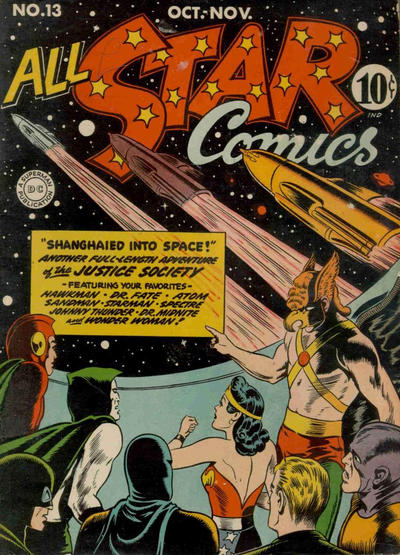

"Shanghaied into Space" is a wild yarn in which the Nazis scheme to rid themselves of the JSA by rocketing the team into outer space, in particular to the various planets of our solar system. Hawkman is sent to Saturn, The Sandman rockets to Uranus, Dr. Mid-Nite lands on Neptune, Starman jets to Jupiter, The Atom ends up on Mars, The Spectre finds the remote Pluto, Johnny Thunder and his Thunderbolt descend onto Mercury, and Wonder Woman explores Venus. Each of the members finds a war being fought by the denizens of these distant worlds and helps. This is really the only issue in the collection in which Wonder Woman has her own individual chapter. 

The script this issue was handled by Gardner Fox with William Moulton Marston handling Chapter 8. The art was handled by Jack Burnley (Cover, Introduction, Chapter 4 & Conclusion), Sheldon Mayer (Chapter 1), Cliff Young (Chapter 2), Stan Aschmeier (Chapters 3 &7), Joe Gallagher (Chapter 5), Bernard Bailey (Chapter 6), and Harry Peters (Chapter 8).
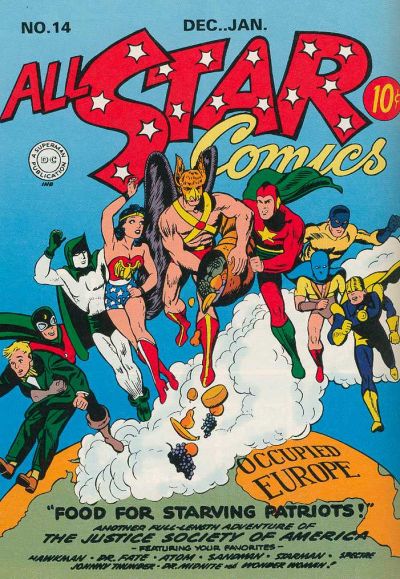

"Food for Starving Patriots" sees the Justice Society help the war effort by delivering enriched food capsules to the hungry populations of Europe fighting against the Fascist forces. Hawkman feeds the French, Starman brings food to Poland, The Atom assists the hungry in Holland, Dr. Fate delivers food to German concentration camps, Dr. Mid-Nite gives sustenance to Norway, The Spectre aids starving folks in Belgium, Johnny Thunder transports needed food to Czechoslovakia, and The Sandman brings food to Greece. The team is still functioning as the "Justice Battalion", supporting the war effort above all other concerns, and doing so by not only feeding but fighting alongside the disparate forces inside occupied Europe. 

The script this issue was handled by Gardner Fox with with Jack Kirby and Joe Simon handling Chapter 8. Cover by Frank Harry. The art was handled by Joe Gallagher (Introduction, Chapter 3 & Conclusion), Sheldon Moldoff (Chapter 1), Lou Ferstadt (Chapter 2), Howard Sherman (Chapter 4), Stan Aschmeier (Chapters 5 & 7), Bernard Bailey and Pierce Rice (Chapter 6), and Jack Kirby, Joe Simon and Howard Ferguson (Chapter 8).


"The Man Who Created Images" introduces the villain Brainwave. For the first time Wonder Woman is sad to report that none of the JSA members have shown up for the regular meeting. Instead, each member has been delayed by a personal mission and as it turns out each of those missions involve illusions (ghosts, walking statues, and other assorted apparitions) created by Brainwave. Wonder Woman for her part contacts the women in the lives of the JSA members and recruits them to stand in for the missing team. 

The script this issue was handled by Gardner Fox with Jack Kirby and Joe Simon handling Chapter 5. Cover by Frank Harry. The art was handled by Joe Gallagher (Introduction, Chapter 4 & Conclusion), Sheldon Moldoff (Chapter 1), Stan Aschmeier (Chapters 2 & 3), Jack Kirby and Joe Simon (Chapter 5), Ed Drobrotka (Chapter 6), Bernard Bailey (Chapter 7), and Howard Sherman (Chapter 8).
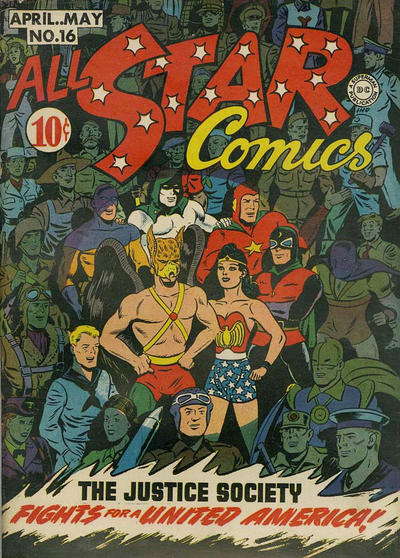

"The Justice Society Fights for a United America!" is my favorite story in this collection and one I wish Americans today would read and take to heart. The JSA seek out members of the Junior Justice Society (advertised in recent issues) for information about those in various communities who are attempting to undermine the unity of American citizens in the fight against fascism. The members confront division within the factories, the mines, and the cities of the nation. Even criminals rise to the challenge and unite against the greater threat. The Final few pages of this epic showcase a united country made up of all kinds of people including those of other races. It's a story which reminds me of Gardner Fox's Silver Age Justice League classic "Man Thy Name is Brother". 

The script this issue was handled by Gardner Fox with Jack Kirby and Joe Simon handling Chapter 5. Cover by Frank Harry. The art was handled by Joe Gallagher (Introduction, Chapter 3 & Conclusion), Sheldon Moldoff (Chapter 1), Stan Aschmeier (Chapters 2 & 8), Jack Kirby and Joe Simon (Chapter 5), Ed Drobrotka (Chapter 6), Bernard Bailey (Chapter 7), and Howard Sherman (Chapter 4).
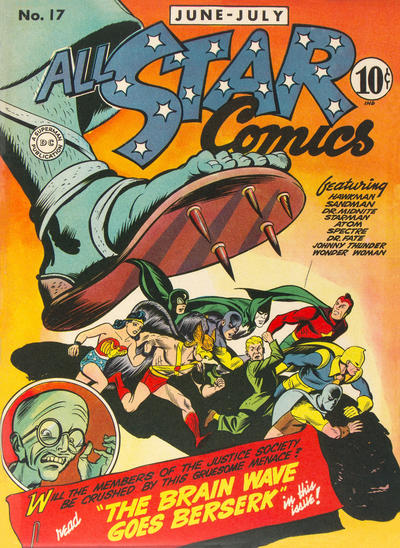

"The Brain Wave Goes Berserk" features the return of the big-domed baddie who had just a few issues before challenged the team and had seemingly fallen to his death. This time the villain shrinks our heroes down to doll size and they have to overcome their individual opponents at that size. It's a nifty handicap to inflict on the team and makes for some fanciful action sequences. In particular I looked forward to reading The Atom chapter in which for the first time he was functioning in a similar fashion to his Silver Age namesake. Wonder Woman missed out as she left the meeting before Brain Wave shrunk the heroes.

 The script this issue was handled by Gardner Fox with Jack Kirby and Joe Simon handling Chapter 2. Cover by Frank Harry. The art was handled by Joe Gallagher (Introduction, Chapter 7 & Conclusion), Sheldon Moldoff (Chapter 1), Stan Aschmeier (Chapters 5 & 8), Jack Kirby and Joe Simon (Chapter 5), Bernard Bailey (Chapter 3), Howard Sherman (Chapter 4), and Paul Reinman and Sam Burlockoff (Chapter 6)


We get a really strange one when "Insects Turn to Crime!" King Bee makes his debut in this wild yarn in which insect hormones are spread out to various criminal gangs who use them in various ways to create strange and dangerous hybrids. The JSA members have to confront dangerous bee-men, offbeat ant-men, ferocious termite-men, manlike water-bugs, flying hornet-men, insidious spider-men, high-flying grasshopper men, and human flies. 

The script this issue was handled by Gardner Fox. Cover by Frank Harry. The art was handled by Joe Gallagher (Introduction, Chapter 7 & Conclusion), Sheldon Moldoff (Chapter 1), Stan Aschmeier (Chapters 5 & 8), Pierce Rice and Arturo Cazeneuve (Chapters 2 & 6), Bernard Bailey (Chapter 3), and Howard Sherman (Chapter 4).


"Crimes Set to Music" has the JSA on a quest to discover the location of the missing Hawkman. They are sent on various missions led by strange notes which disclose names, addresses, and cryptic messages. Each note leads to a musical-themed crime about to be committed and which the JSA members must stop. It turns out the men threatened were once friends in the same town and all demonstrated singular musical talents, all save one, and he is the villain behind the plot to end the music produced by the others who have found successful careers. 

The script this issue was handled by Gardner Fox with Jack Kirby and Joe Simon handling Chapter 5. The art was handled by Joe Gallagher (Cover, Introduction, Chapter 4 & Conclusion), Stan Aschmeier (Chapters 1, 2 & 6), Chester Kozlak (Chapter 3), Jack Kirby and Joe Simon (Chapter 5), Bernard Bailey (Chapter 7), and Sheldon Moldoff (Chapter 8).


"The Movie that Changed a Man's Life" is a strange one. The JSA is contacted by the industrial magnate Jason Rogers who is being besieged by the villain known only as "The Monster". Further Rogers reveals that there is a movie in his possession which when seen had caused the death of his wife and the loss of all his friends. He has turned to the JSA in desperation to end the predations of The Monster's threats to his businesses and holdings. The fanged villain merely laughs as he knows the JSA members are headed his way. Though featured on the cover and in the group scenes, The Sandman does not get his own chapter. 

The script this issue was handled by Gardner Fox. The art was handled by Joe Gallagher (Cover, Introduction, Chapter 3 & Conclusion), Sheldon Moldoff (Chapter 1), Stan Aschmeier (Chapters 4,5 & 6), Bernard Bailey (Chapter 2), and Howard Sherman (Chapter 8).
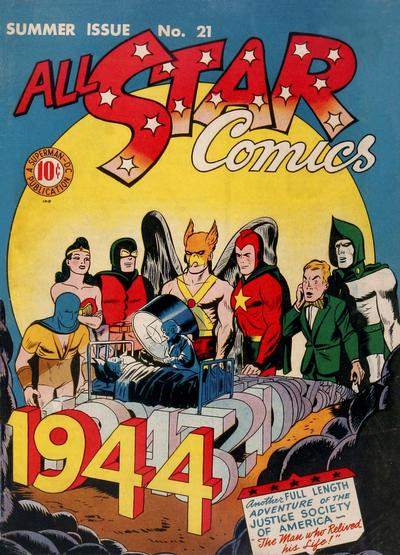

"The Man Who Relived His Life!" is a bizarre tale for sure. Professor Everson, who had previously sent the JSA on time travel jaunts, asks for their help when a man named Joe Fitch is on his deathbed. Fitch had swallowed a drug which proved lethal to him but allowed Everson to know that another drug was beneficial. His sacrifice was a noble one, but Fitch wishes to die with clear conscience and as it turns out he's led a life full of violence and crime. Everson arranges to transport the JSA members back to different parts of Fitch's life and help him to avoid making poor decisions. They agree and see the team get involved with all manner of events from history. Though he's not shown on the cover, he does rate his own chapter this is Sandman's final appearance in the collection. 

The script this issue was handled by Gardner Fox. The art was handled by Joe Gallagher (Cover, Introduction, Chapter 2 & Conclusion), Sheldon Moldoff (Chapter 1), Stan Aschmeier (Chapters 3,4 & 6), Bernard Bailey (Chapter 2), and Joe Kubert (Chapter 5).


"A Cure for the World" is one of the strangest of the JSA stories here. Also going by the title "The Test of Time", this yarn has the JSA empowered by the personification of mankind's collective conscience travel to various time periods where they must overcome the prejudices of each era and situation. Each hero is robbed of his modern sophistication and must rely on his personal desire for fairness and good to overcome the hatreds they encounter. Whether its cavemen, ancient Greeks, frightened Puritans, enraged French peasants, or fearful luddites, the team must overcome to show the youth of today what real progress and brotherhood is. The story ends with a big rally of young people saying the pledge.

The script this issue was handled by Gardner Fox. The art was handled by Joe Gallagher (Cover, Introduction, Chapter 4 & Conclusion), Sheldon Moldoff (Chapter 1), Stan Aschmeier (Chapters 2, 3 & 5), and Bernard Bailey (Chapter 6).


"The Plunder of the Psycho-Pirate" introduces another classic JSA villain, this time one who uses the emotions of people and our heroes against themselves to fulfill his need for crime and to exert pressure on a newspaper publisher. Each member of the team is challenged individually by the mysterious villain to confront the emotions of Love, Hate, Fear, Conceit, Greed, and Despair. As will come as a surprise to nearly no reader, the villain himself is closer than the heroes think. 

The script this issue was handled by Gardner Fox. The art was handled by Joe Gallagher (Cover, Introduction, Chapter 6 & Conclusion), Sheldon Moldoff (Chapter 1), Stan Aschmeier (Chapters 2, 3 & 4), and Cliff Young and Steve Brodie (Chapter 5).
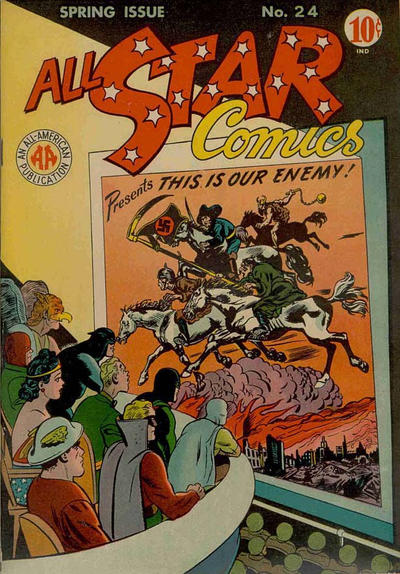

"This is Our Enemy!" is more propaganda for the wartime audience. In the past the stories of this kind have been about strengthening the bonds of Americans and others across the world against a common enemy. In this story, the very nature of that enemy is exposed as Germans are presented as having been singularly warlike over the course of hundreds of years. Sadly, it's the very jingoism often preached against in other JSA stories, but understandable given the desperation of the war effort abroad. A young man is uncertain if he should enlist to battle the German threat overseas, so the JSA with the help of the personified Conscience of Mankind sends the fellow back to various eras of German history where he learns of the relentless warlike nature of German leaders. Flash and Green Lantern turn up in cameos, but this issue is most notable in that both Wildcat and Mr. Terrific debut in separate chapters. 

The script this issue was handled by Gardner Fox. The art was handled by Martin Naydel (Introduction & Conclusion), Joe Kubert (Chapter 1), Stan Aschmeier (Chapters 2, 3 & 6), and Joe Gallagher (Cover and Chapters 4 & 5).

Also included in each issue is a Hop Harrigan text story. I haven't taken the time to document those, however. DC also includes some fun advertising bits and bobs. It was remarkable how little Wonder Woman participated in the team, almost as if she'd been shunted to "Honorary" status alongside other heroes carrying their own titles. But it's not made official in anyway. 

Rip Off