Showing posts with label Peter Jackson. Show all posts

Tuesday, May 21, 2024

Music Of MiddleEarth!


The soundtrack composed by Leonard Rosenman for the 70's animated The Lord of the Rings is a moody and atmospheric affair. It evokes the film quite effectively. Ralph Bakshi has said that he prefers the sound in his films to be somewhat spare and not overwhelm the animation, but rather service it. This soundtrack does that rather well. No aspect of it stands out. I sometimes get the idea that Bakshi makes virtues out of limitations he faces in making his films, and that's not a negative when I say it. To listen to the soundtrack check out this link


Conversely in the Rankin-Bass The Hobbit the music is very topical and specific songs and motifs underlay every scene and to no small extent define the production. That's as it should be since, The Hobbit is actually a musical in its construction. Sometimes the characters sing the songs (the Dwarves for instance) but often tunes enhance and add details to a scene. This is also true to a lesser extent in the less compelling The Return of the King. Glenn Yarbrough's soulful voice does lend a a nifty folklore quality to the proceedings. To listen to this work check out this link. 


Some of my all-time favorite music is the material Howard Shore composed and directed for the three Peter Jackson films. His music is gorgeous and evokes the people and places and key events of the narrative most effectively. When I first got hold of these recordings soon after the films were first released, I'd listen to them on long drives and it not unlike watching the film which was very much fixed in my memory. I have not had that same experience with the music produced for the later, The Hobbit movies, despite the fact much of it is just as impressive. For The Fellowship of the Ring tracks go to this link. For The Two Towers tracks visit this link. And for The Return of the King music check out this link. 


Rick Wakeman's Songs of Middle Earth is whole other thing entirely. This is music meant to evoke the original Tolkien texts and at the same time be successful purely as music on its own. The movements are based on various locations mentioned in the saga such as the Shire, Lothlorlien, and Rivendell. One oddball mistake was misspelling Minas Tirith as "Minis Truth", which suggested to me someone's handwriting is pretty sloppy. Wakeman's rock roots show through some of the tunes and alas that modernity undermines his intention, if I understand it properly. It's still fun to listen to. To hear it check out this link


The first music I ever purchased related to The Lord of the Rings was The Road Goes Ever On: A Song Cycle. by Donald Swann. These are printed scores intended to encourage a reader of the works to take out the guitar and create their own music for Middle-Earth. Since I don't play, I've only ever read the lyrics, but the idea is a delightful one. 


My copy is the second edition, reprinting the original in the mid-70's when the books found a new fanbase. To hear a lecture and to see the music performed go here

 Rip Off

Sunday, May 19, 2024

The Extended Hobbit!


Below are three review I wrote over the years for the three installments of The Hobbit as directed by Peter Jackson. I've tweaked them a bit for the sake of some consistency, but for the most part I've left them as they were originally presented. When my opinion has changed, I've indicated. 


December 2012 - An Unexpected Journey

I went to see The Hobbit - An Unexpected Journey yesterday morning. Usually Sunday morn is a dandy time to catch flicks as it offers quiet reasonably empty theaters. Not yesterday. Despite a 10 AM start, there and the fact I went to the mundane 2-D presentation, there were still over a one hundred folks enjoying the latest trip to Hobbiton and beyond with me.

I have to confess going this time was more a chore than a joy. I was giddy to see the first of the Peter Jackson adaptations over a decade ago, going opening night and braving giant crowds. This time, I mostly wanted to see it before reviews spoiled it. I've not been happy since I learned there are going to be three of these things. I fear we're going to see a trio of bloated narratives, dragging in all manner of off the rack material. A scrupulous adaptation of the Tolkien classic would make for two reasonably sized flicks and would add nicely to what the New Zealanders have already accomplished.

Hobbiton is beautifully rendered, and it was scrumptious to visit this exceedingly cool mythical hamlet again. The scenes of the group tramping across the countryside astride their ponies were beautifully done, really communicating the essence of Tolkien for me. The balance between the unusual and the beautifully mundane is perfectly balanced in these scenes. Riddles in the Dark is outstanding, precisely true to Tolkien as I remember it at least. I'm not a huge Gollum fan in these movies, finding him at times very tedious, but he works here as well as he ever has. The technology supports the performance here wonderfully. Likewise with the Wargs which look really menacing.

It's not the filmmakers' fault, but thirteen dwarves are a challenge for anyone. It is a downright "avalanche" of dwarves. There's no doubt in my mind that if Tolkien's book was not so beloved, a typical adaptation would lower the number of dwarves to six or seven at best. But stuck with the original mob, Jackson and company try to make them distinctive, though we fail to get proper introductions to many. At least they are visually distinctive. It's almost impossible though to keep track.

Unfortunately for this movie and I fear for the franchise, the development of "performance-capture" has "captured" this movie. For me the triumph of the earlier movies was that it made the world of Tolkien's Middle Earth real. It grounded the fantasy into a place and time, adding some blood and thunder to the proceedings. But that alas is lost in this tale which all too quickly reduces itself to a video game as animated figures cavort and crawl across the screen. The action is sweeping and dashes along spritely, almost too quickly to process. The damage the heroes suffer is epic and alas cartoonish. The realism of the early epics is lost, much to detriment of the heart of the project. The scene with Gandalf, Saruman, Elrond, and Galadriel in the middle of the movie seems downright quaint as we have four normal sized people in a regular real-world room talking. This scene actually jars a bit since so much of the movie before and even more so after is overwrought with special effects. They're exquisitely done I'm sure, but they undermine the reality of the experience for me.

All in all, I'd give first Hobbit movie a middling to low grade. It's got some very strong stuff. A good Bilbo, a great Gandalf, some few interesting dwarves, and some beautiful countryside. But the movie is its own worst enemy ironically since it is technology that is sundering the essence of Middle Earth, the very thing Tolkien moaned about so vehemently in his lifetime. 


December 2013 - The Desolation of Smaug

I was a bit underwhelmed by the first installment of Peter Jackson's epic adaptation of J.R.R. Tolkien's The Hobbit, a yarn about the eponymous wandering Hobbit and thirteen dwarves seeking ancient treasure.  Not because it wasn't impressive, but because to my weary eye it came across as more of an animated event than a real- life movie. So, I didn't rush out to see the second installment this past holiday season. I thought I'd wait for the inevitable DVD and just watch it then. That's a far cry from the burning enthusiasm I had for the original Jackson film trilogy which I anticipated with a ripe eagerness.

But with time on my hands and nice warming temperatures and a dry day, I thought I'd take it in at the local discount cinema. With soda and popcorn (each costing more than my ticket) in hand I settled into the well-used theater alongside a few others and watched what surprisingly turned out to be a rousing movie event. The computer-generated elements were surely in evidence, but somehow seemed less apparent to my eye and so failed to draw me out of the adventure which picked up where last year's first installment left off.

Bilbo Baggins and his dwarf companions encounter Beorn the shape-changer, enter the horrible Mirkwood forest and confront the rather grim elves within, and make their way to Laketown, the domain of men at the foot of the Misty Mountain where Smaug came to drive the dwarves out generations before. They raid the dark halls and wake the dragon, a dangerous thing to do.

For a movie which lasts nearly three hours I found time flying by remarkably swiftly and was actually startled when the story ended, leaving me hanging for many months before I can discover the end. Of course, we all know how it will end, but how we'll get there is the challenge Jackson has before him. He's created a rousing thrill-ride with this installment, less dependent on its Tolkien source material, but which does a goodly job of linking this tale to the earlier trilogy.

Good show indeed. I'm eager to see the end now, very eager indeed.


December 2014 - The Battle of the Five Armies

Well, that took long enough. Last week I went to see The Hobbit - The Battle of The Five Armies. It was a long and visually rich film experience, but alas not one that succeeds as it ought. For the first time, I saw one of these new-fangled 3-D movies and frankly while it's a neat curiosity the texture of the movie seemed more like the flatness often translated on video tape; the luster of film was lost and along with it some of the essence of movie magic.

Anyone curious enough to read this review will be familiar with the story and likely the film series which began a few years ago with The Hobbit - An Unexpected Journey which re-introduced us to the realms of Middle Earth as first designed by J.R.R. Tolkien so many decades ago. We meet a youthful Bilbo Baggins who is drawn into a wild and weird adventure by the wizard Gandalf as he joins a company of dwarves who want to reclaim their lost kingdom from the deadly dragon Smaug. In the second film The Hobbit - The Desolation of Smaug we finally get to the Misty Mountain and Bilbo meets the charming but deadly Smaug and the dwarves, led by the quixotic royal heir Thorin Oakenshield fight hard to reclaim their kingdom deep inside the mountain, but in the end, they unleash the dragon who flies to destroy the nearby human settlement of Lake Town.

The Hobbit - The Battle of the Five Armies begins with the struggle to bring down Smaug. I'm not ruining too much by saying this happens before the credits have properly finished rolling and that of course points glaringly to the greatest deficiency in this film series...it's just plain too long.

In a somewhat disdainful attempt to extract as much money from Tolkien fans as possible the decision was made rather late in the production to make the movie into three parts deviating from the original scheme to do only two movies. Given the source material, two seems ample and sadly if the original plan had been followed, I don't doubt we'd have had two very tight films which resonated strongly in the imagination. Alas what we have now are three movies with a host of virtues, but which tumble along with overlong and somewhat vapid action sequences which only serve to weary the viewer and drain the characters of their verisimilitude. No dwarf and no human could survive the falls these characters take over the course of the three movies, and that's a pity in the sense we lose interest in their physical fates.

In my earlier reviews of the first two movies, I decried the tendency for the action sequences to have a video game feel and regrettably this third one has even more of that sense. One fatal flaw in this concoction is the utter failure in creating a villain with which the audience can have any connection. Azog is a cartoon from the get-go a creature right out of a superhero comic who feels out of place in Middle Earth and is rendered so heavily that we can hardly ever detect any real human behind the portrayal.

The core of this final film is the fate of Thorin Oakenshield, who has been set up as the Aragorn equivalent in this story. The fact his fate is far less rosy than that which falls to the former Strider is thoroughly expected, but the road there is less emotionally involving than I anticipated. The sequence where he throws off the maddening avarice which threatens his soul doesn't work at all for me and seems a bit too weird. Allowing the actor to showcase the changes on his face without the hindrance of fancy digital visions would've served the story much better.

It's all so tiring in the final analysis. 


And Now for General Comments

And that seems to me to be the nut. For all the blather, most of it I'm sure exceedingly earnest, the director and his team do not trust the source material. In an effort to mostly recreate the highly successful Lord of the Rings trilogy nearly beat for beat they constantly overheat the story elements of The Hobbit to accommodate that understandable but ultimately self-defeating goal.

We are saddled with a forbidden romance between races which never reaches a boil, we are given a journey through the shadows of a dark goblin-infested realm which becomes a frenetic footrace against the enemy but almost never achieves any sense of true peril, we are given a finale which as promised in the title features five armies, but alas armies so vast and clearly digitized that they lack the ability to draw out our compassion. The sub-plot involving Gol Guldur and the Necromancer and his minions searching for the rings makes perfect sense when the flick is seen as a precursor to the later LoTR, but within the immediate story needs of The Hobbit they become distractions, as spectacular as they are. 

Where the movies most often succeed is in those elements of the story which are demanded by the source material and cannot by and large be tampered with. The encounter by Bilbo with Gollum is tense and properly paced, and his later verbal joust with Smaug is the highlight of all three movies. Sadly, the Hobbit himself gets lost in this last movie, despite several attempts to glue him into the proceedings. But in that respect at least it remains true to the novel in which as I recall Bilbo likewise disappears from the narrative as the battles rage, though for a far shorter time.

So ultimately The Hobbit trilogy stands as a remarkable fantasy adventure, with some really fabulous sequences which properly invigorate the creation of Tolkien, but which sadly trade on those creations to do more than they are capable of and remain valid to the spirit of Tolkien. I find I like these movies better on DVD than in the theater where the visual spectacle bewilders as I try to maintain focus on the story. 

It's a shame the movies weren't better, but they are fine and entertaining, nonetheless. Maybe in a few years Jackson will re-cut the movies and make them into a super-tight two-parter which will allow the story to shine even brighter.

Rip Off

Monday, January 4, 2016

Hail To The Dwarf King!


Because I am at my core a completist, I picked up the extended dvd cut of Peter Jackson's third part of the adaptation of  J.R.R. Tolkien's The Hobbit. I have reviewed the movie several times over the last three years as segments have been released into the wild for us to sample, but as with all of the Tolkien projects out of New Zealand, the roads goes on and on until the extended dvd hits the shelves and then we have our definitive version.


In  previous installments we have met Bilbo Baggins, seen contracting into the company of Thorin Oakenshield and his fellow twelve dwarves to ramble to the Misty Mountain, and there to defeat the dragon Smaug who chased the dwarves out centuries before. Along the way we encounter elves, trolls, shapechangers, spiders, fish-eating ghouls, wizards, and assorted men of various motivations. It's a children's book filled with vivid wonder and lovely thoughts.


But in the hands of Peter Jackson, who performed a wonderful service when he beat the behemoth novel The Lord of the Rings into a delightful trilogy, we get here mostly a reprise of that enterprise, with fantastic special effects, outstanding film craftsmanship both in front of and behind the cameras, and some true visual splendor. What we don't really get is, aside from some signature sequences, a particularly deft adaptation of a whimsical novel. The sleek sword of The Hobbit is beaten into a mighty plowshare to more greatly resemble its offspring The Lord of the Rings. That's it problem, that and the atrocious decision to make three movies when two would've sufficed nicely.

The change of title in the third movie (once the second) from There and Back Again to The Battle of the Five Armies tells anyone paying attention what goes wrong. We enter a delightful high fantasy and we get stranded in a dark fanastical war-themed video game, with extended battle sequences which go on and on and on forever. Dwarves die, but then so do thousands of Orcs, Elves, and Men as the yarn becomes a rather difficult to decipher animated game of Risk.

Why did this happen? Well, you can learn a lot watching the documentaries and they are very revealing, in ways even in which they might not intend to be.


There's no doubt that the success of The Lord of the Rings movies was a great boon to New Zealand, both economically and socially. The country, a little-known distant outpost was given worldwide attention as its magnificent landscapes became Middle Earth for many if not most of the vast audience who latched onto the original movies. A whole film industry, built up to make those movies by Peter Jackson and his associates, was in place, and ready for more.


More was King Kong, a movie which was not quite the success of the Rings movies, but nonetheless pointed the way forward. Jackson made no bones about the fact he did not want to direct The Hobbit, when that project presented itself almost as an inevitability. But as we learn in the making-of videos, the timing of the making of the vast movie (originally two films) made keeping director Guillermo Del Toro an impossibility. So despite his early contributions, Sir Peter descended from his producers loft and set about directing. And as we learn it was all without much really in the way of planning.

What is constantly amazing to me as I watch the background videos is the sheer adulation his colleagues seem to hold Jackson in. Some are downright obsequious about it. As I said, they owe a livelihood to what he developed early on, so loyalty is understandable, but there's a devotion that almost supersedes that. There's a fawning to whim that smacks of idolatry.
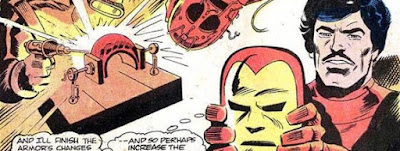

I am reminded of the infamous Iron Man nose incident. The story goes that Stan Lee, largely an absent figure from the Marvel Bullpen in the late 70's, saw some drawings of Iron Man and made some offhand comment about making sure there was room in the mask for his nose. No one can say for sure what he said, but what he meant was to make certain the flat plate of the mask didn't appear to shallow. But somehow that was translated into Stan ordering Iron Man to get a honker on his mask. The devoted Bullpenners followed and one of the great boners in all of comics appeared. Later Stan saw the nose, was appalled and the appendage soon vanished.


That's what it sounds like when folks in the New Zealand studios talk about Peter Jackson, as if his every syllable was pregnant with deep meaning evidence of long and careful thought. The ramshackle way The Hobbit was ultimately produced, sparing no expense and catering to every frolic, shows what happens when a  powerful creator has no one who can say nay. Notably Billy Connelly, who played a dwarf king in the movie seems himself to have little regard for Tolkien, a refreshing counter in a world in which the great writer is seemingly universally loved. What Connelly's attitude about Jackson is, is less clear. Connelly isn't on the dvd all that much either.


Like Thorin Oakenshield or King Thrandruill, Peter Jackson appears like a lord of the manor, sprawled akimbo in his lair (a fully-stuffed living room chair carried to each remote location despite its clear plush design) plugged into headphones or hidden behind wacky 3-D specs or both and the movie fragments unfold before him. He breezes into meetings and passes through departments offering up moments of time and ready opinions which trigger days of action, much of it going to waste as the whim which started it all doomed to pass.

Despite all its many many charms The Hobbit trilogy fell on its face, especially in the third part because no one could tell Sir Peter no. Two films was the limit of this story with space for all the necessary beats, but once the expansion to three became reality (and it became a reality according to the documentaries because the team ran out of time to finish the story properly in two parts) the story had sprawled beyond its proper borders and became something other, a passable entertainment, but not really an adaptation of Tolkien anymore. Hubris too played a part as the creators counted on their past experience and their new wealth to overcome the challenges they self-created, and then they were not able to deliver, at least not in the proper tone.

I don't say these things to be unduly critical of movies I genuinely appreciate and find interesting much of the time, but to say that in all things limits inspire creativity and problem-solving and a creator minus limits will by necessity create new ones as he or she just keeps on going. Writers need editors, coaches need athletic directors, movie directors need producers,  everyone needs someone to keep them in check, at least a little bit.


The Hobbit by J.R.R. Tolkien is in fact a story which is all about limits. But that's an irony which has eluded the Kiwis in their latest epic. I wish them well on the next project. I just hope it has nothing to do with Tolkien.We've all had quite enough.


 Rip Off

Tuesday, December 30, 2014

Forming Bad Hobbits!


Well that took long enough.

Last week I went to see The Hobbit - The Battle of The Five Armies. It was a long and visually rich film experience, but alas not one that succeeds as it ought. For the first time, I saw one of these new-fangled 3-D movies and frankly while it's a neat curiosity the texture of the movie seemed more like the flatness often translated on video tape; the luster of film was lost and along with it some of the essence of movie magic.


Anyone curious enough to read this review will be familiar with the story and likely the film series which began a few years ago with The Hobbit - An Unexpected Journey which re-introduced us to the realms of Middle Earth as first designed by J.R.R. Tolkien so many decades ago. We meet a youthful Bilbo Baggins who is drawn into a wild and weird adventure by the wizard Gandalf as he joins a company of dwarves who want to reclaim their lost kingdom from the deadly dragon Smaug.


In the second film The Hobbit - The Desolation of Smaug we finally get to the Misty Mountain and Bilbo meets the charming but deadly Smaug and the dwarves, led by the quixotic royal heir Thorin Oakenshield fight hard to reclaim their kingdom deep inside the mountain, but in the end they unleash the dragon who flies to destroy the nearby human settlement of Lake Town.

Spoilers below, so tread with care. 


The Hobbit - The Battle of the Five Armies begins with the struggle to bring down Smaug. I'm not ruining too much by saying this happens before the credits have properly finished rolling and that of course points glaringly to the greatest deficiency in this film series...it's just plain too long.

In a somewhat disdainful attempt to extract as much money from Tolkien fans as possible the decision was made rather late in the production to make the movie into three parts deviating from the original scheme to do only two movies. Given the source material, two seems ample and sadly if the original plan had been followed I don't doubt we'd have had two very tight films which resonated strongly in the imagination. Alas what we have now are three movies with a host of virtues but which tumble along with overlong and somewhat vapid action sequences which only serve to weary the viewer and and drain the characters of their verisimilitude. No dwarf and no human could survive the falls these characters take over the course of the three movies, and that's a pity in the sense we lose interest in their physical fates.

In my earlier reviews of the first two movies, I decried the tendency for the action sequences to have a video game feel and regrettably this third one has even more of that sense. One fatal flaw in this concoction is the utter failure in creating a villain with which the audience can have any connection. Azog is a cartoon from the get-go a creature right out of a superhero comic who feels out of place in Middle Earth and is rendered so heavily that we can hardly ever detect any real human behind the portrayal.


The core of this final film is the fate of Thorin Oakenshield, who has been set up as the Aragorn equivalent in this story. The fact his fate is far less rosy than that which falls to the former Strider is thoroughly expected, but the road there is less emotionally involving than I anticipated. The sequence where he throws off the maddening avarice which threatens his soul doesn't work at all for me and seems a bit too weird. Allowing the actor to showcase the changes on his face without the hindrance of fancy digital visions would've served the story much better.

And that seems to me to be the nut. For all the blather, most of it I'm sure exceedingly earnest, the director and his team do not trust the source material. In an effort to mostly recreate the highly successful Lord of the Rings trilogy nearly beat for beat they constantly overheat the story elements of The Hobbit to accommodate that understandable but ultimately self-defeating goal.

We are saddled with a forbidden romance between races which never reaches a boil, we are given a journey through the shadows of a dark goblin-infested realm which becomes a frenetic footrace against the enemy but almost never achieves any sense of true peril, we are given a finale which as promised in the title features five armies, but alas armies so vast and clearly digitized that they lack the ability to draw out our compassion.


The sub-plot involving Gol Guldur and the Necromancer and his minions searching for the rings makes perfect sense when the flick is seen as a precursor to the later LoTR, but within the immediate story needs of The Hobbit they become distractions, as spectacular as they are. 

Where the movies most often succeed is in those elements of the story which are demanded by the source material and cannot by and large be tampered with. The encounter by Bilbo with Gollum is tense and properly paced, and his later verbal joust with Smaug is the highlight of all three movies.

Sadly the Hobbit himself gets lost in this last movie, despite several attempts to glue him into the proceedings. But in that respect at least it remains true to the novel in which as I recall Bilbo likewise disappears from the narrative as the battles rage, though for a far shorter time.


So ultimately The Hobbit trilogy stands as a remarkable fantasy adventure, with some really fabulous sequences which properly invigorate the creation of Tolkien, but which sadly trade on those creations to do more than they are capable of and remain valid to the spirit of Tolkien.

I find I like these movies better on DVD than in the theater where the visual spectacle bewilders as I try to maintain focus on the story. Perhaps my inevitable encounter with the movie again in a few months will make me warm to it more. That has happened to some extent with its predecessors. 

It's a shame the movies weren't better, but they are fine and entertaining nonetheless. Maybe in a few years Jackson will re-cut the movies and make them into a super-tight two parter which will allow the story to shine even brighter.

Rip Off

Friday, March 21, 2014

The Desolation Of Smaug!


I was a bit underwhelmed by the first intallment of Peter Jackson's epic adaptation of J.R.R. Tolkien's epic yarn about a wandering Hobbit and thirteen dwarves seeking ancient treasure.  Not because it wasn't impressive, but because to my weary eye it came across as more of an animated event than a real life movie. So I didn't rush out to see the second installment this past holiday season. I thought I'd wait for the inevitable DVD and just watch it then. That's a far cry from the burning enthusiasm I had for the original Jackson film trilogy which I anticipated with a ripe eagerness.


But with time on my hands and nice warming temperatures and a dry day, I thought I'd take it in at the local discount cinema. With soda and popcorn (each costing more than my ticket) in hand I settled into the well-used theater alongside a few others and watched what surprisingly turned out to be a rousing movie event. The computer generated elements were surely in evidence, but somehow seemed less apparent to my eye and so failed to draw me out of the adventure which picked up where last year's first installment left off.


Bilbo Baggins and his dwarf companions encounter Beorn the shape-changer, enter the horrible Mirkwood forest and confront the rather grim elves within, and make their way to Laketown, the domain of men at the foot of the Misty Mountain where Smaug came to drive the dwarves out generations before. They raid the dark halls and wake the dragon, a dangerous thing to do.


For a movie which lasts nearly three hours I found time flying by remarkably swiftly and was actually startled when the story ended, leaving me hanging for many months before I can discover the end. Of course we all know how it will end, but how we'll get there is the challenge Jackson has before him. He's created a rousing thrillride with this installment, less dependent on its Tolkien source material, but which does a goodly job of linking this tale to the earlier trilogy.


Good show indeed. I'm eager to see the end now, very eager indeed.

Rip Off


Monday, December 17, 2012

There And Back Again Movie Edition!


I went to see The Hobbit - An Unexpected Journey yesterday morning. Usually Sunday morn is a dandy time to catch flicks as it offers quiet reasonably empty theaters. Not yesterday. Despite a 10 AM start, there and the fact I went to the mundane 2-D presentation, there were still over a one hundred folks enjoying the latest trip to Hobbiton and beyond with me.

I have to confess going this time was more a chore than a joy. I was giddy to see the first of the Peter Jackson adaptations over a decade ago, going opening night and braving giant crowds. This time, I mostly wanted to see it before reviews spoiled it,  to get it out of the way so to speak. I've not been happy since I learned there are going to be three of these things. I fear we're going to see a trio of bloated narratives, dragging in all manner of off the rack material. A scrupulous adaptation of the Tolkien classic would make for two reasonably sized flicks and would add nicely to what  the New Zealanders have already accomplished.

The Good --

Hobbiton is beautifully rendered, and it was was scrumptious to visit this exceedingly cool mythical hamlet again. The scenes of the group tramping across the countryside astride their ponies were beautifully done, really communicating the essence of Tolkien for me. The balance between the unusual and the beautifully mundane is perfectly balanced in these scenes. Riddles in the Dark is outstanding, precisely true to Tolkien as I remember it at least. I'm not a huge Gollum fan in these movies, finding him at times very tedious, but he works here as well as he ever has. The technology supports the performance here wonderfully. Likewise with the Wargs which look really menacing.

The Bad --

It's not the filmmakers' fault, but thirteen dwarves is a challenge for anyone. It is a downright "avalanche" of dwarves. There's no doubt in my mind that if Tolkien's book was not so beloved, a typical adaptation would lower the number of dwarves to six or seven at best. But stuck with the original mob, Jackson and company try to make them distinctive, though we fail to get proper introductions to many. At least they are visually distinctive. It's almost impossible though to keep track.

The Ugly --

Unfortunately for this movie and I fear for the franchise, the development of "performance-capture" has "captured" this movie. For me the triumph of the earlier movies was that it made the world of Tolkien's Middle Earth real. It grounded the fantasy into a place and time, adding some blood and thunder to the proceedings. But that alas is lost in this tale which all too quickly reduces itself to a video game as animated figures cavort and crawl across the screen. The action is sweeping and dashes along spritely, almost too quickly to process. The damage the heroes suffer is epic and alas cartoonish. The realism of the early epics is lost, much to detriment of the heart of the project. The scene with Gandalf, Saurmon, Elrond, and Galadriel in the middle of the movie seems downright quaint as we have four normal sized people in a regular real-world room talking. This scene actually jars a bit since so much of the movie before and even more so after is overwrought with special effects. They're exquisitely done I'm sure, but  they undermine the reality of the experience for me.

The Final Analysis --

All in all I'd give first Hobbit movie a middling to low grade. It's got some very strong stuff. A good Bilbo, a great Gandalf, some few interesting dwarves, and some beautiful countryside. But the movie is its own worst enemy ironically since it's technology which is sundering the essence of Middle Earth, the very thing Tolkien moaned about so vehemently.

Rip Off

Monday, November 26, 2012

The Adventures Of Tintin!


My only "Black Friday" purchase was a copy of The Adventures of Tintin which I found cheap at Target. I never got around to seeing this in the theater and as it turned out that was a blessing for two reasons.

One reason is that the "camera work", the blend of motion capture they used to "film" this movie and the lush special effects made me somewhat dizzy in places as the spinning point of view was really a coaster ride at times. It's impressive, very impressive in a major action sequence toward the end of the flick,but  it was a tad annoying early on.

The second reason was that my daughters watched this delightful movie with me. It's the first movie all three of us have watched in years, and certainly the last all three of liked. They enjoyed it, found the characters clever and the action sufficient for their tastes.

I do think the story begins a bit coldly, with not enough set up, and after a bit of explanation by me my girls were plugged into the action nicely. But a typical viewer needed a bit more explanation early in the movie to establish the characters of Tintin and Snowy. It's not revealed that he's a reporter for quite a while, so his motivations seem odd at first. Also some of the faces seem a bit too weird at times, the translation from the abstract of the original art to the more realistic not completely successful in places. 

Captain Haddock was a favorite with all of us. The balance between humor and adventure was nicely handled all the way through, with enough deadly moments to make the action sting. The sweep of the story was excellent, growing as the plot unfolded. The range of settings was remarkable, and did not disappoint. The transitions between scenes were often downright brilliant.

All in all a dandy movie. I hear they might do more, and that's something to look forward to. Perhaps my girls and I can enjoy those too eventually.


Rip Off