Showing posts with label Fritz Leiber. Show all posts

Saturday, April 5, 2025

Dangerous Visions!


I've finally done it. I've finally read all of the 1967 anthology Dangerous Visions edited by the rambunctious Harlan Ellison. For science fiction fans of a certain age this is who's who in the field. It's a crossroads of sorts with plenty of classic names from science fiction's "Golden Age" such as Asimov, Del Rey, Sturgeon, and Pohl. And fresher faces who went on to become a new generation of renowned talents such as Spinrad, Zelazny and Delany. And lots of talents who fall in between such as Farmer, Knight and Dick. The collection garnered two Hugos and two Nebulas for the stories within. Not a bad showing at all for novice editor Harlan Ellison.  

As much as I enjoy Ellison's fiction, I think I prefer his nonfiction better. And this collection offers up some dazzling little essays introducing the various talents. His snark is full on display as he praises and pinches the writers within. Those who are his friends get especially sharp barbs. Each story is also accompanied by an afterword from the author. They range from a single sentence to much larger reflections. 


Here is the table of contents: 

"Foreword 1 - The Second Revolution" by Isaac Asimov'
"Foreword 2 - Harlan and I" by Asimov
"Thirty-Two Soothsayers" (Introduction) by Harlan Ellison
"Evensong" by Lester Del Rey
"Flies" by Robert Silverberg
"The Day After the Martians Came" by Frederick Pohl
"Riders of the Purple Wage" by Phillip Jose Farmer (Hugo for bet novella)
"The Malley System" by Miriam Allen de Ford
"A Toy for Juliette" by Robert Bloch
"The Prowler in the City at the Edge of the World" by Harlan Ellison
"The Night that All Time Broke Out" Brian W. Aldiss
"The Man Who Went to the Moon -- Twice" by Howard Rodman
"Faith of Our Fathers" by Philip K. Dick
"The Jigsaw Man" by Larry Niven
"Gonna Roll the Bones" by Fritz Lieber (Hugo and Nebula for best Novelette)
"Lord Randy, My Son" Joe L. Hensley
"Eutopia" by Poul Anderson
"Incident in Moderan" and "The Escaping" by David R. Bunch
"The Doll-House" by Hugh Jones Parry
"Sex and/or Mr. Morrison" by Carol Emshwiller
"Shall the Dust Praise Thee?" Damon Knight
"If All Men Were Brothers, Would You Let One Marry Your Sister?" by Ted Sturgeon
"What Happened to Auguste Clarot?" by Larry Eisenberg
"Ersatz" by Henry Slesar
"Go, Go, Go, Said the Bird" by Sony Dorman
'The Happy Breed" by John Sladek
"Encounter with a Hick" by Jonathan Brand
"From the Government Printing Office" by Kris Neville
"Land of the Great Horses" by R. A. Lafferty
"The Recognition" by J. G. Ballard
"Judas" by John Brunner
"Test to Destruction" by Keith Laumer
"Carcinoma Angels" by Norman Spinrad
"Auto-da-Fe" by Roger Zelazny
"Aye, and Gormorrah" by Samuel R. Delany (Nebula for best short story)

I haven't the inclination to review every story. But some that stood out were "Eutopia" by Anderson, "The Happy Breed" by Sladek, "Test to Destruction" by Laumer, "The Night that All Time Broke Out" by Aldiss, and "Evensong" by Del Rey. I found all the stories enjoyable in their own way, but I will have to say I'll need to read "Riders of the Purple Wage" by Farmer again to fully grok it. The stories were selected because in most cases they pushed boundaries at a time when boundaries desperately need to be pushed. (Actually, they probably need to be tested all the time.) I wasn't shocked especially by any story, but I'm reading these tales in 2025, over half a century from when they were concocted and first published. That the stories feel fresh at all is a triumph for the collection, but perhaps a sad commentary on society. 


As tall peak as Dangerous Visons was, it's sequel Again, Dangerous Visions is even more daunting. I've already dived into it and expect a report when I get get through with it. That's going to take a spell. 

Rip Off

Tuesday, November 19, 2024

Jack H. Harris Presents Equinox!


See if this plot sounds familiar.

Four teenagers head into the country for some fun and relaxation and end up at a cabin in the woods which comes under attack by the dark forces of Hell. The youngsters fall victim one by one to the various attacks which include intruding monsters and demons who invade the spirits of the kids themselves. The violence seems to be centered around a mysterious book filled with ancient lore. Eventually all the kids succumb save one who is left to tell the tale, though his ultimate fate has little doubt.


Generally speaking, that sounds a lot like Sam Raimi's Evil Dead movies. But it's not a description of those, rather it's a brief overview of the movie Equinox. This movie began as an amateur effort put together by Dennis Murren and other talented special effects "Monster Kids" and some aspiring young actors (including a future Rose Parade queen and Frank Bonner star of WKRP In Cincinnati). 


The movie tells the story of penetrating a barrier to Hell. They even got Frtiz Leiber, the famous science fiction and fantasy author and creator of Fafhrd and Grey Mouser, to do some acting work in this one. Forry Ackerman shows up in a voice cameo.


The movie was completed on weekends with minimal equipment and rough stop-motion effects and then sold to a local producer named Jack Harris who got the cast together again and shot new material to make the film a bit longer for release. This resulted in two versions of the movie, the later one with more overt sexual content. The movie got released into the theaters and has since become a cult favorite.


Some years ago Criterion Collections put together a somewhat pricey but a very entertaining package with both versions of the movie and lots of background information including interviews with the many of the cast members and the creators. It's a very nice collection and it might will be well worth the investment, especially for anyone interested in horror movies, stop-motion animation, or cult movies. This one has something for everyone who is not afraid to watch less than slick Hollywood production.

Next time Harris returns to his roots with Beware! The Blob.    

Rip Off

Monday, October 28, 2024

Fafhrd And The Gray Mouser Omnibus!


Despite the sales domination of Conan the Barbarian for many years from Marvel, other sword and sorcery properties discovered limited or little success in the market. They tried Thongor of Lemuria, Gullivar of Mars, and Elric of Melnibone. But never had they attempted Fritz Leiber's Fafhrd and the Gray Mouser, a series which had been adapted to comics once before by DC in the early 70's. Then in their Epic Comics brand they tried it out and brought back a much more experience and seasoned comic talent Howard Chaykin to do the writing. He'd been the artist on the early DC effort with uneven success and this time he was joined by the up and coming artist Mike Mignola and the respected veteran Al Williamson. And finally we see these two heroes as they should be in the four issue limited run titled Fritz Leiber's Fafhrd and The Gray Mouser.


The first issue adapts "Ill Met in Lankmar" and we see the duo pair up for the first time to carry out raids on the Thieves Guild of Lankhmar. Spurred on by their loves Vlana and Ivrian and no small amount of drink they invade the thieves sanctuary and confront the leader and his resident sorcerer. But they fail to realize that for an earlier attack they were already being targeted for sorcerous destruction, a destruction which tragically claimed the lives of their lady loves. Filled with vengeful rage they attack the Guild again and blood is shed in abundance. Overcome by grief and regret the freshly minted team vow to leave Lankhmar never to return.


The next issue gives us "The Circle Curse" in which we meet Sheelba of the Eyeless Face and Ningauble of the Seven Eyes and we find that despite their best efforts our heroes eventually return to Lankhmar after a long time wandering across the varied and dangerous landscapes of Newhon looking for some measure of solace.

"The Howling Tower" is a properly scary tale which starts with the duo led by native guide encountering ghosts on the plains of Newhon. A mysterious disappearance leads the two of them and later just the Mouser (when Fafhrd too disappears) to an ancient tower in which a weird menace presents itself. Mouser must become a wraith himself to help Fahrd put down the threat but they escape just barely and justice served to some extent.


"The Price of Pain Ease" is adapted for a second time by Chaykin and this time with the proper back story of loss which gives it the emotional depth to the tale that it requires. The duo are in a contest to claim the mask of Death itself for their magical mentors and must compete with the depraved Duke Danius for the prize.

"Bazarr of the Bizarre" has the Mouser fall victim to an other-dimensional marketing scheme which sells garbage but makes the customer convinced it is of great value. Not only is he being swindled but he is about to die when thanks to Fafhrd and the intervention of their mentors he is saved barely.


"Lean Times in Lankhmar" is a classic tale, perhaps the single finest in the canon and is adapted here with skill. Fafhrd and Mouser have fallen out (over how to spell Fafhrd's name it is suggested) and since have followed separate paths. Fafhrd has become a zealous acolyte of the god Issek of the Jug and Mouser has become the top enforcer for the gangster Pulg. The two come into some conflict when Pulg for his own reasons wants to put the pinch on the priest of the cult of Issek and a bizarre and peculiar set of circumstances lead to one of the better finales in all pulp literature. This adaptation is not as deft as the original Leiber text (a masterpiece) but it does a good job nonetheless.

"When the Sea King's Away" closes out the four-issue run with Fafhrd and Mouser seeking treasure and a bit of romance at the bottom of the sea. They snake their way down through a weird tunnel of air and find strangely attractive women but have to make a dash for their lives when the sea closes in.
We leave our heroes adrift in a small bark seeking as always new adventures. 


And that's a wrap for the team. Dark Horse reprinted these stories in 2007 and that's the collection I read this time out. It's surprising that in all the time that has passed there have been no other attempts to adapt these tales. Over forty years since the first try and twenty-five since the second. Whole generations have come since anyone's tried. But maybe they don't think they can do better. It would be hard. But we're not done yet. 
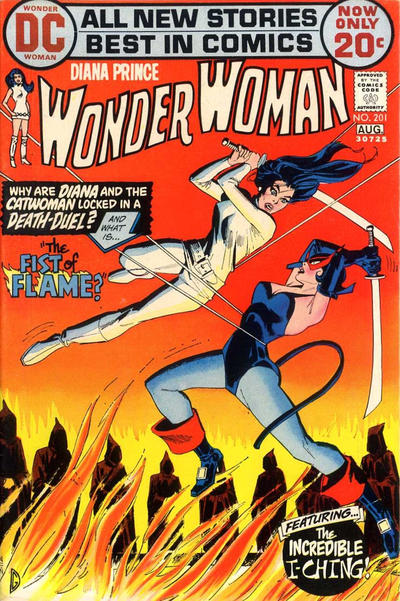

Not included in the collection but rather in another which put together the last of Wonder Woman's Diana Prince stories is the debut of Fafhrd and his pal the Mouser. The story is bit of windy one and in the first part Diana and her mentor of the day I Ching seek to rescue their sometimes partner Jonny Double from the clutches of I Ching's daughter who has kidnapped him to motivate Diana to steal a certain gem. This gem along with its other-dimensional counterpart opens a portal to the world of Newhon. The Catwoman is involved as any decent jewel their might be. At the close of the first part of the story by Denny O'Neil and Dick Giordano the portal is opened and Diana, I Ching and Catwoman find themselves at the mercy of two distinctive swordsmen.
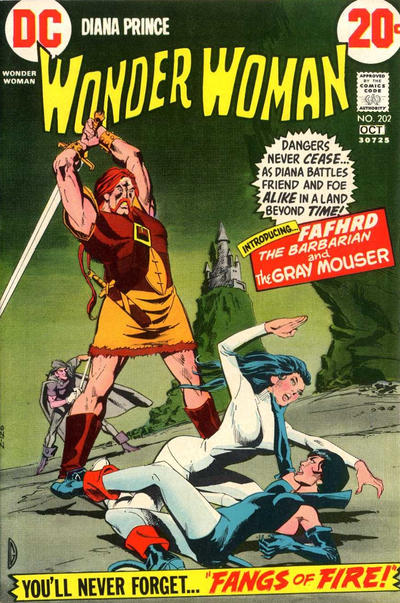

In the second part of the story Fafhrd and Gray Mouser introduce themselves properly and join forces with with our heroes (of a sort) to confront the menace and find a way back to Earth. The battle is at first between the comrades then shifts to the cavernous lair of a sorcerer and his weird machinery. This tale by Samuel R. Delany is magnificently drawn by Dick Giordano and at its end Fafhrd and Mouser find themselves in New York City (and not its Newhonian counterpart Lankhmar) but reject the noise, smell, and hubbub of modern machinery.


They want to return home and thanks to a jewel they still have they disappear. It's a rouser and sets up the series in a manner of speaking. Note that the series was called "Swords Against Sorcery" in this ad.


Under a lush action-filled cover by Mike Kaluta, the series dubbed Sword of Sorcery begins with an adaptation by Denny O'Neil and near novice artist Howard Chaykin of Leiber's "The Price of Pain Ease". This story is seriously clipped with the removal of the core tragedy which motivates the duo of Fafhrd and Mouser, the murders of their twin loves Vlana and Ivrian as a backstory.We get the raid on the Duke Danius and we get the mission by Sheelba of the Eyeless Face and Nignguable of the Seven Eyes for the mask of Death itself but without the underlying regret of those tragic deaths our heroes seem to lack a bit of motivation and sense they need to ease pain is all but lost. A young Howie Chaykin's artwork is merely adequate. and the storytelling is often clumsy with some truly peculiar character designs.
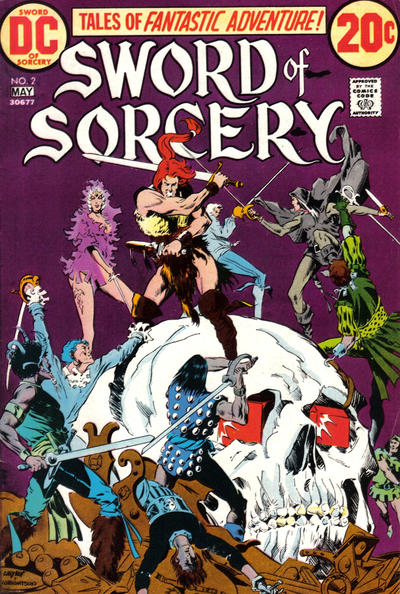

Things look a little bit better in the second issue under a Chaykin cover, this one inked by Berni Wrightson. The story O'Neil adapts this time is "Thieves House" and simplified though it is for comic book purposes most of the misadventure makes it to the page. The horror of the encounter with the bones of ancient thieves is largely lost but the action is ever present. Fafhrd and Mouser trade barbs and quips and they come across with the proper blend of adventure and satire which informs the stories themselves, but again missing the underlying gravity of lives suffering loss.
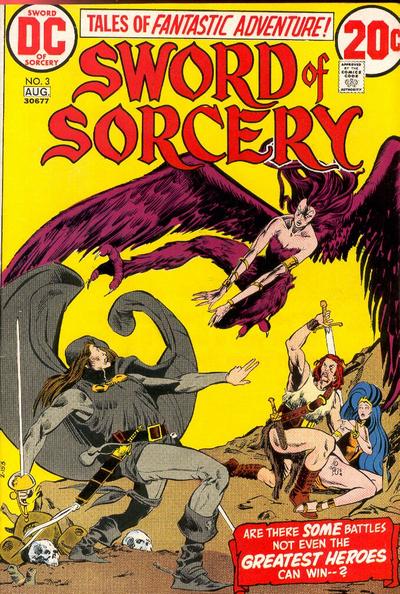

In the third issue we get an original story by Denny O'Neil and a new cover by Chaykin who is getting a wee bit better at the storytelling. We have our heroes waylaid by pirates who steal a girl. After some effort they find the one they thought did them dirt and discover it's more complicated. A beautiful and silent girl with magenta wings and feathers leads to the lout who killed their shipmates and they rescue the girl but find a surprise. With the aid of a dandy deck of cards they wind the day. At long last a death seems to impact the duo, but truth told this story seems to be missing a page or two in its finale. Not that reprint messed up, but I suspect the original dropped at least one page and it makes the end a tad clumsy.
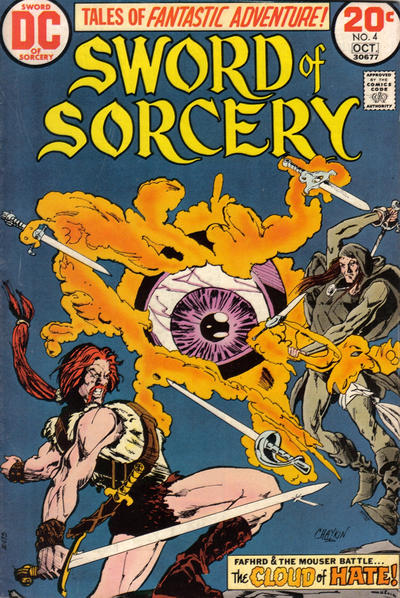

The fourth issue gives us two stories. The first is The Cloud of Hate, an early Fafhrd and Mouser story about a cult which uses a potent fog to enthuse pliable villains to turn to violence in the streets of Lankhmar. The story is simplified a bit but the core remains and our heroes find a solution.


The second story is a tale from the teenage years of Fafhrd himself and tells of his early romance with a blonde beauty and how a Snow Serpent seeks to steal her away. Fafhrd saves her by chance though a prophecy might've shown him the way had he been more attentive. Denny O'Neil's script this time was illustrated wonderfully by Walt Simonson and immediately it's obvious that he should have been at the helm the whole time.


Simonson takes over the lead story in the next issue when the classic Leiber story "The Sunken Land" is adapted by O'Neil. Fafhrd finds a magical ring when fishing and soon enough he and Mouser both run afoul of a no account who is seeking treasure when the hidden land of Simorgya rises from the sea. They get out with their skins barely when dark magic takes over as it usually does in these affairs.


A second story written by George Alec Effinger and drawn by Jim Starlin gives us a peek at the apprenticeship of Mouse (not yet grown to Mouser) and his training in subtlety by a knife artist named Shendai the Deft. This is dandy little tale and features a few cameos, one by a certain Cimmerian is appears. Nice exchange for the appearance of Blackrat and Fafnir in an early Conan story.
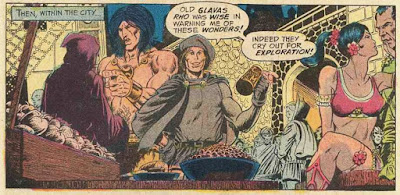
(Is that a certain Cimmerian in your background?)

This series was not a success in terms of sales. Five issues seem hardly a worthy outing but it was for a very long time the only adaptation of these heroes to comics until Marvel took a tumble in the early 90's. As for DC, they dived deep into the barbarian craze. More on that next month. 

Rip Off

Sunday, October 27, 2024

Fafhrd And The Gray Mouser - Book Seven!


The Knight and Knave of Swords is the final volume in the official canon of the Fritz Leiber's Fafhrd and Gray Mouser saga. The stories in this awkwardly named volume all appeared in the late 70's but mostly in the 80's. The saga continues to unfold as the duo have found a life of sorts for themselves on Rime Isle. Events of the last volume have not been forgotten by any means.


"Sea Magic" (1977 The Dragon)

Undersea goddesses seek to get back treasure which has found its way to Rime Isle and end up coming into contact and some clash with Fafhrd as he adjusts to life and archery with his new hook for a hand. 


"The Mer She" (1893 Heroes and Horrors)


The Mouser making a voyage for supplies, discovers an elusive mermaid and keeps her in his cabin away from the curious but prying eyes of his crew. It almost is the end of all of them as it turns out. 


The Curse of the Smalls and the Stars (1983 Heroic Visions)

Our heroes are stuck with strange curses. Fafhrd is obsessed with the big picture, staring endlessly into the maw of the night sky and elsewhere trying to drink in the landscape. Mouser on the other hand becomes weirdly focused on the tiny and spends his time looking always at that which is at his feet for fear he will miss some small detail. 


The Mouser  Goes Below (1988 first publication - portions first printed as "The Mouser Goes Below" (1987 Whispers) and "Slack Lankhmar Afternoon Featuring Hisvet" (1988 Terry’s Universe)

On Rime Isle, the Gray Mouser is sucked into the Earth and as he slides through the ground in a ghostlike fashion Fafhrd and the rest try to find him and dig him out before he is lost forever. It's a very near thing indeed as the race proceeds across the landscape of the island.


And that my friends is that. The adventures or perhaps more correctly called, "misadventures" of Fafhrd and the Gray Mouser come to a rousing end. Our heroes have aged and to some extent matured as life has taken its toll on them. They have found some measure of peace on Rime Isle with Afreyt and Cif, the women who brought them there originally as mercenaries and they along with some of their crews have made a home of it. They seem different men on the island, less full of themselves and more sensitive to those who have fallen under their care. Less like pulp heroes and more like real people.


There are more Fafhrd and Gray Mouser stories, specifically a novel written with Leiber's permission by Robin Wayne Bailey, but I haven't read it, and don't even have a copy. Maybe someday I'll get the urge to journey to Newhon again.

Rip Off

Friday, October 25, 2024

Conjure Wife!


Conjure Wife is Fritz Leiber's first novel. It tells the story of a relatively young college professor and his wife, who just so happens to be witch. She uses her spells and such to protect her chosen man and help him along in his career. When he discovers her little notions, he stupidly destroys them thinking them whims. Things immediately start to go bad in his life. It seems there are other witches in town, and they don't cotton to the new couple at all. 


The short novel was first published in Unknown Worlds in 1943. We meet Norman Saylor who is a professor of Ethnology at Hempnell College, a small school rife with the politics of the kind which are all too common in such places. He's considered a candidate for the head of the Sociology Department. His wife is the lovely Tansy Saylor who is five years younger, she'd been a student of his when they fell in love. It seems that in this universe all women practice witchcraft more or less to different degrees. Men are oblivious to these practices, and sadly as man I can attest that makes too much sense. When Norman finds the various totems and trinkets Transy uses to protect them, he foolishly destroys them and almost immediately his life is turned upside down. There is a threat to his life, a charge is made against him which is untrue, and his chances for the chairmanship dwindle when he makes some strong statements about sexual politics in his class. 


When Norman finds the various totems and trinkets Tansy uses to protect them, he foolishly destroys them and almost immediately his life is turned upside down. There is a threat to his life, a charge is made against him which is untrue, and his chances for the chairmanship dwindle when he makes some strong statements about sexual politics in his class. 


Tansy and Norman fail to communicate, and his lack of belief causes him to constantly seek logical answers to the strange events which increasingly surround him. There are more and more intrusions into their lives as he begins to believe, but then realizes he's rendered himself an easy victim to whatever is moving against hm. When Tansy at last begins to take direct action, it becomes a potential tragedy. 


This is a remarkable story, told by a master who keeps us inside Norman's experience and makes us feel his indecision and ultimate dread. At a critical moment he is called up on to act and the consequences of this actually made me gasp. That's what stories like this want to do, affect the reader, to draw us into the world the author fashions and makes us feel the same love, fear, or this instance terror that informs the characters. A zombie tale with a twist. Remarkable story. 


The novel was adapted to film three times. Weird Woman from Universal is an entertaining if not particularly faithful adaptation in 1944 of the Fritz Leiber story and features Lon Chaney Jr, Anne Gwynne and Evelyn Ankers. The story is hurt by the glossy studio presentation of the rituals, which needed a rougher treatment in places. The girl that played the witch-wife was too white-bread to sell the exotic nature of the tale; the poster makes her seem way scarier than anything in the movie itself. There is some really fine acting in this one, especially by Elizabeth Russell in a part that could have been far less in other hands. Evelyn Ankers is a real stand out and gleefully evil as the scorned woman, and her ultimate scene is pretty offbeat and strange. One big drag on the movie is Lon Chaney Jr. who is woefully miscast, but he was the face that sold the tickets. The most idiotic guy you've even seen on screen is constantly called brilliant by other characters as he did one dumb or insensitive thing after another. 


The story of Conjure Wife was adapted to the screen again in 1962 under the title of Burn Witch Burn, and is also known as Night of the Eagle. This minor classic features a screenplay Richard Matheson and Charles Beaumont and stars Peter Wyngarde and Janet Blair. It's got a damn fine poster, that's for sure. The movie itself is crisp and like most all the British flicks I see, filled with excellent actors. Peter Wyngarde is great as the self-righteous husband who demands that his wife see the world as he does, with relentless logic. Janet Blair is outstanding as Tansy, a thoroughly modern woman who just so happens practices a little witchcraft when her busy and ambitious husband is away. This moody effort is easily the best of the adaptations, making changes necessary to keep a sharp ending. The use of an eagle as an avatar of evil didn't rally track with me and scenes featuring the creature are the weakest in the production. The use of a recording tape is used as a fetish, not unlike those elusive slips of paper in Night of the Demon

There was an early television adaptation of the story on the defunct DuPont Network in 1960 under the title Conjure Wife. I've not seen it and I've found almost nothing online about it.  I'd love to know more, and I welcome any corrections. 


The story was adapted a fourth if unofficial time as Witches Brew or Which Witch is Which in 1980. This outing stars Terri Garr and Richard Benjamin and is Lana Turner's final film. I've read this is supposed to be a comedy, but it's a strange one. The movie has the feel of an Indy film at times, with some clunky sound design. It's edited rather oddly too, keeping a too slow pace. We end up looking at some scenes way too long. At other times we are told the story in brisk effective short cuts. There were two directors on this one and I bet that accounts for the uneven atmosphere. Benjamin and Garr are the college couple in this one and he knows she's a witch but just gets tired of it. She gets rid of her stuff and all hell breaks loose. An angry student even becomes a sniper to take him out, but this side-plot is poorly developed. Lana Turner is great as an older witch looking to improve her lot in life and scoping out Terri Garr to help with it. The most surprising moment is an actual stop-motion flying demon. That's not in the novel. Fritz Leiber's name is never referenced, though some aspects of this movie are the closest of any of the movies. 

This is grand stuff for the Halloween season. I highly recommend the book and even the movies are well worth seeking out. You can read the novel here

Rip Off

Wednesday, October 23, 2024

Fafhrd And The Gray Mouser - Book Six!


Swords and Ice Magic is the first collection I bought when it first appeared. In fact some of the stories I'd read as they'd appeared in various collections and magazines. As Fritz Leiber created more installments in the Fafhrd and Gray Mouster saga during the 70's they eventually reached a critical mass where a new collection was necessary.  There is a certain lack of substance to many of the early stories here, but it gets better.


"The Sadness of the Executioner" (1973, in Flashing Swords! #1, ed. Lin Carter)

The gods plot to end the lives of Fafhrd and the Gray Mouser but our heroes are too much for them. 


"Beauty and the Beasts" (vignette 1974, in The Book of Fritz Leiber)

Fafhrd and Mouser try to split a girl between them and end up with two villainous swordsmen. 


"Trapped in the Shadowland" (1973 Fantastic)

Our heroes look for lost loves in the land of death and find them thanks to Ningauble and Sheelba.

"The Bait" (vignette 1973 Whispers)

In a story which seemed very familiar the two heroes argue over a maiden who ends up becoming two warriors. 

"Under the Thumbs of the Gods" (1975 Fantastic)


The Gods have another go at our heroes as they relive some of their adventures, meet old loves, and learn new lessons from them. They also encounter oh so briefly Alyx the Picklock, a creation of Joanna Russ. I recently read a story by Russ in which her heroine Alyx muses on a lover she had who remind anyone familiar with Leiber's material of a certain red-haired barbarian. Fun little crossover it seems.


"Trapped in the Sea of Stars" (1975 The Second Book of Fritz Leiber)


While on a voyage of forgetfulness, the two heroes end up in a distant sea near the equator of Newhon which blends seamlessly into the very night sky itself. 


"The Frost Monstreme" (1976 Flashing Swords #3, ed. Lin Carter)

Fafhrd and the Mouser begin a new stage of their lives when they are hired by two determined and hard-minded and very lovely ladies named Cif and Afreyt of Rime Isle to gather warriors not unlike themselves and protect that distant land from pirates on a monster ship.  


Rime Isle (1977 Cosmos SF&F Magazine)

Still on Rime Isle and far from Lankhmar, Fafhrd and Mouser find some measure of love and a tiny jot of satisfaction as they appear almost to settle down. Two oddly familiar gods create no end of trouble for the often ungrateful and singularly avaricious people of Rime Isle and our heroes in particular. There is real cost as the threat to life and limb proves very real indeed. 


Aside from the Rime Isle material here, there's a lightness to the storytelling which to some extent undermines the adventures of our heroes. The threats they face are so vaporous that it's difficult to imagine them being under any threat at all. Leiber seems to want to treat his characters with an awareness of their literary reality which invades the stories and frustrates to some extent the suspension of disbelief. The first several stories lack any real depth and at least two of them seem to be two goes at the same yarn, a strange thing to include in a single volume.


But with the journey to Rime Isle that frothy approach settles down, and in a territory more intentionally realistic the heroes find real threats and consequently the ability to demonstrate true bravery.  We are able to care about them again as they seem really to have lives which seem to be grounded in a recognizable reality.


There is one more Sword to go.

Rip Off