I'm not aware of anyone who doesn't admire the work of Russ Manning. Manning created a sleek handsome future world for
Magnus the Robot Fighter, a world which was visually sometimes at odds with the dangerous threats it faced from too much reliance on technology. He'd broken in on
Brothers of the Spear and made himself an international star with his definitive work on
Tarzan of the Apes. So when the
Star Wars folks wanted to take their stripling concept and expand it onto the funny pages, they found the ideal translator in Manning.
Manning was in complete command in the beginning, partly because that's the way he preferred to work and partly because the behemoth that was to become the Star Wars machine was still forming. Eventually they decided they needed to pre-approve things and at that point Manning gave up writing the strip though he continued to draw it.
There were three stories during the Manning-only period, the most famous of these is likely "Gambler's World" which ran in the daily strip and introduced a new villain named "Blackhole". Given the understandable mandate that none of the real status quo of the series could be affected, the story has a frivolous quality to it which was not to my mind in keeping with the Star Wars feel, but there's no denying Manning's skill at capturing the characters likenesses.
In the Sunday pages two other Manning-only efforts ran and they were both more like the movie. They introduced a new character named Gyla Petro who was at once a minor romantic interest for Han Solo and someone for him to talk to since he couldn't have both Luke and Leia at the same time in the series, one of the early restrictions on Manning. Han and later Luke shows to help save a culture from Empire and later we get a glimpse of Wookie culture.
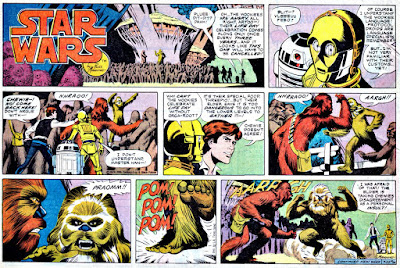
At that point Steve Gerber of Howard the Duck fame steps aboard for an adventure which takes Luke back to Tatooine. It's probably my favorite of the stories as it really evokes the classic feel of the movie. A writer named Russ Helm comes aboard with a few stories and later Don Christensen writes a few. By the time it's over we've met some really interesting new characters such as Lady Tarkin (loved Peter Cushing in the movie and liked seeing him remembered here). Even Boba Fett turns up to make things hot for the trio as that embargo seems to have been lifted at some point.
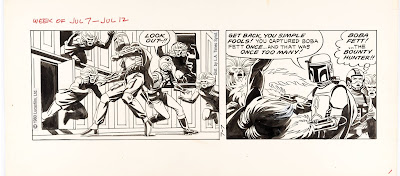
When Manning fell ill his assistants Dave Stevens and Rick Hoberg take the helm for a short transitional period and then the duo of Helm and new artist Alfredo Alacala take over. Now I'm a huge Alacala fan, but he was not well used here and the last strip in this collection is several notches in quality below the rest. The sleek futuristic lines of Manning have been replaced with Alfredo's heavier touches and not to good effect and I have to wonder how much reference Alcala had since the characters look very different and only vaguely like the movie stars they represent. It's a tragedy indeed that Russ Manning died so young.
It's almost unimaginable to me that the work of Russ Manning, an artist who I regard as among the most amazing in comics could be topped on a project. On Tarzan when Joe Kubert came along, he made the character his own and his version didn't seem to compete with Manning's more modernized sleeker Ape Man. But on
Star Wars one has only to glance at the work Al Williamson using the characters and settings of the George Lucas classic movie and you know instantly that it's the ideal pairing of an artist and a project.
Apparently Archie Goodwin and Al Williamson tried out for the strip in the very beginning and seeing the samples reproduced in this collection it's hard to imagine how they were immediately hogtied and forced to take it on. But it didn't happen and Russ Manning ain't no one to sneeze at. But Williamson's adulation of Alex Raymond and the way he took that and other influences to make his own idealized artwork made him the perfect match for the Lucas film, because he and Lucas were coming from the same source though by two different tributaries. Williamson used the original Flash Gordon comic as inspiration for much of his work and Lucas tapped into the zeitgeist of the serials that used Flash as its subject matter. Two craftsmen who looked to the past to make the future.
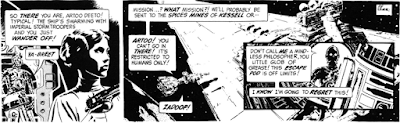
And Archie Goodwin ain't no slouch. The respect he garnered universally across the comic book field in his capacities as writer and editor is nigh near unique. No one seems not to have liked Archie Goodwin, and having been in jobs where he was forced to tell folks things they didn't like to hear that's incredible to imagines and points to a sincerity and competence that was evident to his peers instantly. I will worship him until I pass for his creation of
Manhunter with Walt Simonson, and I fell in love with him in the first story I read by him in the pages of Iron Man. The skill was just evident, even to my boy's eyes and he has always been a talent I followed from that time forward in comics. I never really knew of his simultaneous career in comic strips all that much, to my regret.
But this collection begins with an adaptation of a novel by Brian Daley titled
Han Solo at Star's End. It's scripted by Goodwin but drawn by Alfredo Alcala. Now let me be clear here, the work of Alcala is astounding and his pages and pages of barbarians and damsels and such are wonders in details and construction. He's a master, but his work on
Star Wars is right terrible. He doesn't get the costuming right, his version of robots is all wrong, and really it's quite disappointing.
It was always a delicate matter about these films and the secrecy that surrounded plot points. So, it's no surprise that even after the arrival of
The Empire Strikes Back that Goodwin and Williamson told tales set between the two tent pole movies. It's safer all around and adds to the luster of the Star Wars universe. In the modern-day internet mini-episodes and comic books act as preludes and enriching events in conjunction with a show in real time, such they did with
The Walking Dead and
Star Trek in recent years. But in the early 80's such organized storytelling was not common at all, but then licenses were just becoming a booming business, the whole far more lucrative than the sum of the parts.
The third volume collects up all the remaining Star Wars comic strips produced before the strip ended in 1984. Archie Goodwin and Al Williamson are on hand throughout the process and generate stories of a singular mature character that fill-in the several years between the end of the debut Star Wars movie and the first sequel The Empire Strikes Back. The strip never deals with the tumultuous revelation by Darth Vader that he is Luke Skywalker's father. The romance between Leia and Han Solo is left on a low simmer. Many of the stories are cannily written with the knowledge of the movie The Empire Strikes Back and toward the end the final film Return of the Jedi, but at no point are the storytellers allowed to drift into the core themes of the epic.
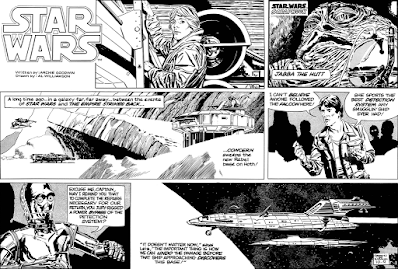
As with any saga in which the ending is known to some degree, a suspense and tension is difficult to manage. I'm thinking the long years of Conan the Barbarian comics written by Roy Thomas filling in gaps in the published Robert E. Howard adventures. The trail can be a winding one, filled with danger and doubt, but always we know that eventually we will end up in a recognizable spot. Star Wars the comic strip is never allowed to reach that recognizable spot, though they do a pretty good job of it in the end with the use of the planet Hoth as a setting.
Williamson didn't work on the artwork alone on this strip this time, getting help from his friend and studio mate Carlos Garzon. In later storylines artists such Tom Yeates and Brent Anderson, both working over Williamson layouts. The artwork in the series is the thing that makes it sing, it's absolutely divine, an ideal matching of talent and subject. The strip ended in early 1984 having told the story it was allowed to tell, and telling that story in a beautiful way.
Rip Off