Showing posts with label Michael Fleisher. Show all posts

Thursday, March 20, 2025

Barbaric Adventures Of Ironjaw!


Michael Fleisher wrote a truckload of comics for DC and Marvel in the 70's and 80's. He also was a key writer in the brief burst of activity which erupted under the name of "Atlas-Seaboard Comics" in the middle of the 70's. How he came to be a mainstay of that momentary company is a curious tale. Another reliable and exceedingly visible talent from that era was Pablo Marcos.


I found some of the story here in an interview from The Amazing World of DC Comics with Joe Orlando. Orlando confirms what I already knew, that Iron Jaw began as a pitch to then editor Orlando from Fleisher.


What I didn't quite realize, was that Fleisher got the chance to pitch the idea of a sword and sorcery Jonah Hex/Conan the Barbarian to DC because of his tenure on Sandman. This version of Sandman was the final pairing of the team of Joe Simon and Jack Kirby. After the first issue, Simon and Kirby went their separate ways, but sales reports suggested there might be life in the Sandman concept. But the classic team was no longer available and so Michael Fleisher and Ernie Chan were pressed into duty. 
 

Anyway, after the relative success of this effort, Fleisher was given a chance to pitch, but was told first to check out the Ironwolf comic in Weird Worlds. What that contributed to the final product aside possibly part of the name is speculative at best. But for whatever reasons, after all that Orlando rejected the Iron Jaw concept and gave Fleisher the freedom to shop it around. He did, sold it to Atlas-Seaboard where it became a bit of a flagship book for that company.


Meanwhile at DC, Orlando green lighted another sword and sorcery project, Claw the Unconquered by David Michelinie and the aforementioned Ernie Chan. By the time though that book hit the stands, the Iron Jaw run was nearly over at Atlas-Seaboard. What took so long I wonder? So, in the elaborate tapestry of history, we find that Joe Simon and Jack Kirby indirectly gave rise to a project at the heart of yet another publishing effort (however brief) by former Timely and Marvel comics publisher Martin Goodman. How utterly strange.
 

Below you'll find the entire story from Atlas-Seaboard's IronJaw #2. It features a fantastic Neal Adams cover (his second after a stunning effort on the debut issue), of which there are two versions, and some incredible Pablo Marcos artwork, here in its original raw, lush form. IronJaw was as close to a flagship title as Atlas-Seaboard had and this is the best issue of the brief run. (I think Marcos looks best in black and white.) The blood and thunder of Michael Fleisher's brutal and blunt barbarian rings through over and over this violent tale. I can almost smell IronJaw in this epic -- and believe me that's not a good thing. 


But before you dive into this feast, take a moment if you need to read the set up for this story, continued from the debut issue. "The World of Ironjaw" (from issue #1) sets it up very nicely.


Pablo Marcos was an artist who was able to communicate great power in his work, and these pages showcase that wonderfully. 


IronJaw went on to star in two more issues in his brief four-issue run. Though those four issues were epic in terms of the Atlas-Seaboard line. He also was the only character in the Atlas-Seaboard line-up that I can think of who headlined a second comic, this titled Barbarians featuring IronJaw. He seems clearly to be one of the tentpoles the company wanted to build around if they had remained solvent. 

This Post is a Revised Dojo Classic. 

Rip Off

Monday, June 3, 2024

Atlas-Seaboard Comics - June 1975!


June was a pivotal month for the fledgling comics company known as Atlas. The change made in the editorial direction of the company was seen in the color comics, as Larry Lieber stepped forward and took control of the whole line following the departure of Jeff Rovin. Before this, the two men had split the color books with Leiber focusing on the genre books. Now all the books got some new talent and new directions. The fragmentation of the line is becoming evident.


PHOENIX #3 offers the latest episode in the life of astronaut-turned-messiah/superhero Ed Tyler as he attempts to solve the dilemma of a distant village overcome by Abominable Snowmen. He finds a destroyed village with a single survivor, an old man, and proceeds to find the rest of the missing folks. That brings him into conflict with the Snowmen and their creator and master Lucifer. Lucifer it turns out is something of a rogue Deiei, who resembles the classic image of Satan quite closely, and who is now free to pursue his inclinations since Phoenix has largely destroyed the Deiei bases on Earth. Needless to say, after much hoopla, and one sacrifice, the village is saved, and Lucifer is frustrated. The story is by Gabe Levy with more worthy artwork by Sal Amendola. Frank Thorne does the cover.


The second feature of the book is DARK AVENGER and it's a reasonably well-crafted tale of urban crimefighting and offers splendid Pat Broderick artwork. A young man finds a mysterious metal, is able to transform it into a suit and so finds himself with a wonderful superhero gimmick. That such a fellow with so vivid an imagination and so specific a set of skills is still living with his mother and brother is arguably the strangest thing about this little one-off story. It's a bit like Spider-Man meets The Katzenjammer Kids, but lots of folks really like this story.


DESTRUCTOR #3 gives us another installment in this ongoing Archie Goodwin - Steve Ditko epic saga. Gone this issue is Wally Wood, and the artwork seems to have been inked by Ditko. I don't know about that. The story continues with the Destructor still battling thugs from the Combine, but this time under the direction of Dr. Shroud. He sends the Huntress and her attentive sidekick Lobo to take on the Destructor, and they trap him in an elaborate casino/canyon (you've really got to see this one to understand that). Because the thugs fight among themselves, the Destructor lives to fight another day. One thing about our hero, he's certainly presented as a cool character who is willing to sacrifice others to achieve his goals. The anti-hero is popular with Atlas, but in many respects Jay Hunter is the purest example of the disaffected modern protagonist.


TIGER-MAN #2 is a real change of pace issue. Steve Ditko takes on the hero and gives him a really dynamic energy he was missing in the earlier chapters. Gerry Conway takes the writing helm, and Tiger-Man seems to become a more conflicted hero, more concerned with the lives of his enemies. He encounters the Blue Leopard, a man empowered with the same talents as himself yet set on a revenge mission against Dr.Hill, the Tiger-Man. There's more than a few clues to suggest the Blue Leopard is a Black Panther clone, with several origin details in common with Marvel's kingly hero. Lots of good fight scenes in this one, and a grand Frank Thorne cover.


TARGITT #2 gives us another story in John Targitt's ongoing war on crime. This issue gives more Howard Nostrand artwork, but the story told in flashback, relates how Targitt is transformed into an undercover FBI secret agent and gives him a uniform to perform his missions against the mob. There's lots of action and mayhem, and the story is reasonably diverting if not particular inspiring. Like the Dirty Harry movies that inspired this comic, there's an ongoing fascination with guns that seems to actually drag the storytelling down a bit.


POLICE ACTION #3 gives us two more crime dramas. LOMAX battles a hotdog vendor turned hitman, and eventually gets his man. Mike Sekowsky does another fine job with more McWilliams inks. LUKE MALONE finds himself drawn into a rock star's murder scam and eventually he uncovers the plot of this thinly veiled swipe of Alice Cooper. Despite an energetic Frank Thorne cover (Noticing a trend on cover art?), the comic seems to be losing its steam a bit, and just in time, because this is the last issue.

And now the new stuff...


THE BARBARIANS #1 gives us a new IRONJAW story, and its an okay effort with Pablo Marcos art and Gary Friedrich story. Under Mike Fleisher Ironjaw was a grim realist, but now there seems to be a desire to make him more heroic and sympathetic. It's poorly considered. In this story Ironjaw fights some barbaric mutants, and to my surprise befriends them. Sheesh! The second feature is a real strange one called ANDRAX. This story seems to be an import and offers the beginning of an epic saga of a young Olympic athelete captured by the obligatory mad scientist and sent (by unexplained means) into the future where the scientist is sure the man's will and stamina will make him a king among the weak future-men. All the newly dubbed "Andrax" finds is a wasteland and soon he's fighting for his life. It ends with him seeking other people. It's a well-drawn story, but has a distinct European feel to it.


FRIGHT #1 gives us the beginning of the SON OF DRACULA story by Frank Thorne on art. It's a rambling story, and involves mild incest and more than a bit of coincidence to concoct a complicated situation that finds a young college professor possessed of the curse and the power of Dracula himself. It's not a bad story, just a confusing one as origins can tend to be. The story sets up a man who seems to be both the hero and the villain of the story, despite his better intentions. This book is the only issue of Fright, and the only story about the Son of Dracula I'm familiar with.


HANDS OF THE DRAGON #1 might just be the strangest new addition to the Atlas-Seaboard lineup. This story with Jim Craig artwork gives us a no-holds origin story which has elements of vintage Silver Age Marvel, along with more recent Bronze Age Marvel and a whisper of old Charlton. The book appears to be (and is) a rip-off of Master of Kung-Fu. But the story is really more a clone of the Iron Fist saga with some exploding atomic bombs thrown in to give several folks some superpowers. Two twins survive the blast to be raised by their grandfather in a monastery where one brother grows to become evil (he also was scarred by the blast though he never really looks like it) and the other becomes our hero "Dragon". There's also a villain called Dr.Nhu who corrupts the brother who eventually gets the name Ling the Cobra. It's a complicated story with a few too many elements thrown in. One gets the feeling the script and the art aren't a perfect match, and that the book was drawn with a somewhat different plot. Another detail is that perhaps the Dragon's outfit was originally to have been green. Despite his very MOKF look, one caption describes him as a green figure. I figure that change was made both to take advantage of Shang-Chi's success and avoid too obvious a comparison to Iron Fist. The story ends with an assassination plot foiled and the Dragon vowing to stop his brother. We never find out what happens as this book too ends with its first issue.


And then there's always VICKI #3. 


The wheels are coming off the Atlas-Seaboard machine. The changes are clear attempts to gather market, and much of the line's early character is disappearing to be replaced by less compelling material.

July will see lots of final issues, and even a debut or two. More next month.

Rip Off

Thursday, May 2, 2024

Atlas-Seaboard Comics - May 1975


May is a tiny production month for Atlas-Seaboard with only two, color comics wear a May date. IRONJAW #3 offers a tremendous tale by Fleisher and Marcos. Ironjaw, who in the previous issue rejected a kingship, finds his way back home to find his adopted father Tar-Lok. Tar-Lok is a grand character and his exchanges with Ironjaw are very entertaining. The two clearly have an affection for each other, but they won't lift a hand to assist each other before a price has been bartered. There are robbers, sheriffs, and serpent-headed cannibals in this wildly imaginative tale that introduces us to the Great Machine, the god that Ironjaw worships and has invoked repeatedly in the first two issues. Well  let's just say the "Great Machine" is a relic from our time and is actually a humble humbug managed by a corrupt cleric more interested in the collection plate than his flock. Ironjaw is shown to be a naive yet devout individual who ignores his father's advice to quit throwing money at his "god". This a well-paced self-contained story with energetic artwork and a very entertaining and funny script.


SCORPION #2 gives us another Moro Frost adventure by Howard Chaykin. This time there is voodoo and curses galore. The Ernie Colon cover isn't all that accurate of what goes on inside the book so beware. The story is another period piece, a bit confusing in places but filled with vivid characters and situations. The artwork is another group-project with diverse hands throughout. This is another indication that Atlas is fragmenting, and Chaykin has clearly pulled away from the project.


Aside from the second installment of the black and white DEVILINA magazine (more on the black and white publications later this year), this is the whole of the Atlas-Seaboard May offerings. One more month and the train comes off the rails for good.

More Atlas-Seaboard to come in June.

Rip Off

Wednesday, April 3, 2024

Atlas-Seaboard Comics - April 1975


Atlas-Seaboard's big month for sure! The company's last big stand really before the fragmentation sets in. Actually, that fragmentation is already evident in the books from this month.

WULF THE BARBARIAN #2 is a grand tale of adventure and in it, Wulf meets some compatriots. After a tussle with an evil and mad king, a monstrous elemental creature from beyond, and his own conscience, Wulf finds himself with a buddy, Rymstrdle, a theif and swordsman who puts me in mind of the Grey Mouser from Fritz Leiber's excellent stories. This is decent fantasy story, but the clear vision of the first issue is has disappeared somewhat. The book is no longer written by Larry Hama, and the artwork is one of those hodgepodge Continuity Associates group-jobs that were not uncommon during the Bronze Age. It's good but uneven material.


THE BRUTE #2 continues right where it left off with more Sekowsky-Marcos artwork. The Brute runs across a mad scientist and what are referred to as Reptile Men, though they all seem clearly amphibian to me. The scientist apparently transforms people into these monsters, and he has plans for the Brute as something of a lackey to kidnap other scientists who have offended him. The lady doctor from the previous issue makes another appearance, and there's a hint that the Brute might be able to speak. The story ends with the Brute presumed dead...and with Atlas-Seaboard's publishing history who knows.
 

THE DESTRUCTOR #2 continues under the multiple hands of Goodwin, Ditko, and Wood, but there seems to have been more haste in the artwork. The story gets Jay Hunter, The Destructor out West where he is manipulated into a battle with Deathgrip, a hitman for the Combine, a criminal organization that wants control of the rackets. Jay runs across a possible love interest and gets himself insinuated in a mod organization so he can destroy it from within. Good intrigue.
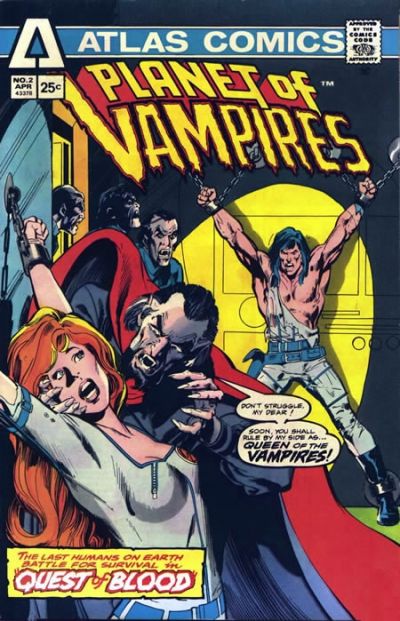

THE PLANET OF VAMPIRES #2 offers up our astronaut heroes as leaders who gather together the various street gangs for a dramatic battle against the "Domies", the high-tech vampires. The battle rages and our two heroes Chis and Craig survive only to find that their wives have been kidnapped and taken to the Dome. The Vampires, deprived of their high-tech solutions begin to revert to the more traditional fanged variety most of us are familiar with. The cover by Adams is okay, but its image has almost nothing to do with the story. The interiors are drawn by Broderick and McLaughlin again.
 

MORLOCK 2001 #2 continues the tale of the plant-man, and we get a Fleisher-Milgrom-Abel tale that demonstrates the true horror of his condition. The government wants to harness him, but he eludes them and eventually ends up killing a young girl. One detail is that Morlock battles some thugs who are very similar to those famous thugs from A Clockwork Orange. The sci-fi sources are various and sundry as this tale unfolds.
 

WEIRD SUSPENSE #2 gives us another TARANTULA story, and the witch that first put the curse on Count Lycosa returns and a battle of the spider-people erupts. More, great Boyette artwork, and a pretty good Fleisher script make this one of the most reliable reads in the Atlas-Seaboard canon so far.


POLICE ACTION #2 offers more LOMAX and LUKE MALONE stories. The former shows the police detective taking on kidnappers at the airport, while the latter gives us the "origin" story which concerns...surprise...kidnappers in a bank. There is a strange similarity to these stories, but again the better one is Malone by Ploog, though once again Sekowsky's and McWilliam's Lomax is sturdy work.


TALES OF EVIL #2 offers a gem of a three-pager by Grandenetti about a train of death; it's a real highlight. Another story about a Werewolf by some guy named Marvin Channing and the much-missed Tom Sutton rounds out the issue. The headliner though in this issue is the BOG BEAST, with Jack Sparling artwork. This series actually began in the B&W magazine Weird Tales of the Macabre #2, and like another comic this month finds its way into the color books. This is a clear indication that things are changing at Atlas. The Bog Beast is another attempt to tap that Man-Thing idea, but this is a really inferior effort.
 

SAVAGE COMBAT TALES #2 gives us another SGT.STRIKER'S DEATH SQUAD story where the squad is formally given its name by a notorious general the Squad saves then transports to his date with destiny. There is clearly some Patton influence in this story of the war in North Africa. The story by Goodwin and McWilliams is sturdy and worthwhile, but not great. The second story in this issue features WARHAWK, a mysterious pilot in the Burma air war who saves a young pilot from whose perspective this excellent Alex Toth story is told. (Note: Warhawk was apparently one of two stories Toth did in this era, and both are discussed in the current Alter Ego issue.)


Two new books debut this month. They are very different from each other, but sadly show the fragmentation of the Atlas line at this point.
 

THE COUGAR #1 is an oddball mix of elements. This comic featuring the adventures of a movie stuntman with story by Steve Mitchell and artwork by Dan Adkins and Frank Springer doesn't deny its source, The Night Stalker TV movie. In fact the creator of that movie is credited as an inspiration for the comic book. The story offers us a movie about a vampire that discovers a real vampire and similar to the famous TV flick, there's a blend of disbelief and mayhem. The Cougar is a weird comic, trapped between genres and oddly uncomfortable in neither. It wants to be a superhero book in places and a horror book in others. Clearly this book was supposed to have been drawn by Dan Adkins, but he must have been unable to finish it and the reliable Frank Springer stepped in to finish it up. The Frank Thorne cover is energetic but seems to have been produced quickly.
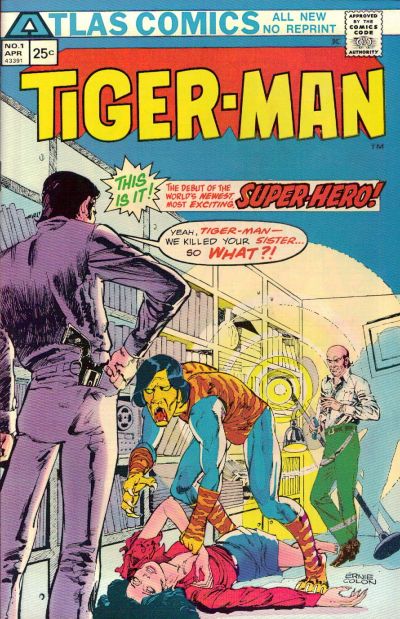

TIGER-MAN is another character that debuted in the B&W books before finding colorful glory. The story of Dr. Hill begins in THRILLING ADVENTURE STORIES #1 and he's a researcher in Africa inspired by the instinct for survival that seems to thrive in animals and people of the region.
 

A few scientific experiments and an injection later he is imbued with those instincts and lots of other powers. He's attacked by a a tiger and later gets its hide to use as a totem. He does so months later in the big city when he takes on muggers and rapists. His sister is attacked and killed and Tiger-Man takes to the streets to seek vengeance. He finds it, and then promises to keep at it. The artwork is decent Ernie Colon, but doesn't have the energy of his Grim Ghost work. The cover for this issue by Colon is one of the strangest in the whole Atlas line, and seems to me to be a very quickly produced item. 


There are of course some B&W magazines this month (more on those later this year) as well as more Vicki's but by and large, the company has reached its zenith. After this month, Atlas-Seaboard will continue to lose its focus as books are abruptly cancelled and directions are changed. But not all of them, not yet. 

More Atlas-Seaboard to come in May.

Rip Off