Showing posts with label Boris Vallejo. Show all posts

Thursday, December 26, 2024

The Broken Sword!


I'm amazed it has taken me this long, most of my life as it turns out to finally read Poul Anderson's famous The Broken Sword. I thought I had read it once before, back in the 80's but soon after launching into it, I realized I was on untraveled ground. The power of this narrative is nigh magical. It captures you, snarls you in its spell and it's hard to put down. But then when you do, it's surprising how short a distance you've come. The story is exceedingly compressed, in the manner of myth which rolls out the narrative with relentlessness. 


The novel was first published in 1954, the same year that J.R.R. Tolkien's masterpiece The Lord of the Rings first began to hit the bookshelves with The Fellowship of the Ring For that reason, I gather Anderson's book has been hidden in that epic's shadow. Not because of any other reason surely as Anderson also gives us a tale full of brave warriors, elves, trolls, and other magical creatures. They are profoundly different from Tolkien's creations, filled with a brutality and violence which fills The Broken Sword. Anderson does a magnificent job of capturing that sense of fatalism which informs Icelandic sagas and other Nordic myth. We meet characters only to see them die a few paragraphs later, but rather we feel that we're being cheated of story we are immediately put onto another trail. The richness if this tale is potent. 


This is a Viking saga in which we meet a brutal man named Orm who seeks his own fame and fortune. He murders the family of a witch, and she curses him. He takes a wife Alefrida and has a son, but circumstances are such that an elf named Imric replaces the child with a changeling. The changeling is named Valgard. Imric names the boy Skafloc and raises him to be the best a human can be in the Elven way. Valgard's origins are such that he's an even more violent and brutal son for a violent and brutal man, and he feels apart from his supposed family. What roles this man and changeling play in the wars between elf and troll and to some small extent man makes up the story, as well as the great sin which forms its darkest center. These can be hard characters to like, but they are characters one can admire, if only on their own brutal terms. 


This is story I'm hesitant to discuss in too much detail, as it might spoil the potential excitement for new readers. And the purpose of this post is just that. I want to encourage everyone and anyone to read The Broken Sword. It's taken me far too long to savor this truly awesome tale and I want others to get to it as soon as possible. Michael Moorcock prefers Anderson's story to Tolkien's more famous tale, and I can see why at last, even if I do hold the latter in still high regard. Many aspects of Anderson's saga find a shape in Moorcock's expansive writings. It has been exciting to find a story I can get excited about, even after all these decades. 


It's been a while since I've read a book I didn't want end, while as at the same time I raced to the inevitable conclusion. Read The Broken Sword

Rip Off

Wednesday, October 2, 2024

Atlas-Seaboard Magazines - 1975!

Jeff Jones

Boris Vallejo

Ernie Colon

Neal Adams

Pujolar

George Torjussen

In addition to the avalanche of color comics, Atlas-Seaboard rolled out several B&W magazines during that hectic year of 1975. Tales of the Macabre and Devilina were straight up horror books in the tradition of Warren and later Marvel. Thrilling Adventure Stories was a bit different, a book featuring a range of stories as the title suggested of a more broadly adventurous nature. Tiger-Man debuted in TAS before getting his own color comic book. There are good stories by Frank Thorne, Jack Sparling, Jerry Grandenetti, and even a wonderful story by the Manhunter team of Archie Goodwin and Walt Simonson.

The covers for the Atlas-Seaboard comic magazines were a pretty scattershot affair. There is the superb Jeff Jones piece for the debut of Tales of the Macabre followed by a solid Boris effort on issue two, in that early part of his career when his textures were still interesting.


Devilina sported a debut cover by some guy named Pujolar which had later did service as a Vampirella cover some years later (an ironic switch for sure) and then for the second issue a George Torjussen effort that really tore up the expectations. That cover is sexy and weird at the same time. Torjussen has expressed a low regard for this cover, but I think it's fabulous.

Ernie Colon's artwork on the first issue of Thrilling Adventure Stories was decent and necessarily muddled, but Neal Adams really showed up strong on the second issue. There sure is no effort to affect a house style with these covers. I had to gather these up years later, as the magazines slipped by me during the summer of 1975 originally. They are worth the effort.

Harryhausen's Cyclops by Greg Theakston

Doctor Zaius by Greg Theakston


Phantom of the Opera by George Torjussen


The Thing by George Torjussen


I gathered these Atlas-Seaboard gems up many years ago. As Famous Monsters of Filmland knockoffs go, these are really good ones. The first issue bears a December date and might well be the first Atlas-Seaboard publication, though that's suspect.

Greg Theakston, he of Pure Imagination Publishing fame and creator of the process of "Theakstonization" for cleaning up smudge and dirty comic pages, turns in two really evocative images for issues one and two. I especially like the Cyclops, the misbegotten but very memorable monster from Ray Harryhausen's Sinbad epic.

George Torjussen though really knocks it out of the park with his two paintings, especially the final one featuring The Thing from Outer Space. That's a fantastic image, and Torjussen has related how he had to watch the movie on late night television to remember what The Thing looked like. He sure did though, giving us a real insight into the shadowing invader.


I'm closing off my current look back at Atlas-Seaboard with these last two publications, neither of which I have nor have ever seen in person.

Above is Gothic Romances a one-time only magazine that hoped to add women to the Atlas-Seaboard reading audience, despite all the content appealing to boys and men they published otherwise. It features a fantastic painted cover by Elaine Duillo, artwork used again on a novel entitled The Conservatory written by Phyllis Hastings.


There are a few bits of spot artwork by Howie Chaykin, Ernie Colon, and Neal Adams in this book, but it's really not a comic book, though a collectible for diehard Atlas-Seaboard fans for sure.


My Secret is another magazine, more recently identified as part of the Atlas-Seaboard cache, but this despite its evocative Marvelesque cover image has no comics content whatsoever according to reports.

And that wraps up my year long look back at the summer of 1975, when a new kid showed up on the block, but who quickly got knocked down because of a combination of poor management and a weak economy. Though the Atlas-Seaboard material shows up in foreign formats sometimes, the rights to it still remain locked up as far as I know.

The stuff is still pretty cheap on the back issue market, save for a few gems like those above. But this material like the stuff from Tower Comics and Skywald Comics would make for some great reprints, and I suspect might well find an audience today.  

Rip Off

Tuesday, December 5, 2023

Conan Of The Paperbacks!


As potent as I find Robert E. Howard's Conan stories, there's little doubt I would not know about them at all if Lancer Books had not decided to take the Gnome hardback series from the 1950's and present them to the world all over again in affordable paperback beginning in 1966. Paperbacks were after all the equivalent in many ways of the pulps from which Howard's brawny barbarian had emerged decades before.  And further one can fairly speculate that without the hiring of the late and great Frank Frazetta to paint covers for many of those paperbacks, their impact on the racks of the day might well have been less potent. 


So many people of my generation were struck by the absolute powerful image of Conan by Frazetta which graces the debut volume titled Conan the Adventurer. Now Frazetta didn't do all the cover paintings. John Duillo was the artist for Conan the Freebooter, Conan the Wanderer, and Conan of the Isles. Boris Vallejo painted the final cover in the series Conan of Aquilonia, but only after the series had lapsed due to the collapse of Lancer and had been transferred to Ace Books. 


Boris Vallejo went on to do more paintings for the Ace series, replacing all of the Duillo covers. I like Vallejo's work in general, but I for my part really like the original Lancers better. 


It should also be noted that Lancer came out with a King Kull volume as well, a proper companion to its Conan series. This cover was done by Roy Krenkel. Robert E. Howard was brought forward in time, and to no small extent immortalized, something the author likely could have hardly imagined. 


Rip Off

Tuesday, October 25, 2022

The Monster Of Frankenstein!


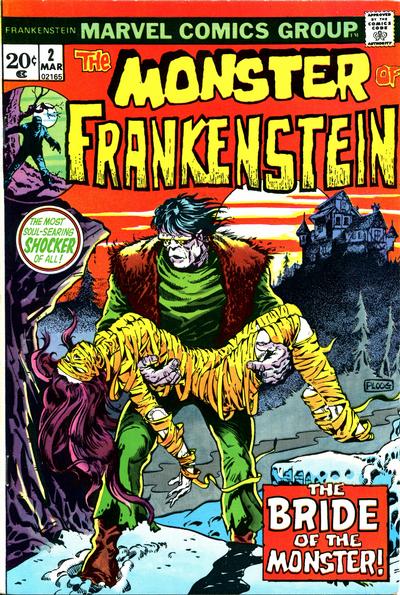
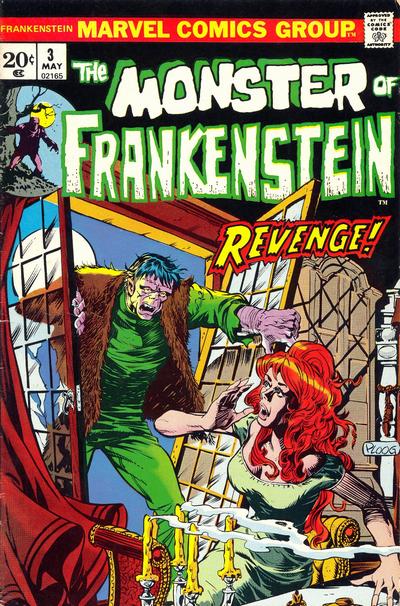
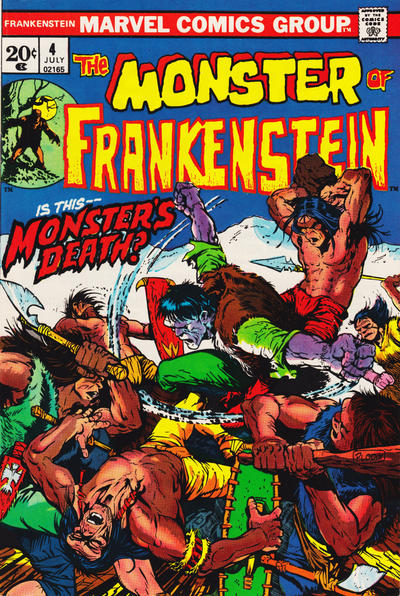
Though not as successful, Marvel's version of Frankenstein has always held a place of high esteem for me. It also is a series that underwent the most severe fall from grace. The classic story by Mary Shelly we all know, it's one of the most famous stories in all of English literature. The saga of the character on film and in comics is also pretty successful, with more than a few excellent movies made about these characters and several fine comics as well. Marvel's first few issues of The Monster of Frankenstein as it was first known is among those. 
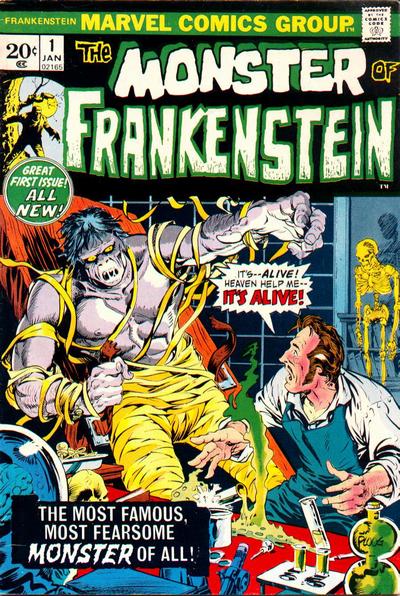


In the first four issues of the comic Gary Friedrich and artist Mike Ploog join forces to retell Mary Shelly's epic tale. They do so with gusto and more than a few alterations to fit their own specific needs for future storytelling. The saga is moved forward in time to the late 19th century for the reader and that is accounted for with Marvel tried-and-true frozen in ice gimmick. They will actually use it twice with the Frankenstein monster. Ploog is joined by inker John Verpooren after the debut issue and the two of them produce work which I think ranks among the very best Ploog created for Marvel. Verpoorten help give Ploog's pencils a heft they sometimes lack. 


In the fifth story the Monster heads out on his own and chances upon a seemingly helpless girl being burned at the stake by some angry villagers. Feeling empathy the Monster intervenes but learns later that was perhaps a mistake. 


The title changes to The Frankenstein Monster with the six issue, the last by Ploog. Here the Monster thinks he encounters the last living Frankenstein but once again he is frustrated when things are not what they seem to be. 


Then John Buscema joins the team and in tandem with Friedrich produces perhaps my favorite of all the tales in this series, a three-part encounter with Dracula himself. In a trilogy of mayhem which hearkens back to the old "Monster Rally" movies from Universal we see the Monster and Dracula mix it up a few times. We see the Monster fall in love and we see that despite a seeming victory he suffers a great loss. This one has frightened villagers, gypsy witches, and just anything one would ask for in a classic Frankenstein tale. 


In a fourth story drawn by John Buscema the Monster does indeed meet the last Frankenstein who assisted by immensely powerful giant hunchback Ivan wants to change out the Monster's brain to make him more obedient. One detail worth noting is that due to a bite from Dracula, the Monster had lost the power of speech. This makes him more like the movie versions, but it sadly takes away much of the power of the stories. 


But with the assistance of Ivan the Monster escapes those schemes leaving the castle after a terrific struggle. Frankenstein himself doesn't live long enough to see his own heir born. 


Doug Moench takes over on scripts and Val Mayerik handles the artwork as they quickly get the Monster frozen yet again. He will not awaken again until 1974 by some sketchy scientists, one of whom reminded for all the world of Dr. Sivana. These events tie into things already presented in Monsters Unleashed and the action picks up after that, with a mute Monster roaming the streets of the modern world. What could go wrong?


The next stop for the Monster is in Giant-Size Werewolf where he of course battles the furry star of that comic. By the end after a ferocious battle against a devilish cult he falls once again into the water amidst a flaming house. Moench and Don Perlin do the honors. 


The Monster's next stop is New York City and he gets mixed up mad scientist type, his worried spouse and their troubled teenage son Ralph Caccone who will become the Monster's sidekick for a good long while. Ralph's Dad cooked up a monster from spare parts and that beast kills the parents. 


Next the duo are intercepted by a private dick named Eric Prawn and soon after fall into the clutches of the last living Frankenstein (1975 variety) and his mammoth helper Zandor. 


Turns out Frankenstein is part of a larger outfit called ICON (International Crime Organizations Nexus) who want the Monster for too. Frankenstein wants to change out the Monster's brain yet again but Prawn helps Caccone and the Monster to escape for a short time until ICON arrives. But it turns out the previous Frankenstein was an imposter and the real last Frankenstein is a woman who is also a scientist. She wants to help the Monster. We are treated to a reprise of the Monster's origin and the images are from the movies not the book. The slow descent of the character is well and truly along. 


Lady Veronica Frankenstein helps the Monster some by giving him voice back, so he's not just some passive lump while others talk around him. The Monster without his voice is played too much like Man-Thing and that's not at all smart for the character in my estimation. ICON attacks again, this time with a robot named Berserker who battles the Monster until they realize they have common goals. 


In the final issue of the color run the Monster loses his buddy Berserker, and falls into the clutches of yet another Lady Frankenstein, this one named Victoria and this one wants vengeance. She's helped by a gaggle of half-men who wiggle all through the comic. 


Soon after he got his own color comic book, the Frankenstein Monster took up residence in Monsters Unleashed. To keep a distinction between the two series, the stories here were set in the modern day. Eventually the color series will coincide with this but for a long time there were two continuities, and I loved that fine at the time. The first installment features some fine art by John Buscema and Syd Shores with Gary Friedrich scripting as well. 


For several bloody installments the Monster's brain keeps getting switched in and out. It proves a distraction to him needless to say. 


Win Mortimer joins the art team as eventually the Monster gets his own mind back into his body, though it took quite a bit of doing. 


Doug Moench and Val Mayerik eventually take over the Monster's doings in the magazine as well as the color comic. Mayerik's art always looks better when he inks himself and I think he is particularly well served by black and white. 


The Monster is still mute through most of these stories which I think really limits the ability of the storytellers to stretch the yarn. He's presented most often a sometimes benign ally to those he deems worthy, but he is capable of horrible violence when provoked. Again, the goal seems to be make the Monster more like the one in the films and less like the verbose creature in the original novel. 


But the Monster's search for someone who will accept him on his own terms is frustrating to say the least. He often finds himself among others of a freakish physical nature. 


In the last Monsters Unleashed issue he tries to help a girl save people aboard a train but it all goes tragically wrong despite the best intentions. 


In the final story from The Legion of Monsters he almost thinks he might have found a spot of romance but actually he's merely being played by an assassin. The Monster's lot seems always to find sadness and even profound grief at every turn. He is a walking living dead man and that contradiction seems to be at odds with the entire world. 

Rip Off