Showing posts with label Professor Challenger. Show all posts

Monday, December 5, 2022

Sherlock Holmes - The War Of The Worlds!


I first read this wonderful pastiche two decades ago when I stumbled across the Warner paperback edition in my local library. I was just thumbing through the rather sparse paperback science fiction section and there it was. I knocked out to find two of my favorite things (Sherlock Holmes and War of the Worlds) had been blended together in what seemed a delightful brew. 


A story blending two of my favorite yarns was irresistible. I snatched it up, raced home and read it almost immediately. I confess I contemplated keeping it, but honesty prevailed, and I returned it to the library. But my good deed was not rewarded as alas that library copy, I enjoyed went missing and I was unable to find another until some years ago Titan Books started to reprint some of the more memorable Sherlock Holmes pastiches.


The saga began in 1969 in the pages of The Magazine of Fantasy and Science Fiction when Wade Wellman assisted by his famous father Manly W. Wellman wrote "The Adventure of the Martian Client". The younger Wellman had been inspired by the movie A Study in Terror which had the Baker Street sleuth tackling Jack the Ripper. 


Several years later in 1972 they revisited the concept in another issue of TMoFandSF with the story "Venus, Mars, and Baker Street".

The idea seemed too good to let go and so they worked up a few more installments and created the patchwork "novel" Sherlock Holmes - The War of the Worlds which came out from Avon in 1975. This is the edition I first read.

The story reveals its origins in its construction. We first meet Sherlock Holmes when in partnership with Professor Edward Challenger he locates and plumbs the depths of a mysterious crystal egg found in an out of the way curio shop. The pair realize they are seeing a distant location, another world in fact, the world of Mars.

Soon enough the world becomes award of the Martians when the cylinders begin to drop. We follow first Holmes and then later Challenger in separate adventures as try to survive the onslaught of the Martian machines. But all the while they plot what might work to defeat the invaders.

Watson joins the team as the inevitable end of the invasion becomes evident. There are lots of fun bits of business calling back to the classic H.G. Wells story which spawned the fun, but the Wellmans seem to want to present in Holmes and the braggart Challenger a more defiant humanity than does Wells, a humanity who doesn't shrink in times of war but rises to face the challenge.

If you're a fan of either Sherlock Holmes or The War of the Worlds, or like me both, you must read this wonderful saga. It will offer up fascinating insights into both.

And I haven't even mentioned Sherlock's fascinating relationship with Mrs. Hudson. Hoo Boy!

NOTE: This is a Dojo Revised Classic Post. 

Rip Off

Monday, April 11, 2022

Dojo Classics - The Lost World And Other Stories!


I've spent the last several days enjoying the robust and often combative personality of Professor George Edward Challenger in the Wordsworth collection The Lost World & Other Stories. Challenger is Sir Arthur Conan Doyle's other great literary creation after the truly iconic Sherlock Holmes.

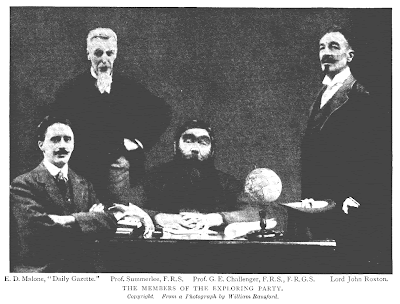
(That's Doyle himself in the center posing as Challenger in this bogus picture taken to advertise The Lost World.)

Professor Challenger is the main character in five Doyle stories, three novels and two short stories written from 1912 to 1929. Easily the most famous is the first titled The Lost World, which has been adapted to film and television several times mostly because it does a bang-up job of pitting measly humans against dinosaurs and other assorted primitive creatures.


The Lost World written and published in 1912 introduces to Professor Challenger and some other memorable characters. Narrated from the perspective of young and energetic newspaperman Edward T. Malone, the tale sets itself up to be a series of dispatches from Malone about an expedition led by Challenger and two other men, Professor Summerlee and Lord John Roxton. This stalwart band travel to South America to follow up on clues Challenger had discovered on a previous expedition which indicate, at least to Challenger, that dinosaurs may well survived deep in the unexplored territory. Summerlee, an aged academic is brutally skeptical and goes to disprove Challenger's claims. Roxton, a dashing adventurer of no small reputation goes along to prove Challenger's claims and to seek some thrills.

It's unlikely few don't know this story already, so I won't belabor those details. Suffice it to say this is at least the third time I've read this saga, the first time in decades, and I enjoyed it immensely. Doyle is able, through the sardonic voice of Malone present highly memorable characters, not the least of which is the incendiary Challenger who is overcome with his own genius and is not squeamish about proving himself right. But this reading suggested to me that the titular "Lost World" might be more than a hidden land of prehistoric survivals and may well speak to the life not lived by so many folks as they satisfy themselves with the humdrum of daily existence. Malone goes adventuring to impress a girl only to find the object of his love less interested than expected. His lessons are meant to be our lessons I suspect.


The Poison Belt is the next Challenger novel, presented first in 1913, this is a much shorter and extraordinarily droll tale in which the Earth is suddenly overcome by some poison in the very fabric of space. The life all over the entire planet seemingly dies and doomsday is upon it. Challenger and the whole gang from the previous novel extend their lives by using oxygen in a sealed room at Challenger's estate as the world solemnly dies around them. Some of the passages are hilarious as they demonstrate to an over-the-top degree the famous British reserve. His comments on what it might take to forestall a golfer are quite funny.  Perhaps my favorite scene is this conversation between Challenger and his decidedly loyal butler and chauffeur Austin.

"Presently Austin laid the cigarettes upon the table and was about to withdraw.
"Austin!" said his master.
"Yes, sir?"
"I thank you for your faithful service." A smile stole over the servant's gnarled face.
"I've done my duty, sir."
"I'm expecting the end of the world to-day, Austin."
"Yes, sir. What time, sir?"
"I can't say, Austin. Before evening."
"Very good, sir." The taciturn Austin saluted and withdrew."


Later after the world has been passed through the belt and the group has surprisingly survived, they explore the dead world by motorcar, even going to London and parts between. Once again, the story is told from Malone's perspective and though less broad than the first tale, nonetheless offers many great scenes which make strong comment on the nature of then modern society.


The Land of Mists written and published in 1926 is the one Challenger story I've never read before. And sadly it's not one I'd recommend to others. It's an episodic, overlong and sometimes tedious narrative bent on proving that Spiritualism is a legitimate philosophy and goes to great lengths to demonstrate that those who profess belief in such psychic phenomenon are repressed and abused by the larger society. The story is not told this time from perspective of Malone and that hurts it immediately as the narrative voice lacks punch. The story deals less with Challenger and more with Malone and Challenger's daughter Enid who investigate various spiritualist individuals and gatherings moving from skepticism to belief as they go. The story then shifts and momentarily gets quite good and downright exciting as Lord John Roxton turns up and he and Malone go ghost-busting in a certified haunted house. But then all too quickly the narrative goes quiet again and eventually Challenger himself, who is hardly in the story at all really, must confront the deaths of his comrade Professor Summerlee and his own beloved wife who was such a charming part of the earlier adventures. As far as I can make out, the "Land of Mists" referred to is our world and the lack of clarity those who disbelieve in Spiritualism suffer from. This is not a great novel alas, though easily the longest in the collection.


"The Disintegration Machine" from 1929 is a wonderful hoot of a short story, again told from Malone's perspective. In this one Challenger and Malone confront a mad doctor named Theodore Nemor who demonstrates the all-too dangerous success of his machine on both Malone and Challenger before the latter has a turn.

"When the World Screamed" from 1928 closes out this charming collection by telling how Challenger using vast resources inherited from an African rubber baron schemes to dig deep into the skin of the Earth and make his own personal introduction to an Earth Challenger insists is much like an Echidna, a living thing through and through with a tough skin protecting it. This story is told by Peerless Jones, an expert in artesian well digging. Malone is on hand to share in this hair-raising romp.

These tales combine to paint a picture of Professor George Edward Challenger, a scientist who powered by his intellect and his ego sees no limit to the explorations of humanity. There is a bracing hubris to Challenger which is easy to celebrate safely within the confines of such compelling fiction. Doyle's other great character is well worth the effort (for the most part) and I heartily recommend all save one of these classic adventures.

Rip Off

Wednesday, June 12, 2013

Challenger Of The Unknown!

That's Doyle himself in the center posing as Challenger in this bogus picture taken to advertise The Lost World.


I've spent the last several days enjoying the robust and often combative personality of Professor George Edward Challenger in the Wordsworth collection The Lost World & Other Stories. Challenger is Sir Arthur Conan Doyle's other great literary creation after the truly iconic Sherlock Holmes. Professor Challenger is the main character in five Doyle stories, three novels and two short stories written from 1912 to 1929. Easily the most famous is the first titled The Lost World, which has been adapted to film and television several times mostly because it does a bang up job of pitting measly humans against dinosaurs and other assorted primitive creatures.


The Lost World written and published in 1912 introduces to Professor Challenger and some other memorable characters. Narrated from the perspective of young and energetic newspaperman Edward T. Malone, the tale sets itself up to be a series of dispatches from Malone about an expedition led by Challenger and two other men, Professor Summerlee and Lord John Roxton. This stalwart band travel to South America to follow up on clues Challenger had discovered on a previous expedition which indicate, at least to Challenger, that dinosaurs may well survived deep in the unexplored territory. Summerlee, an aged academic  is brutally skeptical and goes to disprove Challenger's claims. Roxton, a dashing adventurer of no small reputation goes along to prove Challenger's claims and to seek some thrills.

It's unlikely few don't know this story already, so I won't belabor those details. Suffice it to say this is at least the third time I've read this saga, the first time in decades, and I enjoyed it immensely. Doyle is able, through the sardonic voice of Malone present highly memorable characters, not the least of which is the incendiary Challenger who is overcome with his own genius, but is not squeamish about proving himself right. But this reading suggested to me that the titular "Lost World" might be more than a hidden land of prehistoric survivals, and may well speak to the life not lived by so many folks as they satisfy themselves with the humdrum of daily existence. Malone goes adventuring to impress a girl only to find the object of his love less interested than expected. His lessons are meant to be our lessons I suspect.


The Poison Belt is the next Challenger novel, presented first in 1913, this is a much shorter and extraordinarily droll tale in which the Earth is suddenly overcome by some poison in the very fabric of space. The life all over the entire planet seemingly dies and doomsday is upon it. Challenger and the whole gang from the previous novel extend their lives by using oxygen in a sealed room at Challenger's estate as the world solemnly dies around them. Some of the passages are hilarious as they demonstrate to an over-the-top degree the famous British reserve. His comments on what it might take to forestall a golfer are quite funny.  Perhaps my favorite scene is this conversation between Challenger and his decidedly loyal butler and chauffeur Austin.

"Presently Austin laid the cigarettes upon the table and was about to withdraw.
"Austin!" said his master.
"Yes, sir?"
"I thank you for your faithful service." A smile stole over the servant's gnarled face.
"I've done my duty, sir."
"I'm expecting the end of the world to-day, Austin."
"Yes, sir. What time, sir?"
"I can't say, Austin. Before evening."
"Very good, sir." The taciturn Austin saluted and withdrew."


Later after the world has been passed through the belt and the group has surprisingly survived, they explore the dead world  by motorcar, even going to London and parts between. Again the story is told from Malone's perspective and though less broad than the first tale, nonetheless offers many great scenes which make strong comment on the nature of then modern society.


The Land of Mists written and published in 1926 is the one Challenger story I've never read before. And sadly it's not one I'd recommend to others. It's an episodic, overlong and sometimes tedious narrative bent on proving that Spiritualism is a legitimate philosophy and goes to great lengths to demonstrate that those who profess belief in such psychic phenomenon are repressed and abused by the larger society. The story is not told this time from perspective of Malone and that hurts it immediately as the narrative voice lacks punch. The story deals less with Challenger and more with Malone and Challenger's daughter Enid who investigate various spiritualist individuals and gatherings moving from skepticism to belief as they go. The story then shifts and momentarily gets quite good and downright exciting as Lord John Roxton turns up and he and Malone go ghost-busting in a certified haunted house. But then all too quickly the narrative goes quiet again and eventually Challenger himself, who is hardly in the story at all really, must confront the deaths of his comrade Professor Summerlee and his own beloved wife who was such a charming part of the earlier adventures. As far as I can make out, the "Land of Mists" referred to is our world and the lack of clarity those who disbelieve in Spiritualism suffer from. This is not a great novel alas, though easily the longest in the collection.


"The Disintegration Machine" from 1929 is a wonderful hoot of a short story, again told from Malone's perspective. In this one Challenger and Malone confront a mad doctor named Theodore Nemor who demonstrates the all-too dangerous success of his machine on both Malone and Challenger before the latter has a turn.

"When the World Screamed" from 1928 closes out this charming collection by telling how Challenger using vast resources inherited from an African rubber baron schemes to dig deep into the skin of the Earth and make his own personal introduction to an Earth Challenger insists is much like an Echidna, a living thing through and through with a tough skin protecting it. This story is told by Peerless Jones, an expert in artesian well digging. Malone is on hand to share in this hair-raising romp.

These tales combine to paint a picture of Professor George Edward Challenger, a scientist who powered by his intellect and his ego sees no limit to the explorations of humanity. There is a bracing hubris to Challenger which is easy to celebrate safely within the confines of such compelling fiction. Doyle's other great character is well worth the effort (for the most part) and I heartily recommend all save one of these classic adventures.

Rip Off

Thursday, July 1, 2010

Sherlock Holmes's War Of The Worlds!


Manly Wade Wellman's little book Sherlock Holmes's War of the Worlds is a beaut. I first stumbled across this gem written by Wellman and his son Wade Wellman over in installments over ten years or so, in the local library. Loving both the world of Sherlock Holmes and Professor Challenger (who is also in this) and the world of the infamous invasion from Mars, I couldn't wait to see these two universes blended together. The book was wonderful. So wonderful, that I considered in my fevered brain just lifting the book to add it to my collection. But my civic duty prevailed and I returned it to the library for others to enjoy. It disappeared, so I was never able to read it again. That was years ago.


Yesterday I was reading Steven Bissette's Blog and he was talking about many things Martian and among was this book. That kindled my memory and I wondered if a copy could be had for cheap on ebay or elsewhere. A quick search informed me this little jewel had been reprinted just this year as a part of series The Further Adventures of Sherlock Holmes. There it was, the book I'd loved years ago, just a few computer clicks away. But since I was headed up to check out the new comics anyway, I stopped by the local Barnes & Noble and lo and behold I found it, the very book. Callooh! Callay!

I scarfed it up and gleefully brought it home to add its tiny mass to the mountain on the nightstand. But read it I must, and read it I will.

As it turns out the other books in this series seem pretty intriguing as well. I might have to get some more of those. Nothing tickles me as much as the bright logic of Sherlock locked in combat with the shadows of unreason. It's the very core of what makes the character so appealing.


One thing I also learned about this book is that it was evidently inspired by the 1965 movie A Study in Terror which pits the great detective against the notorious Jack the Ripper. The notion of blending milieus, though common enough in the imagination of Phillip Farmer, was not as broadly apparent at this time it seems. The poster for the movie could only have been produced in that narrow span of time when the Batman TV redefined entertainment. Those atrocious sound effects are so contrary to the nature of Holmes that it's difficult to fathom. Although I do find the "Aieee!" sort of funny.

Oh and by the way, for a look at another series which focused on Sherlock and his doings with those pesky Martians, check out this link.

Rip Off

Sunday, November 15, 2009

Sherlock Holmes In The Case Of The Missing Martian!


This limited series written by Doug Murray and drawn by Topper Helmers with covers by Ian McCraig was published by Eternity Comics nearly twenty years ago. I became aware of the series for the first time prowling a website dedicated to all thing War of the Worlds while doing research for my annual Halloween-season in-class presentation of the classic "panic" radio drama. The series sounded like my cup of tea, but I despaired ever finding such an oddball set of comics.

Well I found them yesterday, and I read them this morning.

The story begins several years after the "invasion" and starts with the apparent disappearance of a presumably dead Martian from a museum display. Sherlock Holmes is called away from his beekeeping in Sussex to tackle the case. Meanwhile Watson is having some trouble with his wife who appears to have mental issues and is connected to an infamous criminal in Whitehall. The mystery develops with Sherlock reflecting back on what he did during the War of the Worlds and the role he and Professor Challenger had in defeating the enemy. I won't say much more, save that many classic Holmes details are present and the story does answer a mystery about Sussex.

The artwork is pretty decent most of the time and does a very nice job of telling the story. The action sequences seem to get lost a bit here and there, but the mood elements are very nicely handled. The B&W format doesn't bother me a bit, and this material actually shines because of it. The covers by Ian McCraig are colored by Murray's wife and they are uniformly handsome.

Murray's story is a solid one, not a great one. I caution any new reader not to read the text pieces by Murray until after you've finished the whole tale as he does spoil the plot a bit early on. All that said it was a fun read; I'm glad I found it.

Rip Off