Showing posts with label Russ Manning. Show all posts

Wednesday, May 14, 2025

Darth Vader Day!


George Lucas was born on this date in 1944. It is difficult to measure the impact that Star Wars has had on films and society. It made science fiction cool, at least for a time. Lucas has other films such American Graffiti and THX-1138 but he'll always be remembered as the guy who gave us Darth Vader, Luke Skywalker, and the gang from a time long, long ago. 

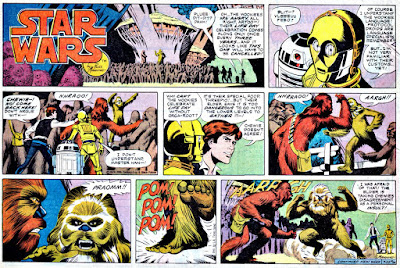
I'm not aware of anyone who doesn't admire the work of Russ Manning. Manning created a sleek handsome future world for Magnus the Robot Fighter, a world which was visually sometimes at odds with the dangerous threats it faced from too much reliance on technology. He'd broken in on Brothers of the Spear and made himself an international star with his definitive work on Tarzan of the Apes. So when the Star Wars folks wanted to take their stripling concept and expand it onto the funny pages, they found the ideal translator in Manning.


Manning was in complete command in the beginning, partly because that's the way he preferred to work and partly because the behemoth that was to become the Star Wars machine was still forming. Eventually they decided they needed to pre-approve things and at that point Manning gave up writing the strip though he continued to draw it. 


There were three stories during the Manning-only period, the most famous of these is likely "Gambler's World" which ran in the daily strip and introduced a new villain named "Blackhole".  Given the understandable mandate that none of the real status quo of the series could be affected, the story has a frivolous quality to it which was not to my mind in keeping with the Star Wars feel, but there's no denying Manning's skill at capturing the characters likenesses. 


In the Sunday pages two other Manning-only efforts ran and they were both more like the movie. They introduced a new character named Gyla Petro who was at once a minor romantic interest for Han Solo and someone for him to talk to since he couldn't have both Luke and Leia at the same time in the series, one of the early restrictions on Manning. Han and later Luke shows to help save a culture from Empire and later we get a glimpse of Wookie culture. 


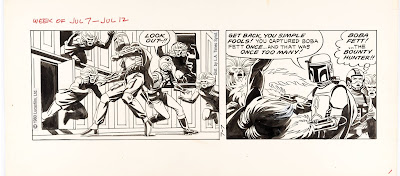
At that point Steve Gerber of Howard the Duck fame steps aboard for an adventure which takes Luke back to Tatooine. It's probably my favorite of the stories as it really evokes the classic feel of the movie. A writer named Russ Helm comes aboard with a few stories and later Don Christensen writes a few. By the time it's over we've met some really interesting new characters such as Lady Tarkin (loved Peter Cushing in the movie and liked seeing him remembered here). Even Boba Fett turns up to make things hot for the trio as that embargo seems to have been lifted at some point. 


When Manning fell ill his assistants Dave Stevens and Rick Hoberg take the helm for a short transitional period and then the duo of Helm and new artist Alfredo Alacala take over. Now I'm a huge Alacala fan, but he was not well used here and the last strip in this collection is several notches in quality below the rest. The sleek futuristic lines of Manning have been replaced with Alfredo's heavier touches and not to good effect and I have to wonder how much reference Alcala had since the characters look very different and only vaguely like the movie stars they represent. It's a tragedy indeed that Russ Manning died so young. 


It's almost unimaginable to me that the work of Russ Manning, an artist who I regard as among the most amazing in comics could be topped on a project. On Tarzan when Joe Kubert came along, he made the character his own and his version didn't seem to compete with Manning's more modernized sleeker Ape Man. But on Star Wars one has only to glance at the work Al Williamson using the characters and settings of the George Lucas classic movie and you know instantly that it's the ideal pairing of an artist and a project.


Apparently Archie Goodwin and Al Williamson tried out for the strip in the very beginning and seeing the samples reproduced in this collection it's hard to imagine how they were immediately hogtied and forced to take it on. But it didn't happen and Russ Manning ain't no one to sneeze at. But Williamson's adulation of Alex Raymond and the way he took that and other influences to make his own idealized artwork made him the perfect match for the Lucas film, because he and Lucas were coming from the same source though by two different tributaries. Williamson used the original Flash Gordon comic as inspiration for much of his work and Lucas tapped into the zeitgeist of the serials that used Flash as its subject matter. Two craftsmen who looked to the past to make the future.
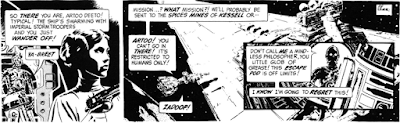

And Archie Goodwin ain't no slouch. The respect he garnered universally across the comic book field in his capacities as writer and editor is nigh near unique. No one seems not to have liked Archie Goodwin, and having been in jobs where he was forced to tell folks things they didn't like to hear that's incredible to imagines and points to a sincerity and competence that was evident to his peers instantly. I will worship him until I pass for his creation of Manhunter with Walt Simonson, and I fell in love with him in the first story I read by him in the pages of Iron Man. The skill was just evident, even to my boy's eyes and he has always been a talent I followed from that time forward in comics. I never really knew of his simultaneous career in comic strips all that much, to my regret.


But this collection begins with an adaptation of a novel by Brian Daley titled Han Solo at Star's End. It's scripted by Goodwin but drawn by Alfredo Alcala. Now let me be clear here, the work of Alcala is astounding and his pages and pages of barbarians and damsels and such are wonders in details and construction. He's a master, but his work on Star Wars is right terrible. He doesn't get the costuming right, his version of robots is all wrong, and really it's quite disappointing.


It was always a delicate matter about these films and the secrecy that surrounded plot points. So, it's no surprise that even after the arrival of The Empire Strikes Back that Goodwin and Williamson told tales set between the two tent pole movies. It's safer all around and adds to the luster of the Star Wars universe. In the modern-day internet mini-episodes and comic books act as preludes and enriching events in conjunction with a show in real time, such they did with The Walking Dead and Star Trek in recent years. But in the early 80's such organized storytelling was not common at all, but then licenses were just becoming a booming business, the whole far more lucrative than the sum of the parts.

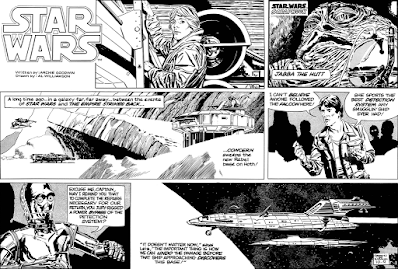
The third volume collects up all the remaining Star Wars comic strips produced before the strip ended in 1984. Archie Goodwin and Al Williamson are on hand throughout the process and generate stories of a singular mature character that fill-in the several years between the end of the debut Star Wars movie and the first sequel The Empire Strikes Back. The strip never deals with the tumultuous revelation by Darth Vader that he is Luke Skywalker's father. The romance between Leia and Han Solo is left on a low simmer. Many of the stories are cannily written with the knowledge of the movie The Empire Strikes Back and toward the end the final film Return of the Jedi, but at no point are the storytellers allowed to drift into the core themes of the epic. 


As with any saga in which the ending is known to some degree, a suspense and tension is difficult to manage. I'm thinking the long years of Conan the Barbarian comics written by Roy Thomas filling in gaps in the published Robert E. Howard adventures. The trail can be a winding one, filled with danger and doubt, but always we know that eventually we will end up in a recognizable spot. Star Wars the comic strip is never allowed to reach that recognizable spot, though they do a pretty good job of it in the end with the use of the planet Hoth as a setting. 


Williamson didn't work on the artwork alone on this strip this time, getting help from his friend and studio mate Carlos Garzon. In later storylines artists such Tom Yeates and Brent Anderson, both working over Williamson layouts. The artwork in the series is the thing that makes it sing, it's absolutely divine, an ideal matching of talent and subject. The strip ended in early 1984 having told the story it was allowed to tell, and telling that story in a beautiful way. 

Rip Off

Saturday, July 30, 2022

Magnus - The Tarzan Of The Future!


One of the greatest comic series of all time is Russ Manning's stunning Magnus Robot Fighter comics from Gold Key. Manning had been like most the capable staff at Gold Key a reliable and sturdy artist, first on Brothers of the Spear in the back pages of Tarzan and later on Korak Son of Tarzan and the lead Tarzan feature itself. In between these gigs he produced one of the most striking and memorable comics of the sizzling 60's. Magnus was an adventure comic in the spirit of the times, forward looking but blended with skepticism about the nature of mainstream society. He took the notion of Tarzan, a man raised by apes and so at once an ally of civilized man and a creature of the jungle as well. Magnus was raised by a robot and is gifted with physical gifts that allow him to combat the unique menace to mankind two millennia from now. 


Magnus appears from nowhere (a problem for him in later stories when the authorities seek to restrict his behavior), the prodigal son of A-1, a benign robot who sees that mankind has become too dependent on the robots who serve their every need and whim. Magnus is given training specially designed to allow him to demolish his potential metal opponents and the ability to understand the subtle electronic communications between robots. This hidden talent is most useful to him and the one secret he guards most zealously, even from his paramour the gorgeous Leeja Clane. Magnus saves North Am, the immense sprawling city-state which occupies all of what is the current United States and more. From the tallest most sleek towers to the darkest alleys in the depths of the society he finds enemies and allies and most importantly adventure, lots and lots of adventure.


Magnus battles aliens from the depths of space, troglodytes from the depths of the Earth, and depraved and sometimes insane men from the bowels of the society of 4000 A.D. The most frequent foe is Xyrkol, a maniac who hatches several schemes to take control of North Am, but he is always stopped by Magnus, though he always seems to turn up again. Also, there's Dr.Laszlo Noel who hates robots and their influence on society even more than Magnus and takes extreme steps to eradicate the problem. Mekman shows up a few times, a deranged but dangerous fellow who imagines himself to be a robot. There are treacherous alien threats from Sirius and even a remote robot planet called Malev-6.

Magnus fights giant robots, tiny robots, indestructible robots, police robots, criminal robots, homemade robots, handsome robots, ugly robots, and even magical robots. Always Magnus with help of Leeja and his sometimes helpers The Outsiders wins the day.


The Outsiders are a gang of boys who want to emulate Magnus and figure in several of the stories. Another recurring item are the neo-animals. These are hyper-intelligent creatures (dogs, apes, raccoons, etc.) created by a lovely woman named Danae. One of these critters even gets the power to speak thanks to some special technology. Then there are the Gophs (as in "gophers"), the people who live in the remote depths of North Am and who challenge the rule of the "Cloud-Cloddies" of the upper reaches. This fracture in North Am society is not much developed in these original Manning stories, but does form a potent angle for Jim Shooter's Valiant revival.


Manning's artwork is uniformly superb throughout the series, his sleek and modern style ideal for this futuristic "Tarzan". Even the fact Magnus wears a tunic with fabulously white boots somehow works.

The saga of Magnus is not some sprawling extended story in the modern sense. Each issue is self-contained, each story has a distinct beginning, middle and end. But the stories do have memory and in the later installments there's an increased sense of a connected quality. Each installment takes you to another part of North Am, spreading the story from coast to coast. It's hard to remember that these stories of a largely contented populace is the dream of society. But there's always the threat to individuality and the interconnected nature of the society often makes it vulnerable to sabotage.


As I was reading, I kept thinking how the world of North Am echoes our own modern world. While the robots which serve us are in the form of handheld communicators and even the desktop wizardry which allows me to type these words, among other things, the sense that society has fallen victim to its own success is familiar. Magnus would see many aspects of North Am in modern America, a shallow population increasingly reliant on technology to live what is deemed a civilized life. Threats to communication, food production, and even our own reproductive capacities are changing as man's ability to use technology gives opportunity and forces decisions. Magnus Robot Fighter is not primarily a cautionary tale for our times, but it is certainly that too.

Here are the covers for Russ Manning's outstanding run by Manning and painters George Wilson and Vic Prezio. 

Russ Manning and George Wilson
George Wilson
Russ Manning
George Wilson
Russ Manning
Russ Manning
George Wilson
George Wilson
George Wilson
George Wilson
George Wilson
George Wilson
George Wilson
Vic Prezio
Vic Prezio
Vic Prezio
Vic Prezio
Vic Prezio
Vic Prezio
George Wilson
Vic Prezio

But it turns out that even after Russ Manning's untimely death and even the collapse of the Gold Key brand Magnus the Robot Fighter was not done. That is all due to a gent named Jim Shooter who once upon a time was editor as Marvel Comics. In 1991 he along with some partners created Valiant Comics and to help cement the new company they leased the rights to Gold Key's vintage heroes, Magnus first and foremost among them. 


The future world of North Am is a bit more complex in this Valiant version. In those halcyon Gold Key days Magnus was an unalloyed hero and when he was suspect it was usually cleared up by the end of the story. Not the case here as the robots rebel and Magnus thinks just maybe a more subtle approach should be taken to the problem. This puts him at odds with the society which just wants its mechnical slaves back online. His relationship with Leeja is put into question as well, though I think Shooter is a bit unfair to Ms. Clane. It's a complex world, but sad to say not as a compelling one as first imagined by Russ Manning. Tarzan of the future is a grand high concept and alas the Valiant version loses some of that glamour. 

Rip Off

Friday, July 29, 2022

Tarzan In The Land That Time Forgot!


Many consider Caspak to be the greatest science fiction concoction by Edgar Rice Burroughs. Certainly, it's the story that has the feel of science fiction as opposed to his normal science fantasy so wonderfully wrought in Princess of Mars and such books. ERB presents this land in three linked novels (which some think are really just one broken up into three slim volumes) titled The Land that Time Forgot, The People that Time Forgot and Out of Time's Abyss. It's a weird isolated an uncharted land surrounded by steep cliffs and inside the whole of evolution works itself out in a single generation. The concept of Recapitulation is what ERB picked up on and he uses it with fine imagination to create a land in which man and dinosaurs live together if not in harmony. 
 

The old Amicus movie outfit made a flick of the story back in the 70's starring Doug McClure and a bunch of Brits pretending to be Germans. The screenplay by Michael Moorcock and James Cawthorn for The Land that Time Forgot has a German submarine find its way into Caspak and then the survivors try desperately to find a way home. It's an above average effort for the time and for Amicus. I always loved the cover artist Nick Cardy knocked out for the Marvel Comics adaptation. There is one direct sequel titled The People that Time Forgot which is a strange entertainment indeed, made when Amicus could not get the rights to the John Carter material. 


Russ Manning is considered by some the definitive Tarzan artist. I give the nod slightly to Joe Kubert, but there's little to choose between them as different as their incarnations of the Ape Man are. At the height of his powers before his untimely death, Manning produced four albums starring Tarzan for the overseas markets. Stunningly they were never published in the United States until Dark Horse brought out two of them under the title of Tarzan in The Land that Time Forgot and The Pool of Time. These are stunning examples of Manning's artwork and the story ain't half bad neither. 


Tarzan is contacted by a young man who wants to rescue his love who has entered Caspak to solve the mystery of her birth. They do so and immediately Tarzan is battling not only dinosaurs but also the brutish men who reside in the bowels of the land. They are menaced in particular by primitive man named Gash-Hak who seems unable like nearly all his kind to evolve into a more refined "New Man". The story takes a twist when sailors from the ship that brought them to Caspak also go into the territory and then Tarzan must discover the secret of the Pool of Time which seems to rest at the heart of Capak's many mysteries and he battles the strange flying creatures called Weiroos. The Pool of Time seems to be a window not only to other eras but to the soul of the watcher as well. It's smashing stuff and moves at a breakneck pace. Why these were presented into the American market I'll never know. But I'm glad they were eventually. Now we must see about those other two Manning epics. 

Rip Off

Sunday, July 24, 2022

Sunday Funnies - The Complete Russ Manning Tarzan 1974-1979!


It's all in color for the final of the four Tarzan collections from IDW collecting Russ Manning's Tarzan comic strip work. Tarzan - The Complete Russ Manning Newspaper Strips Volume Four has strips from across five years, from 1974 to the end in 1979. At the same time as he and his studio were hectically producing this strip, they were also contracted to created full-color graphic albums for the overseas market. These wonderful tomes were not available in the United States so as to not compete with DC's Tarzan material. It was a project full of more promise than accomplishment as the ERB people were trying to find ways to have full control of the comics produced. 

But let's begin. 


"Tarzan Returns to Castra Sanquinarius" finds Tarzan mysteriously captured and aboard a slave galley which is headed to the lost Roman outpost of Castra Sanquinarius which Tarzan first encountered in Tarzan and the Lost Empire. He finds another outsider named Gino Moscatti who is also a slave. Tarzan is drawn into the court intrigues of the vile empress Claudia. After some terrific fights in the arena and outside of it Tarzan and a group of slaves are able to escape. 

"Tarzan and the Valley of the Mist" is a strange outing which finds Tarzan exploring a bizarre little valley in which strange mists make animals and people able to cast off their basic instincts and live side by side as is suggested in the story of the Garden of Eden. This world is overseen by a girl named Luz who wants Tarzan to stay but he rejects this false paradise and sees to it that the valley is closed. 

"Korak and the Amazons of the Elephants' Graveyard" has the son of the Ape Man carried off by balloons to a strange world which turns out to be yet another lost outpost of ancient Atlantis like Opar. In this weird place only women rule, a strange sort of harem maintained by a warrior named Hunlaka who uses ancient powerful armor to maintain control. This yarn had one of the more surprising endings of any I've read. The reader is surprised to learn that the beautiful but deadly women of this city use phrases like "Spa Fon!" and "Squad Tront!" which sound familiar to many a comic book fan. 


"Tarzan and the Giant Insects of Opar" is a sprawling and truly strange epic of an adventure that spans most of a year. It begins when Tarzan and Jane must return to Opar for more gold to help feed the tribes who live around them. Soon Jane is captured by the wild men of Opar and offered up as sacrifice. La for some reason is not in control but soon she and Jane are rescued only for Tarzan and La to fall into another world beneath Opar filled with giant spiders, beetles, dragonflies and other insects. Men live here too but have adapted to life by attempting to become more like insects and seek to make La the mother of thousands of people. What she might become is kept behind the curtain by Manning. 

"Tarzan and the Emigrants" is a story about the classic struggle between those who want to fence in territory and those who want to leave the ranges open for natural migration. When farming settlers build an enormous wall that stops the animals Tarzan goes to see about getting it down and faces a great deal of hostility. But a flood caused by the wall changes things. Tarzan with the help of Tantor fights to save the day. 

"Tarzan and the Jungle Revolution" picks up immediately after and co-stars Jane. She and Tarzan go to town and meet with hostility. Confused they discover a revolution has divided folks and made them wary. When they and a friendly captain are kidnapped along with a paddle boat by revolutionaries they are in for a fight for life. But it's not just soldiers who are a deadly threat when in the middle of vast swamp dinosaurs appear to prey on everyone. It's a very close call for Tarzan and Jane indeed. 

"Korak and the Sacred Lake of Karakao" is a peculiar tale about the son of Tarzan and how he becomes impossibly infatuated with an impossibly beautiful woman from a society which lives inside a volcano. She was bred to be so beautiful that men fall helplessly in love with her if they see her uncovered face. Weird priests protect against the day when she will be sacrificed to the "god" which lives in the waters of the sleeping volcano. That god is an enormous squid and Korak is barely able to escape with is life when the volcano erupts. His heart is well and truly broken. 

"Tarzan and the Dead Moon of Pellucidar" is a delightful adventure which sees Tarzan and his Waziri hop aboard the dirigible which takes them to the world at the center of the Earth after receiving a message from David Innes. Whatever the threat to Pellucidar it is also a threat to the suface world which has been experiencing earthquakes. Tarzan finds arms of varied Pellucidarian populations in arm fighting each other until he is able to galvanize them into a single force to approach Pellucidar's only source of darkness, it's strange moon. He is taken to the surface of that moon and into its interior by Mahars who are using a strange crystal to expand their mental might to create earthquakes. Tarzan's limitless will is all that saves the day. 

"Tarzan and the Games of Ibizzia" is a short adventure in which Korak and Tarzan who follows him are forced to take part in strange games by a mad despot. Instead of actual sport he creates deadly spectacles for a worldwide audience. But Tarzan is more than capable of ending his threat. So ends Russ Manning's run on the comic strip. He signs the final panel of the final Sunday strip with both is names and his assistant Mike Royer. 


These vintage Russ Manning stories of ERB's famous Ape Man are almost all new to me. Reading them was an exquisite pleasure and among the very best comic strip reading experiences I've ever had. The stories flowed delightfully well with a great pacing which never allowed the reader to relax. Sometimes comic strips are burdened by sluggishness but not these. One gets the sense that Manning couldn't wait to get to the next batch of ideas and that communicates to the reader. 

Reading the support pieces in these collections has also given me a greater understanding of the man Russ Manning was as well. I knew he was a great artist, that's obvious. But I've discovered by that was a good man and responsible to his community. He was gracious by most accounts and created a workspace which proved effective and enjoyable to an extent for many artists. His Tarzan was idealistic and sleek, a thoroughly modern interpretation. It's one I've gained an even greater affection for after reading years of Manning's work on the famous ERB creation. 

Rip Off