Showing posts with label Steve Englehart. Show all posts

Tuesday, April 22, 2025

The Foozle Day!


Steve Englehart was born on this date in 1947. Englehart dropped onto the comics landscape at Marvel and left a huge impression with his stories that developed elaborate back histories for some of Marvel's forgotten characters. he co-created Mantis in the Avengers and Coyote for the Epic line.  Englehart was not a writer to suffer too much editorial fussing about and if a story he "wrote" appeared that had been too altered for his tastes he used the pseudonym "John Harkness". Englehart's generosity when it came creation is revealed in tale of The Foozle. 

Here's one of those secret origin type tales that I find fascinating in the comics world. It seems that back in the day, Steve Englehart, something of an itinerant comic book writer had a falling out with DC about his remuneration on an already submitted story. He had it seems already written a DC Presents story starring Superman and featuring The Creeper as the guest star. Since he felt stiffed by the company, he refused at that time to do more work for them, so what to do with the completed script.

I'll let Steve tell the story himself.

(Steve Ditko)

"I had no plan - what was I going to do with DC-specific stories if I didn't sell them to DC? - but that very afternoon, Jan and Dean Mullaney bought them to start their new magazine line (for the price DC had promised).

So, Marshall Rogers, who was going to draw the Superman-Creeper story, sat down and riffed on it. He turned Superman into a little girl and the Creeper into the Foozle, and I rewrote dialogue as needed. Marshall later spun the Foozle into his own series, which he wrote himself, and since it was pretty much his creation, I renounced my rights to him...er, it..."


So The Foozle was born. He debuted in Eclipse Magazine in the story "The Slab". Here's a link to Steve's full account.


Later Konsbon the Foozle showed up in the debut issue of Eclipse Comics running for a few issues.


Later still there appeared two issues of Captain Quick and A Foozle from Eclipse.

For those of us who remember the Foozle, and his eventual companion Captain Quick, it was fun stuff, emerging from an exceedingly fertile time for comics. The Foozle didn't have all that many adventures at Eclipse, but he did make a big impression on my memory at least. I'm tickled to discover that he was inspired by Steve Ditko's wacky giggling superhero.

Thanks DC for always being there for us fans. We owe their corporate incompetence and short-sightedness more than we can imagine I'd suspect.


Rip Off

Saturday, March 1, 2025

A Hero For Hire!

(The dates for 1975 and 2025 are identical.)


I've always cottoned to comic book stories that deal with the logistics of vigilantism. The classic Fantastic Four story when they go broke and end up working for the Sub-Mariner at his movie studio is a delightful story which points back to the real world as most good stories do. The Avengers from time to time have had stories which mentioned the stipends the heroes get while they serve among the ranks. But no Marvel story hit on the economics of heroism more directly than Luke Cage, Hero for Hire. The Epic collection of Luke's earliest adventures emphasizes his name but when the comic first started to show up on comic book spinner racks it was "Hero for Hire" that branded the comic most forcefully. 


We meet Lucas when he is an inmate at Seagate Prison and he's there for a murder he did not commit, the murder of his beloved. His former compadre "Diamondback" set him up and now he stews about his unfair situation while using his fists to defend himself. He's offered the chance to participate in a lab experiment conducted by a Dr. Burstein and it turns out to give Lucas a steel-hard skin and enormous strength and endurance. He literally busts out of prison takes on the ironic name of "Luke Cage" and decides to help those who need help but for a price. Luke cuts a striking figure on the debut cover by John Romita and that look with the blue (black?) descending into his boots is the ideal. He looks rather like Fred Williamson. 


In the second issue he gets his revenge on Diamondback and makes it known to the criminals of Harlem that a new hero is on the block. This is "blaxploitation" at its finest, a yarn about an angry black man who has complicated issues with the civil authority and who seeks to do good but must needs look for himself in the bargain. These early issues really evoke that Shaft vibe. 


By the third issue he's fighting a mercenary named "Gideon Mace" and his mob and is not getting much money for his troubles. It turns out not surprisingly that Luke is a much better hero than businessman. Doc Burstein returns to the story and agrees to hold Luke's secret for a time and we also meet a bonafide love interest in Dr. Claire Temple. Mace appears to drown as the story closes. 


The art in the first three issues had been magnificently done by veteran George Tuska with inks by up and coming African-American artist Billy Graham. But in the fourth issue Graham does all the work in a story which has a Phantom haunting the very neighborhood in which Luke keeps his office. It's above a movie theater run by a friendly young kid named "D.W." after the infamous movie director D.W. Griffith. I'm not sure if the writer Archie Goodwin intends to invoke memories of Birth of a Nation but it's hard not to think so. 


Tuska is back in the fifth issue, but Goodwin is gone, replaced by Steve Englehart. This issue features one of Luke's most memorable villains, the robust "Black Mariah" who runs an ambulance scam in NYC. 


Graham takes the lead again with inks by Al Williamson for an indifferent product. The story too seems off the beaten path as Luke goes to the suburbs to battle armored ghosts in a story about a dangerous inheritance. 


One of my favorite Cage stories from this era is the delightful and dangerous Christmas yarn that Englehart and Tuska spin which weirdly evokes A Christmas Carol and Dr. Strangelove at the same time. 


Then we are treated to a nifty two-parter when Luke comes up against Marvel's top baddie, Doc Doom. First Cage is hired by Doom to chase down some errant robots hiding in Harlem but when the Monarch of Latveria tries to stiff Cage on his fee of two hundred bucks, the Hero for Hire hops over to the tiny kingdom to get his pay. The FF make an appearance and give Luke a rocket to get over to Latveria, This is an early effort to bond Cage more tightly to the larger Marvel continuity. 


One of my favorite Hero for Hire villains is "Mister Surete/Mister Muerte" or "Mister Luck/Mister Death". He's a gambling crime boss who depends on his good fortune to defend his casino operations and has a trick where he spins a wheel which charges up one of his hands with deadly electricity. One handshake is all it takes to burn you to a crisp. He's an arrogant villain who cannot understand why Cage keeps coming at him over the course of their two-issue battle. 


One of the more successful villains from this run is "Chemistro" who wields a handgun that can change one substance into another such as steel becoming glass. This Alchemy Gun is a deadly weapon and it's all Luke can do to survive long enough for the villain, a disgruntled ex-employee of a car manufacturer to be hoist on his own petard. Cage's appearance in Amazing Spider-Man is referenced in this issue. 


Luke Cage always seemed to have the most curious and interesting rogues to battle. Not least among them was Lion-Fang, a disgruntled scientist who used his knowledge to share intelligence with large cats and got from them some degree of ferocious energy. Needless to say, it didn't turn out for him in the end. 


The last three issues of Luke Cage, Hero for Hire were comprised of a three-part tale that reintroduced several characters from the debut issue such Shades and Commanche, two inmates of Seagate who escape and try to set up a protection racket. And Luke's arch nemesis Rackahm, the guard to actually was instrumental in making Cage so powerful turns up again, even more repulsive than before. But first Cage has to fight the giant lawyer named Big Ben who is harassing Mrs. Jenks, a woman Cage had done work for in previous issues. 


She ends up getting kidnapped and a reporter trying to blackmail Cage gets murdered by Rackham but Cage's girlfriend Claire Temple gets arrested for the crime. In an effort to clear her he gets into all sorts of trouble. Billy Graham turns in some of his best work while Tony Isabella steps in to script the story begun by Englehart. 


Frank McLaughlin handles the inks over Graham's pencils on the third part which introduces a new villain called "Stiletto". Both Shades and Commanche help Cage put down this baddie and by the end Cage's secret is safe once more, but a few people do have to die. 


Luke Cage (and the boffins at Marvel) decided that he needed a new monicker for his hero trade, so in this issue he ponders several options striking at last on "Power Man" (as in "Black" Power Man I reckon). It's fine and it's worked for him ever since, but I always preferred the more mercenary "Hero for Hire" label. In this issue Luke is duped into trying to steal some Stark armor and battles old Shellhead himself. George Tuska is back on pencils and Billy Graham bids farewell to Cage with a dandy inking job. The newly titled book slips to a bi-monthly schedule with this installment. For me, it loses some of its specialness when they decide to give Lucas a somewhat standard "codename".  


As I reflect on these Hero for Hire stories again, I was struck by the anger Luke feels nearly all the time. He has that office in a low-rent part of NYC and it's a good thing since he destroys the fixtures at least once an issue. Either he does in a fight, or he just loses his temper and smashes something. Luke Cage is a man who has been treated unjustly and is now working outside the law but also in tandem with it to bring villains to some degree of justice, albeit natural justice at times. He's a hero always seeking to treated on an equal basis with the other heroes in Marvel Universe who he perceives as having fewer obstacle in their way in that regard. 


"Blaxploitation" is about giving black audiences heroes they can root for and since many if not most Black citizens at the time were just getting adapted to a society which was just then legally beginning to treat them as regular citizens. It remains an incomplete process alas. Luke Cage, Hero for Hire speaks to that anger and frustration and presents that audience with a superhero who shows his face with pride and demands that he be treated with respect. 

Rip Off

Thursday, January 2, 2025

Hawkeye The Marksman Day!


"Dashing" Don Heck was born on this day in 1929. Heck was a key artist in Marvel's early days, and he co-created many of their stars including the focus of today's Dojo celebration -- Hawkeye the Marksman. 

When I first tumbled onto the Avengers there were only three members, Goliath, the Wasp and the outstanding Hawkeye the Marksman. Hawkeye is the ultimate no-powers hero, hanging and banging with the big boys against mighty menaces armed with only his arrows, his savage wit, and his unblinking courage. Hawkeye was created by Larry Lieber and artist Don Heck in the pages of Tales of Suspense


He was at first meant to be an antagonist for Shellhead, led astray by the comely Black Widow. But he comes to his senses and his inducted into the Avengers where he serves off and on for decades, even going on to spearhead the West Coast branch of that operation. 


Hawkeye, revealed to be a man named Clint Barton after I started reading about him, could be an asshole for certain. He was difficult to manage as a part of the team when the fighting was not on, but fiercely loyal when that loyalty had been earned. I even liked the period of time when he wasn't Hawkeye but became Goliath. He eventually returned to his best self, but always he was Clint Barton.


It's too bad they gave much of his tempestuous but witty personality to Tony Stark when they made the movies, because think how popular he'd be if he could be himself on the big screen.


It's actually the second time Hawkeye's fiery nature was ripped off, the first was when DC updated their own bowman Green Arrow long ago.


Clint had identity problems for a while. Becoming Goliath for a while helped him feel he mattered but then he returned to his archer roots. Don Heck is the only artist who made this outfit look good. But soon he'd be back in his vintage togs. 


It took Hawkeye years and years to get his own series and to become what I always knew was his first best mission, the leader of the Avengers. When he married Mockingbird, he became even more of a favorite.  I've always liked Hawkeye, or should I say I've always liked the rambunctious Clint Barton. 


Special Note: Look for many more of these one-day celebrations as 2025 tumbles along. 

Rip Off

Wednesday, August 28, 2024

The Prisoner For Our Times!


The Prisoner -Original Art Edition is a fascinating volume. Let me be frank. I don't own this elegant but exceedingly expensive volume featuring the raw unfinished work done by Jack Kirby, Mikey Royer, Gil Kane and Steve Englehart for two different attempts to launch a comic book adaptation of The Prisoner starring Patrick McGoohan. But you can get an expansive and detailed all of it at AE Index. Check out the link for some eye-popping glimpses of comics in different states of undress. This was originally priced at $79.99, but is not available at that price anymore. I found prices ranging from one hundred to two hundred bucks if you can find it. I can't really argue that it's worth the asking price, but it's sure worth a look see at the AE Index location. 


Jack Kirby was a stalwart supporter of our national freedom. He fought in WWII, putting his life on the line to stop a dictator's desire to control the world. Giving The Prisoner another watch in these times of trial when our very freedoms are under direct assault from some of the institutions entrusted to maintain them, might prove to be enlightening. Happy Birthday Jack!  


Secret Agent or as it's known in Britain Danger Man is the McGoohan spy show that predates The Prisoner and first presents the super-spy "John Drake" who is almost certainly the same disaffected spy who become the titular "Prisoner". The connection between the two series is thematic for certain but not official, almost certainly due to the complications of ownership rights and suchlike.
 

Despite being an immense fan of the Johnny Rivers theme song, I've never actually seen an episode of Secret Agent, and I found them excellent entertainment. (Note: The theme to the second season was an offbeat tune which a friend of mine said sounded like the theme of The Munsters performed by The Chipmunks. I can't really disagree.) The first series offers us our first glimpse of Drake, and he's a dashing and extremely capable espionage agent who is able to work in all theaters of operation and like most of his counterparts knows more than it's likely anyone person can know. And of course he laden with all sorts of nifty gadgets, my favorites are the frequently seen camera lighter and the shaver recorder. This conceit is forgiven of course for the sake of drama and he follow as he skips across the globe in a host of guises rescuing capture diplomats, stalking enemy agents and liberating stolen secrets. 
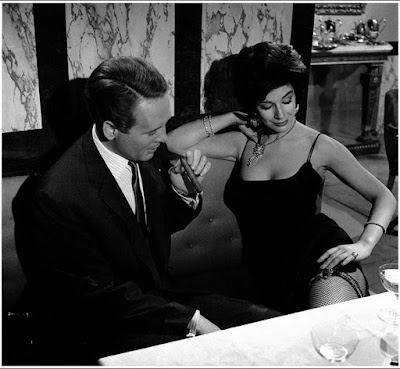

These early episodes are exciting little narrative pellets that race along dispensing just enough information to keep you aware of what's happening and why and then dashing off in a split second. The action is more violence and lasts typically only a few seconds. There are few of the extended fight sequences in the familiar manner of the Republic Serials. Here the movements are quick, brutal and few get up when tossed down some stairs or smacked with a ready piece of furniture. (Though truth told the fights do get more tradional and more tedious as the serious wears on.) Drake eschews guns for the most part, even sometimes when a gun would be the prudent option. He prefers not to kill. 


Likewise, he is a man of a strict moral code, and we don't see McGoohan's hero making much time with the beauties who populate the stories. He's either got little interest or no time and a promiscuous hero seemed not the image McGoohan wanted to convey. The complexity of the character of John Drake was able to be developed a bit more when the show shifted to an hour with the later seasons. But I dreaded that the plotting would suffer and at first it did with odd additional beats added to shows to broaden them to length, stuff that really wasn't key to the main focus of the episode and at times felt almost like a new show. But this improved vastly as the shows went on. 


There's no doubt in my imagination that by the end of the series the super-spy John Drake is a man who has at the very least become overtly jaded by his long service and at the most has developed disdain for his superiors who seem to sacrifice the nobility of humanity to fulfill the needs of any given situation. Drake himself is forced to make hard choices and he chooses to fulfill his duties, but one can see he's a man who is about to change that circumstance. 


I must confess to being a relative latecomer to The Prisoner. For whatever reason I never saw it when it ran originally, nor did I catch subsequently on television. But that doesn't mean I didn't read about it, a groundbreaking television show that has launched decades of debate and discussion about its deeper meanings. I finally took the plunge several years ago and picked up the Fortieth Anniversary edition of the show (it seems to have an anniversary edition every five years or so) and watched the episodes and found them interesting and curious, but I must confess they did not live up to my expectations. But that might well have been because of my overdeveloped expectations and not the fault of the show. 
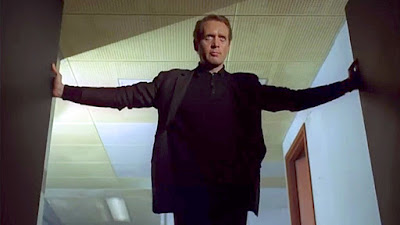

Subsequent research and another good close look have convinced me that there's less to The Prisoner than meets the reputation. That is not to say there isn't plenty to chew on and it is not to suggest its standing as a thought-provoking entertainment isn't earned. I just don't find it to be as dense an experience as some argue, and furthermore I find the haphazard nature of the making of the some of the episodes either gifts or curses the show with an ad hoc feeling. One way to think about it which works for me is that it's like a concept LP album, with different tunes by the same band, but each song with different influences, writers, and featured artists. There's even what you might regard as a cover song, the episode in which McGoohan is "replaced" by another actor thanks to a brain-switching device. 
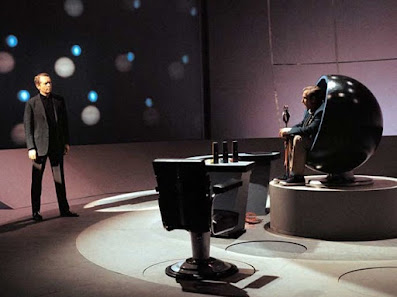

Patrick McGoohan's powerful personality made the show possible, but hearing interviews and reading about the show convinces me that his dour insular manner also shortchanged some of the possibilities of the show. Pun intended, "it takes a village" to make a television show and any auteur is not helped by holding too much of the vision inside for too long. It's clear to me that writer George Markstein deserves much more credit for The Prisoner than he's given. All that said, there's little question that The Prisoner raises some provocative questions which a society dependent on a plethora of techniques to calm their masses might find troubling. "Number Six" is an absolute individualist who demands that he be left alone to think and feel as he chooses. That his thoughts and actions are sometimes contrary to the efficiency of the Village. The ending of The Prisoner is beyond bizarre and consequently will always be open to individual interpretation, and I'm sure that enigmatic nature is why the show persists in the imagination. 
Be seeing you. 

The Bionic Woman tomorrow. 

Rip Off