Showing posts with label Whitman. Show all posts

Saturday, April 25, 2026

Solar Reflections - A Whitman Sampler!


In the fourth and final Dark Horse Doctor Solar Man of the Atom volume we find a delightful blend of vintage superhero yarns from across many many years as the series winds down and then gets revived a time or two.

Doctor Solar battles King Cybernoid in all the remaining Gold Key issues of the series, the android with the brain of Solar's longtime implacable foe Nuro. The series loses much of its distinctive science fictional flavor in attempting to achieve a purely superhero tone.

Dick Wood is the writer of record as the series tumbles along and Al McWilliams does one issue before giving way to Ernie Colon who gives the series a lighter touch and a bit more zip in terms of action. Jose Delbo steps in to handle the last issue of the 60's run.


Then in 1980 Whitman (formerly Gold Key) attempt to revive the series and publish for the first time the second part of the Wood-Delbo story which had begun a decade before. After that scribe Roger McKenzie is brought in to craft new stories with veteran Dan Spiegle handling the artwork. The tone of the McKenzie-Spiegle issues is completely different, very much in keeping with the slightly darker tone of comics of the late Bronze Age as Solar battles King Cybernoid for a final fatal time and a dour villain called the Sentinel.


The volume closes out with a blast to the Gold Key past with a singular issue of The Occult Files of Dr.Spektor in which Doctor Solar appears as a guest star to help rescue Spektor from a charge of murder. The story by Don Glut and the artwork by Jesse Santos is quite yummy.

And that's a wrap. Doctor Solar Man of the Atom was a product of the Cold War, when the glamour and effects of the atomic bomb were an all-consuming fascination for much of the world. Starting in 1962, the year of the Cuban Missile Crisis and wrapping up in the early 80's when the Cold War was nearing its final years, the character seems to embody that phenomenon in many ways.


And that's a wrap on Doctor Solar. 


Rip Off

Thursday, June 26, 2025

The Big Little Book Space Ghost


Among the most cherished items in my collection are my Big Little Books bought for me when I was a tyro, before really I had any sense of what comics were too much. I got into heroes by way of TV cartoons, especially those delightful and evocative Hanna-Barbera cartoons. My favorite was always Space Ghost, and so it's not surprise that the BLB starring Space Ghost, Jan, Jayce, and Blip is one of those I collected up and kept hold of.

The story for "The Sorceress of Cyba-3", perhaps the longest in Space Ghost lore aside from the origin written by Joe Kelly for DC, was penned by Don R. Christensen. The artwork was rendered not by the great Alex Toth who designed the Space Ghost universe, but by Gold Key journeyman Don Spiegle who delivered handsome and sleek artwork very much in the spirit of Toth. Spiegle was the artist who drew the lone Space Ghost comic for Gold Key and handled the character in other Gold Key venues.

As can be seen in the wonderful original artwork below, Spiegle was at the top of this game designing this Space Ghost adventure. These are not all of the pages by any means, but as many as I found roaming the wilds of the internet. Some are just gorgeous! Especially keen are those few which show Space Ghost in his invisible mode, and how Spiegle's art is different to reflect that. The art is in story order.


Rip Off

Friday, April 21, 2023

Mission To Horatius!


I don't read Star Trek novels normally. I bought and read the James Blish adaptations years and years ago, including the "first" Star Trek novel Spock Must Die. But it turns out that what I believed then about that novel was not true. There was another one, the only novel published during the actual run of the show, a Whitman book directed at a younger audience by veteran science fiction writer Mack Reynolds titled Mission to Horatius. I learned of this true first novel only a few years ago and immediately wanted to read it, as I do rather have a passion for items keyed to the first series and which actually were available before the advent of Stark Trek culture. Now I finally have read it. I've written here about the photo-novels and other early items produced for the series for instance and have a real appreciation for the early Gold Key comics.The illustrations for this book were done by  Richard "Sparky" Moore, a talented artist with a long list of accomplishments.


The story as it turns out is a pretty rousing one full of different settings and reasonably recognizable characters. It begins when Bones erupts onto the bridge and announces they have to go home and get everyone a break from the deeps of space or something called "cafard" (French for "cockroach" or "depression") will break out, a space madness which is highly contagious and has resulted in the destruction of more than one space ship when its crew goes mad. But the Enterprise has just gotten a secret mission which will take them to the very edge of Federation space to a star system named Horatius. It seems Horatius has three Class M planets and all have been settled at different times by humans with very specific desires about how to conduct society. A distress signal has been detected and the crew of the Enterprise, despite a long tour, are the closest to the system.


The first of the three planets the Enterprise visits is named Neolithia and the people who settled there were luddite back-to-nature folks who eschewed all modern technology. What Kirk and crew find is a very primitive culture which still uses bows and arrows. One representative named Grang attacks the landing team but eventually they take him captive and find their way to a shaman who takes them deep into the caves to find the leadership council.


The shaman looks suspicious but the team have little choice if they are to find out if it was the people of Neolithia who sent the distress signal. They are eventually led to the leadership who have already decided to kill them, thinking they are part of the mysterious forces from the sky who have harassed the people in the past.


The Enterprise crew seems surrounded by a massive force of bowmen, but Spock is able to detect that the force is merely an illusion cast by the hypnotic powers of the shaman. Kirk, Spock, Sulu, Chekov, and the others do manage to escape unwittingly taking Grong with them, since he too has fallen into disfavor with is people for leading the landing team to the cave system.


Next the Enterprise travels to Mythra, a planet settle by folks with distinct religious beliefs. There they find a medieval culture in which the majority of the population are held in the devout sway of the ruling church leadership by the regular use of an "anodyne" which results in extreme passivity in the face of an abusive heirarchy.


The landing team escapes capture by the powerful leadership, who do have minimal communications technology and also indicate invaders in their skies. The Federation representatives later take steps to neutralize the anodyne which keeps the populace in a drugged stupor. The hope is that they will awaken, rise up against the church overlords and seek a more just society.


The third planet is called Bavarya and it proves to be the most recently settled, merely a century previous but the planet is mysteriously overpopulated. This society is a modern dictatorship with hints of ancient barbaric practice such as the gladiator arena. While the Enterprise is under attack from the planet, Kirk, Spock, and Grong (who has demonstrated significant fighting skills) are pitted against three other warriors who seem to refresh themselves endlessly.


They eventually learn their opponents are "dopplegangers" or zombie-like clones bereft of a soul and a noble woman reveals to them she sent the distress signal because the leader of Bavarya is himself one of these soulless creatures and seeks endless conquest. The endless dopplegangers who currently overrun the planet are considered ideal soldiers. Kirk and his comrades are eventually able to escape but not before learning the forces of Bavarya were indeed the ones harassing the other two planets with an eye to conquest.
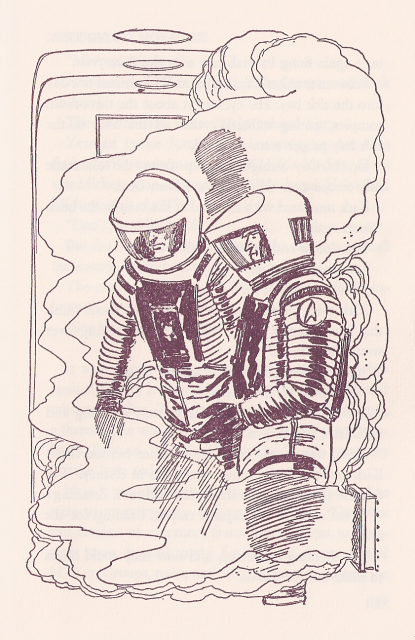

On the way back to Earth the Enterprise comes under another threat when many of the crew develop symptoms of cafard and at the same time a pet mouse by the name of Mickey has escaped into the bowels of the ship and the nigh-forgotten disease of Bubonic Plague threatens to break out. Dr. McCoy marshals all the forces of the Enterprise to at first gas the mouse and later work diligently to find it. But then reveals all of that was a stung to give the weary space travelers a mission to forestall progression of cafard. On that note this briskly paced saga comes to an end.

This is a rousing little saga with lots of changes of setting. The use of three planets visited in such quick succession gives the tale a Gulliver-esque quality as we are clearly meant to compare and contrast these three extreme attempts to organize society, none of which the Enterprise crew finds ideal, hence their eagerness in spite of the Prime Directive to take steps to alter each one of the cultures in turn. Kirk mentions "Special Order Number One" a lot, but he and his crew don't seem at all limited by its mandate, which was much like the show itself to be honest.

The three cultures also suggest something about how the writer might feel about certain drop-out cultures and other aspects of the late 60's. The back-to-nature society in particular reminds me of a hippy commune on the extreme, an utter rejection of modern convenience in an effort to achieve some Thoreau-like ideal balance with the natural world, but here shown to yield a superstitious backward society. The religious planet feels very much like a cult in which the practitioners are blind to the abuse of the leaders who are merely using the devout belief as a means to gain power over a passive culture, the drug in question being LSD makes the comparison even more exact. And finally a totalitarian military society in which the majority of the population are reduced to soulless zombies merely designed to wage war might indeed be an indictment of the way wars are often fought.

Whatever the case, Mission to Horatius is a fun and quick read. Highly recommended to anyone who like me likes these artifacts dedicated to a series which has since become all-consuming.

NOTE: This is a Dojo Revised Classic Post. 

Rip Off

Friday, February 3, 2023

The Space Eagle - Operation Star Voyage!


After a small wait of forty years or so I got to finally read the second Space Eagle book from Jack Pearl. The first Whitman novel starring the Space Eagle fell into my young clutches and I absorbed it at right the same time as I was discovering comic books like The Flash and Captain Marvel and getting to see flicks like Planet of the Apes. It was a Doc Savage-esque story of space exploration melded with Bondian intrigue and and derring-do. 

The hero Paul Girard through use of a Faster-than-Light spacecraft called the SWIFT and some gimmicks and disguises infiltrates a madman's lair and saves the world from utter atomic destruction. In this sequel Paul Girard and his genius twin sister Julie are back. She developed the SWIFT based on the work of a Russian defector scientist, and this scientist tips off the government that the Soviets (the Cold War still rages in this alternate future) are about to master FTL flight themselves using "Spartanium" the rarest of metals found only behind the Iron Curtain and a small particle of which powers the SWIFT. Paul adopts a disguise, goes behind the Curtain and infiltrates the prison camp that masks and mines the ore. He finds out the threat is real and that the source of the Spartanium is an ancient giant meteor. He returns to the U.S. after some gunplay and prepares to head to Alpha Centauri, the only place where Spartanium is found in the spectrum. 

He takes with him Samuel Aarons, a giant but gentle black man who is also a family friend. They go into space and using the FTL drive go almost instantaneously to a planet named Mega-3 where the Megans are not all that happy to see them. The Megans explain in fuller detail to the relatively witless humans the details of FTL transportation but uttlerly refuse to give the primitive humans anymore dangerous Spartnaium. As it turns out the Megans are all too familiar with us, having visited us in those pesky UFOs for quite a while. They do though after becoming convinced of the Space Eagle's virtue, and impressed with a speech given by Sam give the humans another element called Xenon that will make Spartanium useless. The Space Eagle and his deputy return to Earth but before they can make landfall they are intercepted by Space Pirates led by Luchesi Muta who survived his apparent death in the first novel and now wants the get the FTL drive for himself. Ultimatley Paul and Sam escape and defeat the pirates and attempt to drag their space ship the Ming 5 along with in an FTL jump, but the pirate ship is lost in the mists of time. The Space Eagle returns to Earth, seeds the Xenon in the clouds which destroys the Spartanium mine by rendering the mineral useless and the world is safe from tyranny once more. 

Pretty dang good stuff. The story this time did seem somewhat more outlandish, losing a bit of the spy intrigue of the first one. But the sci-fi elements are ramped up for sure. The Megans are pretty stereotypical aliens -- tiny pale eggheads -- and the whole trip to another solar system is presented in a somewhat bland way. The spectacle of the first novel is lost a little in the mad dash of this plot. The return of Luchesi at the end was a neat surprise, but it might've been one detail too many in an already crowded plot. Nonetheless, this is a slam-bang entertaining novel, and well worth the forty-year wait.

NOTE: This is a Dojo Revised Classic Post. 

Rip Off

Thursday, February 2, 2023

The Space Eagle - Operation Doomsday!


The Whitman novel The Space Eagle - Operation Doomsday was a big influence on my young self. The novel was written by Jack Pearl with illustrations by Arnie Kohn. The idea that "superhero" adventures expanded beyond the comics was enlightening and gave me a broader perspective about the nature of genres. Also, it plugged into neatly the very real excitement of the times, an era when the Moon landing was imminent and the exploration of space a real and thriving possibility. We live in less exciting, more mundane times now having given up the thrill of exploration for more prosaic pursuits. The Space Eagle remains a neat tie for me to all that excitement. 

Let reprise the plot briefly. Paul Girard and his sister Julie are twins in command of a large R&D conglomerate that has ties to space travel and cosmetics of all things. Paul is a famous handsome adventurer well-liked by almost everyone. His sister is a genius researcher who prefers the lab to the broader world. After using an experimental faster-than-light spacecraft to rescue some scientists stranded in orbit, Paul is called upon by the President of the United States to be a defacto Marshall of space. This is a world still ruled by the Cold War which has spread into the very cold reaches of space and the colonies established there. Paul takes the challenge and adopting the identity of Space Eagle he uses the SWIFT (his FTL ship) and other scientific breakthroughs from his sister to fight dark menaces. 

The first he is called upon to battle is a mad doctor named Luchesi who plots to use nuclear missles to draw the Superpowers into a conflict leaving him and his ilk to sort out the aftermath. Using special chemicals Paul adopts the role of Luchesi's son to infiltrate the hidden Himalayan lair and after much activity overcomes Doctor Luchesi and his robot agent. The Space Eagle then uses the SWIFT's ftl capabilities to effectively stop time enabling him to end the threat of the nuclear weapons stalling the threat to the world. As the story ends, he and his sister wait the next challenge. 

It's good rousing stuff. Paul is a blend of Doc Savage, The Avenger, and Flash Gordon with a healthy dose of James Bond dashed in too. The story is brisk and involving, offering up some neat suspense. The dilemma is worthy of a superhero and demands both physical skills and dexterity of mind. That's probably what I like most, the Space Eagle must solve most problems with his mind, or the mind of his sister through her special weapons and potions. It's a heady brand of adventure. There's a second novel in the series, and that will be subject of tomorrow's post. 


NOTE: This is a Dojo Revised Classic Post. 

Rip Off

Wednesday, August 26, 2020

Flash Gordon - The Movie Comic!


Flash Gordon had been one of the most popular and well-crafted comic strips of its or any era. Not the first of the space stars in comics (Buck Rogers gets the nod) Flash Gordon was the most accomplished and beautiful. It made a tremendous impression on those who saw it, and the folks at Universal made it even more famous when they cast Buster Crabbe as Flash in a trio of serials which drew heavily from the Don Moore and Alex Raymond source material.


But there came a time when a new Flash Gordon was, if not needed, then certainly sensible. Star Wars had lifted the style and substance of the old sci-fi serials and created a blockbuster success in the cinema. Vintage sci-fi properties such as Buck Rogers and Star Trek were dusted off and given a new big screen gloss. So it was only logical that Flash Gordon would get the nod, and that nod came from Dino DeLaurentis, the most flamboyant producer from an era keen with flamboyant movie figures.


Whitman (Western Publishing) had the rights to Flash Gordon in comic books when the movie landed and did a dandy job of adapting it to the comics form. Actually it's difficult to think how they might have improved. Landing ace Flash artist Al Williamson to draw the comic made it an instant classic. I've read that the artwork to the adaptation by Williamson was physically stolen and it's at least comforting to realize that the thief had such good taste, if not morals. The story was published in big book by Western and then divided up for the comic series itself.


Given the company's history with licensed projects and photo covers (mostly back in the days of the collaboration with Dell) it's not suprising that they put out photos of the stars on the covers, though leaving plenty of room for the artwork itself.


Williamson's take on Flash is perhaps more serious than the movie itself, his art creating a sense of realism that the bright color scheme of the film among other decisions intentionally avoids. Many of the campy details are gone, though no significant plot points are changed. I did much appreciate that Dale Arden has her raven tresses back. The strongest difference is the ending in which Flash collects Ming's ring and there is not last moment suggestion that the tyrant might well return.


Bruce Jones wrote this adaptation which does a remarkable job documenting a movie in a time when the movies themselves were coming into the hands of the consumer. Once upon a time of course these comics would have been the only practical means to relive the experience of the film save for its releases.

Rip Off