The way the Weirdworld stories tumbled out bit by bit from Marvel during the late 70's and into the 80's shows at once the durability of the concepts and the abiding patience of creators who know they have something special to share. Weirdworld was lucky to have some excellent artists in its time such as Mike Ploog, Alex Nino, Pat Broderick, John Buscema, Rudy Nebres, and Marie Severin among others. It seemed that each time a Weirdworld story managed to surface it offered a somewhat different take on the totally peculiar environment which at once evokes the arch danger of Middle Earth by Tolkien and the sardonic whimsy of Wonderland by Carroll. The Weirdworld stories hold up exceedingly well, better than many such works that evoke the Tolkien feel. Moench says he wasn't influenced by The Lord of the Rings and certainly this is not a copy, but details in both do make you scratch your head. Great stuff!
Weirdworld is one of those very special comic book projects that likely should not exist. Its origins are so odd and its development so dependent upon happen chance that I'm surprised it was ever produced. Doug Moench, the creator of
Weirdworld and the only writer for the stories, came up with the concepts when he was just beginning as a writer and proofreader at Marvel. He needed some extra cash to help with his moving expenses to New York City and so he was offered the chance to pen a few back up horror tales for Marvel's black and white mags. One of the stories which came to him didn't fit that premise at all, but rather was an offbeat fantasy yarn, a story with remarkable charm but no apparent market.
"An Ugly Mirror on
Weirdworld" was recognized by the editors at Marvel as being something special and Mike Ploog was assigned to draw it, an inspired choice. The story is about a misfit elf named Tyndall who is assigned by the local dwarf leadership to seek out evil and extinguish it. He journeys into mysterious lands and faces weird and dangerous threats only to eventually find an egg inside the bones of an ancient creature. The egg hatches and revealed is a lovely maiden, an elf like himself named Velanna. They realize that they belong together, and the story ends on a happy note. The story Tyndall and Velanna then languished for a couple of years waiting its chance for publication and a larger audience than the halls of the Marvel offices. Read the story
here.
That chance came in a one-shot mag called
Marvel Super Action. The mag featured Marvel's breakout crime-buster Punisher and no mention is made on the cover of the sweet little story tucked away inside those pages.
Weirdworld was unleashed. And it made a palpable hit on the audience.
A second story "The Lord of Tyndall's Quest" was written, this one once again illustrated by the remarkably talented Mike Ploog and perfectly inked by Alex Nino. Moench's yarn tells the further story of the elf Tyndall and his new-found companion Velanna, the elf from an egg. They fall into the clutches of a wizard named Grithstane who sends Tyndall on another quest, this time into the sky itself to the floating weird ring-island named Klarn (Tyndall's home supposedly) which casts a shadow on
Weirdworld. This shadow is a breeding ground for evil. Tyndall finds a maiden about to be sacrificed but who is in fact a monster and he escapes with his life. He defeats Grithstane and saves Velanna and the pair once again appear to live happily ever after. Read it
here.
This story got a berth in
Marvel Premiere, again after languishing for a few years. Two memorable stories, and many more moons and it appears that
Weirdworld will be no more. But that's not true at all.
Marvel Fanfare was a really odd comic book. An upscale production, it was positioned strangely in the direct sales marketplace because it used stories generally deemed not good enough (for whatever reason) for publication in a regular Marvel comic and gave them a high-end and glossy presentation. Lots of great stuff appeared in its pages, but all of it had a kind of orphan quality to it.
No less was this case with the three issues of the comic dedicated to
Weirdworld. You have to understand that this was published in 1984, but the stories contained in these three issues were produced long before, back in the late 70's, and I assume an abandoned project since the saga of
Weirdworld had exploded in other directions under other hands in high-profile ways, but more on that next time. I'm covering this story here because in terms of what passes for continuity it comes next, though readers weren't treated to it for many years after its sequels. (And this is how it's presented in the recent trade volume.)
Doug Moench is back writing his distinctive creation as is artist Mike Ploog, at least for the first chapter. The second two issues are both drawn by Pat Broderick, an artist of no small reputation. Broderick is ill-served here simply because for all his skill, he is a decided step down from Ploog on this kind of material. Superheroes it might've been a different story, but for high-fantasy Ploog had a special panache.
In this story we meet
Mud-Butt, twice. What I mean is that the seminal character of Mud-butt underwent a profound physical change between the first and second chapters of the story. Mud-Butt is a dwarf malcontent and thief. Tyndall and Velanna throw in with him when they defend him in a bar fight. The trio then head off to confront the wizard Lord Raven who has send Goblins and other monsters to recapture a prize Mud-Butt had stolen from him. The true nature of the item is revealed in another tale. The trio run from and confront goblins and other weird creatures as they rush into and out of dimensional doors taking them all across
Weirdworld. Ultimately, they save the day and defeat the villain, but we knew that already.
This seems like a good time to address one of the understandable but apparently untrue notions about
Weirdworld. According to Doug Moench, the story was not inspired by J.R.R. Tolkien's
Lord of the Rings saga which had taken the world by storm. Moench claims he never read the stories, save perhaps for
The Hobbit before he'd written
Weirdworld. I choose to believe Moench when he says he was not riffing on Tolkien. But someone in editorial sure noticed the similarity.
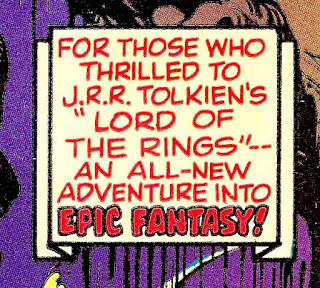
That Marvel quite wisely used the similarity to advertise and promote the Weirdworld stories is understandable and of course suggests to almost any audience that the work was inspired by same, even if that's not the case.
This is the blockbuster! These three very "super special" magazines collectively titled
Warriors of the Shadow Realm, but part of the longer series
Marvel Super Special are among the most beautiful comics ever produced in the genre. That the covers of all three are so riddled with copy and hype that they almost hide the beauty is regrettable, but back in the day a fan took what a fan could get. In this case what a fan got was a potent new way to publish beautiful artwork, giving it a painterly feel for Doug Moench's writing, but still maintaining the verve and energy of a classic comics page. The artists involved were Rudy Nebres (inks), Peter Ledger and Steve Oliff (paint and colors) and most importantly "Big" John Buscema (pencils).
If it were possible to worship an artist, my god would be John Buscema, He was simply the finest comic book artist of his generation and is in a league with Hal Foster and Alex Raymond. Famously disdainful of the superheroes he drew so many of, he took the
Conan franchise made popular by the exquisite and increasingly baroque artwork of Barry Windsor-Smith and toughened it for the long haul. I consider Buscema's Conan the definitive version, even surpassing the transformative version by Frank Frazetta. Only Buscema was able to consistently present a Cimmerian who had all the characteristics described so vibrantly by Robert E. Howard, the charisma, the raw power, the nimble agility, and the raw drama. I'd imagine John Buscema was excited to have a chance to do more fantasy when he came to draw
Weirdworld.
The story of
Warriors of the Shadow Realm goes roughly as follows. Be careful there are spoilers. Tyndall, Velanna, and Mud-Butt come across a Savage Elf who is running from some mysterious flying Nightfangers. Later they encounter him again and come into possession of mysterious gems which have the power to evoke monsters in the Moon's light. The Savage Elf dies when the Riders of the five Shadow Riders enter the City of Seven Delights. The trio take the gems to a wizard who tells them of the origin of
Weirdworld and the near-godly figure of Darklens who created the place as a by-product of his war with other gods. The gems contain the essence of the evil Darklens and the Riders are desperate to gain possession so that he might right again. The trio take the gems and later meet a tribe of Savage Elves who have taken the mission long ago to protect the crypt of Darklens so that he might never rise. The wizard betrays them all and takes possession of the gems giving Darklens access to his body but the intervention of a White Wolf, which also seems to be a wizard or more, helps to forestall the threat. In the end
Weirdworld is safe once again, for the time being.
That's the story, at once classic and evocative of many other stories told over the ages. It feels very familiar indeed that small seemingly weak characters prove pivotal in stopping the resurrection of a dangerous sorcerer who threatens the whole world and beyond. It's as advertised, "in the fantasy tradition of Tolkien".
I'm exceedingly glad that I have this story in its original format as the reprint, as grand as it is, falls short of presenting this artwork in its proper from. The story has a number of triptych fold-outs, and the standard comic book page is simply not capable of properly presenting that grand artwork. There is lushness to the work here which at the time was unlike anything else available on the stands. There was
Heavy Metal, and soon there would be
Epic Illustrated, but when this saga hit the stands, it was unique. The depth and quality of the artwork is simply beyond words.
Weirdworld had one final outing (in terms of continuity if not chronology) and that came in Marvel's high-end magazine Epic Illustrated. Alas the series never rated a cover appearance, but here are the four issues in which the final classic
Weirdworld story was told.
"The Dragonmaster of Klarn" brings together many of the same talents who worked on
Warriors of the Shadow Realm, but sadly minus the transformative work of painter Pete Ledger. Instead the artwork here, as delightful as it was by John Buscema, Rudy Nebres and Marie Severin falls short in many respects to the masterpiece which preceded it. I have nothing but massive respect for these three artists, but sadly the sum is less than the parts in these four chapters.
But that doesn't speak to Doug Moench's story which in many ways reveals many of the secrets which have dotted the saga to this point. If the earlier yarns had a Tolkienesque feel, this story reminds me of Michael Moorcock's work especially how it suggests that
Weirdworld is for intents and purposes a massive game board upon which gods of light and gods of dark vie for advantage. Our heroes and their opponents are merely pawns in that great game.
The story begins with Tyndall, Velanna, and Mud-Butt a year removed from their defeat of Draklens. They are living in a Dwarf village but their typical disdain they encounter frustrates Velanna in particular. She as it turns out has come under the spell of yet another wizard Lord Majister, the brother of Draklens. He has formed a crystal vessel resembling Velanna and is slowly filling it up with darkness, a darkness which is also filling up her spirit. She becomes increasingly angry with Tyndall and Mud-Butt as the trio leave the Dwarf village and get drawn into yet another quest, this one to find the blade of the Glorywand, a magic sword which Mud-Butt had long ago stolen the hilt from. They encounter Goblins who surround a mountain in which lives a beautiful sorceress who sends them across vast distances of
Weirdworld to find a hero named Wulfbuck. who has been changed to more resemble his namesake. This quartet work together against the wizard who has transformed his Goblins into a more powerful undead army and ultimately defeat him when Tyndall's ability to command powerful dragons proves decisive. Velanna eventually overcomes the curse, and the heroes end their adventures once again on a happy note.
This story was enchanting, as are all of the
Weirdworld but somehow this one falls a bit flat. I think it's because of the sameness of the story in many respects. While we do discover more about Tyndall's heritage and we do encounter a Velanna who is different, the story is yet one more battle against yet another wizard. Grithstane, Raven, Zarthon, Darklens, and now Majister, all different but all somewhat the same. I'd have liked maybe something a bit different, but that likely is because this time I read all these stories back-to-back, and that's perhaps unfair to Moench's storytelling.
Whatever the case, these are the last classic
Weirdworld stories, and while the world itself seems to have been revived and quasi-fantasy characters like Arkon and the Black Knight have been woven into a brand new and rather different reality. But without the considerable talents the likes of Moench, Ploog, and Buscema, there is little to attract this reader to them.
Weirdworld was a series of special comic book stories produced by special talents at a special time. It's charm never weakens for me.
Rip Off