Showing posts with label Dick Wood. Show all posts

Saturday, April 25, 2026

Solar Reflections - A Whitman Sampler!


In the fourth and final Dark Horse Doctor Solar Man of the Atom volume we find a delightful blend of vintage superhero yarns from across many many years as the series winds down and then gets revived a time or two.

Doctor Solar battles King Cybernoid in all the remaining Gold Key issues of the series, the android with the brain of Solar's longtime implacable foe Nuro. The series loses much of its distinctive science fictional flavor in attempting to achieve a purely superhero tone.

Dick Wood is the writer of record as the series tumbles along and Al McWilliams does one issue before giving way to Ernie Colon who gives the series a lighter touch and a bit more zip in terms of action. Jose Delbo steps in to handle the last issue of the 60's run.


Then in 1980 Whitman (formerly Gold Key) attempt to revive the series and publish for the first time the second part of the Wood-Delbo story which had begun a decade before. After that scribe Roger McKenzie is brought in to craft new stories with veteran Dan Spiegle handling the artwork. The tone of the McKenzie-Spiegle issues is completely different, very much in keeping with the slightly darker tone of comics of the late Bronze Age as Solar battles King Cybernoid for a final fatal time and a dour villain called the Sentinel.


The volume closes out with a blast to the Gold Key past with a singular issue of The Occult Files of Dr.Spektor in which Doctor Solar appears as a guest star to help rescue Spektor from a charge of murder. The story by Don Glut and the artwork by Jesse Santos is quite yummy.

And that's a wrap. Doctor Solar Man of the Atom was a product of the Cold War, when the glamour and effects of the atomic bomb were an all-consuming fascination for much of the world. Starting in 1962, the year of the Cuban Missile Crisis and wrapping up in the early 80's when the Cold War was nearing its final years, the character seems to embody that phenomenon in many ways.


And that's a wrap on Doctor Solar. 


Rip Off

Saturday, April 18, 2026

Solar Reflections - Nuclear Nightmares!


In the third volume of Doctor Solar Man of the Atom from Dark Horse, we are treated to a fully-realized superhero. Gold Key had been reluctant to dive into the superhero pool, clearly showing a disdain for the underwear crowd which commanded so much attention in the field. But eventually they follow the patterns and give us a Doctor Solar who functions in many ways like a hero in the classic modes.

Paul S. Newman, the ubiquitous writer for Gold Key continued to handle the chores on that end and Frank Bolle had successfully taken over the art, if his style was somewhat less dynamic than what had come before. With this team we continue to get stories which are rock solid science fiction such as when Doctor Solar is forced to travel back in time to stop a deadly doomsday device by going to before it began, and later he confronts a sun spun out of control and threatening to destroy the Earth itself.

Then the stories begin to focus more on the machinations of Solar's arch enemy Nuro, an obscure behind-the-scenes villain akin to many masterminds from the Bond films and other such tales. Nuro employs a robot dubbed "Orun", one who'd battled Solar before and makes of him a steady henchman and persistent threat to Doctor Solar. We get a glimpse of Nuro's face after many years of shadows and see that he has a rather porcine countenance. Nothing much is made of this, but it suggests a slight change in the tone of the series.

Those changes continue when Dick Wood takes on the writing and veteran Al McWilliams steps into do some art on the series and we meet Hamilton Mansfield Lamont, who is Gale's nephew. This brilliant young man joins the cast which had long been comprised of love interest Gale and Dr. Solar's longtime boss and confidant Doctor Clarkson and soon becomes a nerdish Snapper Carr/Rick Jones like figure. You can for sure say that the Man of the Atom becomes a bona fide superhero when he gets a teen sidekick.

We also get a new villain, sort of when King Cybernoid is birthed as Nuro's intellect becomes entrapped in the robotic form of his henchman. This new more physical opponent again creates a more pure superhero dynamic for the book and draws it away from its sci-fi roots, though of course those notions still function to supply threats.

Here are the covers of the issues included in this volume.


Next time Doctor Solar really goes through some changes, and we chase the character through the decades of the 70's and the 80's.


Rip Off

Thursday, April 17, 2025

Daredevils Battles The God Of Storms!


First mentioned, to my knowledge at least, in the pages of The Great Comic Book Heroes by Jules Feiffer is the legendary tale of how a Golden Age comic book was created in a single weekend, one in which the survival of the artists themselves was in some meager doubt. The comic book in question is the second issue of Daredevil Comics from Lev Gleason Publishing which hit the stands in the summer of 1941.


This tale has been told in several venues and even immortalized in fictional form in Michael Chabon's The Amazing Adventures of Kavalier and Clay. It kindles the imagination for a number of reasons, one it speaks to the helter skelter nature of comic book creation in its infant days, how raw energy often substituted for craftsmanship and care. How comics are an art, but they are also a product for sale which are fashioned within the demanding rigors of a deliberate and often unforgiving schedule.


Things have changed nowadays with comics having been reduced to a minor art and no longer a true mass medium, but throughout most of the history of the comic book, we fans want our comics to be good of course, but first and foremost we wanted them to simply be. We were eager to buy and publishers were sure to have it available so that the opportunity would not slip by.


I most recently ran across this legendary yarn in the biography Jerry Robinson - Ambassador of Comics, in which the story is told from the perspective of one of the men who was there on that prodigious weekend of March seventeenth.  The story goes that a gaggle of young energetic artists and writers assembled at a sparsely furnished New York City apartment rented for that very reason. Charles Biro has learned that because of a need to use up their allotment of paper they needed a new comic ready for the presses and they needed it by the following Monday. To that end the talent was assembled and given largely carte blanche to create stories to fill the needed sixty-four pages.

Charles Biro would handle the lead feature Daredevil which accounted for the first thirteen pages. After that it was every man for himself as a ferocious binge of creation ignited. Bernard Klein created "The Whirlwind" about boxing, and other talents such as George Roussos and Dick Wood contributed "Nightro". Jerry Robinson himself created "London", a masked hero who was involved with the Blitz. Dick Briefer wrote and drew "Real American". Others did what they could, creating characters, some which would only appear in this single comic, in the mad rush to hit the deadline.

New York City under snow in March, 1941

The story then takes a dangerous turn when, while the artists are furiously creating in the apartment a heavy winter storm strikes the city, closing down everything save the subways, and forcing stores to close. Getting something to eat was problematic, and Bernie Klein was sent off into the white wastes to find sustenance. He returned hours later with only some eggs and a can of beans. The artists desperately pried loose ceramic bathroom tiles and created a fire to cook the eggs and heat the beans, which staved off fits until the streets quickened with life once again.

Needless to say, the book was completed and assembled and sent to the printer on time. This story shows not only the ruthless nature of publishing but also the wild bristling energy which informed the earliest days of comics, an art form still in its infancy and eager to please the audience which fondled it with such devotion.

The story is made more poignant in that Bernie Klein, a talent with much promise was one of those multitude of young men who lost their lives defeating the Axis powers on the battlefields of Europe. His death made all the more tragic, because as the legendary weekend showed he was like so many of his peers a man filled with spirit and life.


Daredevil must break out the boomerang and confront an evil from ancient history when a deadly mummy is revived. Charles Biro presides. 


Terry Turner is a powerful boxer, but he might have met his match in Jean Jacques, a savage lumberjack. Dick Wood and Bernie Klein do the honors.


Nightro isa rather nifty version of Dr. Mid-Nite when Hugh Goddard is blinded in a radiation accident. He can see in the dark thanks to special lenses and mops up the criminals who attacked him. Dick Wood writes and George Roussos draws this one. 


Dash Dillon at Hale (not Yale I notice) is a sports natural and is recruited by a young woman to join the team and save the season for her school and her dad, the coach. Ed Ashe is both writer and artist. 


Pioneer is a naive young man who lives in a remote valley and is lured to civilization by some thugs who see riches. He turns the tables. Bob Woods wrote this one for Jay Gahr. 


The Bronze Terror is "Real American #1". He's a denizen of the Indian territory and uses his strengths to save the chief from villains who want to prey on the people. Dick Briefer is man for this one. 


London is the hero and London is the place where a brave young man fights against the Nazis for the sake of us all. This one is all Jerry Robinson. 


Pat Patriot is born when a brave young woman stands up for her overworked companions and discovers a smuggling ring. Bob Wood likely wrote and Reed Crandall might well have drawn it. 


The Claw is in fine malicious form as he steals a train and all the men aboard it. He tries to blackmail the government, but one brave man has an idea which might defeat the towering menace. This one is by Bob Wood

To read this epic iconic comic in its glorious totality check this out. They don't make like that anymore.


I enjoyed this wild yarn in the pages of The Original Daredevil  Archives. Tomorrow. we back things up a bit, as the Dojo takes a look at the debut issue of this comic book series. 

Rip Off

Saturday, February 17, 2024

The Phantom - The Charlton Years Volume One!


The folks at King Features discovered making comics was harder than they suspected, so after a year or so, they licensed their characters back to a full-time comics firm, this time Charlton got the nod. Charlton Comics was notorious then and now for its pecunious ways, but they were a company which had been making comics since the Golden Age and with the collapse of the "Action Hero" line, they needed heroes. Enter the Phantom. 


In a move which is pure Charlton, they picked up the numbering of the series with issue thirty, which meant they skipped over twenty-ninth. For whatever reason, this gap exists in the run. The cover for issue thirty above is by Frank McLaughlin the talented penciller and inker who created Judomaster. 


Above is the artwork which would have been the cover for issue twenty-nine. Another lift from the work of Sy Barry. 


And here is a fun creation by fan Jim Keefe, a faux issue twenty-nine to fill the imagination. The actual contents of the first Charlton issue were two stories, the first by artists Jose Delbo and inker Sal Trapani for "The Secret of the Golden Ransom" written by Pat Fortunato. This is an adaption of a story from the comic strip. The second Phantom story is by writer Gary Poole and artist McLaughlin and is titled "The Secret of the Phantom".


With issue thirty-one Charlton really puts their stamp on the character for all time by assigning artist Jim Aparo to the character. Aparo's run on the character is still very well thought of by Phantom fans. Aparo is joined by writer Dick Wood on a story titled "The Phantom of Shang-Ri-La". I love this first Aparo cover, as he makes the Phantom into a veritable giant, chiseled from the mountain. The Ghost Who Walks had always been presented in a sleek manner, but Aparo gave the character an imposing muscular presence. 


In issue thirty-two things get even weirder as The Phantom has to contend with a character rising from an Egyptian tomb and claiming to be the original Phantom who helped Cleopatra among others in ancient times. The battle between this "Phantom" and our own sturdy hero is a rugged one indeed, with the Ghost Who Walks getting more than a few shocks before it's all said and done. Is "The Pharaoh Phantom" for real? I'll let you guess. 
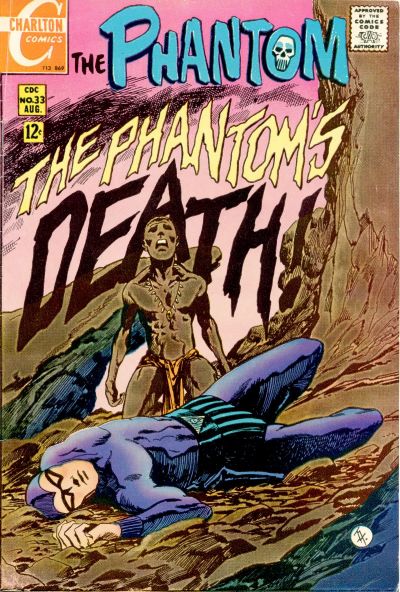

Issue thirty-three gives us two Phanton stories. The first story is titled "The Curse of Kallai" and in this Dick Wood written tale a killer cult comes to the Deep Woods to get the Phantom who they think is responsible for their success many years before. They are of course wrong and suffer in this tale drawn by Pat Boyette with Nicholas Alascia on inks. The second story begins with the Phantom falling to his "death" and then we see the consequences when thugs imagine they've actually done in the hero. It's no great surprise when the Ghost Who Walks, walks in and confronts the villains. This story was drawn by Aparo and written by Steve Skeates. 
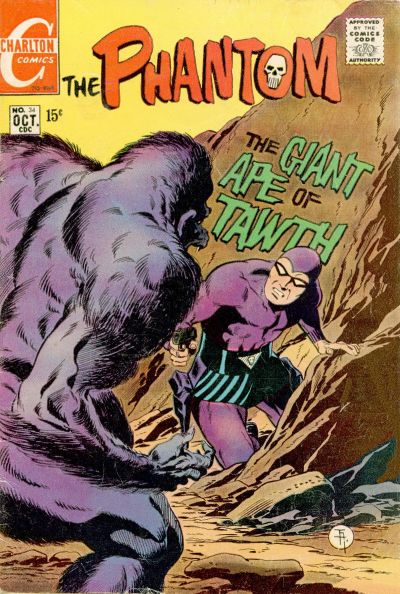

In both stories in this issue the Phantom must contend with madmen. First in "The Cliff Kingdom" a brother and sister have their plane crash amidst a peaceful people, but the brother is driven mad and uses the people as his personal army. In the second story an anthropologist is obsessed with the apes of  Bengalla and when he is saved by the Phantom from a deadly attack by a bull ape goes mad and assumes his role. Jim Aparo is top form in both these tales written by D.J. Arneson under his "Norm DiPluhm" name again. 


"The Ghost Tribe" is apparently the story originally intended for the lost issue twenty-nine and sees the  return of Bill Harris and artist Bill Lignante to the Phantom pages under a sleek Aparo cover. This tribe seek to imitate the Phantom but instead of peace they bring discord. The Phantom must disguise himself to get to the bottom of this latest threat to the Deep Woods. 


Aparo and Arneson return with issue thirty-six with two stories. The first titled "The River that Never Ends" finds the Phantom and some allies swept into a maelstrom which descends into an isolated cavern. It's all he can do to find a way out when pirates attack the area to boot. "Very Special Timber" is about diamond smugglers who use a sawmill to make special logs to carry their booty out and away from suspecting eyes. It doesn't take the Ghost Who Walks long to break up this scheme and free some natives suspected of the crimes from false imprisonment., 
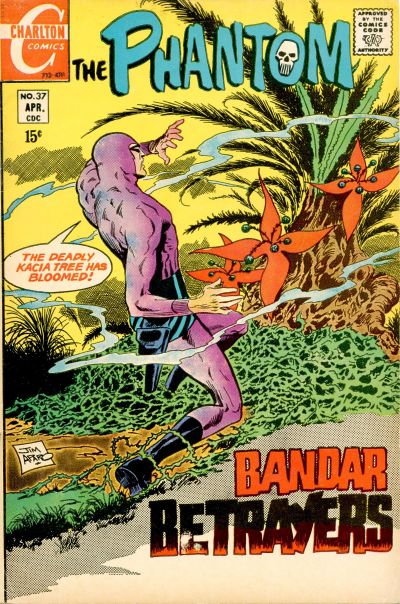

When Charlton first took control of the comic, we got long Phantom tales taking up a complete issue. Then it shifted to two stories per issue and by this time the new standard seems to be three complete Phantom tales in each issue.  I enjoyed the longer stories, but these vignettes have virtues as well. The regular team of Aparo and Arneson are still in command. The first of the three stories is "Bandar Betrayers" and has the loyal warriors attack the Phantom because of the blooming of the Kacia Tree which sends a scent that makes men turn on their allies. It's up to Hero and Devil to save the day. "Skyjack" has the Phantom intercede in the middle of a skyjack by pretending to be an ally of the skyjacker. It's up to Diana Palmer to whisk him away after this one. "Disband the Patrol!" is a strange story in which to improve discipline and moral the Phantom issues strange orders to the Patrol to see how they perform. 
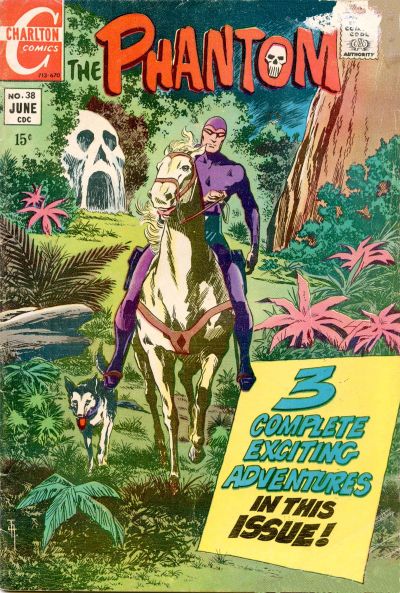

We get three more stories in issue thirty-eight. This is Jim Aparo's final issue, and he leaves the Ghost Who Walks with a stunner of a cover. Aparo's style has been shifting throughout his run on The Phantom, becoming sleeker and more refined. Aparo was already drawing Aquaman for DC when he was still working on The Phantom, and you can see the same shift on style there. It is this style he will use on the pages of The Phantom Stranger and The Brave and the Bold. "The Dying Groud" has the Phantom trussed up in an elephant graveyard as the natives are upset that their ivory is being poached by woodcutters and they blame the Ghost Who Walks. "The Phantom's New Faith" shows the Phantom with a rare moment of doubt as he reflects on the great achievements of his forefathers. But when a volcano erupts, he gets his chance to do the deeds he necessary to carry on the heritage. "The Trap" features Diana Palmer as she comes to Bangalla to catalogue art treasures. She doesn't realize she's being followed by thieves. 
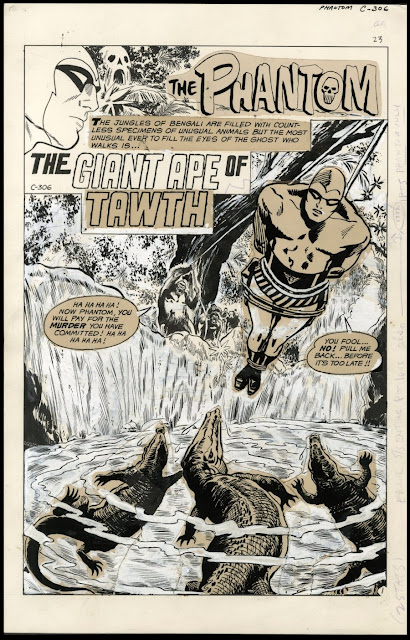

This Hermes volume features a number of pieces of original artwork by Aparo, making this tome a worthy testament to the skills of one of the best talents in comic book history. I've not mentioned it, but Aparo almost always insisted on lettering the artwork he produced and this practice, much in evidence in these stories, gives them a distinctive character unlike anything other folks were doing save perhaps for Pat Boyette. 


And that's ironic since Boyette will be Aparo's replacement on the comic, but more on that next time. 

Rip Off