Showing posts with label John Romita. Show all posts

Friday, May 15, 2026

The Pocket Book Spider-Man!


These three Pocket Book volumes featuring vintage Spidey stories came out from 1977 through 1979 and offered up those choice Lee and Ditko classics in a handy diminutive format. Despite the Johnny Romita covers for the last two volumes all the interiors are vintage Ditko. 

Rip Off

Tuesday, October 21, 2025

Lost Marvels - Tower Of Shadows!


In the summer of 1969 Marvel decided to spread its wings and attempt to return to making magical mystery comics as they had done less than a decade before. The supernatural was popular again, so much so that the Comics Code had done little when DC brought forth a truly scary The House of Mystery under Joe Orlando's editorial control. DC was onto something and Marvel wanted a taste. To that end they announced two new titles -- Tower of Shadows and Chamber of Darkness. Fantagraphics attempted to reprint Tower of Shadows but is only able to do so in an incomplete form. For some reason two stories based on H.P. Lovecraft stories were not able to be reprinted, much to the detriment of this otherwise handsome volume.  
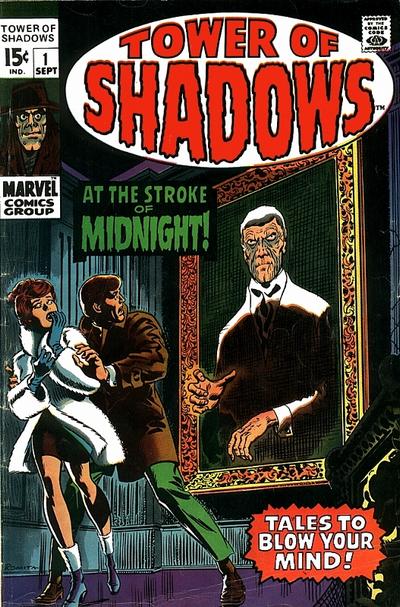

"At the Stroke of Midnight!" by Jim Steranko is the first and the best story in the series. Steranko was at his very best, offering up a haunted house story that fragmented time for the characters and the reader as well.  "From the Brink!" by Johnny Craig gives us a dandy tale of a man who is seeking to root out fake mediums and then he finds a real one. "A Time to Die!" by Stan Lee and John Buscema and Don Heck is a tale of a mad scientist and his even madder assistant and what happens when the former discovers the secret of immorality.  Cover by John Romita, replacing one by Jim Steranko which Stan Lee rightly deemed in my eyes as less effective. 
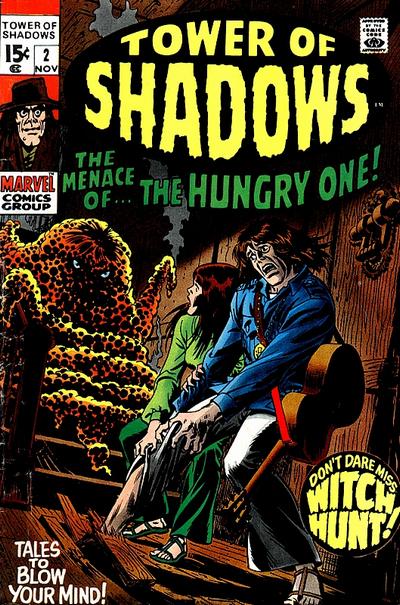

"Witch Hunt!" by Roy Thomas, Don Heck and Dan Adkins tells the tragic story of a man looking for witches but gets surprised when he finds something else. "Look Out, Wyatt -- Automation's Gonna Get Your Job!" by Gary Friedrich, John Buscema and John Verpoorten is a story set in a mine where men fear machines will take their jobs, but one man finds that fear ends up threatening them even more. "One Hungers" by Neal Adams and Dan Adkins has a few hippies uncover a voracious menace from across time.  Cover by John Romita for the Adams story. 
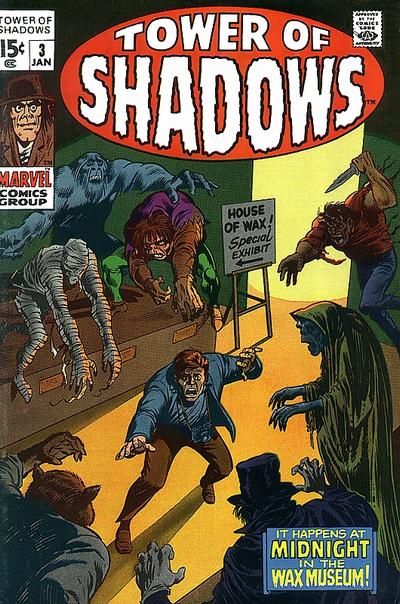

"The Moving Finger Writhes...!" by Len Wein, Gene Colan and Mike Esposito is the story of a man who is a failure until he finds a special book which lets him glimpse the future, but what's there is both wonderful and terrible. "Midnight in the Wax Museum!" by Gary Friedrich, George Tuska and Marie Severin features a reporter who wakes up one day and discovers a house has appeared from nowhere and then he finds aliens. "The Terrible Old Man!" by Roy Thomas and Barry Windsor-Smith finished this issue but sadly is not in this collection. Cover by Marie Severin for the Friedrich and Tuska tale. 
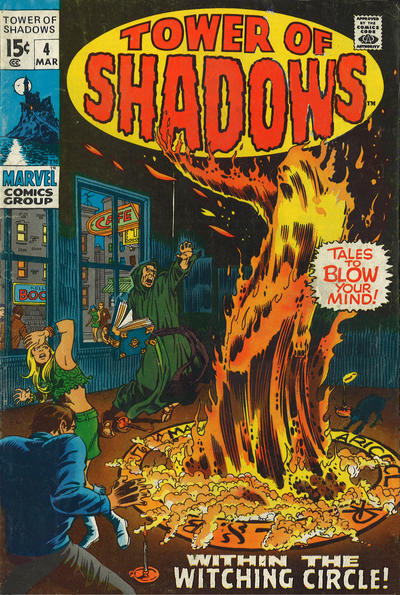

"Evil is a Baaaaad Scene!" by Allyn Brodsky and Don Heck has two hippies seeking cheap thrills but find more than they bargained for when they let an evil mystic cast spells in their apartment. "One Little Indian!" by Marv Wolfman, Gene Colan and Dan Adkins tells the story of a cruel man who is cursed and is warned to avoid Indians, which he tries to do. "To Sneak -- Perchance to Dream!" by Tom Sutton is a sequel to a Chamber of Darkness story in which two spies occupy a living house in order to blow up a plutonium plant. Cover by Marie Severin and Herb Trimpe for the Brodsky and Heck tale. 
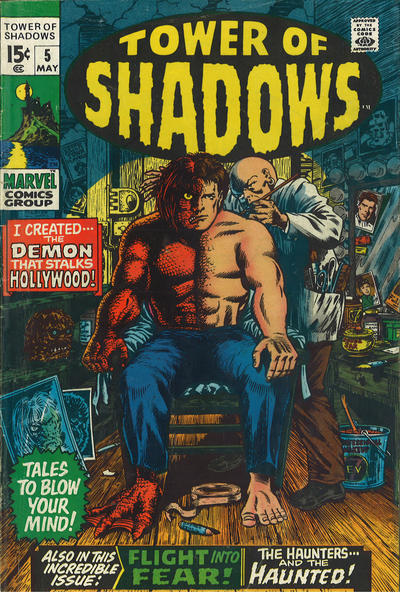

"The Demon that Devoured Hollywood!" by Roy Thomas, Barry Windsor-Smith and Dan Adkins is about a famous horror film actor famous for his make-ups, but who has a terrible secret which ultimately destroys him. "Flight into Fear!" by Wally Wood tells of a lame young man who falls asleep on a gargoyle and before you know it finds himself a giant in a land of people needing a sword-wielding hero. "Time Out!" by Gerry Conway and Syd Shores gives us the story of a desperate couple who find themselves locked in a haunted house, and they lose something but gain something as well. Cover by Barry Windsor-Smith and Bill Everett for the Thomass-Windsor-Smith story. 
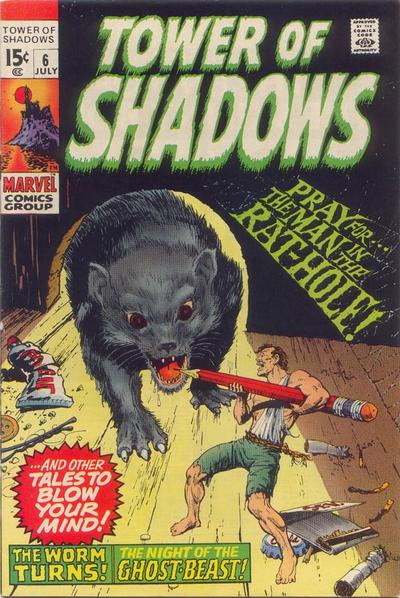

"The Ghost-Beast!" by Wally Wood is another sword and sorcery story in which a character named Beowulf fights a deadly monster, but it turns out he is a menace as well. "Contact!" by Tom Sutton is a two-page bit of fun about a power-hungry old man who makes contact with aliens, much to his regret. "The Scream from Beyond!" by Steve Skeates, Gene Colan, and Dan Adkins tells the story of an evil man who causes crashes to record the sounds, but who finds a sound he doesn't want. Cover by Marie Severin for a reprint story "Man in the Rat Hole!" by Stan Lee and Steve Ditko. (Not in this collection.)
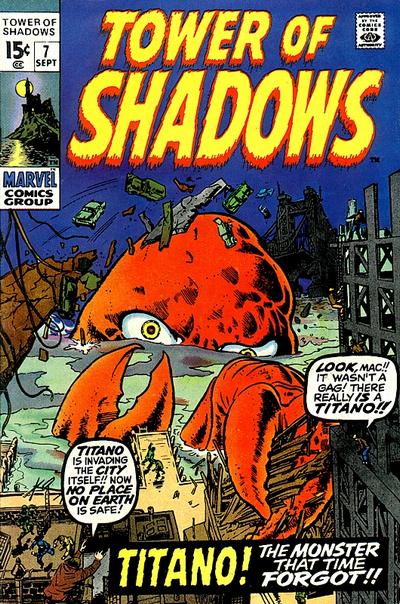

"The Scream of Things" by Allyn Brodsky, Barry Windsor-Smith, and Vince Colletta is about a researcher and an evil girl who find more than they can handle in a cursed mansion. "Of Swords and Sorcery!" by Wally Wood is another sword and sorcery effort, this one filled with an evil sorcerer, an elf, and a transformed dwarf in addition to the usual hero and damsel in distress. Cover by Jack Kirby, Steve Ditko and Marie Severin for the reprint story "I Was Trapped by Titano, the Monster the Time Forgot!" (Not in this collection.)


"Sanctuary!" by Wally Wood is yet another sword and sorcery tale about a man who would be king and seeks a crown in a forbidden place. Cover by Berni Wrightson for the Wood tale. The rest of the issue is comprised of reprints featuring artwork by Steve Ditko and Don Heck. (Not included in this collection.)


"Pickman's Model" by Roy Thomas and Tom Palmer. Cover by Berni Wrightson. The balance of the issue was filled with work drawn by Don Heck and Jack Kirby. Only Wrightson's cover is included in this collection. 


This one-short King-Size Special cover by John Romita is included as well. 


Here is Jim Steranko's rejected cover for the debut issue of Tower of Shadows. It's an awesome piece of artwork, but I have to agree with Lee that Romita's was likely to sell more books. 


With both Tower of Shadows and Chamber of Darkness, Marvel wanted to tap into that EC horror host vibe as both Warren and DC had done. To that end they created Digger, above seen in a distinctive outfit by Steranko. 


John Buscema renders him in his more traditional look for the third story in the first issue. Buscema's version is less offbeat but creepier. 


Digger shared hosting duties with the official host of Chamber of Darkness, one Headstone P. Gravely. Both Digger and Gravely show up in the early issues of Tower of Shadows, but soon Marvel lets them fade away in favor of letting the artists introduce their own tales. I hated to see the hosts go, but using the real talent was actually quite in keeping with Marvel's general trend of promoting that talent for the fans. 


Tower of Shadows changed its title to Creatures on the Loose and became a home to more vintage monster stories from the Atlas days and sword and sorcery, specifically Marvel's first King Kull story by Berni Wrightson, and later Gullivar of Mars by Gil Kane and Thongor of Lemuria by a host of talents. Man-Wolf finished off the series. But for all that, I never forgot Tower of Shadows and really enjoyed this chance to tumble into its pages again. 

Rip Off

Saturday, March 1, 2025

A Hero For Hire!

(The dates for 1975 and 2025 are identical.)


I've always cottoned to comic book stories that deal with the logistics of vigilantism. The classic Fantastic Four story when they go broke and end up working for the Sub-Mariner at his movie studio is a delightful story which points back to the real world as most good stories do. The Avengers from time to time have had stories which mentioned the stipends the heroes get while they serve among the ranks. But no Marvel story hit on the economics of heroism more directly than Luke Cage, Hero for Hire. The Epic collection of Luke's earliest adventures emphasizes his name but when the comic first started to show up on comic book spinner racks it was "Hero for Hire" that branded the comic most forcefully. 


We meet Lucas when he is an inmate at Seagate Prison and he's there for a murder he did not commit, the murder of his beloved. His former compadre "Diamondback" set him up and now he stews about his unfair situation while using his fists to defend himself. He's offered the chance to participate in a lab experiment conducted by a Dr. Burstein and it turns out to give Lucas a steel-hard skin and enormous strength and endurance. He literally busts out of prison takes on the ironic name of "Luke Cage" and decides to help those who need help but for a price. Luke cuts a striking figure on the debut cover by John Romita and that look with the blue (black?) descending into his boots is the ideal. He looks rather like Fred Williamson. 


In the second issue he gets his revenge on Diamondback and makes it known to the criminals of Harlem that a new hero is on the block. This is "blaxploitation" at its finest, a yarn about an angry black man who has complicated issues with the civil authority and who seeks to do good but must needs look for himself in the bargain. These early issues really evoke that Shaft vibe. 


By the third issue he's fighting a mercenary named "Gideon Mace" and his mob and is not getting much money for his troubles. It turns out not surprisingly that Luke is a much better hero than businessman. Doc Burstein returns to the story and agrees to hold Luke's secret for a time and we also meet a bonafide love interest in Dr. Claire Temple. Mace appears to drown as the story closes. 


The art in the first three issues had been magnificently done by veteran George Tuska with inks by up and coming African-American artist Billy Graham. But in the fourth issue Graham does all the work in a story which has a Phantom haunting the very neighborhood in which Luke keeps his office. It's above a movie theater run by a friendly young kid named "D.W." after the infamous movie director D.W. Griffith. I'm not sure if the writer Archie Goodwin intends to invoke memories of Birth of a Nation but it's hard not to think so. 


Tuska is back in the fifth issue, but Goodwin is gone, replaced by Steve Englehart. This issue features one of Luke's most memorable villains, the robust "Black Mariah" who runs an ambulance scam in NYC. 


Graham takes the lead again with inks by Al Williamson for an indifferent product. The story too seems off the beaten path as Luke goes to the suburbs to battle armored ghosts in a story about a dangerous inheritance. 


One of my favorite Cage stories from this era is the delightful and dangerous Christmas yarn that Englehart and Tuska spin which weirdly evokes A Christmas Carol and Dr. Strangelove at the same time. 


Then we are treated to a nifty two-parter when Luke comes up against Marvel's top baddie, Doc Doom. First Cage is hired by Doom to chase down some errant robots hiding in Harlem but when the Monarch of Latveria tries to stiff Cage on his fee of two hundred bucks, the Hero for Hire hops over to the tiny kingdom to get his pay. The FF make an appearance and give Luke a rocket to get over to Latveria, This is an early effort to bond Cage more tightly to the larger Marvel continuity. 


One of my favorite Hero for Hire villains is "Mister Surete/Mister Muerte" or "Mister Luck/Mister Death". He's a gambling crime boss who depends on his good fortune to defend his casino operations and has a trick where he spins a wheel which charges up one of his hands with deadly electricity. One handshake is all it takes to burn you to a crisp. He's an arrogant villain who cannot understand why Cage keeps coming at him over the course of their two-issue battle. 


One of the more successful villains from this run is "Chemistro" who wields a handgun that can change one substance into another such as steel becoming glass. This Alchemy Gun is a deadly weapon and it's all Luke can do to survive long enough for the villain, a disgruntled ex-employee of a car manufacturer to be hoist on his own petard. Cage's appearance in Amazing Spider-Man is referenced in this issue. 


Luke Cage always seemed to have the most curious and interesting rogues to battle. Not least among them was Lion-Fang, a disgruntled scientist who used his knowledge to share intelligence with large cats and got from them some degree of ferocious energy. Needless to say, it didn't turn out for him in the end. 


The last three issues of Luke Cage, Hero for Hire were comprised of a three-part tale that reintroduced several characters from the debut issue such Shades and Commanche, two inmates of Seagate who escape and try to set up a protection racket. And Luke's arch nemesis Rackahm, the guard to actually was instrumental in making Cage so powerful turns up again, even more repulsive than before. But first Cage has to fight the giant lawyer named Big Ben who is harassing Mrs. Jenks, a woman Cage had done work for in previous issues. 


She ends up getting kidnapped and a reporter trying to blackmail Cage gets murdered by Rackham but Cage's girlfriend Claire Temple gets arrested for the crime. In an effort to clear her he gets into all sorts of trouble. Billy Graham turns in some of his best work while Tony Isabella steps in to script the story begun by Englehart. 


Frank McLaughlin handles the inks over Graham's pencils on the third part which introduces a new villain called "Stiletto". Both Shades and Commanche help Cage put down this baddie and by the end Cage's secret is safe once more, but a few people do have to die. 


Luke Cage (and the boffins at Marvel) decided that he needed a new monicker for his hero trade, so in this issue he ponders several options striking at last on "Power Man" (as in "Black" Power Man I reckon). It's fine and it's worked for him ever since, but I always preferred the more mercenary "Hero for Hire" label. In this issue Luke is duped into trying to steal some Stark armor and battles old Shellhead himself. George Tuska is back on pencils and Billy Graham bids farewell to Cage with a dandy inking job. The newly titled book slips to a bi-monthly schedule with this installment. For me, it loses some of its specialness when they decide to give Lucas a somewhat standard "codename".  


As I reflect on these Hero for Hire stories again, I was struck by the anger Luke feels nearly all the time. He has that office in a low-rent part of NYC and it's a good thing since he destroys the fixtures at least once an issue. Either he does in a fight, or he just loses his temper and smashes something. Luke Cage is a man who has been treated unjustly and is now working outside the law but also in tandem with it to bring villains to some degree of justice, albeit natural justice at times. He's a hero always seeking to treated on an equal basis with the other heroes in Marvel Universe who he perceives as having fewer obstacle in their way in that regard. 


"Blaxploitation" is about giving black audiences heroes they can root for and since many if not most Black citizens at the time were just getting adapted to a society which was just then legally beginning to treat them as regular citizens. It remains an incomplete process alas. Luke Cage, Hero for Hire speaks to that anger and frustration and presents that audience with a superhero who shows his face with pride and demands that he be treated with respect. 

Rip Off

Friday, February 28, 2025

The Lady Liberators And Much More!


This wonderful issue of The Avengers introduced the "Lady Liberators", a one-shot gang of Marvel's most dangerous dames led by the Valkyrie (who was in fact the Enchantress in disguise). 

(Marie Severin's early layout for this dynamic cover.)

It's one of my favorite comic books from one of my favorite runs in the series. The message of "Women's Liberation" is again front and center today as reactionary forces work diligently to claw back rights that women have enjoyed for decades. 

(Parody of the cover by Bob Layton)

Strong women in the public square terrorize far too many Americans who had a chance to elevate a strong qualified woman to the highest office in the land and instead selected a raving maniac and useful idiot for the former Soviet Union. Shame. 


Women in comics have always been a mystery of immense proportions. Comic books have almost always been the singular playground for young boys and later young men. Girls were allowed to read romance comics when those got invented and the MLJ line stays alive even today with its Archie line up. But comics are famously about superheroes and superheroes are for boys. We all know that.


So, when dames show up in the four-colored pages they are either damsels in distress or dames of great danger. This month has featured the latter, those women who are just as inclined to stand on the throat of any malignant mope who might imagine she needed saving. (I won't say whose throat I image they might be standing on.) Enjoy these exceedingly dangerous dames


Death to Male Chauvinism! 

Rip Off