Showing posts with label Sci-Fi TV. Show all posts

Wednesday, April 23, 2025

The Starlost - The Television Series!


I've heard about The Starlost for most of my life, but I'd never seen an episode of this notorious science fiction series. My knowledge was most likely a result of reading and reading about Harlan Ellison, the sci-fi writer who concocted the story this series is based on and who wrote the script for the debut episdoe. The Starlost is considered by some to be the worst science fiction series ever and I can vouch that it's not that.


But the guy who first thought it all up was not happy and was so unhappy in fact that he had his named removed and this standby identity of "Cordwainer Bird" punched in to fill the void. Ellison tells the tale of how he was much abused (Ellison is always much abused in his stories) by the folks who wanted to produce this show and how they made promises they either couldn't or had no intention of keeping. I'll take a look at the novel he made with Ed Bryant some time later which presumably puts forth his rendition of this story. But first here's the show.


We meet Devon, an iconoclastic member of an Amish sect which finds its world oddly circumspect. With a limited territory and a limited sky and a limited population the village uses authoritarian techniques to keep the balance. Devon does not fit in, he wants to marry Rachel the girl he loves despite the fact she is promised to another, his friend in fact, a blacksmith named Garth. Devon's confrontations withe powers result in his isolation but he never relents and eventually discovers that all is not what it seems. This Amish clan is floating in space and they don't even know it.


The first episode shows how Devon begins to find the truth and how when he tries to share that truth with his people he is yet again condemned. The three friends end up outside the society and together begin to learn the real truth of their existence. Some of that truth is that they live on a great Ark, a spaceship which was borrowed from the Bruce Dern film Silent Running.


I didn't find The Starlost to be all that bad, a tendency to be dull but certainly possessing special effects typical of the era. Most of the dullness is in the oddball flat way the acting is done. All the actors seem to do it, to demonstrate general lethargy punctuated by moments of furious activity, so I think it must have been intended.  Perhaps they confused ponderous silence with presumed wisdom, but whatever the case it hurts the viewing. As the series tumbles along it does tweak with its look and premise a bit, and toward the end seems to treat our trio of stalwarts as folks more comfortable with technology. That's natural of course, but it felt more like a reboot than an evolution. I've seen worse.

More on The Starlost tomorrow. 

Rip Off

Thursday, August 29, 2024

The Bionic Woman - Seasons 1-3!


I can tell you one thing -- I hate the theme music to The Bionic Woman. It's willowy and soft and noxious in the extreme. But it does point to how the producers want this bionic TV show to come across, and that is friendly and kind, while still stopping villainy. They succeed in that, but I just wish the music was better. Watching this show through 21st Century eyes, the sexism is stunning. Jaime Sommers is smooched and fondled by just about every guy who turns up on the show. Some are cast as family members, but still and all, let the girl breathe. Lindsey Wagner is the lead and she's excellent.


Season One (1976)

There is clearly an attempt to develop a somewhat different tone in The Bionic Woman. Jaime Sommers has had an incredibly stressful origin story. She was severely, suffered surgeries that replaces her arm, her legs, and one of her ears and then used those bionic enhancements to help Steve Austin, the man she'd been engaged to. The difference was she'd lost her memory, and the return of those memories ignited pain, enough that she died. The she was brought back to life and her memories were almost all gone. For the series she has been rehabilitated and knows the truth of her life. She now chooses to live in her old hometown and teach. She is a classic TV teacher who only ever teaches one set of kids and then only when the plot requires it. She is free to help a man who is running from a killer and later an old mentor who seems to want to overthrow the government itself. The also doesn't want anyone to forget its ties to the successful The Six Million Dollar Man and cameos by Lee Majors as Steve Austin are common and Oscar Goldman played by Richard Anderson is a regular.
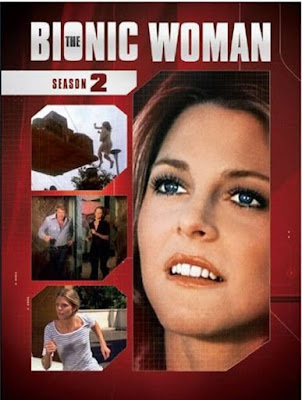

Season Two (1976-1977)

If there is a clear distinction between The Six Million Dollar Man and The Bionic Woman, it is that leading emphasis in the latter is Jaime's idealism. She's a person looking to do good, whether in the classroom or in the field fighting baddies. The crossover with other show is a big deal in the beginning of the second season. She has the freedom to cry and not lose her hero credibility, in fact it only enhances it. Her tears are not weakness but a sign of empathy. She and Steve have a close friendship if not romance. The season has the ballyhooed crossovers with its older sibling when Bigfoot shows up and the duo must stop a scheme to kill Oscar Goldman. Jaime goes undercover as a wrestler, a card dealer, a cop, and as a country singer to stop various thugs and spies, and as a nun to capture some diamond smugglers who dabble in heroin. She pretends to be a teacher to help protect a young prince. There's a terrific episode when she pretends to be one among a very eccentric band of family members who are battling for the family inheritance. Vincent Price is top notch in this one. 
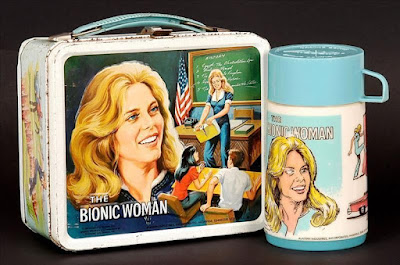

Then she must overcome a small army of what I've dubbed the "Parka People" because they have to wear heavy coats because they've been taken over by an alien force which needs warmth. It's a bit of Invasion of the Body Snatchers meets The Andromeda Strain. (They actually use some footage from the latter I think.) One weird one was titled "Biofeedback" and dealt with a guy who could use that technique to imitate many of the old tricks of the fakirs of days gone by. The end of the world when a pleasant scientist builds a doomsday device. The exchanges between Jaime and the computer named Alex-7000 are clearly meant to evoke Hal-2000. There's a story in which a Jaime must help a young violent girl deal with her horrifying history. A light tale about art forgery and a downright comedic effort about a hard-luck thief who chooses the wrong house to burgle. We get a bit of Oscar history when we learn his brother disappeared during the Pearl Harbor attack under mysterious circumstances. And Jeff Corey shows up as a mentor to Jaime in a story about Native American demons and radiation. Lindsey Wagner must be taking a hand in her wardrobe as well, since some of her frocks are decidedly unusual and there's an awful tendency to wear hats which were regrettably in vogue at the time. But she's not done yet. 
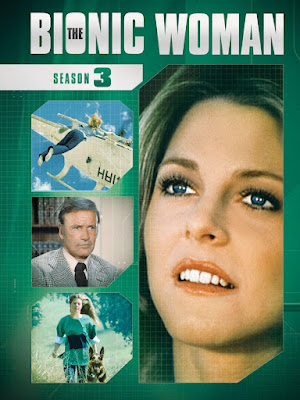

Season Three (1977-1978)

The show moves from ABC to NBC in its third and final season. Sadly, it seems to lose some of the sweetness which characterized the previous shows and gets a more generic TV adventure feel. It's notable that Ken Johnson, the creator of the series was absent from many of these new shows. We meet a bionic dog named Maximillion in a two-parter to kick off the third and final season. One gets the sense this was intended as a possible spin-off with the dog hooking up with a Forest Ranger. Then our heroine has to face down the Fembots again, this time in Las Vegas in a wild fracas. While both Oscar and Rudy maintain strong presences on the show, Steve Austin has been largely pushed into the faceless background. Truth told, his place has been taken by Max the dog, who gets another full episode later in the season. Probably the fact the two shows were now on different networks made things difficult to say the least. 
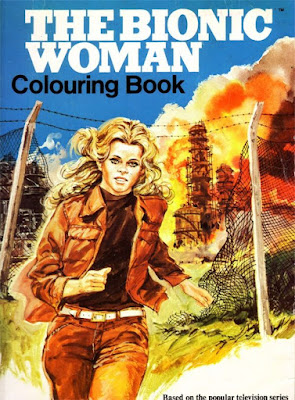

Jamie ends up getting missions which take her to the rodeo to protect an eccentric scientist, the depths of Africa to stop a dictator, and... One weirdness is the guest-starring of Evel Knievel in an episode in which comes across as neither comedy nor drama, just odd, as the daredevil is conscripted to help Jaime cross over into East Germany the typically obscure but essential reasons.  Then's there's a lift of a plot from the first season when Callahan is tricked by her boyfriend into giving up secrets. Jaime goes into some bogus country to rescue some kid who is portrayed poorly by a young actor in only his second TV role. Much better is Franklyn Ajaye as a computer Robin Hood, committing internet crime before the term was invented. Things get dark when Jaime is poisoned, and world peace is on the line. Full blown science fiction breaks out when we get alien returning in a nod toward those Chariots of the Gods books, Jaime must protect an alien girl, and a "UFO" turns up in an episode as well. The show all but forgets Jaime's life as a teacher and that actually plays into what became the final episode, written with the knowledge the show was ending. It's a remarkable effort with some real conflicts that frankly I wish we'd seen more of during the run. 
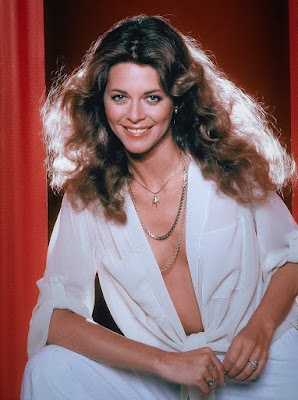

The Bionic Woman was a better show than I remembered. It was a nifty lens into the 70's, my heyday when we still used phone booths and computers still filled rooms. We lived as we ever have under the abstract fear of nuclear destruction, but detente had allowed those fears to abate. The late 70's was a time of economic hardship for many given the price of oil among other things, but it was also a time of hope. Jimmy Carter was President, and he was a decent man trying his best to do a decent job in extremely hard times. After Watergate, the country was seeing some changes which made politics less hostile and government more trustworthy. Women actually were planning to see life the other side of the Equal Rights Amendment which was nearing success after decades of a creeping crawl. (Sadly, it didn't happen.) In many ways Jamie Sommers was a hero for the time. 

Tomorrow, we check out Season Four. 

Rip Off
 

Monday, August 26, 2024

The Six Million Dollar Man - Seasons 1-5!


Before there was a TV hero there was the 1972 novel Cyborg by Martin Caidin which told the tragic story of Steve Austin who after a terrible crash is given by Doctor Rudy Wells, two new legs, a steel plate in his noggin, gimmicks in his eyes and fingers among other things. He becomes a super-agent under the control Oscar Goldman who is an agent of the Office of Strategic Operations (O.S.O.). Sounds pretty familiar doesn't it. That was adapted to television. Before the series we get three pilot movies, which was unusual. Apparently, the powers that be were not convinced of the potential of the show. They were wrong of course. 


The Pilots

The three movies were The Moon and the Desert in March of 1973 and later the year Wine, Women, and War and finally The Solid Gold Kidnapping. The first was the story of the first novel pretty much with alterations such as the bionic arm for extreme strength. Lee Majors was cast as Steve Austin and was made into a star. Richard Anderson became Oscar Goldman and for a time Allan Oppenheimer played Rudy Wells. I was struck by Darren McGavin's role in the first movie where he is a much more cold-blooded Oscar-type character. I hated the theme songs for the last two movies which seemed to evoke some kind of blaxploitation film feel. It's clear that Austin is supposed to be a super-spy sent on exotic missions and battling Bond-Lite villains. 


Season One (1973-1974)

The first season of The Six Million Dollar Man kicked off in January of 1974 and gave us two episodes with punch. The first evoking The Andromeda Strain (using actual footage from that film) and the second featuring a large cast stranded on a remote island with murderers aboard. William Smith was largely wasted in the that one. And then it seems the budget was spent because the next many episodes felt lighter in tone and felt like more traditional TV fare. Jimmy Sangster wrote a silly one about a Soviet nuclear facility. We get John Saxon as a robot in an episode and frankly he seemed largely wasted. Farrah Fawcett shows up in one written by D.C. Fontana as the first woman astronaut and it's not bad at all. Other faces from adventure and science fiction shows appear such as William Shatner as a man whose brain is affected by strange energy, Greg Morris as a downed spy-plane pilot, and George Takei as a mountain-climbing expert. Gary Lockwood as an assassin with a secret was pretty good, but Gary Collins as a Russian was laughable, and Ron Soble playing an Asian warlord was regrettable. The shows had variety with Steve whipping across the globe, but alas the countryside always looked like California. Once I found my footing with the show and realized what it wanted to be, I found it diverting at the very least. It's easy to see why this was a hit. Richard Anderson as Oscar was bit hit and miss for me, as I wish he'd been a more ruthless at times. Lee Majors is stylish and his calm, cool presentation gives the show a solid anchor. 


Season Two (1974-1975)

By this time the series was a hit and one can see that more money was being put into the productions and being used rather well. A highlight of the season is the introduction of "The Seven Million Dollar Man" played by Monte Markum to great effect. It explores how the bionics affect the psyche and how perhaps Steve Austin is more special than we knew. Steve must also face up to some ghosts as the vehicle he was piloting when he crashed is rebuilt and needs a pilot. Some of the quality of these episodes is suspect as the pressures of weekly television show seem to produce cracks. Much is made of Austin's charm toward women and frankly he's quite the womanizer in classic Bond fashion, though maybe not quite so callous. It's frustrating when the writers seem to forget that Steve Austin is a celebrity in this world and have stories in which no one seems to know him. In one he has amnesia (a tiresome cliche) and it's a particularly weak effort. Farrah Fawcett shows up again, this time as a reporter who uncovers Steve's secret and blackmails Oscar in order to get ahead. The whisk her off to Baja and she seems strangely unsuspicious when Oscar starts digging a bit hole. (The story claims it archeology.) She and Steve romance a bit. The big news in the second season is the introduction of Jamie Sommers who would become the "Bionic Woman" and would go on to be a spin-off of the highly successful show. 


Season 3 (1975-1976)

Things start off pretty strong with a two-part episode that brings Jamie Sommers back to life and also explains why she must be separated from her intended husband Steve Austin. Of course this is a set-up for spin-off show The Bionic Woman. Then Steve saves the Liberty Bell as a shout-out to the upcoming bicentennial of the United States. Steve Austin is presented a likeable guy and so I guess it's not an enormous surprise he has lots of friends. And we see them now as his college roommate turns out to Sonny Bono (doing a Tony Orlando imitation) and his high school football pal is Larry Csonka who gets kidnapped by Dick Butkis and Carl Weathers among others. I rather liked the episodes in which Steve is a lumberjack, a stevedore, and a cop. And he starts finally to use some disguises. He's a famous astronaut, yet he goes undercover. It didn't make sense. But you roll with it. 


When rolls into Morgantown, Georgia to break up a moonshine ring, the familiar hillbilly gags and tropes fairly drip off the screen. I'm a hillbilly by birth and raising, so I'm sensitive to these portrayals. Making fun of country hicks gets a free pass in a country which is quite tender about most things. (MAGA hasn't helped the situation any.) This season also has the epic first encounter with Bigfoot played by Andre the Giant. Bigfoot was major fad in the 70's and they grab a piece of that pie. Farrah Fawcett shows up again, this time as yet another old flame of Steve's. She a degenerate gamble helping him rescue a stolen statue. So, the show was running the gamut, from crime drama, to foreign intrigue, to full-blown sci-fi epic.  


Season 4 (1976-1977)

Steve kicks off the longest season of the show's run sporting a pretty cheesy mustache. It doesn't really work for him as it did for Clark Gable. The return of Bigfoot is a headline in a story which moves from this show over to The Bionic Woman. Bigfoot is still controlled by aliens, but this time it's a splinter group stealing stuff to make themselves invincible. Farrah Fawcett returns for the fourth time in the series, this time playing the pilot she portrayed in the first season. There is an epic crossover with The Bionic Woman in which Oscar Goldman is kidnapped. This is a pretty good story with nice twists and opportunities for everyone to showcase their stuff. We get a Bionic Boy when a youngster is given implants which allow him to walk and even more. This was a two-hour episode, one of two in the season. The weird thing about this one was where it was filmed in Kane, Utah and from what I can tell used townspeople as actors, with expected results. 


Steve gets involved with quite a bit of espionage in these stories, going undercover as a contestant in a glider competition, an oil rigger, a boxer, a flying Thunderbird, and even Santa to help bring the Christmas spirit in the most modern Dickens manner. He fights super chimps and relentless probes to Venus gone haywire. Spies try to use carnival rides to bring down experimental aircraft in one truly baffling episode. (Sidebar on that one -- the remains of a long dead cowboy were discovered in a wax figure during the shoot.) One episode title "The Ultimate Imposter" has very little Steve and is in fact an attempt to spin-off a new series about a guy who gets his smarts from computers in order to do espionage. (The show never launched and if it had been the creators of Joe 90 could well have sued.)


Season Five (1977-1978)

The final season of The Six Million Dollar Man kicks off with jolt as its partner show The Bionic Woman shifted to NBC making crossovers untenable. (To the credit of someone though Oscar and Rudy appeared in both shows.) Lee Majors was a bona fide star and in this season his role gets a James Bond juicing when he seems to get a new romance very episode. The season kicks off with two two-part stories, the first dealing with a woman who can control sharks so that a nuclear sub can be stolen and the second about the complications of getting a rocket into orbit to rescue a damaged satellite. In both Steve runs to the rescue in more than a few nicks of time. A yarn about a tornado threatening a community was pretty lame despite having a multitude of moving parts. Then it's the roller derby as Steve infiltrates a team which is planning a heist in a federal building. Then we are treated to a sci-fi blockbuster in the grand tradition of Radar Men from the Moon. The Moon is shifted when nuclear bombs are used to drill for some important ore and results in tragically terrible weather on Earth. It takes Steve two episodes to put down the cold-blooded mad scientist behind the scheme. 


Then he takes an experimental bomb on a road trip in an RV followed by a yarn about a technology that will blind radar. Steve wing walks in an episode that features some outstanding arial stunts. A strange one features Steve thinking he's in the future of 1984, which is revealed to be a con to get some fuel formula. The Death Probe returns looking more bad ass than the first time with a neat black paint job and a distinct Dalek feel. It gets super wacky when Steve and Rudy find an island brimming with aliens hiding from mankind but now mutated into powerful and violent creatures by the radiation from a satellite. There's a nifty art heist story with some great twists and turns followed by a bizarre one in which Steve seems to be haunted by himself. We get a terrific two-parter that hints at the future when Steve must contend with computer hackers and worse still. The Bradbury Building is used in this one and is as always lovely to look at. The season and the show close out with story that pits Steve against a lovely Soviet agent to recover some stolen smart bombs and a rolling launcher. 


One final note on these darn good shows is that I was impressed. They hold up better than I expected, and I was pleased by Steve Austin's belt buckle. Though he's a "superhero", he doesn't have a costumed. But he does have a belt buckle resembling two wings which he wears in every episode. Nice subtle touch I missed out on totally back in the day. 

Tomorrow, we check out Season Six. It's a comic book. 

Rip Off

Friday, June 30, 2023

A Quinn Martin Invasion!


For many years the only experience I ever had with Quinn Martin Productions' The Invaders TV series was through the excellent Big Little Book I got hold of as a kid during the shows brief heyday in 1967 and 1968. I read and enjoyed "Alien Missile Threat" a few times and still have my original and much cherished copy.


But over the intervening years I've been able to get hold of the show itself and give it a proper viewing. I was mostly inspired not only for my love of vintage sci-fi TV, but specifically to see how this show influenced my favorite 90's TV show The X Files. And as it turns out, quite a bit.


The first season followed swiftly on Quinn Martins' successful The Fugitive, and no secret is made that they wanted another show following along those lines. So Larry Cohen cooked up the notion that a lone man, a witness would pursue the threat of alien invasion single-handedly and single-mindedly. The first season was as much a study in paranoia as a sci-fi thriller. While the viewer is reasonably confident David Vincent (played masterfully by the exceedingly handsome Roy Thinnes - according to my wife) has truly seen aliens, few of his fellow characters believe him and he himself doubts from time to time. Slowly and relentlessly, he uncovers threat after threat following the vaguest of clues around the country, and often stopping the menace. But while it's a compelling concept, it's alas a limited one. And even by the end of Season One, you can tell the framework of the series is changing.


Those changes are all too evident in the second and final season as David finds allies in his struggle against the aliens, a group of "Believers" who funded by an important and wealthy industrialist are able to up the ante in the battle against the invaders. Kent Smith plays the industrialist Scoville who becomes a virtual co-star through the remainder of the series run.  Eventually the authorities are drawn into the secret war and by the end of the season it's hardly a matter of David's sanity, but merely a question of how effectively the human race itself will face this looming and growing threat. The second season offers up much more detail about the aliens themselves as we learn there are factions within their ranks, not all of them thinking the invasion is a good thing for anyone. They have a decidedly caste society with some few designated as "Leaders", of which only a half dozen have come to Earth. We get to see inside the iconic spaceships more than once, and the invaders themselves die in droves as they meet their maker by immolating in a bright red after death.


It's a fun, fun show with solid acting and often solid scripts. Some are better than others, but all have the professional patina a viewer can associate with any Quinn Martin show. There's a snap and briskness to the whole endeavor which speaks of quality. The special effects are downright good for the time, and in the final season are often on display. I imagine though if the show had gone on much longer it would've gotten dreary as the struggle against the invaders by definition needed to advance and develop or become repetitive. This happened on The X-Files after several years. The mystery can only be maintained for so long before it becomes an enigma of little interest to anyone.

The Invaders was adapted to not only Big Little Books, but also to comic book form. Below are the covers to the four issues of the comic published by Gold Key. Here are some links which will take you to a site where you can read the complete issues beautifully rendered by the painfully under-appreciated Dan Spiegle. Just click on the issue numbers - go to The Invaders #1, #2, #3, and #4.


Also there were some paperbacks written by the likes of Keith Laumer and others which filled in details of David Vincent's battle. If you would like to check these novels out, all three are available at the Internet Archive at this link


And finally, there's this Whitman gem, a novel which serves as a companion of sorts to the BLB. It's a great stark image of Vincent as he runs in terror from the approaching saucer. The evocative logo for the show is much in evidence on this one. This too is available at the Internet Archive at the following link. 


Great stuff, and highly recommended. If you can find The Invaders for a reasonable price, I don't think you'll be disappointed. And as they dramatically announce at the beginning of every episode, it's "in color".

NOTE: This is a Dojo Revised Classic Post. 

Rip Off

Saturday, May 20, 2023

Genesis II!


The late 60's and early 70's were heady times for TV science fiction. We had just got to the Moon and I seem to remember a general notion that it was the first "giant leap for mankind" with the emphasis on "first". I was ten and now I am over six times that old now, and we haven't really taken any further steps. We've done work in the nearby neighborhood and sent probes to the distant planets, but man himself has been content to walk in his old footprints. The future, so bright and filled with helpful technology as seen in Star Trek and The Jetsons had another side, a darker side. Gene Roddenberry tried to explore possibilities in a few more series after Star Trek and one that lingers in the memory is Genesis II and its siblings.


Genesis II tells the story of a future in which sprawling underground subways link the world and man. Some people in a group called PAX seem to have finally shaken off the old warlike ways. But as one man found, nothing lasts forever. As part of a cryogenic experiment Dylan Hunt was locked into a chamber and put into a coma, and just then an earthquake buried the facility, and he was forgotten. A hundred and fifty years and a small nuclear war later he's discovered and revived and finds that man's old ways of war were not so forgotten. And he learns that mankind itself has given rise to new variations. 


That's story in Genesis II and it features a odd blend of tech and barbaric splendor. Alex Cord plays Dylan Hunt and a ravishing Mariette Hartley plays the woman who brings him back. With the likes of Ted Cassidy around this one is pretty entertaining. But as a pilot it failed to convince the networks. Likely that's because, despite a lot of high concept work done, the basic plot of the story is rather ramshackle. The characters do lots of illogical things and the ending is abrupt and denies the viewer the actual pleasure of seeing what seemed to be some of the best action in the show. A tactical nuclear blast seems a strange way to end a show promoting peace. I really liked the underground sets, presumably in Carlsbad Caverns, but the use of college campuses to represent the future city of the evil overlords doesn't work well at all. 


Alex Cord is acceptable as the hero, but just that and sadly no more. It's not his fault but his porn mustache really holds him back. Like lots of shows of this era, the wigs used by some of the minor characters are unintentionally hilarious and undermine the production. Marjette Hartley is stunning, and the show really comes alive when she's on screen. I can see why the networks balked at this effort from Roddenberry, but he wasn't done trying to sell it. More tomorrow. 

Rip Off

Saturday, April 22, 2023

Star Trek Season Three!


Star Trek has become such a sensational success that it's really difficult to fathom that the original series was loathed by the network which presented it. NBC seemed to work actively to make sure the show was a failure and in that pursuit in the third season, gained only after a potent and unprecedented mail response, saw to it by putting the show on late in the evening on Friday. This time slot was a virtual death sentence for a TV show at the time. The audience for Star Trek was young and on Fridays the young were out and about, and not home watching television. NBC well knew this and so did Gene Roddenberry, so when the time slot was revealed, Roddenberry stepped away from the show which he had husbanded into existence.  As producer he brought aboard a man named Fred Frieberger, a man who has been unfairly blamed for the third season's woes. 


The humor in the second season was not popular with Roddenberry and when Gene Coon departed he directed that the show again become the serious science fiction vehicle he wanted. He wasn't alone in that desire. So Freiberger was instructed to make the show serious which seemed to rile writers of episodes like "The Trouble with Tribbles" who saw potential sequels axed. Freiberger was ordered by NBC and the new owners Paramount to see to it the show stayed within budget, something it had failed to do in its previous two seasons and some of the reason NBC was put out by Roddenberry. At the same time they cut that budget. So Freiberger was given a battery of instructions and then told to go make it work. That it didn't work as well as it had in the previous seasons is hardly his fault alone. Roddenberry had already assigned most of the stories for the season, so Freiberger had little or no control over that aspect of the production either. It was truly a thankless task. But in the end despite the woes and complaints, Frieberger did deliver Star Trek on time and on budget, the first time that had been accomplished and if that had been the norm, maybe the show would not have been such a pariah with the network. But that's pure speculation. 


There seems to be a general agreement that the third season was inferior to the first two. I'm not sure I agree. "Spock's Brain" is held out as possibly the worst episode of the entire series. I rather enjoy it. Some Star Trek episodes can get a bit slow as a sometimes thin story is formatted to fit the four-act structure of hour-long episodic television. That never happens to "Spock's Brain". And it features some of my favorite Nimoy acting, almost a parody of his normally reserved response to his environment. 


But there's certainly no shortage of quality science fiction concepts such as the world in which people move so swiftly they cannot be detected by our human senses in any real way. This hyper speed is a great gimmick, even if a few concessions must needs be made to allow it work.It certainly showcases the most direct suggestion of an overt sexual act when we get the scene where Kirk is slipping on his boots as the comely alien adjusts her hair. Racy stuff for the simple-minded TV of the day. 


Episodes such as the one featuring Yvonne Craig's Orion slave girl have fun aspects even if she's not quite as alluring as Susan Oliver was in the second pilot show. She's still pretty hot. The characters are developed well in episodes like "Spectre of the Gun" which has the crew recreate the shootout at the O.K. Corral almost. I've never been a great fan of the episode which has Kirk marry an Indian maiden only to see her die, but I got more a sense of its depth this time. Maybe my life has matured enough to allow to share his pain somewhat. 


The "Tholian Web" is regarded as a great episode and I concur. Less well regarded is "Let this be our Last Battlefield" which does a great job (if a bit on the nose) of approaching the topic of racism. This show was produced and shown in 1969 at a time when the United States was boiling with violence in the streets and elsewhere in response to the Vietnam War and savage assassinations within the borders. 


Maybe I'm nostalgic for these episodes because this was the only season I actually was able to see (in part) because of its new schedule, the one intended to kill it off. I was a youngster and staying up until ten to see a great show was a struggle (still is) but I succeeded more than a few times. I think people who hold Gene Roddenberry in high esteem are quick to dismiss this season as lesser because his imprint was not as strong on it. I frankly think that Roddenberry is a bit overrated, though still a significant figure in television science fiction. Frieberger did more with less than Roddenberry did, and he did it his way. I get that some folks are not going to cotton to that. 


Star Trek was cancelled in brutal fashion. As was common in shows of the era, things could go bad quickly and NBC intent on getting rid of Roddenberry and his show saw to it that Star Trek was gone and prepared for the onslaught of letters from fans. NBC was intent on not backing down this time and prepared for the avalanche of mail they were about to receive. The show was of undeniable high quality and better ratings initially than has become legend. Given the times, it should have survived, but it didn't. The stories were often quite smart and dealt with the issues of the times, and that I think is really why NBC wanted this albatross from around their collective necks. Star Trek in each episode was capable of saying something which might stir up controversy and that was not good for business overall.  Star Trek stopped production and went into syndication. More on that next time when I take a closer look at the cartoon version of Star Trek. 


Rip Off

Friday, April 14, 2023

Star Trek Trading Cards!


In the spirit of their highly excellent Mars Attacks book which I took a look at a few weeks ago, this little tome showcasing Star Trek cards hit the book racks of my local retailer several weeks ago. There is an unalloyed charm to these books which capture a seemingly more naive time before the engines of industry had fully coordinated all aspects of marketing and trends, and fads could bubble up (pun intended) from some offbeat directions.


At the time that Topps put out their Star Trek card sets, all properly packaged with the inevitably inedible gum, they were responding to the mid-70s' uptick in interest in the series which had been revived from network doom and was finding unexpected success in syndication across the nation. The bicentennial year of 1976 was not one which knew that Star Trek was an unstoppable franchise, but merely a sci-fi TV show that was finding fans all across the country.


In spite of the juggernaut Star Trek would become after the eventual movie arrived, Topps found these cards pretty much a bust. They only did one series and it's speculated that's the reason not all the episodes are represented in this series, something saved for the sequel. But there was no proper sequel, though Topps tried again when the movie did strike a chord some years later.


One oddity is that Sulu doesn't make a single appearance on these cards. Now considered a core member, he is somehow forgotten in all the furor to gather the images (from fan sources it is reported) and doesn't get any type of shout out. That oversight is corrected in the new book which comes with some bonus cards, one of which does finally at last give Sulu is due.

This is a fun little book, and something any fan of the original series might want to take a look at.

NOTE: This is a Dojo Revised Classic Post. 

Rip Off