Showing posts with label The Sunday Funnies. Show all posts

Sunday, May 15, 2022

The Sunday Funnies - Tarzan And The Adventurers!


Tarzan and the Adventurers from Titan Books wraps up their run of Burne Hogarth Tarzan of the Apes comic strips. These strips are from Hogarth's second tour of duty on the strip from 1947 until 1950. In that time Hogarth drew Sunday color strips with scripts from Rob Thompson and James Freeman. His Sunday run narrative is completed in this collection by a few strips from Bob Lubbers who picked up the Tarzan strip from Hogarth. Hogarth also worked on the daily strips, first as a consultant for artists like Dan Barry, Nick Cardy and others. Later still he scripted a few adventures with art by Bob Lubbers. Of note too is that the Sunday pages here are presented in a half-page format which was dictated to the creators due to shifts in the needs of newspapers after the war years had diminished some interest in the Sunday adventures. 

On the Sunday pages here are most of the iconic images I associate with Hogarth's run on the character. He draws the Ape Men as a sleek athlete with grim dark eyes and jet-black hair. The strip is very much about the physicality of Tarzan and given the limits of the times must've come across as quite alluring in many ways. 


As usual Tarzan deals with treacherous white hunters who in the story "Tarzan and the Adventurers" stir up trouble among the natives. Tarzan evades one deadly trap after another as he attempts to stop these men from stealing a hidden submerged treasure. Later in "Tarzan and the Wild Game Hunter" he runs across jungle novices who don't realize the full dangers they are confronting in the wild. 


In the daily strips we begin with the lengthy "Tarzan at the Earth's Core". This was the work primarily of Thompson and Barry with Hogarth giving guidance in the early stages. This is a strange Tarzan tale as much of it focuses on a retelling of At the Earth's Core and the adventures of David Innes in Pellucidar. Tarzan agrees to go to Pellucidar with Jason Gridley and others. They find the hidden territory in the middle of the Earth but are quickly separated. The story goes many days if not weeks without a sign of Tarzan, a strange approach. 


Then we jump ahead a few years to two daily storylines written by Hogarth and drawn by others. "Tarzan and Hard-Luck Harrigan" features art by Nick Cardy and focuses on an old-timer who requires Tarzan's assistance when he fall into the clutches of a gang of bandits. Bob Lubbers draws "Attack of the Apes" which reveals a deadly scheme to turn men and apes against each other when a villain disguises himself as an ape. Tarzan soon clears this mess up. And that abruptly is a wrap on the work of Burne Hogarth on the Lord of the Jungle...with two exceptions. Those have to wait a few decades. More on that next week. 

Rip Off

Sunday, March 27, 2022

The Sunday Funnies - House Of The Seven Haunts!


 By the time we reach the strips in this fourth Fantagraphics volume of Mickey Mouse's comic strip run by Floyd Gottredson, the strip has hit its zenith. The adventures are at once both exciting and funny and the cast is well developed. Goofy joins the cast, replacing his earlier incarnation of Dippy Dog. The strip was under mandate to reflect the animation and did that for the most part, at least in terms of casting. But whereas the Mickey of the cartoons was becoming increasingly a somewhat bland adult, the Mickey of the strip was still full of wild vigor and easily talked into many a bizarre misadventure.


But the volume begins with "Oscar the Ostrich" which once again sees our hero encumbered with a bizarre animal for a pet such as he was in the earlier escapades with Bobo the Elephant. Oscar though is a great deal more wantonly destructive, and it puts Mickey in a hard way facing both fines and potential jail before he is able to wriggle free of this latest mishap. 


"Mickey Mouse Joins the Foreign Legion" is a full-blown adventure with Mickey called upon to protect state military secrets. He chases a spy across the world, and when that chap joins the Foreign Legion to meet his partner in crime, Mickey must also join. He finds himself under the thumb of Pegleg Pete for some of this yarn, but as we all know Mickey prevails in the end. 


"House of the Seven Haunts" is one of my all-time favorite Mickey outings. This ghostly outing was inspired by flicks like The Bat Whispers and such, features Mickey and Goofy and Donald Duck also are a detective agency who hire out to investigate the haunted mansion of a local rich fellow who seems less bothered by the supernatural aspects of the "ghosts" and more upset at their dreadful manners. It doesn't take Mickey with the minor aid of his two allies to plumb the bottom of this mystery. 


"Island in the Sky" is a full-blown science fiction adventure. Mickey takes to the air once again to find out the secret of a strange flying car and finds much much more when he encounters a scientist who has mastered gravity. Pegleg Pete is back once again to try and wrangle this secret to sell to the highest bidder but neither the scientist named "Einmug", nor Mickey think this is a good idea. 


"In Search of Jungle Treasure" is exactly what it seems. Mickey and his friends head out once again to find treasure on a remote island led there by his old friend the gorilla "Spooks" who it turns out is a homing gorilla. There are some decidedly non-PC cannibals, a sign of a less enlightened era. For all that, this a wild and funny adventures. 


This Fantagraphics collection ends with "Monarch of Medioka", perhaps Mickey's greatest adventure based on The Prisoner of Zenda. Mickey is an exact match for the wasteful King Michael XIV who is spending his nation into ruin. He is convinced to go and party abroad while Mickey tries to do his level best to get the nation on a better financial footing. He is not helped by the antique traditions of the country which is more law than justice. 


And that wraps this month-long review of the earliest Mickey Mouse strips. I have more but we'll save for those for another day. Floyd Gottfredson created in his Mickey Mouse strips with the help of many other artists and writers an adventurous daily with panache and style. Inspired by but not limited by the cartoons which were becoming increasingly humdrum, the stip was able to do things that the shorter cartoons were not able to capture. 

Rip Off

Sunday, March 20, 2022

The Sunday Funnies - High Noon At Inferno Gulch!


One of the main reasons I prefer Mickey Mouse comics to Mickey Mouse cartoons is that I've always been a bit annoyed at the high-pitched whine that passes for his voice in the cartoons. Visually Mickey is a clever and vital creation but when he speaks, I lose interest. When I read the comic strips by Floyd Gottfredson, I can imagine Mickey talking any way I like. 

The first two Mickey stories in this volume are "The Captive Castaways" which sees Mickey rejoin the Air Mail Service once again, this time to make sure a little town in the far North called Rock Ledge gets some much-needed supplies during a blizzard. He finds the towns resources are being stolen by a familiar pirate -- Peg-Leg Pete. After some stunning derring-do Mickey saves the town and the day. When he returns to Mouseton, he's called upon to save Pluto from the dog catcher in "Pluto's Rival". 


Then for the sake of continuity it's necessary to jump over to the Sunday color Mickey Mouse strips where Mickey and Minnie head out west again to help Minnie's Uncle Mortimer who is running a large ranch now. It's there that we first encounter this ranch and its denizens and in an odd move that continuity then is picked up in the daily strip. 


"The Bat Bandit of Inferno Gulch" is one of the best Mickey Mouse comic stories and has Mickey and Minnie battling the hooded figure of the aforementioned Bat Bandit. The villain is striking terror into the local townsfolk and as we learn the threat is closer to Mickey and Minnie than they suspect for some time. 


The cover of the Big Little Book adventure of this story was the inspiration for the second of the Air Pirates Funnies books by Bobby London and friends. It's a good imitation with a satirical edge, too good thought the mavens at Disney, so they sued over it. 


This is also the first Mickey Mouse comic strip I ever read when I got hold of it in the Golden Special The Best of Walt Disney Comics series from the folks at Gold Key. I still have this handsome edition from 1974 in my collection. 


After cleaning up the West, Mickey then finds himself having to deal with the hardships of pet ownership in "Bobo the Elephant". This pachyderm is hard to care for to say the least and causes no end of trouble until Mickey finds a happy solution. 


"The Sacred Jewel" has Mickey helping out Captain Churchmouse who is in trouble when a great gem is stolen on his watch and he is under threat of death unless Mickey can find the villains and return the jewel. Mickey and Minnie take to air in a bizarre blimp to try and save the day and their friend as they explore the deserts of the Middle East. 

"Pluto the Racer" showcases Mickey's famous pet and Mickey's naivete about gambling when he tries to enter Pluto in the dog races. As usual there is a great deal of trouble for Mickey and his friends unless Pluto can win the great race and the prize money. 


"Editor-in-Grief" is a story that co-stars the old-style Donald Duck along with Horace Horsecollar and Dippy Dog. They along with Mickey take on newspaper publishing, in particular the kind of investigative journalism which can prove fatal when they try to uncover the corruption in the city. I love the name of the paper which is "The Daily War-Drum". 


"Race for the Riches" has Mickey teaming up with Horace for a final time as a main character when the pair head out West once again to find treasure which will save Clarabelle Cow's house and home from the mortage holder, who this time is also the villain of the piece. 


This collection closes out with "The Pirate Submarine" which has Mickey in the skies once again, this time aboard the experimental "Submarplane" built by his old ally Gloomy the Mechanic. With this machine which will go over and beneath the watery waves Mickey is able to battle the ruthless Dr. Vultur,  a villain very much in the tradition of Jules Verne's Captain Nemo, but with a nasty streak. 

The volume closes with the usual collection of vintage covers and bio sketches and a wild and weird Donald Duck story from Europe about going to Mars. Strange, very strange. 

Rip Off

Sunday, March 13, 2022

The Sunday Funnies - Trapped On Treasure Island!


 By the time we get to these Mickey Mouse comic strips from 1932 to 1934 in the second volume of Fantagraphics' series titled Trapped on Treasure Island the series has momentum and is well on its way to becoming a sleek comedy-adventure comic. The strip under the care of Floyd Gottfredson is still very different from the hectic cartoons which promote Mickey's fame and the stories in the strip often take their inspiration from the cartoons to maintain that synthesis which is good in a quality product. But the future of the series can be seen and some of the older aspects of the strip will begin to be shaken off by the end of this book. 


"The Great Orphanage Robbery" opens the book and gives us a Mickey story which is equal parts humor and adventure. It's a pretty revealing title as we see Mickey arrange to gather funds for the local orphanage only to see those monies stolen and himself accused of that theft. Mickey's personality is still fluid enough that his community seems all to ready to accuse him of such a crime. His accused collaborator in the crime is Horace Horsecollar who is on trial for the crime and even threatened with lynching as we also follow Mickey as he races to the frozen North to recover the stolen loot. There's an actual tension as the strip cuts back and forth between its two narratives. 


"Micky Mouse Sails for Treasure Island" has our hero and his take up a classic treasure hunt complete with maps, ships, mutinous crews, cannibals, crazed gorillas and long-lost sailors. Robert Louis Stevenson would possibly be pleased that his works had been so fondly remembered and mined for comic strip adventure. 


"Blaggard Castle" is my favorite story on this tome and it's an intentional homage to the then quite popular comedy-horror movies of the era such as Dr..X. Mickey and Horace go to what seems a haunted castle but is in fact the booby-trapped lair of three mad scientists named Ecks, Dubblex, and Triplex. 


They are presented as evil apes and their gruff and sunken-eyed look was inspired by Boris Karloff in his role as the dangerous muttering butler in The Old Dark House. There is a great deal of wild action in this one and this Fantagraphics volume even offers up a color sequel to the story from decades later in the supplement section of the book. 

"Pluto and the Dogcatcher" is a quick little sequence that features Mickey's mutt and is a breather of sorts between the heavy adventures. 


Those adventures kick off again with "The Mail Pilot" which sees Mickey becoming a member of the Air Mail Service. Those brave souls who risked life and limb to see that the mail got through are given a nod before Mickey learns his new craft and then almost immediately becomes embroiled in a plot by some familiar villains to hijack the mails using an extremely high-tech zeppelin. There's lots of derring-do in this sci-fic adventure story. One thing which amused me is that while Mickey saves the day by capturing the villains, he never actually gets around to delivering any mail. 


The Big Little Book cover fo this adventure when it was collected inspired the remarkable cover for Air Pirates Funnies #1 which got its creators Bobby London and others into so much legal trouble with Disney. 


"Mickey Mouse and his horse Tanglefoot" gets Mickey involved in horse racing and shows some of the weaker aspects of both his and Minnie's personalities as they spend their money rather carelessly and only a win at the track will let them stay whole. Since it's a comic strip we can imagine what happens, but the real-world equivalent of this dilemma often ended up with tragedy indeed. 


"The Crime Wave" features Mickey becoming a detective formally for the first time as he partners with Dippy Dog. Dippy will seem really familiar since he will soon become known as Goofy. These two novice sleuths are not really good at their trade, especially the careless Dippy but nonetheless they end up taking on a counter-fitting ring which also just so happens to be stealing all the hair and long underwear in town. 


We get lots of grand supplements, nifty essays and lots of classic images of vintage covers. This is a very entertaining package from the folks from Fantagraphics. 

Rip Off

Sunday, March 6, 2022

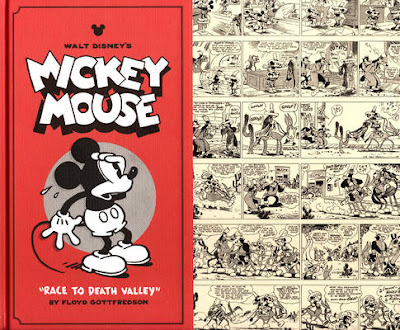
The Sunday Funnies - Race To Death Valley!


I love spelunking in the deep caverns and catacombs of pop culture and much of what we know of modern pop culture has its beginnings in the Depression Era of the 1930's. None more than my subject today and for the next several Sundays, the might Mickey Mouse. Mickey Mouse was the creation they say of Walt Disney and that's true to a degree though we all know that Ub Iwerks designed the character and many other artists and animators helped define his personality in cartoons and ultimately in comic strips. The Disney behemoth pushes the myth relentlessly that it is largely the product of one man's imagination. Not all unlike the Star Wars franchise and the Marvel Comics franchise, both of which have been consumed by the Disney corporate leviathan. Star Wars always pushes that George Lucas was the brains and while he was the inspiration and guiding hand, he hardly did it alone nor could he have done. Likewise, people foolishly believe that Stan Lee manufactured the Marvel Universe which we know is not the case, at least on his own. Both of these stalwart brands thrive because of the work of thousands of other talents but the myth of singular creation lurks at their base, and that's true of the Walt Disney myth as well. Walt has been dead for over half a century and the Disney monster has shambled well past his wildest imaginings. But it did start with a Mouse, or that's what they'd like you to believe.


Actually, it started with a rabbit -- one Oswald Rabbit. But Disney was scammed out of his creation and so thunk up another critter named ultimately Mickey Mouse. Mickey became a sensation, timed perfectly to seize the day when sound motion pictures were ascendant. 


Then it was success on success and the public wanted more and King Features demanded more when they said give us a comic strip. And it was made so. Now the strip in its beginnings was indeed written to some degree by Disney and drawn by Iwerks among others, but it found its footing and its ultimate success in the capable hands of Floyd Gottfredson who took the wheel and didn't let go for forty-five years, some of those years after Mr. Disney himself had shaken off this mortal coil. 
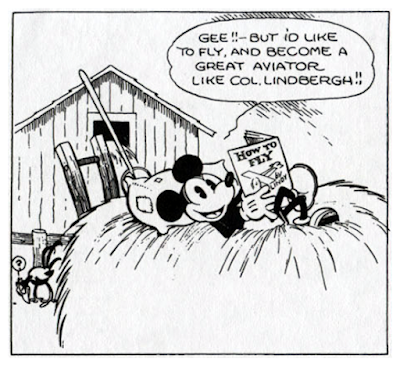

In the early years of the strip there was a logical connection of the strip to the cartoons and so it's logical that the first strip by folks other than Gottfredson used Plane Crazy as a template or at least a spur for the more developed comic story. Some of these earliest strips are included in this debut volume from Fantagraphics in the supplements section which is quite impressive. We get a good look at the art by Ub Iwerks for the story on which Walt Disney himself did contribute. But their involvement only lasted a few weeks. 
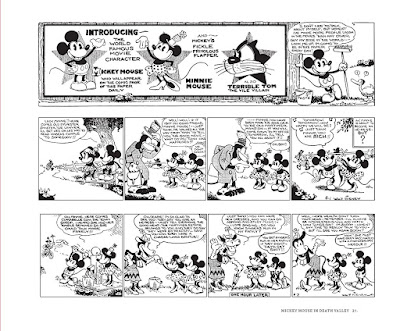

The artist who begins our first big story arc is Win Smith, but Smith was not long for the series. He was nearly twice the age of most of the creators in Disney's outfit and the generational friction was too much for the experienced cartoonist who left when his work was questioned. Anther artist who worked on a few of the strips included in the first continuity was James Patton King. Other artists involved in those early strips as assistants were Roy Nelson and Hardy Gramatky. These early strips are decent but lack the verve that will come when Gottfredson makes his mark. 
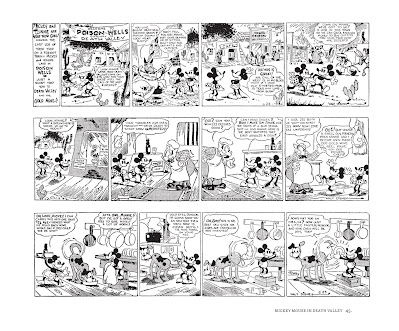
A number of diverse hands worked to make the strip happen and eventually Gottfredson was brought along out of his cartooning work to lend a hand and eventually take control, doing the layouts and so telling the story. The first few yarns feature a Mickey Mouse still in the formative stages. I've never been much of a Mickey fan because by the time I was first getting a glimpse of him, he was the venerable centerpiece of the Disney empire and so was largely forbidden to be anything but a stalwart upstanding element of society. In these early tales Mickey is much more the youthful instigator, at times even a downright miscreant. We are introduced to some important colleagues of Mickey's in these earliest strips such as Pluto, Horace Horsecollar, and Clarabelle Cow. The latter two are like Mickey himself, designed in an era where realism was less important. Pluto was part of the future with a more realistic presentation. It's remarkable that Gottfredson and his fellows were able to make these two different styles work together. 
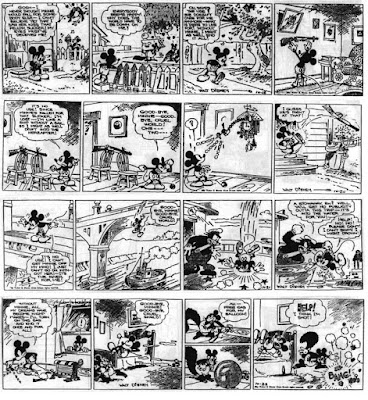


The stories deal with all sorts of things and have both Mickey and Minnie traveling far and wide. The opening tale has Minnie and Mickey trying to find a gold mine which Minnie has inherited. They helped by a mysterious figure called "The Fox" (a precursor of "The Blot") and are hindered by mainstay villains Mr. Shyster and Pegleg Pete. When that's cleared up Mickey finds himself in a struggle for Minnie's affections when a unscrupulous fellow named "Mr. Slicker" shows up. At one point Mickey is so forlorn about the matter that he attempts suicide. The stirp spends many days exploring the various ways Mickey might off himself -- a gun, jumping off a bridge, and others. It's startling stuff today, but much of these earlies Mickey's would make modern fans cringe. Mickey is often accused of crimes in these early tales suggesting his reputation is not very well established. All of this only makes him more interesting to me as he's an undefined character and not all unlike Tom Sawer in many ways. When he gets into a feud with a tough fellow named "Kat Nipp" I found that Mickey was more the bully than the reverse, not perhaps what the creators intended. 

These Fantagraphic volumes have a wonderful number of supplementary features and expect my reports on these to focus attention there to no small degree. I gathered up the first several volumes of these some years back and it's nice to finally at last be getting around to savoring these vintage Disney classics. 

Rip Off

Sunday, February 27, 2022

The Sunday Funnies - Tarzan And The Lost Tribes!


Tarzan and the Lost Tribes is the fourth and penultimate installment in Titan Books series putting together the comic strips by Burne Hogarth starring Edgar Rice Burroughs mighty Ape Man. Hogarth had stepped away from the series for a few years but was hustled back onto the scene when Burroughs himself took an interest in the declining Tarzan comic strip and demanded some changes. Rex Maxon was hustled off the daily strip and replaced by Hogarth (sort of -- more on this next week) and Hogarth took over the Sunday page from Ruben Moriera with a new writer named Rob Thompson taking over for Don Garden who had helmed the series since its inception. 


This is the work that Hogarth is best remembered for, this is the stuff that made his rep for all these decades and made him a sought-after instructor for many up-and-coming artists. It's from these pages that the images I've long associated with Hogarth are derived. The first of the three continuities in this volume is titled "Tarzan and N'ani". The N'ani in the title is a queen of yet another remote tribe who worship a pagan god that resembles a giant ape. 


It's a rarity in the Hogarth Tarzan stories in that Jane makes an appearance is the center of the action, or at least the catalyst for the action as Tarzan fights to save her from the tribes that seek to sacrifice her. Needless to say that Tarzan does indeed save Jane (we knew it all the time) and poor N'ani meets a terrifying end. 


"Tarzan on the Island of Mua-Ao" is a departure from the norm in that Tarzan leaves the African continent entirely when he is abducted and taken aboard a submarine which voyages to the region near Polynesia. On an island there he and his abductors (some scientists) are captured by the Lahtians, a race that inhabit an underground grotto kingdom. Turns out that in addition to a bounty of tigers on the island there are two other societies (Orang-Rimba and Thalia) and Tarzan along with his ally, the giant Soros seek them out and band them together to overthrow the Lahtians. I noticed that in this series Hogarth loved to draw large cats and has Tarzan fight all manner of lions and tigers and such. 


Back in his home territories (more or less) in "Tarzan and the Ononoes" our jungle hero comes across perhaps the weirdest of the societies he's met yet in the comic strip when he enters the land of the bizarre Ononoes, a race of giant heads with arms who appear to achieve mobility by rolling around. I'm never quite able to picture that as the rolling always leaves them face up, but they are striking creatures. Tarzan is looking for a lost daughter of an explorer, and finds her and rescues her, albeit with the assistance of an ape-like tribe called the Wolos. 


One thing that is notable is that the format of the Sunday page alters to a horizontal one for the last few installments of this story. This new format as well as some of the dailies produced under Hogarth's watch will be the focus of the next report. 


But that report will be delayed for a month or so for reasons that will become clear. Next month in "The Sunday Funnies" something completely different. 

Rip Off
 

Sunday, February 20, 2022

The Sunday Funnies - Tarzan Versus The Nazis!


 Burne Hogarth is front and center in Tarzan Versus The Nazis, the third volume in Titan Books' series dedicated to the vintage comic strip series. Don Garden had been the writer of the series from the very beginning, working first with Hal Foster and then with Hogarth when he took over the artistic reins. Now he was called away to military service in 1943 and Hogarth became both the writer and the artist of the high-profile comic strip. 


Hogarth's first storyline was "Tarzan Against Kandullah and the Nazis". It's a tale that calls upon Tarzan to help his old allies the Boers who are now facing a threat from Nazis who are stirring up the black natives yet again to take up arms against the white settlers. The next story is "Tarzan Against Don Macabre" and it brings in a villain who is at once suave and deadly, a sophisticated Spaniard who uses his charisma as well as violence to maintain his power. The centerpiece of this story is Tarzan's battle against a ferocious bull. Macabre also keeps a "Garden of Death" filled with deadly flesh-eating plants. Tarzan is able lead a small insurrection against Don Macabre before he heads off to battle with Nazis again in "Tarzan and the Nazis". This time he has as an ally a white ape named Bulak. It turns out the battle is against both the Nazis and the Japanese as both have representatives using locals to fight for them. When they prove unreliable modern troops are brought in but Tarzan is able to deploy a small army of wild animals to help quell the threat. He leads the forces into a trap where he destroys their munitions in a mighty panel. 


"Tarzan Against The Gorm-Bongara Monster" has the Ape Man once again battling a deadly dinosaur, a variation of the T-Rex this time but drawn in Hogarth's distinctive style. Hogarth's animals often don't look exactly like you'd expect but they are brimming with power and speed. In "Tarzan and the Tartars" Tarzan once again is battling to return a rightful heir to the throne. He seems to do an awful lot of this in the series but then he does so in the novels as well. This time the saga takes on echoes of King Arthur with a magic sword and scepter being retrieved by our hero to prove the bonafides of the heir apparent. There's even a wizened old man guarding them in the manner of Merlin. The art begins to slide during this period and eventually Hogarth steps aside for the artist Ruben Moreira who signed his work here as "Rubimor". Rumbimor is decidedly less impressive than either Foster or Hogarth and the series takes a tumble in quality as the stories themselves seem perfunctory. But most of Rubimor's work is not collected here since the focus is on Hogarth. 


The last story in this collection is "Tarzan on the Island of Ka-Gor" which begins with scripts by a returning Garden with art by Rubimor who was wrapping up his tenure on the strip. Then Garden continues in tandem with Hogarth until Hogarth takes over in the third and final part of this tale, which is neatly divided into three in the collection. Tarzan battles all sorts of critters in this tale which ends with a triple volcanic eruption.  And for the first time in the Hogarth era, we meet Jane though she doesn't stay around long as a young woman wants Tarzan to find her diamond-hunting father. Tarzan recovers from an illness in the last part of this tale and is cared for by the animals of the jungle. 


Don Garden it seems has wrapped up his tenure on the strip, but more on that next time, as well as sme of Hogarth's greatest work. 

Rip Off