Showing posts with label Atlas Comics. Show all posts

Tuesday, February 18, 2025

Melvin The Monster Day!


Joe Maneely was born on this day in 1926. Maneely was a key artist in Marvel's Atlas years, and he illustrated many of their stars including the focus of today's Dojo celebration -- Melvin the Monster. Maneely was Stan Lee's favorite artist and without his untimely death, the Marvel era might have never happened since there would have been less need for Jack Kirby. 

The success of Hank Ketcham's Dennis the Menace created in 1951 brought on a predictable wave of imitators, all with various and sundry names. The 1956 Atlas version dubbed "Melvin the Monster" was one. 


The beautiful cover above by Joe Maneely catches that "Ketchamesque" feel wonderfully while still maintaining a particular unique character which is distinctly Maneely. To read a Melvin the Monster story check out this link


Marvel brought out these stories in reprint at the very beginning of the Bronze Age, but for some reason changed Melvin's name to "Peter the Little Pest". I guess that name seemed less robust and so less potentially offensive.


Or more likely the scions at Marvel wanted to avoid confusion with John Stanley's Melvin Monster created in the 60's. 


The title was even called "Petey" for one issue, a name even less vivid. (I have the lame notion somehow when I see these that they might interpreted by some archiving "Marvelite" someday as the boyhood adventures of a rascally Peter Parker.) Comparing some of the covers above, you can see how Melvin/Peter changed, not only in name, but in demeanor over the decades. Somehow the idea of what kids were seems to have undergone a fundamental adjustment, shifting from threatening beasts over to cute creatures. 


But the "Peter the Pest" name sure is less potentially toxic than what Atlas changed Melvin's name to in the last issue of the original run. Here the tyke gets called "Dexter the Demon". Yikes!


Someone once suggested that Peter the Pest might be Peter Gyrich all grown up. Although I find no indication of it on the official websites regarding Henry Peter Gyrich's history, I think it's a very compelling and interesting theory. His desire for secrecy might explain the myriad names associated with this past and Gyrich sure deserves the description of "Monster", "Demon", and "Pest" if any character in the Marvel Universe does.

Rip Off

Monday, July 8, 2024

Favorite Covers - Young Men!


One of the most important comics, a real gem is Young Men #24 published in 1953. Sparked by the success of DC's Superman on the new-fangled televisions across the nation, Martin Goodman, as always on the lookout for the latest fad, decided it was time to rekindle the Human Torch as well as his Timely cohorts Captain America and the Sub-Mariner. To that end the trio are gathered together in one big comic which tells the world what they've been up to since last seen some four to five years earlier. 
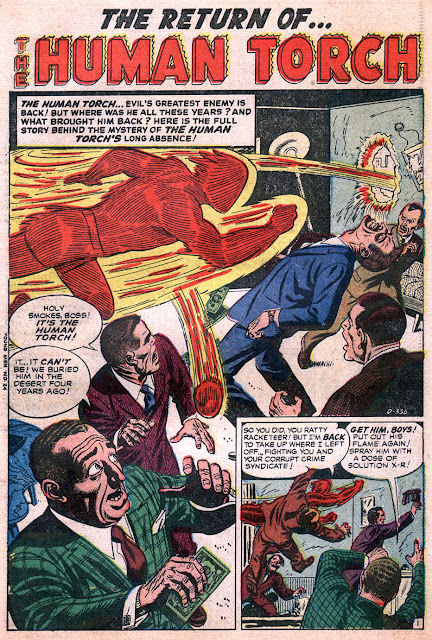

The Human Torch had been buried by gangsters after they found a way to stifle his flames. But they'd imprudently used Yucca Flats as the burial ground and the eventual atomic tests there allowed the Torch to awaken, this time with a radioactive snap to his original flame profile. He quickly finds the thugs who had tried to salt him away, but then cannot find his partner Toro. It turns out Toro had been traded to the Commies and a quick flight to Korea allows the Torch to see a mysterious jet streaking across the sky as his partner who brainwashed fought for the Communist forces. Torch brings him home and soon he's cured, and the duo work together to rescue an FBI agent's daughter from the clutches of the mob.
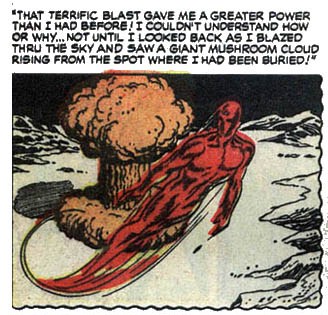

A lot is piled into a very briskly paced story. But its real impact was a visual one. Russ Heath was the artist of record despite the cover of the comic and the splash page for the Torch story having been done by Torch creator Carl Burgos. Heath's version of the Torch while aflame is different from the classic Burgos version which had been the template for many later renditions.


This sleeker version would be adopted for The Fantastic Four's Johnny Storm when Roy Thomas took control of that book after Stan Lee departed to the west coast to see to Marvel's movie needs. I've always thought this particular rendering of the Torch to be about the best one there is.


Captain America and Bucky get revived too. With artwork by John Romita (and Mort Lawrence on the splash panel) the duo have been playing it cool as Steve Rogers is now a professor teaching at the (ahem) Lee School. Bucky is one of his students and gets fired up when other boys seem to imagine that Cap and Bucky are the stuff of legend. Soon though the return of the Red Skull, this time an agent for the Communists, and a plot to take over the United Nations building are scotched when Steve and Bucky again suit up and dive in fists flying.


In a later story in a later issue of Young Men, Cap, the Torch, and the Sub-Mariner actually share an adventure sort of in a story dedicated to Cap. The trio lasts only briefly as seen in this panel.


The real significance of this 1953 revival though is not sorted out until the early 70's when Steve Englehart takes it up as a plot point. Of course, since in the then current Marvel continuity Cap had been on ice since before the end of WWII, the presence of a Cap and a Bucky during the Cold War was a conundrum. It turns out this duo were wannabes who got hold of a bad batch of the Super-Soldier serum which enhanced their already racist and jingoistic attitudes. This bad Cap battled the real Steve Rogers in a memorable four-parter by Englehart and Sal Buscema. (More on this tomorrow.) 


The third story in this great comic features Prince Namor, the Sub-Mariner. The story is written and drawn by his creator Bill Everett. And Namor's absence is handled in the most off-hand way possible. He's just been out of town. When Betty Dean becomes curious about some ships which have gone missing, she makes some calls and soon enough the Sub-Mariner knocks on her door.


I love the way Namor fills out that suit, looking downright dapper and surprisingly urbane. He's far from the berserker he's often portrayed as in other stories, before and after. (The story goes that Namor lasted longer than the others during this revival phase because TV was interested in bringing him to the small screen. It never happened, but this smooth operator would've been right at home.)Namor and Betty find out the ships are being sunk by alien robots from Venus and end the threat, though no one in the official channels believes them.


Bill Everett was a great artist, one of the polished ever to tackle a page in the Golden Age. He seemed only to ever get better, each time he took on his prize creation showing more and more sophistication. His final run on the Sub-Mariner ended when Everett passed away too soon.


I first ran across Young Men #24 in the back of Marvel Super-Heroes #20 which was fronted by a Doc Doom story. The reprint blew me away back then, the polish and sophistication of the artwork was a real eye-opener.


Later still I picked up a copy of Marvel Masterworks - Atlas Era Heroes. I got it for the Marvel Boy stories, but was delighted to find all of the Young Men issues featuring the "Big Three" included.


I read it this time in the trade paper The Golden Age of Marvel Comics Volume One, a beautiful package with a nice overview of comics of the era.


Final Issues

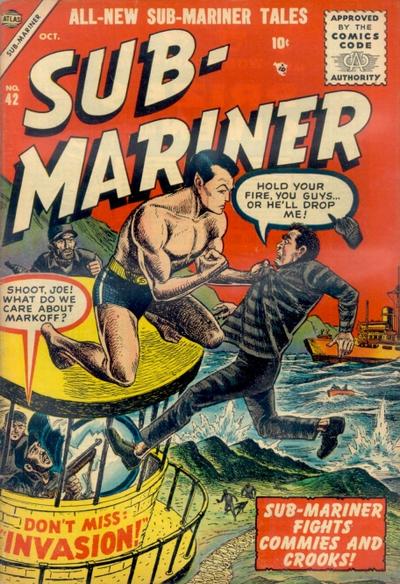
The Timely revivals in 1953 were unsuccessful. The Sub-Mariner lasted the longest because of TV interest, but despite a legitimate push the heroes found no firm footing and by 1955 were back in the bin of forgotten heroes, until the next time they were needed.

This is a Revised Red, White, and Blue Dojo Classic. 

Rip Off

Friday, January 13, 2023

The Black Knight Five!


The fifth and final issue of Black Knight sees yet another change. After only one issue Fred Kida is replaced by Syd Shores who does all of the stories in this issue including The Crusader tale. He is inked by Christopher Rule. This issue is dated April, 1956 and is five months removed from its predecessor.


Joe Maneely produces his final Black Knight artwork though, an excellent and dynamic cover for the issue.


The Black Knight faces a dragon when Modred plots with a disloyal knight named Sir Gilles to capture one of the legendary beasts and bring it to Camelot. After facing off against Gilles, the Black Knight attacks the "Dragon" revealing that it is merely a fake operated by a gang of soldiers.


Sir Percy is waylaid by a gang of robbers who are upset that King Arthur is taxing them so heavily. Percy tells them that the taxation they suffer from is the result of Sir Costain the Sheriff and not the King. Later as the Black Knight he goes to the Costain's castle and is captured but the robbers rescue him and together they bring about the fall of the evil Sheriff.

"The Invaders" is a two-page text story tell the story of Viking leaders who appear in force before Camelot, but who rather than seeking violence seek peaceful trade with King Arthur. 


The Crusader is forced once again to go in disguise to rescue King Richard when he is kidnapped by De Montfort who uses men dressed up as Moslems. El Alamain finds the King in a cave and rescues him after a fierce battle, but there is no solid evidence left that De Montfort was behind the plot.


Merlin warns Sir Percy not to take a pilgrimage along with Rosaumund and King Arthur. But despite these warnings they do go and are waylaid by Tartars who warriors under Mohar Jinn. The prisoners are taken aboard a ship but manage to escape thanks to some rotten wood. Sir Percy rescues King Arthur and they return to shore where Percy becomes the Black Knight and follows Arthur to Camelot where they defeat the Tartar invaders. Later to preserve his dual identity Percy arrives at Camelot on a donkey.

Apparently, the production of this issue was a chore since it didn't appear for several months after it should have. Syd Shores is a terrific artis,t and he brings a lush consistency to the pages here. On some pages I can even detect a desire to evoke the Maneely feel, but still it falls short of the magnificent work which appeared in the first three pages. Sir Percy gets some more time on the page in these stories it seems, but sadly looks a bit goofy to be honest.

The Black Knight would go away for many years after the cancellation of this series, not to be revived until the early days of what would become the Marvel Universe. But that was a different time and as it turns out a different Knight. More on that next time.

The second Black Knight story is reprinted.


NOTE: This is a Dojo Revised Classic Post. 

Rip Off

Thursday, January 12, 2023

The Black Knight Four!


The fourth issue of Black Knight dated November, 1955 brings significant change. While Joe Maneely does the cover as usual, Fred Kida moves in as regular artist on the Black Knight stories inside while John Romita supplies the artwork for The Crusader tale.


A knight named Sir Guy Wanderell is put down for his plundering his neighbors thanks to the efforts of the Black Knight, but pleads with King Arthur that he did it to win the hand of Rosamund, the King's ward. The lie spares him the dungeons but he immediately plots to destroy the Black Knight's reputation by pretending to be him. The two "Black Knights" meet in a joust and Wanderell is soundly defeated.


The Black Knight rescues a peasant who happens to be living in the abandoned Black Castle. Later the former resident of that castle, Kevin McCaull returns and plots revenge against King Arthur for having been driven away years before. The peasant finds the Black Knight and warns him and helps him to lead a successful attack on the Black Castle despite the mighty beasts McCaull has brought with him such as lions and elephants.

"The Intruder" is a two-page text story about Richard the Lion-Heart. A suspicious man is spotted on the outskirts of Richard's camp and his men work overtime to find what they believe to be a Moslem spy from Saladin's army. A swarthy man is captured but Richard demands to speak to him alone and it is revealed that he is rather a loyal knight who has come to report the results of his spy mission in Saladin's camp. Armed with new information Richard changes his strategy and then pretends to let the intruder get the better of him while is loyal knight escapes to spy some more. 


The Crusader is forced to go in disguise into the camp of Saladin when Quincy, a loyal knight of Richard the Lion-Heart is captured along with a precious map. De Montfort, a disloyal knight sends one of his henchmen to warn Saladin of the spy in his midst, but the noble Saladin is more impressed with El Alamain's bravery than with the treachery and sets both the Crusader and Quincy free while sending the traitor to the slave galley.


King Arthur is captured by pirates in the employ of Modred and he and his party are taken aboard the pirate ship. Sir Percy escapes and becomes the Black Knight returning to Camelot and leading loyal knights to the pirate stronghold to rescue the King and Rosamund.

The loss of Joe Maneely on this series is a severe blow, despite the largely competent work of Kida here. Maneely brought something intangible to the book, some glowing effervescent sense of wonder which despite all the clear and appropriate storytelling here is missing. Romita brings some distinction to the Crusader pages, but even they fall short. 

The first Black Knight story reprinted.


One more to come.

NOTE: This is a Dojo Revised Classic Post. 

Rip Off

Wednesday, January 11, 2023

The Black Knight Three!


The third issue of Black Knight dated September, 1955 features one of Joe Maneely's best covers, a wildly exciting image of the Black Knight himself charging right at the reader.


The first story begins with the Black Knight showing off his prowess in the a mock battle but Merlin is wary and consulting his crystal ball finds that Modred and his man Hawkes are plotting to defeat the Knight by bringing in a burly knight who strikes him from behind and wounds him. Merlin is able to use his magic to obscure the scene so that he can administer a potion to Sir Percy to help heal him. Later Modred seeks to find the wounded man in the castle, thus revealing the true identity of the Black Knight. He finds Sir Percy is injured and despite his disbelief confronts him but Merlin appears in the Black Knight's armor and Modred is fooled. Later Percy assumes the armor and defeats Modred and his men.


King Arthur is proud to announce that gypsies have come to Camelot and with them a large collection of lions for a magnificent hunt. But Modred plots with one of the trainers to release the lions and isolate Arthur to arrange an accident. The Black Knight learns of this treachery and arrives to save his King single-handedly defeating the lions and with Arthur's help the gypsies too.

"The Plotters" is a two-page text story which has Modred and his wife Morgan Le Fay conspire with the son of a man who once claimed King Arthur's throne. With Lancelot away, the time is ripe to challenge the King and some knock-out drops in his wine makes him a very soft target. But thanks to Merlin, Lancelot arrives in time to save the day and King Arthur's throne. 


The Crusader finds himself falling victim to Richard the Lion-Heart's treacherous knight De Montfort and imprisoned on a slave galley. He leads a revolt and returns to the camp in time to foil De Montfort's schemes to unseat the king.


A knight named D'Arcy wishes the hand of King Arthur's ward Rosamund in marriage, but is denied. While on a journey Rosamund is waylaid by some of a brash man named Simon but the Black Knight appears sans his armor in time to defend her honor. Then D'Arcy reappears and the Knight and Simon and his men escape and join forces to rescue Rosamund, though she is not impressed with Sir Percy's ballad about the adventure.

The third issue of the series featuring Joe Maneely's artwork doesn't miss a step. The consistency of Maneely's work, whether on adventures of this sort or westerns or mystery stories, is one of the striking characteristics. He apparently roughed his work then did the final product directly in ink, a bold technique but one which gave a vigor to the work. He clearly could see what the page was supposed to look like in his head and then proceeded to make it happen.

Some of these stories have been reprinted and in fact it was in the pages of Marvel Super-Heroes #16 that I read my very first Black Knight adventure. 

The first Black Knight story reprinted.

The second Black Knight story reprinted.


More to come.

NOTE: This is a Dojo Revised Classic Post. 

Rip Off