Showing posts with label Nick Cardy. Show all posts

Monday, October 20, 2025

Bat Lash Day!


Nick Cardy was born on this date in 1920. Cardy worked tirelessly for DC Comics and made his mark on Aquaman, Teen Titans among other titles. He was DC's go-to cover artist in the early Bronze Age and created some stunningly fine images. He worked with Sergio Aragones on Bat Lash, a different kind of western hero. 


Bat Lash and I chanced upon the DC Universe at almost the same moment. Not that I actually read any Bat Lash comics, but I did see in the DC books I found here and there a fascinating ad which told that Bat Lash was at once a most mysterious and most disruptive desperado and called into question whether he would "Save the west? Or ruin it!" The ad (drawn by Joe Orlando I assume) set into my imagination what the dangerously named "Bat Lash" must be.


It turns out I was mistaken, but it would be many years before I was disabused of the errors of my imagination.


My first Bat Lash story was not really one at all. Bat Lash debuted as did so many DC characters in the fabled pages of Showcase. Showcase became a long running title reaching its one hundredth issue and in that very special edition drawn by an exuberant Joe Staton, the many characters from its pages were jammed together into a wild and raucous adventure which blended times and genres to utterly entertaining effect. I like to consider this comic almost like the zero issue for Crisis on Infinite Earths which did the same thing a decade or so later.


In his brief appearance we see Bat Lash putting the moves on the lovely Angel of Angel and the Ape fame. So, I immediately realized that Bat was only dangerous if you were an unsuspecting damsel. And he wore a flower, that didn't make sense.


I ran across a few more Bat Lash tales here and there in the pages of Jonah Hex and whatnot, but I never took the chance to read the original run until it was reprinted some years ago in the much-missed Showcase editions. Here in glorious black and white was the saga I'd been teased to read so many decades before. And despite not being what I expected, it was still a ton of fun.


The Bat Lash of the early episodes is an unabashed womanizer and is so confirmed in his selfishness that he's hard to root for at times. He's not especially trustworthy, even to those who appear to have earned some measure of trust.


But somehow Aragones, O'Neil and Cardy find a way to keep Bat just above water in terms of our admiration. He's not good, but he's not exactly bad. He's a cad but not a villain, though we wonder from moment to moment when he might let us down.


The stories are light and frothy and that keeps the reader from investing too deeply in the antics. They have that same tone as comedies of the silent era which thrust the hero into all sorts of dangerous situations but never allow him to come to real threat since we know it will come out in the end. That's the one of Bat Lash, danger and death loom but he is immune.


But these lightly toned episodes give way in the end as the origins of Bat Lash are more seriously explored.


We learn that Bat Lash is a man who has lost most that meant much to him. He is a man who has no home and who has taken vengeance on those who robbed him of it. We learn he has a sister who has suffered as much as he has and a love who has done likewise. They have not become rogues but have taken their misfortune and made lives with a positive character.


This makes Bat Lash feel more pathetic than he has in earlier stories. Bat Lash had that devil-may-care attitude which made him impervious and he was a dashing hero, but now we learn he is a tragic figure filled with regrets and remorse.


He even has a brother who has been lost in the most baroque of ways. Their meeting is a stranger event in the story and takes the series into a strange place just before it finds its somewhat abrupt ending.


Bat Lash lingers on in the DC Universe, a part of the western landscape and he shows up in some entertaining yarns after his initial run, but despite some fine craftsmanship the magic has slipped away somewhat. The wacky nature of the early tales has been lost a bit and he feels more conventional somehow.


I always wanted to read about Bat Lash, and I finally got to do it. He was everything I imagined and nothing I imagined.


Rip Off

Thursday, July 3, 2025

The Quality of Freedom!


DC snatched up the vintage Quality Comics heroes and more than a bit of fun with them. They became the Freedom Fighters. How they got there is one of my favorite stories in all of comicdom. What we commonly call Quality Comics rose from the ashes of Centaur Publications, and the machinations are complex but not uncommon in an era where hucksters hoped to make a quick buck in a medium which was exploding in popularity. But the main guy behind Quality Comics was a chap known as Busy Arnold and he seems to be a businessman who valued his employees by and large and honored contracts. 

(The First Quality Comic - 1937)

Quality really made its mark when Arnold made a deal with Will Eisner who quit his gig with Jerry Iger and went to work with Arnold. 

(Doll Man -- Quality's First Super-Hero)

It was here that he created such characters as The Ray, Black Condor, Doll Man, Lady Luck, Blackhawk, and his most famous creation of all -- The Spirit. Such was the relationship between Arnold and Eisner that Eisner allowed the creation of Midnight by Lou Fine for Quality in case WWII did something to Spirit sales. 

(Will Eisner)

But nothing lasts forever, and eventually Arnold and Eisner go their separate ways. The comic book industry gets torpedoed by likes of Frederic Wertham, and eventually Quality closes shop in 1956. Much of their material was sold to DC who continued the highly successful Blackhawk series.

(Among the Last Quality Comics - 1956)

Eventually DC tried out Plastic Man as well. Then in the pages of Justice League of America Len Wein, Dick Dillin, and Dick Giordano brought back the Quality heroes with gusto. 


By the time of Justice League of America #107, the general template of the Justice League and Justice Society crossovers had been set. The two teams would meet and the added value from year to year would be new heroes. This time the heroes of Earths One and Two would meet the Quality heroes on Earth-X. DC had control of these heroes since they had bought out Quality Comics some many years before. Len Wein had wanted the name to be Earth-Swastika, but editor Julie Schwartz kiboshed that idea for obvious reasons.


The story really began with the previous two issues of Justice League in which both Elongated Man and Red Tornado were inducted into the League. The Tornado had survived the end of the last JLofA-JSofA adventure and been stranded on Earth-1 where he was found by his creator T.O.Morrow who promptly gave the android hero a new face and tried to use him to destroy the League which had welcomed the android hero into their ranks. Morrow's plan failed, but the Red Tornado now had the distinction along with Black Canary of being a member of both the League and the Society.
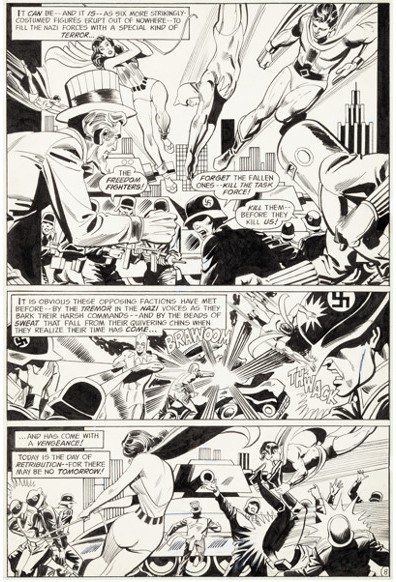

"Crisis On Earth-X" was written by Len Wein and drawn by Dick Dillin and Dick Giordano. The comic featured another outstanding Nick Cardy cover. The action begins with both the Justice League and the Justice Society trying to synchronize two transporter devices with which they hope to be able travel between the Earths at any time of the year. Despite Red Tornado's pleading to be allowed to return to his Earth, the League sends Green Arrow, Elongated Man, and Batman into the machine. Likewise, the Society sends Sandman, Dr. Fate, and Superman into their device. But Red Tornado stows away in the device causing the transporters to malfunction and the seven heroes to vanish. They end up on another Earth entirely, one that seems to have Nazis in control. They battle the Nazis who have super-scientific devices and are saved from defeat by the intervention of Uncle Sam, the Human Bomb, Phantom Lady, the Ray, the Black Condor, and Doll Man. Uncle Sam reveals that on this Earth World War II lasted far longer due to the untimely death of the President, and that eventually the Nazis won taking control of the globe. They maintain power with mind control devices to which Uncle Sam and his freedom fighters are immune. Dr. Fate uses his magic to detect the locations of the hidden mind control devices, and the heroes divide into teams and Uncle Sam sends the teams away to destroy the devices. Red Tornado is left behind. Batman, Dr. Fate, Ray, and Human Bomb are sent to Paris where the mind control device seems to be in the Eiffel Tower. The quartet battle their way to the top and find the machine which is sentient and defends itself with specially constructed foes for each of the heroes. The heroes prevail but then are taken over directly by the machine. They are able to destroy the machine though by combining their powers and relying on their reflexes. Meanwhile the heroes of Earths One and Two search for their disappeared comrades.
 

"Thirteen Against the Earth!" under another great Cardy cover is again by the Wein, Dillin and Giordano team. Uncle Sam breaks the fourth wall and brings the reader up to date on the events of the last issue. Superman, Doll Man, Green Arrow, and Phantom Lady arrive in Japan, the former Axis power which was also defeated by the Nazis, to find the second mind-control machine. It is hidden in plain sight and Superman detects it and reveals it. The machine threatens to destroy Japan if the heroes attack it, but Superman is undeterred landing a ferocious punch. Immediately Japan suffers a massive earthquake, and Superman flies off to alleviate the problem. Meanwhile the other heroes work together to get Doll Man inside the machine where he disables it. Elongated Man, Sandman, Black Condor, and Uncle Sam arrive at Mount Rushmore where Hitler's face has been added to the monument. The heroes fight their way to another machine only to discover that it's an illusion. They deduce the machine must be inside the Hitler head and Uncle Sam aided by Elongated Man delivers a massive punch to Hitler's stony ediface destroying the machine. The heroes are them reassembled but discover that the mind control has not diminished despite the destruction of the three machines. In fact, the heroes of Earths One and Two are taken over by the mind control and attack the heroes of Earth-X. Red Tornado detects the source of the mind control and follows the trail into orbit where he finds a huge Nazi satellite "manned" by an android Hitler. It turns out the Nazis had actually been defeated by their own mind control machines some years before and that the machines have ruled Earth-X since. Red Tornado attacks and succeeds in causing the satellite to fall out of orbit and crash into the ocean. He rescues a bit of equipment the machines used to communicate, and the heroes are able to contact Earths One and Two to arrange rescue. The leave Earth-X free of its oppressors and they leave behind some truly quality freedom fighters.


The Freedom Fighters proved to be pretty popular and even got their own series several years later. It was a quirky series and brought the heroes to Earth-1 and made them fugitives, an attempt I guess to recreate their underground guerrilla warrior role from the crossover. I enjoyed it, but after a few years the series was cancelled. This crossover itself is one of my absolute faves. The artwork by Dillin and Giordano is outstanding, with Giordano giving Dillin's storytelling some real drama. In the years before internet and archives and whatnot, getting to see these vintage heroes was an awesome treat. While I adore the modern era with access to old comics easy to get hold of, part of me yearns for those sweet days when such glimpses were exceedingly precious because they were so rare. 

The Freedom Fighters went on to get their own series, one which lasted a few years and was caught up in the end in DC's notorious implosion. Here's a cover gallery. 


The book might have died, but there was no killing these Quality characters. 


A few years later Roy Thomas developed an origin story of sorts for the Freedom Fighters in the pages of All-Star Squadron. This comic was Roy's attempt to organize and to some extent sanitize DC's often chaotic Golden Age era. 


Alas, his hard work was largely undone by Crisis on Infinite Earths. The arrival of Harbinger was the end of classic DC take on those vintage Quality heroes. 

Look for more posts on the Quality heroes as July rumbles along. For more about these comics, I highly recommend Twomorrow's Quality Companion. (See the cover at the top of this post.) It has a wide array of features and traces the rise and fall of the company and its many talents. It even includes many full-color comic stories from Quality's heyday. 

Rip Off

Thursday, June 19, 2025

Earth-Prime Day!


Julie Schwartz was born on this date in 1915. He was among the earliest science fiction fanboys and published a sci-fi fanzine called The Time Traveler with buddy Mort Weisinger. The two ended up working in the comics business as editors primarily for DC Comics. Schwartz oversaw the updating of the DC Universe in the Silver Age. 

When I was a new fan my comic book tastes were broad and inclusive, limited only by my meager cash resources. I read Marvel, Charlton, Harvey, Gold Key, Archie, and of course DC. The first DC character I latched onto was the Flash and the very first Flash story I read had him go to Earth Prime, and not only was I not confused by this parallel Earth story, I was utterly fascinated, and it remains one of my all-time favorite DC stories.

"The Flash--Fact or Fiction?" is not strictly a crossover tale, but this 1968 classic does introduce the world of Earth Prime, our world where comic book heroes are just that, the stuff of comics. The Flash ends up here after clashing with an alien creature named the "Nok" which has escaped from a space zoo transport. The Nok attacks the Flash propelling him into another dimension and another Earth on which he discovers he's just a comic book hero like Jay Garrick is on Earth-1. Flash needs his Cosmic Treadmill to return home but has no resources so he visits the DC Comics offices and meets up with Julie Schwartz. Schwartz is soon convinced of the fantastic situation and helps Flash, who quickly puts together a treadmill and rushes back to Earth-1 to defeat the Nok. I've not mentioned Schwartz in these reports, since his role as editor is largely an invisible one, but as it turns out none of the crossover stories would have happened without him. All of the stories I've taken a look at happened in books he edited and he had a hand in plotting all of them I'd reckon. So it's fitting that he actually turns up in one of the crossovers, and it all started so to speak with this Flash story.
 

Later in the Flash series, Cary Bates, the book's writer ends up on Earth-1 also, where he helps out the Flash too. This 1974 story sets up in a manner of speaking the big crossover which would happen only a few months later in 1975.
 

"Where On Earth Am I?" was written by Cary Bates and Elliot S! Maggin and drawn by the ever reliable Dick Dillin who is joined by his longtime inker Frank McLaughlin. The cover is by Ernie Chua/Chan. The story begins in the office of Julie Schwartz where Bates and Maggin are hashing out the latest Justice League plot. They are stuck but Bates remembers the Cosmic Treadmill that Schwartz has and soon enough has used it and has disappeared. He turns up on Earth-2 and he is changed, having villainous thoughts and superpowers as well. He uses his new powers to help some robbers escape Johnny Thunder and Robin. Back on Earth Prime Schwartz and Maggin decide to send Maggin to get Bates, but Maggin ends up in the ocean on Earth-1 where he is saved by Aquaman. Quickly Aquaman gets him to the League satellite headquarters where Maggin convinces the League members Batman, Hawkman, Green Arrow and Black Canary of the truth of his story by revealing their secret identities. His story is confirmed by the Flash who turns up. On Earth-2 the Justice Society (Hourman, Wonder Woman, Dr.Mid-Nite, Johnny Thunder, and Robin) are battling some out of control plants and defeated by same controlled by the evil Bates. The League meanwhile decides to go to Earth-2 after it is determined Bates has gone there and they immediately encounter six villains (Icicle, Sportsmaster, Huntress, Gambler, Shade, and Wizard) stealing some aircraft from a Navy carrier. They quickly subdue the villains only to discover that the baddies are the Justice Society members in disguise and further that the defeated heroes are dead. Cary Bates takes credit for the scheme in the final panel.
 

"Avenging Ghosts of the Justice Society!" is again by the Bates, Maggin, Dillin, and McLauglin team. Ernie Chua/Chan supplies one of his best ever covers for the series. The story picks up with the League members memorializing the fallen JSofA members. Cary Bates is still in the middle of his crime spree and we discover that he works for the six villains seen in part one. A mysterious misty presence though makes itself known and plans vengeance for the fallen Society. The League is filling in for the dead Society members until they can figure something else out. Elliot S! Maggin is captured by Bates and imprisoned in a gigantic bubble gum bubble. The League is attracted to a black portal which takes them to the villains while the Spectre makes his presence known. A battle rages between the heroes and the villains with the heroes losing because they are haunted by the guilt of the fallen Society members who they killed while in the guise of the very villains they now fight. The Spectre implores the highest powers to allow him to revive the fallen JSofA members while Maggin tries to undermine the powers of Bates by insulting his writing skills. The combined efforts weaken the effects of the guilt on the Leaguers and the Society members suddenly appear hale and hearty. Quickly the villains are beaten and even more quickly Bates and Maggin are sent back to Earth Prime where Julius Schwartz is waiting anxious to get the next story out.

This is not the greatest story ever told by any means. The writers seem a bit too intrigued with showing off their wit and not clearly hammering out the plot details such as they are. Perhaps they considered the story just so absurd that there was no need to sweat the small stuff, but it hurts. The motivations of the characters are poorly examined. It is the Wizard who is controlling Bates, but that is not at all really clear and is supposed more than stated. Further the League and the Society don't come off in these stories looking all that competent. The Spectre's role is very offbeat, with him essentially performing a deus ex machina ending which solve the whole mess. Maybe the writers were playing with the cliches of the storytelling and making these elements explicit, but the whole story is a jumble.

But that doesn't undermine for me, the sheer fun of Earth-Prime, the comic book universe that exists right out my window. 

 Rip Off

Tuesday, March 4, 2025

The Hawk And The Dove!


The Hawk and The Dove comic was the absolute exquisite product of a powerful moment in American history when the nation was torn about wars abroad and the youth culture of the time was demanding accountability and a new way forward. The schism in the society of the day was between those who had long trusted their government to prosecute necessary wars in the defense of the nation and those who felt that the government had violated the trust of the average citizen by pursuing a war by means of deception. The argument waged between the brothers Hall, who are the titular heroes Hawk and Dove was an argument raging in many if not most households across the nation in the day.


Steve Ditko had left behind his co-creation of Spider-Man and found at DC under editor Dick Giordano, at least momentarily, a haven where he could produce the kinds of politically sensitive stories he craved to present. His Beware The Creeper showcased his long-standing complaint against personal cowardice in the news media and here we see his take on the war debate. He didn't last long on the book, producing only the first three issues (one the Showcase debut issue). Gil Kane with writer Steve Skeates picked up the reins and later Kane himself wrote the stories. The duo also made a guest-starring appearance in the Teen Titans by Neal Adams and Nick Cardy. This led to more appearances in later years and the brothers Hall were considered members of a sort. 


The collection is highly recommended and sits on the very tip top of my reading stack.


The United States is undergoing the greatest stress to its character since those now seemingly far-off days of the Vietnam War. A pirate has swindled and lied his way into the White House and he and his minions seem intent on not just lining their own pockets, but they are breaking the peace of the world to do it. The struggle for the soul of America is far from over. The current powers of the opposition have not fully grokked the nature of the threat, or they hide cowardice and timidity behind parliamentary procedure. New leaders are rising even now, and again it's among the young. The inevitable success of that struggle might well not end in my lifetime, or it might end more quickly than we imagine. These are unprecedented and troubled waters we sail on today. 

Rip Off