Showing posts with label Luiz Santilli Jr. Show all posts

Monday, May 25, 2009

You Calling Me A Basket Case?

Hang On, They're Petunias

Photograph copyright: DAVID McMAHON


Last July we were on a family holiday in Malaysia, a part of the world I'd never visited before although I have made several visits to neighbouring Singapore. The result was that the clan had a great two-part holiday, on the island of Langkawi where time stood still, and then in Kuala Lumpur where there were too many photographs to be taken, so I couldn't stand still.

This was taken on the main road, just outside our hotel, the Shangri-La, as we walked to the monorail shortly after checking in. I was determined to get as close to the kerb as possible (within the bounds of safety, of course) to take this shot, because I wanted to frame the white petunias with the blue-and-white sign. Yes, it is a taxi bay.

They really do things in style in KL. If you want a taxi, you don't have to stand there windmilling your arms as the traffic flies past you. You just walk to a taxi bay, clearly designated and prominently marked - and hey presto, it all happens as if by magic. And if you do have to wait a minute or two, you have beautiful flowers to gaze at in the interim.

Visit Luiz Santilli Jr for the home of Today's Flowers.

Monday, May 18, 2009

My Name Is Swirl

This Reminded Me Of Noah's Arc

Photographs copyright: DAVID McMAHON


One of the things about visiting different countries is that the local flora is always fascinating. This shot was taken in Malaysia, during our family holiday last July. We were on the tropical island of Langkawi when I first spotted these flowers growing in a clump near the beach.

They caught my attention because of the grace of the long, tapering petals and the manner in which they seem to be flung at random to all points of the compass. These white tendrils formed beautiful arcs against the dark green foliage underneath and in the background.

It was only after I moved closer to take this shot that I spotted the delicate, long pistils with the dark pods. I had my 18-125mm lens on the camera, which is a great all-purpose lens. Despite the deep shadows in the vicinity, the strength and contrast of the colours really dictated the way I composed these two shots.

Do I know what the flowers are called? Er, no, but if you have any clues, do let me know.


Visit Luiz Santilli Jr for the home of Today's Flowers.

Monday, May 11, 2009

Learning Curve

Maybe It's A Will O’ The Wisp

Photographs copyright: DAVID McMAHON


Exactly a year ago, I spotted this plant in a public-access area and I scratched my head because I had no idea what it was. The other thing that caught my interest was the manner in which the main stem seemed to grow in a curve.

I didn’t think anything of it at the time, but I just assumed that the stem would probably straighten out as the plant continued to grow. I went back to the same spot a couple of weeks later and found that the stems had not produced blooms yet, but that the curve was now much longer and even more pronounced.


I also noticed the fine, fibrous tendrils on the lower part of the plant, Like wisps of angel hair, they would have been great to photograph in the late afternoon, because they would have caught the sunlight and would have stood out more clearly on any image.

As it happened, I had my standard 18-125mm lens on the camera, so I had to use an all-encompassing composition that showed the plant’s structure as well as the delicate white wisps. And to answer the question I know you are going to ask – no, I still don’t know what the plant is called. Any information will be gratefully accepted.


Visit Luiz Santilli Jr for the home of Today's Flowers.

Monday, May 04, 2009

Waratah, Waratah Everywhere

But Not A Drop To Drink

Photographs copyright: DAVID McMAHON


If you’re looking for a cut flower that looks amazing in a vase and lasts for a very long time, you can’t go past a waratah. This Australian native plant is actually the floral symbol of New South Wales, our neighbouring state.

The conical flower heads are huge – these ones were just average size, about 15 centimetres (six inches) across, although they can grow much larger. They can be grown from seeds and cuttings alike and I was once told that they show re-growth remarkably quickly after a bushfire.

I’ve only ever seen red waratahs, but a little diligent research has shown me that there are other colours too – mainly pink or white. One of the things that has struck me about waratahs is that, like camellias, they have distinctive leaves that add a lot of character to any floral arrangement.

Of course, the leaves of the waratah are very different from those of the camellia. The latter are small but high in sheen, adding a lot of character to a vase. But waratah leaves are much tougher and longer and surround each bloom like a protective circle, with each leaf about 15 centimetres long.

During the 2006 Commonwealth Games, staged here in my hometown of Melbourne, waratahs took pride of place in the bouquets that were handed to each medal winner. So if you watched the Games on TV and wondered what the huge flowers were, now you know!

Visit Luiz Santilli Jr for the home of
Today's Flowers.

Monday, April 27, 2009

Blossoms Of Autumn

Do These Petals Remind You Of Waves On A Beach?

Photographs copyright: DAVID McMAHON


This is probably the last serious flush of roses in the garden at Casa Authorblog. After a mild start to our spring and summer, they were heat-blasted through January and February, when the scorching conditions and lack of rain took a severe toll.

But now that we’re in the second half of autumn, the roses have made their last stand. I shot these images last weekend, late in the afternoon on one of those days when the slanting sun can produce light that sometimes encroaches on the very subtlety that you are trying to capture with a camera.


Yes, there were fresh blooms unfurling on this beautiful Chicago Peace rose bush. Yes, there were high, proud buds. Yes, there was a profusion of spent blooms that were less than 24 hours away from withering. But I decided that I would use the light to emphasise the intricate pastel shades spanned by a single bloom that was well past its use-by date.

I particularly like the first and last shots in this sequence, because they capture the delicate waves and subtle nuances of colour. At its best, this rose is brilliant in vivid orange and pink tones, with a distinct buttery quality to some of the blooms.


Not only does it have a wonderful perfume, the size of the blooms is also so striking that two stems are often enough to dominate a huge crystal vase. I thought the playing card would be a great visual aid to show you just how large the blooms are.

Yes, I deliberately chose the King of Spades card because I was the person who actually dug up the turf to put in what was then a tiny bare-rooted plant with a few minor sprouts.


Visit Luiz Santilli Jr for the home of Today's Flowers.

Monday, April 20, 2009

Paradise Regained

A Feast Of Colours And Angles

Photographs copyright: DAVID McMAHON


This series of shots was taken last week, while I was in Sydney with my family. Travelling interstate is always an interesting experience for anyone with the slightest interest in horticulture, because some plant varieties thrive as you travel further north.


These are called the bird of paradise but the correct botanical term is Strelitzia reginae, while they are known as the crane flower in South Africa, where they originated.

Although it is several weeks since they disappeared in Melbourne, they are still very showy in New South Wales. We were walking through a mall to get to a bakery when I noticed this clump, with their vivid colours.


After we had picked up some hot cross buns and other wonderful products from the bakery, I told the Authorblog clan to walk on to the car and that I would catch up with them. They didn’t even need to ask what had caught my attention.

Several other shoppers must surely have wondered about my sanity as I poked my head into the towering foliage. You see, these blooms can grow to two metres or more, depending on soil conditions, sunlight and drainage.


While the dominant colour is orange, you can sometimes find specimens where the mauve segments, lower down on the flower, are still redolent of the sort of vivid colour you’d expect in a neon sign.

I think I was just lucky to catch these plants at the right time. If you look closely at the second shot in this sequence, you’ll notice a couple of droplets of thick orange sap trickling down the side, which suggests that they were about to start decaying as winter begins to draw closer.


Visit Luiz Santilli Jr for the home of Today's Flowers.

Monday, April 13, 2009

Buzz Stop

My Garden Is A Hive Of Activity

Photographs copyright: DAVID McMAHON


Some months ago, before the hot, dry summer that even killed some of the rose bushes at Casa Authorblog, it was a lazy afternoon that demanded photography. I'd spent about half an hour or so shooting some of the freshest roses that surround our property, when I decided to take a complete change of approach.

I went looking for the oldest rose bloom in the greatest state of decay. That just happened to be this specimen, standing tall but distinctly ragged and well past its best on a bush called Chicago Peace.


Since I had a macro lens on the camera, I figured this was the perfect opportunity to go for the unflattering close-up. Forget the petals, forget the colour that had faded well past its best display. I figured I would go so close that I could literally stick my nose in the rose.

I was going to concentrate on the miniature tendrils at the very centre of the bloom. Let's put this in perspective. They are absolutely minuscule, a few millimetres long at the very most. As I could see in the clear afternoon light (and as you can see in these images) even they had succumbed to age and were completely tattered.


I got a couple of decent shots and then I thought I heard a sound. I knew it wasn't a sound from within the inner recesses of Casa Authorblog. I knew it wasnt the distant sound of an angle grinder. I knew it wasn't the sound of the camera.

So, like some of the shrewdest generals in military history, I staged a retreat. No, let me amen that. I staged a strategic pull-back to assess the situation.

Sometimes my brain isn't the quickest on the planet. The sound I'd heard was the unmistakable buzz of a bee.

Sure, and it wasn't the theme music from 'The Sting'.


Visit Luiz Santilli Jr for the home of Today's Flowers.

Monday, April 06, 2009

Poker School

Aloe, Aloe, What Have We Got Here?

Photographs copyright: DAVID McMAHON


Early last week, it suddenly struck me that I had missed a great opportunity to photograph the stunning red-hot pokers and to publish them for this weekly theme. I rued the missed chance, because as I explained to the Authorbloglets, the flowers seem to be at their very best in early March.

Of course, we're almost in mid-autumn now and the clocks turned back an hour yesterday, so the chances of finding any red-hot pokers (properly called aloe or kniphofia) in half-decent condition seemed extremely remote, especially as the days get shorter and the cooler weather returns.

Then I had a stroke of luck. I was driving around a bend and I was using my peripheral vision to the best of my ability when I noticed a solitary bloom standing proudly among several that had withered and dried. I couldn't believe my good fortune.


Naturally, I pulled over, parked the car and reached for my camera. Let me tell you that shooting this single flower was no easy task. There was a strong and persistent southerly breeze, so my target was bobbing around like a cork on a wave.

As you can see, the blooms comprise several tassels of different colours, almost like long, uninflated balloons. The newest "tassels" are up the top, while the oldest ones turn from reddish-orange to distinct yellow. As this final shot shows you, they also open to reveal seed pods.

The shape of the yellow parts, as they break open, has always made me think they look like trumpets. I guess they are Nature's clarion call, telling us that summer is long gone.


Visit Luiz Santilli Jr for the home of Today's Flowers.

Monday, March 30, 2009

Nature's Salute To The Morning

In The Mellow Sunlight Of An Indian Haven

Photographs copyright: DAVID McMAHON


These shots were taken in a friend’s garden in December 2006. I was in Dehra Dun, northern India, for only four days and was revelling in the opportunity to use my camera in a part of the country I had never been to.

Even though I grew up in India, and travelled widely, there are many parts I still have not visited and Rajasthan, in particular, still draws me like a magnet.

I was up early every morning in Dehra Dun, the better to use the soft winter light. The frosts had not started, but there was heavy dew on the grass and the diffused light was great to capture soft tones that might otherwise have been harder to nail down in bright light.


Bougainvillea, as any Indian will tell you, is common in all parts of the country and it’s not unusual to see great bursts of vivid colours across a stark wall or boundary area. The plant is actually named after Louis Antoine de Bougainville, an French admiral who is credited with being the first European to discover the captivating species in Brazil in 1768.

Like many of the older villas in Dehra Dun, a prime outpost in the Raj era, this is a beautiful cottage with an English-style garden. The bougainvillea was growing in large pots, so I was able to shoot at slightly below eye level, choosing my angle so as to utilise the light to best effect.

And if you do grow bougainvillea, I am reliably told that it flowers most profusely if trimmed lightly. Resist the urge to cut it back harshly – and you’ll be rewarded with bursts of long-lasting colour in a variety of shades.


Visit Luiz Santilli Jr for the home of Today's Flowers.

Monday, March 23, 2009

After The Blessing Of Rain

Looks Like There's Been A Growth Spurt

Photographs copyright: DAVID MCMAHON


These photographs were talen a few hours ago, to show you a remarkable transformation. Through the long, hot, dry summer just past, our many roses continued to thrive. We had every colour imaginable, with a variety of scents. Maybe they were not as profuse as they have been in years where the drought has been tempered by some occasional rain, but there were roses on every bush nonetheless.


Then last month we had a three-day spell that was hotter than anything else in our history. Unrelentingly, the heat reached the 46C mark (almost 115 Fahrenheit and stayed there. On the first day, I showed the Authorbloglets several fresh blooms on the rose bushes across our property - and I pointed out that by midday they would all have withered.


Even the rose hips were burnt to a crisp. Normally, the hips form a beautiful head-tossing dance in a strong breeze, but few of them took on the orange-green hue that is common to their form. As you can see in this shot (above) taken a few hours ago, some of the rose hips in our garden looked like remnants in a fireplace.


At the end of that torturous hot spell, there were no flowers left in our garden. Then, last Saturday we had real rain. In a few days, the dun-coloured lawns and nature strips of Melbourne have turned green again. And sure enough, some of our rose bushes have burst into bloom once more.


Visit Luiz Santilli Jr for the home of Today's Flowers.

Monday, March 09, 2009

Raindrops On Roses

These Are A Few Of My Favourite Things

Photographs copyright: DAVID McMAHON


You know the sound of rain? The sound that most of the world takes for granted? The sound that those of us who live in Victoria haven't heard for so long?

Sometimes the sound of rain can be music to our ears. And when you live in a severely drought-ridden state, as I do, that precious sound can be more musical than Handel's "Hallelujah Chorus".

We've just had the driest ever start to the year. Until the first drops of hesitant drizzle began to fall late last week, this was a scorched landscape. Less than a millimetre of rain (yes, that's right, less than a millimetre) has fallen since before Christmas.

It's been a tough six weeks for Victorians. The deadliest bushfires in our history began on January 30th - and one of them is still burning out of control. Then we had an earthquake on Friday night, which left a few people shaken, literally and metaphorically.

But yes, we have been blessed by rain. And now, as we move into the second week of autumn, I have to decide where exactly I must start to rescue my garden. But for the moment, I want to ask you a simple question. In the first picture, what caught your attention first?

Was it the raindrops on the windscreen? Or was it the flower carpet roses in the background?

Both the photographs in this post were taken in exactly the same spot, with one subtle difference. In the first frame, the rain-spattered windscreen is in sharp focus, but in the second frame (below) it is the roses in the background that are the main subject.


Visit Luiz Santilli Jr for the home of Today's Flowers.

Monday, March 02, 2009

Colour Palette

Before The Blast Of The Heatwave

Photographs copyright: DAVID McMAHON


These shots were taken in my garden, in late December. At the time, we’d had a few warm days but nothing like the scorching heat that has been a hallmark of Australian summers. In early November, we had endured a string of hot days and warm nights but they were swiftly replaced by balmy days and cool nights.

Had we missed out in summer entirely, we asked. But that question was answered less than a month later, when the heatwave returned in earnest. We stumbled through days that tested this city’s infrastructure, with the heat buckling train lines and leading to such heavy demand on domestic power supplies that the evenings often saw some areas without electricity.

Then came The Great Heatwave – the spell of savage temperatures the like of which we have never seen. For three consecutive days the mercury climbed above 43 Celsius (about 110 Fahrenheit) and even surpassed 46 Celsius (about 115 Fahrenheit).

Just after dawn on the first day of the heat, I noticed several new blooms on this and other rose bushes in our garden – but when I got back from work, they looked as if they had been sand-blasted or roasted in an oven.

For the first time ever, I have lost hardy rose bushes in the heat and the dry conditions. But we have much to be thankful for. Our home still stands, unlike so many in this city.

Yes, I will soon replace the roses and the mature azalea bushes that we lost this summer. Not now. The soil is too dry. There are no rain clouds on the horizon. I’ll wait until mid-April, when we’re halfway through autumn, to go and choose the replacements at our local nursery.

There’s so much to strip out of our garden. But on a positive note, there will equally be as much to plant and nurture and nurse to maturity.


Visit Luiz Santilli Jr for the home of
Today's Flowers.

Monday, February 23, 2009

Symphony In Orange

Vivid Colours In A Tropical Paradise

Photographs copyright: DAVID McMAHON


I'd be delighted if some expert could tell me what these flowers are called. The first two images was shot in Singapore in December 2007, as I walked around the island city-nation. A tropical thunderstorm had just passed through the area and I was making sure that I was never too far from an arcade or some form of shelter.
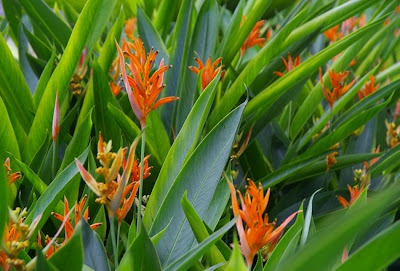

There was sound logic behind this. Just in case the heavens opened again, I would be able to do a quick sprint to the nearest point of shelter to protect my precious camera.

The flowers were simply growing by the side of the footpath, in that wonderfully landscaped environment that has been a part of my earliest Singapore memories, ever since my first visit there as an eleven-year-old.
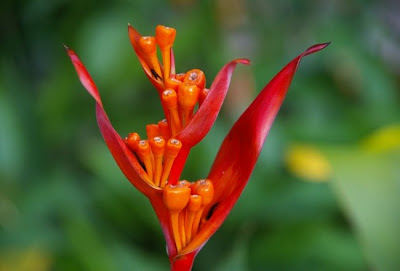

It was not just the formation of the plant that attracted my attention, but the way the vivid orange stood out against the green foliage in the background. So too the graceful manner in which the leaves seemed to echo the intricate grace of a Thai or an Indian classical dancer.
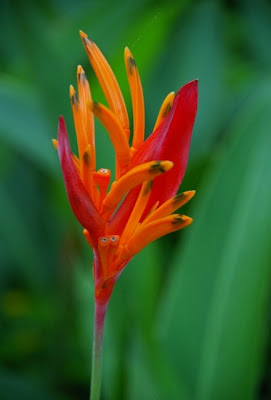

This shot (above) was actually taken in Langkawi, Malaysia, last year. We were walking around the vast hotel property when I noticed this, but couldn't find anyone to tell me what it was called.
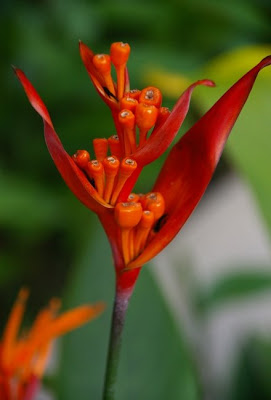

This frame (above) was shot in the Malaysian capital, Kuala Lumpur. We'd been sitting by the pool at our hotel for a few minutes when of course I had to do my customary "what's-in-the-vicinity-for-me-to-photograph" survey and lo and behold, I saw the same plant a few metres away.
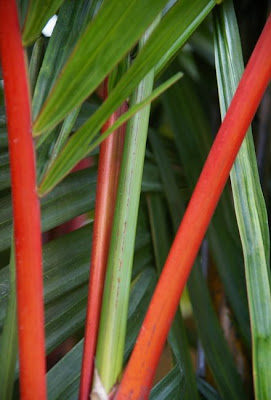

After I'd shot a couple of frames of the blooms themselves, I also noticed that the long, narrow stems made an interesting sight with their contrasting colours and gentle angular orientation. So, quite naturally, I had to shoot a frame of that unusual view as well.

Obviously it was the same species of plant, but I couldn't find an amateur horticulturalist to tell me what it was called. I guess I'll just have to go back there to find out .....

(Extra, extra, read all about it: I've been interviewed here. Thank you to all those who have followed this link and checked out the interview. There have been so many wonderful comments that I've tried to reply to each one personally - but you're setting a cracking pace. My humble and heartfelt thanks to all of you for the wonderful tributes and thoughts you have shared on the interview.)

Visit Luiz Santilli Jr for the home of Today's Flowers.