Showing posts with label Yukon Tourism. Show all posts

Friday, May 01, 2009

The World's Ultimate Theatre

Tarry A While After The Lights Are Turned Down

Photographs copyright: DAVID McMAHON


Sometimes a photographer is rewarded for patience. Actually, let me amend that advice. More often than not, there is great reward for patience. Long after the main event has come and gone, there will always be an unusual image worth capturing.

A few months ago I was in Dawson City at the invitation of Yukon Tourism and I was lucky enough to be atop The Dome during a memorable sunset. The images of that evening, as the sun sank slowly and unhurriedly over the surrounding hills, can be seen at Sunset Over The Klondike.

But long after the golden orb had finally slipped into the embrace of the horizon far below me, I remained at The Dome, completely entranced by the 360-degree view.

After the liquid gold tones had vanished from the sky, they were replaced by a new range of pastel colours. Combined with the blue-azure of the hills in the west, they made an irresistible sight. In other words, never hurry away from a sunset. Chances are the aftermath will be just a memorable.


For other participants in Dot’s concept, go to Sky Watch HQ.

Friday, March 06, 2009

Perfection Under The Vast Yukon Sky

Yes, We Did A U-Turn On The Alaska Highway

Photographs copyright: DAVID McMAHON


Sometimes you need a bit of luck. In early September, I was on the Alaska Highway, travelling from Haines Junction to Whitehorse, after being lucky enough to get a shot of a charging grizzly a couple of hours earlier.

We had covered close to 2000 kilometres in six days and, as always, my head was swivelling in every direction as I sat in the passenger seat. I used two cameras during the trip, a Pentax K100D with my 18-125mm lens and a Pentax K200D with my 70-300mm lens. I had shot several hundred pictures through the window of the 4WD as we travelled at 100 kilometres an hour.

But this time, I only had time to squeeze off a couple of shots as a lake flashed past on my side of the vehicle. Margaret Goodwin of Yukon Tourism was at the wheel and I asked her a few seconds later if she would actually mind turning back. Willingly, she found a spot to do a U-turn and we retraced our path as I looked for the lake.

It was the only time on the entire trip that we had doubled back – and it was well worth it.

So why did I make the unusual request? Because all through my week in the territory, I had been looking for the quintessential Yukon shot. I wanted one frame that would capture a vast horizon, under a big sky, encapsulating snowy mountains and some of the beautiful fall colours.


Yes, I had shot several scenes that fulfilled those self-imposed requirements – but for some reason I knew this vista would be one of the best. I guess I would rank it with another shot taken on the same trip, the fourth and final frame on my post Big Blue of mountain peaks reflected in the surface of an amazing blue lake near Dawson City.

The Blue Lake shots were taken under a flawless blue sky, but here on the Alaska Highway, the sky was a showcase of beautiful hues that looked like a watercolour painting. As you can see from these shots, it was dusk and there were ribbons of blue-grey cloud above the mountains. The lake was perhaps 250 metres from one end to the other. As you can see from the shots, it was fringed by trees that spanned several colours from autumn’s palette.

And there was very little breeze. While this might not seem like an important factor, it comes into play in a big way when you are photographing a reflection on the surface of water, as I was attempting here.

Not one of these images has been enhanced in any way. I never use Photoshop – as most readers know by now. The true beauty of communicating through photography is to allow someone to see exactly what you saw through your lens.

That evening in the Yukon, everything suddenly seemed to come together for this series of shots.


For other participants in
Dot’s concept, go to Sky Watch HQ.

Thursday, January 22, 2009

The Doors (3)

Looking For The Wonderful Alley, McGraw

Photograph copyright: DAVID McMAHON


Wherever I travel, I seem to take photographs of unusual objects. But doors, for some reason, seem to be a constant theme for me. Is there a Freudian reason for this fascination? Maybe because we, the human race, use doors to control access to ourselves, our lives, our thoughts and indeed our very existence.

Doors, I guess, are like the human mind. We open them readily to those we recognise and love, while (generally) we close them to those we do not know or trust or those whose proximity brings more questions than answers.

Doors are the most ancient method of protecting our personal space. I've also found that doors are like snowflakes, for you seldom find two that are identical. Perhaps that explains why the opening sequence of Monsters Inc sticks in our collective consciousness, as the myriad doors traverse a never-ending roller-coaster production line.

Recently I posted Traffic Jamb, then a couple of weeks ago, I posted a shot of this burgundy doorway in Calcutta, India and last week I followed it up with this random shot of a weathered blue door in Fremantle, Western Australia. I received a lot of comments and emails suggesting that I start a regular series.

Yes, I like the idea. So here is the next instalment in the series. This was shot in September, in Whitehorse, capital city of the Yukon. I was there at the invitation of Yukon Tourism and this was one of about 200 shots I took in the last couple of hours on Canadian soil before I caught my flight back to Australia.

Those who have read my travel writing and my blog would know that the Yukon has occupied a special place in my consciousness since my first trip there in 1999. So I guess it's fitting that this was taken in Paradise Alley. This part of Canada has always been my idea of paradise.

Saturday, November 22, 2008

Snow Patrol

There's Always Time For A Backward Glance

Photographs copyright: DAVID McMAHON


Sometimes we are privileged to gaze on paradise, but we don’t always realise it. Mountains have been a part of my life since my high school years, when I was a boarder at St Joseph’s College, Darjeeling – which probably explains why I spend so much time photographing them wherever and whenever I can.

A few weeks ago I was in Canada at the invitation of Yukon Tourism and literally a few hours before I flew home, Charles McLaren of Shadow Lake Expeditions took me on a memorable four-wheel-drive ride.

We explored the Coal Road area outside Whitehorse and when we returned to his vehicle after one stop, I was just about to put my seatbelt on when I spotted this sight. I asked Charles not to start up and not to move his vehicle an inch.

He looked at me quizzically, but I pointed to the rear-view mirror mounted on the left-hand side, where this mountain was reflected clearly in the glass. Yes, I could have got out and probably got a better shot, but by taking this from where I sat, I was able to capture an unusual view.

Around the perimeter of the rear-view mirror you can see the hillside in front of us, while the reflection itself shows the mountain that was directly behind us.

In retrospect, this would have been an even more spectacular shot a fortnight later. You see, the fall colours were just starting. A few days later the hillside would have been covered in reds and yellows, forming a virtual wreath for this mountain reflection.

Then again, the real challenge for any photographer is to capture the moment, not to wait for a better opportunity.


Visit TNChick, creator of
Photo Hunt. Today's theme: "Reflection".

Saturday, September 27, 2008

The "Charge" Of The Flight Brigade

Yes, You Could Call It A Power Struggle

Photographs copyright: DAVID McMAHON


Until a couple of years ago, I’d used quite a few camera brands. Then in mid-2006 I used a Pentax for the first time when I had to review the performance of a K100D. I liked the camera so much that I bought it. I liked the way it handled, I liked its balance, I liked the feel of the camera, I liked the weather-proofing of the body. But more than anything else, I liked the fact that it was powered by simple AA batteries.

For more than a decade, I had become accustomed to sealed battery units, but with the Pentax and its 18-125mm lens, I suddenly realised there was much greater freedom. It’s the perfect lens if you’re travelling. And it’s the perfect power source - crucially - if you’re on the road. Hey, have you ever come across a place, even a remote town, where you can’t buy AA batteries?

In the two years that I’ve had the Pentax, I’ve always used rechargeable batteries, but I’ve always carried backup with me. In my camera bag, I always have one set of AA batteries. A few months ago, I made assurance doubly sure and slipped in a second set.

It was a simple decision that saved me from what could have potentially been my greatest embarrassment. Last month, I was privileged to be invited by Yukon Tourism aboard a Fireweed chopper flight over the snowy peaks of Tombstone Territorial Park. It was my second day in the Yukon and because I was using a Pentax K200D along with the K100D, I had charged both sets of rechargeable batteries overnight.


The chopper had barely taken off and I started shooting immediately. We took off from Dawson City and had been flying for about ten minutes when the battery indicator on the K100D showed I had no power. I was puzzled, but I knew I had backup in my bag.

Mate, if you’re six foot three, never try this in the cockpit of a helicopter. I emptied the battery compartment and, scrabbling around by feel only, found four spare AA cells in my camera bag. Praying that I wouldn’t drop one (or more) I put the fresh batteries into the camera. No worries at all.

About ten minutes later, the same thing happened on my other camera, which had my 70-300mm lens on it. Again I had to repeat the process in the cramped confines of the left-hand seat.


Yes, I had two sets of spare rechargeable batteries, but they were in my hotel room. Now I had to work out why my batteries had died so quickly and unexpectedly. The answer slowly dawned on me. I was using a 240-volt Australian charger - in Canada, where the voltage is significantly lower.

Immediately after the flight, during which I shot almost 1000 frames, I headed into Dawson and bought a set of lithium batteries and a Canadian-voltage charger. From that point on, I had no worries.

Certainly, my decisions to a) buy Pentax and b) always carry two sets of spare Energisers in my camera bag had paid rich dividends.


Visit TNChick, creator of Photo Hunt. Today's theme: "View".

Monday, September 22, 2008

Ingot We Trust

That Is One Beautiful Rust Bucket

Photograph copyright: DAVID McMAHON


A couple of weeks ago, I was in Alaska for a few hours, traversing the Top of The World Highway as we looped back into the Yukon. This was taken when we made a brief stop at the tiny settlement of Chicken, just past the US-Canada border at Poker Creek.

But a photographer never rests. There are too many sights to shoot, too many visions of beauty to capture. I opted for the Pentax K200D with my long lens (the Sigma 70-300mm) to take the shots of the biplane kite that can be seen at Soar Point.

I was just walking away when I noticed an unusual sight. I am an avid gardener and I'm accustomed to seeing flowers blooming in some very creative spots. But the sights of these healthy petunias in a large, rusty bucket caught my eye immediately.

I'd seen the buckets lined up alongside the SS Klondike in Whitehorse, and I'd seen them at several places during this week-long trip organised by Yukon Tourism. The heavy metal objects, of course, are disused dredge buckets, which are such a common sight along the gold trail in this part of the world.

I should have used my Pentax K100D with the 18-125 Sigma lens, but as I walked, I just hit the shutter on the K200D with the long lens. I shot three frames, very quickly, in the bright midday sun. My main focus in this particular frame was the fresh bud and its clear-cut shadow. I wanted to try and use the harsh light and the corroded surface of the dredge bucket to emphasise the sight of Nature's beauty surrounded by rust.

This is just a low-res version of the shot, but on the high-res original you can actually see the delicate white fibres that are so common to petunia buds and that give the blooms and leaves that unique sticky feeling.

I used the gentle diagonal slope of the bucket's left-hand edge and the deep shadow on its outer lip, facing away from the sun, as added value for the foreground, while the composition allowed me to use the soft colours and purples spikes of the other blooms as an interesting background.

Also, when you think about it, you don't often get the chance to photograph a flower's shadow on metal in such close proximity.

Visit Luiz Santilli Jr for the home of Today's Flowers.

Friday, September 19, 2008

Flight Attendance

Has Anyone Seen The Pair To This Sock?

Photographs copyright: DAVID McMAHON


I was very little when my parents showed me a windsock at Calcutta’s Dum Dum Airport (yes, it really was called Dum Dum, after the suburb which gave its name to the infamous bullets, which were manufactured there). I was struck by the simplicity of the windsock and the line-of-sight information it instantly conveyed.

It’s not just pilots who use this simple device. Here in Australia, we still have windsocks along the Western Highway from Melbourne to Adelaide, to give drivers and truckers an immediate reference point on prevailing wind conditions over bridges and across valleys.

But I’d never seen a multi-coloured windsock until I saw this one fluttering strongly on the outskirts of Haines Junction in the Yukon. One of the many great experiences I had during the week-long trip organised by Yukon Tourism was an Icefields Discovery Flightseeing Tour over the Kaskawulsh Glacier and Mount Logan.

Just before our pilot, Andy Williams, led us to the aircraft, I walked over to the windsock but decided not to take a shot of it horizontally as it flew proudly from the mast. Instead, I figured it would be a more unusual view if I shot it vertically, from straight in front, looking through the windsock as its canvas surface whipped in the strong, crisp breeze off the mountains.

It crossed my mind that the red and white stripes of the windsock were patriotic and appropriate for a Canadian airfield. That’s when I noticed the national flag flying proudly a few metres away. Let me tell you, I had to work very hard to get the right angle on this shot below, with the flag seeming to fly over the snowy peak in the distance.
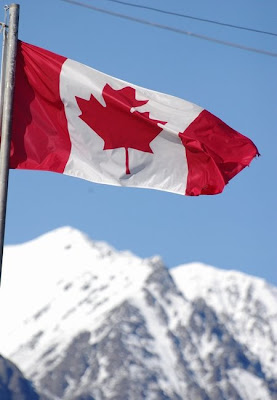

Was I proud of the fact that I "saw" this composition? Yes, absolutely, because it wasn’t immediately apparent - and that’s one of the challenges for any photographer.

I've also included a view of a mountain overlooking Andy’s aircraft. I used a vertical frame to emphasise the tightness of the frame and to utilise the diagonal shadows to best effect. There is nothing extraneous in this shot, because I guess it’s like a good speech - it gets straight to the point, while it includes details that attract attention.
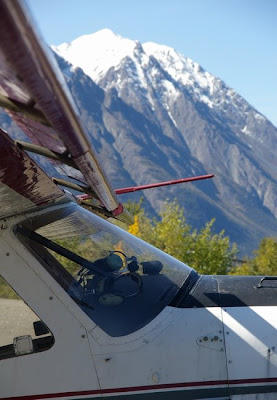

Through the Perspex of the cockpit canopy, you can clearly see the headsets. These are vital for communication between the pilot and the passengers, because the engine noise drowns out normal conversation. I sat in the back seat at Andy’s instruction, so that I would be able to use both cameras to get an interrupted view through the port and starboard windows. As he pointed out, if I’d sat in front, in the right-hand seat, he would have obscured some of the best views on my left.

I was also interested in the confidence in his voice when he said the weather would soon start to deteriorate. There was clear blue sky above us before we took off, but he was spot-on. Less than two hours later, the weather was less photographer-friendly.

Back in 1999, Doug Makkonen, base manager of Trans North Helicopters, took me on a memorable flight above the Lowell Glacier. This time, as Andy flew us in from the other direction over the Kaskawulsh Glacier, I was in my element, shooting with both Pentax digital cameras, one with my Sigma 18-125mm lens and the other with my Sigma 70-300mm lens.

And Andy was right. I shot 520 frames during the hour-long flight, which is roughly one every nine seconds. They were all shot through the port and starboard windows, except the final shot below. Watch this space for glacier and mountain-top photographs taken during the flight, but in the meantime, here is my closing thought.

How richly blessed does one have to be to fly over two glaciers on two separate occasions?

For other participants in Dot’s concept, go to Sky Watch HQ.

Wednesday, September 17, 2008

I Is For Ilium

Pelvis Isn’t Dead, He’s Just Stuck In Traffic

Photographs copyright: DAVID McMAHON


I must have been paying close attention during Year Nine biology classes when I was at St Joseph’s College, North Point, in the Himalayan town of Darjeeling - because I remember that the "ilium" is the large broad bone forming the upper part of each half of the pelvis.

Just before I flew out of Whitehorse, on my return to Melbourne, Margaret Goodwin of Yukon Tourism told me she knew of an unusual sight that I would definitely like to photograph. But, no, she wouldn’t reveal what it was.


She just said I would know what it was as soon as we saw it. And she was absolutely right. As soon as I saw this skeleton, artfully arranged in the driver’s seat of a rusty old car, I had to jump out with both my cameras.

It was the little details that really made me smile - the artificial flower, and the carefully arranged necklace. It seems the property (and the car) belong to a local stonemason, and I couldn’t help but make a suggestion for him.


If he ever put a tombstone beside the car, he could engrave the words "Rust in peace". I’m not sure if the owner has ever needed security to patrol his premises - but if the need should ever arise, he can rely on his skeleton staff instead.

And if you want to drive a vintage car across the Yukon, here’s a valuable lesson. Use a map or GPS, because as you can see by this photograph, it’s a lot better than, er, dead reckoning.


For the home of ABC Wednesday, go to Mrs Nesbitt's Place.

Tuesday, September 16, 2008

Big Blue

Have You Ever Seen Anything Quite Like This?

Photographs copyright: DAVID McMAHON


I was privileged to share in many great experiences during my week in the Yukon, but a helicopter ride over Tombstone Territorial Park was the highlight of my time in Dawson City. Like everything else during my time here, this exceptional experience was organised by Yukon Tourism.

Our pilot was Brent from Fireweed, the well-known chopper company - and did he ever give us an experience to remember. You can see other photographs of the mountains, taken from the cockpit of the helicopter during that flight, on my post titled Climb Every Mountain. But I'd like to share these photographs as well.

It was Brent's first day flying out of Dawson City, but shortly after we took off, he mentioned that he'd heard the other pilots talk about an amazing blue lake among the mountains. Let me tell you, they weren't kidding.

I shot the first three images with my 300mm lens, to give you an idea of the unique colour. It was almost like looking at a coral reef, because the blue was so striking.

I took the first shot to capture the gentle ripples across the surface of the lake, while the second shot (below) is an interesting contrast between the deep blue of the water and the soft yellow-green colour of the surrounds.

Then I realised that despite the gentle breeze causing the surface of the water to pucker, there was a very interesting reflection to be seen. Take a look at the picture below and tell me if you can figure out the object that is reflected in the water.


Is it a bird? Is it a plane? Is it Superman, perhaps? Put on your thinking cap, because I've given you a couple of clues already.

However, if you're ready to give up and you want the answer, here it is. I shot this final frame with my 18-125 mm lens.

Monday, September 15, 2008

Me And Poppy McGee

A Burst Of Scarlet Amid The Yellow

Photographs copyright: DAVID McMAHON


I shot these photographs at Moose Creek, north of Whitehorse, while I was in Canada a few days ago, at the invitation of Yukon Tourism. I didn't notice the colourful little garden until I was ready to get in the car and drive away.

I was busy taking some unusual shots that I posted on Saturday at Rack 'Em Up and then I went out the back to get some shots of the timber huts and the trapper's cottage.

As an avid gardener, my attention was then diverted to this delightful patch of colour and the great mix of bright colours. I grow lots of colour in my own garden at home, but I've never tried poppies. Maybe this summer ....


Visit Luiz Santilli Jr for the home of Today's Flowers.

Tuesday, September 09, 2008

Diamond Jubilation

A Blur Of Colour And Motion At Gertie's

Photographs copyright: DAVID McMAHON


Last week, on my second night at Dawson City, I spent a couple of hours reliving history at Diamond Tooth Gertie’s. In case you haven’t heard of it before, this is a non-profit gambling hall named after Gertrude Lovejoy, famous for wedging a diamond between her teeth during the gold rush of the 1880s.


They have three cabaret shows a night at Gertie’s and I guess sitting halfway back down the crowded hall was not the smartest thing I did, especially since I wanted to try and get some unique photographs of the famous show.

Because I do not use a tripod, I should have headed upstairs, where I would have got a better view and where I would have been able to rest my camera on the wooden balcony to hold it rock-steady.

The problem here is the level of fitness of the dancers. They move swiftly. Yes, S W I F T L Y. Even using a quick aperture setting, I was barely able to get a shot of them without a shimmering blur.

Next time you come round, I’ll show you my shots of the opening number, where not one of my images of the brightly coloured cancans is up to scratch. But I’m glad I didn’t give up.

I did the best I could under the circumstances. Then, more than halfway through their routine, where the dancers changed costumes just as rapidly as they pirouetted and twirled, my opportunity presented itself without warning.


First, two of the dancers bent down and picked up two long, broad sashes. Then the other two did the same.

Suddenly I realised that their speed could be used to great advantage in an unusual series of photographs. The length of the sashes gave me a wonderful opportunity - and all of a sudden I realised that I was actually sitting in a great spot to make use of the lighting, the backdrop, the lightning-quick choreography and the rhythmic motion of the sashes.

Just goes to show - when you think you’re in the worst possible spot to take photographs of something you only see once in a lifetime (hey, how many times do we get to visit the Klondike as guests of Yukon Tourism?) something always comes along to give you a startling opportunity.

I guess the trick is to recognise the opportunity and make the most of it, even when things seem to be going wrong.

Monday, September 08, 2008

Sweet And Sauer

Size This Up, If You Can

Photographs copyright: DAVID McMAHON


Last week, while I was in Dawson City at the invitation of Yukon Tourism, I dropped my luggage off at the Dawson City B&B on Craig Street, but I headed straight out again to take some shots of the unique Gold Rush city in the mellow late-evening sun.

As I left the B&B, I took note of the many varied blooms in the immaculately maintained garden and this one caught my eye because of its sheer size. I had to shoot it immediately and when I saw the owner later, I asked if it was a flowering cabbage.

Yes, she said, it was the bloom of sauerkraut - which I've never seen before. Then I figured the best way to give you an idea of perspective was to shoot it from a different angle, including a couple of petunias in the same frame (see below) so you could judge just how huge the lilac flowers are.


Visit Luiz Santilli Jr for the home of Today's Flowers.

Sunday, September 07, 2008

Elk Dorado

Herd It On The Grapevine

Photographs copyright: DAVID McMAHON


Sometimes you just get plain lucky. Late on Monday, as we drove from Haines Junction to Whitehorse, I was shooting through the window of the fast-moving 4WD, as I had done right through the trip. We were more than halfway through the journey when I spotted an oval-shaped lake.

There was very little breeze, so the surface of the water was absolutely calm, reflecting the beautiful yellow and green tones of the fall colours. We turned around and headed back up the highway so I could take some shots of the reflections - and while I did so, we could hear the high-pitched sound of what I thought was a herd of caribou.

But Margaret Goodwin, of Yukon Tourism, pointed out that it was actually the sound of elk. In the stillness of the evening, the sound was clear and dramatic. It drew me like a magnet.

Sure enough, less than a quarter of a mile up the highway, up a grassy knoll, was the herd. I got some shots of the animals closest to me, when we noticed the antlers belonging to a stag.


So there I am, pointing my lens at this magnificent beast, but what I really want, more than anything else, is for him to look directly at me. Antler shots are great, but there's nothing better than actually having a stag looking directly into your lens.

When in doubt, improvise. So I relied on the age-old theory that if you don't know an Aussie bloke's name, you call him Bruce.

"Psssst, Bruce," I called out (not too loudly, though) as I tried to attract the attention of the stag.


If Crocodile Dundee could hypnotise a water buffalo, maybe (just maybe) I could get this fella to look straight at me.

"Oi, Bruce," I tried again, speaking in a low, measured tone that I hoped would carry clearly. "Look this way."

So he did. And I hit the shutter as quick as I could, before he turned majestically away.


I have to say, though, my best animal photo from this week was a priceless shot of a Charging Grizzly. Do check it out and tell me whether you agree wth a very funny comment from Sharon Ishika, a brilliant doctor who has been a close friend of mine since we were about seven years old.

She checked out the shot I took of the grizzly on the charge and had a short but succinct message for me. This is what she said: "That is exactly what I told my mother when she insisted you were a "nice boy" -- he's stupid! Forty years down the line you prove me right. Forget the attempts at being smart like working out the camera details."

Check out the rules at Camera Critters or go to Misty Dawn.

Friday, September 05, 2008

Pentax Branch Office

Twig Or Treat

Photographs copyright: DAVID McMAHON


Sometimes, just sometimes, a photographer has to put his cameras down. On Monday I had the privilege of being taken on a hike into Kluane National Park, which is a UNESCO World Heritage Site.

Our guide for the day was Brent Liddle of Kluane Ecotours and I reckon that I lagged behind the group for most of the day, simply because I kept stopping to take photographs every few seconds.

This shot was taken on a rocky outcrop just before we turned back and let me tell you, the views were simply stunning. As we sat there, eating our lunch in the silence of the mountainous region, we were truly blessed with our surroundings.

Behind us we had a rocky peak with fresh early-autumn snow. To our left we had a mountain range shielding Canada's highest peak, Mount Logan, from view. In front of us, we had the shimmering expanse of Lake Kathleen.

While the rest of the group sat there, getting their breath back, I simply had to keep shooting because the view were simply priceless. Regretfully, I had to eat too, and the thought of the salmon and cream cheese bagel could not be ignored for much longer.

It was one of those rare moments on this six-day trip organised by Yukon Tourism when I actually had to put both my cameras down. But where's a bloke to put his cameras when you're in the wilderness?

On the wet grass? Naaaah. On the shale? Nope. On the rocks? Never. (My love affair with photography will never be on the rocks!)

That's when I spotted this dead tree trunk on the slope beside me. My Pentax K100D with the 18-125mm lens was soon nestled into the dry bark, suported by a gnarly branch. And the Pentax K200D with my 70-300mm lens soon found an equally inventive place, suspended by its strap from the fork in a strong branch.

But I simply couldn't resist the impulse that soon overtook me. I temporarily (only temporarily, mind you) deserted the delicious bagel and picked up my K100D. I simply had to shoot the other camera, secure in its inventive spot.

I took about a dozen shots, all up. The first one (above) was taken while standing over and slightly to the left of the fallen branch, to make full use of the splashes of autumn foliage. And the shot below was taken from a different angle to make best use of the snowy peak in the background.

The Yukon's like that. You don't have to go searching for a great angle. The real problem is choosing which of the stunning sights you're going to capture.

Visit MamaGeek and Cecily, creators of Photo Story Friday.