Showing posts with label Quebec City. Show all posts

Wednesday, August 12, 2009

D Is For Drop

Okay, So Maybe It Also Signifies Danger As Well

Photograph copyright: DAVID McMAHON


I guess it’s not often you get to take a shot directly above a waterfall, but this shot of the Montmorency Falls in Quebec City was taken in mid-September 2005. I wasn't rafting over the edge - but I had a great vantage point from the wooden walkway that spans the falls themselves.

I was astonished when the guide told me that these falls are actually higher than the Niagara Falls – but obviously not as wide. She also told me that the Montmorency Falls freeze over completely in winter – and yes, that’s a sight I would love to replicate from this identical angle.

I shot this with a Canon EOS 3000 in fairly grim weather. There was low cloud and rain, but I was determined to get a bird’s-eye view of the gorge.

As I’m well over six foot, I was able to lean over and hold my camera out a long way to take this shot directly above the apex. If you look to the left of the frame, you’ll actually see floating logs down below, looking like a collection of matchsticks.

I shot about a dozen frames, from slightly different angles, but I like this one because of three reasons: a) it is an almost even balance between foaming water and relatively calm water far below; b) it is unmistakably Canadian because of the logs and c) I was lucky enough to catch two separate tendrils of “mist” emerging from far below.

This is just a low-resolution version of the original shot. To see the high-res version, just view my RedBubble version of the same shot at Over The Edge Of The Waterfall.

For the home of ABC Wednesday, go to Mrs Nesbitt's Place.

Thursday, July 23, 2009

Playing To The Gallery

Hang Around Any Time - It Works For The Art

Photograph copyright: DAVID McMAHON


This shot was taken in 2005, when I spent a couple of days in beautiful Quebec City in mid-September. The weather wasn't too flash when I was there, but that minor point didn't deter me from exploring every nook and cranny of the city and photographing everything that caught my eye.

This was taken on my first evening, when I literally sheltered from doorway to doorway in the Lower Town, just so my cameras wouldn't get too wet. Opposite me on the cobbled street was this warm, inviting art gallery. Should I spend five minutes inside? No, I decided instead to take a quick shot and move on.

Why? Five minutes in a gallery could have meant I missed a few photographs as dusk approached. But I did love the fact that the frame of the burgundy door was a perfect match for the frame of the window.

Yep, that's a lot of great frames for a single gallery.

For earlier posts in this series, check out The Doors Archive.

Thursday, April 09, 2009

Draw A Bead

Catch A Glimmer Of A Shimmer

Photographs copyright: DAVID McMAHON


This shot was taken in Quebec City in mid-September 2005. It was not just the vivid colours that stopped me outside this entrance to a street-facing novelty/tourist store, but the beautiful cascade of inter-connecting discs that looked like a monochrome waterfall.

I shot this just before I ventured inside the store. At the time, I was using a Pentax compact digital camera as well as a film-based Canon EOS 3000 that I’d only bought less than a year earlier. I had a standard 35mm lens on the Canon and used it to shoot this frame.

I could have simply concentrated on the beaded discs and yes, it would have been an interesting image, but there would have been nothing to define the shot as being in Quebec City. So I opted to shoot the entrance from side-on, to make use of the distinctive steps leading up, as well as the metal handrail.

If you look to the left of the picture you’ll see a couple of familiar Quebec City landmarks - the distinctive red metal roof and the coat of arms on the building in soft focus in the background. But the thing that dominated my perception of the scene - and therefore my depiction of it as well - was the combination of yellow plastic in a soft curve, the bright red of the wall and of course the green of the steps.

Would I have shot the scene any differently now that I have made significant progress as a photographer, almost four years later? Yes, probably. For one thing, I would have taken probably half a dozen frames with my Pentax digital SLR, using a different composition each time.

You see, you think differently when you use a film camera; when you have a digital camera in your hands, you know you can shoot about 1000 images on a single 4GB memory card. - rather than having to change a spool of film every 36 exposures.

It was raining, it was damp and there was a low, grey sky - not great conditions for stopping every few minutes to reload a spool of Kodak film. But if you look below, you’ll see that I have cropped the original image to show you exactly how I’d shoot the same scene from the same angle the next time I’m walking down the street.


For earlier posts in this series, check out The Doors Archive.

Thursday, March 26, 2009

Hallowed Turf

Basilica Has An Open-Door Policy

Photographs copyright: DAVID McMAHON


If ever you seek proof that religion played a strong hand in Canada’s early history, drive about half an hour out of Quebec City, to the stunning Basilica of St Anne de Beaupre. Despite a strong religious background in my upbringing, I heard never heard of St Anne until my guide explained that the saint was the mother of the Virgin Mary and the grandmother of Jesus.


Inside the magnificent basilica is the statue of St Anne (above) carved from a single piece of oak. The gold crown is studded with diamonds, pearls and rubies and the figure is known as the statue of miracles.


I was in Quebec City in late 2005 at the invitation of the Canadian Tourism Commission. Having spent a memorable day in my childhood reading about the city’s rich history, it was a great privilege to be able to spend two days there as I toured the country’s east coast.

As I stood in wonderment in the middle of the basilica, I was struck by the realisation that despite the constant stream of pilgrims, there was a reverent, enveloping silence inside the stunning structure.


Acknowledged as the first pilgrimage shrine in North America, the original chapel was built in 1658. Apart from the deep faith and the strong historical links, the modern-day basilica is a must-see, even for those with no appreciation for architecture. I was there on a grey, rainy day, but the 240 stained-glass windows and the huge domed ceiling were a fabulous silent opera in magical light.

Many people tell you about miracles that have taken place on this hallowed ground. At the entrance are wheelchairs, crutches and other medical equipment, left behind by those who came with damaged bodies and souls but fortified with religious belief and who found a miraculous cure.


For earlier posts in this series, check out The Doors Archive.

Wednesday, November 12, 2008

Q Is For Quebec City

The Cloudscape That Led Me To A Memorial

Photographs copyright: DAVID McMAHON


I’m not a stormchaser. But yes, I guess you could call me a cloudchaser. I photograph them from terra firma, I photograph them from light planes, I photograph them from hills and mountains, I photograph them from commercial airliners.

Part of the fascination is that they constantly change shape and colour, but most of the time these massive mobile works of art escape the attention of the general public.

Three years ago, while I was walking around Quebec City, I was hoping to get some good shots around the port area, but the weather was not the best. I had shot a lot of unusual scenes in pouring rain when things started to clear up, but only marginally.


Looking across the famous grain elevators towards the Saint Lawrence River, I was fascinated by the colours and the cloudscape. All the photos in this sequence were shot on a film-based Canon EOS 3000, a camera I always enjoyed using.

At some point, this statue caught my eye and I remember walking a fair distance to see what it was. I’m so glad I did. The commemorative figure at Pointe-à-Carcy, sculpted by Raoul Hunter, had been unveiled almost three years previously to the day. It shows a generic merchant seaman, with no apparent definition of rank, waving goodbye in a casual, frozen salute.


While writing this post, I researched the background story and realised that the statue honours those from the province of Quebec who lost their lives in wartime. At the base of the statue you can actually see the stern of a sinking vessel. The monument was paid for by donations from a group of organisations including the Canadian Merchant Service Guild.

This final shot (below), taken at plinth level, is probably my favourite from the series. Trouser cuffs, the boots of a man who never came home – and a wreath to all those who failed to return home from the sea.


For the home of ABC Wednesday, go to Mrs Nesbitt's Place.

Friday, June 20, 2008

Running Repairs

Time To Prop Up A Founding Father

Photographs copyright: DAVID McMAHON


One of the great joys of photography is being able to capture vivid colours, but to me one of the supreme challenges is to be able to use a camera in unfavourable light conditions. A couple of years ago, I was using a film-based Canon EOS 3000 in Quebec City and I got some great, stark shots of a grey dawn as the rain came angling down over the St Lawrence River.

Later that morning, I explored the Terrasse Dufferin and the Promenade des Gouverneurs, shooting as I walked. I had already photographed the statue of Samuel de Champlain, the founder of the beautiful city, the previous evening, but now I spied an unusual challenge. Could I work the angles so as to include the Champlain statue in the same frame as the Chateau Frontenac?

As you’ll see from my 2006 post Beyond A Chateau Of Doubt it was a fair task, but it resulted in an unusual angle that made decent use of the overcast conditions. It's interesting to note, in retrospect, that the most efficient way I could shoot the scene was actually from behind and under the statue!


Then I was about to walk away and explore the Lower Town when I noticed the remnants of repair or restoration work on the Champlain statue. So of course I had to shoot the scene (below) to capture the evidence of the painstakingly-placed woodwork propping up the incredibly heavy marble and bronze.

And that was pretty much when I decided to use the heraldic angels just below the plinth to form an unusual image. Under a clear blue sky, this would have been an easy object to photograph. But with the formless overcast, I had to rely completely on composition to present the strength of the image.


Because of the weather, it looks like a black-and-white image - and that, in turn, gives me an appreciation of how hard photographers in the pre-colour technology era had to work to interpret the sights that caught their attention.


For other participants in Dot’s concept, go to Sky Watch Friday.

Tuesday, June 03, 2008

Not So Jolly, Roger

Aye-Aye, Captain, There's A Pirate On The Bridge

Photograph copyright: DAVID McMAHON


It's not every day you come face to face with a seafarer in period costume. I shot this on a grey, rainy day in beautiful Quebec City in September 2005. Some places look unimpressive in inclement weather, but this historic city simply looks amazing in any light.

I was down on the wharf when I realised this tourist vessel was about to set sail for an hour-long cruise. I saw a couple of crew members getting ready to cast off the ropes from the dock and that's when I spotted this person in full regalia on the deck of the ship.

I raced up to the gangplank and asked if I could get aboard, take a few shots and then get off the vessel before it set sail. The crew members were puzzled. They couldn't believe that a tourist with cameras around his neck would not want to take the cruise. But I explained that I only had two days in Quebec City and did not have any time to spare.

They agreed, but I think they wondered about my sanity. So I sprinted up the gangplank, took my photographs and briefly pondered whether I would have to walk the plank to leave the ship. It wouldn't have worried me - but I would have done anything to prevent my cameras from getting wet!

Check out RuneE's "Building Bridges" theme at Visual Norway.

Wednesday, May 14, 2008

Hit The Wall

Living History Watches Over Quebec City

Photographs copyright: DAVID McMAHON


I was probably about six years old when I picked up a Ladybird book and took it into the huge garden to read on the cane furniture under the shade of the giant trees. That book was my first introduction to Quebec City and I was immediately fascinated. Now, as an adult I look back on that crystal-clear memory and I am trying to work out why I was immediately captivated.

It was because of a simple reason. As a little fella who had not yet studied much history, I simply didn’t realise the strong French influence in the region and I had never heard the term "French Canadian" before. Little did I know that one day I would travel to Quebec City with cameras slung around my neck, to record scenes from a beautiful city that captivated me so many years ago.

So here is my Q for Quebec City post. In September 2005 I was fortunate enough to travel to Quebec City, Montreal and parts of Muskoka, Ontario, to photograph those regions for the Canadian Tourism Commission. Quebec City was my first stop and I was instantly captivated.
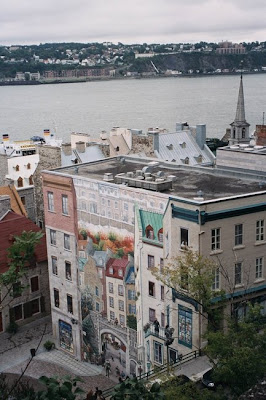
It was the first time I set eyes on the Quebec City Mural, a three-dimensional, five-storey trompe d’oeil (French for "to deceive the eye") that includes several people who played a prominent role in the city’s rich history. Among those who are painted into the mural are François de Montmorency-Laval, Louis-Joseph Papineau, François-Xavier Garneau, Jacques Cartier, Jean Talon, Comte de Frontenac, Louis Jolliet, Samuel de Champlain, Lord Dufferin and Felix Leclerc.

As you can see from the shot above, the weather was dull and grey. The mighty St Lawrence in the background reflects a brooding sky, yet the whole sight is arresting nonetheless.
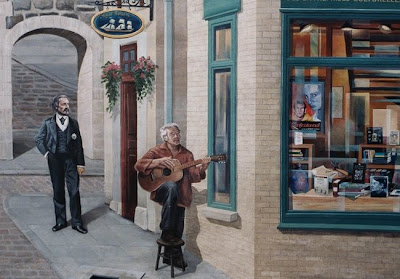
The mural itself can be quite challenging to photograph. Can you guess why? Because there are always tourists milling around, listening to tour guides and trying to focus their cameras on the mural to capture their own distinctive view of it. I spent about an hour there on a cloudy afternoon, shooting various aspects of the mural.

There are many things that fascinate me as a photographer. It’s not just the technology at our fingertips; it’s not just appreciating the rapid advance from mixing chemicals in a darkroom to chips and memory cards; it’s not just the choice of angles and compositions. Above all those, it is the human process of self-discovery that completely enthralls me.

Give a human being a camera and you open up a whole range of possibilities.

So as I stood there, hoping it wouldn’t rain as the heavens had opened above me the previous day, I realized there was a distinct possibility that I might not get a chance to photograph the entire mural without anyone else ‘intruding’ into the frame. And that’s when my own process of self-discovery began.

If you have a problem and you can’t work around it, then you worth with it. Quite simply, I decided to use the milling tourists as a bonus, rather than a detriment.

Instead of becoming frustrated that I could not get that one elusive, clear shot, I spent an hour with a big grin on my face, enjoying the challenge of using the tourists around me to tell the story of the mural. I began to utilise the very presence of other visitors as an added dimension to the mural.
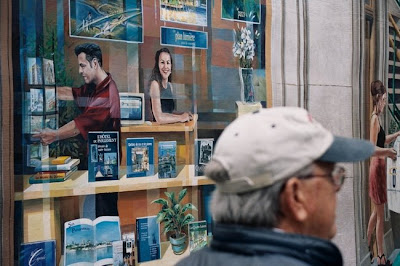
This shot (above) was taken from the left-hand side of one group. I trained my lens on the bottom storey of the mural, showing not seventeenth-century figures in flowing robes but contemporary figures in modern clothes. The "real" tourist in the foreground fitted in perfectly. Why did I choose him? Because he was wearing a baseball cap and it was more or less the same colour as the wall. Simple as that.
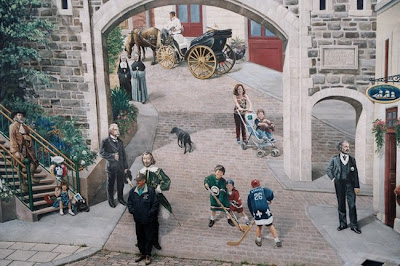
This shot (above) was taken from a slightly different angle. I had a few seconds to make my decision on this composition, because I saw a male tourist hand his camera to someone else and I knew he wanted his photograph taken. To my good luck, he strode off to stand beside the mural.

I had just enough leeway to frame this shot that almost endows him with the same quality as the people painted on the wall. To a casual observer, he might just pass off as just another painted figure. Can you pick the real man? (Answer: he's the figure in the foreground, wearing a cap and a jumper over a blue T-shirt!)
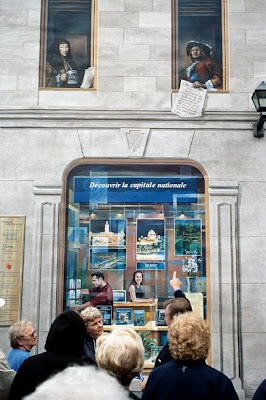
There was a group of about twenty tourists hanging on every word of their tour guide. The guide, mindful of the threatening clouds, was in a hurry to move the group through the square. I quickly composed this shot, lest they scoot off to their next stop, or seek shelter from the weather.
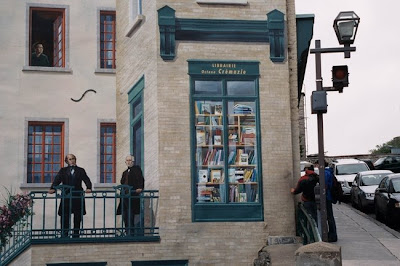
I was in the middle of the square when I noticed these two people on the curve of the hill to my right. They were in perfect position for me to swing my camera up and take a quick shot, freezing two contemporary figures alongside the men and women who shaped the history of the beautiful city.

If you didn't know that the mural ended at the wall, you might even think that this whole frame, including the cars and the two men by the street light, were artfully included in it.
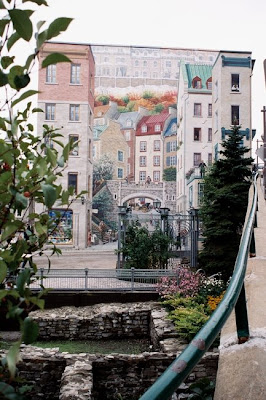
Sometimes the strangest things happen when you have a camera in your hands. Having started out by trying to get a clear shot of the mural, I walked back as far as I could to try and get a shot of the whole mural with as many tourists in front of it as I could possibly get in one vertical frame. By the time I had found the perfect vantage point, with the added value of the curved, dark green handrail, guess what had happened? It had started to drizzle. The crowd cleared miraculously. And I was blessed with the shot (above) I had sought all along.

For the home of ABC Wednesday, go to Mrs Nesbitt's Place.

Wednesday, April 30, 2008

One-Knight Stand

If It’s A Dinner Date, Just Bring An Armour Plate


Quebec City, Canada, September 2005. Canon EOS 3000.

Photograph copyright: DAVID McMAHON

Sunday, November 04, 2007

The Rain Of King Louis XIV

Where's The Royal Brolly, Your Majesty?

Photographs copyright: DAVID McMAHON


Quite a few people have asked me about using a camera in the rain and I always say as long as you're confident you can keep the camera itself relatively dry, there is nothing to stop you photographing a scene in driving rain.

Yes, the light is always murky. Yes, you have to think carefully about the scene you want to capture. Yes, you have to juggle a camera and an umbrella if the rain is bucketing down. But hey, who doesn't love a challenge? I reckon my two favourite photographs in heavy rain are these ones, both taken in September 2005.

I was on a photographic assignment for the Canadian Tourism Commission and spent ten days in Quebec City, Montreal and parts of Muskoka. This shot was taken on a very wet afternoon in Quebec City and shows not one but two symbols of the beautiful city. On the right is the famous bust of King Louis XIV of France, with the steeple of Notre Dame on the left. You can actually see little pearls of rain across the statue and on the high-res version, there are droplets across the royal nose as well!


The other photograph (above) was taken about 100 or 150 metres away. I had walked away from the square towards the wharf when I was struck by the scene in front of me. To the right was a tourist vessel. To the left was the huge structure - a gift from France - that the locals refer to as the Rubik's Cube. And while the prevailing colour was grey, I was amazed how the little splashes of vibrant yellow lfited the scene.

So next time you're stuck indoors in the rain, don't despair. Just grab your camera, put a smile on your face - and take up the challenge of finding something beautiful in challenging weather.

Tuesday, August 21, 2007

Nice Stone Wall, Jackson

Look In On Us Any Time

Photograph copyright: DAVID McMAHON


This is for Annie of Little Rock Daily Photo, whose work always brings a smile to my face. Her recent post Afternoon Pleasure reminded me of a couple of shots in my own portfolio because she took that particular shot through a rusty metal grate. Yes, I like shooting through impromptu frames as well, as you can see by the shot above, taken with a Canon EOS 3000. I was in Quebec City at the time, walking through the Lower Town. Through this centuries-old historic brickwork, I saw a nook that offered great shopping. The mortar and the metal spike are in soft focus, while I've concentrated on the interior, where you can see some garments on display and some hanging baskets of petunias.

Monday, June 25, 2007

Take The (Paint) Tube

Some Photographers Love The Rain

Photographs copyright: DAVID McMAHON


It's great taking photographs in rain, because the wet streets open up a whole range of reflection. This shot was taken late on a rainy September night in Quebec City. I had just walked past the Chateau Laurier hotel and the soft colours on the street corner caught my eye. The shot above was taken with a Pentax Optio, while below you can see a different rendering of the same frame. As I showed you in the recent post Easel Come, Easel Go, this is what it would look like as a virtual oil painting.

Sunday, June 24, 2007

Easel Come, Easel Go

Oil Painting Without Any Brush Strokes

Photographs: DAVID McMAHON


Towards the end of 2005, just after I returned from photographing Quebec City, Montreal and parts of Muskoka for the Canadian Tourism Commission, I spent a few days cataloguing the images from that memorable trip. At the time, my son asked me if I had done any watercolours during my time in Canada. For once, I had not, because I had concentrated only on my cameras.

Then he showed me a program by which you can convert a photograph into a file that looks remarkably like an oil painting. The picture above was taken with a Pentax Optio down the charming lane in Quebec City that is famous for its artwork. The rendering below is what the same shot would look like in oils.

Friday, June 15, 2007

Star Tech

Putting Photographic Memory To Good Use

Photograph copyright: DAVID McMAHON


I normally drop everything when I get a question from anyone who says he/she is new to blogging. This question is from a Melbourne-based blogger, Rudy.

Can I use photographic prints on my blog?

Want the good news, Rudy? That's a yes. If you have (or have access to) a scanner, this is certainly possible. Any document or print can be scanned, provided it can fit on a normal flatbed scanner. The prices of scanners have dropped drastically, and a lot of the home printers on offer also come with scanning facilities.

If you have any difficulty with the actual scanning process, let me know what imaging software you have on your computer and I can ``talk'' you through the steps. Once you've scanned the pictures you want, I'd suggest saving them to a common folder as well as backing them up on a USB drive or an SD memory card.

From this point on, you'd just have to click the ``add image'' icon when writing a new post on your blog. Then select the location (desktop, folder or removable storage device) and click on the image you want and hit the ``upload image'' tab.

The image I've attached here is one I took with a Canon EOS 3000 film camera. It was taken in the Old Town section of beautiful Quebec City, Canada. I was walking down a street when I noticed the figure of a Spanish conquistador. It was made of fibreglass, but stopped me in my tracks because it was so imposing. I shot it from this angle to get a good view of the amazing patterns on the ancient helmet , as well as to include the modern streetscape.

It was a difficult shot to take because the figure was in shadow while the background was in bright sunlight. But it shows you that even prints can be scanned and uploaded to a blog. Digital cameras are brilliant, but never throw away your prints.