Showing posts with label Battalion Attack. Show all posts

Saturday, 19 April 2014

Project and Painting Table Review:

"Who am I?", "what an I?" and "Where am I?" are my most confusing questions. As of January 1st 2014 I certainly did not think I would be donning a "Napoleonic Naval" cap in March/April, but as the old adage goes "variety is the spice of life!")

Active Projects:
  • Playing and Making: Napoleonic Naval (1/1200)
  • Playing and Making: (1/72:20mm) WWII 'Chain of Command' Skirmish (Normandy + others?)
  • Currently Reading: Ancients Marathon/Xenophon/Sparta and Thebes
Projects "To Pick back up": 
  • Ready and Waiting: WWII (1/200) Battalion Attack (Phil Sabin) v Miniature Rules (time to test some miniature rules [Spearhead, BGC, CDIII] against the same scenario)
  • Ready and Waiting: WWII "Plastic Kit" construction Backlog aka "The Plastic and Metal;  Mountain" - paused for respite and ready for second wind
  • Ready and Waiting: Ancients: Peloponnesian War (15mm) "The First Battle of Mantinea"  418BC using BBDBA (Big Battle DBA)
Future (and de-hibernated) Projects - "The Shape of Things to Come"(?): 
  • More Preparation Required: Circus Maximus (6mm) Avalon Hill Board (Ancient Race Horse in Chariots) Game
  • Undercoated and Ready to Start Painting: Impetus Army Unit Expansion: (25mm/28mm) Mounted Harquebusier Unit for Renaissance Period "Maximilian-Landschneckts" 
  • Army in Early Stages of Collection: (25mm/28mm) ECW Covenanter/Montrose Armies
  • Naval Musings (1) Ships Acquired but Intellectual Thoughts (Aka Rules)/Historical Reading Required : WWI/WW2 [Jutland/Bismarck Chase/Early Pacific War] 
  • Naval Musings (2) In Minds Eye Only: A strange attraction with sailing ships seems to be developing [Napoleonic has started it up (see above)] but then there is the Spanish Armada, Dutch Wars and Salamis to contend with (the latter been a "project" I know I must do)
"That's all for now folks" ... but like every other wargamer I can think of I would be very disappointed if I could not find even more material in the "loft" that I had totally forgotten about that goes "active" (did I mention my crazy 2mm Napoleonics or more traditional 15mm Franco-Prussians?)

;)

Saturday, 3 August 2013

A Wood in the Hand is Worth Two Bushes? (More Terrain)


Terrain (continued): 

Ridges done, now time to wrap-up the "tree hex" collection. I had previously "flocked" these bases and PVA'ed thicker bushier clumps (but all at the 'same level'). A trip to Hobbycraft was needed to top up my supplies and a side-effect I that was able to generate an improved "multi-level tree-line" (see below):  


This all came about from an errant purchase, but 'quality' purchase (see below):


Instead of something that was "a lot of little bits" that I poured flat onto some PVA glue that just stuck, I got a big, solid block of  "foam stuff". I had to break chunks off. In the end I think it worked to my advantage because it meant with a touch of the artistic I created a jagged tree line instead of flat uniformity.

Into every stable system a little bit of chaos should be poured ;)

Thursday, 1 August 2013

Much ado about "Green Hills and Ridges" (Battalion Attack Terrain)

To my little bowl of grit varying shades of flock are added. This is reminiscent of true Shakespearean drama, aka the Witches of Macbeth, "hubble, bubble, boil and trouble". It is also why I am probably such a terrible cook limited to a 'Chilli Con Carne' at best (see below):  


But these you have it, my terrain features are complete (see below):


From another angle (see below):


A new world of randomised terrain awaits ;)

Wednesday, 31 July 2013

Much ado about "Brown Hills and Ridges" (Battalion Attack Terrain)

Terrain:

Time to attack the pile of terrain "ridges" that I need for the 'free form' randomised terrain set-up of "Battalion Attack", aka "Fire and Movement". By now I~ have had my fill of the introductory scenario, its duty is done.

There are twenty 'ridge hexes' needed all told (to match the books counters), two have been already 'done' (but may need a little rework to look similar to the others) and eighteen are on the 'highlight' production line (see below): 


Note: To the ultra observant, you are not mistaken, you do in fact see the painted footprints of a small child leading away from the "Man Shed" table in the photograph above (bottom right). I will not dwell on the matter further, but suffice it to say that my stock of brown paint was seriously depleted by mysterious guest(s) who in Neolithic cave-art fashion had great fun (and if truth be told produced some fantastic abstract art in the process). Luckily the paint wore off, half way up the path, before they got back to the house proper.

Back to the Man Shed work in hand ...

I really like this highlight red-brown and white-brown effect and it seems such a shame to now have to paint and flock over most or all of it, but such is the sacrifice of 'art' and such is the urgent  need is for wargaming ridges not comic-book alien moonscapes (see below): 


Next comes the varying degrees of 'pebble and sand' stuck onto prominent features with the ubiquitous PVA hobby glue in copious quantities. These terrain making materials have been gathered from a variety of sources ranging from the left over DIY projects ("mixed grit"), to the ridiculously expensive connoisseur train-set gravel. I even have a as yet unused secret weapon; a packet of budgie grit, unopened, left on the side, waiting for 'its moment of glory'. See the result below:   


The hills are now half Terra-formed (we are back on the Sci-Fi theme again) and need an urgent  vegetation upgrade. To me they still look "cool" in this raw form IMHO :)

Next: How Green is my Valley? 

Thursday, 25 July 2013

Battalion Attack: The Reason Why - Fire and Movement (Game 3 - Part III)

End Game: 

After the butcher's bill (casualty counters) is paid and the logistic (ammo low counters) withdrawals depart the British central portion of the front line looks depleted and a "tad" (a traditional Yorkshire expression) forlorn. Only one British platoon from "Green Company" remains in close assault position but is now effectively out numbered three-to-one (see below):   


Off to the left hand side a solitary "Blue Company" platoon had reached "Outcast Wood" and was in a position to close assault it (see below). This was in the twilight phase of the game. The last four turns were played out in effect solo as the British Commander "had seen enough" and was contemplatively sipping on his John Smiths with his 2-in-C knocking back a Guinness. As I was driving I was looking at them rather enviously ;)

But to me it also raises the question of "The Reason Why" we should play to a finish. Not to win, sorry if I sound overtly pacifist here, because nobody wins in war. No it is to see how it pans out. Not in a statistical sense, as in "how many ones and sixes followed" but did the game still manage to represent at the end what it nobly stated to achieve at the start?

Certainly a "philosophical" point.     


In terms of "Fire and Movement" Battalion Attack, retreat is impossible. If a platoon tries to retreat the chances are they will get suppressed and effectively be pinned in place and whittled away by the defenders  (which have no ammunition restrictions). So there is no point going back unless you are guaranteed (or stand a good chance of not being hit because of the enemy's range to you) to get off table as you will become suppressed, frozen in place and subject to the cruellest direct and indirect fire (war is unfair and hell).

What you need to seek is "hard cover" (aka "farms") or a hidden from view hex. This could explain the situation with respect to the final position (see below). The British platoon in the centre successfully close assaulted the "Farm Crescent" to inflict three casualties on the Germans, which brought their total to six, one more and a German platoon is removed. However this victory was Phyric as "ammunition expenditure removed the unit from play" - this was the bane of the British commander's life! The British platoon in "Little Gibraltar" was again lost to "ammo expenditure" but the Vickers HMG platoon caught a bullet from the defenders of the "Farm Crescent".

The one German casualty was caused by "catching a German platoon in the open" as it came from behind the "Farm Crescent" in a vain hope to reinforce "Outcast Wood". With no protective cover or dug-in status, the Germans are as equally vulnerable in the open. One additional casualty to the German total meant a platoon  removal. The board below shows the end of the game (German turn twelve - there is no British turn twelve to avoid the "last two minutes of the Superbowl land grab" - not an issue in this game).

The one ray of hope for the remaining British platoon is that it has isolated one-on-one a German platoon and if the fight were extended past turn twelve it would have at least the initiative. The bad news is that everybody else has "gone home" (not necessarily as in "dead") and with nothing left to pin the Germans in place it is only a matter of time before they bring overwhelming force to bear - but that is beyond the scope of the scenario brief and who knows "operationally" what else would be happening on the wider battlefield.


Was there a point to playing on?

I think so, not just because it is a forty mile round trip for me to play the game and that this was the only wargaming thing I managed to do this month. I did offer to "play on" but switching sides, winning was not the issue here. This was a "road test2 of the rules, it doesn't happen very often as this is only the third game I have managed to play in over seven months. To me it tested out the (unsavoury?) end game and illustrated as much as what we are NOT playing more than what we are trying to play. We are not simply killing people/soldiers. Counters are removed because the unit (some forty soldiers) becomes "combat ineffective" (10-20% casualties should do that). Over half the removals in the game were actually logistical (7) and only half combat casualties (6). In a campaign setting the battalion would have half its 'order of battle' force ready to defend itself against an immediate counter-attack.

Does the game need to visually represent the fact that there are British troops still on the table in some way? Is the ground taken/last-occupied by the British now 'unfriendly' (in some way) to the Germans and will they need to clear it? Does it restrict their future defences or give the British a closer jumping off point for next time. Will the surviving Germans be subject to a withering artillery bombardment or 'Jabo' fighter-bomber attack? I will take the discussion to the to the forum:       

http://groups.yahoo.com/group/simulatingwar/message/1739
http://groups.yahoo.com/group/simulatingwar/message/2057
http://groups.yahoo.com/group/simulatingwar/message/2077

Meanwhile, although not played to win, what was the scale of the British defeat?

Victory Points: 

In the end it was a clear German win in the order of magnitude of six British platoons lost to one German platoon. However with respect to scenario balance it was very "pro-German" in terrains (a statistical extreme given the number of "farms" generated as terrain pieces) and had already been started with an idea to go through as many rule mechanisms as possible, rather than purely tactical gain.

The next game will be a random terrain generation affair. The book's play-test scenario should be put back in the bag as the Germans have convincingly took it (3-0). I would love to hear from anybody who has played it and got a British win. IMHO this was clearly was NOT the sector to attack

;)

Monday, 22 July 2013

Battalion Attack: The Bloodied Ground (Fire and Movement Game 3 - Part II)

The Middle is Pressed:

The British commander moves up a flanking platoon from "Blue Company" (bottom left below, which in this colour photograph looks almost the same colour as the "Green Company" marker dots) but in turn it draws additional fire from another German platoon off camera. Soon it too becomes suppressed and the steady tide of British casualties begins to mount ominously (see below):  


The sickening rise of red casualty markers as the British commander extended the attack frontage is evident (see below). Two German platoons are managing to freeze 'in-situ' four British attacking platoons in the 'open'. Controversially(?) the British mortar was engaged in (it had to be said very effectively) pinning two German platoons on the far right of the board (albeit a third of the total German defending forces) for most of the game, but leaving the supporting Vickers HMG too much to do on its own

The advanced British platoon from "Yellow Company" is poised to (almost) make an end-run assault on the left most portion of the German "Farm Crescent". The huge amount of open space makes this area a true killing field for the PBI (see below, red casualty markers indicating hits this round):


The result is bitter sweet for the British. Although the 'Yellow Company; platoon is in position to close assault the flanking wood, another British rifle platoon (from 'Blue Company') is removed from play through casualties (see below):


The Germans reinforce the centre by advancing a platoon to the far right wood. This is approximately turn seven with everything still hanging in the balance. There is a heavy exchange of fire along the line with the Germans besting the British. The 'open ground' is literally the killer factor for the British. They even suffer the indignity of being close assaulted 'back out of the far left wood' by the Germans (see below):  


British casualty removal and losses through ammunition expenditure has broken their attack. The British commander concedes 'the attack has failed' in his turn eight, but do we stop there? After all I am keen to understand what "Battalion Attack" simulates, can the British make a tidy fighting withdrawal?

Sunday, 21 July 2013

Battalion Attack: The Familiar Starting Point (Fire and Movement - Game 3 - Part I)

After what seems an absolute age, I finally got behind the familiar wargaming table to throw some dice. Playing "Battalion Attack", using the book's tutorial scenario (again), but this time the co-player (rather than an opponent) had also 'read the book' (Simulating War, by Phil Sabin), hurray. Pump-primed we jumped into the action walking the scenario through to the step-off point in the book, the start of German Turn Three (see below, British attacking left to right): 


One advantage of having played the game/scenario several times before, is that the 'counters/logistics/terrain' are now prepared for in advance and subtle playing aids (e.g. units from the same company having the same coloured sticker, counters instead of cumbersome dice markers for ammo and causality counts). The "big plus" was that we never lost track of what was happening, or debated what the status of a unit was and whose turn was it to do something. The game mechanics ran smoothly.

The battle soon heated up with the British pressing the German held "Farm Crescent" hard with an important 'close assault' attack opportunity after the Germans had critically failed to nail a 'sure thing' (anything but a one .. we've all been there) on an adjacent British Infantry platoon (see picture below).

Note: The assault position (see below, before British move but after the German turn three was completed) was one the British had worked very hard (as in 'bled' casualties) to get to. The British 'Green Company' platoon adjacent to the "farm" will be assaulting this turn and a second 'Green Company' platoon is set to move up and exploit the situation and hopefully double close assault a suppressed(?) German platoon in the subsequent turns. This 'potentially' could crack the German 'Farm Crescent' defensive line wide open (which would be a 'first' in all my play tests of this scenario).


The odds were in the attackers favour: 1d6, with a British roll of (3,4,5,6) and the German defender would take three casualties as well as becoming suppressed and incapable of firing next turn, but a roll of (1,2) and the Germans would be fresh to wreck havoc on the exposed British Infantry platoons ("PBI").

The die was cast ...

The British attack was stymied (with a roll of a 1). If there was even a candid lesson in statistics and there is "no such thing as a racing certainty", then this is it. The Germans (after breathing a huge sigh of relief) in return elected to spread their defensive fire (rather than concentrate a close assault on one British Infantry platoon for slightly higher casualties) to suppress both British Infantry platoons (see below, two rolls of anything but a one [this time] sufficed for the Germans to achieve this):   


The British "Green Company" are now left 'hanging on the wire'. The proximity of friendlies stopping their 3" mortar helping and the proximity plus terrain leaving the HMG with only 50% chance of being effective each turn. Piling more troops forward will not directly help the British but probably instead serve to increase their casualties Meanwhile the German mortar has been very effective in causing additional PBI casualties in the rear ranks of the British attack.  

Next: The battle is pressed

Monday, 8 July 2013

Man in Shed - Making Terrain (Battalion Attack)

A painter's progress ...

A sight that Picasso would have been proud of, thick slabs of acrylic paint daubed seemingly indiscriminatingly at random over 'many' surfaces (see below):    


You should be able to see (in the picture above) ten hexagon 'ridge tiles' getting prepared for the terrain box needed for Battalion Attack's random board set-up (see below):


In total  there will be:
  • 20 Ridges
  • 10 Woods
  • 6 Farm Complexes
Which is six extra ridges and one extra farm complex than the counters provided in the box, but the hexagon terrain project is slighter larger in scope than the 'Battalion Attack' game. 

Monday, 1 July 2013

Battalion attack - Fire and Movement (1944) : Game 2

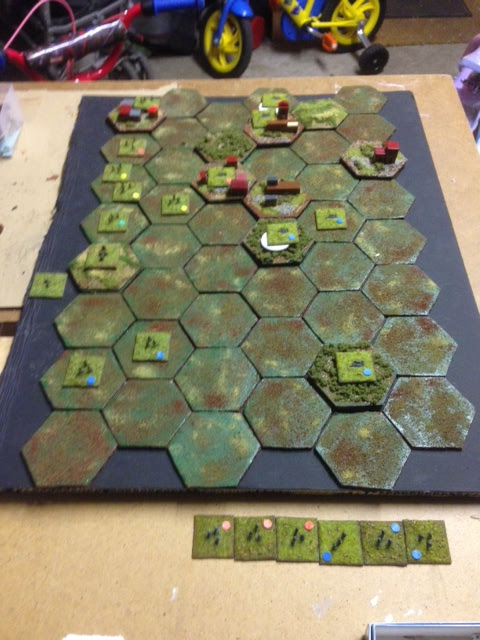
Return to "Battalion Attack" - Fire and Movement project (from Phil Sabin's Simulating War book) got a second outing. See below for the revised terrain board, with the British Infantry Battalion (1943-45) attacking left to right, hits a German defensive line of two companies. This is a hasty attack scenario.

The British start in the left most column (Germans setting up in columns 4,5 and 6). My acquisition of "brownish "Lego (TM) pieces from a trade with my eldest son has enhanced the look and feel of the "Farm Complexes" terrain sections. A certain familiarity with the board (second time out now) also allows me now to nickname certain features.
  • Top left hand corner, "Little Gibraltar" (the only British held "Farm Complex" at the start of the game)
  • Top right hand side corner, "The Alamo" (the German 'retreat' bastion)
  • The top centre, "The Iron Crescent" (German held/dominated defensive lynch-pin of this sector, comprising of three farm complexes, one ridge and two sections of woods)
  • Bottom right, "Outcast Wood" (home to the German left flank platoon, in a similar role to the 20th Maine at Gettysburg, "You sir are the left flank")
  • Bottom left, "Overhang Ridge", (a superb British HMG baseline position situation ideal for 'overhead fire' on "The Iron Crescent")


'Putting the toys on the board' (as per the Simulating War "example of play pp215-219, see below). The book play through was a good training session for the two newcomers (but experienced wargamers and board gamers) I umpired for. They took up where the book left off.

Note: The figures "off table" (in the black non-playing area) are:
  • To the left hand side the British off-table three inch mortar support platoon
  • To the bottom, the German replacement counters for any platoons that move out of their dug-in status. Also to note all fighting rifle platoons have been given a 'company colour' sticker for ease of identification (which is important in some firing circumstances). The platoon number has been dropped as insignificant to the rules).    
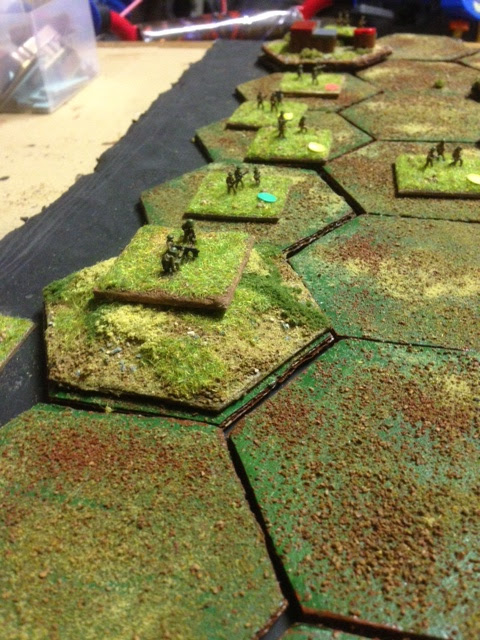
Another 'improvement' to the terrain from last time were the 'new look' ridges. Instead of being another layer cardboard tile I used a magic material called Dufaylite (TM) which is a cardboard honeycomb (think "bees" hexagonal honey cells) used as the filler in a thick cardboard sandwich. The beauty of it is that the material is that it can be cut with a hand saw into hexagon shapes. Then the hexagon sides can be easily sculptured into slopes with a bit of pressing, snipping and gluing (a cheap glue gun helped here) up to a small plateau. Finally  painted and flocked (see below for the "Overhang Ridge" HMG position):.

The emphasis I place on styled terrain is intended to 'better' represent the terrains impact on the battlefield. For example when I used the plain brown hexes for "farm complexes" in the first game I felt that it unintentionally mislead the British player into thinking that "the attack prospects" were much easier than they actually were. I thinking by making the terrain look more formidable this important balance should be somewhat redressed.

The Second Replay

Despite Battalion Attack - Fire and Movement being a "short game" we only managed to play eight full turns, filled with wargaming discussion. The situation you see below is at the start of Turn 9 (as in the German player goes next).


Game summary: Coached to a certain degree as regards what had happened in the first (experimental) game, I think the players made a decent stab at playing the game as to how it was intended to be played. It also helped that the fire combat modifiers had been better clarified on the Simulating War YahooGroup. The rules now played correctly (in the first 'experimental' game the Germans benefited from additional defensive modifiers that were from misreading the rules) gave a much more fluid game.

Review of Tactics: The British battalion commander decided to press forward with an infantry close assault on "The Iron Crescent" despite the daunting nature of the task. His slow methodical progress paid off to the extent of clearing the furthest forward "farm complex" and inflicting one German Platoon casualty (the one the Germans had decided to 'advance into during the first two turns of the game). "Outcast Wood" was largely ignored but nevertheless was a bullet magnet as the British commander fell for that old wargame adage of "use what you have got while you have still got it". The result is a cumulative frittering away of assets (every seventh shot eliminates a friendly platoon through ammunition attrition), no one attack being the deadly sin, but the net effect is a poor "fire discipline". At the end of turn eight the German baseline was still looked a very long way off, the Germans still at five sixths strength and the British down to half half combat effectiveness (six rifle platoons and two support platoons). The defence looked like it might be bent but not broken. The German player "hung tight" and committed his reserve platoons to "strengthen the line" at the moment of crisis and I think he was heading to win as the British commander was gradually "running out of infantry". 3VP to the Germans and only 1VP to the British. Who had the idea of attacking this sector without tanks?  


The Rules Re-examined (again):

One feature of the Fire and Movement combat mechanisms (i.e.the ammunition attrition and direct fire casualties) is that the attacker can "bleed from the back," with more often than not the attacker being able to selectively choose what platoon dies (and not necessarily being the unit being "hit" the most). This allows the attacking player to 'keep the momentum going".

Another rules feature was the incredible usefulness of the HMG (especially in indirect fire mode) and the battalion mortar in providing covering fire for the infantry attack.. The former is particularly useful as a well sited HMG (on a ridge) can provide some covering fire (albeit with a negative modifier) 'danger close' whereas the mortar has to 'check fire' due to 'adjacent friends'.

One thing that became clearly apparent was that "dug-in troops" can be relatively easily suppressed but not KIA'ed. The designer notes this as a deliberate feature, something that a lot of miniature rule sets do not follow, the classic being Squad Leaders 'breaking' broken units on a second hit and the tendency of heavier shells "Verdun'ing" infantry (Command Decision and Spearhead).  

Finally, to make any headway the British player has to pay the butcher's bill and get some rifle platoons into a Close Assault position on the German occupied "fortified/covered" hexes (i.e. the farm complexes and troops dug in woods) as it is the only way to score casualties on the Germans

Addendum:
Wow, bit of a big "brain dump" of a post but I think it was worth it ;)

YahooGroup and this Posting can also be found at: 
http://groups.yahoo.com/group/simulatingwar/message/1992 

Monday, 22 April 2013

"Fire and Movement" - Battalion Attack (Terrain Version II)

I need to run the "walk through" scenario again. Firstly to get the rules correct, secondly to use a consistent terrain look and feel (I was four farms short last time and substituted in some 'brown card' which I think made the prospects of attacking the 'farm crescent' LOOK too easy) and thirdly it was challenging fun. If possible I would like to play the attacker this time.

The 'new' farm terrain (courtesy of my son's Lego collection) is shown below, British attacking left to right, moving onto the board on Turn 1 (hex row 1), with the Germans defending the right hand side board, positioned in rows 4, 5 and 6 (where rows in this photograph are running vertically up and down the page).  


The 'new look' of the formidable defensive 'farm crescent' as per viewed from the British lines looking across at the German positions, with the German 'Alamo' farm in the far distant (see below):

Note: This picture (below) is rotated 90 degrees from the first picture in this post (above)  


An aerial view of the 'farm crescent' from behind the German side of the lines, with the German 'Alamo' nearest the camera bottom-middle and away top-right of the frame is the British farm I nicknamed contentiously as 'Little Gibraltar' (see below): 


By contrast the countryside to the left hand side of the battlefield is spare and open, dominated by the German held 'Hexagon Wood' far left and the wood to the left of the 'farm crescent' complex (see below):


So the attacker has the choice of a bloody assault into the 'crescent farm complex' or a rush across open ground, hmm, the game is called 'Fire and Movement' but perhaps it would br better called 'Fire, Suppress and (only) then Move'.

Saturday, 20 April 2013

"Fire and Movement" (Battalion Attack) TO HIT TABLES


Courtesy of Phil Sabin's:
Simulating War KCL pages and the Simulating War Yahoo Group 

Message 1753

Rifle Fire "Range Bands"
  • (0 Hex)Same Hex is Illegal:
  • (6+ Hexes) NA for attack
Range measured excluding firing hex but including target hex
Therefore range of 1 hex implies the target is adjacent

Rifle Fire:
[No negative modifiers .. but see Mortar restrictions]
  • Target is in OPEN and target NOT adjacent to FRIENDLY troops or
  • Target is in OPEN but NEXT TO FRIENDLY (but from firer's own company)
Then a hit is scored on ..
(1 Hex ): 2,3,4,5,6
(2 Hexes): 3,4,5,6
(3 Hexes): 4,5,6
(4 Hexes): 5,6
(5 Hexes): 6

Indirect and MG:
  • British HMG: 2,3,4,5,6
(HMG is NEVER considered part of "same company")
  • German Mtr : Check Fire (if FRIENDLY adj) or 2,3,4,5,6
  • British Mtr (Ranged in) : Check Fire (if FRIENDLY adj) or 2,3,4,5,6
  • British Mtr (First Shot at this Target Hex): Check Fire (if FRIENDLY adj) or 3,4,5,6
(Mortars are NEVER considered part of "same company")
(Mortars IGNORE "terrain" to hit modifiers)

Rifle Fire
[One Negative Modifier (-1)]
  • Target is in OPEN but PARTIALLY OBSCURED or
  • Target is in OPEN but NEXT TO FRIENDLY (not from firer's company) or
  • Target is in TERRAIN (Ridge, Wood, Farm)
Then a hit is scored on ..
(1 Hex ): 3,4,5,6
(2 Hexes): 4,5,6
(3 Hexes): 5,6
(4 Hexes): 6
(5 Hexes): Miss

Indirect and MG:
  • British HMG: 3,4,5,6
(HMG is NEVER considered part of "same company")
  • German Mtr : Check Fire (if FRIENDLY adj) or 3,4,5,6
  • British Mtr (Ranged in) : Check Fire (if FRIENDLY adj) or 3,4,5,6
  • British Mtr (First Shot at this Target Hex): Check Fire (if FRIENDLY adj) or
  • 4,5,6
(Mortars are NEVER considered part of "same company")
(Mortars IGNORE "terrain" to hit modifiers)

Rifle Fire
[Two Negative Modifiers (-2)]
  • Target is in OPEN, PARTIALLY OBSCURED and NEXT TO FRIENDLY (not from firer's
  • company) or
  • Target is in TERRAIN (Ridge, Wood, Farm) and PARTIALLY OBSCURED or
  • Target is in TERRAIN (Ridge, Wood, Farm) and NEXT TO FRIENDLY (not from firer's company)
Then a hit is scored on ..
(1 Hex ): 4,5,6
(2 Hexes): 5,6
(3 Hexes): 6
(4 Hexes): Miss
(5 Hexes): Miss

Indirect and MG:
  • British HMG: 4,5,6
(HMG is NEVER considered part of "same company")
  • German Mtr : Check Fire (if FRIENDLY adj) or 3,4,5,6
  • British Mtr (Ranged in) : Check Fire (if FRIENDLY adj) or 3,4,5,6
  • British Mtr (First Shot at this Target Hex): Check Fire (if FRIENDLY adj) or 4,5,6
(Mortars are NEVER considered part of "same company")
(Mortars IGNORE "terrain" to hit modifiers)

[Three Negative Modifiers (-3)]
  • Target is in TERRAIN (Ridge, Wood, Farm) and PARTIALLY OBSCURED and NEXT TO
  • FRIENDLY (not from firer's company)
Then a hit is scored on ..
(1 Hex ): 5,6
(2 Hexes): 6
(3 Hexes): Miss
(4 Hexes): Miss
(5 Hexes): Miss

Indirect and MG:
  • British HMG: 5,6
(HMG is NEVER considered part of "same company")
  • German Mtr : Check Fire (if FRIENDLY adj) or 4,5,6
  • British Mtr (Ranged in) : Check Fire (if FRIENDLY adj) or 4,5,6
  • British Mtr (First Shot at this Target Hex): Check Fire (if FRIENDLY adj) or 5,6
(Mortars are NEVER considered part of "same company")
(Mortars IGNORE "terrain" to hit modifiers)

Final Note on British Mortars: 
Ranging in penalty of -1 negative modifier only applies if the mortar was firing on a different target hex last turn. Therefore if the preceding turn was a "fallow (none firing turn)" then the -1 modifier does NOT apply. The crew implicitly had time to "range in". The modifier is to penalise the British player if he jumps around all over the place. The German mortar on the other hand is "pre-registered" so is not adversely affected.   

Saturday, 13 April 2013

Note to Self: Thoughts on "Fire and Movement" after the first play test

Game Post Mortem: 
  • The game was brutal and unforgiving
  • It had a different mind set from previous miniature rule sets I have played (Spearhead, Battle Group Commander, Command Decision I/II/III, Squad Leader)
  • Logistics played a prime function in the attack in stark contrast to the defence
Assumptions to follow up on: 
  • All platoons have a 360 degree arc of fire (including dug-in troops, as in their entrenchments protection and arc of fire)
Did I get these bits correct?
  • I played "dug in troops" were -1 to hit and the first casualty was discounte
  • Note: I "think" (confirmed) the -1 modifier was wrong
Interesting Game Mechanics to "mull" Over:
  • The attacker losing strength points (stands) proportional to the amount of ammunition used (per six fire combats)
  • Firing hits an area (all units stacked in a hex)
  • Firing can hit two adjacent hexes (meaning for the attacker it pays to spread out leaving a hex perimeter between platoons to minimise casualties from incoming fire)
  • Platoon removal due to fire combat (not ammunition depletion) was of the owners choice with the restriction that the stand had to have taken a casualty that round
  • A "fresh"  platoon have one action, it can fire OR move (not both)
  • "Spent" platoons (as in those having received incoming fire (as in been successfully hit irrespective of terrain modifiers) from are suppressed and cannot do anything bat automatic suppression removal at the end of the turn
  • Benefits of "company orientated" attacks (implied by good local co-ordination)
  • HMG platoon is used to supporting attacking forces, can stack with (but still suffers from -1  fire modifier when friendly adjacent troops to hex it is firing at)
  • MTR (indirect fire) will only fire within a safe zone when supporting plattons, has to stop when enemy get danger close
Things Missing::
  • The normally modelled "Morale Tests" were completely absent, troops were assumed to follow orders unquestioningly (perhaps why the British Ministry of Defence (MoD) liked the game so much) .. Note: See Phil Sabin's response.
[Phil Sabin said ..] "I do not agree that morale is ignored - rather, it is factored into the ease with which troops are suppressed by incoming fire, losing the ability to move or fire"
  • The ability of troops effectively to retire was absent. In the latter stages of the trial game the last two British infantry platoons were cut to pieces, yet retiring troops are often are ignored as threats
  • "Indirect Smoke" planned to obscure assault movement from the "defenders"
  • "Direct Smoke" to cover reactive withdrawals and involuntary break-offs
Future Actions: 
  • Make four more "Farm complex" terrain squares (visual effect of sterner terrain on tactics?)
  • Repeat scenario using 20mm figures (visual effect on game using bigger figures - skirmish feel?)
  • Repeat scenario with Squad Leader game counters (visual affect effect of 'more' counters - better visualisation of troop numbers?) 

Friday, 12 April 2013

(Part 3 of 3) "Fire and Movement" - "Battalion Attack" : First Rules Outing

With the assault "stuck in the mud" the British infantry found itself perilously close to "fresh" German infantry platoons who did not hesitate to conduct three vicious close assault counter attacks. This time the dice rolled high as the British infantry caught in the open and suffered nine brutal casualty points (see below):    


With existing casualty points that meant the removal of another two British platoons, the British attack was now "gone" (see below): 


As "spent forces" cannot move (and in a controversial move) the British commander retreated the HMG platoon off table while it could rather it becoming "another casualty (see below the "missing" stand from the hill). Both remaining British platoons pull back towards the baseline but are then trapped in a withering crossfire from the German left hand side company. The additional casualties mean that one more stand is lost and the other is "spent" (see below):  .


The Germans then close in on the pinned (aka "spent") British platoon with the right hand side company. The hapless British platoon can only flip back itself back to its "fresh" status before the assault comes is. Caught in the open the British platoon is 'murdered' sustaining six casualties breaking it and ending the game (see below):


The final situation stood at four German platoons being the only troops left on the map at the end of the game (earning 4 VP) plus eight British Platoons had broken in fire combat (earning an additional 8VP) for a grand total of 12 VP for the Germans, versus the two German platoons broken (earning 2VP) but no German baseline hexes occupied, hence for the British for a Grand Total of 2 VP. 


A clear margin of victory for the Germans who are in undisputed control of the board suffering. They suffered 33% losses that means the German battalion commander is rushing much needed reinforcements to this sector in advance of another Allied attack.  

Thursday, 11 April 2013

(Part 2 of 3) "Fire and Movement" - "Battalion Attack" : First Rules Outing

British Infantry assault the "Farm Complex Crescent": 

The line of two hundred British Tommies formed up in two companies to attack the "Farm Complex Crescent" (see below):   


One company (see below, top right) assaults the leading farm hex and inflicts three casualties (poor attack dice rolling as only one one platoon hits out of three, needing 3+ on a d6) while the other moves up into a close assault position for next round (see below):


Note: Platoons from different companies cannot participate in the same fire combat or assist assault combats onto the same target hex. 

The Germans respond by extracting a high price on the exposed British platoons in front of the central wood inflicting three casualties. The German platoon chose to shoot at two adjacent hexes rather than assault one hex to try and make more British units spent and therefore inactive on the British player turn.

This allowed a fresh German platoon to move up into the defensive position of "farm house crescent".

Footnote (in forthcoming turns): 
As these two German platoons are from different companies the British will protected from a nasty doubling up (as each platoon can fire on two adjacent hexes) because the two defending platoons are from different companies cannot attack the same hexes. If they had been from the same company the fire attacks would double up because of the 'extra' coordination of fire discipline implied (see below, the red British mortar marker separates the two platoons in question). The attack preference in future turns for these two platoons will be to close combat assault individual hexes.  


Stands removed from casualty losses are "1 German" and "1 British" and from ammunition expenditure (1 British, because it effects attackers only). The Germans losing the "spent" platoon in the leading farm complex, the British opting to lose one from their extreme right wing (which had little chance of making a headway) and one from the middle. There are now six active attackers to the defenders four remaining platoons: 


The British moved a infantry platoon into the lead farm complex and the Germans countered by occupying the wood adjacent to it. Crucially this meant that five British platoons have remained in the 'open' as they are flipped to the "fresh" status.

Decisive Combat Round:

After an incredible sequence of five successive ones on close assault combats which meant that both sides 'blew or missed' what were game winning chances in the fire fight for the 'middle wood and adjacent farm complex'. The Germans managed (eventually) to 'break the bad luck duck' and taking a British platoon out in a close assault.

Note: In the rules a hex stacked with two platoons on the receiving end to a close assault automatically loses one stand - effectively double casualties, six casualty points. After the return British phase the ammunition expenditure rule also removed another British platoon levelling the active platoon count at four a piece (see below):


The wind had clearly been taken out of the sails of the British attack, but there was four turns left to play. The Victory points were clearly in favour of the Germans 4 (as in the four British platoons broken by fire combat [note not removed because of ammunition expenditure])to the British 2 (for the two German platoons broken by fire combat). The likelihood of getting British platoons to the German baseline now seems rather remote. 

Next: Can the British conduct a fighting withdrawal?

Wednesday, 10 April 2013

(Part 1 of 3) "Fire and Movement" - "Battalion Attack" : First Rules Outing

Bringing the new game game out into the full glare of the sun.

Despite having created my own random terrain, it made a heck of a lot of sense walking through the example in Philip Sabin's Simulating War book (see pages 215 to 220) to get a feel for the rules (as we all know rules read are quite a different thing to rules played in albeit 'friendly anger' down at the club, see pages 208 to 214 of the book). In setting up the terrain I suddenly realised that I had not quite the requisite number of "farm complexes" created, so I substituted in some blank dark brown hexes instead. I silently cursed myself for not building first the example set-up as per the book. By the time we had played through the example two player turns it seemed pointless to "set-up" again to my randomly generated terrain, so we simply carried on (see below, as per the book ready for the German turn  to start): 


To Note: The 'red' poker chip denotes the position of the British mortar attack (moving the mortar around suffers a -1 to hit modifier simulating the delay in ranging in as opposed to poring on a continuous barrage of shells. The 'white' poker counters underneath the troops denote the "spent" status. The glass beads denote casualties inflicted that turn. Finally the the little white markers on or near the British infantry denote the different companies within the battalion. The Germans are defending the bottom three hex rows above, being particularly well fortified on the right hand side "farm complex and wood crescent" salient. The attacking British have massed for an attack into the heart of this defence and are "waiting" for the oncoming fire from an unsuppressed German infantry platoon to hit them.   

The Germans pour as much fire as possible onto the advancing British infantry (PBI), inflicting a bloody three casualty hits from a German counter attack close assault from the central farm complex (see below, top middle). Long range German fire brings another two casualties on the left hand side too (see below, top left): 


The British player (I was German) has now taken over six hits (five from that round and a couple of accumulated hits from the last were "still in the bag2) so he chooses to remove a unit from his right (but the German left) electing to hold onto the unit that took three casualties because of its advanced position, despite it still being spent for the upcoming round. The German player eagerly removes his spent markers leaving all six German platoon "fresh" and giving the British player the headache of trying to suppress them (as in making them "spent" status ) so they cannot fire the next go (see below):  


The British player tries the rather risky tactic of "pushing troops" forwards in the face of unsuppressed German infantry, if he is not careful this could be a replay of the Somme (see below, top right for the cluster of massed British infantry targets): 


The British HMG (on the ridge, see top middle below) and mortar keep firing and suppressing two of the central German platoons, causing casualties which eventually causes the removal of a German platoon from the "farm complex crescent"  (see below):


An interesting feature of the game system is that the British player (the attacker) is hampered by the fact that the act of "shooting" and "expending ammunition" will cause him causalities (very sixth shot removes a British stand through the notion of ammunition exhaustion) so he must choose his targets carefully. The defender has no such concerns/fire restrictions as they are firing from prepared positions (bombed up for defence). It is assumed that the British troops have already traversed half a kilometre from their start line, whereas the Germans are still on theirs. 

The above situation represents some two hundred British infantry men are exposed in the open before the "farm complex crescent". The Germans are rushing their reserve platoons in from their right hand side and hoping to hang on in the middle (a process of 'dying hard'). The British have suffered two ammunition and one combat casualties so far (three in total, so that means nine active infantry platoons remaining) and the Germans have lost one platoon with five remaining. Therefore the scenario is hanging in the balance but with a slight advantage to the Germans thanks to the defensive terrain still in their possession and their dug in status.  

Next: The "central attack" goes in

Monday, 8 April 2013

WWII "Fire and Movement" - Battalion Attack Game - A Tour of the Terrain

The basic clear battle board with coloured card marking the terrain features (see below):
  • Dark Green : Woods
  • Dark Brown : Farm Complex
  • Light Brown : Ridge Line

Basic card mounted on thick box cardboard and painted with the appropriate colours (see below):


Quantum jump to the terrain as it is landscaped (see below):


Yes, I have no shame, the children's Lego box is raided to represent some simple farm houses (see below): 


Trying to get the 3D perspective at a slight angle (see below):


A close-up on the "island" of randomly generated terrain (a farm complex hid amongst woods). The bottom right hex is looks an Achilles heel to the defender as it potentially is a hidden rout into the "island" (see below):


Across to the left of the "island" are the open 'killing fields', a albeit small protective copse of woods and two small ridges to the far distant horizon (see below):


The battle board from the defenders baseline perspective (see below):


A final look at the "farm complex" on the "island" (see below):


All that is missing is the troops and an opponent ;)