Showing posts with label 10mm. Show all posts

Tuesday, 25 February 2025

What "Another" Sherman .. this time 10mm from Pendrakon

As part of the props for the Wargames Developments (WD) Convention Demonstration Game 2024 of Arnhem (1944), I decided I needed to paint up a Sherman tank. I needed a relatively small one, ignoring the fact that I had several suitable models already (15mm and 1/200), I thought it appropriate to use a Pendrakon 10mm Sherman V seeing as the game was going to be ran at their Battleground Show (see below, the Sherman faced off against a Stug IIIG and some German Infantry moving up a linear battle track/ladder): 


It went together, four pieces, no flash, fitting in tightly together with a tiny bit of filing. 

The painting scheme was:

  • A grey primer (Airfix Acrylic 001), with a Vallejo Brown Dipping Wash liberally spread into the cracks. 
  • Next an undercoat shade of (924) Russian Uniform Green.
  • Base layer of 50% Olive Grey (888) and 50% Russian Uniform Green (924).
  • Final highlight Olive Grey (924). 
  • Tracks matt Black (950) and dry brushed Gun Metal (863).
I planned but epically failed to put any decals on it but I did manage to put it on a base (not shown above) which took more time than I thought, hence no decals!

Note: The Sherman faced against the Stug III shown in an earlier post (click link)!

Tuesday, 26 November 2024

Painting German WWII Three Tone Camouflage the Vallejo Way! [Shade-Base-Highlights and Washes]

As part of the preparation for the Pendrakon Battleground Middlesbrough Wargames Show, I had to practice my late-war German three tone camouflage painting scheme. The idea was to use Pendrakon 10mm miniatures for the Wargames Development (WD) "A Bridge Too Far" participation game. For my 20mm models I had previously used Tamiya colours (Sand, Matt Earth and Deep Green/Olive Drab, highlighted up with Yellow and White) but for smaller scales the Vallejo paints are a much better to paint with. The Flames of War (FoW) painting guide gives a very good Vallejo recipe (see below, this is "Issue Two" which was the "German" edition - with lots of Panzer (and other things German) painting guides):


The Late War German Three Colour Camouflage Vallejo Recipe:

Shade:
Y: Green Brown (879)
B: Flat Brown (894)
G: Luftwaffe Camo Green (823)

Base:
Y: Middlestone (882)
B: Chocolate Brown (872)
G: Reflective Green (890)

Highlight:
Y: Buff (876)
B: Beige Brown (875)
G: Russian Uniform Green (924)

Tracks: 
German Primer undercoat Cavalry Brown (987)
Brown Wash
Gunmetal (863) Dry Brush 
Black Wash
Final Gunmetal (863) Highlight

Washes: 
Watered down Black and Brown Vallejo "Dipping Washes" (the big vat ones) 

For my first subject matter "test case" I chose a couple of 1/200 Skytrex Action 200 WWII German AFV miniatures I had (see below, two Stug IIIGs, nasty when coupled with close support Panzer Grenadiers. I was pleased with the result but wanted some more experimentation before I jumped up to 10mm):


For my second subject matter "test case" again I chose some 1/200 Skytrex Action 200 WWII German AFV miniatures (they had been around for ages, purchased from a hobby lot on eBay and I have been meaning to repaint them for absolutely ages - no better time than now). In fact these were used in the WD "A Bridge Too Far" participation game I hosted with John Armatys at Partizan, Newark (Second Partizan in the vernacular I think) earlier this year (see below, a Panther [with added foliage] and a Pz IVH, looking for Shermans, or anything with a White Star on it for that matter. They are are old [1980s?] but I think they still hold their own!):  


I always thought the Skytrex 1/200 Action 200 AFVs were nice kits, but I was less taken with their infantry, although perhaps to scale they are a bit spindly. I do have the infantry but I prefer to use their early war 1/200 AFV models freely with Pendrakon's "slightly larger" 10mm infantry figures. I think it works really well for Spearhead and Command Decision level games, wheer a base is a platoon of infantry or a troop of tanks. I use this combination for my France 1940, Russian 1941-42 [while German things were painted grey] collections, however for my new Western Desert project [British, Commonwealth, Italian and DAK] I am going full in for 10mm (Pendrakon and Miniature Figurines being my current figure sources). I have not quite decided for late war, originally it was going to be big-boy 10mm kits in 1943-45 in Europe and the East. Quite unexpectedly though, I acquired two battalions (one Sherman and one Cromwell) worth 1/200 1944 British Armour and a 1944 Panzer Division's worth of German Armour (Panthers, Pz IVHs, Stug IIIs, Half Track 251s, Tigers, King Tigers and various assault guns). eBay, a blessing and a curse! The same old dilemma [same period and multi-scale hell], but in my heart I know I will do what I usually do and - collect both, so late war Eastern Front beckons in 10mm methinks [unless a large 1/200 set of Russians appear]. Which means I will have to double up on German 10mm late war kits - which I think I can live with (see below, I do like the way the camouflage blends into the terrain board):  


Practice run complete and I jumped up in scale to the 10mm Pendrakon AFVs (see below, a 10mm Stug IIIG - it is very nice, it naturally takes more time to paint but it is very satisfying and the metal pieces went really well together - nice casting Pendrakon!): 


When the camouflage painting is done there comes the tactical markings and/or national insignia, so do you decal or go free hand paint? I decided to give the free hand a go [it was only a single tank], with the aid of a new secret weapon! A Posca Art Paint Pen I had picked up ages ago, in a back to school sale (see below, sadly I discovered the pen nibs were a tad too large for meaningful detail work [OK for 20mm-25mm-28mm-54mm] but all I could get was a blob that was useful for the outer white cross area, so I could then fill in black and touch up round the edges (see below, the finished product, which in the end I am quite proud of):  


Altogether a satisfying project. I intend to finish the rest of the 1/200 German battalions (Spearhead and Command Decision Order of Battle) in this scheme.

Wednesday, 15 November 2023

Contrast Paints - Am I still not "Getting It"? (Probably Not)

As is my want, when in town I pop into any shop that could vaguely have wargaming "related" (as in useful) material in it. My local "Boyes" shop (apologies for those overseas or out of the relative area - so Boyes makes no sense) has Vallejo paints. Straight in like Flynn! As I was perusing the Vallejo aisle doing my usual -"Which colours do I have?" and only having a vague sense of this one and that one" - I  saw a new rack of Vallejo paints called, Xpress Color. Well certainly I had "none" of them and what is more there, was only a pitiful few of them left on the shelves. That talked volumes to me, so I picked up two of the stragglers (see below, Plague Green and Black Lotus - Contrast Paints by any other name): 


I rushed back home eager to give it a bash with Vallejo's babies - having had a hit and miss affair with GW's Contrast Paints. The targets were a set of 10mm Pendraken Modern Warsaw Pact and NATO British ("Cold War Gone Hot" era) toys. The result was really a heavy all over green wash with blue-black boots and metal gun parts. They are relatively small kit so probably not the 25/28mm ideal target range, but to me it was still a "primer and very good wash" [all my crevesses are certainly covered] but still really wanting paint. Though probably "less" than normal. It certainly was a factory style productionline, which is good.

Afterwards I set off around the Internet to see what others thought. The accomplished painter "The Beard Bunker" was of interest.


My verdict: I think I am still missing the point and probably playing around with too small a scale for real benefit! Washes are probably good enough for 10mm. 

Sunday, 29 October 2023

10mm Pendrakon British Cold War and their Paint Schemes

While at Pendrakon HQ, on impulse I picked up a couple of packets of their lovely 10mm Cold War British. To be honest this was on a bit of a whim and fancy - as most of my wargaming projects start (see below, confession - I thought these were the normal Ferrets (Reece Scout Cars), but on closer inspection these were the Vigilant Swingfire Anti-Tank missile version, which all seems a tad exotic and heavy hitting for a lightly armoured Recce Scout Car - careful before you to decide to engage that T-55 or T-62):  


The other packet I picked up was much more of a rarity or stylish collector piece - the last true British Heavy Tank (before they became designated MBTs I think). It's roots lay in tank design and thinking in the late 1944's. Perhaps they were thinking of something taking on the likes of the German Tiger, King Tiger and Panther classes of tanks (see below, the British Conqueror, it is a fantastic model - looking a bit Sci-Fi if you ask me, but the T-55 had a ceratin out of this world look to it too):


The kits were staring at me in their unfinished silver so I quickly primed them in my favourite Airfix Acrylic Grey and set about looking for teh official looking Vallejo painting guides to give me a list of paint codes to chase. Luckily for Flames of War - Team Yankee they had a Cold War British Camouflage Pack, even better I already had the paints (see below, a Conqueror in a weather base coat, not finished but it is starting to look the part): 


Other wargamers who preceding me [many thanks Stefanof] giving advice is always welcome: 


Vallejo reference material from:


More of this to come, in due course, methinks.

Tuesday, 26 September 2023

Big "Near" - Small "Far Away"

To honour a genius of British TV comedy, the sit-com Father Ted, I present wargaming terrain in perspective (see below, "near" is Big, whereas far away is "small" - but it is really the same thing): 


Or to the more wargame informed 15-20mm and 6-10mm, don't get them mixed up in the boxes or you will have a very funny looking game!

Sunday, 27 August 2023

Charity Shop (I) Bargain Terrain Piece

Charity Shop bargain (50 pence), I would call it 10mm terrain (see below, small and yet beautiful with a wargaming purpose in mind):


You don't always get something but it is very satisfying when you do!

Sunday, 20 February 2022

Connections UK 2019 Fire-Move Game 2

The afternoon/early evening Connections UK 2019 game was played with one defender and three attackers. The attackers being a mixture of old wargaming Grognards (from Wargames Developments) and a newbie DSTL wargamer C-in-C, with the defender being a newly civilianised DSTL military man who clearly knew his way around wargames. You may have guessed that with his astute interlocking defence [without clumping two units adjacent to each other] and good deployment in rather problematic terrain set-up for the defender (see below, the defender it always made to think hard about whether to occupy exposed hills [with the disadvantage of potentially defending too far forward] or sit back in the "lee" [defending on the baseline] risking being overrun, it is always a compromise of sorts. Another sensible choice was a simplicity of choice in that the two German infantry companies defended separate areas of the board and were not "layered" in a confusing manner [that did not help the defender in the first game Connections UK 2019 game]):  
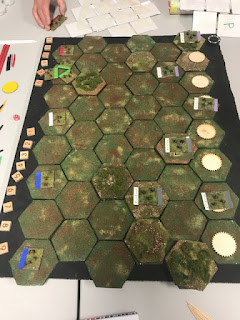

The British came in "across the board", using three out of four companies represented from the get go, plus sticking the Vickers HMG platoon in the first turn [the middle seemed to be a safe bet]. Of note is the use of the cover afforded by the wood on the second row in. The Green company commander was able to place his full company in its "protective lee" outside of German LOS. However, the notion of an overall "plan" seemed to be missing for this set-up, but all players "were on the board," great for playability but the consequences could be somewhat fatal for the troops involved (see below, the question the British player should ask is where do I use my support assets - the Vickers HMG and 3" mortar - to best effect? It looks like they will continuously be "haggled" over, too many cooks perhaps will spoil this broth): 


Turn 2: The British Grognards see Blue company advance unsupported by the Vickers HMG because of LOS problems and the mortar was "haggled over" and taken to the other end of the table, to what purpose I am still not exactly sure. The Blue attack looks promising as there is a local British superiority of 3:1 and the potential of an additional 3" mortar support on later rounds that means there is a very good chance of suppressing the defender and getting a close assault in (see below, Red company at the top of table has a covered approach [it will take some long range fire initially], then there is an awful "show yourself over the top" moment at the end): 


Turn 3: The British make a big push or rather two big pushes at two separate ends of the table. The British re-sight their mortar (taking precious time and still leaving Blue company unsupported in its continued attack) and provide the German Purple Company some  "target practice" on Green company's platoon as it enters the woods. Blue company has moved a platoon to a close assault position but has rather rashly has opened itself up to more defensive fire than is healthy for the British assaulting troops liking! All depends on Lady Luck and the dice (see below, Blue company has missed a classic fire-fire-move tactic, with a 50% and 33.3% chance of suppressing the defender - one thing the British have forgotten about LOS is that you don't block LOS if you are in the same friendly hex firing, they have swung their assaulting platoon too far left and got into trouble): 
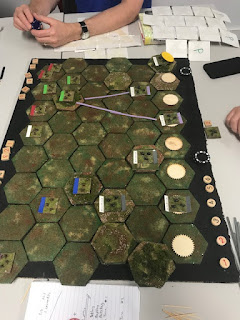

Turn 4: There is a withering hail of German defensive fire with seven "fire for effects" being rolled for. The German defending platoon in peril of being close assaulted is opting to fire for a single hit on two British platoons to make them both "spent" and inactive until their rally phase rather than hurting one with three hits. As it stands with accumulated casualties the British player is very near to withdrawing one for platoon with KIAs and also one platoon for ammunition expenditure (see below, the dice rolls will be "make or break" for the southern British attack):  
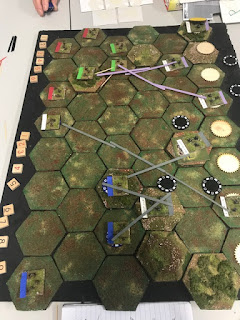

To the horror of the British players, Blue Company evaporates under withering fire and logistic depletion (loosing two platoons, but the Germans gaining only 1 VP  for the KIA platoon). The reserve Yellow company is now thrown on - in the middle of the battlefield, which is literally the teeth of the German defence presenting themselves as bunches targets (a German platoon firing can hit two adjacent hexes, remember also the Germans do not have to worry about ammunition depletion and the only way you can cause hits on an entrenched German platoon is to close assault them). This looks an increasingly hard task for the British players to pull off and now depends on the main attack in the North going well for them - but again it is into well sited German entrenched platoons (see below, the surviving Blue platoon it providing distant covering fire for the Yellow company, which really should have been following like avenging demons in the tracks of their brave Blue infantry compatriots [route one down the middle is "not open"]): 

The British again have to pay the butcher's bill from the German defensive fire and again, because they fired so many units - the ammunition depletion rule hurts them. Blue company is no more (ammunition depletion) and both Yellow and Green company have removed KIA platoons. What also does not seem to help the British is the fact that the supporting mortar and Vickers HMG seem to be supporting in the wrong places (see below, the British are now looking very thin on the ground thanks to some costly human wave tactics against entrenched Germans): 
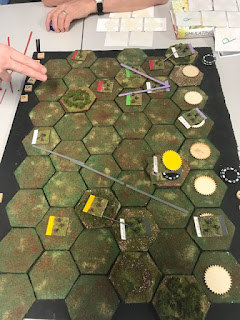

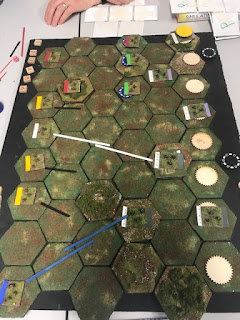
The German defensive fire has left the Northern attack "pinned under the guns" and they are likely to be stuck there for some time. The British Green company loses another assaulting British infantry platoon and the attrition is going to be only one way from point in (see below, the battle is called at this point, the British will not be able to destroy a single German platoon, let alone get to the baseline [therefore zero VPs, whereas the German player has at least 4VP]): 
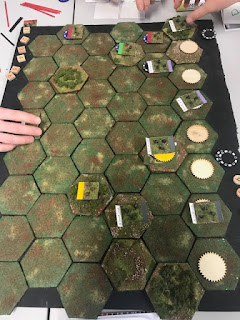

The British have attacked in what amounted to piecemeal "Human Waves" (I don't think alternative "all-in-charge" would have done any better though) and have been comprehensively beaten. I believe in the South they did have an "in" [an isolated German platoon] with Blue company but mismanaged it, but could have reworked it with Yellow following it up, In the North there was a terrain problem to work out, domination of the ridgeline which would have been a protracted firefight (with correct positioning of "supports" - keeping a company off table would have pinned the German platoons "in position" in the middle as the flanks were attacked. This one was a hard nut to crack, in fact a win in VP terms needed very patient play (see below, the Grognards did use it very much as a "learning the rules2 experience and game away thinking how they would do it next time, after many games the nuisances of the rules only come out after several play-throughs): 
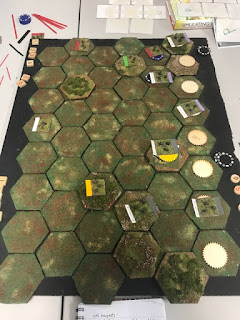

The laurels for this play-test definitely lay with the defender, but with terrain generated randomly it means that any two games are highly unlikely to ever play the same. 

Saturday, 19 February 2022

Connections UK 2019 Fire-Move Game 1

The Connections UK 2019 Conference allowed me the opportunity to run two games of Fire Move, one in the morning and one in the afternoon. The morning game had one defender and two attacking players, all of which had never played the game before. Interestingly this meant that a few new wrinkles came to light as the players discovered important aspects of the rules, which as we all know is an invaluable and the critical part of playing the game in the first place (see below, we are several turns into the game - the German player has elected to keep a platoon in reserve off table [a sound tactic], but he has "stacked heavy" [concentrated] in the centre in order to try and dominate the centre and the German right flank. However the terrain to the German also left disrupts "his line of sight" which has isolated his far left platoon. In the centre a single British platoon firing can hit two German platoons simultaneously, so note the positioning of the Vickers HMG platoon allows the British a good chance to suppress two German platoons each turn):  


The problem on the German left is an awkward hill that lies three rows in from the British side, which means the German cannot set up on it. Three waves of British infantry are now in the process of assaulting the German left flank [8:3 in the British favour ], so the German player hastily calls forth his platoon out of reserve and ponders the use of his valuable mortar ammunition (see below, the yellow "sun" marker is the landing point for the British 3" mortar, note also the British players have pounced on this avenue of attack, to the almost the point of ignoring attacking the German right flank. remember the black cocktail sticks denote movement - the blue coffee stirrer denotes firing): 


The British player starts to crowd and concentrate multiple platoons into single hexes [a potentially dangerous tactic if in clear LOS to an enemy "fresh/active" platoon or if the German player can conduct a mortar attack on the hex in question - however it could pay off in close assault and allows a better chance of supporting fire by clearing LOS hexes]. The key thing here is to suppress the Germans in the British "fire phase" so they cannot return fire in their "fire turn" - it is all a balance of risk and probabilities (see below, suppression and poor LOS are very frustrating to the German player):  


The British "Yellow Company" conducts a classic and very successful close combat that destroys a German platoon, note "close assault" being the only way in the rules an entrenched infantry platoon can take damage (all other hits simply supress and is a design feature of the rules). The platoon in question takes six hits and is removed from play - excess hits would not carry over to other platoon, they are simply lost (see below, the risk in this case payed off with handsome rewards - the barn door is now swinging open, the deployed reserve platoon is looking very vulnerable in the "open"): 


The Fire/Move battlefield looks very good from a British point of view, fifty percent of the German forces are effectively "out of play" because they cannot interfere with the streams of British infantry flanking to their left threatening to roll up the German baseline. The Vickers HMG is causing extra pain by consistently pinning them in place to stop the German platoons reinforcing the German left (see below, the British have performed a very good attack exploiting the weaknesses of the German set-up): 


Despite the outstanding success the British players were hit by the "cunningly clever" logistics rule of Fire-Move, again a purposely designed subsystem in the game which means that after a certain amount of firing [set IIRC at eight or nine fires - note this is a factor that can be calibrated as a game parameter] the British have a "depleted ammunition platoon removal". No victory points awarded to the Germans but there is one less manoeuvre element for the British Battalion Commander to use (see below, if you look closely there are now only two not three "yellow company" British infantry platoons - and note to fulfil this logistics requirement you have to take a platoon off that has been actively firing that turn [cheesy play is always possible - which platoon you take, but the temperament of the players is arbitrated by the umpire's oversight (or overrule - aka final word) to be "simulation" and not "competition" play (aka avoid unrealism's)]): 
 

The German reserve platoon (in the open) was mercilessly gunned down. The Germans had suffered 50% casualties and could not stop the British advance. The game was called as a comprehensive British victory, well played to the two young players from DSTL who had not played a wargame before! The German player took away some valuable lessons learned. 

Thursday, 17 February 2022

Connections 2019 Fire/Move Components

In hindsight perhaps I should have showed this post first as this was in preparation for the 2019 Connection UK Fire-Move games. I decided to take the same terrain as I did for Connections UK 2016 when I first did Fire-Move, but upgrade the infantry models from Skytrex Action 200 to Pendrakon 10mm figures (see below, the basic British OoB for the game [as per the book], comprising of an infantry battalion, four companies [red, yellow, green, blue] of three infantry platoons, plus a Vickers HMG support platoon [white] and a 3" mortar platoon [top right hand corner, off-table left with basic flocking]): 


The similarity to a Spearhead or Command Decision order of battle (OoB) is somewhat striking (and reassuring) - so I now can field a British infantry battalion for those rulesets too, which is a bonus. These are also the playing pieces that can appear on table top - note the Vickers HMG can support all the other companies with direct fire, but once placed on the baseline cannot move other than to retire out of the game for good. The other thing to remember about the Vickers is a -1 DRM applies when danger close, as in a friendly unit is adjacent to an enemy unit it is firing at. The distinct colour banding is also to act as a aide memoir to help supporting direct fire and close assault respect the "same" company restriction (see below, I have also colour coded fire and assault markers [painted cocktail stick and coffee stirrers] for the combat phase, so a simple "same colour" visual check can be applied): 


The Germans can in theory operate in two modes, the common static defence position, as shown below with a colour coded company (as per the British because the same fire restrictions apply to the Germans)  and a crude "barbed wire" representation to their front (X-X-X). This slip of paper could be detached or folded under the figure base if it was moved in the course of the game (see below, a simple system that worked well in practice, although it is noted that the Germans hardly ever elected to move .. note in the London Exiles game, the only German movement was to move [retreat] off table): 


With that the game components were complete ready to "meet the players". Going back to reference the Spearhead and Command Decision rulesets again, in Fire-Move there is no reference to a Battalion Command Stand, so there is no limitation to the number of orders that could be given in a turn, either in the number of or distance from the battalion. Command Decision drops a level further down to Company Command Infantry stands [Nationalities like the Americans and German can actually elect to have a separate Company Command Stand]. One last difference is the provision of the Battalion Carrier Platoon, often used in a fighting Reece function or a very valuable Admin helper moving munitions and stores around, even evacuating casualties. That element is ignored for Fire-Move and assumed to be on "other duties".

Tuesday, 1 February 2022

Brown Tanks on the way to Beda Fomm

Slow excruciatingly painful progress to Beda Fomm as the A13's get washed in Vallejo Brown (see below, caught in the glare of the desert sun - but starting to look the part): 


A big parcel arrived from Pendrakon so time to get cracking with the painting proper ;)

Wednesday, 26 January 2022

Heading to Beda Fomm .. a troop of A13 Mk IIa (10mm Pendrakon)

All this talk of the simulation of the battle of Beda Fomm has left me (or the collective "us") a few models short of being ale to create the British RTRs for Beda Fomm on the table top. Particularly because the A9, A10 and A13 fleets of British cruiser tanks did not have a long shelf life, particularly when they later came into contact with the Africa Korp. So A9s, A10a and A13s don't make it into the 1942+ battles, which is the popular 8th Army collection phase [for us currently]. Therefore "I had to" (or rather chose to) order some early war British kit from Pendrakon - well that was my excuse anyhow. That really meant I better start painting the three A13's I already had (see below, stunned into action I have primed in the Airfix acrylic primer grey): 


Next stop will be a Vallejo Brown Wash and a dark sand colour. I am thinking four collections of three tanks  (comprising or rather representing a squadron) would make up the armoured regiment, with a couple of the precious CS tanks (which could fire HE to take out AT Guns and fire smoke) in the HQ Troop. That should be enough for Beda Fomm as the cruiser formations were understrength by that point in the campaign anyhow.

Monday, 3 January 2022

Test of Battle Beda Fomm Scenario

The last revision of the Command Decision WWII wargame rules system was Command Decision: Test of Battle (see link below): 


The site itself does not seem to have been updated since 2011, however from here you can see the OrBats and scenario (see below, a screenshot of the British Order of Battle):


And the Italians too (see below, quite a few M13/40's required)


Command Decision formation morale values are shown (see below, not sure what game system WPD is referring to)


The aim for me is perhaps to do this in 10mm Pendrakon. It would be interesting to find out if CD: Test of Battle (or any other variant is still actively being played in the wargaming community). There does seem to be "some" activity on the linked CD:TOB forum. 

Sunday, 12 December 2021

A13 Mk II British Cruiser Tank: 10mm Pendrakon

Time to see how this little fella paints up. Recently picked up from the Battleground 2021 Stockton Show from Pendrakon miniatures(see below, the early war Western Desert Force, the precursor to the famous 8th Army): 


I am keen to build up an early war British force to face against my painted Italians, probably using Sam Mustafa's Rommel as a set of rules. I also have some 8th Army Infantry to paint up. First I should check out what tanks were with the 7th Armoured at this time.

Additional source of inspiration for this Western Desert Force project scenarios courtesy of Bob Mackenzie's website:
Orders of Battle and Command Decision Websites:


Friday, 11 June 2021

10mm Vietnam Game: Take That Village Playtest

Something in the pipeline, play tested once with a friend and it was good, then lots of other interesting things got in the way, but it is about to be picked up again (see below, the jungles of Vietnam created on Kallistra terrain): 


A Vietnam game without a Huey? Never! (see below, which a chemistry see through paperweight, hurriedly pressed into (very effective) service as a flying stand): 


The wide expanse of the "jungle table" means that the figures seem lost in its midst. which feels about right (see below, it it only possible to spot the troops, because of the camouflage, with teh aid of counters - which again seems about right): 


The Pendrakon 10mm figures although small are beautifully sculped (see below, US Blue - NVA/VC Red, naturally): 


Looking forwards to play testing this home-brew rule set of a friend ;) 

Monday, 14 September 2020

10mm Vietnam Game

The objective, pacification of a Vietnam village that has been reported as "taken over" by teh NVA and VC but still has "friendlies" inside it or so what the precursory Huey overflight can tell us (see below, Kallistra terrain again serving up the goodies - water = paddy fields no cover; Orange with scatter = broken ground which offers partial cover;  green = dense jungle counting as cover; huts = hard cover; brown tracks = roads or raised bridge over paddy fields; grey = secret tunnels): 


Each hex in the set up is scaled to represent 50m across and each figure represents approximately five men. Two figures to a squad and four squads to a platoon with a heavy weapons squad assigned to each ans a light mortar tagged along for the ride with the Company Commander (see below, first and second platoon cover ten hexes of the baseline to give the US the maximum amount of fire support - to give back plenty if they took any "incoming fire"):  


The "blue" counters represent what Charlie see, a lot of US strung out in a continuous skirmish line and opens opens up, also revealing "his" position. First blood went to Charlie but the intense retaliatory fire cleared the dense jungle outpost and the VC/NVA threw forces forward to bolster their 'point position' (see below, there were no clever scouting rules but recon by contact): 


This VC/NVA tactic ran into a stream of American firepower as the US MGs hard a beaten zone cutting down and pinning any visible "enemy". The exchange cost the US too, especially as the VC/NVA brought some mortars down (see below, a 10:3 ratio was within the 3:1 (min) to 4:1 (preferred) trade the US were prepared to pay as per their Victory Condition [although the term "victory" in itself seemed a trifle dubious for this scenario]): 


xx


The VC/NVA resistance stiffened as they received an additional two platoons of infantry - as the America testified to higher level of incoming fire coming in from around the flanks. The US Commander at first engaged in the fire fight but then pulled back and informed the umpire of his intention to assume a more defensive position and let the VC/NVA come to him. Either than or until he received reinforcements. To go forward would be to court disaster. In the meantime he requested and plotted an artillery strike on the VC/NVA positions outside the village. The umpire announced battalion had committed a platoon of M113s to help push towards the village and a Huey Gunship was "on call" (see below, the M113's were a huge morale boast to the US having MGs and effectively gaving hard cover to US troops behind them - the left flank received one M113 to "pin" the enemy, while two M113s were allocated to the right flank along with the artillery strike and Huey with the intention to punch through to the village on the right): 


The concentration of force on the tight flank played dividends as the defending VC/NVA troops were wiped out by the unexpected artillery "stonk", followed up by the Huey and armoured infantry assault (see below, the track/path to the village was now open):  


The quiet village itself lay dormant in the background (see below, no signs of any activity as nothing above ground was spotted but in Vietnam appearances can be very deceptive):


The Huey took incoming fire from two HMGs hidden in the village (see below, the AA fire missed but spooked the chopper to call the "on call" Phantom to eradicate this threat): 


"The Air don't care" about friendlies when heavy weapons are being fired at fellow "fliers" and the bomb run came down with sadly a bit of drift variation missing the HMG nests (see below, one tunnel complex was taken out which included some friendly prisoners and a luckier hit on the NVA/VC mortar positions):     


The final line of VC/NVA resistance was a series of poorly constructed booby-traps was "driven through" by the M113s leaving the remaining VC/NVA troops to disappear back into the jungle (see below, all that remaining was to take a tally of casualties to ascertain the "winners" in this chaotic mayhem):  


In total the US took seven squad hits, but that Phantom killed four poor civilians rather than VC/NVA - although it did convince the VC/NVA it was time to "bug out". This was a total of eleven, to forty seven NVA/VC casualties. 11: 37 was a greater than 3:1 so no US loss (of face) but below the desired/preferred 4:1 required by Westmoreland. The only thing to add would be that the war was getting attritional for the US as one thing was for sure, "Charlie would be back" and the US platoons would have less or be filled out with rookies learning their trade.

It did feel like Vietnam although the rule mechanisms lacked patrol/cover nuances it did play well with a "flip-flop" rather than IGOUGO sequence of play. The rules were a home set that was ad-libbed and in development but showed really good promise. I think I will take another look at Peter Pigs "Men of Company B" rules and "Buckle for your Dust" by the late Paddy Griffith. Many thanks to Ian for putting the game on and Adrian who was a worth VC/NVA opponent.