I have to confess I am not the same wargamer I once was after I finished reading big T's (Thucydides) "History of the Peloponnesian War". No it did not break my spirit because it was a big book, quite the contrast in fact. As I read more I rather got into it. However I was expecting to be uplifted, as I was after reading Big H's (Herodotus) "The Histories", but quite unexpectedly I felt unclean, as my values and perceptions had been radically changed. On reflection the "good guys" of the Persian Wars now looked rather "bad", in fact everything looked tacky, tardy and amateurish.
Originally I though the Persian Wars were where it was "at" in the ancient Greek period, but the Peloponnesian War is now the point of fascinating interest to me. Previously I had shunned it as a triviality or something I would like to rather forget about, as it seemed a case of two good friends fighting needlessly (Athens v Sparta) but I see now that I had it all wrong. In many ways it seem to be the defining moment in Greek history and a game changer in the conduct of war. The length of the war meant that hostilities were passed down through generations, with 'old scores' to settle which had faded from living memory, but used as excuses for action by the opportunistic figures of influence. The Greek reasoning often was caught up with the notion of "rank" among City States which often defied the pragmatics of winning a war in the most effective fashion (please see Song of Wrath for further details as this really needs to be read with the benefit of a professional author to do the concept justice)
It seems the factions of City States and alliances had more than enough potential to produce a pre-WWI wrecking scenario, but the seedy shifting nature of subterfuge between so called 'allies' was unbelievable in scale and duplicity. Another startling feature was the lack of "large battles" (Delium 424 and First Mantinea 418 BC) meant that is was a succession of short to medium size hoplite battles, ideal it has to be said for wargaming actions. To this end I am using "The Peloponnesian War", a solitaire game from Victory Games, as a further learning tool and source for tabletop battle generation.
The ongoing adventures of a boy who never grew out of making and playing with plastic model kits (and even some metal ones too). Also a wargamer in search of the perfect set of wargaming rules for WWII Land and 20th Century Naval campaigns.
Showing posts with label Herodotus. Show all posts
Tuesday, 28 January 2014
Wednesday, 26 September 2012
Summer Reading Project Completed
This summer I set myself a task of tackling one of the 'big' books of
the wargaming library shelf (a metaphorical shelf at that!). I've had it
for over five years, probably nearer to ten come to think about it, without having the stamina
or minimum background knowledge to try and understand it. I did flick through it a couple of times but bottled out of reading it in full and turned to something with pictures in it (aka various Osprey titles). Arguably it is the first
'History', as in the first modern history book of all time; Herodotus and his "The Histories". Not really
one book but a compilation of nine separate tomes, a bargain for sure. Its readability is somewhat restricted as
its chapters are acknowledged as being artificial divisions of his
writings so that the scrolls would roll up neatly for Alexandrian scholars to
shelve away. Nevertheless it is a hotbed of tyrannical intrigue, sex and stomach turning gratuitous violence.
A do-it-yourself kit for any would-be tyrant of the ancient world and
on reflection quite reminiscent of certain characters that I have I met in the
commercial world of business/industry over the last twenty years. Some things seem much clearer to me now ;)
I read "The Histories" in a rather peculiar order (but in hindsight I found it to be a recommended reading pattern). As I was interested in "The Greeks in Peril" campaign I read:
And what did I get out of it? A lot of background for my "Greeks in Peril" game for sure! I will read it again (it's one of those books), but I'll also probably go for the Landmark edition with maps to get a better geographical sense of where things are ;)
I read "The Histories" in a rather peculiar order (but in hindsight I found it to be a recommended reading pattern). As I was interested in "The Greeks in Peril" campaign I read:
- Book 7: The Xerxes invasion to Thermopylae
- Book 8: Sack and ruin of Attica and Athens until the unlikely victory at Salamis
- Book 9: The told you so ending at Platea
- Book 5: Those meddlesome Greeks being naughty on the Mediterranean coast and Black Sea
- Book 6: It all ends in tears for the Greeks as Darius get angry that is until he meets his match Marathon
- Book 4: Darius versus the Skythians and the Skythians win hands down, "never, never, never and try and catch a nomadic conglomeration of tribes with no fixed place worth for them to fight over, especially if most of your army is on two legs and all of their army is on four legs, and they have several thousand miles of steppe to run around in" (Hitler should have noted this about the Russians in WWII)
- Chapter 1: Who the Persians are why the "Cyrus the Great" was so important in the Persian psyche and how he came to sticky end underestimating the Skythians
- Chapter 2: Herodotus describes the Egyptians and you suddenly realise how big a part of the ancient world Egypt was, as everybody knew it was really, really old ad everybody feared it. No fighting (and it was a bit of a grind to get through) but it cast Herodotus as the first modern documentary producer. Half way between the National Geographic and the History Channel.
- Chapter 3: How after the death of Cyrus, Cambyses II (a deranged fellow but nevertheless he still managed to conquered Egypt - hence it was worth Herodotus spending all that time telling us about it in Chapter II) expanded the Persian Empire and how then Darius I after an internal squabble with the Magi (Persian religious hierarchy) who try a fast one to put a Mede back in charge, again expanded the Persian Empire.
And what did I get out of it? A lot of background for my "Greeks in Peril" game for sure! I will read it again (it's one of those books), but I'll also probably go for the Landmark edition with maps to get a better geographical sense of where things are ;)
Labels:
Achaemenid Persian,
Ancients,
Books,
Greece,
Greeks in Peril,
Herodotus,
Persia,
The Histories
Tuesday, 24 July 2012
Greeks in Peril : Good Guys?
Men in Skirts:
Following on from my reading I mustered my long standing 15mm Greek collection into a semblance of City States for inspection. As per the original intention they are in DBA army format (twelve elements and their alternates). Note: Apologies from the relatively distanced long camera shots.
Athens: Mostly Xyston Miniatures, bar the Cavalry which is Chariot Miniatures. I do have the requisite mounted figures in Xyston, but it takes me a long time to paint their 'sculptures' as a good thing deserves not to be rushed.
Again Athens, this time a close up of Athenian hoplites (see below). These shields are awaiting application of the "Little Big Man" 15mm shield decals (some things don't change no matter what period I do, decals always have and will be my bugbear).
Sparta: The hoplites are from Chariot Miniatures, while the "hoard" are a mixture of Xyston Miniatures. The hoplite line has far too many officers (with their traverse crests), I will at some point have to break them out mixing them with the normal rank and file. Painting the horse hair plumes a mixture of white, red and black will help the appearance too. They also need the application of the "Veni Vidi Vici" lambda decals (no surprises there then).
Thebes: "Ooooh" gasps the crowd in pantomime horror. Greeks in alliance at the start of the invasion but they were (historically) the first to turn and go over to the Persians. Understandable when you consider that the line of Greek defense in Attica meant that their Boetian lands were left for the Persians without a fight. Even more ominous is the fact that I have managed to apply the "Veni Vidi Vici" decals (the white club of Thebes) to them. These figures are from Irregular Miniatures and despite their relative cheapness in comparison to other manufacturers they paint up extremely well. In fact I may safely say these are my favourite hoplite figures to paint.
Sicilian Greek: These boys historically never made it to the show being distracted from the main party by a different 'invasion' from the neighboring Carthaginians (paid by the Persians to cause mischief). Gelon the Tyrant of Syracuse (tyrant being more a term describing an ancient 'undisputed' king rather than out and out pure baddie, Gelon in fact was recognized as a very capable and enlightened ruler). Again the foot are from Irregular Miniatures and the mounted from Chariot Miniatures.
Other "non-core" Greek City States: The front army is Thessalian (the only 'horse heavy' Greek army), a collection of figures from various manufacturers (hoplites from Chariot Miniatures, psiloi I think are from Tin Soldier, the horses from Chariot Miniatures and Essex Miniatures). Behind them are the Phokians (no that's their historical name honest), mostly light troops and a few hoplites (all from Essex miniatures - I have to sadly say Essex hoplites are my least favourite figures of all time, it's the spear pose in particular I don't like, but the hoarder I am I won't throw them away, hence their demotion to possibly the worst Greek DBS army!).
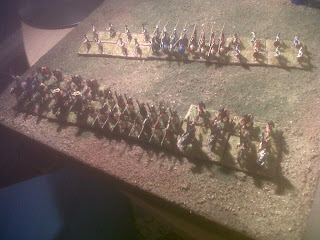
All the above armies are usually found fighting each other. Only the threat of the massive Persian invasion of Greece in 480BC (or BCE now as some modern historians have it) brought any form of uniformity of cause. The combination of the above armies should also allow me to field a Basic Impetus Greek Army (well certainly one and possibly a Greek (Athens/Sparta) versus Greek (as in Thebes) match up as well).
Back to reading Herodotus, The Histories, Chapter VII now, the Great King has made his preparations and has crossed the Hellespont on his big bridge of boats ;)
Next: Men in Trousers
Following on from my reading I mustered my long standing 15mm Greek collection into a semblance of City States for inspection. As per the original intention they are in DBA army format (twelve elements and their alternates). Note: Apologies from the relatively distanced long camera shots.
Athens: Mostly Xyston Miniatures, bar the Cavalry which is Chariot Miniatures. I do have the requisite mounted figures in Xyston, but it takes me a long time to paint their 'sculptures' as a good thing deserves not to be rushed.
Again Athens, this time a close up of Athenian hoplites (see below). These shields are awaiting application of the "Little Big Man" 15mm shield decals (some things don't change no matter what period I do, decals always have and will be my bugbear).
Sparta: The hoplites are from Chariot Miniatures, while the "hoard" are a mixture of Xyston Miniatures. The hoplite line has far too many officers (with their traverse crests), I will at some point have to break them out mixing them with the normal rank and file. Painting the horse hair plumes a mixture of white, red and black will help the appearance too. They also need the application of the "Veni Vidi Vici" lambda decals (no surprises there then).
Thebes: "Ooooh" gasps the crowd in pantomime horror. Greeks in alliance at the start of the invasion but they were (historically) the first to turn and go over to the Persians. Understandable when you consider that the line of Greek defense in Attica meant that their Boetian lands were left for the Persians without a fight. Even more ominous is the fact that I have managed to apply the "Veni Vidi Vici" decals (the white club of Thebes) to them. These figures are from Irregular Miniatures and despite their relative cheapness in comparison to other manufacturers they paint up extremely well. In fact I may safely say these are my favourite hoplite figures to paint.
Sicilian Greek: These boys historically never made it to the show being distracted from the main party by a different 'invasion' from the neighboring Carthaginians (paid by the Persians to cause mischief). Gelon the Tyrant of Syracuse (tyrant being more a term describing an ancient 'undisputed' king rather than out and out pure baddie, Gelon in fact was recognized as a very capable and enlightened ruler). Again the foot are from Irregular Miniatures and the mounted from Chariot Miniatures.
Other "non-core" Greek City States: The front army is Thessalian (the only 'horse heavy' Greek army), a collection of figures from various manufacturers (hoplites from Chariot Miniatures, psiloi I think are from Tin Soldier, the horses from Chariot Miniatures and Essex Miniatures). Behind them are the Phokians (no that's their historical name honest), mostly light troops and a few hoplites (all from Essex miniatures - I have to sadly say Essex hoplites are my least favourite figures of all time, it's the spear pose in particular I don't like, but the hoarder I am I won't throw them away, hence their demotion to possibly the worst Greek DBS army!).
All the above armies are usually found fighting each other. Only the threat of the massive Persian invasion of Greece in 480BC (or BCE now as some modern historians have it) brought any form of uniformity of cause. The combination of the above armies should also allow me to field a Basic Impetus Greek Army (well certainly one and possibly a Greek (Athens/Sparta) versus Greek (as in Thebes) match up as well).
Back to reading Herodotus, The Histories, Chapter VII now, the Great King has made his preparations and has crossed the Hellespont on his big bridge of boats ;)
Next: Men in Trousers
Labels:
15mm,
480BC,
Athens,
Basic Impetus,
DBA,
Greece,
Greek,
Greeks in Peril,
Herodotus,
Impetus,
Phokian,
Sicilian Greeks,
Sparta,
Thebes,
Thessalian,
wargame campaign,
Xerxes
Subscribe to:
Posts (Atom)