Showing posts with label Russia 1941. Show all posts

Wednesday, 26 February 2025

Skytrex 1/200 - KV2 Model

This (KV2) has been been on my Barbarossa 1941 (1/200 scale) wish list for a long time. It is the eternal frightening tank (along with its sister KV1) that the Germans encountered in 1941 and was looked upon with a sense of awe and arcane wonder. It was usually photographed with a German Landser looking at or standing on a knocked out or abandoned example (see below, stage one "flash removal"): 


It almost looks like a sensible tank in 1/200 - its insanity shows up more in 1/76. I remember I needed two of these for one of the Spearhead Scenarios. It was a "bunker buster" (a child of the 1940 Finnish War requirements for getting through the Mannerheim Line) rather than a true MBT, but it looked like a prehistoric monster. 

Note: That closes off my 1/200 - 1941 Russian Tank wish list, but for 1942-43 opens up my need for T60, T70 and lease lend vehicles (M3 Stuart, Valentine, Matilda, M3 Lee, Churchill, Tetrarch  - methinks I would need battalion batches of ten for each of these, apart from a singleton for the Tetrarch).  

Thursday, 25 July 2024

Spring and Summertime Audible Reading: WWII (Early War from 1939 to 1941)

Thanks to Audible (via listening in the car and while I am doing the washing up) I am able to keep up with my "electronic book time" (and in all honesty, I usually buy a paper copy of the books I like and have listened to too).  It is nourishing when you can mine a consistent meme or theme, even as a background task. I have recently gone back to one of my first loves of history, the early war period of WWII (clanky tanks, Stukas and all that stuff), with some nice new author "finds" and their revisionist reviews of oft forgotten episodes of the early war.

Reading List (Done):

Starting at the beginning - Case White: The Invasion of Poland 1939 (see below, Robert Forczyk is a great new author find for me and the Poland 1939 Campaign is covered in greater detail that I have managed to find before):


Of interest were the "learning mistakes" of the German Army, as not everything went right for them and how an alliance which looks good on paper is, when tested (France and Great Britain supporting the Poles - allegedly), falls apart through lack of any tangible help Britain and France could give Poland in 1939! The Allies in short wanted everything to go much slower, but were simply not given this luxury.  

The open fighting war in Poland now over, we move onto Narvik .. the campaign before the Low Countries started and the site of the Allies first "land" victory in WWII. This was after a bizarre naval start to to proceedings, where we almost saw an  "Allied invasion of Norway" first and arguably "an Allied act or war on Norway" (courtesy of the RN) ! A beguiling episode of unfathomable "what ifs" that could have spelled out a very different outcome. Overall an excellent book (see below, where bizarrely the displaced Polish troops helped the French and British inflict the first Blitzkrieg era defeat on Germany by the recapture of Narvik in what was the final moments of this ill-prepared campaign [on both sides]):


Then back to more familiar territory of France 1940 proper, but with a twist, not the familiar and beloved Alister Horne's recount, (France 1940: To Lose a battle) and looking predominately at Case Yellow, but instead just a review of that and then greater focus on Case Red. This is looking at the battle of France post Dunkirk, and what was termed the Second BEF's brief campaign. This includes the 2nd Armoured Divisions "trials and tribulations "in what was a travesty of combat, or "How not to attack with a British cruiser armed tank division in 1940, thinking it was the same as a French tank division and had supporting infantry". Fascinating early war "cringe" details, again a story of what could have been (see below, subtext - how allies can hurt each other as much as the enemy):


Then a real focus on Dunkirk from the German view, illuminating when considering the operation from a German perspective (see below, a huge take away was that the German effort to take Dunkirk was uncoordinated and from a C3 perspective was horrifically fragmented and certainly not combined arms, a fascinating read):


After the fall of France how long could Britain stand? Many thought, including Joseph Kennedy, JFK's father and American ambassador to Great Britain, thought not long. Britain was doomed as it could not stand alone. "We March Against England". This gives a peculiar twist to viewing and understanding  this period. Absolutely fascinating stuff (see below, again its from my latest author find, Mr Robert Forczyk):

This information was especially interesting when reviewing it against Paddy Griffith's epic1974 Operation Sea Lion game and the capabilities (see below, Paddy's book is full of of detailed notes and is available from the History of Wargaming Project):


Yet one more thing leading to another, the Western Desert comes into focus and another book from Robert Forczyk fills this gap nicely (see below, those early Italian and DAK battles covered in fascinating details [still as yet only available in hardback - so note to self, it is a book still for me to get]):  

Again a great book and brings a new perspective on the early war Western Desert campaign(s) and specifically Rommel's character and leadership in particular (a tank commander is being very hard on a felloe tan commander). Logistics, logistics and logistics! It is no good getting something after a hard fought battle if you cannot supply yourself sufficiently to keep it.

The above might explain my lack of posting over the last few months (first half of 2024), coupled with increased WhatsApp-Facebook-X  usage (a trio of digital distractions) and heck, a busy work-family life balance.

Reading List (To Do): 

Where next? Historically, all eyes turn East (as did Hitler) and the war swings in a very dramatic fashion as an 'irresistible force' hits an 'unmovable object' (Germany invades Russia) and believe it or not there is a book for that (see below, in truth there are many books, but this one concentrates on tanks which is a leading draw to me, thank you Mr Forczyk): 

Although I think, instead of a picture of a sexy Tiger Tank on the front cover (which is "just" in period, but will sell books for sure), I would have preferred a picture of a weather-worn, workhorse PzIII, which would have been much more appropriate IMHO. 

Note: Any more book recommendations appreciated and welcome, as I seem to have come to the bottom of my list (ready-use locker). 

Wednesday, 17 May 2023

Command Decision IV - Test of Battle (To Be or Not To Be the ONE? That is the question!). First looking back at CD1.

For some thirty years I have been searching the hobby game stores for THE WWII "land war rule set" that will be the saviour, or rather my excuse for, buying my 20mm (and 1/200) wargaming collections (now 15mm, 10mm and 6mm need also to be included). Like a little lost soul seeking love and attention I yearn for the "perfect enough" set of rules to make me happy. In this quest "Command Decision I, II, III and finally IV (Test of Battle)" have been acquired - as has been the likes of Spearhead and Crossfire. Alas the bonfire does not burn as well as I expected - although I always thought Command Decision was almost right and crossing the Rubicon (its morale and its orders for command decisions, hence the name). Nevertheless the 20mm collection grows steadily bigger with each passing year, but few games have really been played on the sacred table top (see below, what the collective from Board Game Geek thought of CD1):  


Piquing my interest in WW2 land war recently were these posts: 

Has Sgt Steiner succeeded where I have failed for all these years? In fairness teh games get rated better with each edition (see below, V2, V3 and V4 ratings - so Frank Chadwick must have been onto something I think): 


For my own consumption I revisited the large stack of Command Decision boxes I have, containing therein the sacred rules and decided to do a play-test, actually going back to CD 1 (fondly remembering the day I discovered it lurking on the shelves of the Aberdeen Virgin Store, in the Games Section alongside boxes of Computer Games, thinking "now this looks interesting", as I thought then and still think so now).  

So I took CD1 out for a stroll, to show two of my wargaming allies some 1941 Barbarossa action near Kiev. I chose a 3:1 odds battle of a Veteran German Motorised Battalion from a Panzer Division versus a Green Soviet Infantry Battalion defending a couple of hills in front of a town, a real slap in the face job, but "only" using the organic German and Russian battalion weaponry. A full strength German Panzer Grenadier Battalion is easy 3:1 in advantage over a weakened Soviet Infantry Battalion. I thought he morale extremes should make it a relatively quick battle, just to learn the rules again (I expected the Russian force to melt, as it did). Rather than player versus player, as it was a very static Russian defence (one command order) and an active German (our command orders) there was much more discussion about what the Germans could and could not do.

Most of the issues on the day really stemmed from the difference between reading the rules and getting the gist, then playing a game and finding the reference to the right rule quickly when simultaneously explaining it to two other wargamers (there were too many pauses but my friends were patient). The game (IMHO) played well though, the order system was very representative of the capabilities of WWII forces although it played slower than the accepted 1:1 timeline [game time v real battlefield time] in the Designers Notes (something which I always though should be quicker in CD .. later versions simplified mechanics and tried to streamline .. maybe just a case of familiarity). I think I still need to convince my compatriots though, one a die-hard convicted "Avalon Hill Panzer Blitz rules in miniatures is the way forward", the other likes to see a few examples before making his mind up. Which is all fair enough.

I smile though as I thought it worked and I will tell you why, because the German plan was worked through the CD1 Order System, not as an after thought. No such thing exists in Panzer Blitz and many other rule sets. Two dismounted (that is from trucks) German infantry companies went forward supported by their own "company organic but dropped off" MG Platoons and the well-sited MGs/Mtr of the Weapons Company which punished the Russian defenders. The armoured half-track company was kept in reserve. For simplicity I had the defender's positions already spotted (assuming the Panzer Recon and Veteran Infantry Patrol had doe their job well the night before). A quick full advance and a cautious cautious advance allowed the Germans to fire in the General Phase. This melted away the Russian defenders on the two hills, causing as expected an adverse morale effect for the third Russian company, in the town with battalion commander and a infantry weapon stand (they hunkered down - pinned). One German company however stalled with a bad morale roll (in fairness it took the brunt of the Russian fire). The German reserve was released by their battalion commander while the battered German company regrouped. With over whelming effective fire power the Germans reduced the defenders and their morale broke on turn four, the only survivor - the Russian indirect mortar platoon - decided discretion was the better part of valour and legged it. To me it had an authentic feel to it. Like anything after playing the rules once (especially after so many years) re-reading the rules again ironed out a few queries. Introducing spotting is the next key, as bumping into stuff you have not spotted and dropping indirect on stuff you have spotted is another tactical feature of the CD system I liked! 

PS1: Apologies for forgetting to take pictures of the battle!

PS2: Most significant features I had forgotten about was extreme range for infantry was double normal effective range - which makes life  little more dangerous. 


Saturday, 26 December 2020

A "Boxing Day" Battle - The Battle of Tula 1941 - One Hour Wargame Rules

End of Barbarossa, the Fascist German invasion ran out of steam before Moscow. Heroic units of the Soviet Army were called upon by Stalin to fall upon the stricken German units at they retreated (see below, although seriously under-strength themselves the Soviets attacked with patriotic fury - as per shown in the Soviet master plan revealed from the surviving manuscript below): 


And then replicated on tabletop, the grey German column runs top to bottom in the photograph (see below, a nice excuse for some new toys to appear on table I am lead to believe): 


Looking down upon the retreating (don't tell Herr Hitler) German column the Soviet hoards steeled themselves for a furious battle of attrition (see below, the "Flanking Force": armour, Cossacks and leg infantry - a mix, it is the Soviet way): 


The "Blocking Force" of Soviet ski infantry (Siberians) faces the toughest task, blunting the might of the Hitlerite Panzers (see below, they are to trade their blood for time, stall the head of the column so that the "Flanking Force" can wreck havoc upon it):


The infernal Nazi machine has a cunning plan though, the Panzers are to swing south and engage the Soviet ski troops from the flank as the Motorised Infantry pin them frontally (see below, the head of the German column acts first): 


The rest of the German column is slower being restricted to mostly horse, foot and the odd motor transport bundles forward with the end of the column feeling compelled, somewhat reluctantly, to turn and face the Soviet foe (see below, it will be a fast an furious battle right from the start of the battles proceedings because of the proximity of the enemy forces): 


The Soviet forces are quick out of the blocks, they'haul ass' and 'start firing', nothing complicated here. The rules of warfare from the ACW Confederate General Nathan Bedford Forrest apply here, "get there with the mostest firstest" to win (see below, the Ski troops open fire causing considerable destruction of the lightly armoured German Infantry Motorised infantry and all of the rest of the Soviets move "full" -the Cossacks being a particularly fearful sight crossing the snow at the gallop): 


Bloodied, the German column is compressed and unwieldy, with its head being hammered by three  Soviet units (see below, the Panzers must act with alacrity to right the situation whereas the Motorised infantry have to take time to "rally" themselves from a perilous state of disorder, which foregoes them attacking this turn):  


The Panzers swing round but the rest of the German column is somewhat fixed and performs what can be best described as an aggressive shuffle towards the enemy, although the Cossacks bear the brunt of the effective fire (see below, the Soviets have to hang tight here and take an aggressive round of incoming fire): 


The threatened unit of Siberians turn to face the Panzers and are determined to "die hard". Meanwhile the Russian general assault continues along the line (see below, note that the Russian Tanks have a hull-down position on the hill to make it an even harder task for the German Landsers at the rear of the column): 


The Russian attack on the Motorised German Infantry is too much for it to take and it simply ceases to exist as a fighting formation (see below, the gap at the front of the German column where it used to be and note the bulk of the German infantry is locked in combat with the Soviets in the wrong [central] part of the board): 


The Panzers slug it out with the Siberians and the rest of the Germans engage their opposites. Again it is noticeably the Cossacks who take the brunt of the casualties, perhaps it is their style of fighting (see below, however the overall unit count is now 6:5 in favour of the Soviets): 


The Soviets are now pinching both ends of the German Column, obtaining good local odd advantages. The Soviet tanks on the hill now deem it appropriate to charge into the flank of a weakened German infantry unit (see below, note as a flanking unit doubles its attack dice the Soviets have effectively got 3:1 combat odds at front and back of the German Column): 


The Soviet tank action causes the catastrophic destruction of another German infantry unit (see below, the Germans are now losing units at an alarming rate, 6:4 now in the Soviet favour, with no sign of an open exit to extract themselves through): 


Desperate times call for desperate measures and the rearmost German infantry unit seizes the opportunity to counterattack into the flan of the victorious Soviet armour. How many times have you seen that, at the moment of your success you are also at your most weakest or vulnerable. The Soviet tankers have their moment of hubris. At the front of the column a dire slugging match continues (see below, this is a very dark moment for the Germans as they appear to be on the verge of being swept from the board): 


Secret Soviet Footnote added: During the course of the action the NKVD detachment did valuable service to the Motherland by performing patriotic duties behind the 'front-line of action', instilling the Cossacks with righteous fervor, that allowed them to continue fighting despite the terrible losses incurred (see below, the movement of a small unit at the back can be observed attaching itself to the second Soviet Cossack unit over the next few photographs): 


The German success appears from an unexpected quarter, in the middle of the battlefield, a Cossack unit disintegrates. The Machine guns and mortars of modern weaponry have finally taken their toll on the horses. Once committed to a frontal battle and not able to use their mobility the butcher's bill is an almost inevitable consequence (see below, this ruthlessly exposes the flank of a Soviet Infantry formation vital to successfully blocking the German exit, 5:4 but still in favour of the Soviets): 
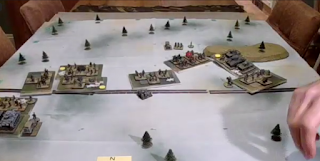

It was a measure of the Soviet Commander's ability to see  that he did not panic at this reversal (and it was not I so it is not self-praise). With a practical sense of grace he pulled the endangered tanks back to the hill using their superior speed to orientate themselves for aggressive action next turn and simultaneously hurled the second Cossack regiment into the melee to pin the German Infantry unit that had a potential exploitation move if left unchecked (see below, the old wargaming motto of "fight where you have to and don't fight where you don't have to" applies in its truest form here):   


His calmness was well rewarded as good news came from the front of the column, in that a second German Infantry unit had been dispatched by the terrible Siberian ski troops (see below, the Germans were once again on the back foot, 5:3 in favour of the Soviets - there only glimmer of hope being that the Germans Panzers were making in-roads against their blocking unit of Siberian ski troops): 
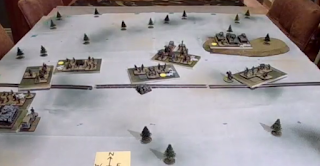

And so it came to pass that the terrible swift sword of the Germans finally struck down the valiant Soviet ski troops, the Cossacks once again suffered accurate and punishing fire, while it was clear that the Soviet tankers needed to spend precious time to reorganise themselves on the hill. If the Germans were fully motorised then they perhaps could have seized the moment to extract themselves. Instead they were now fighting three disconnected battle in separate pockets of resistance (see below, every German success had come at a price, be it is casualties or being forced to move at a tangent to the direction of safety (see below, the odds are now 4:3 but still in favour to the Soviets, but is hard to see how the two middle German Infantry units can get a clear run off the board)
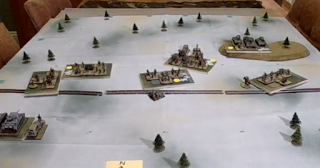

At the rear of the German Column the Soviets reorganise their tanks and pull back their cavalry out of 'harms way'. while at the front of the German Column the Soviets orientate themselves to face the new dangerous threat of the Panzers but also take time to rally their own battered infantry that have been doing some hard fighting (see below, for the first time the Germans have the potential to gain a local 3:2 advantage in fighting through the blocking force to safety and their salvation. The question is will the Soviets be kind enough to give them time enough to exploit this?):   
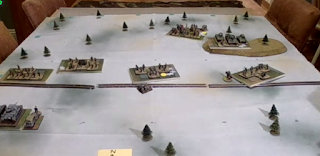

The Germans sensibly now try to pull their infantry to one pocket in the center of the battlefield. The German Infantry that fought so well and heroically defeated the charges of Cossacks also suffered horrendous casualties, so are very disorganised and it will take two turns of continuously rallying them to bring them back together as a fighting unit. This is time the Germans simply do not have. The Panzers meanwhile start the attrition on a second Siberian ski unit (see below, so tantalisingly close for the Germans but they need to get all three units off the board to claim a significant amount of rescued men and material that "can live to fight another day"):  


The Soviets are coming, ominously the Soviets tankers and Cossacks begin their final charge, meanwhile the Siberians hunker down for more attention from the Panzers. The Siberians elected to try and at least damage the Panzers rather then digging deeper snow holes, but alas were ineffective (see below, the mobile Soviet forces are not going to give the time the German leg forces need to exit, another good Russian command decision): 
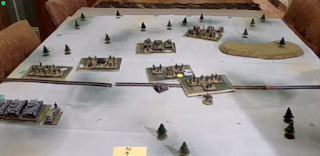

The Germans tried one last desperate "attack out of a pocket" at the Soviets, with their last "throw of the dice" they hoped to break one or both of the two Soviet infantry units blocking the exit. It was successful in inflicting some casualties but did not disorder either of the Soviet units, so it was clear they would fight back. That meant the avenging angels of the Soviet mobile forces would fall upon the now perilously weakened German Infantry at the rear of the German Column (see below, if only the Germans could move faster, but they know in their heart of hearts they are going to get caught, it is whether they can ride out the storm or not): 
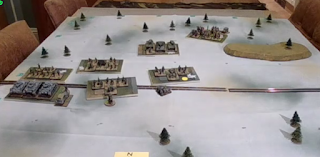

The Soviet tankers make contact this turn with the Cossacks, as per their historical preference - well at least since 1812 - lurking menacingly on the flanks and rear of the German Infantry unit. It does not look good for that unit of Landsers as they already start the combat "disordered". The rest of the Soviet infantry is simply "holding the line" and inflicting what casualties they can on the other German units (see below, the jaws of the Soviet trap close tightly around the rear of the German Column):  
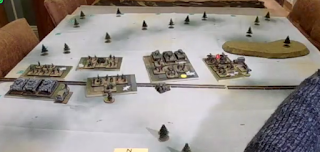

The rear German Infantry unit disintegrates under the pressure of the Soviet tankers attack, even before the flanking Cossacks could or are needed to engage - what then followed would be simply a "massacre". It is now a case of the Germans performing a damage limitation exercise as best they can. The Panzers can always make safely it the off table and with the "road" bonus it is deemed that the remaining German Infantry can move to the end of the table with only the remaining "battered" Siberian unit in contact and viewed as incapable of destroying it in one turn, so it will be in effect off regardless on the following turn. The remaining Russian, albeit mobile, forces are just slightly too far away to intervene (see below, end-game, so despite the Soviet abuse two German units do exit off the table, though the scenario stated three to be considered a victory .. so the Soviet team takes the laurels and once again Corporal Hitler is very displeased with his Prussian Generals): 
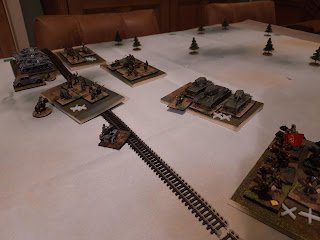

In the end it was 4:2 in favour of the Soviets, with the Germans failing to get at least three units off the table. A splendid historical winter victory for the Soviets and "Hero of the Soviet Union" goes to Marshall Tim commander of the Soviet forces. Many thanks to the Sheffield Boys for a very engaging and entertaining game, which pretty much did what it said on the tin and gave a really good fun game in just under an hour. I was so impressed I may even stage this very scenario for my local wargaming group using my 20mm kit [some of which I needs to be painted first]. The above was played via Zoom video conferencing, the umpiring moving and rolling all dice, the players giving vague instructions and directions. Good fun!


Sunday, 3 June 2018

Panzer II Ausf A 1/72 Scale

They do not come more collectable than this, an original Panzer II Ausf A. The training vehicle the Germans went to war with and ended up in combat service until 1942; still being used on rear area policing duties in 1943 (see below): 


A beautiful fast build model, I would happily get another. Next stop the painting tray ;)

Monday, 23 October 2017

An Old Esci Friend: Pz 35(t) .. Old School Modelling!

By way of comparison and in start contrast to the new "First To Fight" I have pulled out an old friend from circa 1994 and a rare (even in those days) model of the Pz 35(t). I wince now remembering the pain I had putting the running track/wheels together. The track plastic itself was simply awful and broke several times. It needs redoing to say least. Yet still somehow it is an old favourite of mine and I would not part with it (see below):


I promise or rather pledge to redo the track this year!

Sunday, 22 October 2017

Early War Pz 35(t) Bef .. First to fight

In for a penny, in for a pound. While I was in that York model shop I acquired a second First to Fight model. The particularly 'clanky' Pz 35(t) that the German Army acquired via Czechoslovakia in 1938. The 'other' Czech tank is the Pz 38(t) and I have a hoard of them (6) from Fujimi, but the rarer Pz 35(t) is represented by only one old Esci kit. Again the quality is superb, especially since the complicated bogie wheels were a single piece. The Esci kit had literally hundreds of parts by comparison (see below):


I could not resist putting on the Command Variant aerial antenna on the back! My only regret is that I did not buy the second one that was sat next to it on the shelf ;)

Friday, 20 October 2017

Early War Pz IIIE from "First to Fight"

I saw these (Firts to Fight) advertised on the Plastic Soldier Company (PSC) website and thought they looked good but resisted. However the first model shop I visited and picked one up I succumbed By heavens they are good! More pricey (£8 for one model) than ArmourCast but retaining their simplicity with added extra detail worthy of Fujimi and eclipsing Esci. Methinks they would give many a metal manufacturer a good run for their money being plastic injection and a lot cleaner on the "flash" side of things (see below a beautiful Pz IIIE):


The only thing that puzzled me was a minor piece of detail on the left side if the hull. Something ever so small but a curious details. The instructions on the back didn't quite show it in the detail my old eyes needed. However the link below (of one done in Blue Peter fashion by another) showed me where it should go (and Murphy's Law meant that I had done it wrong, not that anyone would notice, bar a rivet counter).

See you in its "full glory" here:
http://modelwork.pl/viewtopic.php?p=686365

A welcome addition to my early war panzer collection!

Tuesday, 18 February 2014

Plastic Soldier Company Pz III (50mm short)

The Panzer III was designed to be the prime German MBT (although I acknowledge I use this post-war modern term in a historical sense, perhaps "cruiser" would have been better) of the Second World War, but the Pz III found itself compromised right from the outset. Slow to get into production and hence only playing a minor part in the Polish 1939 campaign (A-D versions), it was found lacking in the France 1940 campaign (E) against the better French tanks. Up gunned to the short 50mm (F/G) it optimistically went into the Russian 1941 campaign only to met the shock of the KV I and T34 monsters.

The PSC models (along with the 4 x HaT models I have) nicely finishes off my Panzer Battalion for the early-mid Russian campaign (1041-42) now with a max of seven Pz III F's to field (see below):


As the Pz III tanks were improved via workshop upgrades as well as new factory additions the Panzer battalion was always a mixture of types up until the end of 1942.

The F/G model was the Barbarrossa workhorse as well as being the DAK chariot in the desert (see below):


The PSC models are perfect for company command tanks given their nice commander poses (see below):


Nice to get my hands on so many short Pz III 50mm tanks, as a kid they were nowhere to be seen, bar a broken barrel Matchbox conversion. 

To understand German tank development in WWII IMHO I think you need to know the Pz III story.


The story does not end here as the Pz III gets a final upgrade to the long 50mm gun (L-M)1941(late)-42-43(mid) that takes it to its Kursk swansong on the Eastern Front. Not forgetting the final (N) version as it was demoted from MBT to an anti-infantry "support" tank (notably seen in Tunesia supporting Tigers) with a short 75mm.

My Esci/Italeri/Matchbox/Revell/Fujimi long 50mm models will nicely fill into the final chapter of the Pz III tank battalions (a future post methinks). 

Note: The PSC Pz III's are not their simplest models but still damn good for ease of construction. 

Sunday, 5 May 2013

Plastic Soldier Company (PSC) Russian 45mm AT and Inf 76mm Gun

The Plastic Soldier Company 1/72 (20mm) model assembly line continues a pace. This Bank Holiday weekend has been spent 'toiling' in the garden with the family during the day and relaxing at night with a beer and a pile of models from the PSC (see below, beer is out of camera shot).

This little packet of Russian (small calibre guns) is a god send from PSC as they fill the little nooks and crannies of the Russian Infantry orbat that requires AT defence and direct/indirect infantry gun support (see the range of four below):   


The family lines of the German Pak 36 (37mm AT gun) can be clearly seen in the gun shield design (courtesy of that secret Russo-German mutual cooperation pact in the 1930's). See below:
  • Left: The (long barrelled) 45mm M1942 AT gun - Note: This model fits in well with my Skytrex metal version of the same gun (but the PSC are a lot cheaper)
  • Right: The 76mm M1943 Infantry Gun 

The 1941 Barbarossa invasion meant that teh Soviet AT hopes fell upon the M1937 45mm AT gun which was about on par for the needs against the German lighter armour of the time. It soon found itself in an evolutionary arms race against the PzIII  and PzIV (see below).


The crews look "cute" too but I will make a move on them when I deal with the PSC "Summer Infantry" and other boxes of Russian Infantry I have waiting lined up.