The previously broken (as in a snapped rear axle) 221 Armoured Car (which is an old Airfix conversion of mine) and a HaT ArmourFast Pz III Ausf G (with the short 50mm gun) appear on the painting table. To those in "the know", where you see one Pz III Ausf G from HaT you know there will be another because they sell them in packs of two. Seen from the front (see below):
Note: I am trying not to get distracted with painting the armoured cars just yet. The idea is to be painting 'all' the required German tanks for a Command Decision II/III early war (1939 to early 1942, when they were still just "grey") Panzer Battalion. Hence the 222's armoured cars I got out of the box because they were sitting next to the Pz I's and Pz II's in my previous posts have gone back into the box (sniff). The stuff on tyres can come later, tracks first. Seen from the back (see below):
The HaT model comes fairly clean (and is a "big" 1/72 rather than a small Matchbox 1/76) and begs to be cluttered with bric-a-brac picked up on campaign, individualisation shall we say. Jerry cans and bits of wood, as well as national flags are queuing up in the spares box but like the decals that will be done in a "battalion flurry" some dark winter night. A closer look at the Pz III Ausf G (seen below):
The HaT model sadly comes without a front machine gun sticking out of the RHS side, so that is another "spares box" request for yet another winter's night. meanwhile the 221 armoured car drives off into the distance (see below). It's nice to finish it but I do worry about a recurrence of the "broken axle" before too long.
What I need to do to complete my "project" with the Pz III:
Pz III Orbats:
- Poland (1939) I need just 'one' Pz III in a pure combat role (i.e. no command tank variants). The Germans were just so, so short of their expected Main Battle Tank (MBT), they were largely equipped with training vehicles.
- France (1940) I need 'two' combat tanks and 'one' command tank (although I am tempted to use my little old Pz I Ausf B command tank, much to the displeasure of the proud battalion commander I am sure). The Germans were actually little better off in French Campaign from an indigenous MBT perspective. Luckily for them they had a good supply of stop-gap Czech (35T's and 38T's) to supplement their MBT stock.
(Note: Technically for 1939/40 they should be the Pz III Ausf E, with the even shorter 37mm AT gun, but for the time being it's a case of "close enough", at least it's not the long barrelled 50mm Italeri/Esci models)
- Russia (1941) This gets interesting, I need 'four' combat tanks and 'three' command tanks. The command tanks are 'one' battalion command tank and 'two' company command tanks (again what's wrong with using a Pz I Ausf B command tank for the battalion commander I ask you, it's only for show not combat after all?). The gun varieties become "diverse" too, the 37mm of the Ausf E is on the way out after its poor performance in France against the French and British heavy tanks. Therefore every Pz III from the Ausf F gets a 50mm short gun and the old Pz III E's (and below) are up-gunned in battlefield workshops. The tanks in the panzer battalions have a "mix" of types when they go into combat, but by Xmas 1942 everything is pretty much a 50mm short or special units are seeing the long 50mm appear to try and combat the T-34 tankers "tank fright".
- Russia (1942) The Pz III tanks that have their short 50mm guns are upgraded to long 50mm guns as soon as possible to stand a chance in combat against the T-34's and KV I's.
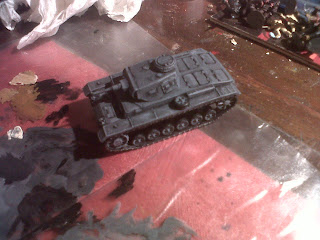
The HaT Pz III Ausf G (see above) is a quick and easy build and paint. It also is the most inexpensive way to upgrade to a 1941 German Panzer Battalion Orbat without breaking the bank buying expensive metal and plastic kits. I am not too keen to be forking out lots of cash for expensive metal/plastic command tanks either (the radio/aerial assembly looks quite daunting too)!