Showing posts with label strategos II. Show all posts

Tuesday, 20 July 2021

Phil Sabin's Wargame Website

 https://sites.google.com/view/sabinwargames/home


Lots of Good stuff there! Old favourites like Lost Battles, Simulating War (Fire and Movement), his air war stuff and newer games he has been working on!

Board Game Geek (BBG) discussion on Phil's "Horse and Musket" rules


Thursday, 3 September 2015

Lost Battles/Strategos II with a Veteran Wargamer .. The Acid Test (Part II) First Mantinea 418 BC

The Argives make their momentous "march on Sparta" attack, thrusting their powerful right wing at the weak Spartan left (ahem, full of the 'suspect' Pelloponnesian "average" allies, sadly just off photograph, see below). The Argives were positioned ready to inflict a decisive round of combat, alas "next go". Meanwhile the Argive centre with its six average hoplites "took it to Sparta" with great effect, causing three casualties, of which the Spartan King Agis saved none but at least did not get himself killed in the process. The remaining Argive hoplites at the rear scurried forward to reinforce their comrades in the center before the inevitable Spartan riposte hits them (see below):


Sparta hit back hard, inflicting a savage three hits back in return on the central Argives, taking the Argives to six out of eight units spent (75%) while Sparta is only 'cruising' on (50%) themselves (see below, black counter indicates spent status):


Meanwhile the Spartan left manned with those expendable Peloponnesian allied hoplites, tickles the Argive "chosen men" on their right with a token 'hit' (hoorah) before the pseudo-Spartans are steamrolled into the ground, ow, I know what's coming as I have seen this movie before (see below):


So a round of mutual destruction follows, as the Spartan left disappears (a mere speed bump to the chosen men of Argive) a similar disaster befalls the Argive middle on a grander scale, double the number of units in fact. Note: The veteran Spartan "happily" hoplites soaked up another two hits before they destroyed the Argive centre. Each hit constituted 4VP worth of damage, which all adds up.

Cinematic direction "in slow motion" of the death if the Argive middle: 

As the first spent Argive Hoplite unit takes a second killing hit, the dreaded "don't roll a one or two" morale test is required. The result (slow motion close-up of dice being dropped and bouncing onto a 1), no more 'central' Argives. A litter trail of discarded Argive armour leads to the rear as they depart "helter skelter". Agis breathes a sigh of relief and orders his far wing right forces to turn to face the left hand threat, the day is his, but "don't count your chickens before the Helots have hatched them for you" as they say in Sparta (see below):


Out numbered by over two to one the Argives had great cause for concern, they were in a fight with a much more powerful foe that now distinctly had the upper hand. Yet they had played a textbook game and had caused the Spartans great pain but still they were on the receiving end. Frustrating to say the least. This is a cruel game of war we play and the Argives had to look deep into their hearts to see if they still had the will to fight. Indeed there was a strong argument to say that the Argives were best to retire with as much of their army intact to lessen the Spartan VPs and reduce their level of victory. There was an audible groan as Mr K to his great credit said no, he would fight on to finish the game "as history would have it".

The Argives and Spartans flung themselves headlong into each other to settle the matter, though not instantaneously, as from the Spartan perspective (me) it took an alarming number of turns (three) and the Spartans were sorely pushed. Agis himself fell  after an unsuccessful rally attempt which in turn caused the Spartans to take an "Army morale test" (which they passed to the credit of there superior quality and numbers). Now without a King the Spartans fought with a cold fury and inevitably a hit came to rest on a square full of spent Argives. The morale roll was not good enough to save them and it was over (see below, the final stand of the Argives):


Did it work as a gaming system? Mr K was unconvinced but There is something about its simplicity I like and its focus on modelling aka simulation. Certainly in comparison to Mr K's favourite miniatures rule system (Impetus) it lacked flavour, colour and a certain "edge of the seat" enjoyment factor. There was an air of predictability about the final outcome right from the start, yet that was partly my fault as I had chose this tutorial because it was so one-sided and simple in the number of troop types involved. I agreed with Mr K in that I think he had played a very good game (better than I had managed previously in his position) but there was still nothing he could do to change the course of history, but rather not lose as bad as the Argives had done. For this scenario yes, it was not finely balanced and Lost Battles simulates rather than entertains. It is not a miniatures experience although for myself I like to play on a board using miniatures as opposed to counters.

Victory Point Calculation (under the amended Lost Battle system):

Argive: 92 points
  • Killed: 1xLHC[4], 1xAHO[6], 1xUL[6] = 16
  • Routed: 2xAHO[6] +2 for each unit = 8
  • Spent: 6xVHO[24], 3xAHO[9] = 33
  • Offset: 19x3 = 57, reduced to 35 as max is half initial Spartan FV 70 = 35
Spartan: 74 Points
  • Killed: 4xAHO[24] = 24
  • Routed 3xVHO[12], 8xAHO[24] +11 for each unit = 47
  • Retired: 1xAHC[3] = 3

Outcome: Although a clear tabletop victory for Sparta the Argive (+18) outperformed his historical counterpart [by a narrow margin]

Postscript: This game was still a play-test being my fifth Strategos II/Lost Battles game. I am really grateful for Mr K putting the game system through the hoops and giving it a good stress-test with no prisoners taken. Subsequent analysis and questions raised on the Lost Battles forum has revealed that my still incomplete grasp of the rules gave the Spartans a few more advantages than they should have.

Example: Agis was not so hot as an uninspired leader so never should have been able to give his guard unit a second command bonus for example.

Additionally a few amendments that affected both sides were highlighted.

Example: When a hoplite unit moves up adjacent to an enemy hoplite unit the inevitable attack that comes at it does not receive a +1 DRM of Hoplite fighting Hoplite until both units are static

All-in-all the above would have made it a slightly harder task for the Spartans but still odds on to win the historical set-up


Thursday, 27 August 2015

Lost Battles/Strategos II with a Veteran Wargamer .. The Acid Test (Part I) First Mantinea 418 BC

This was the one I had been waiting for. No more playing-testing and explaining things to newbies but a rolled-up shirt sleeves, head-to-head with a "Grognard". This guy had seen it all, from death on the snowy plains before Moscow with Napoleon, to marching with Alexander The Great into Persia, to the modern slaughter of Hill 112 in Normandy. He is also no stranger to 'any' Wargaming genre and has been official play tester to several leading brand rule sets and organiser of convention events, notably Impetus. Most importantly he is not a "bad-ass" competition wargamer (pardon my DBM French). I implicitly trust Mr K's analysis as honest and revealing. He too had been intrigued by my Strategos II posts and wanted to play, so with great anticipation we set-up First Mantinea (see below, Argive to the top, Spartan to the bottom of the photograph [yes there is Frankie Howard joke there]):


As befits his character and genuine interest in playability Mr K even opted to play Argive knowing full well from history he was going to get the much harder time of it. He opted for a strong middle advance, feeding units from his weak left flank into the middle where he faced Spartan veterans. His logic being to win on his right, hold the middle until help arrives and use his Athenian horse to worry the Spartan right into guarding a "key zone" with hoplites. Arms folded he awaited developments (see below):


Sparta's turn. As the bulk of the average Argive hoplites (six average units) had come within spear thrust of the Spartan King Agis and his bodyguard plus another the Spartan veteran hoplite unit in the central square, it seemed reasonable to exchange cordial greetings of death. It also caused the first interesting conversation. The newbie's had not questioned the factors but accepted them but a Grognard will ask "what does that mean exactly?" Why does a "lead" unit benefit from a "+1 attack bonus" but not a veteran? Why when attacking outnumbered (in a local tactical sense) is there no negative modifier? Which is a very interesting point to be taken up with the Lost Battles YahooGroup. Meanwhile combat dished out two spent markers on the Argives, which in retrospect does seem a "good result" attacking at poor odds (1:3 if you count "units" but 1:6 if you calculate it out in terms of men), even considering the Command points spent on buying "attack bonuses". The Spartan's refused their left (not keen on meeting the best Argive troops any time soon) and advanced in the center to guard their king. On the Spartan right the two advanced veteran hoplite units advanced fearlessly forward to threaten the Argive central flank even though this also placed themselves in a perilous position to (flanked left and right by enemy troops which means they would fight at a -1 modifier). The risk seemed worth it as the enemy hoplites to their front were off to reinforce the Argive center and cavalry of this period does not (or was deemed) not to be a "big threat" besides the Spartan "levy" cavalry (levy=danger to themselves) was about to "have a go"! (see below):


Sadly (for the Spartans, aka me) the "charge of the party ponies" (sorry I have been reading too much Percy Jackson with my son lately) came to naught. After concluding the cavalry action on the right flank Agis posed for an heroic "action shot". One may perhaps deem this as un-Spartan and tempting fate as Greek gods were known for their love of teaching mortals the meaning of hubris (see below):


The Spartan battle-line composed themselves to receive the Argive attack (see below, the "party ponies" despite their number seemed a tad nervous):


For good reason it turned out. The first Argive action was to charge them with "average" Athenian horse, but average is still a quality ark above "levy" and when you throw as good a dice as this Grognard you simply shatter and scatter them to the four corners of the battlefield (see below):


First blood to the Argive, can he turn it too his advantage and help the political career of the young Alcibiades by ruining Sparta in the field of battle?

To be continued ...

Wednesday, 19 August 2015

What? Yet another go at The First Battle of Mantinea 418BC using Strategos II ...

As the First Battle of Mantinea Wargaming kit was still to hand when 'another' (evil laughter) unsuspecting Wargaming newbie came round to call, the opportunity could simply not be resisted. So as the children played in the garden the fathers opened a bottle of beer and settled down to recreate an epic moment of ancient history. Having already 'umpired' and 'played Sparta' it felt appropriate that this time I took the underdog Argives knowing well in advance what 'likely fate' awaited me, but I faced the challenge undaunted. My strategy was simple, a bold bloody strike with the right, fight a delaying action in the middle and refuse the left flank (see below, the Argives push forward in the middle and right, blurred action photography courtesy of my youngest son who decided to "take control of the camera" and snap daddy):


After a brief run through of the rules the Spartan was convinced enough (partly as to his continued references to "300" cinematography) to attack where he was strong and defend where he was weak (good philosophy for ancients if not all wargaming). A round of relatively straight forward dice throwing saw the Spartans deliver a powerful punch from the two veteran central hoplites (including the Spartan King and his personnal guards) on the central Argives that had obligingly moved up. He then clumped forward with six more veteran hoplites to reinforce the center, quite a formidable looking block. The Spartan right kept pace with the middle while the Spartan left was refused but touching my most advanced hoplites, so they gave the Argives an ineffectual prod with their spears (see below):

Note the plastic black ex-ice cream box defining the legal dice throwing area. Saves all sorts of needless arguments :)


A profile study of the two Strategos, the silver haired Argive (me) removes the Spartan levy cavalry from the table (not as hard as it sounds given the better Athenian horse to hand), as the younger Spartan Agis (aka "the rookie") watches more concerned with shielding his bandaged hand (from a self inflicted DIY injury) from being knocked. First blood to Argos but it is a long way to go (see below):


Taken from the far right behind the Argive lines (see below) it shows the battle's congested center as the spirit of the Argive average hoplites waned, as one-by-one they become spent. A second Argive (moral) victory is scored on the Peloponnesian left flank as the allied (average) hoplites are shattered. One dying and making the other scarper for the safety despite scornful looks of the Ephors, From this high water mark there even looked like a vague possibility of an Argive envelopment of the Spartan center. Looks can be deceptive (see below):


The young Agis started to look concerned but his angst was almost immediately eased when the central Argive hoplites took such a beating they "quit the field" en masse. The glorious Spartan phalanx abruptly left faced and wheeled in almost perfect formation to face the Argive threat to their left. Very impressive! Meanwhile the Spartan right was crunching home into the weak Argive left, leaving it spent but not quite yet broken. The victorious Athenian cavalry moved to avoid the pointy ends of the Spartan hoplite spears, aka the unit left to defend the Spartan "key hex" but the Athenian  horses were rather milling around on the enemy baseline looking "rather disinterested" in things. As seen in the photograph above thetwo Argive hoplites were trying to catch up to the action in the middle but the Argive Strategos used his command points for combat purposes instead, so they were spectators (see below):


The Spartan Strategos emphasizing his grievous DIY (self-inflicted) injury for the camera sits back and readies himself for a rigourous  round of dice rolling and the final Spartan push. Crunch time and rank after rank of veteran Spartan hoplites break even the few "chosen men of Argos". Game set and match Sparta, the only non-routed Argive unit, the Athenian cavalry decide discretion is the better part of valour and quietly slink off to their waiting Athenian triremes (see below):


Points tallied up reveal a marginal (as per expected due to historical factors) Spartan win (even though they wiped the floor with the Argives, they did as they did historically). So in conclusion a good little "historical" game. Despite it being my third outing I am still picking the nuances of the rules. Yep, rereading a paragraph always seems to make a different interpretation come to life. At least I seem to be applying the combat factors appropriately, but I have a few questions to take to the Lost Battles forum.

Note: There is still much to learn and put into practice as in the previous games I managed to misread the OoB and forget to field the full Spartan Army! I was playing missing a veteran Spartan unit along side Agis, not that it really seem to matter in any of the games ;)

3-0 to Sparta!


Monday, 3 August 2015

(Another go at) Strategos II - First Battle of Mantinea 418 BC (Part 2of 2)

The Spartans push hard as only they know how. In the center successive hits from the 'seven' (ow) veteran hoplite units capable of attacking, rock the Argives. As the hits roll in the Argive force quickly becomes totally spent. This means another hit would mean a shattered (dead) unit and a dangerous Army Morale Test for the Argives. The Spartans make that kill, an Army Morale Test is required and the Argives pass, but only just and it is not over yet. Another Spartan kill (ow, ow) and this time the Argives luck does not hold, the average spent hoplites have had enough and break en masse, routing to the rear. This clears the Spartan right from a dangerous Argive envelopment and (without that penalty DRM of -1) they pummel and destroy the weak Argive left wing. The final command point is spent on the weak Spartan left as it makes a spoiling attack on the powerful Argive right with some limited success )just to add insult to injury). Sparta seems to have done enough, well done Agis (see below):  
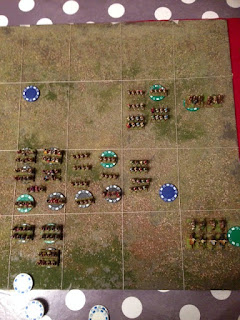

The Argive commander looks forlornly at his shattered army. All he can do is push on with his right wing but with reduced command points (as a lot of his officers are now running to the rear) it lacks impetus to drive forward and the Spartan left bends but does not break. Ominously on the Spartan turn, the central phalanx of Spartan veteran hoplites turn as one readying their spears for a terrifying flank attack "next turn" on the remaining Argives. Meanwhile the Spartan left is not inactive and again has limited success in wearing down the Argive elites (those "chosen men" veteran hoplites of Argos). The Argives have one last chance of a push on these cheeky average Spartan (Peloponnesian allied) hoplites before the hammer-blow catches them in the flank (see below):  
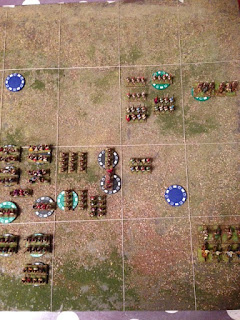

The Argives remove two of the three Spartan commanded hoplites, but as a point of honour Sparta passes its Army Morale Tests and can proudly claim that their hoplite line did not break even in its weakest sector [which is better than their historical counterparts] (see below, the Spartan left just to say holds on):


The Argive commander requested this 'swan-song' picture of 'what could have been' were it not for this brave Spartan (or Peloponnesian allied) hoplite unit. Seven Argive hoplite units are about to receive a death blow from the Spartan killing machine coming in from their left (see below, Spartans coming in from the right of the picture):


The Argives first become spent and then as the first Argive hoplite unit is shattered they spectacularly fail their Army Morale Test and the remaining six units, even the "chosen men" of Argos, are routed off the field (see below, "where have all the Argives gone?")


The Spartan (levy") cavalry sensed 'their wargaming moment' was at hand and charged the Athenian (Argive led) average cavalry in an "all-out attack" and succeeded in making the Athenian force spent (see below):


The already victorious Spartan right now turned to face the Athenians to make them be under no allusions as to what fate awaited them if they did not "get out of dodge" next turn and retire (see below):


Rubbing salt directly into the wounds of the bloodied and broken Argive army, the surviving Spartan left flank hoplite unit (an unnamed Peloponnnesian allied unit), although spent from its efforts, moved onto the Argive "key terrain square" and started building a victory monument from the cast off Argive arms and armour that littered the field (see below):


Meanwhile the Athenian cavalry quietly slipped away in search of their ships and a safe passage home to Athens before Argos changed sides in the Peloponnesian War and once their once friends & hosts became enemies (see below):


The result, a clear Spartan win, not only on the tabletop (which was expected given the force composition) but also according to the Victory Point off-set chart. A good game played in great spirit with a lovely educational narrative throughout the night. Looking forward to another game with my old friend, he just might have been bitten by the wargaming bug? The game flowed well and was not perceived as "chancy" or a "fidgety fiddle" with a good intuitive "what you see is what you get" feel to it (oh and the Spartan dice rolling was very good).

This is a good set of rules from the Society of Ancients and Phil Sabin!

Note: I will have to dig a little deeper into changes to the Strategos II system refined in Lost Battles and move forward with their newer rule system, but I have been assured the core concepts play the same.

Sunday, 2 August 2015

(Another go at) Strategos II - First Battle of Mantinea 418 BC (Part 1 of 2)

Following hot on the heels from my first rekindling of Strategos II, I had the opportunity to run The First Battle of Mantinea (418 BC) again on a second outing with another wargaming newbie (albeit with a degree in history including modules covering the ancient Greek period). The by now familiar set-up is shown below before hostilities started (see below):


Randomly drawing lots for sides I found myself acting as good king Agis with his chief adviser Hippeis (see below, phew I am glad not to be on the receiving end of he Spartan phalanx, the newbie gets the tough assignment - who said war is fair?):


After talking things through with the Argive commander he launches into a fairly historical solid advance into the center and with his strong right flank (the historical point of honour for the best troops), the Argive weak left hanging back in conspicuous Greek fashion (see below, looking at the Argive advance):


In response the Spartans go for it, throwing their powerful right as far forward as it can go (double timing) against the weak Argive left (just two paltry average hoplite units). The Spartan king's guard unit also severely spanks the cheeky Argive center (obtaining a double hit) that dared to come within reach of his spear. (Note: the bulk of the veteran Spartiate hoplites now come to his assistance, it would not do to replay a Leonidas scenario here). In customary Greek fashion the Spartan left flank is also slow to move/engage the more stronger Argive right [even Peloponnesian's can show discretion] (see below):


Time for the Argives to show their mettle. They boldly advance deep against the Spartan left (aka the Argive right with their best troops), setting up a powerful attack for the next turn. Meanwhile in the center and Argive left they attack, in addition bring up their sole unit of the cavalry onto the flank the most advanced Spartan units. These Argives attacks bruise the Spartans but this serves merely to whet the Spartan appetite for punishment and relish their turn in the combat to come. The Argives also suffer with casualties this turn, as per the hoplite "all out attack rule" leaving them 50% spent against a very powerful force of veteran Spartan hoplites next turn. (see below):


Across the board the hoplite lines are in contact (see below, as viewed from the Spartan side, Agis in the center square amidst the chaos of war):


The battlefield as seen from the Spartan far left flank viewing across the battlefield (see below):


The Spartan young king Agis knows that he must effect a "ruthless round of combat" to secure his advanced right from an Argive envelopment. A good result in the center is the key and will be the main focus of his command point distribution .

Next: "This is Sparta!"

Thursday, 16 July 2015

Strategos II (aka Lost Battles) First Battle of Mantinea 418 BC (Part 2 of 2)

Time to pay the Ferryman: Turn 3+

The Argives advanced on their right flank in a desperate attempt to relieve the pressure on their centre (too late perhaps?). On their left a success was scored as the Argive Cavalry hit and panicked away the Spartan "levy" Cavalry (first 'true' blood to Argos but the Spartans easily passed their Army Morale Test caring nought about those 'bloody silly horses'). The Argives strategos could see a flicker of hope though. The Argives renewed their push in the centre showing great spirit and indeed managed to hurt the Spartans, but we all know the Spartans like it rough and was it really enough damage? No. The Spartan response was swift and devastating. It only took two hits to effectively destroy the Argive centre. An impressive blow took the last "fresh" Argive hoplite to "spent" status, then a follow up hit smashed into the lead unit and took it away causing a morale check. The Argive Army Morale now needed to be tested and the Argive strategos rolled a one. Seeing their comrades so brutally slain was too much for the sensitive sons of Argos and the remaining five hoplite units as a single mass turned and ran for their lives least they be "reaped like ripe wheat". The Argive centre was no more, it had bolted. Oh the fickle fortune of war, the damning hand of fate or yet another wargaming example of when not to throw a one when a two would have saved you, we've all done it! (see below, where have all the Argives gone?):


Bravely the remaining (left and right flank) Argives fought on, steadfast in adversity gaining Spartan respect. Then the myth of  Spartan "martial invincibility" took a Public Relations battering. Two whole units of Spartan hoplites were removed from play. Admittedly it was probably "other Peloponnesian Allies" under the microscope rather than true Spartiates, but still the fact remained the Spartan left wing 'disintegrated' as the powerful Argive right wing lead by their Argive "chosen" Veteran hoplites struck home. However the panic was checked as the rest of the Spartans outside the "zone of disaster" passed their important Army Morale Test. Unfettered by the shackles imposed by the Spartan "levy" Cavalry the Athenian Cavalry took great delight in racing to an advantageous position in the rear of the Spartan battle line (heroic stuff, the poets of Athens will make use of this feat of arms)! Finally the Spartan centre turned to face the emerging threat on their left flank while the elite Spartan right wing wreaked reciprocal havoc on weak Argive left wing (of a puny) two "average" hoplite units. In cricket terms the Argives here "did not trouble the scorer" (see below, see the emerging spiral of the classic hoplite battle):


The Argive ultimate hope rested on their last relatively "fresh" units of their right wing hitting the mostly "spent" Spartan centre. Great store was put in store for the (albeit "spent") Athenian Cavalry charge into the flank of the Spartan centre phalanx. The latter four legged Athenian attack alas spluttered, so sadly no great advantage was gained as the Spartans held the 'central squares' which were deemed to be good solid infantry terrain. In truth the Athenian horse were not true "impact cavalry" (unlike Alexander's Companions or Cataphracts of later years) and were content to mill about not appreciating the long pointy spears of the Spartans. So it fell again to remaining fresh units of the Argive right which attacked with urgent fury but was absorbed (not without pain) by the stoic Peloponnesians. The Spartans had somehow hung on and now it was their superior "veteran" status allowed them to go on fighting and start the "true killing phase of the battle". Despite being mostly "spent" the additional command attack bonuses and the leadership of the their King Agis tipped the balance. The keenness of the edge of the Argive attack was ground away as four out of the last seven Argive hoplite units became "spent" (see below):


Note re: Agis: Received mixed reports from his elders. It has to be said (negatively) he did not manage to rally a spent unit all game despite a dozen or so tries, but in fairness he did not also die either which could have had worse morale test consequences (as well as in terms of young Agis' personal self esteem and his ability to walk upright).

As the hoplites fought on in continued mutual savagery the "average" units on both sides melted away from either hits and/or morale checks. These included the Spartan "average" hoplite unit that had "walked the long walk" from the left flank to die in the centre (that's the type of thing the Spartan poets would like, if they had poets that is). Finally the three remaining Argive "veteran" hoplite units (the chosen men of Argos) were all that faced the entire Spartan Army (see below):  


The Argives had fought well but now enough was enough. The Athenian cavalry too slipped away to fight another day, or rather race back to their boats and get back to Athens. The "chosen" Argives backed away, one step then two and then turned around and fled, discarding all items of  heavy armour and weapons that could have slowed them down. The Spartans abruptly halted on seeing this. Theirs was not the way of senseless "butchery of the defenceless" without purpose. When a heroic enemy was defeated and yielded the field without trickery the Spartans often just let them go. The defeated would tell their own tales of impossible Spartan martial might so well as to spread fear into the stoutest heart. All one had to do would be to mention the name of  "Sparta" and peace treaties and tributes would flow. So today there would be no savage slaughter of pursuit. They were Spartans, with the battle now undisputed, their victory complete they would now attend to their rituals and keep their cohesion lest Ares spring a surprise upon them. The Spartans were a conservative breed fearing hubris. The classic "spiral wheel" effect of the ancient hoplite battle has been nicely replicated in this encounter. The "veteran" Spartan hoplites and the command benefit of Agis which the Spartan King had bestowed were the deciding factors (see below):


Victory Points: The Winner is ...

Despite the overwhelming tabletop position it "only" translated to a "marginal victory" for the Spartan players as it followed more or less the historical lines. The game was heavily in favour of the Spartans (FV70 to FV51) so the Spartans should always "win" on tableto but the question is how many Spartans would die in the process. Also note, most of the Argives ran away (through morale failure) rather than were killed . Historically Sparta probably killed more on the day.

The game I feel was very well played by both sides (completely novice to the rules) and played in a great spirit of friendship and fairness, with good humour abounding. All-in-all I was not too displeased at all with how it went, part simulation, part "active learning" and part "good conversation".

:)

Wednesday, 15 July 2015

Strategos II (aka Lost Battles) First Battle of Mantinea 418 BC (Part 1 of 2)

I brought together some old friends round a wargaming table to conclude my journey through the early Greek Hoplite battles, finishing at The First Battle of Mantinea (418 BC) in The Peloponnesian War. I decided to switch rule sets from Big Battle DBA (BBDBA) to Strategos II (the forerunner of Phil Sabin's Lost Battles). The change was precipitated from a request for less wargamng "twiddling" with a multitude of figures and the prospect of a quicker game, to fit comfortably within an evening's play. The advantage in Strategos II is that it concentrates the brain more to a few key decision points during the game, rather than a multitude of bottom up interactions (all those dice rolls galore with local tactical factors beloved by Grognards) that 'may or may not' make sense towards a "grand strategic way of thinking" (aka "the plan") that the C-in-C wanted to happen.

Table-Top Set-Up: 

The Argives (Argos and their Athenian Allies) start on the left hand side of the photograph and the Spartans (Sparta and Peloponnesian Allies) start on the right hand side (see below, all as per the battle set-up from the book, red poker chips designate "key terrain squares" and green poker chips designate "lead units" in the zone):


The Argives go first and advance their centre and right flank, with their "average" Cavalry supporting their refused left flank (and who wouldn't want to hang back when facing the Spartan elites). The Spartan hoplite lines counter by advancing their centre and their right too, also hanging back with their weaker left hand flank of hoplites. King Agis of Sparta, through either foresight or fear and having some spare command points, tried to move a left hand unit of hoplites to reinforce his strong centre ("every little helps" or "over egging the custard"?). So far the novice Strategoes have played a respectable if not 'rather sophisticated' hoplite battle with their opening moves. Interestingly the Spartan inferior "levy cavalry" also chose to 'seize the moment' and try to get a first hit on their better quality "average" Athenian opposition, which almost paid off. There is certainly no lack of guts from Agis, the young "Spartan King" (see below):


By virtue of moving first the Argives are in position to attack first on turn two, the Spartans having nicely moved up into spear range. Going with the obligatory hoplite "all out" attack mode (as per the rules, as per the hoplite art of combat) the Argives give a very good account of themselves, scoring three hits out of their four attacks (ouch) but suffering one hit in return from the costly caveat of the "all out attack" (if you equal but do not exceed the opponent you do still strike a hit but receive one in return). The Argives miss a "potentially" (but nothing is certain in war) 'good move' of continuing onwards with their best hoplite troops (on their right) against the weakest of Spartan hoplites (on the Spartan left). However they instead concentrated their commands buying additional combat bonuses in the centre (a tactic which seemed to work well). The cavalry battle remains a bit of a "wet handbag" stand off as the Argive cavalry fails to score a hit on the "levy" Spartan Cavalry" (see below):  


On their phase of the second turn the Spartan war machine unloads on the hapless Argives who discover the sharp end of  "The Spartan Way of War". Four hits from the Spartan seven attacks (this being the result of being able to stack more veteran hoplites into the zones 'attack area' [not as complicated as it sounds]). The result: All bar one of the average Argive hoplite unit is now "spent", to the cost of a mere additional hit to the Spartans via the "all out attack rule". Even the Cavalry exchange on the flank is bloody as the Spartan "levy" Cavalry ups-the-stakes and also go "all out" scoring a hit but themselves becoming "spent" (see below):


So far a bloody affair indeed. From a small Argive opening advantage, the battle has swung in favour to the Spartans by virtue of the "push of spear" in the middle of the field. Can the Argives take back the initiative on Turn 3?

Saturday, 6 June 2015

Ancient Rule Sets

Well, what rules to use, what rules to avoid?

They range from something as simple as DBA (ten infamous pages of simple rules later clarified with a unofficial guide of only seventy four pages [yes that is sarcasm], or even BBDBA), then to as "mind boggling" a set of rules as DBM (for more, ahem, er competition orientated gamers), to what I consider as a cry for sanity and call for good gaming in DBMM (played in good spirit but still suffering from the rules lawyer issue, and its DBMM100, DBM200 variants - there is hope here) or to the still serious but strangely fun rules of Impetus to the novel simulation orientated rules of Strategos II (aka Lost Battles) and a few more in between (such as Armati) I could have mentioned.

I guess it all depends who is going to play them. For me my next task is to entertain an intelligent set of jovial beginners who want to play in a competitive but historically realistic fashion, win or lose. So ,,, Strategos II/Lost Battles gets the call (see below):


A grid based system that avoids most of the common or cunning wargaming wibbles. It is from the academic stable of Prof Phil Sabin from King's College and has playability and historical simulation at its core. Should be fun ;)

The battle I intend to play is The First Battle of Mantinea (418BC) in the Peloponnesian War.


Sunday, 6 January 2013

"Books Read over Xmas" and new Projects Spawned

Over the Xmas break I also finished reading a very interesting book (see below):


But now the real work begins as although teh content itself was interesting, it also contained seven games (which although designated board games in my eyes should be taken to the tabletop) that simply set up and beg to be played. In particular two WWII era infantry games:
  • Fire and Movement (A rural infantry battle: "an attacking battalion versus two defending companies")
  • Blockbusting (An urban battle: "an attacking company versus two defending platoons")
Maps can be found at: Phil Sabin's King's College Website Link
Half way down the page you will see an "Infantry Combat" Link which gives a useful PDF to Print Out

The intention is to take them to the tabletop and play them over and over again, then contrast them with some of my many existing WWII rule sets (Command Decision, Spearhead, BGC, Great Battles of WWII, Squad Leader to name but a few) to 'compare and contrast' and see what comes out in the mix. If I had a new years resolution it would have been to make more use of my WWII assets (er, I mean toys).

That's not to say I am forgoing the ancients as Strategos II, BBDBA and Phil Sabin's book on "Lost Battles" figure highly on my radar screen. 


Oh and I have also to paint the Bismarck (again) and finish off my 1/72 Mosquito and Westland Whirlwind