Superman's career has been a very
slow moving pendulum, arcing back and forth between
The Man Of Steel and
SuperGod.
When
Kal-El started out, seventy-some years ago, we all know he was at a much lower power level. He couldn't fly, he could only leap really far; he may have been faster than a speeding bullet, but there was no interplanetary travel or breaking the light barrier; he was more powerful than a locomotive, not strong enough to casually move Earth out of its orbit.
But as time went on, various creators couldn't resist bumping him up on the power scale, giving him more and more powers, increasing his strength to fantasy levels. His "
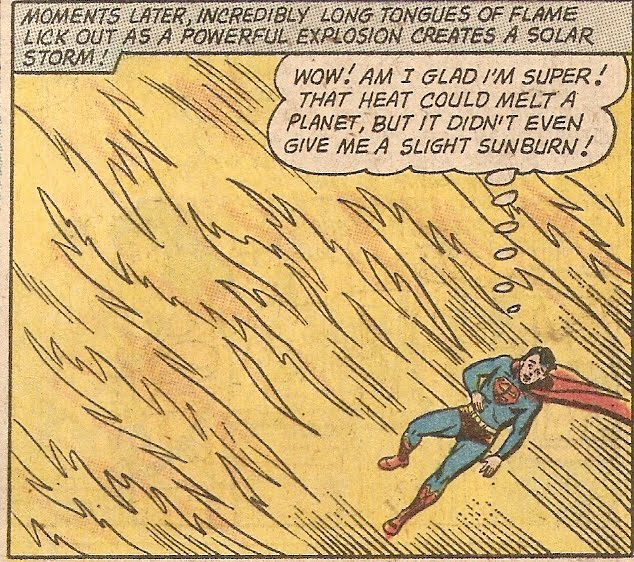
invulnerability" became such that he didn't need to eat, or breathe, or sleep; nothing could hurt him except magic and kryptonite, he could fly into the
freakin' sun:
His "
super-brain" became a
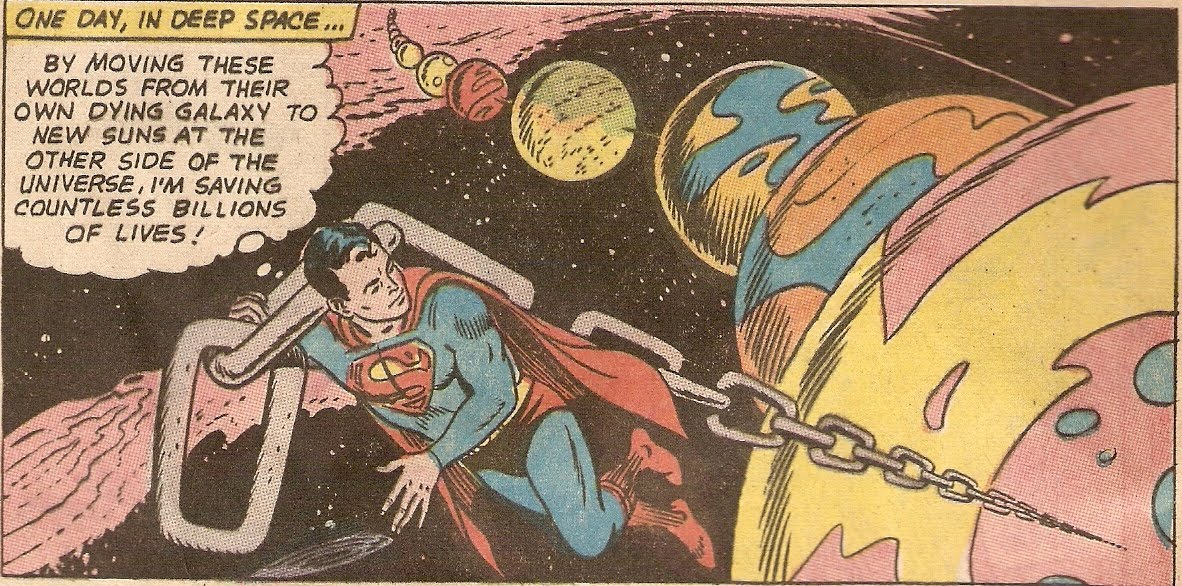
tenth-level super-intelligence, as opposed to mere humans, who are only 6th-level. His super-strength? As a teenager the dude was
moving planets around the cosmos:
This explains much of the
DC style of storytelling of the
Silver Age. When you've allowed your character to become this powerful, he really has no credible adversaries, at least physically. And you can't bring back
Luthor,
Brainiac and
Mxyzptlk every story to try to out-think him or throw magic at him.
So you end up with lots of "
protect the secret identity panto" and "
convoluted explanation for how this seemingly impossible cover scene came about theater." And of course, a lot of DC Silver Age titles picked up on that style ("hey, it works for Superman!"), although they didn't take it quite so far, as those other heroes weren't
so omnipotent, so they could be more regularly challenged by the rogues gallery.
As
Marvel began to challenge DC, the pendulum began to swing back, and DC took baby steps to try and make Kal-El a little more relatable.
Bronze Age Superman seemed (to my eyes, at least) to be subtly powered down. There was a lot less god-level, moving planets around; they introduced more villains who were able to give Kal-El a hard time (even though, by the old rules, they shouldn't have stood a chance--
Terra-Man? Really?); and there was a shift from "
Superman creates a puzzle to baffle friend and foe" stories to "
Superman is really strong but boy is he baffled by this villain" tales.
Of course, post-
Crisis,
John Byrne swung the pendulum (most of the way) back with his
Man Of Steel reboot.
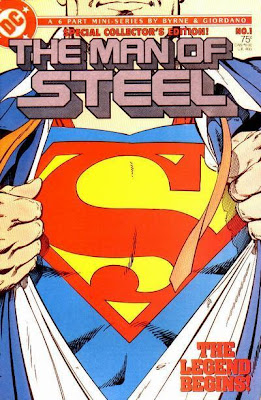
No more moving planets--hell, no more lifting entire buildings upon his shoulders. No more journeys into space without a ship and an oxygen supply--goodbye to Superman, the interstellar cop.
Yes, Byrne substantially powered down Superman, but aside from the obvious changes, he made a number of
subtle tweaks that brought Superman back down to a more human level. There was no more
Superbaby or
Superboy--
Clark Kent grew up a (
mostly) normal kid, gradually coming into his powers. He made
Krypton a much more remote and alien place, and Clark never found out about it until adulthood--so it exerted much less of a pull on Kent, making him much more an
Earthman with a Kryptonian background, as opposed to a
Kryptonian living amongst us.
Ma and Pa Kent were still alive, further tethering Clark as a mortal human.
After Byrne left, and especially after
The Death Of Superman, the pendulum began to swing back the other way. Superman became more and more powerful, and older, discarded powers began to return. After
Infinite Crisis,
Geoff Johns just flat out undid Man Of Steel (albeit by fiat and gradual revelation, rather than giving us a mini-series or even
any explanation). Suddenly Superman had been active as a teenager (and the enlarged
Kandorians got their superpowers after 10 minutes of yellow sunlight, undoing Byrne's "it took years to build up"). Suddenly, Superman was a ridiculous powerhouse,
able to withstand supernovas that evaporate the planet he's standing on:
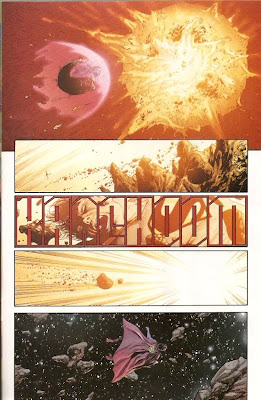
That sequence, from
Action Comics #867, pretty much establishes Superman as immortal, right? If a supernova can't take you out, what possibly could?
 Grant Morrison
 took things even further in
All-Star Superman--he
turbocharged Superman's powers even more,to the point where he's effectively
Doctor Manhattan: "
I can see the electromagnetic spectrum, I can hear atoms dancing, I understand fundamental forces of the universe" (yes, I know I'm paraphrasing
Luthor, but he was experiencing Superman's powers--before he became "supercharged"). Superman cures cancer and goes to live in the heart of the sun to keep it from dying. Kal-El was no longer a man, he was
a god, experiencing the universe in ways we never could, understanding the fundamental mechanics of the universe (but not deigning to share them with us)...Superman was as far above humans as we are above ants.
Sure, that wasn't in continuity. But now, in
Flushpoint, Morrison
will be undoing the last vestiges of Man Of Steel. The Kents will be dead, Clark will
never have been married to Lois. DC tells us, "
This Superman is very much an alien, one struggling to adjust to his adopted home...(h)e is more Kal-El from the planet Krypton than Clark Kent from Kansas."
Dan DiDio and Jim Lee have said that all these steps are to increase Superman's isolation from humanity, to accentuate his alienness. And I still half suspect that Morrison will be using this to implement his
Superman 2000 Project, conceived with
Mark Waid, Tom Peyer and
Mark Millar, where in addition to a new costume and no longer being married to Lois, Kal-El would suddenly be
"three times more powerful and three times smarter." This from a character already described in the proposal thusly:
Suddenly young Clark doesn’t just know his Ma and Pa through sight, touch, sound--he knows the exact timbre of their pulse rates, he can look at their DNA and recognize their distinctive electrical fields and hear the neural crackle and release of chemicals which tell him they’ve changed their minds about something. And he can do all this, he can scan the entire environment in an INSTANT, with levels of perception we can only imagine...his experiences as Superman are experiences on a level of existence we can only hope to imagine.
There's room for
many Supermen in the mythos, just as there are room for many
Batmen. But I'll tell you which one I prefer. A Superman who has ties to Earth, who grew up a (relatively) normal kid and then came into his (relatively) non-infinite powers, and chose to use them wisely, is someone I find inspiring, a character I can relate to on a human level: a
hero. Someone who is more Kryptonian than Earthling, whose powers and perceptions are so far above mine that I couldn't
begin to comprehend them, is a god, not a hero. He might as well be an omnipotent alien race from classic
Star Trek that is so far above us we could never hope to understand him, but fortunately, he's benevolent (and who rooted for the
Metrons or
Organians, after all?). In a choice between Man Of Steel and SuperGod, I choose the Man Of Steel.
Which is not to say that Byrne's run was perfect, or that Morrison's won't be wonderful, or that the friendly neighborhood god of the Silver Age wasn't fun to read. It's not just the
concept, it's the
execution...although with Superman, the concept is
pretty damned important.
But, of course, it's a pendulum, so someday, years or decades from now, someone (perhaps the
Siegel & Shuster estates!) will realize they've made Superman too powerful, they've drained any potential drama out of the character and his stories, and things will begin to swing back towards a more human hero.