Another menace is threatening Metropolis--but never fear, Superman is on the job!! Let's watch:
Wait...who?
OK, that may be the best villain name ever.
Kal-El does not agree.
The entirely too self-aware onlookers have plenty of meta-commentary on the issue:
You know, I'm not sure whether to blame plotter Stuart Immomen or "dialoguist" Mark Millar, but if that's the point/joke you're oh-so-subtly trying to make, maybe you should have given the guy the name Joe Smith or Eric Jones. That would have worked much better. Instead, you named him the certainly-sounds-like-a-super-villain-name of Gabriel Van Daniken, which isn't as funny and sort of undercuts your oh so clever commentary.
Just sayin'.
From Adventures Of Superman #574 (2000)
Showing posts with label Millar. Show all posts
Monday, May 29, 2017
Thursday, November 27, 2014
I'm Thankful They're Not On The Title Anymore
It's probably too obvious to bring up again...
...but the fact that Millar and Hitch thought this cover scene to be "lame," and felt obliged to ironically trumpet their disdain with a "look at us being too cool for the room" caption, pretty much explains why their Fantastic Four run itself was lame.
Just sayin.'
Happy Thanksgiving!!
Fantastic Four #564 was from 2009
...but the fact that Millar and Hitch thought this cover scene to be "lame," and felt obliged to ironically trumpet their disdain with a "look at us being too cool for the room" caption, pretty much explains why their Fantastic Four run itself was lame.
Just sayin.'
Happy Thanksgiving!!
Fantastic Four #564 was from 2009
Wednesday, October 15, 2014
Civil War Revisited: Pre-Crime!!
Well, between vague promos and vague movie announcements, Marvel's Civil War has been talked about an awful lot the past few days.
One article, when describing the nearly-a-decade-old Marvel event, described it as "well written."
Hahahahahaha.
Now, this blog wasn't around during those days, even though I've made my disdain for Civil War: Front Line #11--The. WORST. COMIC. EVER.--quite clear.
But since it's back in the news, I'm glad to have the opportunity to share with you the exact moment--the very second--when it was clear that this series would be pretty damn stupid.
It's issue 1 of the main series, and we're up in the S.H.I.E.L.D. Helicarrier. Maria Hill is quizzing Captain America about what the heroes' reaction will be to the pending Super-Human Registration Act, and whether Cap will lead the Avengers in enforcing it:
No, I'm not going to ding Mark Millar too hard for criminally blurring the distinction of whether S.H.I.E.L.D. is a national or international organization. Marvel writers have been blowing that one for decades. S.H.I.E.L.D. is an international organization, and has been since their founding. And anyone who says different is kinda wrong.
Still, even though it's a common mistake, it should be noted that this mistake really undermines the series' premise in a big way. Having S.H.I.E.L.D. enforcing the SHRA is akin to having NATO or U.N. troops enforcing the Patriot Act on U.S. soil--not bloody likely.
But again, common mistake, let's give him a pass.
No, what's more important is something that Hill says. Close-up, please:
See, the SHRA hasn't become law yet. It hasn't even been voted on in Congress yet, and doesn't look to become the law of the land for at least a month.
That's kinda crucial, as Cap and Hill argue about the act:
"CHIK-CHAK"??? Really?
Yes, really.
Let's be clear--S.H.I.E.L.D. agents are drawing their weapons on Captain America and are preparing to take him down BECAUSE HE DISAGREES WITH AN ACT THAT CONGRESS HASN'T EVEN VOTED ON YET. He hasn't broken any law yet, made any threatening move...apparently, in Mark Millar's view of how politics work, agents (federal or international) can draw their weapons on you for merely expressing a contrary opinion on a hypothetical law.
Ah, but it's just some out of control lackeys, right? This isn't official policy, is it?
Uh, yeah, it is. The director of S.H.I.E.L.D. is going to detain Captain America refusing to promise to help her enforce a law that hasn't passed yet.
And that's when you knew there was little hope of Civil War making a lick of sense.
Look, there were some interesting ideas in the mix for Civil War. A discussion of vigilantism, of private citizens holding essentially weapons of mass destruction, of post-9/11 America being willing to trade some freedom for security...I'm not saying that these are necessarily great ideas for a comic full of costume wearing super-heroes. But somebody else might have been able to make the idea work, at least a little better.
But when you try to make super-heroes a metaphor in your real-world allegory, and can't even get the basic facts about the real world right, you've lost before you started. By carelessly turning this into Minority Report--where people can be punished before they commit crimes, indeed before the law even exists--you're no longer making a slippery slope argument, you're setting up a very stupid strawman that takes everyone away from your real arguments. If your text doesn't make any sense, your sub-text doesn't, either.
All because Millar couldn't find a better way to get Captain America initially involved, and needed an action scene in a book where people spend pages and pages standing around talking politics.
"Well written" my ass.
One article, when describing the nearly-a-decade-old Marvel event, described it as "well written."
Hahahahahaha.
Now, this blog wasn't around during those days, even though I've made my disdain for Civil War: Front Line #11--The. WORST. COMIC. EVER.--quite clear.
But since it's back in the news, I'm glad to have the opportunity to share with you the exact moment--the very second--when it was clear that this series would be pretty damn stupid.
It's issue 1 of the main series, and we're up in the S.H.I.E.L.D. Helicarrier. Maria Hill is quizzing Captain America about what the heroes' reaction will be to the pending Super-Human Registration Act, and whether Cap will lead the Avengers in enforcing it:
No, I'm not going to ding Mark Millar too hard for criminally blurring the distinction of whether S.H.I.E.L.D. is a national or international organization. Marvel writers have been blowing that one for decades. S.H.I.E.L.D. is an international organization, and has been since their founding. And anyone who says different is kinda wrong.
Still, even though it's a common mistake, it should be noted that this mistake really undermines the series' premise in a big way. Having S.H.I.E.L.D. enforcing the SHRA is akin to having NATO or U.N. troops enforcing the Patriot Act on U.S. soil--not bloody likely.
But again, common mistake, let's give him a pass.
No, what's more important is something that Hill says. Close-up, please:
See, the SHRA hasn't become law yet. It hasn't even been voted on in Congress yet, and doesn't look to become the law of the land for at least a month.
That's kinda crucial, as Cap and Hill argue about the act:
"CHIK-CHAK"??? Really?
Yes, really.
Let's be clear--S.H.I.E.L.D. agents are drawing their weapons on Captain America and are preparing to take him down BECAUSE HE DISAGREES WITH AN ACT THAT CONGRESS HASN'T EVEN VOTED ON YET. He hasn't broken any law yet, made any threatening move...apparently, in Mark Millar's view of how politics work, agents (federal or international) can draw their weapons on you for merely expressing a contrary opinion on a hypothetical law.
Ah, but it's just some out of control lackeys, right? This isn't official policy, is it?
Uh, yeah, it is. The director of S.H.I.E.L.D. is going to detain Captain America refusing to promise to help her enforce a law that hasn't passed yet.
And that's when you knew there was little hope of Civil War making a lick of sense.
Look, there were some interesting ideas in the mix for Civil War. A discussion of vigilantism, of private citizens holding essentially weapons of mass destruction, of post-9/11 America being willing to trade some freedom for security...I'm not saying that these are necessarily great ideas for a comic full of costume wearing super-heroes. But somebody else might have been able to make the idea work, at least a little better.
But when you try to make super-heroes a metaphor in your real-world allegory, and can't even get the basic facts about the real world right, you've lost before you started. By carelessly turning this into Minority Report--where people can be punished before they commit crimes, indeed before the law even exists--you're no longer making a slippery slope argument, you're setting up a very stupid strawman that takes everyone away from your real arguments. If your text doesn't make any sense, your sub-text doesn't, either.
All because Millar couldn't find a better way to get Captain America initially involved, and needed an action scene in a book where people spend pages and pages standing around talking politics.
"Well written" my ass.
Thursday, September 12, 2013
Tales From The Quarter Bin--Mark Millar's Doctor Strange?
As I mentioned last week, in 2000 Marvel ran a tiny, self-contained event:
It's a cute little premise--show us what the comics actually published inside Marvel-616 look like.
It should be noted, that this is in direct opposition to the Moore-Gibbons hypothesis, that a universe with actual super-heroes in it would have no market for super-hero comics, and would instead gravitate to pirate comics, or skateboarding comics, or whatever...
With the Fantastic Four, the concept is a no-brainer: everyone knows their identities, and they've actually licensed their adventures to Marvel Comics-616. We've seen their interactions with the Bullpen numerous times.So we great a pretty straightforward FF adventure, as "narrated by" the members themselves.
With the other heroes, things get a little more tricky. Since their identities, their origins, and often their very powers aren't publicly known, and they don't have licensing agreements giving Marvel Comics-616 access to the true stories of the adventures, what do the comics do?
In the case of Captain America, Marvel hires "celebrity writer" Rick Jones (and the story is penciled by up and coming artist Steve Rogers). Clever (and really done by Peter David, Ron Frenz & Mark Bagley).
In Thor, though, we see them just start to make stuff up--they (and in fairness, probably a good portion of the Marvel-616 public) don't believe the "he's really an Asgardian god" jive, so they present him as a hero pretending to be the actual Thor, using a super high-tech hammer for all his feats. (Of course, with Asgard now hanging above Oklahoma, people might me more receptive to the whole premise).
And then the concept begins to run off the rails a bit, as we start to look more like Elseworlds books than "this is how the Marvel Universe looks at their masked men." Spider-Man, for example, is presented as "urban horror," and he's more of a Man-Thing type character, a man transformed into a silent, inhuman creature. He's hunted by a fictional paper (The Daily Clarion) and his foe is Professor Squid. It's not like there would be any dearth of publicly available pictures upon which to base their stories--why change him so radically? Why the fictionalized elements--is Marvel Comics-616 afraid of being sued? Afraid of being retaliated against by vigilante or super-villain?
When we get to Daredevil, things get even weirder:
What?!?
Again, there would be plenty of information available on Daredevil--no secret ID, no definition of his powers, but enough to know that he was a human acrobat, not a flipping demon! Do people in Marvel-616 actually think DD is from Hell?!?!?
And then we come to the X-Men, by Mark Millar. We've completely lost moorings from anything here, so grab on to something...
The Weapon X program is run by the U.S. government and Colonel America. Who??
O....K....? That's all the explanation we're given.
Anyway, all mutants are wanted terrorist criminals, all condemned to die for being mutants. Except...
And yes, they all have devices implanted in them so they can killed if they run or disobey. So not at all like Suicide Squad.
Their mission: an experimental Tony Stark-built nuclear weapon was stolen (and Iron Man captured) by:
So, Doctor Strange is an evil mutant?
A very evil mutant, I guess...
A genocidal evil mutant.
And when Mastermind is captured and brought before Strange...
So, Doctor Strange is a cannibal genocidal evil mutant. How very Millar...
And as various fighting break out...
Remember, this is supposedly how the Marvel Universe views these characters...
Anyway, Wolverine sacrifices himself, and...
...blows up the whole freaking island, along with Strange and his mutant army.
Hey, how about a nice eulogy, Colonel America and Cyclops?
Oh my...
It's a cute little premise--show us what the comics actually published inside Marvel-616 look like.
It should be noted, that this is in direct opposition to the Moore-Gibbons hypothesis, that a universe with actual super-heroes in it would have no market for super-hero comics, and would instead gravitate to pirate comics, or skateboarding comics, or whatever...
With the Fantastic Four, the concept is a no-brainer: everyone knows their identities, and they've actually licensed their adventures to Marvel Comics-616. We've seen their interactions with the Bullpen numerous times.So we great a pretty straightforward FF adventure, as "narrated by" the members themselves.
With the other heroes, things get a little more tricky. Since their identities, their origins, and often their very powers aren't publicly known, and they don't have licensing agreements giving Marvel Comics-616 access to the true stories of the adventures, what do the comics do?
In the case of Captain America, Marvel hires "celebrity writer" Rick Jones (and the story is penciled by up and coming artist Steve Rogers). Clever (and really done by Peter David, Ron Frenz & Mark Bagley).
In Thor, though, we see them just start to make stuff up--they (and in fairness, probably a good portion of the Marvel-616 public) don't believe the "he's really an Asgardian god" jive, so they present him as a hero pretending to be the actual Thor, using a super high-tech hammer for all his feats. (Of course, with Asgard now hanging above Oklahoma, people might me more receptive to the whole premise).
And then the concept begins to run off the rails a bit, as we start to look more like Elseworlds books than "this is how the Marvel Universe looks at their masked men." Spider-Man, for example, is presented as "urban horror," and he's more of a Man-Thing type character, a man transformed into a silent, inhuman creature. He's hunted by a fictional paper (The Daily Clarion) and his foe is Professor Squid. It's not like there would be any dearth of publicly available pictures upon which to base their stories--why change him so radically? Why the fictionalized elements--is Marvel Comics-616 afraid of being sued? Afraid of being retaliated against by vigilante or super-villain?
When we get to Daredevil, things get even weirder:
What?!?
Again, there would be plenty of information available on Daredevil--no secret ID, no definition of his powers, but enough to know that he was a human acrobat, not a flipping demon! Do people in Marvel-616 actually think DD is from Hell?!?!?
And then we come to the X-Men, by Mark Millar. We've completely lost moorings from anything here, so grab on to something...
The Weapon X program is run by the U.S. government and Colonel America. Who??
O....K....? That's all the explanation we're given.
Anyway, all mutants are wanted terrorist criminals, all condemned to die for being mutants. Except...
And yes, they all have devices implanted in them so they can killed if they run or disobey. So not at all like Suicide Squad.
Their mission: an experimental Tony Stark-built nuclear weapon was stolen (and Iron Man captured) by:
So, Doctor Strange is an evil mutant?
A very evil mutant, I guess...
A genocidal evil mutant.
And when Mastermind is captured and brought before Strange...
So, Doctor Strange is a cannibal genocidal evil mutant. How very Millar...
And as various fighting break out...
Remember, this is supposedly how the Marvel Universe views these characters...
Anyway, Wolverine sacrifices himself, and...
...blows up the whole freaking island, along with Strange and his mutant army.
Hey, how about a nice eulogy, Colonel America and Cyclops?
Oh my...
Posted by
snell
at
8:17 AM
6
comments
Labels:
Doctor Strange,
Millar,
Tales From the Quarter Bin,
X-Men
Monday, July 30, 2012
Manic Monday--Maybe He Needs A Braille Cat
The funniest thing I've seen all week...hell, all year:
OK, it's out of context, but it's still freakin' hilarious.
If you want the context--which involves (in part) making fun of Mark Millar, which is always a worthy goal--truck on over to The Gutters.
Hell, visit them regularly--they put out new toons deflating the industry three time a week. Buy their books.
Because we all need to laugh a little more. And mock Millar a little more, too.
If you want the context--which involves (in part) making fun of Mark Millar, which is always a worthy goal--truck on over to The Gutters.
Hell, visit them regularly--they put out new toons deflating the industry three time a week. Buy their books.
Because we all need to laugh a little more. And mock Millar a little more, too.
Tuesday, February 1, 2011
Great Moments In Incorrect Predictions
It's 1998, and DC writer Mark Millar is sitting down with the Flash to discuss story ideas for an upcoming issue...
Wait, I guess we'd better remind the readers: in the DC Universe, the comic books about DC super-heroes are non-fiction; they recount actual adventures, not "made up" stories, as Millar reminds us...

So, as Millar tries to debrief Wally West (remember him?) about his recent adventures, the subject of how non-fiction comic books dealt with the private lives and secret identities of the heroes comes up:


Oh, if only that's what the Identity Crisis maxiseries had turned out to be about...
Mark Millar (and Ariel Olivetti) toss off a far better plot idea for Identity Crisis than Brad Meltzer could ever come up with in a hundred years Flash 80 Page Giant #1 (1998).
Wait, I guess we'd better remind the readers: in the DC Universe, the comic books about DC super-heroes are non-fiction; they recount actual adventures, not "made up" stories, as Millar reminds us...
Mark Millar (and Ariel Olivetti) toss off a far better plot idea for Identity Crisis than Brad Meltzer could ever come up with in a hundred years Flash 80 Page Giant #1 (1998).
Wednesday, April 21, 2010
No Squatters!!
This just in: Mark Millar invented word balloons and captions, so please stop using them, as that interferes with his new project that he swears will actually be out soon (it won't, actually--but don't worry, some studio will ask him to make a movie of it anyway, but because every Hollywood executive is so in awe of his awesome talent, they'll deny the story, the cowards).
Also, he invented the internet, and he's really cheesed at all you lesser talented persons using it, because he called dibs decades ago.
And don't get him started on Velcro...
Also, he invented the internet, and he's really cheesed at all you lesser talented persons using it, because he called dibs decades ago.
And don't get him started on Velcro...
Friday, March 26, 2010
Mark Millar Damns A Woman's Soul To Hell
Dear Mark Millar:
Green tea has caffeine, you putz. Not as much as an Americano, sure, but hardly OK for someone who has "given up caffeine for Lent."
Than again, since this is a Mark Millar book, it's not unlikely that Washington D.C. police chief Blake Morrow is an incredible jerk who is purposely trying to get one of his "inner circle" to break her Lent pledge.
I mean, it couldn't because you were just too lazy to actually look something as basic as that up, right?
Than again, since this is a Mark Millar book, it's not unlikely that Washington D.C. police chief Blake Morrow is an incredible jerk who is purposely trying to get one of his "inner circle" to break her Lent pledge.
I mean, it couldn't because you were just too lazy to actually look something as basic as that up, right?
Sunday, September 13, 2009
Miracles Do Happen!!
Wait a minute!!?!
"The epic finale??"
You mean Mark Millar is actually going to finish a project?!?
Who woulda thought?
By the way, those who had "over one year" in the "When will War Heroes #3 come out" pool can collect your winnings now.
Funny how once he sells the movie rights to a project, the work kinda stops, isn't it?
You mean Mark Millar is actually going to finish a project?!?
Who woulda thought?
By the way, those who had "over one year" in the "When will War Heroes #3 come out" pool can collect your winnings now.
Funny how once he sells the movie rights to a project, the work kinda stops, isn't it?
Friday, May 22, 2009
Wishes
Tuesday, January 6, 2009
Well, We Can't Do THAT Bit Any Longer
Well, it seems Mark Millar just had a brush with a nasty medical condition, and he's having to take some time off.
So for the time being, any comments about the lateness of Fantastic Four or any of his other books are tabled. Slay Monstrobot (and all our readers, I'm sure) wish you a speedy recovery, Mr. Millar.
However, I'm still allowed to think his FF plots are terrible and that he has no idea how to write Doctor Doom.
And I can't help but notice, despite his "itsy-bitsy, near-fatal episode," Millar still has the strength in the article to relentlessly promote his movie projects, and somehow finagled the reporter or editor to refer to him as a "genius" in the sub-headline. Even on death's door, Mark Millar is an unparalleled hype machine!! Keep on keeping on, Mark.
So for the time being, any comments about the lateness of Fantastic Four or any of his other books are tabled. Slay Monstrobot (and all our readers, I'm sure) wish you a speedy recovery, Mr. Millar.
However, I'm still allowed to think his FF plots are terrible and that he has no idea how to write Doctor Doom.
And I can't help but notice, despite his "itsy-bitsy, near-fatal episode," Millar still has the strength in the article to relentlessly promote his movie projects, and somehow finagled the reporter or editor to refer to him as a "genius" in the sub-headline. Even on death's door, Mark Millar is an unparalleled hype machine!! Keep on keeping on, Mark.
Saturday, January 3, 2009
...Even To The Edge Of Doom
It's no secret that my favorite comic of all time is the Fantastic Four. And it's also no secret that I'm not particularly thrilled with the way that Millar and Hitch are handling my foursome.
First, there's the dour, dank and depressing art. This is the Fantastic Four, for heaven's sake!! Things should, at least on occasion, be bright and colorful, right?!? Not so. With the artwork by Bryan Hitch and assorted inkers, and colors by Paul Mounts, the Fantastic Four have become the Fotorealistic Four, or the Fairlymonochromatic Four. Everything is washed out and drab, as if photographed through a damn filter. During this run, have we had a single scene set during daylight hours? (Please don't respond--I know the answer is yes--but...). Everything takes place at night, or in dimly lit rooms, or on glum and overcast days, or in a snow storm. This is the FF, by thunder, Marvel's first family, the World's Greatest Comic Magazine, "adventurers, explorers and imaginauts"...would it kill them to at least go out in the sunshine once? To actually have some color and excitement? Just looking at the pages these days--regardless of what is happening--is damn near sleep inducing. And that stinks.
And then there are Millar's plots, which manage to be both terribly predictable and terribly boring. I think that he thinks he's being awfully clever, but he telegraphs his punchlines months ahead of time, and what he plans to be big "ta-da!" moments turn out to be "uh, we figured that out several issues ago, sir" moments. Example: in the first storyline of his run, we're given an artificial replica of Earth being created in a parallel dimension, for when our Earth becomes uninhabitable. The next storyline features the "New Defenders" come from the future, seeking refuge for the 8 billion inhabitants of depleted Earth 2509, and planning to move them all onto contemporary Earth. Now, it seems pretty obvious that you're going to give this "Nu-World" to them, right? This was clear from minute number 1, no? Apparently not, as Millar spent five issues pretending that no one could figure out the only possible resolution.
And then there is the "Death of The Invisible Woman" storyline, in which we're introduced to an elderly Susan Richards come from that future...yet somehow we're not supposed to know immediately that the future Sue is the one who is going to die, as Millar continues to give interviews pretending that it's the present-day Sue who's going to kick the bucket. Perhaps he believes his audience is too stupid to figure out the obvious answer to his silly conundrum. No stupider than the rest of the Fantastic Four, I suppose, as we're supposed to believe that none of them recognized future Sue. Apparently, someone who looks sixty bears absolutely no resemblance whatsoever to someone in their forties (must be all the dim lighting Hitch and Mounts are giving them).
But the capper came this week, as it becomes apparent that Millar has absolutely no idea how to write Doctor Doom. There's certainly room for variations, for slightly skewed takes on the good Doctor. But there's also a certain baseline, you would think.
But in this week's FF #562 (only 3 months late!!), Reed goes to visit Von Doom, who is being held in the Hague awaiting a trial for crimes against humanity:
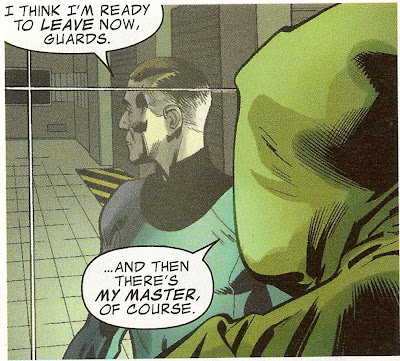
It's obvious what Millar was trying to do here--he wants to impress us about how scary forthcoming Villain X is, by showing that even Victor is in awe of his power. Bendis tried the same tactic (and I can't believe I'm saying this, but he did it much better!) with the mysterious "figure behind the door" in Purple Reign #1.
But...but...whereas in PR Doom sat silently, here he praises villain X as his "master," as "the one who taught me everything I know." Which, of course, is never, never, never how Victor Von Doom would do it. Ever.
This is Victor Von Doom, who, when confronted with the near-infinite power of the Beyonder, didn't grovel or declare him "master"--he decided to seize that power for himself!! This is Doctor Doom, who is willing to face off against Galactus, his heralds, Mephisto. With any being of such power as Doom describes Villain X, can there be any doubt that the lord of Latveria would simply try to seize the power for himself?
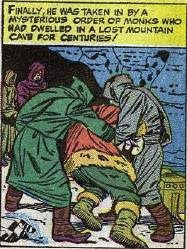
And note (from Doom's origin in FF Annual #2 (1964)):

Doom clearly didn't learn "everything he knew" from Villain X (unless, of course, he had been one of the monks...hmmmm). And when Doom learned from you, he surpassed you, and became your master--not vice versa!!
And especially in front of Reed Richards--would Victor acknowledge any being to be his superior? Admit indebtedness to him for knowledge? Even as a ruse. Doom's ego wouldn't let him do that.
So thanks, Mark Millar, for reducing Doctor Doom to the Darth Vader to Villain X's Darth Sidious, for turning Marvel's greatest villain into a lackey. Well played.
Oh, and by the way...if you're holding Doom prisoner, wouldn't you at least make him take off the damned armor? Hell, let him keep the mask--although that's a pretty terrible idea:
...but for crying out loud put him in prison wear and get rid or the armor!! I'm just saying...
First, there's the dour, dank and depressing art. This is the Fantastic Four, for heaven's sake!! Things should, at least on occasion, be bright and colorful, right?!? Not so. With the artwork by Bryan Hitch and assorted inkers, and colors by Paul Mounts, the Fantastic Four have become the Fotorealistic Four, or the Fairlymonochromatic Four. Everything is washed out and drab, as if photographed through a damn filter. During this run, have we had a single scene set during daylight hours? (Please don't respond--I know the answer is yes--but...). Everything takes place at night, or in dimly lit rooms, or on glum and overcast days, or in a snow storm. This is the FF, by thunder, Marvel's first family, the World's Greatest Comic Magazine, "adventurers, explorers and imaginauts"...would it kill them to at least go out in the sunshine once? To actually have some color and excitement? Just looking at the pages these days--regardless of what is happening--is damn near sleep inducing. And that stinks.
And then there are Millar's plots, which manage to be both terribly predictable and terribly boring. I think that he thinks he's being awfully clever, but he telegraphs his punchlines months ahead of time, and what he plans to be big "ta-da!" moments turn out to be "uh, we figured that out several issues ago, sir" moments. Example: in the first storyline of his run, we're given an artificial replica of Earth being created in a parallel dimension, for when our Earth becomes uninhabitable. The next storyline features the "New Defenders" come from the future, seeking refuge for the 8 billion inhabitants of depleted Earth 2509, and planning to move them all onto contemporary Earth. Now, it seems pretty obvious that you're going to give this "Nu-World" to them, right? This was clear from minute number 1, no? Apparently not, as Millar spent five issues pretending that no one could figure out the only possible resolution.
And then there is the "Death of The Invisible Woman" storyline, in which we're introduced to an elderly Susan Richards come from that future...yet somehow we're not supposed to know immediately that the future Sue is the one who is going to die, as Millar continues to give interviews pretending that it's the present-day Sue who's going to kick the bucket. Perhaps he believes his audience is too stupid to figure out the obvious answer to his silly conundrum. No stupider than the rest of the Fantastic Four, I suppose, as we're supposed to believe that none of them recognized future Sue. Apparently, someone who looks sixty bears absolutely no resemblance whatsoever to someone in their forties (must be all the dim lighting Hitch and Mounts are giving them).
But the capper came this week, as it becomes apparent that Millar has absolutely no idea how to write Doctor Doom. There's certainly room for variations, for slightly skewed takes on the good Doctor. But there's also a certain baseline, you would think.
But in this week's FF #562 (only 3 months late!!), Reed goes to visit Von Doom, who is being held in the Hague awaiting a trial for crimes against humanity:
But...but...whereas in PR Doom sat silently, here he praises villain X as his "master," as "the one who taught me everything I know." Which, of course, is never, never, never how Victor Von Doom would do it. Ever.
This is Victor Von Doom, who, when confronted with the near-infinite power of the Beyonder, didn't grovel or declare him "master"--he decided to seize that power for himself!! This is Doctor Doom, who is willing to face off against Galactus, his heralds, Mephisto. With any being of such power as Doom describes Villain X, can there be any doubt that the lord of Latveria would simply try to seize the power for himself?
And note (from Doom's origin in FF Annual #2 (1964)):
And especially in front of Reed Richards--would Victor acknowledge any being to be his superior? Admit indebtedness to him for knowledge? Even as a ruse. Doom's ego wouldn't let him do that.
So thanks, Mark Millar, for reducing Doctor Doom to the Darth Vader to Villain X's Darth Sidious, for turning Marvel's greatest villain into a lackey. Well played.
Oh, and by the way...if you're holding Doom prisoner, wouldn't you at least make him take off the damned armor? Hell, let him keep the mask--although that's a pretty terrible idea:
Subscribe to:
Posts (Atom)