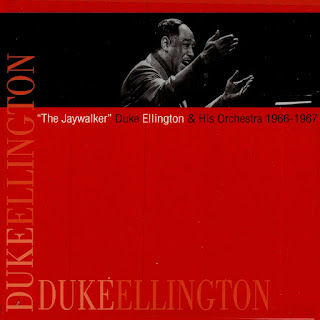
Biography by William Ruhlmann
Duke
Ellington was the most important composer in the history of jazz as
well as being a bandleader who held his large group together
continuously for almost 50 years. The two aspects of his career were
related; Ellington used his band as a musical laboratory for his new
compositions and shaped his writing specifically to showcase the talents
of his bandmembers, many of whom remained with him for long periods.
Ellington also wrote film scores and stage musicals, and several of his
instrumental works were adapted into songs that became standards. In
addition to touring year in and year out, he recorded extensively,
resulting in a gigantic body of work that was still being assessed a
quarter century after his death.
Ellington was the son of a White
House butler, James Edward Ellington, and thus grew up in comfortable
surroundings. He began piano lessons at age seven and was writing music
by his teens. He dropped out of high school in his junior year in 1917
to pursue a career in music. At first, he booked and performed in bands
in the Washington, D.C., area, but in September 1923 the Washingtonians,
a five-piece group of which he was a member, moved permanently to New
York, where they gained a residency in the Times Square venue The
Hollywood Club (later The Kentucky Club). They made their first
recordings in November 1924, and cut tunes for different record
companies under a variety of pseudonyms, so that several current major
labels, notably Sony, Universal, and BMG, now have extensive holdings of
their work from the period in their archives, which are reissued
periodically.
The group gradually increased in size and came
under Ellington's leadership. They played in what was called "jungle"
style, their sly arrangements often highlighted by the muted growling
sound of trumpeter James "Bubber" Miley. A good example of this is
Ellington's first signature song, "East St. Louis Toodle-oo," which the
band first recorded for Vocalion Records in November 1926, and which
became their first chart single in a re-recorded version for Columbia in
July 1927.
The Ellington band moved uptown to The Cotton Club in
Harlem on December 4, 1927. Their residency at the famed club, which
lasted more than three years, made Ellington a nationally known musician
due to radio broadcasts that emanated from the bandstand. In 1928, he
had two two-sided hits: "Black and Tan Fantasy"/"Creole Love Call" on
Victor (now BMG) and "Doin' the New Low Down"/"Diga Diga Doo" on OKeh
(now Sony), released as by the Harlem Footwarmers. "The Mooche" on OKeh
peaked in the charts at the start of 1929.
While maintaining his
job at The Cotton Club, Ellington took his band downtown to play in the
Broadway musical Show Girl, featuring the music of George Gershwin, in
the summer of 1929. The following summer, the band took a leave of
absence to head out to California and appear in the film Check and
Double Check. From the score, "Three Little Words," with vocals by the
Rhythm Boys featuring Bing Crosby, became a number one hit on Victor in
November 1930; its flip side, "Ring Dem Bells," also reached the charts.
The
Ellington band left The Cotton Club in February 1931 to begin a tour
that, in a sense, would not end until the leader's death 43 years later.
At the same time, Ellington scored a Top Five hit with an instrumental
version of one of his standards, "Mood Indigo" released on Victor. The
recording was later inducted into the Grammy Hall of Fame. As "the
Jungle Band," the Ellington Orchestra charted on Brunswick later in 1931
with "Rockin' in Rhythm" and with the lengthy composition "Creole
Rhapsody," pressed on both sides of a 78 single, an indication that
Ellington's goals as a writer were beginning to extend beyond brief
works. (A second version of the piece was a chart entry on Victor in
March 1932.) "Limehouse Blues" was a chart entry on Victor in August
1931, then in the winter of 1932, Ellington scored a Top Ten hit on
Brunswick with one of his best-remembered songs, "It Don't Mean a Thing
(If It Ain't Got That Swing)," featuring the vocals of Ivie Anderson.
This was still more than three years before the official birth of the
swing era, and Ellington helped give the period its name. Ellington's
next major hit was another signature song for him, "Sophisticated Lady."
His instrumental version became a Top Five hit in the spring of 1933,
with its flip side, a treatment of "Stormy Weather," also making the Top
Five.
The Ellington Orchestra made another feature film, Murder
at the Vanities, in the spring of 1934. Their instrumental rendition of
"Cocktails for Two" from the score hit number one on Victor in May, and
they hit the Top Five with both sides of the Brunswick release "Moon
Glow"/"Solitude" that fall. The band also appeared in the Mae West film
Belle of the Nineties and played on the soundtrack of Many Happy
Returns. Later in the fall, the band was back in the Top Ten with
"Saddest Tale," and they had two Top Ten hits in 1935, "Merry-Go-Round"
and "Accent on Youth." While the latter was scoring in the hit parade in
September, Ellington recorded another of his extended compositions,
"Reminiscing in Tempo," which took up both sides of two 78s. Even as he
became more ambitious, however, he was rarely out of the hit parade,
scoring another Top Ten hit, "Cotton," in the fall of 1935, and two
more, "Love Is Like a Cigarette" and "Oh Babe! Maybe Someday," in 1936.
The band returned to Hollywood in 1936 and recorded music for the Marx
Brothers' film A Day at the Races and for Hit Parade of 1937. Meanwhile,
they were scoring Top Ten hits with "Scattin' at the Kit-Kat" and the
swing standard "Caravan," co-written by valve trombonist Juan Tizol, and
Ellington was continuing to pen extended instrumental works such as
"Diminuendo in Blue" and "Crescendo in Blue." "If You Were in My Place
(What Would You Do?)," a vocal number featuring Ivie Anderson, was a Top
Ten hit in the spring of 1938, and Ellington scored his third number
one hit in April with an instrumental version of another standard, "I
Let a Song Go out of My Heart." In the fall, he was back in the Top Ten
with a version of the British show tune "Lambeth Walk."
The
Ellington band underwent several notable changes at the end of the
1930s. After several years recording more or less regularly for
Brunswick, Ellington moved to Victor. In early 1939 Billy Strayhorn, a
young composer, arranger, and pianist, joined the organization. He did
not usually perform with the orchestra, but he became Ellington's
composition partner to the extent that soon it was impossible to tell
where Ellington's writing left off and Strayhorn's began. Two key
personnel changes strengthened the outfit with the acquisition of
bassist Jimmy Blanton in September and tenor saxophonist Ben Webster in
December. Their impact on Ellington's sound was so profound that their
relatively brief tenure has been dubbed "the Blanton-Webster Band" by
jazz fans. These various changes were encapsulated by the Victor release
of Strayhorn's "Take the 'A' Train," a swing era standard, in the
summer of 1941. The recording was later inducted into the Grammy Hall of
Fame.
That same summer, Ellington was in Los Angeles, where his
stage musical, Jump for Joy, opened on July 10 and ran for 101
performances. Unfortunately, the show never went to Broadway, but among
its songs was "I Got It Bad (And That Ain't Good)," another standard.
The U.S. entry into World War II in December 1941 and the onset of the
recording ban called by the American Federation of Musicians in August
1942 slowed the Ellington band's momentum. Unable to record and with
touring curtailed, Ellington found an opportunity to return to extended
composition with the first of a series of annual recitals at Carnegie
Hall on January 23, 1943, at which he premiered "Black, Brown and
Beige." And he returned to the movies, appearing in Cabin in the Sky and
Reveille with Beverly. Meanwhile, the record labels, stymied for hits,
began looking into their artists' back catalogs. Lyricist Bob Russell
took Ellington's 1940 composition "Never No Lament" and set a lyric to
it, creating "Don't Get Around Much Anymore." The Ink Spots scored with a
vocal version (recorded a cappella), and Ellington's three-year-old
instrumental recording was also a hit, reaching the pop Top Ten and
number one on the recently instituted R&B charts. Russell repeated
his magic with another 1940 Ellington instrumental, "Concerto for
Cootie" (a showcase for trumpeter Cootie Williams), creating "Do Nothin'
Till You Hear from Me." Nearly four years after it was recorded, the
retitled recording hit the pop Top Ten and number one on the R&B
charts for Ellington in early 1944, while newly recorded vocal cover
versions also scored. Ellington's vintage recordings became ubiquitous
on the top of the R&B charts during 1943-1944; he also hit number
one with "A Slip of the Lip (Can Sink a Ship)," "Sentimental Lady," and
"Main Stem." With the end of the recording ban in November 1944,
Ellington was able to record a song he had composed with his
saxophonist, Johnny Hodges, set to a lyric by Don George and Harry
James, "I'm Beginning to See the Light." The James recording went to
number one in April 1945, but Ellington's recording was also a Top Ten
hit.
With the end of the war, Ellington's period as a major
commercial force on records largely came to an end, but unlike other big
bandleaders, who disbanded as the swing era passed, Ellington, who
predated the era, simply went on touring, augmenting his diminished road
revenues with his songwriting royalties to keep his band afloat. In a
musical climate in which jazz was veering away from popular music and
toward bebop, and popular music was being dominated by singers, the
Ellington band no longer had a place at the top of the business; but it
kept working. And Ellington kept trying more extended pieces. In 1946,
he teamed with lyricist John Latouche to write the music for the
Broadway musical Beggar's Holiday, which opened on December 26 and ran
108 performances. And he wrote his first full-length background score
for a feature film with 1950's The Asphalt Jungle.
The first half
of the 1950s was a difficult period for Ellington, who suffered many
personnel defections. (Some of those musicians returned later.) But the
band made a major comeback at the Newport Jazz Festival on July 7, 1956,
when they kicked into a version of "Dimuendo and Crescendo in Blue"
that found saxophonist Paul Gonsalves taking a long, memorable solo.
Ellington appeared on the cover of Time magazine, and he signed a new
contract with Columbia Records, which released Ellington at Newport, the
best-selling album of his career. Freed of the necessity of writing
hits and spurred by the increased time available on the LP record,
Ellington concentrated more on extended compositions for the rest of his
career. His comeback as a live performer led to increased opportunities
to tour, and in the fall of 1958 he undertook his first full-scale tour
of Europe. For the rest of his life, he would be a busy world traveler.
Ellington
appeared in and scored the 1959 film Anatomy of a Murder, and its
soundtrack won him three of the newly instituted Grammy Awards, for best
performance by a dance band, best musical composition of the year, and
best soundtrack. He was nominated for an Academy Award for his next
score, Paris Blues (1961). In August 1963, his stage work My People, a
cavalcade of African-American history, was mounted in Chicago as part of
the Century of Negro Progress Exposition.
Meanwhile, of course,
he continued to lead his band in recordings and live performances. He
switched from Columbia to Frank Sinatra's Reprise label (purchased by
Warner Bros. Records) and made some pop-oriented records that dismayed
his fans but indicated he had not given up on broad commercial
aspirations. Nor had he abandoned his artistic aspirations, as the first
of his series of sacred concerts, performed at Grace Cathedral in San
Francisco on September 16, 1965, indicated. And he still longed for a
stage success, turning once again to Broadway with the musical
Pousse-Café, which opened on March 18, 1966, but closed within days.
Three months later, the Sinatra film Assault on a Queen, with an
Ellington score, opened in movie houses around the country. (His final
film score, for Change of Mind, appeared in 1969.)
Ellington
became a Grammy favorite in his later years. He won a 1966 Grammy for
best original jazz composition for "In the Beginning, God," part of his
sacred concerts. His 1967 album Far East Suite, inspired by a tour of
the Middle and Far East, won the best instrumental jazz performance
Grammy that year, and he took home his sixth Grammy in the same category
in 1969 for And His Mother Called Him Bill, a tribute to Strayhorn, who
had died in 1967. "New Orleans Suite" earned another Grammy in the
category in 1971, as did "Togo Brava Suite" in 1972, and the posthumous
The Ellington Suites in 1976.
Ellington continued to perform
regularly until he was overcome by illness in the spring of 1974,
succumbing to lung cancer and pneumonia. His death did not end the band,
which was taken over by his son Mercer, who led it until his own death
in 1996, and then by a grandson. Meanwhile, Ellington finally enjoyed
the stage hit he had always wanted when the revue Sophisticated Ladies,
featuring his music, opened on Broadway on March 1, 1981, and ran 767
performances.
The many celebrations of the Ellington centenary in
1999 demonstrated that he continued to be regarded as the major
composer of jazz. If that seemed something of an anomaly in a musical
style that emphasizes spontaneous improvisation over written
composition, Ellington was talented enough to overcome the oddity. He
wrote primarily for his band, allowing his veteran players room to solo
within his compositions, and as a result created a body of work that
seemed likely to help jazz enter the academic and institutional realms,
which was very much its direction at the end of the 20th century. In
that sense, he foreshadowed the future of jazz and could lay claim to
being one of its most influential practitioners.
https://www.allmusic.com/artist/duke-ellington-mn0000120323#biography
///////
Biografía de William Ruhlmann
Duke
Ellington fue el compositor más importante de la historia del jazz,
además de ser un director de orquesta que mantuvo unido a su gran grupo
de forma continua durante casi 50 años. Los dos aspectos de su carrera
estaban relacionados; Ellington usó su banda como laboratorio musical
para sus nuevas composiciones y moldeó su escritura específicamente para
mostrar el talento de los miembros de su banda, muchos de los cuales
permanecieron con él durante largos períodos. Ellington también escribió
bandas sonoras de películas y musicales teatrales, y varias de sus
obras instrumentales se adaptaron a canciones que se convirtieron en
estándares. Además de girar año tras año, grabó extensamente, lo que
resultó en un gigantesco cuerpo de trabajo que aún se estaba evaluando
un cuarto de siglo después de su muerte.
Ellington era hijo de un
mayordomo de la Casa Blanca, James Edward Ellington, y por lo tanto
creció en un entorno confortable. Comenzó a tomar lecciones de piano a
los siete años y estaba escribiendo música en su adolescencia. Abandonó
la escuela secundaria en su tercer año en 1917 para seguir una carrera
en la música. Al principio, reservó y actuó en bandas en el área de
Washington, DC, pero en septiembre de 1923 The Washingtonians, un grupo
de cinco integrantes del que él era miembro, se mudó permanentemente a
Nueva York, donde obtuvieron una residencia en el lugar de Times Square,
Hollywood Club (más tarde Kentucky Club). Hicieron sus primeras
grabaciones en noviembre de 1924 y grabaron melodías para diferentes
compañías discográficas bajo una variedad de seudónimos, de modo que
varios sellos importantes actuales, en particular Sony, Universal y BMG,
ahora tienen extensas existencias de su trabajo de la época en sus
archivos, que se reeditan periódicamente.
El grupo aumentó
gradualmente de tamaño y quedó bajo el liderazgo de Ellington. Tocaron
en lo que se llamó estilo "jungla", sus arreglos astutos a menudo
resaltados por el gruñido apagado del trompetista James "Bubber" Miley.
Un buen ejemplo de esto es la primera canción característica de
Ellington, "East St. Louis Toodle-oo", que la banda grabó por primera
vez para Vocalion Records en noviembre de 1926, y que se convirtió en su
primer sencillo en una versión regrabada para Columbia en julio de
1927.
La Ellington band se mudó a la parte alta de la ciudad al
Cotton Club en Harlem el 4 de diciembre de 1927. Su residencia en el
famoso club, que duró más de tres años, convirtió a Ellington en un
músico conocido a nivel nacional debido a las transmisiones de radio que
emanaban del quiosco de música. En 1928, tuvo dos éxitos bilaterales :"
Black and Tan Fantasy"/"Creole Love Call" en Victor (ahora BMG) y
"Doin' the New Low Down"/"Diga Diga Doo" en OKeh (ahora Sony), lanzado
como por the Harlem Footwarmers. "The Mooche" de OKeh alcanzó su punto
máximo en las listas de éxitos a principios de 1929.
Mientras
mantenía su trabajo en el Cotton Club, Ellington llevó a su banda al
centro para tocar en el espectáculo musical de Broadway Girl, con la
música de George Gershwin, en el verano de 1929. El verano siguiente, la
banda se ausentó para dirigirse a California y aparecer en la película
Check and Double Check. A partir de la partitura, "Three Little Words",
con la voz de The Rhythm Boys con Bing Crosby, se convirtió en un éxito
número uno en Victor en noviembre de 1930; su otra cara," Ring Dem
Bells", también llegó a las listas de éxitos.
La Ellington band
abandonó el Cotton Club en febrero de 1931 para comenzar una gira que,
en cierto sentido, no terminaría hasta la muerte del líder 43 años
después. Al mismo tiempo, Ellington obtuvo un éxito entre los Cinco
primeros con una versión instrumental de uno de sus estándares, "Mood
Indigo" lanzado en Victor. La grabación fue incluida más tarde en el
Salón de la Fama de los Grammy. Como "the Jungle Band", la Orquesta
Ellington trazó en Brunswick más tarde en 1931 con "Rockin' in Rhythm" y
con la larga composición "Creole Rhapsody", presionada en ambos lados
de un sencillo de 78, una indicación de que los objetivos de Ellington
como escritor comenzaban a extenderse más allá de las obras breves. (Una
segunda versión de la pieza fue una entrada en la lista de Victor en
marzo de 1932.) "Limehouse Blues "fue una entrada en las listas de
Victor en agosto de 1931, luego, en el invierno de 1932, Ellington
obtuvo un éxito entre los Diez primeros en Brunswick con una de sus
canciones más recordadas," It Don't Mean a Thing (If It Ain't Got That
Swing)", con la voz de Ivie Anderson. Todavía faltaban más de tres años
para el nacimiento oficial de la era del swing, y Ellington ayudó a dar
nombre al período. El siguiente gran éxito de Ellington fue otra canción
característica para él, " Sophisticated Lady. Su versión instrumental
se convirtió en un éxito entre los Cinco Primeros en la primavera de
1933, con su otra cara, un tratamiento de "Stormy Weather", también
entre los Cinco primeros.
La Orquesta Ellington hizo otro
largometraje, Asesinato en las Vanidades, en la primavera de 1934. Su
interpretación instrumental de "Cocktails for Two" de la partitura
alcanzó el número uno en Victor en mayo, y llegaron a los cinco primeros
con ambos lados del lanzamiento de Brunswick "Moon Glow" / "Solitude"
ese otoño. La banda también apareció en la película Belle of the
Nineties de Mae West y tocó en la banda sonora de Many Happy Returns.
Más tarde, en el otoño, la banda volvió a estar entre los Diez primeros
con "Saddest Tale", y tuvieron dos éxitos entre los Diez primeros en
1935, "Merry-Go-Round" y "Accent on Youth". Mientras este último anotaba
en el hit parade en septiembre, Ellington grabó otra de sus
composiciones extendidas, "Reminiscing in Tempo", que abarcaba ambos
lados de dos 78. Sin embargo, incluso cuando se volvió más ambicioso,
rara vez salía del hit parade, anotando otro éxito entre los Diez
primeros, "Cotton", en el otoño de 1935, y dos más, "Love Is Like a
Cigarette" y "Oh Babe! Quizás Algún día", en 1936. La banda regresó a
Hollywood en 1936 y grabó música para la película de los Hermanos Marx
Un día en las carreras y para Hit Parade de 1937. Mientras tanto,
estaban anotando éxitos entre los diez primeros con "Scattin' at the
Kit-Kat " y el estándar de swing "Caravan", coescrito por el trombonista
de válvulas Juan Tizol, y Ellington continuaba escribiendo obras
instrumentales extendidas como "Diminuendo in Blue" y " Crescendo in
Blue.""Si Estuvieras en Mi Lugar (¿Qué Harías?)," un número vocal con
Ivie Anderson, fue un éxito entre los Diez primeros en la primavera de
1938, y Ellington obtuvo su tercer éxito número uno en abril con una
versión instrumental de another standard, "I Let a Song Go out of My
Heart."En el otoño, volvió a estar entre los diez primeros con una
versión de la canción del programa británico "Lambeth Walk."
La
banda de Ellington sufrió varios cambios notables a fines de la década
de 1930. Después de varios años grabando más o menos regularmente para
Brunswick, Ellington se mudó a Victor. A principios de 1939 Billy
Strayhorn, un joven compositor, arreglista y pianista, se unió a la
organización. No solía tocar con la orquesta, pero se convirtió en el
compañero de composición de Ellington hasta el punto de que pronto fue
imposible saber dónde terminó la escritura de Ellington y comenzó la de
Strayhorn. Dos cambios de personal clave fortalecieron el equipo con la
adquisición del bajista Jimmy Blanton en septiembre y del saxofonista
tenor Ben Webster en diciembre. Su impacto en el sonido de Ellington fue
tan profundo que su relativamente breve mandato ha sido apodado "the
Blanton-Webster Band" por los fanáticos del jazz. Estos diversos cambios
fueron encapsulados por el lanzamiento de Victor de "Take the 'A' Train
" de Strayhorn, un estándar de la era del swing, en el verano de 1941.
La grabación fue incluida más tarde en el Salón de la Fama de los
Grammy.
Ese mismo verano, Ellington estuvo en Los Ángeles, donde
su musical teatral, Jump for Joy, se estrenó el 10 de julio y tuvo 101
presentaciones. Desafortunadamente, el espectáculo nunca fue a Broadway,
pero entre sus canciones estaba" I Got It Bad (And That Ain't Good)",
otro estándar. La entrada de Estados Unidos en la Segunda Guerra Mundial
en diciembre de 1941 y el inicio de la prohibición de grabar convocada
por la Federación Estadounidense de Músicos en agosto de 1942 frenaron
el impulso de la Ellington Band. Incapaz de grabar y con las giras
restringidas, Ellington encontró la oportunidad de volver a la
composición extendida con el primero de una serie de recitales anuales
en el Carnegie Hall el 23 de enero de 1943, en los que estrenó "Black,
Brown and Beige."Y regresó al cine, apareciendo en Cabin in the Sky y
Reveille con Beverly. Mientras tanto, los sellos discográficos,
obstaculizados por los éxitos, comenzaron a buscar en los catálogos
atrasados de sus artistas. El letrista Bob Russell tomó la composición
de Ellington de 1940 "Never No Lament" y le puso una letra, creando "
Don't Get Around Much Anymore."The Ink Spots anotó con una versión vocal
(grabada a capella), y la grabación instrumental de Ellington de tres
años también fue un éxito, alcanzando el Top Ten pop y el número uno en
las listas de R&B recientemente instituidas. Russell repitió su
magia con otro instrumental de Ellington de 1940, " Concerto for Cootie
"(un escaparate para el trompetista Cootie Williams), creando "Do
Nothin' Till You Hear from Me."Casi cuatro años después de su grabación,
la grabación retitulada llegó al Top Ten del pop y al número uno en las
listas de R&B de Ellington a principios de 1944, mientras que las
versiones vocales recién grabadas también anotaron. Las grabaciones
antiguas de Ellington se volvieron omnipresentes en la cima de las
listas de R&B durante 1943-1944; también alcanzó el número uno con
"A Slip of the Lip (Can Sink a Ship)", "Sentimental Lady" y "Main Stem.
Con el fin de la prohibición de grabar en noviembre de 1944, Ellington
pudo grabar una canción que había compuesto con su saxofonista, Johnny
Hodges, con letra de Don George y Harry James: "Estoy empezando a Ver la
Luz."La grabación de James llegó al número uno en abril de 1945, pero
la grabación de Ellington también fue un éxito entre los Diez primeros.
Con
el final de la guerra, el período de Ellington como una fuerza
comercial importante en los discos llegó a su fin en gran medida, pero a
diferencia de otros grandes líderes de bandas, que se disolvieron a
medida que pasaba la era del swing, Ellington, que era anterior a la
era, simplemente siguió de gira, aumentando sus ingresos por carretera
disminuidos con sus regalías de composición para mantener a flote a su
banda. En un clima musical en el que el jazz se alejaba de la música
popular hacia el bebop, y la música popular estaba dominada por
cantantes, la Ellington Band ya no tenía un lugar en la cima del
negocio; pero siguió funcionando. Y Ellington siguió probando piezas más
extensas. En 1946, se asoció con el letrista John Latouche para
escribir la música del musical Beggar's Holiday de Broadway, que se
estrenó el 26 de diciembre y tuvo 108 funciones. Y escribió su primera
partitura de fondo de larga duración para un largometraje con The
Asphalt Jungle de 1950.
La primera mitad de la década de 1950 fue
un período difícil para Ellington, quien sufrió muchas deserciones de
personal. (Algunos de esos músicos regresaron más tarde.) Pero la banda
hizo un gran regreso en el Festival de Jazz de Newport el 7 de julio de
1956, cuando lanzaron una versión de "Dimuendo and Crescendo in Blue"
que encontró al saxofonista Paul Gonsalves tomando un solo largo y
memorable. Ellington apareció en la portada de la revista Time y firmó
un nuevo contrato con Columbia Records, que lanzó Ellington at Newport,
el álbum más vendido de su carrera. Liberado de la necesidad de escribir
éxitos y estimulado por el mayor tiempo disponible en el disco LP,
Ellington se concentró más en composiciones extendidas durante el resto
de su carrera. Su regreso como intérprete en vivo generó mayores
oportunidades para realizar giras, y en el otoño de 1958 realizó su
primera gira a gran escala por Europa. Por el resto de su vida, sería un
viajero ocupado por el mundo.
Ellington apareció y compuso la
banda sonora de la película Anatomy of a Murder de 1959, y su banda
sonora le valió tres de los Premios Grammy recién instituidos, a la
mejor interpretación de una banda de baile, la mejor composición musical
del año y la mejor banda sonora. Fue nominado a un Premio de la
Academia por su siguiente partitura, Paris Blues (1961). En agosto de
1963, su obra teatral My People, una cabalgata de la historia
afroamericana, se montó en Chicago como parte de la Exposición Century
of Negro Progress.
Mientras tanto, por supuesto, continuó
liderando a su banda en grabaciones y presentaciones en vivo. Cambió de
Columbia al sello Reprise de Frank Sinatra (comprado por Warner
Bros.Records) e hizo algunos discos orientados al pop que consternaron a
sus fanáticos, pero indicaron que no había renunciado a amplias
aspiraciones comerciales. Tampoco había abandonado sus aspiraciones
artísticas, como indicaba el primero de su serie de conciertos sagrados,
realizado en Grace Cathedral de San Francisco el 16 de septiembre de
1965. Y aún anhelaba un éxito teatral, volviendo una vez más a Broadway
con el musical Pousse-Café, que se inauguró el 18 de marzo de 1966, pero
cerró a los pocos días. Tres meses después, la película de Sinatra
Asalto a una reina, con partitura de Ellington, se estrenó en cines de
todo el país. (Su última partitura cinematográfica, for Change of Mind,
apareció en 1969.)
Ellington se convirtió en un favorito de los
Grammy en sus últimos años. Ganó un Grammy en 1966 a la mejor
composición original de jazz por "In the Beginning, God", parte de sus
conciertos sagrados. Su álbum de 1967 Far East Suite, inspirado en una
gira por Medio y Lejano Oriente, ganó el Grammy a la mejor
interpretación instrumental de jazz ese año, y se llevó a casa su sexto
Grammy en la misma categoría en 1969 por And His Mother Called Him Bill,
un tributo a Strayhorn, quien había muerto en 1967. "New Orleans Suite"
ganó otro Grammy en la categoría en 1971, al igual que "Togo Brava
Suite" en 1972, y el póstumo The Ellington Suites en 1976.
Ellington
continuó actuando regularmente hasta que fue superado por una
enfermedad en la primavera de 1974, sucumbiendo al cáncer de pulmón y la
neumonía. Su muerte no puso fin a la banda, que fue asumida por su hijo
Mercer, quien la dirigió hasta su propia muerte en 1996, y luego por un
nieto. Mientras tanto, Ellington finalmente disfrutó del éxito teatral
que siempre había deseado cuando la revista Sophisticated Ladies, con su
música, se estrenó en Broadway el 1 de marzo de 1981 y tuvo 767
funciones.
Las numerosas celebraciones del centenario de
Ellington en 1999 demostraron que seguía siendo considerado como el
principal compositor de jazz. Si eso parecía una anomalía en un estilo
musical que enfatiza la improvisación espontánea sobre la composición
escrita, Ellington tenía el talento suficiente para superar la rareza.
Escribió principalmente para su banda, permitiendo a sus jugadores
veteranos espacio para tocar en solitario dentro de sus composiciones, y
como resultado creó un cuerpo de trabajo que parecía probable que
ayudara al jazz a ingresar al ámbito académico e institucional, que era
en gran medida su dirección a fines del siglo XX. En ese sentido,
presagiaba el futuro del jazz y podía presumir de ser uno de sus
practicantes más influyentes.
https://www.allmusic.com/artist/duke-ellington-mn0000120323#biography
dukeellington.com/orchestra ...