egroj world: Adam Rogers
Showing posts with label Adam Rogers. Show all posts

Friday, February 21, 2025

James Carter • Heaven on Earth


Review by Thom Jurek
Present Tense was born out of two very specific desires. First, saxophonist James Carter wanted a precise recorded portrait of where he was at as a musician, aesthetically and technically. Second was producer Michael Cuscuna's dead-on assertion that Carter, for all his instrumental and aesthetic virtuosity, had never been represented well on tape. Carter's inability to resist overdoing it on virtually everything he records (ten-minute solos in standards, etc.) makes that point inarguable. Cuscuna proves to be the perfect producer -- as both ally and foil -- and reins Carter in to benefit the recording as a whole. The band on Present Tense is solid: the young trumpeter and fellow Detroiter Dwight Adams, pianist D.D. Jackson, bassist James Genus, and drummer Victor Lewis round out the quintet, with percussionist Eli Fountain and guitarist Rodney Jones playing on three cuts each. The program is wide-ranging and eclectic, but it locks. It offers a portrait of Carter as an exciting traditionalist who can stretch arrangements and previous interpretations to the breaking point, without simply making them egotistical statements about him as a soloist.

Dave Burns "Rapid Shave" opens the set on a stomping, storming, Blue Note-style hard bop workout with Carter's tenor and Adams' trumpet playing the 24-bar jump blues with joyous abandon. Adams' comps push the fat harmonic center straight to the front. Genus and Lewis offer sprightly tempos and interesting rhythmic accents. Adams proves he can hang with the big fellows nicely in his own solo. Carter's "Bro. Dolphy" is one of the most compelling and emotionally satisfying tunes on the set, with Carter on bass clarinet. It opens as an angular, slightly dissonant harmonic sprint but gives way to some of the most lyric balladry Carter has ever composed; one can hear his love of Billie Holiday in the melody even as he evokes Dolphy's own love of the blues and simpler melodies. But this isn't enough by a long shot, and before long the ballad gives way to a stomping, Mingus-style workout, the very kind that showcased Dolphy's artistry as both a soloist and arranger.

Django Reinhardt's ballad, "Pour Que Ma Vie Demeure," with Carter on soprano, is lovely. It lowers the intensity and features a fine solo by Genus. Other standouts include Dodo Marmarosa's "Dodo's Bounce," with Carter on flute and Adams playing a muted trumpet. Its elegant, cool swing is balanced by Jones' semi-percussive strum that adds a weight to the rhythm section. Jones also appears on the Carter original "Bossa J.C." Fountain's congas shimmer in this samba, which contains a post-bop force inspired by Ray Barretto's tough Latin jazz sensibility and the lyricism of Tom Jobim. Carter's solo seeks the places where the tune's melody breaks out, and succeeds in finding it. Jones follows the roll of rhythms in his single-string and chord voicings as he alternates between George Benson-esque funk and Baden Powell's elegant textural statements. It works without a hitch. Whether it's in the sprinting bop pyrotechnics of Gigi Gryce's "Hymn of the Orient," or the off minor tropical blues of Jimmy Jones' "Shadowy Sands," or the balladry of the standard "Tenderly," Present Tense showcases Carter at his most disciplined and ambitious. Even his originals -- check "Sussa Nita" -- use the tradition in ways he hasn't employed before. This may be Carter's finest album because of its insistence on the balance between restraint and adventure. Carter placed himself in Cuscuna's expert hands and it has paid off handsomely.
https://www.allmusic.com/album/present-tense-mw0000785680

///////


Reseña de Thom Jurek

El tiempo presente nació de dos deseos muy específicos. En primer lugar, el saxofonista James Carter quería un retrato grabado preciso de dónde se encontraba como músico, estética y técnicamente. En segundo lugar, fue la afirmación categórica del productor Michael Cuscuna de que Carter, a pesar de todo su virtuosismo instrumental y estético, nunca había sido bien representado en una cinta. La incapacidad de Carter para resistirse a exagerar en prácticamente todo lo que graba (solos de diez minutos en estándares, etc.) hace que ese punto sea indiscutible. Cuscuna demuestra ser el productor perfecto, tanto como aliado como contrapeso, y reine a Carter para beneficiar la grabación en su conjunto. La banda en Tiempo Presente es sólida: el joven trompetista y compañero de Detroit Dwight Adams, el pianista D. D. Jackson, el bajista James Genus y el baterista Victor Lewis completan el quinteto, con el percusionista Eli Fountain y el guitarrista Rodney Jones tocando en tres cortes cada uno. El programa es amplio y ecléctico, pero se bloquea. Ofrece un retrato de Carter como un tradicionalista emocionante que puede estirar los arreglos y las interpretaciones previas hasta el punto de ruptura, sin simplemente hacer declaraciones egoístas sobre él como solista.

Dave Burns "Rapid Shave" abre el set con un entrenamiento de hard bop al estilo Blue Note pisoteando, asaltando, con el tenor de Carter y la trompeta de Adams tocando los blues de salto de 24 compases con alegre abandono. Las composiciones de Adams empujan el gordo centro armónico directamente al frente. Genus y Lewis ofrecen tempos vivaces y acentos rítmicos interesantes. Adams demuestra que puede pasar el rato con los big fellows muy bien en su propio solo. El "hermano. Dolphy " es una de las melodías más convincentes y emocionalmente satisfactorias del set, con Carter en el clarinete bajo. Se abre como un sprint armónico angular y ligeramente disonante, pero da paso a algunas de las baladas más líricas que Carter haya compuesto jamás; uno puede escuchar su amor por Billie Holiday en la melodía, incluso cuando evoca el amor de Dolphy por el blues y las melodías más simples. Pero esto no es suficiente por mucho, y en poco tiempo la balada da paso a un entrenamiento pisoteante al estilo Mingus, del mismo tipo que mostró el arte de Dolphy como solista y arreglista.

La balada de Django Reinhardt, "Pour Que Ma Vie Demeure", con Carter en soprano, es encantadora. Disminuye la intensidad y presenta un buen solo por género. Otros destacados incluyen "Dodo's Bounce" de Dodo Marmarosa, con Carter en la flauta y Adams tocando una trompeta apagada. Su swing elegante y fresco se equilibra con el rasgueo semipercusivo de Jones que agrega peso a la sección rítmica. Jones también aparece en las congas shimmer de Carter original "Bossa J.C." Fountain en esta samba, que contiene una fuerza post-bop inspirada en la dura sensibilidad del jazz latino de Ray Barretto y el lirismo de Tom Jobim. El solo de Carter busca los lugares donde estalla la melodía de la melodía y logra encontrarla. Jones sigue el ritmo de los ritmos en sus voces de una sola cuerda y acordes mientras alterna entre el funk al estilo de George Benson y las elegantes declaraciones texturales de Baden Powell. Funciona sin problemas. Ya sea en la pirotecnia bop de Gigi Gryce "Hymn of the Orient", o en el blues tropical apagado y menor de Jimmy Jones "Shadowy Sands", o en la balada de the standard "Tenderly", Present Tense muestra a Carter en su forma más disciplinada y ambiciosa. Incluso sus originales, como "Sussa Nita", usan la tradición de una manera que no había empleado antes. Este puede ser el mejor álbum de Carter debido a su insistencia en el equilibrio entre moderación y aventura. Carter se puso en las manos expertas de Cuscuna y ha valido la pena.

https://www.allmusic.com/album/present-tense-mw0000785680


jamescarterlive.com ...


Thursday, January 30, 2025

Adam Rogers Quintet • Allegory


Adam Rogers is an American guitarist specializing in post bop, contemporary jazz, and classical music. He formally was a member of the Michael Brecker Group, the Mingus Orchestra, and Lost Tribe.

As one of the most in-demand guitarists in the world, Rogers has performed and/or recorded with many top musicians including Michael Brecker, Chris Potter, David Binney, Edward Simon, Randy Brecker, John Patitucci, Brian Blade, Bill Stewart, Scott Colley, Clarence Penn, Nate Smith, Craig Tayborn, John Zorn, Regina Carter, Elvis Costello, Norah Jones, the Mingus Orchestra, Bill Evans, Matt Garrison, David Krakauer, and Ben Perowsky. He has appeared on over one hundred and fifty albums and toured extensively throughout the United States, Canada, Europe, Japan, South America, The Middle East and Russia.

He has also maintained a presence in the N.Y.C. studio world having played on the soundtracks of numerous films and television commercial jingles.

///////


Adam Rogers es un guitarrista estadounidense especializado en post bop, jazz contemporáneo y música clásica. Formalmente fue miembro del Grupo Michael Brecker, la Orquesta Mingus y Lost Tribe.

Como uno de los guitarristas más solicitados del mundo, Rogers ha actuado y/o grabado con muchos de los mejores músicos, incluidos Michael Brecker, Chris Potter, David Binney, Edward Simon, Randy Brecker, John Patitucci, Brian Blade, Bill Stewart, Scott Colley, Clarence Penn, Nate Smith, Craig Tayborn, John Zorn, Regina Carter, Elvis Costello, Norah Jones, la Orquesta Mingus, Bill Evans, Matt Garrison, David Krakauer y Ben Perowsky. Ha aparecido en más de ciento cincuenta álbumes y ha realizado numerosas giras por los Estados Unidos, Canadá, Europa, Japón, Sudamérica, Oriente Medio y Rusia.

También ha mantenido una presencia en el mundo de los estudios de Nueva York habiendo tocado en las bandas sonoras de numerosas películas y jingles comerciales de televisión.


www.adamrogersmusic.com ...


Tuesday, January 28, 2025

Adam Rogers • Apparitions


Review by Ken Dryden
Adam Rogers' third Criss Cross CD as a leader focuses exclusively on his challenging original works. Joining the guitarist are four superb musicians: tenor saxophonist Chris Potter, pianist Edward Simon, bassist Scott Colley, and drummer Clarence Penn. The many twists within the opener, "Labyrinth," are finessed with ease by the group, while Rogers adds a bit of distortion to his instrument for the intense "Tyranny of Fixed Numbers." The extended workout of "The Maya" is built upon an ostinato bass pattern, with Rogers and Potter playing in unison until the piece opens up and the bassist's role is freed; then the leader works his magic with an inventive solo. "Apparitions" is truly a haunting melody as Rogers and Potter introduce the theme, with Penn gradually adding background percussion. The finale, "Moment in Time," is an intriguing low-key ballad, omitting the piano and tenor sax, while Colley (a veteran of guitarist Jim Hall's trio) responds to the stripped-down setting with some of his best work of the session. Highly recommended.
https://www.allmusic.com/album/apparitions-mw0000475728

///////


Reseña de Ken Dryden
El tercer CD entrecruzado de Adam Rogers como líder se centra exclusivamente en sus desafiantes obras originales. Junto al guitarrista se encuentran cuatro magníficos músicos: el saxofonista tenor Chris Potter, el pianista Edward Simon, el bajista Scott Colley y el baterista Clarence Penn. Los muchos giros dentro del abridor, "Labyrinth", son refinados con facilidad por el grupo, mientras que Rogers agrega un poco de distorsión a su instrumento para la intensa " Tiranía de los números Fijos."El entrenamiento extendido de" The Maya " se basa en un patrón de bajo ostinato, con Rogers y Potter tocando al unísono hasta que la pieza se abre y se libera el papel del bajista; luego, el líder hace su magia con un solo inventivo. "Apparitions" es realmente una melodía inquietante, ya que Rogers y Potter introducen el tema, y Penn agrega gradualmente percusión de fondo. El final, "Moment in Time", es una balada intrigante y discreta, que omite el piano y el saxo tenor, mientras que Colley (un veterano del trío del guitarrista Jim Hall) responde a la configuración simplificada con algunos de sus mejores trabajos de la sesión. Muy recomendable.
https://www.allmusic.com/album/apparitions-mw0000475728


adamrogersmusic.com ...


Monday, January 27, 2025

Gary Versace • Outside In


Biography:
 Since basing himself in New York City in June of 2002, jazz organist, pianist, and accordionist Gary Versace has quickly become one of the busiest and most versatile musicians on the scene, often featured in bands led by musicians such as John Scofield, John Abercrombie, Maria Schneider, Matt Wilson, Lee Konitz, Eliot Zigmund, Scott Wendholt, Joe Magnarelli, Danny Gottlieb, Seamus Blake, John Hollenbeck, Andy LaVerne, Adam Nussbaum, Brad Shepik, Ingrid Jensen, Tim Ries and many others.

Versace was voted a "rising star" on the Hammond organ in the last three Downbeat critics polls, and was the subject of a feature article in the July 2004 issue of Keyboard magazine.

Versace has been a featured soloist on several critically acclaimed recordings of recent years: accordionist on Maria Schneider's Grammy-winning recordings "Concert in the Garden" and "Sky Blue" and as the pianist on John Hollenbeck's Grammy-nominated large ensemble recording, "A Blessing."

Over the past five years, Versace has appeared as a leader for the Criss Cross and SteepleChase labels, and as a sideman on over 50 recordings with artists on various labels including Palmetto, ACT, Omnitone, Songlines, Pirouet, High Note, Justin Time, ArtistShare, Fresh Sound, Kind of Blue, and many others.

As a pianist, Versace performed in a two-piano recital with Marian McPartland, and in April of 1999 appeared on her acclaimed National Public Radio program, "Piano Jazz." McPartland has called him "...endlessly inventive...(Versace) really has an extraordinary talent."

Gary Versace has a masters degree in music performance from the Eastman School of Music, and spent eight years as a tenured associate professor in the jazz studies department at the University of Oregon. He remains active as a clinician and guest soloist both nationally and around the world.
https://www.allaboutjazz.com/musicians/gary-versace

///////

Biografía:
 Desde que se instaló en la ciudad de Nueva York en junio de 2002, el organista, pianista y acordeonista de jazz Gary Versace se ha convertido rápidamente en uno de los músicos más activos y versátiles de la escena, apareciendo a menudo en bandas lideradas por músicos como John Scofield, John Abercrombie, Maria Schneider, Matt Wilson, Lee Konitz, Eliot Zigmund, Scott Wendholt, Joe Magnarelli, Danny Gottlieb, Seamus Blake, John Hollenbeck, Andy LaVerne, Adam Nussbaum, Brad Shepik, Ingrid Jensen, Tim Ries y muchos otros.

Versace fue votado como "estrella emergente" del órgano Hammond en las tres últimas encuestas de los críticos de Downbeat, y fue objeto de un artículo en el número de julio de 2004 de la revista Keyboard.

Versace ha sido solista en varias grabaciones aclamadas por la crítica en los últimos años: acordeonista en las grabaciones de Maria Schneider ganadoras del Grammy "Concert in the Garden" y "Sky Blue" y como pianista en la grabación de John Hollenbeck nominada al Grammy para un gran conjunto, "A Blessing".

En los últimos cinco años, Versace ha aparecido como líder para los sellos Criss Cross y SteepleChase, y como acompañante en más de 50 grabaciones con artistas de varios sellos, como Palmetto, ACT, Omnitone, Songlines, Pirouet, High Note, Justin Time, ArtistShare, Fresh Sound, Kind of Blue y muchos otros.

Como pianista, Versace actuó en un recital a dos pianos con Marian McPartland, y en abril de 1999 apareció en su aclamado programa de la National Public Radio, "Piano Jazz". McPartland lo ha calificado de "...infinitamente inventivo...(Versace) tiene realmente un talento extraordinario".

Gary Versace tiene un máster en interpretación musical por la Eastman School of Music, y pasó ocho años como profesor asociado titular en el departamento de estudios de jazz de la Universidad de Oregón. Sigue activo como clínico y solista invitado tanto a nivel nacional como en todo el mundo.
https://www.allaboutjazz.com/musicians/gary-versace


instagram.com/garyversace ...


Wednesday, June 19, 2024

Adam Rogers • Apparitions


Review by Ken Dryden
Adam Rogers' third Criss Cross CD as a leader focuses exclusively on his challenging original works. Joining the guitarist are four superb musicians: tenor saxophonist Chris Potter, pianist Edward Simon, bassist Scott Colley, and drummer Clarence Penn. The many twists within the opener, "Labyrinth," are finessed with ease by the group, while Rogers adds a bit of distortion to his instrument for the intense "Tyranny of Fixed Numbers." The extended workout of "The Maya" is built upon an ostinato bass pattern, with Rogers and Potter playing in unison until the piece opens up and the bassist's role is freed; then the leader works his magic with an inventive solo. "Apparitions" is truly a haunting melody as Rogers and Potter introduce the theme, with Penn gradually adding background percussion. The finale, "Moment in Time," is an intriguing low-key ballad, omitting the piano and tenor sax, while Colley (a veteran of guitarist Jim Hall's trio) responds to the stripped-down setting with some of his best work of the session. Highly recommended.
https://www.allmusic.com/album/apparitions-mw0000475728


On Apparitions, for the third time, guitarist Adam Rogers convenes band mates Ed Simon (piano), Scott Colley (bass) and Clarence Penn (drums), who appear on his well-received label debut, Art Of The Invisible (Criss 1223) and Allegory (Criss 1242).
From the latter date, tenor saxophonist Chris Potter, a Criss Cross regular, returns as well.
The 8 originals, performed in trio, quartet and quintet configurations, span the gamut from ballad to burnout, and all members play with appropriate nuance and fire. The date will burnish Rogers' reputation as one of the jazz world's freshest voices
https://www.crisscrossjazz.com/album/1263.html

///////

Reseña de Ken Dryden
El tercer CD de Criss Cross de Adam Rogers como líder se centra exclusivamente en sus desafiantes obras originales. Acompañan al guitarrista cuatro magníficos músicos: el saxofonista tenor Chris Potter, el pianista Edward Simon, el bajista Scott Colley y el batería Clarence Penn. Los numerosos giros del primer tema, "Labyrinth", son afinados con facilidad por el grupo, mientras que Rogers añade un poco de distorsión a su instrumento en la intensa "Tyranny of Fixed Numbers". El extenso ejercicio de "The Maya" se construye sobre un patrón de bajo ostinato, con Rogers y Potter tocando al unísono hasta que la pieza se abre y el papel del bajista se libera; entonces el líder hace su magia con un solo inventivo. "Apparitions" es realmente una melodía inquietante mientras Rogers y Potter introducen el tema, con Penn añadiendo gradualmente percusión de fondo. El final, "Moment in Time", es una intrigante balada de bajo perfil, omitiendo el piano y el saxo tenor, mientras que Colley (un veterano del trío del guitarrista Jim Hall) responde a la configuración despojada con algunos de sus mejores trabajos de la sesión. Muy recomendable.
https://www.allmusic.com/album/apparitions-mw0000475728


En Apparitions, por tercera vez, el guitarrista Adam Rogers reúne a sus compañeros de banda Ed Simon (piano), Scott Colley (bajo) y Clarence Penn (batería), que aparecen en su bien recibido debut discográfico, Art Of The Invisible (Criss 1223) y Allegory (Criss 1242).
De esta última fecha regresa también el saxofonista tenor Chris Potter, habitual de Criss Cross.
Los 8 temas originales, interpretados en trío, cuarteto y quinteto, abarcan desde la balada al burnout, y todos los miembros tocan con el matiz y el fuego adecuados. Esta cita reforzará la reputación de Rogers como una de las voces más frescas del mundo del jazz.
https://www.crisscrossjazz.com/album/1263.html


adamrogersmusic.com ...


Tuesday, June 4, 2024

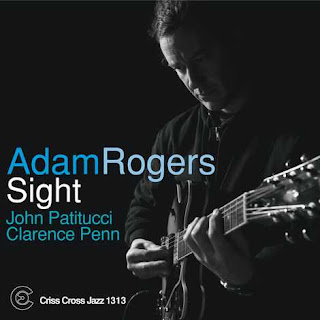
Adam Rogers • Sight


Guitarist Adam Rogers returns with Sight, an album that continues his exploration of heady originals and standards, in the trio format that, with Time and the Infinite (Criss Cross, 2007), took a left-turn from his earlier quartet and quintet records.

Surrounded by friends old and new on Time, with Sight Rogers returns to longtime drummer Clarence Penn after that brief hiatus. John Patitucci may replace equally longtime bassist Scott Colley, but they're hardly new acquaintances. Rogers spent plenty of time with Patitucci in the studio and on the road with the late Michael Brecker's Quindectet project, Wide Angles (Verve, 2003), resulting in a trio chemistry here that possesses both that wonderful "first encounter" energy, and no shortage of established empathy between the individual players. That best of both worlds makes Sight an improvement over the undeniably fine Time.

As meticulous here as in his sideman stint with saxophonist Chris Potter's Underground on Ultrahang (ArtistShare, 2009), in the director's chair Rogers is more decidedly cerebral, with often knotty and unpredictable compositions and arrangements. That doesn't mean a lack of resonance, however. Rogers' title track grooves mightily, a modal tune that opens with a vamp which could easily ratchet into the red zone were it not for the same dark, warm, and woody tone that largely defines Rogers playing throughout the disc, the one exception being his fairly literal look at the balladic standard "Beautiful Love," that Rogers makes his own on nylon-string guitar.

After emerging as a chops-meister in the 1980s with Chick Corea's Akoustic and Elektric bands, Patitucci has evolved into one of his generation's most important bassists. His work in Wayne Shorter's nearly decade-old quartet has contributed to the revitalization of the legendary saxophonist/composer's career, and he brings a similar telepathic elasticity to Rogers' trio. He constantly juggles the role of anchor with that of lyrical foil, and while he clearly still has chops to burn it's never in service of anything but the music. The near-classicism of Rogers' "Kaleidoscope" finds Patitucci acting as contrapuntal partner and harmonic focus for Rogers, whose lithe, graceful lines weave in and out of this ethereal composition with the increasing confidence that's marked the guitarist's trajectory for two decades.

Penn engenders loyalty, whether with Rogers or trumpeter Dave Douglas, in whose electro-acoustic quintet he's held the drum seat since inception nine years ago. Here he creates a stable but flexible pulse to Rogers' complex rhythmic, harmonic, and temporal rearrangement of Jerome Kern's "Yesterdays" and a more faithful version of Woody Shaw's enduring "The Moontrane," the latter a song that—with brass removed and guitar its primary melodic and chordal instrument—still swings, but with in a lighter, more open-ended fashion.

When compared to Kurt Rosenwinkel's standards-heavy Reflections (Wommusic, 2009), Sight is a more challenging and overtly virtuosic look at music that spans decades. For a younger generation of players, it's clear that music at the very foundation of jazz continues to provide inspiration for ultra-modern exploration.
By John Kelman
December 17, 2009
https://www.allaboutjazz.com/sight-adam-rogers-criss-cross-review-by-john-kelman

///////


El guitarrista Adam Rogers regresa con Sight, un álbum que continúa su exploración de originales y estándares embriagadores, en el formato de trío que, con Time and the Infinite (Criss Cross, 2007), dio un giro a la izquierda de sus discos anteriores de cuarteto y quinteto.

Rodeado de viejos y nuevos amigos a tiempo, con Sight Rogers regresa con el baterista Clarence Penn después de esa breve pausa. John Patitucci puede reemplazar al bajista Scott Colley, igualmente veterano, pero apenas son nuevos conocidos. Rogers pasó mucho tiempo con Patitucci en el estudio y en la carretera con el proyecto Quindectet del difunto Michael Brecker, Wide Angles (Verve, 2003), lo que resultó en una química de trío aquí que posee tanto esa maravillosa energía del "primer encuentro" como la falta de empatía establecida entre los jugadores individuales. Lo mejor de ambos mundos hace que Sight sea una mejora con respecto al innegablemente buen Momento.

Tan meticuloso aquí como en su temporada de acompañante con Underground del saxofonista Chris Potter en Ultrahang (ArtistShare, 2009), en la silla del director Rogers es más decididamente cerebral, con composiciones y arreglos a menudo retorcidos e impredecibles. Sin embargo, eso no significa falta de resonancia. La canción principal de Rogers, grooves mightily, una melodía modal que se abre con un vampiro que fácilmente podría entrar en la zona roja si no fuera por el mismo tono oscuro, cálido y amaderado que define en gran medida a Rogers tocando a lo largo del disco, la única excepción es su mirada bastante literal al estándar baládico "Beautiful Love", que Rogers hace suyo con una guitarra de cuerdas de nailon.

Después de emerger como maestro de ceremonias en la década de 1980 con las bandas Akoustic y Elektric de Chick Corea, Patitucci se ha convertido en uno de los bajistas más importantes de su generación. Su trabajo en el cuarteto de Wayne Shorter, de casi una década de antigüedad, ha contribuido a la revitalización de la carrera del legendario saxofonista/compositor, y aporta una elasticidad telepática similar al trío de Rogers. Constantemente hace malabares entre el papel de ancla y el de contrapunto lírico, y aunque claramente todavía tiene chuletas para quemar, nunca está al servicio de nada más que la música. El clasicismo cercano del "Caleidoscopio" de Rogers encuentra a Patitucci actuando como socio contrapuntístico y enfoque armónico para Rogers, cuyas líneas ágiles y elegantes se entrelazan dentro y fuera de esta composición etérea con la creciente confianza que ha marcado la trayectoria del guitarrista durante dos décadas.

Penn genera lealtad, ya sea con Rogers o con el trompetista Dave Douglas, en cuyo quinteto electroacústico ha ocupado el puesto de batería desde su creación hace nueve años. Aquí crea un pulso estable pero flexible al complejo reordenamiento rítmico, armónico y temporal de Rogers de "Yesterdays" de Jerome Kern y una versión más fiel de la perdurable "The Moontrane" de Woody Shaw, esta última una canción que, con los metales eliminados y la guitarra su instrumento melódico y cordal primario, todavía oscila, pero de una manera más ligera y abierta.

En comparación con Reflections, de Kurt Rosenwinkel, con muchos estándares (Wommusic, 2009), Sight es una mirada más desafiante y abiertamente virtuosa de la música que abarca décadas. Para una generación más joven de músicos, está claro que la música en la base misma del jazz continúa proporcionando inspiración para la exploración ultramoderna.
Por John Kelman
17 de diciembre de 2009
https://www.allaboutjazz.com/sight-adam-rogers-criss-cross-review-by-john-kelman


adamrogersmusic.com ...


Friday, May 10, 2024

Adam Rogers-David Binney • R&B


About the album
From his many Criss Cross dates as a leader to his extraordinary sideman work with Chris Potter, the late Michael Brecker and many more, Adam Rogers continues to blaze a path as one of jazz's most compelling guitarists. His longtime associate David Binney, alto saxophone great and an influential composer and producer, has also distinguished himself with numerous innovative sessions for Criss Cross and others. On R & B, Rogers and Binney unite to co-lead a lean and hard-swinging quartet with bassist Reuben Rogers (no relation) and drummer Gerald Cleaver. In a departure from their usual focus on original material, Rogers and Binney aim straight for bebop, ballads and classics by Thelonious Monk, Freddie Hubbard and Wayne Shorter, among others.
https://www.challengerecords.com/products/14307432874784

///////

Sobre el álbum
Desde sus numerosas citas con Criss Cross como líder hasta su extraordinario trabajo como sideman con Chris Potter, el difunto Michael Brecker y muchos más, Adam Rogers sigue abriéndose camino como uno de los guitarristas más convincentes del jazz. Su viejo socio David Binney, gran saxofonista alto e influyente compositor y productor, también se ha distinguido con numerosas sesiones innovadoras para Criss Cross y otros. En R & B, Rogers y Binney se unen para codirigir un cuarteto esbelto y duro con el bajista Reuben Rogers (sin parentesco) y el batería Gerald Cleaver. Alejándose de su habitual enfoque en el material original, Rogers y Binney apuntan directamente al bebop, las baladas y los clásicos de Thelonious Monk, Freddie Hubbard y Wayne Shorter, entre otros.
https://www.challengerecords.com/products/14307432874784


adamrogersmusic.com ...

Tuesday, March 5, 2024

John Patitucci Electric Guitar Quartet • Brooklyn


Bassist John Patitucci has few peers when it comes to doubling on the acoustic upright and electric variations of his instrument. However, he utilizes only a Yamaha electric semi-hollow six-string on his latest release, Brooklyn, an homage to his hometown. Still, the album, recorded by his Electric Guitar Quartet, with guitarists Adam Rogers and Steve Cardenas, presents an overabundance of six-stringed instruments, especially during the lower points of an 11-song roller coaster.

The disc gets off to an adventurous start. On Patitucci’s evocative medley “IN9-1881/The Search,” drummer Brian Blade’s bomb-drops set the stage for his bandmates’ interweaving lines. Rogers was half of a twin-guitar lineup with David Gilmore in the underrated 1990s fusion band Lost Tribe. His interplay with Cardenas sizzles on Patitucci’s surprisingly bluesy, Allman Brothers-influenced funk vehicle “Band of Brothers.

In contrast, a cover of Malian vocalist Oumou Sangare’s “Dugu Kamalemba” spins in place more than it entrances. Versions of Thelonious Monk standards “Trinkle Tinkle” and “Ugly Beauty” serve as vehicles for Patitucci’s admittedly jaw-dropping solos but sound empty compared to the original versions by their unorthodox piano-playing composer. Ditto Wes Montgomery’s “The Thumb,” a novelty piece to display its transposition from guitar to bass, and a curious cover of the classic spiritual “Go Down Moses.”

Some of Patitucci’s own compositions sound more focused. On “JLR,” he and Blade form a stomping cushion for the guitarists. And the bassist’s intro solo on “Do You?” borrows the form of the jazz standard “I’ve Got Rhythm” to approximate a Charlie Parker saxophone solo (shades of Jaco Pastorius on Bird’s “Donna Lee”). But other originals — the impressionistic “Bells of Coutance,” the balladic “Tesori” — contribute to the album’s scattered feel during a session that might have been better served live.
Bill Meredith
https://www.jazziz.com/john-patitucci-electric-guitar-quartet/

///////


El bajista John Patitucci tiene pocos pares cuando se trata de duplicar las variaciones acústicas verticales y eléctricas de su instrumento. Sin embargo, utiliza solo una Yamaha eléctrica semihueca de seis cuerdas en su último lanzamiento, Brooklyn, un homenaje a su ciudad natal. Aún así, el álbum, grabado por su Cuarteto de Guitarras Eléctricas, con los guitarristas Adam Rogers y Steve Cárdenas, presenta una sobreabundancia de instrumentos de seis cuerdas, especialmente durante los puntos más bajos de una montaña rusa de 11 canciones.

El disco tiene un comienzo aventurero. En el evocador popurrí de Patitucci "IN9-1881 / The Search", los lanzamientos de bombas del baterista Brian Blade prepararon el escenario para las líneas entrelazadas de sus compañeros de banda. Rogers era la mitad de una formación de guitarras gemelas con David Gilmore en la subestimada banda de fusión Lost Tribe de la década de 1990. Su interacción con Cárdenas chisporrotea en el vehículo funk sorprendentemente blues e influenciado por Allman Brothers de Patitucci "Band of Brothers.

En contraste, una versión de "Dugu Kamalemba" del vocalista maliense Oumou Sangare gira en su lugar más de lo que entra. Las versiones de los estándares de Thelonious Monk "Trinkle Tinkle" y "Ugly Beauty" sirven como vehículos para los solos asombrosos de Patitucci, pero suenan vacíos en comparación con las versiones originales de su compositor poco ortodoxo para tocar el piano. Lo mismo ocurre con "The Thumb" de Wes Montgomery, una pieza novedosa para mostrar su transposición de la guitarra al bajo, y una curiosa versión del clásico espiritual " Go Down Moses.”

Algunas de las composiciones propias de Patitucci suenan más enfocadas. En "JLR", él y Blade forman un cojín para los guitarristas. Y el solo de introducción del bajista en " Do You?"toma prestada la forma del estándar de jazz "I've Got Rhythm" para aproximarse a un solo de saxofón de Charlie Parker (tonos de Jaco Pastorius en "Donna Lee"de Bird). Pero otros originales, las impresionistas "Bells of Coutance", la balada "Tesori", contribuyen a la sensación dispersa del álbum durante una sesión que podría haberse servido mejor en vivo.
Bill Meredith
https://www.jazziz.com/john-patitucci-electric-guitar-quartet/


johnpatitucci.com ...
johnpatitucci.com/discography ...