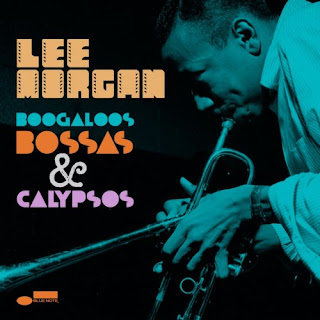
A
cornerstone of the Blue Note label roster prior to his tragic demise,
Lee Morgan was one of hard bop’s greatest trumpeters, and indeed one of
the finest of the ’60s. An all-around master of his instrument modeled
after Clifford Brown, Morgan boasted an effortless, virtuosic technique
and a full, supple, muscular tone that was just as powerful in the high
register. His playing was always emotionally charged, regardless of the
specific mood: cocky and exuberant on up-tempo groovers, blistering on
bop-oriented technical showcases, sweet and sensitive on ballads. In his
early days as a teen prodigy, Morgan was a busy soloist with a taste
for long, graceful lines, and honed his personal style while serving an
apprenticeship in Art Blakey’s Jazz Messengers. As his original
compositions began to take in elements of blues and R&B, he made
greater use of space and developed an infectiously funky rhythmic sense.
He also found ways to mimic human vocal inflections by stuttering,
slurring his articulations, and employing half-valved sound effects.
Toward the end of his career, Morgan was increasingly moving into modal
music and free bop, hinting at the avant-garde but remaining grounded in
tradition. He had already overcome a severe drug addiction, but sadly,
he would not live to continue his musical growth; he was shot to death
by his common-law wife in 1972.
Blue TrainEdward Lee Morgan was
born in Philadelphia on July 10, 1938. He grew up a jazz lover, and his
sister apparently gave him his first trumpet at age 14. He took private
lessons, developing rapidly, and continued his studies at Mastbaum High
School. By the time he was 15, he was already performing professionally
on the weekends, co-leading a group with bassist Spanky DeBrest. Morgan
also participated in weekly workshops that gave him the chance to meet
the likes of Miles Davis, Dizzy Gillespie, and his idol Clifford Brown.
After graduating from high school in 1956, Morgan — along with DeBrest —
got the chance to perform with Art Blakey’s Jazz Messengers when they
swung through Philadelphia. Not long after, Dizzy Gillespie hired Morgan
to replace Joe Gordon in his big band, and afforded the talented
youngster plenty of opportunities to solo, often spotlighting him on the
Gillespie signature piece “A Night in Tunisia.” Clifford Brown’s death
in a car crash in June 1956 sparked a search for his heir apparent, and
the precocious Morgan seemed a likely candidate to many; accordingly, he
soon found himself in great demand as a recording artist. His first
session as a leader was cut for Blue Note in November 1956, and over the
next few months he recorded for Savoy and Specialty as well, often
working closely with Hank Mobley or Benny Golson. Later in 1957, he
performed as a sideman on John Coltrane’s classic Blue Train, as well as
with Jimmy Smith.
CandyMorgan’s early sessions showed him to be a
gifted technician who had his influences down pat, but subsequent dates
found him coming into his own as a distinctive, original stylist. That
was most apparent on the Blue Note classic Candy, a warm standards album
completed in 1958 and released to great acclaim. Still only 19,
Morgan’s playing was still imbued with youthful enthusiasm, but he was
also synthesizing his influences into an original sound of his own. Also
in 1958, Gillespie’s big band broke up, and Morgan soon joined the
third version of Art Blakey’s Jazz Messengers, which debuted on the
classic Moanin’ album later that year. As a leader, Morgan recorded a
pair of albums for Vee Jay in 1960, Here’s Lee Morgan and Expoobident,
and cut another for Blue Note that year, Leeway, with backing by many of
the Jazz Messengers. None managed to measure up to Candy, and Morgan,
grappling with heroin addiction, wound up leaving the Jazz Messengers in
1961. He returned to his hometown of Philadelphia to kick the habit,
and spent most of the next two years away from music, working
occasionally with saxophonist Jimmy Heath on a local basis. His
replacement in the Jazz Messengers was Freddie Hubbard, who would also
become one of the top hard bop trumpeters of the ’60s.
EvolutionMorgan
returned to New York in late 1963, and recorded with Blue Note
avant-gardist Grachan Moncur on the trombonist’s debut Evolution. He
then recorded a comeback LP for Blue Note called The Sidewinder,
prominently featuring the up-and-coming Joe Henderson. The
Morgan-composed title track was a funky, danceable groover that drew
from soul-jazz, Latin boogaloo, blues, and R&B in addition to
Morgan’s trademark hard bop. It was rather unlike anything else he’d
cut, and it became a left-field hit in 1964; edited down to a 45 rpm
single, it inched onto the lower reaches of the pop charts, and was
licensed for use in a high-profile automobile ad campaign. Its success
helped push The Sidewinder into the Top 25 of the pop LP charts, and the
Top Ten on the R&B listing. Sales were brisk enough to revive the
financially struggling Blue Note label, and likely kept it from
bankruptcy; it also led to numerous “Sidewinder”-style grooves popping
up on other Blue Note artists’ albums. By the time “The Sidewinder”
became a phenomenon, Morgan had rejoined the Jazz Messengers, where he
would remain until 1965; there he solidified a long-standing partnership
with saxophonist Wayne Shorter.
Search for the New LandMorgan
followed the most crucial recording of his career with the excellent,
more abstract Search for the New Land, which was cut in early 1964,
before “The Sidewinder” hit. An advanced modal bop session called Tom
Cat was also recorded shortly thereafter, but both were shelved in hopes
of scoring another “Sidewinder.” Accordingly, Morgan re-entered the
studio in early 1965 to cut The Rumproller, whose Andrew Hill-penned
title cut worked territory that was highly similar to Morgan’s breakout
hit. Commercial lightning didn’t strike twice, but Morgan continued to
record prolifically through 1965, cutting excellent sessions like The
Gigolo, Cornbread, and the unissued Infinity. The Gigolo introduced one
of Morgan’s best-known originals, the bluesy “Speedball,” while the
classic Cornbread featured his ballad masterpiece “Ceora.” Search for
the New Land was finally issued in 1966, and it achieved highly
respectable sales, reaching the Top 20 of the R&B album charts; both
Cornbread and The Gigolo would sell well among jazz audiences when they
were released in 1967 and 1968, respectively.
DelightfuleeBy the
time Morgan completed those albums, he had left the Jazz Messengers to
begin leading his own groups outside the studio. He was also appearing
frequently as a sideman on other Blue Note releases, working most often
with tenorman Hank Mobley. Morgan was extraordinarily prolific over
1966-1968, cutting around eight albums’ worth of material (though not
all of it was released at the time). Highlights included Delightfulee,
The Procrastinator, and the decent-selling Caramba!, which nearly made
the Top 40 of the R&B album chart. His compositions were
increasingly modal and free-form, stretching the boundaries of hard bop;
however, his funkier instincts were still evident as well, shifting
gradually from boogaloo to early electrified fusion. Morgan’s recording
pace tailed off at the end of the ’60s, but he continued to tour with a
regular working group that prominently featured saxophonist Bennie
Maupin. This band’s lengthy modal explorations were documented on the
double LP Live at the Lighthouse, recorded in Los Angeles in July 1970;
it was later reissued as a three-CD set with a generous amount of extra
material.
Morgan led what turned out to be the last session of
his life in September 1971. On February 19, 1972, Morgan was performing
at the New York club Slug’s when he was shot and killed by his
common-law wife, Helen More. Accounts of exactly what happened vary;
whether they argued over drugs or Morgan’s fidelity, whether she shot
him outside the club or up on the bandstand in front of the audience,
jazz lost a major talent. Despite his extensive recorded legacy, Morgan
was only 33 years old. Many of his unreleased Blue Note sessions began
to appear in the early ’80s, and his critical standing has hardly
diminished a whit. ~ Steve Huey
/////////
Piedra
angular de la lista del sello Blue Note antes de su trágica
desaparición, Lee Morgan fue uno de los mejores trompetistas del hard
bop, y de hecho uno de los mejores de los años 60. Un maestro de su
instrumento, inspirado en Clifford Brown, Morgan poseía una técnica
virtuosa sin esfuerzo y un tono completo, flexible y musculoso que era
igual de poderoso en el registro alto. Su forma de tocar siempre estaba
cargada de emoción, independientemente del estado de ánimo: arrogante y
exuberante en los ritmos rápidos, explosivo en las exhibiciones técnicas
orientadas al bop, dulce y sensible en las baladas. En sus primeros
días como adolescente prodigio, Morgan era un solista muy ocupado con un
gusto por las líneas largas y elegantes, y perfeccionó su estilo
personal mientras era aprendiz de los Jazz Messengers de Art Blakey.
Cuando sus composiciones originales empezaron a incorporar elementos de
blues y R&B, hizo un mayor uso del espacio y desarrolló un sentido
rítmico contagiosamente funky. También encontró formas de imitar las
inflexiones vocales humanas tartamudeando, arrastrando las
articulaciones y empleando efectos sonoros a medias. Hacia el final de
su carrera, Morgan se adentraba cada vez más en la música modal y el
free bop, insinuando la vanguardia pero manteniéndose en la tradición.
Ya había superado una grave adicción a las drogas, pero lamentablemente
no viviría para continuar su crecimiento musical; fue asesinado a tiros
por su pareja de hecho en 1972.
Blue TrainEdward Lee Morgan nació
en Filadelfia el 10 de julio de 1938. Creció como un amante del jazz y,
al parecer, su hermana le regaló su primera trompeta a los 14 años.
Tomó clases particulares, desarrollándose rápidamente, y continuó sus
estudios en el Mastbaum High School. A los 15 años, ya actuaba
profesionalmente los fines de semana, codirigiendo un grupo con el
bajista Spanky DeBrest. Morgan también participó en talleres semanales
que le dieron la oportunidad de conocer a gente como Miles Davis, Dizzy
Gillespie y su ídolo Clifford Brown. Tras graduarse en el instituto en
1956, Morgan -junto con DeBrest- tuvo la oportunidad de actuar con los
Jazz Messengers de Art Blakey cuando éstos pasaron por Filadelfia. Poco
después, Dizzy Gillespie contrató a Morgan para que sustituyera a Joe
Gordon en su big band, y concedió al joven talento muchas oportunidades
para actuar como solista, destacando a menudo en la pieza emblemática de
Gillespie "A Night in Tunisia". La muerte de Clifford Brown en un
accidente de coche en junio de 1956 provocó la búsqueda de su heredero, y
el precoz Morgan parecía un candidato probable para muchos; en
consecuencia, pronto se encontró con una gran demanda como artista de
grabación. Su primera sesión como líder fue grabada para Blue Note en
noviembre de 1956, y en los meses siguientes grabó también para Savoy y
Specialty, a menudo trabajando estrechamente con Hank Mobley o Benny
Golson. Más tarde, en 1957, actuó como acompañante en el clásico Blue
Train de John Coltrane, así como con Jimmy Smith.
Las primeras
sesiones de CandyMorgan mostraban que era un técnico dotado que tenía
sus influencias bien definidas, pero en las fechas posteriores se le vio
como un estilista distintivo y original. Esto fue más evidente en el
clásico de Blue Note Candy, un cálido álbum de estándares completado en
1958 y publicado con gran éxito. Con sólo 19 años, Morgan seguía tocando
con entusiasmo juvenil, pero también sintetizaba sus influencias en un
sonido propio y original. También en 1958, la big band de Gillespie se
disolvió, y Morgan pronto se unió a la tercera versión de los Jazz
Messengers de Art Blakey, que debutó en el clásico álbum Moanin' ese
mismo año. Como líder, Morgan grabó un par de álbumes para Vee Jay en
1960, Here's Lee Morgan y Expoobident, y grabó otro para Blue Note ese
año, Leeway, con el apoyo de muchos de los Jazz Messengers. Ninguno
consiguió estar a la altura de Candy, y Morgan, luchando contra la
adicción a la heroína, acabó dejando los Jazz Messengers en 1961.
Regresó a su ciudad natal, Filadelfia, para dejar el hábito, y pasó la
mayor parte de los dos años siguientes alejado de la música, trabajando
ocasionalmente con el saxofonista Jimmy Heath a nivel local. Su
sustituto en los Jazz Messengers fue Freddie Hubbard, que también se
convertiría en uno de los mejores trompetistas de hard bop de los años
60.
Morgan
regresó a Nueva York a finales de 1963 y grabó con el vanguardista de
Blue Note Grachan Moncur en el debut del trombonista, Evolution. A
continuación, grabó un LP de regreso para Blue Note llamado The
Sidewinder, en el que participó de forma destacada el prometedor Joe
Henderson. La canción que da título al disco, compuesta por Morgan, era
un tema funky y bailable que se inspiraba en el soul-jazz, el boogaloo
latino, el blues y el R&B, además del hard bop característico de
Morgan. No se parecía a nada de lo que había grabado, y se convirtió en
un éxito de la izquierda en 1964; editada en un single de 45 rpm, se
coló en los primeros puestos de las listas de éxitos del pop, y se
autorizó su uso en una campaña publicitaria de automóviles de alto
nivel. Su éxito ayudó a situar a The Sidewinder en el Top 25 de las
listas de LPs de pop y en el Top Ten de la lista de R&B. Las ventas
fueron lo suficientemente rápidas como para revivir el sello Blue Note,
que se encontraba en dificultades financieras, y probablemente lo
alejaron de la bancarrota; también hizo que aparecieran numerosos temas
al estilo de "Sidewinder" en los álbumes de otros artistas de Blue Note.
Para cuando "The Sidewinder" se convirtió en un fenómeno, Morgan se
había unido a los Jazz Messengers, donde permanecería hasta 1965; allí
consolidó una larga asociación con el saxofonista Wayne Shorter.
Search
for the New LandMorgan realizó la grabación más importante de su
carrera con el excelente y más abstracto Search for the New Land, que se
grabó a principios de 1964, antes de que llegara "The Sidewinder". Poco
después también se grabó una sesión de bop modal avanzado llamada Tom
Cat, pero ambas fueron archivadas con la esperanza de conseguir otro
"Sidewinder". En consecuencia, Morgan volvió a entrar en el estudio a
principios de 1965 para grabar "The Rumproller", cuyo corte principal,
escrito por Andrew Hill, trabajaba en un terreno muy similar al del
éxito de Morgan. Los relámpagos comerciales no cayeron dos veces, pero
Morgan continuó grabando prolíficamente a lo largo de 1965, grabando
excelentes sesiones como The Gigolo, Cornbread y la inédita Infinity.
The Gigolo introdujo uno de los originales más conocidos de Morgan, el
blues "Speedball", mientras que el clásico Cornbread presentaba su obra
maestra de balada "Ceora". Search for the New Land se publicó finalmente
en 1966, y alcanzó unas ventas muy respetables, llegando al Top 20 de
las listas de álbumes de R&B; tanto Cornbread como The Gigolo se
venderían bien entre el público de jazz cuando se publicaron en 1967 y
1968, respectivamente.
DelightfuleePara cuando Morgan completó
esos álbumes, había dejado los Jazz Messengers para empezar a liderar
sus propios grupos fuera del estudio. También aparecía con frecuencia
como acompañante en otros discos de Blue Note, trabajando sobre todo con
el tenor Hank Mobley. Morgan fue extraordinariamente prolífico durante
1966-1968, grabando alrededor de ocho álbumes (aunque no todos fueron
publicados en su momento). Entre los más destacados se encuentran
Delightfulee, The Procrastinator y el decente Caramba!, que estuvo a
punto de entrar en el Top 40 de la lista de álbumes de R&B. Sus
composiciones eran cada vez más modales y libres, ampliando los límites
del hard bop; sin embargo, sus instintos más funkies seguían siendo
evidentes, pasando gradualmente del boogaloo a la primera fusión
electrificada. El ritmo de grabación de Morgan disminuyó a finales de
los años 60, pero siguió haciendo giras con un grupo de trabajo regular
en el que destacaba el saxofonista Bennie Maupin. Las largas
exploraciones modales de esta banda quedaron documentadas en el doble LP
Live at the Lighthouse, grabado en Los Ángeles en julio de 1970;
posteriormente se reeditó como un conjunto de tres CD con una generosa
cantidad de material extra.
Morgan dirigió la que resultó ser la
última sesión de su vida en septiembre de 1971. El 19 de febrero de
1972, Morgan estaba actuando en el club neoyorquino Slug's cuando fue
asesinado a tiros por su pareja de hecho, Helen More. Los relatos sobre
lo que ocurrió varían; si discutieron por las drogas o por la fidelidad
de Morgan, si ella le disparó fuera del club o en el quiosco delante del
público, el jazz perdió un gran talento. A pesar de su extenso legado
discográfico, Morgan sólo tenía 33 años. Muchas de sus sesiones inéditas
de Blue Note empezaron a aparecer a principios de los 80, y su
prestigio crítico apenas ha disminuido. ~ Steve Huey
www.bluenote.com/lee-morgan ...