Biography:
It is difficult to pin the multi-talented Michel Legrand down into one single category. This amazingly versatile French singer, songwriter, composer, arranger, conductor and producer has enjoyed a whirlwind career, excelling in an impressively broad range of domains from film soundtracks and French 'chanson' to jazz and classical music. An international star, who has won as much respect in the States as he has in Europe, Legrand is an insatiable musician whose creativity and ambition appear to know no bounds.
Michel Legrand was born in Bécon-les-Bruyères, in the Paris suburbs, on 24 February 1932. His mother, Marcelle der Mikaelian, married Raymond Legrand, a French musician renowned for hits such as “Irma la douce.” Michel spent a rather solitary childhood, growing up with his sister, Christiane. He revealed a prodigious musical talent at an early age, playing the piano when he was just four years old. As a child, he was fascinated about the life of composer Franz Schubert. Michel eventually went on to train at the Paris Conservatoire in 1942. He spent seven years there, studying under renowned teachers such as Nadia Boulanger, Henri Challan, Noël Gallon and Lucette Descaves. The young prodigy went on to win numerous awards for his skills in counterpoint, piano, fugue and 'solfège' (an award he received on 6 June 1944).
In the immediate post-war years, Michel Legrand discovered a new passion: jazz. The moment that triggered off this musical conversion was when he attended a concert by Dizzy Gillespie “ and left, totally blown away by what he had seen! By the time he graduated from the Conservatoire in 1949, Legrand had mastered a dozen instruments. And he found himself launched straight into the world of French 'chanson,' thanks to introductions from his father (with whom he had renewed ties by this point). The gifted teenager was soon working as an accompanist to many of the major French stars of the day including Henri Salvador, Juliette Gréco, Zizi Jeanmaire and Catherine Sauvage.
In 1954, Legrand stepped from the accompanying shadows centre stage when the American record label Columbia-EMI commissioned him to make an album of English adaptations of French classics. The album “I Love Paris” went on to sell a staggering 8 million copies, turning Legrand into an overnight star both at home and abroad. It was at this point that legendary French 'chanson' star Maurice Chevalier approached Legrand and offered him a post as his musical director. Legrand accepted and, in Chevalier's company, flew across the Atlantic, discovering the States in the course of numerous tours.
Meanwhile, Legrand's own solo career continued to go from strength to strength. He recorded a whole string of albums: “Holiday In Rome,” (1955) “Michel Legrand Plays Cole Porter,” (1957) and “Legrand In Rio,” (1958) all released on the Philips label, directed by Jacques Canetti. One of the high points of Legrand's early recording career was his 1956 album recorded with Boris and Henri Salvador (aka Henri Cording) under the pseudonym Big Mike “ a nickname Jean Cocteau had bestowed upon him! The following year, Legrand was invited to the USSR to perform at the Student Youth Festival. It was on this trip that he met his future wife, a young French model with who he went on to have three children (Hervé, Benjamin and Emilie).
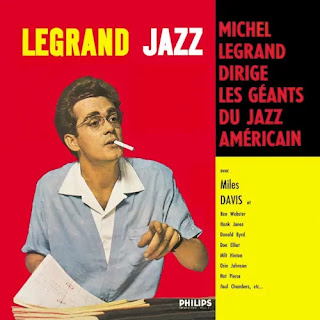
In 1958, Legrand headed back across the Atlantic to the States and spent valuable time in New York, directing studio sessions where he mixed with the crème de la crème of the jazz world, working with the likes of Miles Davis, John Coltrane, Bill Evans and Ben Webster. The album “Legrand Jazz” was a result of this white-hot jazz period.
In 1955, Michel Legrand branched out in a new direction, writing the music for Henri Verneuil's film “Amants du Tage,” under the pseudonym Lucien Legrand. But Legrand's involvement in the world of French cinema really began in earnest in the late 50s when he was caught up in the French New Wave. Working in close collaboration with a new breed of French directors, Legrand kept up a hectic non-stop schedule, composing soundtracks for up to a dozen feature films and television films a year.
Between 1961 and 1967, Legrand scored seven films for directors Jean-Luc Godard, and Jacques Demy, with whom he would work on ten major feature films between 1961 and 1988. In short, Michel Legrand was responsible for creating a new - either much-loved or much-hated - genre in the French film world: the musical! Besides working with the most avant-garde directors of the “Nouvelle Vague”, Legrand also collaborated with a number of more 'traditional' French film-makers such as Gilles Grangier and Yves Allégret. He soon found himself in great demand abroad, too. The first foreign director to recognise Legrand's talent was Joseph Losey (for whom Legrand scored “Eva” in 1962). Losey and Legrand subsequently worked together on another three occasions, most famously for “The Go-Between” (which won the 'Palme d'or' at the Cannes film festival in 1971).
Legrand had long been familiar with the French 'chanson' world, having accompanied some of its biggest stars when he was a young 20-year-old just starting out in the business. He had also put in several years at the Philips label, orchestrating countless songs for the big names of the day. When Legrand met the famous Toulousan singer Claude Nougaro in 1962, the two men hit it off immediately thanks to their shared passion for jazz. The pair even went on to write a number of Nougaro classics together including “Les Dom Juan” and “Le Cinéma.” Legrand also went on to compose and arrange material for Serge Reggiani in 1970 and he worked with Yves Montand, too, composing hits such as “Coucher avec elle.” Meanwhile, Legrand's songs were covered by a number of international stars from Liza Minnelli to Greek diva Nana Mouskouri.
But it was Jacques Brel, a singer for whom Legrand had written arrangements in the 50s, that was to play a decisive role in Legrand's career , for Brel was the one that persuaded him to get up behind the microphone and start performing his own work. As early as 1964, Legrand began building his own repertoire with a helping hand from Eddy Marnay and Jean Dréjac (for the lyrics). Over the following years, he would also work with the likes of Jean-Loup Dabadie, Boris Bergman, Jean Guidoni and novelist (and occasional songwriter) Françoise Sagan. Ever eager to branch out and conquer new territory, Michel Legrand set off for Los Angeles in 1966, with his wife and three children in tow. He spent three years there, which turned out to be an amazingly productive period for him. In 1968, Legrand sat down and wrote the soundtrack to Norman Jewison's swinging 60s film “The Thomas Crown Affair.” The theme tune from the movie, “The Windmills Of Your Mind”, (”Les Moulins de mon c”ur”) which featured French lyrics by Eddy Marnay and English lyrics by Alan and Marilyn Bergman went on to become a huge hit. In fact, Legrand ended up scooping the Oscar for Best Film Theme Song in 1969. What's more, he won another famous gold statue two years later for Best Film Music thanks to “The Summer of '42”, a film which was famous for its theme song “The Summer Knows” (French lyrics by Jean Dréjac, English lyrics by Alan and Marilyn Bergman) performed by Barbra Streisand.
Needless to say, Michel Legrand went on to become a major star in the U.S. Indeed, he soon became such a household name that he was soon invited to appear on all the prime time chat shows from The Maurice Chevalier Show and The Danny Kaye Show to The Shirley Bassey Special. Legrand, who was nominated for a Grammy Award no less than 27 times, carried off the prestigious prize five times between 1971 and 1975.
America at that time also meant jazz, of course. And, jazz being one of Legrand's greatest passions in life, he went on to perform several concerts with Ray Brown in 1968 in the famous L.A. club, Shelly's Manne-Hole. The album, “Verve”, was produced as a result of this.
Legrand's astounding versatility continued, if anything increasing over the years. He took his film work to new heights, working with Clint Eastwood in 1973 and Orson Welles in 1976. In 1983, his theme tune to Barbra Streisand’s movie “Yentl” won him yet another Oscar. Later that same year, Legrand wrote the score for “Never Say Never Again” (the last James Bond film starring Sean Connery). Meanwhile, he also extended his work to the theatre, writing the music for Jean-Louis Barrault’s play “Jarry sur la butte” (1970) and “Monte Cristo” in 1975.
In January 1972, Legrand took to the stage in his own right, performing a successful run at the Olympia (in Paris) with the singer Caterina Valente. In 1975, he gave a helping hand to a young unknown singer, Jean Guidoni, helping assure his promote him as a new talent.
In 1974, Michel Legrand suffered a blow in his personal life when he lost his father, Raymond Legrand.
In the 80s, Legrand chose to devote his time and energy to jazz, forming a trio with drummer André Ceccarelli and double-bass virtuoso Marc-Michel Le Bévillon. The threesome went on to make three albums together. In 1982, Legrand pulled off another major musical exploit, getting the two famous saxophonists, Phil Woods and Zoot Sims, together in the studio to make the album “After The Rain.” Later that year, Legrand was responsible for organising the mega-Shirley Bassey show which opened Midem (the annual record industry fair in Cannes). His first solo album as a singer since 1972 was also released at this point.
In the late 80s, as part of the official celebrations for the Bicentenary of the French Revolution, Michel Legrand staged the première of his oratorio (based on the Universal Declaration of Human Rights) in Lyon. And he ended the decade branching out in a totally new direction, stepping behind the camera to direct his own film. “Cinq jours en juin”, starring Sabine Azema and Annie Girardot, hit French cinema screens in 1989, but failed to make a major impact on cinema-goers or the critics.
Following his work as part of a jazz trio, Legrand changed musical format in the 90s, creating a big band which he took on several international tours in subsequent years, accompanying Ray Charles, Diana Ross and Icelandic pop diva Björk. He then went off to Suresnes to record an album with the orchestra (which featured a number of well-known musicians including the Belmondo brothers). The album was released in September 1999. Legrand also organised a show at the Olympia for French violinist Stéphane Grappelli who celebrated his 85th birthday in 1992. (A CD was released to mark the occasion).
In 1995, Michel Legrand got down to his composing work, writing new material for Jean Guidoni’s album “Vertigo”. The pair took to the stage together at the Casino de Paris in 1996 for a joint show which won a coveted “Victoire de la musique” award. Throughout the 90s, Legrand returned to his classical roots on several occasions. He recorded several CDs with the trumpet-player Maurice André (in 1998 and 2004), staged performances of Erik Satie’s work three times (in 1993, 1999 and 2002) and conducted requiems by Fauré and Duruflé in 1994. In the meantime, a number of songs from his own repertoire were covered by the world-famous opera singer Kiri te Kanawa on an album entitled “Kiri Sings Michel Legrand.”
In 1997, working in collaboration with the playwright Didier Van Cauwelaert, Legrand staged a new show “Le Passe Muraille” (based on Marcel Aymé’s work) at Les Bouffes Parisiens. The show proved to be a big hit with theatre-goers and Legrand also took “Le Passe Muraille” to Japan in 2000. But when, in 2002, he attempted to reinvent the show on Broadway in a new adaptation, “Amour”, it proved to be a total flop.
Various Legrand compilations have been available on the international scene since the 1980s. But in 2001, Mercury/Universal finally got round to releasing an official Legrand anthology, summing up the versatile singer-composer-musician’s career. The year before, a major tribute was staged to Michel Legrand when a bevy of stars performed his classics at an open-air concert in the courtyard of the Louvre as part of the annual “Fête de la musique.” In 2003, Legrand received recognition at an even higher level, when he was presented with the ‘Légion d'honneur’. Snowed under with honours, music awards and Oscars, this formidable talent has never let fame go to his head or dull his prodigious artistic appetite.
In 2005, Universal Jazz released “Le Cinéma de Michel Legrand”, a boxed set compilation featuring Legrand's best known film soundtracks. But Legrand himself appeared reluctant to focus on the past and was not involved in the production of this 'greatest film hits.' The 4 CD set proved to be a veritable musical treasure trove, however, featuring 90 tracks composed in the course of Legrand's 50-year career.
In June 2005, Legrand returned to the studio. This time round, it was not to compose his own work, however, but to pay tribute to his late friend and music colleague, the Toulousan singer Claude Nougaro (who died in 2004). Working with a number of leading jazz musicians and using tapes of Nougaro's voice, Legrand recorded new versions of many of the “Little Bull's” lesser-known songs which they had written together in the course of various collaborations. The album “Legrand Nougaro” also included reworkings of Nougaro classics such as “Don Juan”, “Le Cinéma” and “Le Rouge et le Noir.” The album, which proved to be more of a jazz extravaganza than a strictly 'chanson' affair, featured a special bonus, including a new song “Mon Dernier Concert” (which Nougaro had written before his death but never recorded himself).
https://musicians.allaboutjazz.com/michellegrand
Note: Michel Legrand died on January 26, 2019.
///////
Biografía:
Es difícil clasificar al polifacético Michel Legrand en una sola categoría. Este cantante, compositor, arreglista, director de orquesta y productor francés sorprendentemente versátil ha disfrutado de una carrera fulgurante, destacando en una impresionante gama de ámbitos que van desde las bandas sonoras de películas y la "chanson" francesa hasta el jazz y la música clásica. Estrella internacional, que se ha ganado tanto el respeto en Estados Unidos como en Europa, Legrand es un músico insaciable cuya creatividad y ambición parecen no tener límites.
Michel Legrand nació en Bécon-les-Bruyères, en los suburbios de París, el 24 de febrero de 1932. Su madre, Marcelle der Mikaelian, se casó con Raymond Legrand, un músico francés famoso por éxitos como "Irma la douce". Michel pasó una infancia bastante solitaria, creciendo con su hermana, Christiane. Reveló un prodigioso talento musical a temprana edad, tocando el piano cuando tenía sólo cuatro años. De niño, le fascinó la vida del músico Franz Schubert. Finalmente, Michel se formó en el Conservatorio de París en 1942. Pasó siete años allí, estudiando con profesores de renombre como Nadia Boulanger, Henri Challan, Noël Gallon y Lucette Descaves. El joven prodigio ganó numerosos premios por sus habilidades en contrapunto, piano, fuga y solfeo (premio que recibió el 6 de junio de 1944).
En los años inmediatos a la posguerra, Michel Legrand descubrió una nueva pasión: el jazz. El momento que desencadenó esta conversión musical fue cuando asistió a un concierto de Dizzy Gillespie " y se marchó, ¡totalmente impresionado por lo que había visto! Cuando se graduó en el Conservatorio en 1949, Legrand ya había dominado una docena de instrumentos. Y se lanzó directamente al mundo de la chanson francesa, gracias a las presentaciones de su padre (con quien ya había renovado sus lazos). El talentoso adolescente pronto trabajó como acompañante de muchas de las principales estrellas francesas de la época, como Henri Salvador, Juliette Gréco, Zizi Jeanmaire y Catherine Sauvage.
En 1954, Legrand se apartó de las sombras del acompañamiento cuando el sello discográfico estadounidense Columbia-EMI le encargó un álbum de adaptaciones en inglés de clásicos franceses. El álbum "I Love Paris" vendió la asombrosa cantidad de 8 millones de copias, convirtiendo a Legrand en una estrella de la noche a la mañana tanto en casa como en el extranjero. Fue entonces cuando la legendaria estrella francesa de la chanson Maurice Chevalier se acercó a Legrand y le ofreció un puesto como director musical. Legrand aceptó y, en compañía de Chevalier, cruzó el Atlántico, descubriendo los Estados Unidos en el curso de numerosas giras.
Mientras tanto, la carrera en solitario de Legrand seguía avanzando con fuerza. Grabó toda una serie de álbumes: "Holiday In Rome" (1955), "Michel Legrand Plays Cole Porter" (1957) y "Legrand In Rio" (1958), todos publicados por el sello Philips, dirigido por Jacques Canetti. Uno de los puntos culminantes de la carrera discográfica de Legrand fue su álbum de 1956 grabado con Boris y Henri Salvador (alias Henri Cording) bajo el seudónimo de Big Mike " un apodo que Jean Cocteau le había dado! Al año siguiente, Legrand fue invitado a la URSS para actuar en el Festival de la Juventud Estudiantil. En este viaje conoció a su futura esposa, una joven modelo francesa con la que tuvo tres hijos (Hervé, Benjamin y Emilie).
En 1958, Legrand volvió a cruzar el Atlántico a los Estados Unidos y pasó un tiempo valioso en Nueva York, dirigiendo sesiones de estudio donde se mezcló con la crème de la crème del mundo del jazz, trabajando con gente como Miles Davis, John Coltrane, Bill Evans y Ben Webster. El álbum "Legrand Jazz" fue el resultado de este período de jazz al rojo vivo.
En 1955, Michel Legrand tomó una nueva dirección, escribiendo la música de la película "Amants du Tage" de Henri Verneuil, bajo el seudónimo de Lucien Legrand. Pero la implicación de Legrand en el mundo del cine francés comenzó realmente en serio a finales de los 50 cuando se vio envuelto en la Nueva Ola Francesa. Trabajando en estrecha colaboración con una nueva generación de directores franceses, Legrand mantuvo una agitada agenda sin parar, componiendo bandas sonoras para hasta una docena de películas de cine y televisión al año.
Entre 1961 y 1967, Legrand realizó siete películas para los directores Jean-Luc Godard y Jacques Demy, con los que trabajaría en diez grandes largometrajes entre 1961 y 1988. En resumen, Michel Legrand fue el responsable de crear un nuevo género -muy querido o muy odiado- en el mundo del cine francés: ¡el musical! Además de trabajar con los directores más vanguardistas de la "Nouvelle Vague", Legrand también colaboró con algunos cineastas franceses más "tradicionales" como Gilles Grangier e Yves Allégret. Pronto se encontró también muy solicitado en el extranjero. El primer director extranjero que reconoció el talento de Legrand fue Joseph Losey (para el que Legrand firmó "Eva" en 1962). Posteriormente, Losey y Legrand trabajaron juntos en otras tres ocasiones, la más famosa de ellas para "The Go-Between" (que ganó la 'Palma de Oro' en el festival de cine de Cannes en 1971).
Legrand conocía desde hacía mucho tiempo el mundo de la chanson francesa, ya que había acompañado a algunas de sus mayores estrellas cuando era un joven de 20 años que empezaba en el negocio. También había trabajado varios años en el sello Philips, orquestando incontables canciones para los grandes nombres del momento. Cuando Legrand conoció al famoso cantante tolosano Claude Nougaro en 1962, los dos hombres se llevaron bien inmediatamente gracias a su pasión común por el jazz. Incluso escribieron juntos varios clásicos de Nougaro como "Les Dom Juan" y "Le Cinéma". Legrand también pasó a componer y arreglar material para Serge Reggiani en 1970 y trabajó con Yves Montand, también, componiendo éxitos como "Coucher avec elle". Mientras tanto, las canciones de Legrand fueron cubiertas por varias estrellas internacionales, desde Liza Minnelli a la diva griega Nana Mouskouri.
Pero fue Jacques Brel, un cantante para el que Legrand había escrito arreglos en los años 50, el que jugó un papel decisivo en la carrera de Legrand , ya que Brel fue el que le convenció para que se pusiera detrás del micrófono y empezara a interpretar su propia obra. Ya en 1964, Legrand comenzó a construir su propio repertorio con la ayuda de Eddy Marnay y Jean Dréjac (para las letras). Durante los años siguientes, también trabajaría con gente como Jean-Loup Dabadie, Boris Bergman, Jean Guidoni y la novelista (y compositora ocasional) Françoise Sagan. Siempre deseoso de expandirse y conquistar nuevos territorios, Michel Legrand partió hacia Los Ángeles en 1966, con su esposa y sus tres hijos. Pasó allí tres años, que resultaron ser un período increíblemente productivo para él. En 1968, Legrand se sentó y escribió la banda sonora de la película de los 60 de Norman Jewison "The Thomas Crown Affair". El tema de la película, "Los molinos de tu mente", ("Les Moulins de mon c "ur"), con letra francesa de Eddy Marnay y letra inglesa de Alan y Marilyn Bergman, se convirtió en un gran éxito. De hecho, Legrand terminó ganando el Oscar a la mejor canción temática en 1969. Es más, ganó otra famosa estatua de oro dos años más tarde por la mejor música de película gracias a "El verano del 42", una película famosa por su canción temática "El verano sabe" (letra francesa de Jean Dréjac, letra inglesa de Alan y Marilyn Bergman) interpretada por Barbra Streisand.
No hace falta decir que Michel Legrand se convirtió en una gran estrella en los EE.UU. De hecho, pronto se hizo tan conocido que pronto fue invitado a aparecer en todos los programas de chat en horario de máxima audiencia, desde The Maurice Chevalier Show y The Danny Kaye Show hasta el especial de Shirley Bassey. Legrand, que fue nominado para un premio Grammy no menos de 27 veces, se llevó el prestigioso premio cinco veces entre 1971 y 1975.
América en ese momento también significaba jazz, por supuesto. Y, siendo el jazz una de las mayores pasiones de Legrand en la vida, realizó varios conciertos con Ray Brown en 1968 en el famoso club de Los Ángeles, Shelly's Manne-Hole. El álbum, "Verve", fue producido como resultado de esto.
La asombrosa versatilidad de Legrand continuó, si acaso aumentando a lo largo de los años. Llevó su trabajo cinematográfico a nuevas alturas, trabajando con Clint Eastwood en 1973 y Orson Welles en 1976. En 1983, su tema de la película "Yentl" de Barbra Streisand le hizo ganar otro Oscar. Más tarde ese mismo año, Legrand escribió la partitura de "Never Say Never Again" (la última película de James Bond protagonizada por Sean Connery). Mientras tanto, también extendió su trabajo al teatro, escribiendo la música para la obra de Jean-Louis Barrault "Jarry sur la butte" (1970) y "Monte Cristo" en 1975.
En enero de 1972, Legrand se subió al escenario por derecho propio, realizando una exitosa carrera en el Olympia (en París) con la cantante Caterina Valente. En 1975, ayudó a un joven cantante desconocido, Jean Guidoni, asegurando su promoción como un nuevo talento.
En 1974, Michel Legrand sufrió un golpe en su vida personal cuando perdió a su padre, Raymond Legrand.
En los años 80, Legrand eligió dedicar su tiempo y energía al jazz, formando un trío con el baterista André Ceccarelli y el virtuoso del contrabajo Marc-Michel Le Bévillon. El trío llegó a hacer tres álbumes juntos. En 1982, Legrand realizó otra gran hazaña musical, reuniendo a los dos famosos saxofonistas, Phil Woods y Zoot Sims, en el estudio para hacer el álbum "After The Rain". Más tarde ese año, Legrand fue responsable de organizar el mega-show de Shirley Bassey que inauguró Midem (la feria anual de la industria discográfica en Cannes). Su primer álbum en solitario como cantante desde 1972 también fue lanzado en este momento.
A finales de los años 80, en el marco de las celebraciones oficiales del Bicentenario de la Revolución Francesa, Michel Legrand estrenó en Lyon su oratorio (basado en la Declaración Universal de los Derechos Humanos). Y terminó la década tomando una dirección totalmente nueva, poniéndose detrás de la cámara para dirigir su propia película. "Cinq jours en juin", protagonizada por Sabine Azema y Annie Girardot, llegó a las pantallas francesas en 1989, pero no tuvo gran repercusión ni en los espectadores ni en la crítica.
Después de su trabajo como parte de un trío de jazz, Legrand cambió de formato musical en los años 90, creando una big band que realizó varias giras internacionales en los años siguientes, acompañando a Ray Charles, Diana Ross y a la diva del pop islandés Björk. Luego se fue a Suresnes para grabar un álbum con la orquesta (en el que participaron varios músicos conocidos, entre ellos los hermanos Belmondo). El álbum se publicó en septiembre de 1999. Legrand también organizó un espectáculo en el Olimpia para el violinista francés Stéphane Grappelli, que celebró su 85 cumpleaños en 1992. (Un CD fue lanzado para marcar la ocasión).
En 1995, Michel Legrand se puso manos a la obra para componer, escribiendo nuevo material para el álbum "Vértigo" de Jean Guidoni. La pareja subió al escenario juntos en el Casino de París en 1996 para un espectáculo conjunto que ganó el codiciado premio "Victoire de la musique". A lo largo de los 90, Legrand volvió a sus raíces clásicas en varias ocasiones. Grabó varios discos compactos con el trompetista Maurice André (en 1998 y 2004), realizó tres representaciones de la obra de Erik Satie (en 1993, 1999 y 2002) y dirigió réquiemes de Fauré y Duruflé en 1994. Mientras tanto, varias canciones de su propio repertorio fueron cubiertas por el cantante de ópera mundialmente famoso Kiri te Kanawa en un álbum titulado "Kiri Sings Michel Legrand".
En 1997, en colaboración con el dramaturgo Didier Van Cauwelaert, Legrand puso en escena en Les Bouffes Parisiens un nuevo espectáculo "Le Passe Muraille" (basado en la obra de Marcel Aymé). El espectáculo tuvo un gran éxito entre los espectadores y Legrand también llevó "Le Passe Muraille" a Japón en 2000. Pero cuando en 2002 intentó reinventar el espectáculo en Broadway en una nueva adaptación, "Amour", resultó ser un fracaso total.
Varias compilaciones de Legrand han estado disponibles en la escena internacional desde la década de 1980. Pero en 2001, Mercury/Universal finalmente logró lanzar una antología oficial de Legrand, que resume la carrera del versátil cantante-compositor-músico. El año anterior, se rindió un gran homenaje a Michel Legrand cuando un grupo de estrellas interpretó sus clásicos en un concierto al aire libre en el patio del Louvre como parte de la "Fête de la musique" anual. En 2003, Legrand recibió un reconocimiento de un nivel aún más alto, cuando se le otorgó la "Légion d'honneur". Bajo la nieve de los honores, los premios de la música y los Oscars, este formidable talento no ha dejado nunca que la fama se le suba a la cabeza ni que se apague su prodigioso apetito artístico.
En 2005, Universal Jazz lanzó "Le Cinéma de Michel Legrand", una compilación en caja con las bandas sonoras de las películas más conocidas de Legrand. Pero el propio Legrand parecía reacio a centrarse en el pasado y no participó en la producción de este "gran éxito cinematográfico". El set de 4 CDs resultó ser un verdadero tesoro musical, sin embargo, con 90 canciones compuestas en el curso de los 50 años de carrera de Legrand.
En junio de 2005, Legrand volvió al estudio. Esta vez no fue para componer su propia obra, sino para rendir homenaje a su difunto amigo y colega musical, el cantante tolosano Claude Nougaro (fallecido en 2004). Trabajando con algunos de los principales músicos de jazz y utilizando cintas de la voz de Nougaro, Legrand grabó nuevas versiones de muchas de las canciones menos conocidas de "Little Bull" que habían escrito juntos en el curso de varias colaboraciones. El álbum "Legrand Nougaro" también incluía reelaboraciones de clásicos de Nougaro como "Don Juan", "Le Cinéma" y "Le Rouge et le Noir". El álbum, que resultó ser más un extravagante espectáculo de jazz que un asunto estrictamente de "chanson", incluía un bono especial, incluyendo una nueva canción "Mon Dernier Concert" (que Nougaro había escrito antes de su muerte pero que nunca grabó él mismo).
https://musicians.allaboutjazz.com/michellegrand
Nota: Michel Legrand murió el 26 de enero de 2019.
http://michellegrandofficial.com/