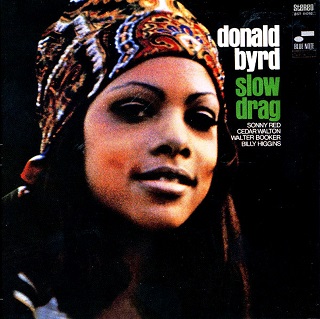
Biography by Steve Huey
Donald
Byrd was considered one of the finest hard bop trumpeters of the
post-Clifford Brown era. He recorded prolifically as both a leader and
sideman from the mid-'50s into the mid-'60s, most often for Blue Note,
where he established a reputation as a solid stylist with a clean tone,
clear articulation, and a knack for melodicism. Toward the end of the
'60s, Byrd became fascinated with Miles Davis' move into fusion, and
started recording his own forays into the field. In the early '70s, with
the help of brothers Larry and Fonce Mizell, Byrd perfected a bright,
breezy, commercially potent take on fusion that was distinct from Davis,
incorporating tighter arrangements and more of a smooth soul influence.
Opinions on this phase of Byrd's career diverge wildly -- jazz purists
utterly despised it, branding Byrd a sellout and the records a betrayal
of talent, but enraptured jazz-funk fans regard it as some of the most
innovative, enduring work of its kind. In fact, proportionately
speaking, Byrd was held in even higher esteem by that audience than by
straight-ahead jazz fans who enjoyed his hard bop output.
Donaldson
Toussaint L'Ouverture Byrd II was born in Detroit, Michigan, on
December 9, 1932. His father, a Methodist minister, was an amateur
musician, and Byrd was already an accomplished trumpeter by the time he
finished high school, having performed with Lionel Hampton. Byrd served a
stint in the Air Force, during which time he played in a military band,
and subsequently completed his bachelor's degree in music at Wayne
State University in 1954. He moved to New York in 1955 to get his
master's at the Manhattan School of Music, and soon began performing
with pianist George Wallington's group. In December of that year, he was
invited to join Art Blakey's Jazz Messengers, filling a chair once held
by his idol, Clifford Brown, and Kenny Dorham. Byrd also began his
recording career during this period, leading several sessions (mostly
for Savoy) and working often as a sideman, particularly at the Prestige
label. He left the Jazz Messengers in 1956 and joined up with Max Roach;
he went on to play with the likes of John Coltrane, Sonny Rollins, and
Red Garland, and also co-founded the Jazz Lab Quintet with altoist Gigi
Gryce in 1957.
In 1958, Byrd signed an exclusive recording
contract with Blue Note, and also formed a band with baritonist Pepper
Adams, who would remain Byrd's regular partner until 1961. Byrd's Blue
Note debut was 1958's Off to the Races, and he and Adams collaborated on
a series of excellent hard bop dates over the next three years,
including Byrd in Hand (1959), At the Half Note Cafe, Vols. 1-2 (1960),
The Cat Walk (1961), and Royal Flush (also 1961), among others. Another
1961 recording, Free Form, found Byrd giving a young Herbie Hancock some
of his earliest exposure. Following this burst of activity, Byrd took a
sabbatical to continue his studies in Europe, where he spent some time
under the tutelage of the legendary French music educator Nadia
Boulanger. He returned to the U.S. in 1963 and recorded A New
Perspective, a now-classic set that broke new ground by incorporating
gospel choirs into its arrangements; its signature piece, "Cristo
Redentor," became quite popular.
In the mid-'60s, Byrd focused
more of his energies on teaching, and worked diligently to make jazz and
its history a legitimate part of the college curriculum. He taught at
Rutgers, Hampton, New York University, and Howard in the late '60s, and
the last one remained a steady association for much of the '70s. In the
meantime, Byrd continued to record occasionally, cutting a final spate
of hard bop albums over 1966-1967 that included Mustang! and Blackjack.
Byrd also began to study African music, inspired partly by the emerging
Black-consciousness movement, and became interested in Miles Davis'
efforts to woo a younger audience (including Byrd's own students) by
experimenting with electronics and funk rhythms. Released in 1969, Fancy
Free found Byrd using electric piano for the first time, with a spacy
sound that recalled Davis' In a Silent Way. Issued in 1970, Electric
Byrd had more of a Bitches Brew flavor, and the jams on 1971's Ethiopian
Knights were longer, funkier, and more aggressive.
Byrd truly
came into his own as a fusion artist when he hooked up with brothers
Larry and Fonce Mizell, who began to handle production, writing, and
some musical support duties. Their first collaboration was 1972's Black
Byrd, an upbeat, funky blend of jazz and R&B. Jazz critics detested
the album and called Byrd all sorts of names, but the record was a smash
hit; it became the biggest seller in Blue Note history, and just missed
hitting number one on the R&B albums chart. In the wake of its
success, Byrd formed a supporting group, the Blackbyrds, who were culled
from the cream of his music students at Howard University and recorded
through the rest of the '70s. Byrd went on to release a string of
successful LPs in partnership with the Mizell Brothers, including the
imaginary blaxploitation soundtrack Street Lady (1974), Stepping into
Tomorrow (1975), the much-lauded Places and Spaces (1976), and
Caricatures (1977). All made the Top Ten on the R&B album charts,
and the Places and Spaces single "Change (Makes You Wanna Hustle)" even
got substantial play in discotheques. Jazz-funk fans revere this period
in general, but usually reserve their highest praise for Street Lady
and, especially, Places and Spaces. As a side note to his musical
career, Byrd finished law school in 1976, and went on to teach at North
Carolina Central University.
Following Caricatures, Byrd parted
ways with Blue Note and the Mizell Brothers and moved to Elektra. He
recorded several albums between 1978 and 1983, but even the most
commercially successful, 1978's Thank You...For F.U.M.L. (Funking Up My
Life), didn't match the infectiousness of his Blue Note jazz-funk
outings. In 1982, Byrd received his Ph.D. from Columbia Teachers
College. He spent a few years in the mid-'80s away from recording, due
in part to ill health, but continued to teach, moving on to North Texas
State and Delaware State. In the late '80s and early '90s, Byrd returned
to the hard bop of his early days on several sessions for the Landmark
label. He participated in rapper Guru's Jazzmatazz project in 1993, and
with the advent of the jazz-rap movement and England's acid jazz
revival, his '70s albums became hugely popular sources for samples. In
the meantime, Byrd continued his activities as a jazz educator. He died
in February 2013 at the age of 80.
https://www.allmusic.com/artist/donald-byrd-mn0000149946#biography
///////
Biografía de Steve Huey
Donald
Byrd fue considerado uno de los mejores trompetistas de hard bop de la
era posterior a Clifford Brown. Grabó prolíficamente como líder y
acompañante desde mediados de los 50 hasta mediados de los 60, la
mayoría de las veces para Blue Note, donde estableció una reputación
como un estilista sólido con un tono limpio, una articulación clara y
una habilidad especial para el melodicismo. Hacia finales de los 60,
Byrd quedó fascinado con el movimiento de Miles Davis hacia la fusión y
comenzó a grabar sus propias incursiones en el campo. A principios de
los 70, con la ayuda de los hermanos Larry y Fonce Mizell, Byrd
perfeccionó una versión brillante, alegre y comercialmente potente de la
fusión que era distinta de Davis, incorporando arreglos más ajustados y
una influencia soul más suave. Las opiniones sobre esta fase de la
carrera de Byrd divergen enormemente: los puristas del jazz lo
despreciaron por completo, calificando a Byrd de vendido y los discos de
traición al talento, pero los entusiastas fanáticos del jazz-funk lo
consideran uno de los trabajos más innovadores y perdurables de su tipo.
De hecho, proporcionalmente hablando, Byrd era tenido en una estima aún
mayor por esa audiencia que por los fanáticos del jazz que disfrutaban
de su producción de hard bop.
Donaldson Toussaint L'Ouverture
Byrd II nació en Detroit, Michigan, el 9 de diciembre de 1932. Su padre,
un ministro metodista, era músico aficionado, y Byrd ya era un
trompetista consumado cuando terminó la escuela secundaria, habiendo
actuado con Lionel Hampton. Byrd sirvió un período en la Fuerza Aérea,
tiempo durante el cual tocó en una banda militar, y posteriormente
completó su licenciatura en música en la Universidad Estatal de Wayne en
1954. Se mudó a Nueva York en 1955 para obtener su maestría en la
Escuela de Música de Manhattan, y pronto comenzó a tocar con el grupo
del pianista George Wallington. En diciembre de ese año, fue invitado a
unirse a los Jazz Messengers de Art Blakey, ocupando una silla que
alguna vez ocuparon su ídolo, Clifford Brown, y Kenny Dorham. Byrd
también comenzó su carrera discográfica durante este período, dirigiendo
varias sesiones (principalmente para Savoy) y trabajando a menudo como
acompañante, particularmente en el sello Prestige. Dejó los Jazz
Messengers en 1956 y se unió a Max Roach; pasó a tocar con gente como
John Coltrane, Sonny Rollins y Red Garland, y también cofundó el Jazz
Lab Quintet con la altoista Gigi Gryce en 1957.
En 1958, Byrd
firmó un contrato de grabación exclusivo con Blue Note, y también formó
una banda con el barítono Pepper Adams, quien seguiría siendo el socio
habitual de Byrd hasta 1961. El debut de Byrd en Blue Note fue Off to
the Races en 1958, y él y Adams colaboraron en una serie de excelentes
fechas de hard bop durante los siguientes tres años, incluido Byrd in
Hand (1959), En Half Note Cafe, Vols. 1-2 (1960) , The Cat Walk (1961) y
Royal Flush (también 1961), entre otros. Otra grabación de 1961, Free
Form, encontró a Byrd dándole a un joven Herbie Hancock parte de su
exposición más temprana. Tras este estallido de actividad, Byrd se tomó
un año sabático para continuar sus estudios en Europa, donde pasó un
tiempo bajo la tutela de la legendaria educadora musical francesa Nadia
Boulanger. Regresó a los Estados Unidos en 1963 y grabó A New
Perspective, un conjunto ahora clásico que abrió nuevos caminos al
incorporar coros góspel en sus arreglos; su pieza emblemática, "Cristo
Redentor", se hizo bastante popular.
A mediados de los 60, Byrd
centró más de sus energías en la enseñanza y trabajó diligentemente para
hacer del jazz y su historia una parte legítima del plan de estudios
universitario. Enseñó en Rutgers, Hampton, la Universidad de Nueva York y
Howard a fines de los 60, y la última siguió siendo una asociación
estable durante gran parte de los 70. Mientras tanto, Byrd continuó
grabando ocasionalmente, cortando una serie final de álbumes hard bop
durante 1966-1967 que incluían Mustang! y Blackjack. Byrd también
comenzó a estudiar música africana, inspirado en parte por el emergente
movimiento de conciencia negra, y se interesó en los esfuerzos de Miles
Davis por atraer a un público más joven (incluidos los propios
estudiantes de Byrd) experimentando con ritmos electrónicos y funk.
Lanzado en 1969, Fancy Free encontró a Byrd usando un piano eléctrico
por primera vez, con un sonido espacioso que recordaba a Davis De una
Manera Silenciosa. Emitido en 1970, Electric Byrd tenía más sabor a
brebaje de Perras, y las mermeladas de Ethiopian Knights de 1971 eran
más largas, funky y agresivas.
Byrd realmente se convirtió en un
artista de fusión cuando se conectó con los hermanos Larry y Fonce
Mizell, quienes comenzaron a encargarse de la producción, la escritura y
algunas tareas de apoyo musical. Su primera colaboración fue Black Byrd
de 1972, una mezcla alegre y funky de jazz y R & B. Los críticos de
jazz detestaban el álbum y llamaban a Byrd todo tipo de nombres, pero
el disco fue un gran éxito; se convirtió en el más vendido en la
historia de Blue Note, y simplemente no alcanzó el número uno en la
lista de álbumes de R&B. A raíz de su éxito, Byrd formó un grupo de
apoyo, The Blackbyrds, que fueron seleccionados de la flor y nata de sus
estudiantes de música en la Universidad de Howard y grabaron durante el
resto de los años 70. Byrd lanzó una serie de LP exitosos en asociación
con los Hermanos Mizell, incluida la banda sonora imaginaria de
blaxploitation Street Lady (1974), Stepping into Tomorrow (1975), los
muy elogiados Places and Spaces (1976) y Caricatures (1977). Todos
llegaron al Top Ten en las listas de álbumes de R&B, y el sencillo
de Places and Spaces "Change (Makes You Wanna Hustle)" incluso tuvo un
gran éxito en las discotecas. Los fanáticos del jazz-funk veneran este
período en general, pero generalmente reservan sus mayores elogios para
Street Lady y, especialmente, para Lugares y espacios. Como nota al
margen de su carrera musical, Byrd terminó la escuela de derecho en 1976
y luego enseñó en la Universidad Central de Carolina del Norte.
Después
de Caricatures, Byrd se separó de Blue Note y los Hermanos Mizell y se
mudó a Elektra. Grabó varios álbumes entre 1978 y 1983, pero incluso el
más exitoso comercialmente, Thank You de 1978...Para F. U. M. L.
(Funking Up My Life), no coincidía con la infecciosidad de sus salidas
Blue Note jazz-funk. En 1982, Byrd recibió su doctorado en Columbia
Teachers College. Pasó unos años a mediados de los 80 alejado de la
grabación, debido en parte a problemas de salud, pero continuó
enseñando, mudándose al Estado del Norte de Texas y al estado de
Delaware. A finales de los 80 y principios de los 90, Byrd volvió al
hard bop de sus primeros días en varias sesiones para el sello Landmark.
Participó en el proyecto Jazzmatazz del rapero Guru en 1993, y con la
llegada del movimiento jazz-rap y el resurgimiento del acid jazz de
Inglaterra, sus álbumes de los 70 se convirtieron en fuentes muy
populares de muestras. Mientras tanto, Byrd continuó sus actividades
como educador de jazz. Murió en febrero de 2013 a la edad de 80 años.
https://www.allmusic.com/artist/donald-byrd-mn0000149946#biography