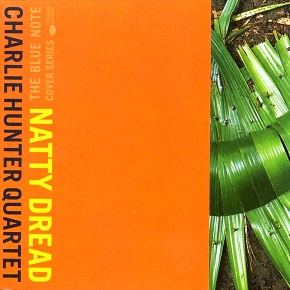
Review by Bill Meredith
In choosing to record Bob Marley's classic 1974 reggae album Natty Dread track-for-track in an instrumental jazz style, eight-string guitarist Charlie Hunter opened himself up for skepticism. Yet an idea that looked questionable in theory would prove stellar in practice, as Hunter turned Natty Dread -- with the songs sequenced exactly as they were on Marley's original release -- into one of the best CDs of his career. Hunter's customized eight-string instrument and prodigious talent allow him to play simultaneous guitar melodies and basslines, but his Wurlitzer organ simulations and walking bass aren't the only highlights of the opening "Lively Up Yourself." Alto saxophonist Calder Spanier and tenorman Kenny Brooks alternate between swinging leads and supportive harmonies, and drummer Scott Amendola gets in creative solo flurries near the end. Hunter's beautiful intro to "No Woman, No Cry" echoes both Pat Martino and Django Reinhardt; the saxophonists' interplay and Amendola's clever rimshots, tom-toms, and cowbell work lively up "Them Belly Full." The secrets to Hunter's success lie in separate amplifiers for his instrument's guitar and bass portions; great wah-wah pedal work to achieve keyboard tones, and the requisite brain power to play basslines with both thumbs while fretting and fingerpicking the melodies. All are illustrated in readings of the tranquil "Rebel Music," energetic "So Jah Seh" and the shuffling title track. Throughout Natty Dread, reggae is implied more often than played, as Hunter and his quartet portray the fun they had in arranging these pieces with performances both swinging and stirring (even dropping an "I Shot the Sheriff" quote into "Bend Down Low"). Spanier died after Natty Dread's release when he was struck by a car, and Hunter subsequently moved from California to New York and restructured his band. There's no telling what might have come afterward from this quartet of two saxophonists, a drummer, and Hunter, the one-man guitarist, keyboardist, and bassist.
https://www.allmusic.com/album/natty-dread-mw0000099526
By Douglas Payne
May 1, 1997
From the surprisingly successful Blue Note Cover Series comes this exceptional disc by multi-talented eight-string guitarist Charlie Hunter. The 29-year old Hunter has made a thankfully unpredictable choice "covering" Bob Marley's influential and popular 1974 reggae classic Natty Dread. Hunter, heard here in a quartet with an alto, tenor sax and drums, resists the urge toward reverential readings and reggae clichés in this music. As a result, the soulful beauty of Marley's outstanding music shines through. Anyone familiar with Hunter's work in the ultra-cool quartet T.J. Kirk can expect another dose of thoughtful, sometimes funky -but always original -takes on somewhat familiar material.
Charlie Hunter, like Bill Frisell and John Abercrombie, can wield any sound he wants to from his guitar (an eight-string is only slightly less weird than Ron Escheté's unimaginably difficult seven-string guitar). Hunter can make his axe wail like an organ, ring like a pedal steel, whine with Hendrix-like feedback or sing like Grant Green on an especially soulful day. Hunter is comfortable in just about any style imaginable too—but he sticks mostly to very accessible playing. What he does with Marley's hit "No Woman, No Cry" is tender, passionate and unbelievably beautiful. It's origins are evident but the liners spell out the influence Bill Frisell and Ry Cooder (nice to see Cooder get his due for a change). Hunter's version has hit potential, and deserves to get widespread airplay. Everyone who heard this song while I played the disc (including my mother, who doesn't like jazz) was just hypnotized by it. Another hit-worthy tune is the marvelous version of the anthem-like "Revolution" which features the reeds. Hunter also kicks out the jams here, crafting a John Patton / John Zorn / Ed Cherry does James Brown groove on "Bend Down Low." And there's something appealing about the '70s Jeff Beck funk of "Lively Up Yourself" and "Talkin' Blues" too. Throughout, Hunter sounds inspired and interested—and the average listener will find as much to appreciate here. A very nice surprise worth checking out.
Another nice surprise is guitarist Fareed Haque's "cover" of Crosby, Stills, Nash and Young's 1970 "classic rock" album Deja Vu. Haque's incredible six-string talents (on classic guitar) and the acid-jazz appeal often overcome what could have been simply a smooth-jazz recollection of some hippy-dippy fun. A Blue Note concept (that must have sounded gimmicky on paper) turns out to yield some good, valuable music for the 1990s.
https://www.allaboutjazz.com/natty-dread-charlie-hunter-blue-note-records-review-by-douglas-payne
///////
Reseña de Bill Meredith
Al elegir grabar el clásico álbum de reggae Natty Dread de Bob Marley de 1974 pista por pista en un estilo instrumental de jazz, el guitarrista de ocho cuerdas Charlie Hunter se abrió al escepticismo. Sin embargo, una idea que parecía cuestionable en teoría resultaría estelar en la práctica, ya que Hunter convirtió a Natty Dread, con las canciones secuenciadas exactamente como estaban en el lanzamiento original de Marley, en uno de los mejores CD de su carrera. El instrumento personalizado de ocho cuerdas de Hunter y su prodigioso talento le permiten tocar melodías de guitarra y líneas de bajo simultáneas, pero sus simulaciones de órgano Wurlitzer y el bajo andante no son los únicos aspectos destacados de la apertura "Lively Up Yourself."El saxofonista alto Calder Spanier y el tenorista Kenny Brooks alternan entre pistas oscilantes y armonías de apoyo, y el baterista Scott Amendola se mete en ráfagas creativas en solitario cerca del final. La hermosa introducción de Hunter a "No Woman, No Cry" se hace eco tanto de Pat Martino como de Django Reinhardt; la interacción de los saxofonistas y los ingeniosos rimshots, tom-toms y cencerro de Amendola funcionan animadamente " Con el estómago lleno."Los secretos del éxito de Hunter radican en amplificadores separados para las partes de guitarra y bajo de su instrumento; un gran trabajo de pedales wah-wah para lograr tonos de teclado y la capacidad cerebral necesaria para tocar líneas de bajo con ambos pulgares mientras se preocupa y toca las melodías con los dedos. Todos están ilustrados en lecturas de la tranquila "Música Rebelde", la enérgica "So Jah Seh" y la pista que da título al álbum. A lo largo de Natty Dread, el reggae se insinúa con más frecuencia que cuando se toca, ya que Hunter y su cuarteto retratan la diversión que tuvieron al arreglar estas piezas con actuaciones tanto oscilantes como conmovedoras (incluso dejando caer una cita de "Le disparé al Sheriff" en "Agáchate"). Spanier murió después del lanzamiento de Natty Dread cuando fue atropellado por un automóvil, y Hunter posteriormente se mudó de California a Nueva York y reestructuró su banda. No se sabe qué podría haber salido después de este cuarteto de dos saxofonistas, un baterista y Hunter, el guitarrista, tecladista y bajista de un solo hombre.
https://www.allmusic.com/album/natty-dread-mw0000099526
Por Douglas Payne
1 de mayo de 1997
De la sorprendentemente exitosa serie de portadas Blue Note llega este excepcional disco del talentoso guitarrista de ocho cuerdas Charlie Hunter. Hunter, de 29 años, ha tomado una decisión afortunadamente impredecible al "cubrir" el influyente y popular clásico de reggae de Bob Marley de 1974 Natty Dread. Hunter, escuchado aquí en un cuarteto con saxo alto, tenor y batería, resiste el impulso hacia lecturas reverenciales y clichés reggae en esta música. Como resultado, brilla la belleza conmovedora de la excepcional música de Marley. Cualquiera que esté familiarizado con el trabajo de Hunter en el cuarteto ultra genial T. J. Kirk puede esperar otra dosis de tomas reflexivas, a veces funky, pero siempre originales, de material algo familiar.
Charlie Hunter, como Bill Frisell y John Abercrombie, puede manejar cualquier sonido que desee con su guitarra (una guitarra de ocho cuerdas es solo un poco menos extraña que la inimaginablemente difícil guitarra de siete cuerdas de Ron Escheté). Hunter puede hacer gemir su hacha como un órgano, sonar como un pedal de acero, gemir con comentarios similares a los de Hendrix o cantar como Grant Green en un día especialmente conmovedor. Hunter también se siente cómodo con casi cualquier estilo imaginable—pero se apega principalmente a tocar de manera muy accesible. Lo que hace con el éxito de Marley "No Woman, No Cry" es tierno, apasionado e increíblemente hermoso. Sus orígenes son evidentes, pero los liners explican la influencia de Bill Frisell y Ry Cooder (es bueno ver a Cooder recibir su merecido por un cambio). La versión de Hunter ha alcanzado potencial y merece una amplia difusión en el aire. Todos los que escucharon esta canción mientras tocaba el disco (incluida mi madre, a quien no le gusta el jazz) quedaron hipnotizados por ella. Otra melodía digna de éxito es la maravillosa versión del himno "Revolution" que presenta las cañas. Hunter también saca los atascos aquí, creando un ritmo de John Patton / John Zorn / Ed Cherry does James Brown en " Bend Down Low."Y también hay algo atractivo en el funk de Jeff Beck de los 70 de "Lively Up Yourself" y "Talkin 'Blues". En todo momento, Hunter suena inspirado e interesado, y el oyente promedio encontrará mucho que apreciar aquí. Una sorpresa muy agradable que vale la pena echarle un vistazo.
Otra agradable sorpresa es la "versión" del guitarrista Fareed Haque del álbum de "rock clásico" Deja Vu de Crosby, Stills, Nash y Young de 1970. Los increíbles talentos de seis cuerdas de Haque (en la guitarra clásica) y el atractivo del acid-jazz a menudo superan lo que podría haber sido simplemente un recuerdo suave de jazz de algo de diversión hippy-dippy. Un concepto de Blue Note (que debe haber sonado efectista en el papel) resulta producir música buena y valiosa para la década de 1990.
https://www.allaboutjazz.com/natty-dread-charlie-hunter-blue-note-records-review-by-douglas-payne
www.charliehunter.com ...