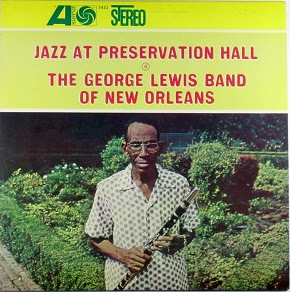
El
clarinetista George Lewis fue el típico jazzman de New Orleans,
autodidacta, incapaz de leer música y sin embargo supo desarrollar su
propio estilo, un modo de tocar absolutamente personal que sólo pudo
darle la escuela del segregacionismo y de la miseria.
Se
estrenó profesionalmente muy joven en Nueva Orleáns; fue miembro de la
"Black Eagle Band" y tocó después con Leonard Parker, Chris Kelly, Kid
Rena y con la orquesta de Buddy Petit. A diferencia de muchos otros
músicos, George Lewis, jamás se desplazó de su lugar de origen en busca
de fortuna, pero sí consiguió formar su propia orquesta con el
trompetista, Henry Red Allen. Lamentablemente, a principios de los años
treinta su popularidad decayó, por lo que hubo de abandonar la escena
musical y empezó a trabajar como estibador portuario en su ciudad natal.
Por fortuna, Gene Williams lo redescubrió en 1942,
convirtiéndose en uno de los principales exponentes de la New Orleáns
Renaissance, fenómeno que revolucionó el mundo del jazz en los años
cuarenta. Por aquel entonces, Lewis fue contratado en el grupo de Bunk
Johnson, el célebre trompetista de New Orleáns, también "repescado" en
aquella época. En 1943, formó la "George Lewis New Orleáns Stompers",
formada por el trompetista, Avery Hodward, el trombonista, Jim Robinson,
el banjoísta, Lawrence Marrero, el contrabajista, Chester Zardis y el
baterista, Edgar Mosley. Con esa formación grabó para la American Music y
también con otra formación de Bunk Johnson denominada, "Bunk Johnson
and Street Paraders".
En 1957, después de algunos años
invernando en New Orleáns, viajó a Inglaterra para tocar con la orquesta
de Ken Colyer. Posteriormente en 1959 realizó una gira por Europa y
Japón, donde cosechó grandes éxitos. De vuelta a Nueva Orleáns, siguió
tocando y actuando, sobre todo en el "Preservation Hall" con la orquesta
de Deedee Pierce hasta que le sobrevino la muerte en 1968.
https://es.wikipedia.org/wiki/George_Lewis
///////
Biography
by Scott Yanow
George
Lewis never tried to be a virtuoso soloist. He loved to play melodic
ensembles where his distinctive clarinet was free to improvise as simply
as he desired. When Lewis was inspired and in tune, he could hold his
own with any of his contemporaries in New Orleans and he always sounded
beautiful playing his "Burgundy Street Blues." To everyone's surprise
(including himself), he became one of the most popular figures of the
New Orleans revival movement of the 1950s.
It took Lewis a long
time to achieve fame. He taught himself clarinet when he was 18 and
worked in the '20s with the Black Eagle Band, Buddy Petit, the Eureka
Brass Band, Chris Kelly, Kid Ory, the Olympia Orchestra, and other New
Orleans groups. He played with Bunk Johnson in Evan Thomas' group in the
early '30s but had a day job throughout most of the decade. When Bunk
was discovered in 1942, Lewis became part of his band, playing with him
Johnson, however, was difficult to get along with and a homesick Lewis
returned to New Orleans by 1946. He played locally with his own group
(featuring trombonist Jim Robinson) and in 1950 was portrayed in an
article for Look. That exposure led to him recording regularly, and by
1952, Lewis was in such great demand that he was soon working before
crowds in California and touring Europe and Japan. In addition to
Robinson, Lewis' band in its prime years often featured trumpeter Kid
Howard, pianist Alton Purnell, banjoist Lawrence Marrero, bassist Alcide
"Slow Drag" Pavageau, and drummer Joe Watkins. George Lewis, who
recorded for many labels (a Mosaic box set of his Blue Note sessions is
one of the best reissues), became a symbol of what was right and wrong
about the New Orleans revival movement, overpraised by his fans and
overcritized by his detractors. At his best he was well worth hearing.
https://www.allmusic.com/artist/george-lewis-mn0000945658/biography