egroj world: Art Taylor
Showing posts with label Art Taylor. Show all posts

Saturday, May 31, 2025

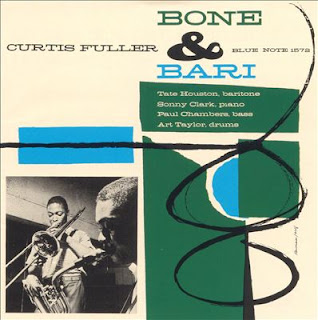
Curtis Fuller • Bone & Bari


Review
by Lee Bloom
Curtis Fuller emerged during the 1950s as a leading hard bop trombonist. A native of Detroit, Fuller was initially inspired by hearing J.J. Johnson, who became a mentor for the young musician. This recording was completed only weeks before Fuller went into the studio to record John Coltrane's Blue Trane. The session is unique in its pairing of trombone with the baritone sax of Tate Houston. The resultant front line sound is thick and rotund. The rhythm section of Sonny Clark, Paul Chambers and Art Taylor had a lovely rapport; individually and collectively, these three made many important recordings in the late 1950s, especially for the Blue Note label. Highlights of Bone & Bari include the title tune, penned by Fuller, and the group's rendering of the standard "Heart and Soul."
https://www.allmusic.com/album/bone-bari-mw0000341687


Biography
by Ron Wynn
Curtis Fuller belonged in the select circle with J.J. Johnson, Kai Winding, and a few others who make the trombone sound fluid and inviting rather than awkward. His ability to make wide-octave leaps and play whiplash phrases in a relaxed, casual manner was a testament to his skill. Fuller's solos and phrases were often ambitious and creative, and he worked in several fine bands and participated in numerous great sessions.

Fuller studied music in high school, then began developing his skills in an Army band, where he played with Cannonball Adderley. He worked in Detroit with Kenny Burrell and Yusef Lateef, then moved to New York. Fuller made his recording debut as a leader on Transition in 1955, and recorded in the late '50s for Blue Note, Prestige, United Artists, and Savoy. He was a charter member of the Jazztet with Benny Golson and Art Farmer in 1959, then played in Art Blakey's Jazz Messengers from 1961 to 1965. There were additional recording dates for Warwick, Smash/Trip, Epic, and Impulse! in the '60s. Fuller toured Europe with Dizzy Gillespie's big band in 1968, then did several sessions in New York.

During the '70s, he experimented for a time playing hard bop arrangements in a band featuring electronic instruments, heading a group with guitarist Bill Washer and Stanley Clarke. He concluded that phase with the 1973 album Crankin'. Fuller toured with the Count Basie band from 1975 to 1977, and did dates for Mainstream, Timeless, and Bee Hive. He co-led the quintet Giant Bones with Winding in 1979 and 1980, and played with Art Blakey, Cedar Walton, and Benny Golson in the late '70s and early '80s. During the '80s, Fuller toured Europe regularly with the Timeless All-Stars, and performed and recorded with the revamped Jazztet in addition to leading a fine session for Savoy in 1993.

Fuller continued playing dates and working in the decades that followed, recording albums for labels like Delmark, Capri, and Savant. He retired from playing in the early 2010s; his final studio album was 2012's Down Home. The legendary trombonist died on May 8, 2021, at the age of 88.
https://www.allmusic.com/artist/curtis-fuller-mn0000139566/biography

///////


Reseña
por Lee Bloom
Curtis Fuller surgió durante la década de 1950 como un destacado trombonista de hard bop. Nativo de Detroit, Fuller se inspiró inicialmente al escuchar a J.J. Johnson, que se convirtió en mentor del joven músico. Esta grabación se realizó sólo unas semanas antes de que Fuller entrara en el estudio para grabar Blue Trane de John Coltrane. La sesión es única por el emparejamiento del trombón con el saxo barítono de Tate Houston. El sonido resultante de la primera línea es grueso y rotundo. La sección rítmica de Sonny Clark, Paul Chambers y Art Taylor se compenetraba muy bien; individual y colectivamente, estos tres hicieron muchas grabaciones importantes a finales de los años 50, especialmente para el sello Blue Note. Lo más destacado de Bone & Bari incluye la melodía del título, escrita por Fuller, y la interpretación del grupo del estándar "Heart and Soul".
https://www.allmusic.com/album/bone-bari-mw0000341687


Biografía
por Ron Wynn
Curtis Fuller pertenece al selecto círculo de J.J. Johnson, Kai Winding y algunos otros que hacen que el trombón suene fluido y atractivo en lugar de incómodo. Su capacidad para dar saltos de octava amplia y tocar frases latigazosas de forma relajada y desenfadada era un testimonio de su habilidad. Los solos y frases de Fuller eran a menudo ambiciosos y creativos, y trabajaba en varias bandas excelentes y participaba en numerosas y grandes sesiones.

Fuller estudió música en el instituto y luego empezó a desarrollar sus habilidades en una banda del ejército, donde tocó con Cannonball Adderley. Trabajó en Detroit con Kenny Burrell y Yusef Lateef, y luego se trasladó a Nueva York. Fuller hizo su debut discográfico como líder en Transition en 1955, y grabó a finales de los 50 para Blue Note, Prestige, United Artists y Savoy. Fue miembro fundador del Jazztet con Benny Golson y Art Farmer en 1959, y luego tocó en los Jazz Messengers de Art Blakey de 1961 a 1965. También grabó para Warwick, Smash/Trip, Epic e Impulse en los años 60. Fuller realizó una gira por Europa con la big band de Dizzy Gillespie en 1968, y luego hizo varias sesiones en Nueva York.

Durante los años 70, experimentó durante un tiempo tocando arreglos de hard bop en una banda con instrumentos electrónicos, encabezando un grupo con el guitarrista Bill Washer y Stanley Clarke. Concluyó esa etapa con el álbum Crankin', de 1973. Fuller estuvo de gira con la banda de Count Basie de 1975 a 1977, y realizó fechas para Mainstream, Timeless y Bee Hive. Codirigió el quinteto Giant Bones con Winding en 1979 y 1980, y tocó con Art Blakey, Cedar Walton y Benny Golson a finales de los 70 y principios de los 80. Durante los años 80, Fuller realizó giras regulares por Europa con los Timeless All-Stars, y actuó y grabó con el renovado Jazztet, además de dirigir una excelente sesión para Savoy en 1993.

Fuller siguió tocando y trabajando en las décadas siguientes, grabando discos para sellos como Delmark, Capri y Savant. Se retiró de tocar a principios de la década de 2010; su último álbum de estudio fue Down Home, de 2012. El legendario trombonista falleció el 8 de mayo de 2021, a la edad de 88 años.
https://www.allmusic.com/artist/curtis-fuller-mn0000139566/biography


Charlie Rouse • Takin' Care Of Business


Biography
by Scott Yanow
Possessor of a distinctive tone and a fluid bop-oriented style, Charlie Rouse was in Thelonious Monk's Quartet for over a decade (1959-1970) and, although somewhat taken for granted, was an important ingredient in Monk's music. Rouse was always a modern player and he worked with Billy Eckstine's orchestra (1944) and the first Dizzy Gillespie big band (1945), making his recording debut with Tadd Dameron in 1947. Rouse popped up in a lot of important groups including Duke Ellington's Orchestra (1949-1950), Count Basie's octet (1950), on sessions with Clifford Brown in 1953, and with Oscar Pettiford's sextet (1955). He co-led the Jazz Modes with Julius Watkins (1956-1959), and then joined Monk for a decade of extensive touring and recordings. In the 1970s he recorded a few albums as a leader, and in 1979 he became a member of Sphere. Charlie Rouse's unique sound began to finally get some recognition during the 1980s. He participated on Carmen McRae's classic Carmen Sings Monk album and his last recording was at a Monk tribute concert.
https://www.allmusic.com/artist/charlie-rouse-mn0000176387/biography

///////


Biografía
por Scott Yanow
Poseedor de un tono inconfundible y un estilo fluido orientado al bop, Charlie Rouse formó parte del cuarteto de Thelonious Monk durante más de una década (1959-1970) y, aunque en cierto modo se da por sentado, fue un ingrediente importante en la música de Monk. Rouse siempre fue un intérprete moderno y trabajó con la orquesta de Billy Eckstine (1944) y con la primera big band de Dizzy Gillespie (1945), debutando en disco con Tadd Dameron en 1947. Rouse apareció en muchos grupos importantes, como la orquesta de Duke Ellington (1949-1950), el octeto de Count Basie (1950), en sesiones con Clifford Brown en 1953 y con el sexteto de Oscar Pettiford (1955). Codirigió los Jazz Modes con Julius Watkins (1956-1959), y después se unió a Monk para una década de extensas giras y grabaciones. En los años 70 grabó algunos álbumes como líder, y en 1979 se convirtió en miembro de Sphere. El sonido único de Charlie Rouse empezó a obtener por fin cierto reconocimiento durante la década de 1980. Participó en el clásico álbum de Carmen McRae Carmen Sings Monk y su última grabación fue en un concierto homenaje a Monk.
https://www.allmusic.com/artist/charlie-rouse-mn0000176387/biography


Sunday, May 18, 2025

Paul Chambers • Bass on Top


Review by Stephen Thomas Erlewine
Bass on Top is another thoroughly engaging set of straight-ahead, mainstream jazz from Paul Chambers. The bassist leads a quartet comprised of guitarist Kenny Burrell, pianist Hank Jones, and drummer Art Taylor through a selection of standards, including "Yesterdays," "You'd Be So Nice to Come Home To," and "Dear Old Stockholm," as well as a handful of contemporary jazz numbers and originals. There's a relaxed, friendly atmosphere to the music, both in its tone and in the fact that Chambers lets Jones and Burrell have some time in the spotlight. The result is a warm, entertaining collection of mainstream jazz that nevertheless rewards close listening.
https://www.allmusic.com/album/bass-on-top-mw0000191612

///////


Reseña de Stephen Thomas Erlewine
Bass on Top es otro atractivo conjunto de jazz directo y mainstream de Paul Chambers. El bajista dirige un cuarteto compuesto por el guitarrista Kenny Burrell, el pianista Hank Jones y el baterista Art Taylor a través de una selección de estándares, incluyendo «Yesterdays», «You'd Be So Nice to Come Home To» y «Dear Old Stockholm», así como un puñado de números de jazz contemporáneo y originales. Hay un ambiente relajado y amistoso en la música, tanto en su tono como en el hecho de que Chambers deja que Jones y Burrell tengan algo de tiempo en el centro de atención. El resultado es una colección cálida y entretenida de jazz convencional que, sin embargo, merece una escucha atenta.
https://www.allmusic.com/album/bass-on-top-mw0000191612


Saturday, April 19, 2025

Dizzy Reece Quintet • From in to out


Alphonso Son "Dizzy" Reece is a hard bop jazz trumpeter with a distinctive sound and compositional style.
Reece was born January 5, 1931 in Kingston, Jamaica, the son of a silent film pianist. He attended the Alpha Boys School (famed in Jamaica for its musical alumni), switching from baritone to trumpet at 14. A full-time musician from age 16, he moved to London in 1948 and spent the 1950s working in Europe, much of that time in Paris. He played with Don Byas, Kenny Clarke, Frank Foster and Thad Jones, among others. Winning praise from the likes of Miles Davis and Sonny Rollins, he emigrated to New York City in 1959, but found New York in the 1960s a struggle. Too little heard-from in the intervening years, he had a reissue on Mosaic in 2004 that gave fans hope of a comeback. https://www.allaboutjazz.com/musicians/dizzy-reece/


Biography by Scott Yanow
Dizzy Reece is a fine hard bop trumpeter who has been overshadowed by the innovators of the style. He started on trumpet when he was 14 and moved to Europe in 1949. It was while he was based in England (1954-1959) that he achieved some recognition through a series of recordings with top English musicians, plus a 1958 date with Donald Byrd. He moved to New York in 1959 but, after a few notable recordings and a bit of publicity, Reece seemed to largely fade away despite remaining active. He was with the Dizzy Gillespie's orchestra in 1968 and the Paris Reunion Band in 1985. https://www.allmusic.com/artist/dizzy-reece-mn0000161947#biography

///////

Alphonso Son «Dizzy» Reece es un trompetista de jazz hard bop con un sonido y un estilo compositivo característicos.
Reece nació el 5 de enero de 1931 en Kingston, Jamaica, hijo de un pianista de cine mudo. Asistió a la Alpha Boys School (famosa en Jamaica por sus antiguos alumnos de música), y cambió el barítono por la trompeta a los 14 años. Músico a tiempo completo desde los 16 años, se trasladó a Londres en 1948 y pasó la década de 1950 trabajando en Europa, gran parte de ese tiempo en París. Tocó con Don Byas, Kenny Clarke, Frank Foster y Thad Jones, entre otros. Tras recibir los elogios de Miles Davis y Sonny Rollins, emigró a Nueva York en 1959, pero en la década de 1960 Nueva York le resultó difícil. En 2004, Mosaic reeditó su música, lo que dio a los aficionados la esperanza de un regreso. https://www.allaboutjazz.com/musicians/dizzy-reece/


Biografía de Scott Yanow
Dizzy Reece es un excelente trompetista de hard bop que ha sido eclipsado por los innovadores del estilo. Empezó a tocar la trompeta a los 14 años y se trasladó a Europa en 1949. Fue durante su estancia en Inglaterra (1954-1959) cuando alcanzó cierto reconocimiento gracias a una serie de grabaciones con los mejores músicos ingleses, además de una cita en 1958 con Donald Byrd. Se trasladó a Nueva York en 1959 pero, tras unas pocas grabaciones notables y un poco de publicidad, Reece pareció desvanecerse en gran medida a pesar de seguir en activo. Formó parte de la orquesta de Dizzy Gillespie en 1968 y de la Paris Reunion Band en 1985.
https://www.allmusic.com/artist/dizzy-reece-mn0000161947#biography


Thursday, April 17, 2025

Dizzy Reece Quintet • From in to out


Review by Sean Westergaard
From in to Out is a live set from what was probably a one-off group of Dizzy Reece on trumpet, John Gilmore (doing a bit of freelancing on an Arkestra tour of Europe) on tenor, Siegfried Kessler on piano, and a rhythm section of Patrice Caratini on bass and Art Taylor on drums. Side one has a very Coltrane-esque feel, thanks mostly to Kessler's McCoy Tyner-isms and the driving rhythms of Art Taylor. Presumably without much rehearsal time, they basically set up a groove and blow. Reece solos first, followed by Gilmore and Kessler, before moving into a brief unaccompanied bass solo. Side two has the band shifting into an odd-meter groove, strongly reminiscent of "Dancing Girls" from Pete La Roca's Turkish Women at the Bath (another rare foray outside the Arkestra for Gilmore). About halfway through the second side, the band heads back to Trane territory to close out the set. Overall, this is an excellent, well-recorded set, even if it's nothing groundbreaking or earth-shattering. Highlights are the great drumming of Art Taylor and another fairly rare chance to hear John Gilmore operating outside of Sun Ra's music.
https://www.allmusic.com/album/from-in-to-out-mw0001882149

///////


Reseña de Sean Westergaard
From in to Out es una grabación en directo de lo que probablemente fue un grupo único formado por Dizzy Reece a la trompeta, John Gilmore (que trabajaba como freelance en una gira de la Arkestra por Europa) al tenor, Siegfried Kessler al piano y una sección rítmica formada por Patrice Caratini al bajo y Art Taylor a la batería. La primera cara tiene un aire muy Coltrane, gracias sobre todo a los McCoy Tynerismos de Kessler y a los ritmos de Art Taylor. Presumiblemente sin mucho tiempo de ensayo, básicamente establecen un groove y soplan. Reece hace el primer solo, seguido de Gilmore y Kessler, antes de pasar a un breve solo de bajo sin acompañamiento. En la segunda cara, la banda se adentra en un groove de compás extraño, que recuerda mucho a «Dancing Girls» del disco de Pete La Roca Turkish Women at the Bath (otra rara incursión de Gilmore fuera de la Arkestra). Hacia la mitad de la segunda cara, la banda vuelve al territorio de Trane para cerrar el set. En general, se trata de un conjunto excelente y bien grabado, aunque no sea nada rompedor ni revolucionario. Lo más destacado es la gran batería de Art Taylor y otra rara oportunidad de escuchar a John Gilmore fuera de la música de Sun Ra.
https://www.allmusic.com/album/from-in-to-out-mw0001882149


Saturday, February 15, 2025

Louis Smith • Smithville


Review
by Stephen Thomas Erlewine
Like his debut, Smithville is another set of thoroughly winning straight-ahead bop from the underappreciated trumpeter Louis Smith. Stylistically, there are no surprises here -- this is mainstream bop and hard bop, comprised of original and contemporary bop numbers, as well as standards ("There'll Never Be Another You," "Embraceable You") -- but since the music is performed so well, it doesn't matter. There is genuine passion to this music, not only from Smith, but also from pianist Sonny Clark, tenor saxophonist Charlie Rouse, bassist Paul Chambers and drummer Art Taylor. It's a first-rate hard bop set that deserves wider distribution than it has received.
https://www.allmusic.com/album/smithville-mw0000498692

///////


Reseña
por Stephen Thomas Erlewine
Al igual que su debut, Smithville es otro conjunto de bop straight-ahead completamente ganador del subestimado trompetista Louis Smith. Estilísticamente, no hay sorpresas aquí - se trata de bop mainstream y hard bop, compuesto de números bop originales y contemporáneos, así como estándares ("There'll Never Be Another You", "Embraceable You") - pero como la música se interpreta tan bien, no importa. Hay auténtica pasión en esta música, no sólo por parte de Smith, sino también del pianista Sonny Clark, el saxofonista tenor Charlie Rouse, el bajista Paul Chambers y el batería Art Taylor. Es un conjunto de hard bop de primera clase que merece una distribución más amplia de la que ha recibido.
https://www.allmusic.com/album/smithville-mw0000498692


Thursday, February 13, 2025

Dizzy Reece • Blues In Trinity


Review
by Stephen Thomas Erlewine  
As Dizzy Reece's first album for Blue Note, Blues in Trinity goes a long way to establish the trumpeter's signature sound. Reece doesn't take chances stylistically; he prefers to stay within the confines of hard bop. Nevertheless, he has a bold, forceful sound that simply burns with passion. Even on slower numbers, there's a fire to his playing that keeps Blues in Trinity from being predictable. The high quality of the album is even more impressive given the recording circumstances. The English-based Reece was playing in Paris at the time, and he assembled a sextet featuring the vacationing British musicians Tubby Hayes (tenor saxophone) and Terry Shannon (piano), visiting American stars Donald Byrd (trumpet) and Art Taylor (drums), and Canadian bassist Lloyd Thompson, who was playing in Paris with Zoot Sims. Although the band was thrown together, there's a definite spark to this combo, which interacts as if it had been playing together for a long time. Throughout it all, Reece steals the show with his robust playing, and that's why Blues in Trinity rises above the level of standard-issue hard bop and becomes something special.
https://www.allmusic.com/album/blues-in-trinity-mw0000710553

///////


Reseña
por Stephen Thomas Erlewine  
Como primer álbum de Dizzy Reece para Blue Note, Blues in Trinity contribuye en gran medida a establecer el sonido característico del trompetista. Reece no se arriesga estilísticamente; prefiere permanecer dentro de los confines del hard bop. Sin embargo, tiene un sonido audaz y contundente que arde de pasión. Incluso en los números más lentos, hay un fuego en su forma de tocar que hace que Blues in Trinity no sea predecible. La alta calidad del álbum es aún más impresionante dadas las circunstancias de la grabación. Reece, afincado en Inglaterra, estaba tocando en París por aquel entonces y reunió a un sexteto formado por los músicos británicos Tubby Hayes (saxo tenor) y Terry Shannon (piano), las estrellas americanas Donald Byrd (trompeta) y Art Taylor (batería), y el bajista canadiense Lloyd Thompson, que estaba tocando en París con Zoot Sims. Aunque la banda se formó de improviso, hay una chispa definida en este combo, que interactúa como si hubieran estado tocando juntos durante mucho tiempo. En todo momento, Reece se lleva la palma con su robusta interpretación, y por eso Blues in Trinity supera el nivel del hard bop estándar y se convierte en algo especial.
https://www.allmusic.com/album/blues-in-trinity-mw0000710553


Monday, February 10, 2025

Paul Chambers • Bass on Top


Review
by Stephen Thomas Erlewine
Bass on Top is another thoroughly engaging set of straight-ahead, mainstream jazz from Paul Chambers. The bassist leads a quartet comprised of guitarist Kenny Burrell, pianist Hank Jones, and drummer Art Taylor through a selection of standards, including "Yesterdays," "You'd Be So Nice to Come Home To," and "Dear Old Stockholm," as well as a handful of contemporary jazz numbers and originals. There's a relaxed, friendly atmosphere to the music, both in its tone and in the fact that Chambers lets Jones and Burrell have some time in the spotlight. The result is a warm, entertaining collection of mainstream jazz that nevertheless rewards close listening.
https://www.allmusic.com/album/bass-on-top-mw0000191612

///////


Reseña
por Stephen Thomas Erlewine
Bass on Top es otro atractivo conjunto de jazz directo y mainstream de Paul Chambers. El bajista dirige un cuarteto compuesto por el guitarrista Kenny Burrell, el pianista Hank Jones y el baterista Art Taylor a través de una selección de estándares, incluyendo "Yesterdays", "You'd Be So Nice to Come Home To" y "Dear Old Stockholm", así como un puñado de números de jazz contemporáneo y originales. Hay un ambiente relajado y amistoso en la música, tanto en su tono como en el hecho de que Chambers deja que Jones y Burrell tengan algo de tiempo en el centro de atención. El resultado es una colección cálida y entretenida de jazz convencional que, sin embargo, merece una escucha atenta.
https://www.allmusic.com/album/bass-on-top-mw0000191612


Saturday, February 8, 2025

Cliff Jordan • Cliff Jordan [BN 1565]


Biography
by Scott Yanow
Clifford Jordan was a fine inside/outside player who somehow held his own with Eric Dolphy in the 1964 Charles Mingus Sextet. Jordan had his own sound on tenor almost from the start. He gigged around Chicago with Max Roach, Sonny Stitt, and some R&B groups before moving to New York in 1957. Jordan immediately made a strong impression, leading three albums for Blue Note (including a meeting with fellow tenor John Gilmore) and touring with Horace Silver (1957-1958), J.J. Johnson (1959-1960), Kenny Dorham (1961-1962), and Max Roach (1962-1964). After performing in Europe with Mingus and Dolphy, Jordan worked mostly as a leader but tended to be overlooked since he was not overly influential or a pacesetter in the avant-garde. A reliable player, Clifford Jordan toured Europe several times, was in a quartet headed by Cedar Walton in 1974-1975, and during his last years, led a big band. He recorded as a leader for Blue Note, Riverside, Jazzland, Atlantic (a little-known album of Leadbelly tunes), Vortex, Strata-East, Muse, SteepleChase, Criss Cross, Bee Hive, DIW, Milestone, and Mapleshade.
https://www.allmusic.com/artist/clifford-jordan-mn0000157487/biography

///////

Biografía
por Scott Yanow
Clifford Jordan fue un excelente intérprete interior/exterior que, de alguna manera, se mantuvo junto a Eric Dolphy en el Sexteto de Charles Mingus de 1964. Jordan tenía su propio sonido de tenor casi desde el principio. Actuó en Chicago con Max Roach, Sonny Stitt y algunos grupos de R&B antes de trasladarse a Nueva York en 1957. Jordan causó una gran impresión de inmediato, dirigiendo tres álbumes para Blue Note (incluida una reunión con el también tenor John Gilmore) y realizando giras con Horace Silver (1957-1958), J.J. Johnson (1959-1960), Kenny Dorham (1961-1962) y Max Roach (1962-1964). Después de actuar en Europa con Mingus y Dolphy, Jordan trabajó sobre todo como líder, pero tendió a pasar desapercibido, ya que no fue demasiado influyente ni marcó la pauta en la vanguardia. Clifford Jordan, un músico fiable, realizó varias giras por Europa, formó parte de un cuarteto dirigido por Cedar Walton en 1974-1975 y, durante sus últimos años, dirigió una big band. Grabó como líder para Blue Note, Riverside, Jazzland, Atlantic (un álbum poco conocido de temas de Leadbelly), Vortex, Strata-East, Muse, SteepleChase, Criss Cross, Bee Hive, DIW, Milestone y Mapleshade.
https://www.allmusic.com/artist/clifford-jordan-mn0000157487/biography


Tuesday, February 4, 2025

Dizzy Reece • Star Bright


In the 1950s and '60s, there were two jazz trumpeters named Dizzy. One was famous. This is the other guy.

Dizzy Reece is a pretty obscure name, even among Blue Note fans. He was a young hard bop trumpeter from Jamaica who spent most of the 1950s playing in Europe, recorded four very good records as a leader from 1958 to 1962, mostly in America, then vanished for 20 years.

Fortunately, some of Reece's best work was preserved on three Blue Note records: Blues in Trinity in 1958, Star Bright in 1959 and Comin' On in 1960.

The middle album, Star Bright, shows incredible promise. This is a trumpeter who could have been a star. Though he was no innovator, unlike that other Dizzy guy, Reece was still a really good bopster.

Star Bright features six songs: three standard bop numbers, two blues pieces and one tune with a swing feel. The band, other than Reece, is full of well-known names, so it's no surprise the music rocks. There's Hank Mobley on tenor, Wynton Kelly on piano, Paul Chambers on bass and Art Taylor on drums. With this backing band, Rudy Van Gelder could have pulled any schlub off the street, handed him a kazoo and it would have sounded great.

OK, that undersells Reece, who really was a fine trumpeter. How fine is hard to tell based on scant evidence. Not a firestarter like Dizzy Gillespie, Reece was softer, more soulful, but still capable of keeping up with the fastest tempos.

Star Bright feels like one of those classic Blue Note affairs in which all the pieces click. To my ear, Kelly is the standout, especially on a truly terrific, jaunty blues number, "Groovesville." But really, that's a matter of taste. The bright piano is a great contrast to the hard horns. And Mobley is his usual wonderful self.

Overall, Star Bright is a fun, hard-working, hard-bop record. Reece has the chops and, more important, the blues feel. If the record doesn't stand out as a great one, it also doesn't wilt, either. It stands up well, and makes me wonder why this particular Dizzy never made a name for himself.
By Marc Davis
January 18, 2016
https://www.allaboutjazz.com/dizzy-reece-star-bright--1959-dizzy-reece-by-marc-davis

///////


En los años 50 y 60, había dos trompetistas de jazz llamados Dizzy. Uno era famoso. Este es el otro.

Dizzy Reece es un nombre bastante oscuro, incluso entre los fans de Blue Note. Fue un joven trompetista jamaicano de hard bop que pasó la mayor parte de los años 50 tocando en Europa, grabó cuatro discos muy buenos como líder entre 1958 y 1962, la mayoría en Estados Unidos, y luego desapareció durante 20 años.

Afortunadamente, algunos de los mejores trabajos de Reece se conservaron en tres discos de Blue Note: Blues in Trinity en 1958, Star Bright en 1959 y Comin' On en 1960.

El disco del medio, Star Bright, es increíblemente prometedor. Se trata de un trompetista que podría haber sido una estrella. Aunque no era un innovador, al contrario que el otro Dizzy, Reece seguía siendo un gran intérprete de bops.

Star Bright contiene seis canciones: tres números de bop estándar, dos piezas de blues y una melodía con un toque de swing. La banda, aparte de Reece, está llena de nombres conocidos, así que no es de extrañar que la música mole. Hank Mobley al tenor, Wynton Kelly al piano, Paul Chambers al bajo y Art Taylor a la batería. Con esta banda de acompañamiento, Rudy Van Gelder podría haber sacado a cualquier imbécil de la calle, darle un kazoo y habría sonado genial.

Vale, eso subestima a Reece, que realmente era un buen trompetista. Es difícil saber hasta qué punto basándose en las escasas pruebas. Reece no era tan fogoso como Dizzy Gillespie, era más suave, más conmovedor, pero capaz de seguir el ritmo de los tempos más rápidos.

Star Bright parece uno de esos clásicos de Blue Note en los que todas las piezas encajan. En mi opinión, Kelly es el más destacado, especialmente en un blues verdaderamente estupendo y alegre, "Groovesville". Pero eso es cuestión de gustos. El brillante piano es un gran contraste con las duras trompas. Y Mobley es el mismo de siempre.

En general, Star Bright es un disco de hard-bop divertido y muy trabajado. Reece tiene el talento y, lo que es más importante, el sentimiento del blues. Si el disco no destaca como uno de los grandes, tampoco flaquea. Se sostiene bien, y me hace preguntarme por qué este Dizzy en particular nunca se hizo un nombre por sí mismo.
Por Marc Davis
18 de enero de 2016
https://www.allaboutjazz.com/dizzy-reece-star-bright--1959-dizzy-reece-by-marc-davis


Thursday, January 30, 2025

Buddy Tate-Claude Hopkins • Buddy & Claude


Review
by Alex Henderson
Buddy and Claude combines two 1960 sessions on a single 74-minute CD. The first is Yes Indeed!, a Claude Hopkins date that features Buddy Tate prominently and also employs trumpeter Emmett Berry, bassist Wendell Marshall, and drummer Osie Johnson. The other is Tate's Tate-A-Tate, which doesn't employ pianist Hopkins at all, but boasts Clark Terry on trumpet and flügelhorn, Tommy Flanagan on piano, Larry Gales on bass, and Art Taylor on drums. When these swing-to-bop sessions were recorded, Tate was in his late 40s, and his breathy tenor playing continued to reflect his years in the Count Basie Orchestra. Indeed, Basie's influence is prominent on both sessions, and it comes through whether Tate is swinging passionately on Duke Ellington's "It Don't Mean a Thing" and Billy Strayhorn's "Take the A Train," blowing the blues on "Empty Bed Blues," or favoring smoky, sentimental ballad playing on "What Is This Thing Called Love," "All Too Soon," and "Willow Weep for Me." It's interesting to note that Hopkins and Flanagan interact with Tate equally well -- even though they were two very different pianists. Hopkins started out as a stride pianist, whereas Flanagan (who was 27 years younger) became well known in the 1950s and was primarily a hard bopper. Both pianists enjoy a strong rapport with Tate, and both of them do their part to make Buddy and Claude the rewarding reissue that it is.
https://www.allmusic.com/album/buddy-and-claude-mw0000050358

///////


Reseña
por Alex Henderson
Buddy and Claude combina dos sesiones de 1960 en un único CD de 74 minutos. La primera es Yes Indeed!, una fecha de Claude Hopkins en la que Buddy Tate ocupa un lugar destacado y en la que también trabajan el trompetista Emmett Berry, el bajista Wendell Marshall y el batería Osie Johnson. El otro es Tate-A-Tate de Tate, que no emplea al pianista Hopkins en absoluto, pero cuenta con Clark Terry a la trompeta y flügelhorn, Tommy Flanagan al piano, Larry Gales al bajo y Art Taylor a la batería. Cuando se grabaron estas sesiones de swing-to-bop, Tate rondaba los 40 años, y su soplo de tenor seguía reflejando sus años en la orquesta de Count Basie. De hecho, la influencia de Basie es prominente en ambas sesiones, y se percibe tanto si Tate está tocando apasionadamente "It Don't Mean a Thing" de Duke Ellington y "Take the A Train" de Billy Strayhorn, soplando blues en "Empty Bed Blues", o favoreciendo una balada humeante y sentimental en "What Is This Thing Called Love", "All Too Soon" y "Willow Weep for Me". Es interesante observar que Hopkins y Flanagan interactúan con Tate igual de bien, a pesar de que eran dos pianistas muy diferentes. Hopkins empezó como pianista de stride, mientras que Flanagan (27 años más joven) se dio a conocer en los años 50 y era principalmente un pianista de hard bopper. Ambos pianistas disfrutan de una gran compenetración con Tate, y ambos ponen de su parte para hacer de Buddy and Claude la gratificante reedición que es.
https://www.allmusic.com/album/buddy-and-claude-mw0000050358


Tuesday, January 28, 2025

Wilbur Harden • Tanganyika Strut


Biography by Scott Yanow
Wilbur Harden is a mystery man in jazz history, for he appeared on some important recording sessions (most notably with John Coltrane) and then, after 1960, pretty well disappeared. He played R&B with Roy Brown (1950) and Ivory Joe Hunter, and then served in the Navy. Harden emerged in 1957, recording with Yusef Lateef, and led four record dates for Savoy in 1958; three were with Coltrane (who became the leader on reissues), and one in a quartet with Tommy Flanagan. In 1960, Wilbur Harden (who was one of the first trumpeters to regularly double on flügelhorn) recorded one title with Curtis Fuller, but then ill health forced him to retire at the age of 35.
https://www.allmusic.com/artist/wilbur-harden-mn0000254942#biography

///////


Wilbur Harden, (31 diciembre 1924 – 10 junio 1969), se retiró de la escena del jazz a la edad de sólo 35 años, después de grabar un puñado de sesiones entre 1950 y 1960, las mas conocidas con el saxofonista, John Coltrane.

Comenzó tocando Rhythm and blues con Ray Brown e Ivory Joe Hunter, y luego sirvió en la Marina. Harden, empezó a destacar en 1957, grabando con Yusef Lateef, y como líder grabó cuatro álbumes que registró el sello Saboy en 1958, de estas, tres fueron con el citado, John Coltrane y una en un cuarteto con Tommy Flanagan. En 1960, Wilbur Harden que fue uno de los primeros trompetistas en tocar el fliscorno, registró un título con Curtis Fuller, pero una enfermedad le obligó a retirarse tempranamente, muriendo el año 1969 a la edad de 45 años. Entre sus composiciones se encuentran obras como: “Equinox”, “Giant Steps”, “Ogunde”, “Impressions”, “Naima” y “Lazy Bird”. En el año 1991 se le incorporó al “Alabama Jazz Hall of Fame”.
https://apoloybaco.com/jazz/wilbur-harden/


Friday, December 20, 2024

Jackie McLean • Strange Blues


Biography
John Lenwood (Jackie) McLean was an alto saxophonist, composer, bandleader and educator, born in New York City.

His father, John Sr., who died in 1939, played guitar in Tiny Bradshaw's orchestra. After his father's death, his musical education was continued by his godfather, by his stepfather, who owned a record store, and by several noted teachers. He also received informal tutoring from neighbours Thelonious Monk, Bud Powell, and Charlie Parker. During high school he played in a band with Kenny Drew, Sonny Rollins, and Andy Kirk Jr. (the tenor saxophonist son of Andy Kirk).

He recorded with Miles Davis, on Davis' Dig album, when he was 19 years old. Rollins played on the same album. As a young man McLean also recorded with Gene Ammons, Charles Mingus, andGeorge Wallington, and as a member of Art Blakey's Jazz Messengers (he reportedly joined the Jazz Messengers after being punched by the notoriously violent Mingus and, fearing for his life, stabbing him in self-defence). His early recordings as leader were in the hard bop school. He later became an exponent of modal jazz without abandoning his foundation in hard bop. Throughout his career he was known for his distinctive tone (often described with such adjectives as withering, piercing, or searing), his slightly sharp pitch, and a strong foundation in blues.

McLean was a heroin addict throughout his early career, and the resulting loss of his New York City cabaret licence forced him to undertake a large number of recording dates; consequently, he produced a large body of recorded work in the 1950s and 60s. He was under contract with Blue Note Records from 1959 to 1967, having previously recorded for Prestige. Blue Note offered better pay and more artistic control than other labels, and his work for Blue Note is highly regarded.

In 1962 he recorded Let Freedom Ring for Blue Note. This album was the culmination of attempts he had made over the years to deal with harmonic problems in jazz, especially in soloing on his piece "Quadrangle." (*"Quadrangle" appears on BST 4051, Jackie's Bag, recorded in 1959). Let Freedom Ring began a period in which he performed with avant-garde musicians rather than the veteran hard bop performers he had been playing with. His recordings from 1962 on, in which he adapted the innovations of modal and free jazz to hard bop, made his body of work distinctive.

In 1964, he served six months in prison on drug charges. The period immediately after his release from prison is known as his acid period because the three albums he released during it were much harsher in tone than his previous albums.

In 1967, his recording contract, like those of many other progressive musicians, was terminated by Blue Note's new management. His opportunities to record promised so little pay that he abandoned recording as a way to earn a living, concentrating instead on touring. In 1968, he began teaching at The Hartt School of the University of Hartford. He later set up the university's African American Music Department (now the Jackie McLean Institute of Jazz) and its Jazz Studies degree program.

In 1970, he and his wife, Dollie, founded the Artists' Collective, Inc. of Hartford, an organization dedicated to preserving the art and culture of the African diaspora. It provides educational programs and instruction in dance, theatre, music and visual arts.

He received an American Jazz Masters fellowship from the National Endowment for the Arts in 2001.

His stepson René is a jazz saxophonist and flautist as well as a jazz educator.

After a long illness, McLean died on March 31, 2006, in Hartford, Connecticut.
https://www.allaboutjazz.com/musicians/jackie-mclean/

 ///////

 Biografía
John Lenwood (Jackie) McLean fue un saxofonista alto, compositor, director de orquesta y educador, nacido en la ciudad de Nueva York.

Su padre, John Sr., fallecido en 1939, tocaba la guitarra en la orquesta de Tiny Bradshaw. Tras la muerte de su padre, su educación musical fue continuada por su padrino, por su padrastro, propietario de una tienda de discos, y por varios profesores de renombre. También recibió clases informales de sus vecinos Thelonious Monk, Bud Powell y Charlie Parker. Durante el instituto tocó en una banda con Kenny Drew, Sonny Rollins y Andy Kirk Jr. (el saxofonista tenor hijo de Andy Kirk).

Grabó con Miles Davis, en el álbum Dig de Davis, cuando tenía 19 años. Rollins tocó en el mismo álbum. De joven, McLean también grabó con Gene Ammons, Charles Mingus y George Wallington, y como miembro de los Jazz Messengers de Art Blakey (al parecer, se unió a los Jazz Messengers después de recibir un puñetazo del notoriamente violento Mingus y, temiendo por su vida, apuñalarle en defensa propia). Sus primeras grabaciones como líder pertenecían a la escuela del hard bop. Más tarde se convirtió en un exponente del jazz modal sin abandonar su base en el hard bop. A lo largo de su carrera fue conocido por su tono característico (a menudo descrito con adjetivos como fulminante, penetrante o abrasador), su tono ligeramente agudo y una sólida base de blues.

McLean fue adicto a la heroína al principio de su carrera, y la consiguiente pérdida de su licencia de cabaret en Nueva York le obligó a realizar un gran número de grabaciones; en consecuencia, produjo una gran cantidad de trabajos discográficos en los años cincuenta y sesenta. Entre 1959 y 1967 firmó un contrato con Blue Note Records, tras haber grabado anteriormente para Prestige. Blue Note le ofrecía mejores salarios y más control artístico que otros sellos, y su trabajo para Blue Note goza de gran prestigio.

En 1962 grabó Let Freedom Ring para Blue Note. Este álbum fue la culminación de los intentos que había hecho a lo largo de los años para tratar los problemas armónicos en el jazz, especialmente en el solo de su pieza "Quadrangle". (*"Quadrangle" aparece en BST 4051, Jackie's Bag, grabado en 1959). Let Freedom Ring inició un periodo en el que actuó con músicos de vanguardia en lugar de con los veteranos intérpretes de hard bop con los que había estado tocando. Sus grabaciones a partir de 1962, en las que adaptó las innovaciones del jazz modal y el free jazz al hard bop, dieron un carácter distintivo a su obra.

En 1964 pasó seis meses en la cárcel acusado de tráfico de drogas. El periodo inmediatamente posterior a su salida de la cárcel se conoce como su periodo ácido porque los tres álbumes que publicó durante el mismo tenían un tono mucho más duro que sus álbumes anteriores.

En 1967, su contrato discográfico, como el de muchos otros músicos progresistas, fue rescindido por la nueva dirección de Blue Note. Sus oportunidades de grabar prometían tan poca paga que abandonó la grabación como forma de ganarse la vida, concentrándose en cambio en las giras. En 1968 empezó a dar clases en la Hartt School de la Universidad de Hartford. Más tarde creó el Departamento de Música Afroamericana de la universidad (ahora Instituto de Jazz Jackie McLean) y su programa de estudios de jazz.

En 1970, él y su esposa, Dollie, fundaron el Artists' Collective, Inc. de Hartford, una organización dedicada a preservar el arte y la cultura de la diáspora africana. Ofrece programas educativos e instrucción en danza, teatro, música y artes visuales.

En 2001 recibió una beca American Jazz Masters de la National Endowment for the Arts.

Su hijastro René es saxofonista y flautista de jazz, además de profesor de jazz.

Tras una larga enfermedad, McLean falleció el 31 de marzo de 2006 en Hartford, Connecticut.
https://www.allaboutjazz.com/musicians/jackie-mclean/


Saturday, December 14, 2024

John Coltrane • Dakar


John William Coltrane was born on September 23, 1926 in Hamlet, North Carolina. At the age of three his family moved to High Point, NC, where young Coltrane spent his early years. His father, John Robert Coltrane, died in 1939, leaving twelve year-old John and his mother on their own.

His mother, Alice Blair Coltrane, moved to New Jersey to work as a domestic while John completed high school. John played first the clarinet, then alto saxophone in his high school band. His first musical influence was the tenor saxophonist Lester Young of Count Basie's band. In June of 1943, after graduation, Coltrane moved to Philadelphia to be closer to his mother.

After a yearlong stint in the Navy (1945-46), Coltrane began playing gigs in and around Philadelphia. During this time he became involved in drug and alcohol use, vices that would follow him throughout his career and ultimately lead to his death.

In late 1949 Coltrane was invited to play alto sax with Dizzy Gillespie's band; the first recording session was on November 21 of that year. When the big band broke up in May of 1950 Coltrane moved to the tenor saxophone and played with Gillespie's small band until May of the next year. Coltrane played with Earl Bostic's group in 1952, switching to the band of his early idol Johnny Hodges in 1953.

Problems with drug and alcohol abuse, however, forced Coltrane out of the group in 1954. Miles Davis called upon Coltrane in the summer of 1955 to join a group he was forming. The Miles Davis quintet's first recording was made in October of 1955, the same month in which Coltrane was married to Naima Grubbs. The quintet was comprised of Davis on trumpet, Coltrane on tenor sax, Red Garland on piano, Paul Chambers on bass, and Philly Joe Jones on the drums. It was in his years with this quintet that Coltrane's abilities were truly recognized and appreciated.

In April 1957, though, Coltrane was again forced to take a break from playing to deal with his substance abuse problems; Davis replaced him with Sonny Rollins. He played briefly with Thelonious Monk in late 1957 before rejoining the Miles Davis quintet in January 1958. Coltrane played with this group until April 1960, when he set out to form his own group.

The John Coltrane quartet first formed in April of 1960 with Coltrane playing tenor saxophone, McCoy Tyler on piano, Elvin Jones on drums, and Jimmy Harrison on bass. It was during the first years of this group that Coltrane graduated from an above-average tenor saxophonist to an elite bandleader, composer, and improvisor. "My Favorite Things", the epic album featuring "Every Time We Say Goodbye", "Summertime", "But Not For Me", and the title track, was recorded in 1960. This was undoubtedly Coltrane's most successful and popular album, and granted him the commercial success that had eluded him thus far in his career.

Perhaps due to this success, Coltrane's approach to his music began to shift during 1961-62, moving towards a more experimental, improvisational style. This "free-jazz" alienated many of the fans Coltrane had collected after "My Favorite Things", but at the same time expanded the horizons and definition of jazz. Among the more popular recordings of the quartet in the following years were "Africa Brass" (1961), "Ballads" (1962), "A Love Supreme" (1964), and "Meditations" (1965), as well as concerts recorded at The Village Vanguard (NYC) in 1961 and at Birdland, also in New York, in 1963.

Coltrane's continuing desire to break new boundaries with his music, though, led to the end of the group in January 1966. During the mid-1960's the turmoil in Coltrane's professional life was mirrored by disruptions in his personal life. In the summer of 1963 he moved out of the house he shared with his wife, Naima, and moved in with Alice McLeod. Coltrane had met Alice, a pianist, in 1960, and they had been friends since then.

A son, John Coltrane Jr., was born to Coltrane and Alice on August 8, 1964; this was followed on August 6, 1965 by a second son, Ravi. A year later Coltrane divorced Naima and married Alice. A final son, Oran, was born to Coltrane and Alice on March 19, 1967. On July 17, 1967,

John Coltrane died due to complications arising from his years of alcohol and drug abuse.
https://www.allaboutjazz.com/musicians/john-coltrane/

///////

John William Coltrane nació el 23 de septiembre de 1926 en Hamlet, Carolina del Norte. A la edad de tres años, su familia se mudó a High Point, Carolina del Norte, donde el joven Coltrane pasó sus primeros años. Su padre, John Robert Coltrane, murió en 1939, dejando solos a John, de doce años, y a su madre.

Su madre, Alice Blair Coltrane, se mudó a Nueva Jersey para trabajar como empleada doméstica mientras John completaba la escuela secundaria. John tocó primero el clarinete y luego el saxofón alto en la banda de su escuela secundaria. Su primera influencia musical fue el saxofonista tenor Lester Young de la banda de Count Basie. En junio de 1943, después de graduarse, Coltrane se mudó a Filadelfia para estar más cerca de su madre.

Después de un período de un año en la Marina (1945-46), Coltrane comenzó a tocar en Filadelfia y sus alrededores. Durante este tiempo se involucró en el consumo de drogas y alcohol, vicios que lo seguirían a lo largo de su carrera y finalmente lo llevarían a la muerte.

A finales de 1949 Coltrane fue invitado a tocar el saxo alto con la banda de Dizzy Gillespie; la primera sesión de grabación fue el 21 de noviembre de ese año. Cuando la big band se disolvió en mayo de 1950, Coltrane se pasó al saxofón tenor y tocó con la pequeña banda de Gillespie hasta mayo del año siguiente. Coltrane tocó con el grupo de Earl Bostic en 1952, cambiando a la banda de su ídolo Johnny Hodges en 1953.

Sin embargo, los problemas con el abuso de drogas y alcohol obligaron a Coltrane a abandonar el grupo en 1954. Miles Davis llamó a Coltrane en el verano de 1955 para unirse a un grupo que estaba formando. La primera grabación del quinteto de Miles Davis se realizó en octubre de 1955, el mismo mes en que Coltrane se casó con Naima Grubbs. El quinteto estaba compuesto por Davis a la trompeta, Coltrane al saxo tenor, Red Garland al piano, Paul Chambers al bajo y Philly Joe Jones a la batería. Fue en sus años con este quinteto que las habilidades de Coltrane fueron verdaderamente reconocidas y apreciadas.

Sin embargo, en abril de 1957, Coltrane se vio obligado nuevamente a dejar de tocar para lidiar con sus problemas de abuso de sustancias; Davis lo reemplazó con Sonny Rollins. Tocó brevemente con Thelonious Monk a fines de 1957 antes de reincorporarse al quinteto de Miles Davis en enero de 1958. Coltrane tocó con este grupo hasta abril de 1960, cuando se propuso formar su propio grupo.

El cuarteto John Coltrane se formó por primera vez en abril de 1960 con Coltrane tocando el saxofón tenor, McCoy Tyler al piano, Elvin Jones a la batería y Jimmy Harrison al bajo. Fue durante los primeros años de este grupo que Coltrane se graduó de saxofonista tenor por encima del promedio a líder de banda, compositor e improvisador de élite. "My Favorite Things", el álbum épico con "Every Time We Say Goodbye", "Summertime", "But Not For Me" y la canción principal, se grabó en 1960. Este fue sin duda el álbum más exitoso y popular de Coltrane, y le otorgó el éxito comercial que le había eludido hasta ahora en su carrera.

Quizás debido a este éxito, el enfoque de Coltrane hacia su música comenzó a cambiar durante 1961-62, moviéndose hacia un estilo más experimental e improvisado. Este " free-jazz "alienó a muchos de los fanáticos que Coltrane había reunido después de" My Favorite Things", pero al mismo tiempo amplió los horizontes y la definición del jazz. Entre las grabaciones más populares del cuarteto en los años siguientes se encuentran" Africa Brass " (1961)," Ballads " (1962)," A Love Supreme "(1964) y" Meditations " (1965), así como conciertos grabados en Village Vanguard (NYC) en 1961 y en Birdland, también en Nueva York, en 1963.

Sin embargo, el continuo deseo de Coltrane de romper nuevos límites con su música llevó al final del grupo en enero de 1966. A mediados de la década de 1960, la agitación en la vida profesional de Coltrane se reflejó en interrupciones en su vida personal. En el verano de 1963 se mudó de la casa que compartía con su esposa, Naima, y se mudó con Alice McLeod. Coltrane había conocido a Alice, pianista, en 1960, y habían sido amigos desde entonces.

Un hijo, John Coltrane Jr., nació de Coltrane y Alice el 8 de agosto de 1964; a esto le siguió el 6 de agosto de 1965 un segundo hijo, Ravi. Un año después, Coltrane se divorció de Naima y se casó con Alice. Un último hijo, Oran, nació de Coltrane y Alice el 19 de marzo de 1967. El 17 de julio de 1967,

John Coltrane murió debido a complicaciones derivadas de sus años de abuso de alcohol y drogas.
https://www.allaboutjazz.com/musicians/john-coltrane/


www.johncoltrane.com ...


Thursday, November 7, 2024

Gene Ammons • Jammin' In Hi-Fi With Gene Ammons


Gene Ammons Review by Scott Yanow
Tenorman Gene Ammons headed a series of notable studio jam session in the 1950s and this is one of the better ones. With such fine young players as trumpeter Idrees Sulieman, altoist Jackie McLean, pianst Mal Waldron, guitarist Kenny Burrell, bassist Paul Chambers and drummer Art Taylor, Ammons and his friends jam through four numbers all of which clock in between 11:59 and 13:01. The results are an accessible and often exciting brand of bebop.
https://www.allmusic.com/album/jammin-in-hi-fi-with-gene-ammons-mw0000078419

///////


Gene Ammons Reseña por Scott Yanow
El tenor Gene Ammons encabezó una serie de notables jam sessions de estudio en la década de 1950 y ésta es una de las mejores. Con jóvenes músicos de la talla del trompetista Idrees Sulieman, el contralto Jackie McLean, el pianista Mal Waldron, el guitarrista Kenny Burrell, el bajista Paul Chambers y el batería Art Taylor, Ammons y sus amigos tocan cuatro temas, todos ellos entre las 11:59 y las 13:01. El resultado es un estilo de bebop accesible y a menudo emocionante. El resultado es un bebop accesible y a menudo emocionante.
https://www.allmusic.com/album/jammin-in-hi-fi-with-gene-ammons-mw0000078419