Showing posts with label Howard McGhee. Show all posts

Saturday, May 31, 2025

Howard McGhee • The Classic 1960s Albums Vol 1


Among the first bebop jazz trumpeters (along with Dizzy Gillespie, Fats Navarro and Idrees Sulieman), Howard McGhee was known for his fast fingers and very high notes, but is rarely credited for the influence he extended to younger trumpeters in an era when the instrument had come back into vogue among students of jazz. Despite a troubled life and career, Howard McGhee remains a huge inspiration for younger jazz musicians, students and fans alike. The collection here brings together eight of the very finest albums the great man ever released or played on, making it the ideal go-to- compilation for collectors and fans of this pioneering, albeit hugely underrated, musician.

///////


Entre los primeros trompetistas de bebop jazz (junto con Dizzy Gillespie, Fats Navarro e Idrees Sulieman), Howard McGhee era conocido por sus dedos rápidos y sus notas muy agudas, pero rara vez se le reconoce la influencia que ejerció sobre los trompetistas más jóvenes en una época en la que el instrumento había vuelto a ponerse de moda entre los estudiantes de jazz. A pesar de una vida y una carrera problemáticas, Howard McGhee sigue siendo una gran inspiración para los músicos de jazz más jóvenes, los estudiantes y los aficionados. Esta colección reúne ocho de los mejores álbumes que el gran hombre publicó o en los que tocó, lo que la convierte en la compilación ideal para los coleccionistas y aficionados a este músico pionero, aunque enormemente infravalorado.


Howard McGhee • The Classic 1960s Albums Vol 2


Howard McGhee • The Classic 1960s Albums Vol 3


Howard McGhee • The Classic 1960s Albums Vol 4


Monday, May 26, 2025

Flip Phillips • Four Classic Albums


Flip Phillips albums plus including original LP liner notes on a finely re-mastered and low priced double CD.
Here we feature four albums plus from clarinettist turned tenor saxophonist Flip Phillips, a stalwart of first the Woody Herman Herd and later as one of the mainstays of the Jazz At The Philharmonic line up with Norman Granz.
“The Flip Phillips - Buddy Rich Trio”; “Flip”; “Flip Wails” and “Swinging With Flip”
We catch Flip in many different line ups across our four selections………… As a Trio with Buddy Rich and Hank Jones on piano from 1952 (also in attendance Ray Brown on bass on half the selections). With orchestra on “Swinging With Flip” where he is joined by Charlie Shavers, Oscar Peterson, Ray Brown, Barney Kessel and Buddy Rich………………not a bad line up!! Another classic line up with orchestra joins Flip for “Flip Wails”………..and wail he certainly does alongside Bill Harris, Billy Bauer, Harry Edison, Hank Jones, Ray Brown and Buddy Rich! Finally “Flip” where our hero is joined again by the orchestra with Howard McGhee and Benny Green.

///////


Álbumes de Flip Phillips más las notas originales del LP en un doble CD finamente remasterizado y a bajo precio.
Aquí presentamos cuatro álbumes más del clarinetista convertido en saxofonista tenor Flip Phillips, un incondicional de la manada de Woody Herman primero y más tarde como uno de los pilares de la línea de Jazz At The Philharmonic con Norman Granz.
"The Flip Phillips - Buddy Rich Trio"; "Flip"; "Flip Wails" y "Swinging With Flip"
Vemos a Flip en muchas formaciones diferentes a lo largo de nuestras cuatro selecciones............ Como trío con Buddy Rich y Hank Jones al piano desde 1952 (también asiste Ray Brown al bajo en la mitad de las selecciones). Con orquesta en "Swinging With Flip", donde le acompañan Charlie Shavers, Oscar Peterson, Ray Brown, Barney Kessel y Buddy Rich................... Otra formación clásica con orquesta se une a Flip para "Flip Wails" ........... y ciertamente grita junto a Bill Harris, Billy Bauer, Harry Edison, Hank Jones, Ray Brown y Buddy Rich. Por último, "Flip", en la que nuestro héroe vuelve a estar acompañado por la orquesta con Howard McGhee y Benny Green.


Friday, April 11, 2025

Billy Strayhorn & Johnny Hodges • Stanley Dance Session


Some rare non-Ellington material from Billy Strayhorn and Johnny Hodges -- both sessions recorded as part of a series done by producer Stanley Dance at the end of the 50s! The feel here is a almost a bit more open and less restrained than the usual Ellington groove -- with some standout longer tracks, plus a number of more familiar numbers crafted in that rich Strayhorn love of colors and tones -- all topped with beautiful solo work by Johnny Hodges.
 
///////
 
Some rare non-Ellington material from Billy Strayhorn and Johnny Hodges -- both sessions recorded as part of a series done by producer Stanley Dance at the end of the 50s! The feel here is a almost a bit more open and less restrained than the usual Ellington groove -- with some standout longer tracks, plus a number of more familiar numbers crafted in that rich Strayhorn love of colors and tones -- all topped with beautiful solo work by Johnny Hodges.


Sunday, February 23, 2025

Charlie Parker • Jazz At The Philharmonic 1946


Review by Ken Dryden
The 1946 Jazz at the Philharmonic concerts were true all-star events. This CD compiles portions of two different evenings. The first track, from January, includes trumpeters Dizzy Gillespie, Al Kilian, and Howard McGhee and saxophonists Charlie Parker, Willie Smith, Charlie Ventura, and Lester Young in thae front line. Young, having recently gotten out of the military service, is still not at full strength, with Parker and Gillespie taking charge in the rousing "Sweet Georgia Brown." McGhee takes Dizzy's place on the remaining January numbers. Parker, Smith, and Young are on hand for the April show, adding tenor saxophonist Coleman Hawkins and trumpeter Buck Clayton battling it out in an old-fashioned jam session on-stage. In the opening "J.A.T.P. Blues," Parker and Hawkins outshine the others, while "I Got Rhythm" gets things percolating and enlivens the crowd in an extended workout. Unlike later Jazz at the Philharmonic shows, the rhythm section is merely average, aside from pianist Mel Powell's contributions to "Sweet Georgia Brown." The audio is quite good for the era, considering the limitations of live recording in a large hall in 1946.
https://www.allmusic.com/album/at-the-1946-jatp-concert-mw0000083724

///////


Crítica de Ken Dryden
Los conciertos de Jazz at the Philharmonic de 1946 fueron auténticos acontecimientos estelares. Este CD recopila partes de dos veladas diferentes. La primera pista, de enero, incluye a los trompetistas Dizzy Gillespie, Al Kilian y Howard McGhee y a los saxofonistas Charlie Parker, Willie Smith, Charlie Ventura y Lester Young en primera línea. Young, recién salido del servicio militar, aún no está a pleno rendimiento, y Parker y Gillespie toman el mando en la entusiasta «Sweet Georgia Brown». McGhee ocupa el lugar de Dizzy en los restantes números de enero. Parker, Smith y Young están presentes en el concierto de abril, añadiendo al saxofonista tenor Coleman Hawkins y al trompetista Buck Clayton, que se baten en una jam session a la vieja usanza en el escenario. En el primer tema, «J.A.T.P. Blues», Parker y Hawkins eclipsan a los demás, mientras que «I Got Rhythm» pone las cosas en su sitio y anima al público en un largo entrenamiento. A diferencia de los conciertos posteriores de Jazz at the Philharmonic, la sección rítmica es simplemente regular, aparte de las contribuciones del pianista Mel Powell en «Sweet Georgia Brown». El sonido es bastante bueno para la época, teniendo en cuenta las limitaciones de la grabación en directo en una gran sala en 1946.
https://www.allmusic.com/album/at-the-1946-jatp-concert-mw0000083724


Thursday, January 23, 2025

Wardell Gray • Way Out Wardell


Review by Mark Romano
This album was recorded live in Los Angeles in 1948, and finds the great Wardell Gray amidst some of the finest musicians of the time. In the late 1940s, the West Coast jazz scene introduced the big band jazz concert idea to the public. At this time in his short career, Gray was starting his ascent and would achieve lasting fame in tenor sax history. The recorded sound on the album is tinny, given that it was recorded in a hall, and the echo is distracting. However, the compact disc cleaned much of this up, and the dueling between the two tenors shines right through. Vido Musso, the other fine tenor here, was with Stan Kenton for a time. His punchy style plays off the smoother swing of Gray. There's also some strong, bright soloing by Howard McGhee, Ernie Royal, Barney Kessel, and Red Callender. The rhythm section swings hard throughout the session, and Gray knows how to ride the wave with a vengeance. He had that effortless tone of Lester Young, and was full with the fire of bop at the same time. His improvisation was prodigious, and he could translate a landslide of ideas through his horn. The genius Erroll Garner, then only 35, renders a fine solo version of "Tenderly." The compact disc version adds the bonus cut "Sweet Georgia Brown." This is what ignited jazz at the summit sounded like in concert in the late 1940s. Recommended.
https://www.allmusic.com/album/way-out-wardell-mw0000234851

///////


Reseña de Mark Romano
Este álbum fue grabado en vivo en Los Ángeles en 1948, y encuentra al gran Wardell Gray en medio de algunos de los mejores músicos de la época. A fines de la década de 1940, la escena del jazz de la Costa Oeste presentó al público la idea de los conciertos de jazz de big band. En este momento de su corta carrera, Gray estaba comenzando su ascenso y alcanzaría una fama duradera en la historia del saxo tenor. El sonido grabado en el álbum es metálico, dado que fue grabado en una sala, y el eco distrae. Sin embargo, el disco compacto limpió gran parte de esto, y el duelo entre los dos tenores brilla a través. Vido Musso, el otro tenor excelente aquí, estuvo con Stan Kenton durante un tiempo. Su estilo contundente juega con el swing más suave de Gray. También hay algunos solos fuertes y brillantes de Howard McGhee, Ernie Royal, Barney Kessel y Red Callender. La sección rítmica oscila con fuerza durante toda la sesión, y Gray sabe cómo subirse a la ola con fuerza. Tenía ese tono sin esfuerzo de Lester Young, y al mismo tiempo estaba lleno del fuego del bop. Su improvisación era prodigiosa y podía traducir una avalancha de ideas a través de su trompa. El genio Erroll Garner, entonces de solo 35 años, hace una excelente versión en solitario de " Tenderly."La versión en disco compacto agrega el corte extra" Sweet Georgia Brown."Así sonaba el jazz encendido en la cumbre en concierto a fines de la década de 1940. Recomendado.
https://www.allmusic.com/album/way-out-wardell-mw0000234851


Tuesday, September 17, 2024

Howard McGhee • Dusty Blue


Review
by Ken Dryden
The 1950s had largely been a waste for Howard McGhee, as drug addiction had taken its toll on his playing. But he is in good form for this 1961 studio session for Bethlehem, leading a septet with baritone saxophonist Pepper Adams, trombonist Bennie Green, and tenor saxophonist Roland Alexander, with a top-notch rhythm section of Tommy Flanagan, Ron Carter, and Walter Bolden an added bonus. His delicious muted horn is the centerpiece of the lightly swinging take of "The Sound of Music" and strolling rendition of the normally bittersweet "Cottage for Sale," while he's on open horn for a snappy take of Cole Porter's "I Concentrate on You." McGhee's explosive side comes out in bop favorites like "Groovin' High," yet he is just as powerful playing long notes in the lush ballad "With Malice Toward None." McGhee's originals are all enjoyable, though none caught on with other jazz musicians.
https://www.allmusic.com/album/dusty-blue-mw0000242421

///////


Reseña:
por Ken Dryden
La década de 1950 había sido en gran medida un desperdicio para Howard McGhee, ya que la adicción a las drogas había hecho mella en su forma de tocar. Pero está en buena forma en esta sesión de estudio de 1961 para Bethlehem, liderando un septeto con el saxofonista barítono Pepper Adams, el trombonista Bennie Green y el saxofonista tenor Roland Alexander, con una sección rítmica de primera categoría formada por Tommy Flanagan, Ron Carter y Walter Bolden, un extra. Su deliciosa trompa silenciada es la pieza central de la versión ligeramente oscilante de "The Sound of Music" y de la interpretación de la normalmente agridulce "Cottage for Sale", mientras que está en la trompa abierta para una ágil versión de "I Concentrate on You" de Cole Porter. El lado explosivo de McGhee sale a relucir en los favoritos del bop como "Groovin' High", aunque es igual de poderoso tocando notas largas en la exuberante balada "With Malice Toward None". Los originales de McGhee son todos agradables, aunque ninguno de ellos ha sido aceptado por otros músicos de jazz.
https://www.allmusic.com/album/dusty-blue-mw0000242421


Friday, August 9, 2024

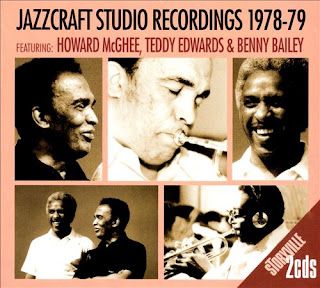
Howard McGhee, Teddy Edwards & Benny Bailey • Jazzcraft Studio Recordings 1978-79


Review by Rick Anderson
The configuration of this two-disc set is a little strange. It is actually comprised of two separate albums: the first, originally issued as Wise in Time, is a quintet date co-led by trumpeter Howard McGhee and saxophonist Teddy Edwards. The rhythm section for this 1979 session consists of pianist Art Hillery (who, sadly, is playing a rather lousy-sounding piano), and a truly great bass-and-drums duo, Leroy Vinnegar and Billy Higgins. The group focuses here on ballads and midtempo tunes, jumping up to higher speed on a handful of bop standards ("Relaxin' at Camarillo," "Moose the Mooche") but mostly sticking to more laid-back fare. Sadly, this seems partly to be because that's all McGhee was up to; his tone is weak, his pitch is consistently flat, and at times, he is audibly dragging the beat. Edwards is in fine form here, but McGhee really sounds pretty terrible. The second disc was originally released as Home Run; it was recorded a year earlier and is credited to the Howard McGhee/Benny Bailey Sextet. Bailey is also a trumpeter, and he and McGhee lead their sextet (which includes Barry Harris on piano) through a program consisting mostly of standards from the bop and immediate post-bop eras. On this disc, McGhee is in much better form, playing with invention, energy, and noticeably fuller tone and better pitch. Tempos are brisker, and if McGhee seems to falter a bit on both "Moose the Mooche" and Thelonious Monk's "In Walked Bud," he sounds much better on the more moderately paced material. All in all, this set makes an interesting document but perhaps isn't the best memorial to a major mid-century jazz talent.
https://www.allmusic.com/album/jazzcraft-studio-recordings-1978-79-mw0002174104


“Largely forgotten today, Howard McGhee (who died 25 years ago this month at age 69) was a pioneering bebop trumpeter in the '40s, a member of Coleman Hawkins’ seminal bop band as well as a recording partner of Charlie Parker in Los Angeles. In those years he was often compared to Dizzy Gillespie as another fleet, soaring trumpeter, but one with a less abstract, more melodic style. When these recordings were made, McGhee, already in his 60s and buffeted by health problems, was a more introverted, reflective player with slightly blurry intonation, rarely rising above his mid-register. But, as these sessions prove, he was also a font of musical ideas, capable of producing sturdy, lyrically flowing, logically intriguing solos. Made at the end of the '70s, just on the cusp of the neo-bop revival – before Wynton Marsalis mania - the music here comes from two Jazzcraft CD5: Wise in Time by the Howard McGhee/ Teddy Edwards Quintet and Home Run from the Howard McGhee/ Benny Bailey Sextet, the latter including outtakes from the quintet session to round out the CD. The Quintet repertoire is almost all from the early bebop era, plus a Clifford Brown bop tune as well as ‘I Remember Clifford’ and, the one anomaly, John Coltrane’s modal ‘Crescent’. The mood verges on elegiac, with ballads and midtempos dominating. It's a mature bebop album by veterans fondly remembering, but not necessarily trying to emulate, the heady, breakneck excitement of those earlier times. What they bring is the wisdom of elders leavened with affection for the music of their youth. Edwards, whose tenor’s vocal timbre harks back to the Swing Era, quotes a Kansas City staple of the that time, ‘I Want a Little Girl’, on Billy Eckstine’s ‘I Want to Talk About You’. Other bop ballads include Tadd Dameron’s ‘If You Could See Me Now’, showcasing McGhee’s lyricism, a valid alternative to Miles Davis’ modern ballad approach; Bud Powell's Time Waits’ and a sumptuous version of Monk's Ruby My Dear’. Monk's In Walked Bud’ and a trio of Charlie Parker pieces plus Oscar Pettiford’s ‘Blues in the Closet’ are done at fast but not blistering tempos, bringing out the songful intricacies of the tunes. Both McGhee and Edwards bring admirably personal voices to their playing, avoiding the facile technique and polished clichés endemic to so many of today's neo- and postbop players. Of the 12 tracks on the Home Run CD, only seven are by the McGhee/ Bailey Sextet, as one is a feature for hard-edged tenor saxist Sonny Redd and four are outtakes (three alternates) from the Edwards Quintet sessions. However, those seven tracks are winners, the presence of trumpeter Benny Bailey stirring McGhee’s competitive instincts, resulting in his best solos on the album. Right from the opening track, his own bluesy hardbop ‘Get It On’, McGhee plays faster, higher and with more crackling intensity than his mellower form with the Wise in Time quintet. Bailey, who forged most of his career in Europe, is a mercurial bopper who plays with bright bravura and a brilliant tone to match. On ‘Get It On’ he brings out a plunger for fours with McGhee and the trades, down from half-choruses to fours and twos, on ‘Brownie Speaks’ are a scintillating brass battle capped off by Bailey's exuberant slide whistle-effect ending. Other highlights include ‘Jonas’, McGhee’s ‘Love for Sale’ contrafact with the composer Harmon-muted, Bailey tight muted with plunger; ‘Funky Senor’, Bailey's nod to Horace Silver's ‘Senor Blues’, with more wah-wah trumpet and Fats Navarro’s ‘Nostalgia’, an ‘Out of Nowhere’ contrafact worth reviving.” George Kanzler, NYCJR

///////


Reseña de Rick Anderson
La configuración de este conjunto de dos discos es un poco extraña. En realidad se compone de dos álbumes separados: el primero, publicado originalmente como Wise in Time, es una fecha del quinteto codirigido por el trompetista Howard McGhee y el saxofonista Teddy Edwards. La sección rítmica de esta sesión de 1979 está formada por el pianista Art Hillery (que, lamentablemente, toca un piano que suena bastante mal), y un dúo de bajo y batería realmente genial, Leroy Vinnegar y Billy Higgins. El grupo se centra aquí en las baladas y los temas a medio tiempo, saltando a una velocidad más alta en un puñado de estándares de bop ("Relaxin' at Camarillo", "Moose the Mooche"), pero en su mayor parte se ciñe a una tarifa más relajada. Lamentablemente, esto parece ser en parte porque eso es todo lo que McGhee estaba haciendo; su tono es débil, su tono es consistentemente plano, y a veces, está arrastrando audiblemente el ritmo. Edwards está en buena forma aquí, pero McGhee suena realmente terrible. El segundo disco se publicó originalmente con el nombre de Home Run; se grabó un año antes y está acreditado a Howard McGhee/Benny Bailey Sextet. Bailey también es trompetista, y él y McGhee dirigen su sexteto (que incluye a Barry Harris al piano) a través de un programa que consiste en su mayoría en estándares de las épocas del bop y del post-bop inmediato. En este disco, McGhee está en mucha mejor forma, tocando con invención, energía y un tono notablemente más completo y mejor afinado. Los tiempos son más rápidos, y si McGhee parece flaquear un poco en "Moose the Mooche" y en "In Walked Bud" de Thelonious Monk, suena mucho mejor en el material de ritmo más moderado. En definitiva, este conjunto constituye un documento interesante, pero quizá no sea el mejor homenaje a un importante talento del jazz de mediados de siglo.
https://www.allmusic.com/album/jazzcraft-studio-recordings-1978-79-mw0002174104


"Howard McGhee (fallecido este mes hace 25 años a la edad de 69) fue un trompetista pionero del bebop en los años 40, miembro de la banda seminal de Coleman Hawkins y compañero de grabación de Charlie Parker en Los Ángeles. En aquellos años, se le comparaba a menudo con Dizzy Gillespie como otro trompetista de flota, pero con un estilo menos abstracto y más melódico. Cuando se realizaron estas grabaciones, McGhee, que ya tenía 60 años y estaba afectado por problemas de salud, era un músico más introvertido y reflexivo, con una entonación ligeramente borrosa, que rara vez superaba el registro medio. Pero, como demuestran estas sesiones, también era una fuente de ideas musicales, capaz de producir solos robustos, líricos y lógicamente intrigantes. Realizado a finales de los años 70, justo en la cúspide del renacimiento del neobop - antes de la manía de Wynton Marsalis - la música que aquí se presenta procede de dos CD5 de Jazzcraft: Wise in Time del Howard McGhee/ Teddy Edwards Quintet y Home Run del Howard McGhee/ Benny Bailey Sextet, este último incluye tomas sueltas de la sesión del quinteto para completar el CD. El repertorio del quinteto es casi todo de la primera época del bebop, además de un tema de bop de Clifford Brown, así como "I Remember Clifford" y, la única anomalía, el modal "Crescent" de John Coltrane. El ambiente roza lo elegíaco, con predominio de las baladas y los medios tiempos. Se trata de un álbum de bebop maduro realizado por veteranos que recuerdan con cariño, pero que no tratan necesariamente de emular, la embriagadora y vertiginosa emoción de aquellos tiempos. Lo que aportan es la sabiduría de los mayores aderezada con el afecto por la música de su juventud. Edwards, cuyo timbre vocal de tenor se remonta a la Era del Swing, cita un elemento básico de Kansas City de aquella época, 'I Want a Little Girl', en 'I Want to Talk About You' de Billy Eckstine. Otras baladas bop incluyen 'If You Could See Me Now' de Tadd Dameron, que muestra el lirismo de McGhee, una alternativa válida al enfoque de balada moderna de Miles Davis; 'Time Waits' de Bud Powell y una suntuosa versión de 'Ruby My Dear' de Monk. In Walked Bud' de Monk y un trío de piezas de Charlie Parker, además de 'Blues in the Closet' de Oscar Pettiford, se interpretan a tempos rápidos pero no estridentes, sacando a relucir las complejidades canoras de las melodías. Tanto McGhee como Edwards aportan voces admirablemente personales a su forma de tocar, evitando la técnica fácil y los clichés pulidos endémicos de muchos de los músicos neo y postbop actuales. De los 12 temas del CD Home Run, sólo siete son del Sexteto McGhee/Bailey, ya que uno es una presentación del duro saxofonista tenor Sonny Redd y cuatro son tomas falsas (tres alternas) de las sesiones del Quinteto de Edwards. Sin embargo, esos siete temas son ganadores, ya que la presencia del trompetista Benny Bailey despierta los instintos competitivos de McGhee, dando lugar a sus mejores solos en el álbum. Desde el primer tema, su propio blues hardbop "Get It On", McGhee toca más rápido, más alto y con más intensidad que su forma más suave con el quinteto Wise in Time. Bailey, que forjó la mayor parte de su carrera en Europa, es un músico mercurial que toca con una brillante bravura y un tono brillante. En 'Get It On' saca un desatascador para los cuatros con McGhee y los intercambios, de medio coro a cuatros y dos, en 'Brownie Speaks' son una batalla de metales centelleante coronada por el exuberante final de Bailey con efecto de slide whistle. Otros momentos destacados son 'Jonas', el contrafacto 'Love for Sale' de McGhee con el compositor silenciado por Harmon, Bailey silenciado con émbolo; 'Funky Senor', el guiño de Bailey al 'Senor Blues' de Horace Silver, con más trompeta wah-wah y 'Nostalgia' de Fats Navarro, un contrafacto de 'Out of Nowhere' que vale la pena revivir." George Kanzler, NYCJR


storyvillerecords.com ...


Sunday, June 23, 2024

Dexter Gordon & Wardell Gray • The Hunt


The Hunt is a 1977 jazz album of performances from 1947 by a nonet featuring saxophonists Dexter Gordon and Wardell Gray. The title song is referenced in the book On the Road by Jack Kerouac.
https://en.wikipedia.org/wiki/The_Hunt_(Dexter_Gordon_album)

///////


The Hunt es un álbum de jazz de 1977 con actuaciones de 1947 de a nonet con los saxofonistas Dexter Gordon y Wardell Gray. La canción principal se menciona en el libro On the Road de Jack Kerouac.
https://en.wikipedia.org/wiki/The_Hunt_ (Dexter_Gordon_álbum)


Friday, May 3, 2024

Teddy Edwards-Howard McGhee • Together Again!


Review by Scott Yanow
Tenor saxophonist Teddy Edwards and trumpeter Howard McGhee had played together regularly from 1945 to 1947. For their recorded reunion, they are assisted by the masterful pianist Phineas Newborn, bassist Ray Brown and drummer Ed Thigpen. Edwards, McGhee, and Brown contributed one new song apiece which alternates with a trio of standards ("You Stepped Out of a Dream," "Misty" and Charlie Parker's "Perhaps"). The trumpeter was having a short-lived comeback at the time and he had largely regained his earlier form. Edwards sounds as strong as ever and Newborn was an up-and-coming talent. Their collaboration for this boppish date is generally quite memorable.
https://www.allmusic.com/album/together-again%21%21%21%21-mw0000654720

///////


Reseña de Scott Yanow
El saxofonista tenor Teddy Edwards y el trompetista Howard McGhee habían tocado juntos regularmente de 1945 a 1947. Para su reunión grabada, cuentan con la ayuda del magistral pianista Phineas Newborn, el bajista Ray Brown y el batería Ed Thigpen. Edwards, McGhee y Brown contribuyeron con una canción nueva cada uno que se alterna con un trío de estándares ("You Stepped Out of a Dream", "Misty" y "Perhaps" de Charlie Parker). El trompetista estaba teniendo un regreso de corta duración en ese momento y había recuperado en gran medida su forma anterior. Edwards sonaba tan fuerte como siempre y Newborn era un talento prometedor. Su colaboración para esta cita boppish es, en general, bastante memorable.
https://www.allmusic.com/album/together-again%21%21%21%21-mw0000654720


Thursday, March 28, 2024

Johnny Hodges • Johnny Hodges And All The Duke's Man


"Never the world's most highly animated showman or greatest stage personality, but a tone so beautiful it sometimes brought tears to the eyes, this was Johnny Hodges. Because of this great loss, our band will never sound the same. Johnny Hodges sometimes sounded beautiful, sometimes romantic, and sometimes people spoke of his tone as being sensuous. With the exception of a year or so, almost his entire career was with us. So far as our wonderful listening audience was concerned, there was a great feeling of expectancy when they looked up and saw Johnny Hodges sitting in the middle of the saxophone section, in the front row. I am glad and thankful that I had the privilege of presenting Johnny Hodges for forty years, night after night. I imagine I have been much envied, but thanks to God....” Duke Ellington eulogy.

John Cornelius Hodges was born on the 25th July 1906 in Cambridge, Mass. He started his musical career playing drums and piano before taking up the saxophone at the age of 14, beginning on the soprano and later the alto. Originally self-taught he was given lessons by Sydney Bechet, whom he got to know through his sister. He followed Bechet into Willie 'The Lion' Smith's quartet at the Rhythm Club (around 1924), then played in the house band with Bechet's Club ‘Basha’ in Harlem. He continued to live in Boston and traveled to New York at weekends playing with such musicians as Bobby Sawyer (1925), Lloyd Scott (1926), then from late 1926 with the great Chick Webb at The Paddock Club and The Savoy Ballroom, etc. followed by a short stint with Luckey Roberts.

In May 1928 Johnny joined Duke Ellington's orchestra and he remained a mainstay of the group for the next 40 years. From his first recording in 1928 he revealed his authority and technical mastery of the saxophone, playing with a broad, sweeping tone and producing impressive, cascading runs. In the opinion of many people, he soon became Duke's most valuable soloist. He made hundreds of recordings with Duke and from 1937 led his own small studio group drawn from the orchestra which made many successful series of recordings for Victor and other labels. Titles included “Jeep's Blues,” “Hodge Podge,” “The Jeep is Jumpin” all of which were co-written with Duke. Also in this period of great creativity he played in many other small groups with musicians such as Lionel Hampton, Teddy Wilson, etc., producing classics of the period.

Johnny was one of the many stars of the Ellington band of the 40s producing solos of immense authority on songs such as “Things Ain't What They Used To Be,” “Don't Get Around Much Any More,” “Passion Flower,” etc. From the 40s he concentrated on the alto leaving the soprano alone completely and in this period he regularly won the popularity polls run by magazines such as Downbeat, Metronome, and Esquire.

In March 1951 Johnny left Duke to form his own small group taking with him Lawrence Brown and Sonny Greer and in their first recording session they produced a hit record of “Castle Rock.” Johnny disbanded the group in the spring of 1955 and after a brief spell of TV work on the Ted Steele Show, rejoined Duke in August of that year where, apart from a few brief periods, he remained for the rest of his life. In the spring of 1958 he worked with Billy Strayhorn and in 1961 went to Europe with some of the other band members in a group called The Ellington Giants.

He continued to record prolifically with musicians such as Wild Bill Davis, Earl Hines, and even one session with Lawrence Welk. Duke and Billy Strayhorn continued to write compositions and arrangements featuring Johnny's unique sound and talents leaving a wonderful legacy of recorded music for the enjoyment of successive generations of enthusiasts. He won the admiration of many saxophonists such as Ben Webster and even John Coltrane who played in one of the small groups in 1953-4 said that Johnny was always one of his favorite players.

In his later years Johnny used fewer and fewer notes, remaining close to the melody in ballads and improvising simple but telling riffs on the faster numbers, many of which were based on the blues . The power of his playing came from his sound and his soul, generating immense swing and building the dramatic tension from chorus to chorus. His last attempt at recording was the monumental “New Orleans Suite,” but he would not live to see the final product.

Johnny Hodges died of a heart attack in New York City on the 11th May 1970.
Source: James Nadal
https://www.allaboutjazz.com/musicians/johnny-hodges/

///////

"Nunca fue el showman más animado del mundo o la personalidad teatral más grande, pero un tono tan hermoso que a veces hacía llorar a los ojos, este era Johnny Hodges. Debido a esta gran pérdida, nuestra banda nunca sonará igual. Johnny Hodges a veces sonaba hermoso, a veces romántico y, a veces, la gente hablaba de su tono como sensual. Con la excepción de un año más o menos, casi toda su carrera estuvo con nosotros. En lo que respecta a nuestra maravillosa audiencia oyente, hubo una gran sensación de expectativa cuando levantaron la vista y vieron a Johnny Hodges sentado en el medio de la sección de saxofones, en la primera fila. Estoy contento y agradecido de haber tenido el privilegio de presentar a Johnny Hodges durante cuarenta años, noche tras noche. Me imagino que me han envidiado mucho, pero gracias a Dios...."Elogio de Duke Ellington.

John Cornelius Hodges nació el 25 de julio de 1906 en Cambridge, Massachusetts. Comenzó su carrera musical tocando la batería y el piano antes de comenzar a tocar el saxofón a los 14 años, comenzando con la soprano y luego con el alto. Originalmente autodidacta, Sydney Bechet le dio lecciones, a quien conoció a través de su hermana. Siguió a Bechet al cuarteto de Willie' The Lion ' Smith en el Rhythm Club (alrededor de 1924), luego tocó en la banda de la casa con el Club 'Basha' de Bechet en Harlem. Continuó viviendo en Boston y viajaba a Nueva York los fines de semana tocando con músicos como Bobby Sawyer (1925), Lloyd Scott (1926), luego desde finales de 1926 con el gran Chick Webb en el Paddock Club y el Savoy Ballroom, etc. seguido de una breve temporada con Luckey Roberts.

En mayo de 1928, Johnny se unió a la orquesta de Duke Ellington y siguió siendo un pilar del grupo durante los siguientes 40 años. Desde su primera grabación en 1928 reveló su autoridad y dominio técnico del saxofón, tocando con un tono amplio y amplio y produciendo carreras impresionantes en cascada. En opinión de mucha gente, pronto se convirtió en el solista más valioso de Duke. Hizo cientos de grabaciones con Duke y, a partir de 1937, dirigió su propio pequeño grupo de estudio extraído de la orquesta, que realizó muchas series exitosas de grabaciones para Victor y otros sellos. Los títulos incluyeron "Jeep's Blues", "Hodge Podge"," The Jeep is Jumpin", todos los cuales fueron coescritos con Duke. También en este período de gran creatividad tocó en muchos otros pequeños grupos con músicos como Lionel Hampton, Teddy Wilson, etc., produciendo clásicos de la época.

Johnny fue una de las muchas estrellas de la Ellington Band de los años 40 produciendo solos de inmensa autoridad en canciones como "Things Ain't What They Used To Be"," Don't Get Around Much Anymore"," Passion Flower", etc. A partir de los años 40 se concentró en el alto dejando completamente sola a la soprano y en este período ganó regularmente las encuestas de popularidad que manejan revistas como Downbeat, Metronome y Esquire.

En marzo de 1951 Johnny dejó Duke para formar su propio pequeño grupo llevándose consigo a Lawrence Brown y Sonny Greer y en su primera sesión de grabación produjeron un exitoso disco de " Castle Rock. Johnny disolvió el grupo en la primavera de 1955 y después de un breve período de trabajo televisivo en The Ted Steele Show, se reincorporó a Duke en agosto de ese año, donde, aparte de unos breves períodos, permaneció por el resto de su vida. En la primavera de 1958 trabajó con Billy Strayhorn y en 1961 se fue a Europa con algunos de los otros miembros de la banda en un grupo llamado Ellington Giants.

Continuó grabando prolíficamente con músicos como Wild Bill Davis, Earl Hines e incluso una sesión con Lawrence Welk. Duke y Billy Strayhorn continuaron escribiendo composiciones y arreglos con el sonido y los talentos únicos de Johnny, dejando un maravilloso legado de música grabada para el disfrute de sucesivas generaciones de entusiastas. Se ganó la admiración de muchos saxofonistas como Ben Webster e incluso John Coltrane, quien tocó en uno de los grupos pequeños en 1953-4, dijo que Johnny siempre fue uno de sus músicos favoritos.

En sus últimos años, Johnny usó cada vez menos notas, permaneciendo cerca de la melodía en las baladas e improvisando riffs simples pero contundentes en los números más rápidos, muchos de los cuales se basaban en el blues . El poder de su interpretación provino de su sonido y su alma, generando un swing inmenso y construyendo la tensión dramática de coro en coro. Su último intento de grabación fue la monumental "Suite de Nueva Orleans", pero no viviría para ver el producto final.

Johnny Hodges murió de un ataque al corazón en la ciudad de Nueva York el 11 de mayo de 1970.
Fuente: James Nadal
https://www.allaboutjazz.com/musicians/johnny-hodges/