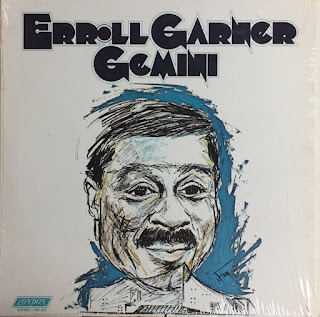
Biography by Scott Yanow
One of the most distinctive of all pianists, Erroll Garner proved that it was possible to be a sophisticated player without knowing how to read music, that a creative jazz musician can be very popular without watering down his music, and that it is possible to remain an enthusiastic player without changing one's style once it is formed. A brilliant virtuoso who sounded unlike anyone else, on medium tempo pieces, Erroll Garner often stated the beat with his left hand like a rhythm guitar while his right played chords slightly behind the beat, creating a memorable effect. His playful free-form introductions (which forced his sidemen to really listen), his ability to play stunning runs without once glancing at the keyboard, his grunting, and the pure joy that he displayed while performing were also part of the Erroll Garner magic.
Garner, whose older brother Linton was also a fine pianist, appeared on the radio with the Kan-D-Kids at the age of ten. After working locally in Pittsburgh, he moved to New York in 1944 and worked with Slam Stewart's trio during 1944-1945 before going out on his own. By 1946, Garner had his sound together, and when he backed Charlie Parker on his famous Cool Blues session of 1947, the pianist was already an obvious giant. His unclassifiable style had an orchestral approach straight from the swing era but was open to the innovations of bop. From the early '50s on, Garner's accessible style became very popular and he never seemed to have an off day up until his forced retirement (due to illness) in early 1975. His composition "Misty" became a standard. Garner, who had the ability to sit at the piano without prior planning and record three albums in one day (all colorful first takes), made many records throughout his career for such companies as Savoy, Mercury, RCA, Dial, Columbia, EmArcy, ABC-Paramount, MGM, Reprise, and his own Octave label.
https://www.allmusic.com/artist/erroll-garner-mn0000206967/biography
///////
Biografía de Scott Yanow
Uno de los más distintivos de todos los pianistas, Erroll Garner demostró que es posible ser un músico sofisticado sin saber leer música, que un músico de jazz creativo puede ser muy popular sin diluir su música y que es posible seguir siendo un músico entusiasta sin cambiar su estilo una vez formado. Un virtuoso brillante que sonaba como nadie, en piezas de tempo medio, Erroll Garner a menudo establecía el ritmo con su mano izquierda como una guitarra rítmica mientras que su derecha tocaba acordes ligeramente por detrás del ritmo, creando un efecto memorable. Sus juguetonas introducciones de forma libre (que obligaban a sus acompañantes a escuchar de verdad), su capacidad para tocar carreras impresionantes sin tener que echar una sola mirada al teclado, sus gruñidos y la pura alegría que mostraba mientras actuaba también formaban parte de la magia de Erroll Garner.
Garner, cuyo hermano mayor Linton también era un buen pianista, apareció en la radio con los Kan-D-Kids a la edad de diez años. Después de trabajar localmente en Pittsburgh, se mudó a Nueva York en 1944 y trabajó con el trío de Slam Stewart durante 1944-1945 antes de salir por su cuenta. En 1946, Garner ya tenía su sonido, y cuando apoyó a Charlie Parker en su famosa sesión de Cool Blues de 1947, el pianista ya era un gigante obvio. Su inclasificable estilo tenía un enfoque orquestal directo de la era del swing, pero estaba abierto a las innovaciones del bop. Desde principios de los 50, el estilo accesible de Garner se hizo muy popular y nunca pareció tener un día libre hasta su retiro forzoso (por enfermedad) a principios de 1975. Su composición "Misty" se convirtió en un estándar. Garner, que tenía la habilidad de sentarse al piano sin planificación previa y de grabar tres álbumes en un día (todas primeras tomas coloridas), hizo muchos discos a lo largo de su carrera para compañías como Savoy, Mercury, RCA, Dial, Columbia, EmArcy, ABC-Paramount, MGM, Reprise y su propio sello Octave.
https://www.allmusic.com/artist/erroll-garner-mn0000206967/biography
www.errollgarner.com ...