Showing posts with label Ernie Wilkins. Show all posts

Tuesday, April 14, 2026

Jimmy Cleveland • Cleveland Style


Review
by Scott Yanow
Although trombonist Jimmy Cleveland is the main star of this album, arranger Ernie Wilkins comes in a close second. Wilkins' charts for the septet make inventive use of either Jay McAllister or Don Butterfield on tuba and he also brought in two excellent originals (including one called "Goodbye Ebbets Field"). With trumpeter Art Farmer, tenor saxophonist Benny Golson, pianist Wynton Kelly, bassist Eddie Jones and drummer Charlie Persip also featured with the septet, it is not surprising that the result is high-quality straightahead jazz. Worth searching for.
https://www.allmusic.com/album/cleveland-style-mw0000910790

///////


Revisión
por Scott Yanow
Aunque el trombonista Jimmy Cleveland es la estrella principal de este álbum, el arreglista Ernie Wilkins le sigue de cerca. Los gráficos de Wilkins para el septeto hacen un uso inventivo de Jay McAllister o Don Butterfield en la tuba y también trajo dos excelentes originales (incluyendo uno llamado "Goodbye Ebbets Field"). Con el trompetista Art Farmer, el saxofonista tenor Benny Golson, el pianista Wynton Kelly, el bajista Eddie Jones y el baterista Charlie Persip también incluidos en el septeto, no es de extrañar que el resultado sea jazz directo de alta calidad. Merece la pena buscarlo.
https://www.allmusic.com/album/cleveland-style-mw0000910790


Saturday, April 5, 2025

Ernie Wilkins ‎• The Big New Band of the 60's


Review by Scott Yanow:
Despite its title, the Ernie Wilkins Orchestra did not become "the big new band of the '60s" and this LP was its only recording. With such an all-star cast (including trumpeters Clark Terry and Charlie Shavers, tenors Zoot Sims and Yusef Lateef, vibraphonist Eddie Costa and guitarist Kenny Burrell) the big band would not have had much of a chance anyway in the 1960s. Wilkins' progressive but swinging arrangements for three of his originals and nine standards are enjoyable but the brevity of the tracks (the longest one is 3½-minutes) and the rather short solos is unfortunate. This LP falls a bit short of its great potential.

///////

Reseña de Scott Yanow:
A pesar de su título, la Orquesta de Ernie Wilkins no se convirtió en "la nueva gran banda de los 60" y este LP fue su única grabación. Con un elenco tan estelar (incluyendo a los trompetistas Clark Terry y Charlie Shavers, los tenores Zoot Sims y Yusef Lateef, el vibrafonista Eddie Costa y el guitarrista Kenny Burrell) la gran banda no habría tenido muchas posibilidades de todos modos en los 60. Los arreglos progresivos pero swingers de Wilkins para tres de sus originales y nueve standards son agradables, pero la brevedad de los temas (el más largo es 3½-minutos) y los solos bastante cortos son desafortunados. Este LP se queda un poco corto de su gran potencial.


Saturday, February 8, 2025

Cat Anderson & His Orchestra • Cat's in the Alley


William Alonzo “Cat” Anderson (1916–1981) was a musician in the Ellington tradition - He was first trumpet man with Duke for more than twenty years, being best known for his amazingly consistent high-note work - On 'Cat on a Hot Tin Horn,' his first LP as a leader, Cat’s upper-register is handsomely displayed, along with some brash, bluesy trumpet work and a glimpse of his lyrical qualities - Also on display are his talents as a composer and arranger, along with the redoutable Ernie Wilkins, of a big band, which featured a dazzling all-star group of jazzmen - But as vigorous and technically dazzling as Anderson’s excursions into the upper register were, they too often overshadowed the fact that he was a trumpet player with a rich and varied palette of expression at his command -

For the second LP included in this CD set, entitled 'Ellingtonia,' Cat assembled some of the finest Ellington musicians - The tunes chosen were in the soft swing vein and done essentially as a tribute to Duke Ellington.

///////


William Alonzo "Cat" Anderson (1916-1981) fue un músico de la tradición de Ellington - Fue el primer trompetista de Duke durante más de veinte años, siendo más conocido por su increíblemente consistente trabajo en los agudos - En "Cat on a Hot Tin Horn", su primer LP como líder, el registro superior de Cat se muestra de forma magnífica, junto con un trabajo de trompeta descarado y bluesy y un atisbo de sus cualidades líricas - También se muestra su talento como compositor y arreglista, junto con el redoutable Ernie Wilkins, de una big band, que contaba con un deslumbrante grupo de jazzistas - Pero por muy vigorosas y técnicamente deslumbrantes que fueran las incursiones de Anderson en el registro superior, con demasiada frecuencia eclipsaban el hecho de que era un trompetista con una rica y variada paleta de expresión a sus órdenes -

Para el segundo LP incluido en este CD, titulado "Ellingtonia", Cat reunió a algunos de los mejores músicos de Ellington - Las melodías elegidas estaban en la onda del swing suave y se hicieron esencialmente como homenaje a Duke Ellington.


Friday, December 27, 2024

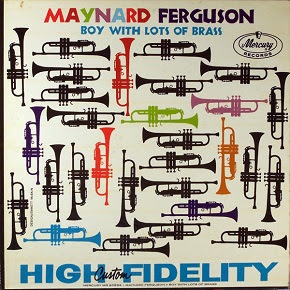
Maynard Ferguson • Boy With Lots Of Brass


Walter "Maynard" Ferguson was a Canadian-born jazz trumpet player and bandleader. He came to prominence playing in Stan Kenton's orchestra, before forming his own band in 1957. He was noted for being able to play accurately in a remarkably high register, and for his bands, which served as stepping stones for up-and-coming talent.

Early life and education
Ferguson was born in Verdun, Quebec (now part of Montreal). Encouraged by his mother and father (both musicians), Maynard was playing piano and violin by the age of four. At nine years old, he heard a cornet for the first time in his local church and asked his parents to purchase him one. At age 13, Ferguson first soloed as a child prodigy with the Canadian Broadcasting Corporation Orchestra and was heard frequently on the CBC, notably featured on a Serenade for Trumpet in Jazz written for him by Morris Davis. Ferguson won a scholarship to the French Conservatory of Music where he studied from 1943 through 1948 with Bernard Baker.

Ferguson dropped out of Montreal High School at age 15 to more actively pursue a music career, performing in dance bands led by Stan Wood, Roland David, and Johnny Holmes. While trumpet was his primary instrument, Ferguson also performed on other brass and reed instruments. Ferguson later took over the dance band formed by his brother Percy, playing dates in the Montreal area and serving as an opening act for touring bands from the United States. During this period, Ferguson came to the attention of numerous American band leaders and began receiving offers to come to the United States.

Ferguson moved to the United States in 1949 and initially played with the bands of Boyd Raeburn, Jimmy Dorsey, and Charlie Barnet. The Barnet band was notable for a trumpet section that also included Doc Severinsen, Ray Wetzel, Johnny Howell, and Rolf Erickson. Ferguson was featured on a notoriously flamboyant Barnet recording of Jerome Kern's All The Things You Are that enraged Kern's widow and was subsequently withdrawn from sale. When Barnet temporarily retired in 1949 and disbanded his orchestra, Ferguson was free to accept an offer to join Stan Kenton's newly formed Innovations Orchestra.

Kenton and Hollywood
Stan Kenton had a longstanding offer to Ferguson but had temporarily disbanded when Ferguson moved to the United States. Kenton's bands were notable for their bombastic brass sections and Ferguson was a natural fit. In 1950, Kenton formed the Innovations Orchestra, a 40-piece jazz concert orchestra with strings, and with the folding of the Barnet band, Ferguson was available for the first rehearsal on January 1, 1950. While the Innovations Orchestra was not commercially successful, it made a number of remarkable recordings, including Maynard Ferguson, one of a series of pieces named after featured soloists.

When Kenton returned to a more practical 19-piece jazz band, Ferguson continued with him. Contrary to the natural assumption, Ferguson was not Kenton's lead trumpet player, but played the fifth chair with numerous solo features. Notable recordings from this period that feature Ferguson include Invention for Guitar and Trumpet, What's New and The Hot Canary.

In 1953, Ferguson left Kenton to become a first-call session player for Paramount Pictures. Ferguson appeared on 46 soundtracks including The Ten Commandments. Ferguson still recorded jazz during this period, but his Paramount contract prevented him from playing jazz clubs. While he enjoyed the regular paycheck, Ferguson was very unhappy with the lack of live performance opportunities and left Paramount in 1956.

The Birdland Dream Band
In 1956, Ferguson was tapped to lead the Birdland Dream Band, a 14-piece big band formed by Morris Levy as an "All-star" lineup to play at Levy's Birdland jazz club in New York City. While the name "Birdland Dream Band" was short-lived and is represented by only two albums, this band became the core of Ferguson's performing band for the next nine years. The band included, at various times, such players as Slide Hampton, Don Ellis, Don Sebesky, Willie Maiden, John Bunch, Joe Zawinul, Joe Farrell, Jaki Byard, Lanny Morgan, Rufus Jones, Bill Berry, and Don Menza. Arrangers included Bob Brookmeyer, Jimmy Giuffre, Bill Holman, and Marty Paich.

As big bands declined in popularity and economic viability in the 1960s, Ferguson's band performed more infrequently. Ferguson began to feel musically stifled and sensed a resistance to change among American jazz audiences. According to a Down Beat interview, he was quoted as saying that if the band did not play Maria or Ole, the fans went home disappointed. Ferguson began performing with a sextet before finally officially disbanding his big band in 1967.

India and England
Following the path taken by many important jazz artists in the 1960s, Ferguson left the United States in 1968. Needing a period of spiritual exploration, Ferguson initially moved with his family to India and taught at the Krishnamurtl-based Rhishi Valley School near Madras. In 1969, he relocated to Manchester, England, manufacturing personally designed trumpets and mouthpieces and performing with a variety of ensembles in Europe.

In 1969 Ferguson signed with CBS Records in England and formed a big band with British musicians that performed in the newly popular jazz/rock fusion style. The band's repertoire included original compositions as well a pop and rock songs rearranged into a big band format with electronic amplification. This British band's output is represented by the four MF Horn albums that included very popular arrangements of the pop songs MacArthur Park and Hey Jude.

Return to the U.S.
Ferguson's new band made its North American debut in 1971. With a revived career, Ferguson relocated to New York in 1973 and gradually replaced his sidemen with American performers while reducing the band size to 12 (four trumpets, two trombones, three saxophones and three rhythm plus Maynard). The quintessential recording of this period is the album Live at Jimmys, recorded in 1973 in New York. Ferguson latched on to the burgeoning jazz education movement by recruiting talented musicians from colleges with jazz programs (notably Berklee College of Music, North Texas State University and the University of Miami) and targeting young audiences with performances and master classes in high schools. This practical and strategic move helped him develop a strong following that would sustain him for the remainder of his career.

In 1976, Ferguson began working with producer Bob James on a series of commercially successful albums that were complex studio productions featuring large groups of session musicians, including strings, vocalists and star guest soloists. The first of these albums was Primal Scream, featuring Chick Corea, Mark Colby, and Steve Gadd. The second, Conquistidor in 1977, resulted in a top-10 pop single, Gonna Fly Now (from the movie Rocky), a rare accomplishment for a jazz musician in the 1970s. Aside from an exciting Jay Chattaway arrangement and dense Bob James production, the single was also helped by the fact that it was released prior to the official soundtrack album of the hit movie. Ferguson maintained a hectic touring schedule during this period, with well-attended concerts that featured concert lighting and heavy amplification.

Ferguson continued with this musical model for the remainder of the 1970s, receiving considerable acclaim from audiences but often tepid response from jazz purists who decried his commercialism and questioned his taste. Ferguson reportedly also began to experience great frustration with Columbia over being unable to use his working band on recording projects and having difficulty including even a single jazz number on some albums. Ferguson's contract with Columbia Records expired after the 1982 release of the Hollywood album, produced by Stanley Clarke.

Ferguson recorded three big band albums with smaller labels in the mid '80s before forming a more economical fusion septet, High Voltage, in 1986. This ensemble, which featured multi-reed player Dennis DiBlasio as the only other horn player, recorded two albums and received mixed reviews. The format was ultimately unsatisfying to Ferguson, who had grown up in big bands and developed a performing style most appropriate to that structure.

Big Bop Nouveau
In 1988, Ferguson returned both to a large band format and to mainstream jazz with the formation of Big Bop Nouveau, a nine-piece band featuring three trumpets, one trombone, two reeds and a three-piece rhythm section. The band's repertoire included original jazz compositions and modern arrangements of jazz standards, with occasional pieces from his 70s book and the Birdland Dream Band. This format proved to be successful with audiences and critics and Ferguson toured nine months a year with Big Bop Nouveau for the remainder of his life. This band recorded extensively, including albums backing vocalists Dianne Shurr and Michael Feinstein.

Although in later years Ferguson did lose some of the range and phenominal accuracy of his youth, he remained an exciting performer into his late 70s. Just days after completing a weeklong run at New York's Blue Note and recording a studio album in New Jersey, Ferguson developed an abdominal infection that resulted in kidney and liver failure. Ferguson died on the evening of August 23, 2006 at the Community Memorial Hospital in Ventura, California.

Influence
Maynard Ferguson was one of a handful of virtuoso musician/bandleaders to survive the end of the big band era and the rise of rock and roll. He demonstrated a remarkable ability to adapt to the musical trends that evolved from the 1940's through the 2000's. Ferguson's albums show an evolution from big band swing, bebop, cool jazz, Latin, jazz/rock, fusion with classical and operatic influences.

While not the first trumpeter to play in the extreme upper register, Ferguson had a unique ability to play high notes with full, rich tone, power, and musicality. While regarded by some as showboating, Ferguson's phrasing and vibrato have been extremely influential on generations of trumpet players. With interviewers Ferguson shared that he was able to command the upper registers of the trumpet not so much with his 'lip', but more with the breath control he had discovered as a youngster playing the instrument while growing up in Montreal. Ferguson attributed the longevity of his demanding bravura trumpet technique through his later years to the spiritual and yoga studies he pursued while in India.

While Ferguson's range was his most obvious attribute, his personal charisma was also a significant factor in his success. Through his devotion to music education in America, Ferguson was able to impart the spirit of his jazz playing and technique to scores of amateur and professional trumpeters during the many Master Classes held throughout his long career.

Ferguson popularized and enhanced two unique instruments - a trumpet with both traditional valves (played with the left hand rather than the right) and a trombone-style slide called the 'Firebird' as well as a trombone with both a slide and valves called 'Superbone.' Ferguson regularly incorporated Indian instruments and influences in albums and concerts.

Personal Life
While Ferguson's life had its ups and downs, Ferguson was fortunate to have evaded the destructive behaviors that bedeviled so many other artists of his generation. In the mid 1970s, Ferguson resettled to Ojai, California, where he lived to the end of his life. Ferguson's first marriage was to singer / actress Kay Brown in 1951. Maynard second marriage to Flo Ferguson lasted until her death on February 27, 2005. Ferguson had four daughters: Kim, Lisa, Corby, and Wilder. Kim Ferguson is married to Maynard's former road manager, Jim Exon. Wilder Ferguson is married to pianist (and former Big Bop Nouveau member) Christian Jacob. At the time of his death, Ferguson had a granddaugher, Erica.

///////

Walter "Maynard" Ferguson fue un trompetista de jazz y director de orquesta nacido en Canadá. Saltó a la fama tocando en la orquesta de Stan Kenton, antes de formar su propia banda en 1957. Se destacó por ser capaz de tocar con precisión en un registro notablemente alto y por sus bandas, que sirvieron como trampolines para el talento emergente.

Vida temprana y educación
Ferguson nació en Verdún, Quebec(ahora parte de Montreal). Animado por su madre y su padre (ambos músicos), Maynard tocaba el piano y el violín a los cuatro años. A los nueve años, escuchó una corneta por primera vez en su iglesia local y les pidió a sus padres que le compraran una. A los 13 años, Ferguson tocó por primera vez en solitario como un niño prodigio con la orquesta de la Canadian Broadcasting Corporation y se le escuchó con frecuencia en la CBC, destacando en una Serenata para Trompeta en Jazz escrita para él por Morris Davis. Ferguson ganó una beca para el Conservatorio Francés de Música, donde estudió de 1943 a 1948 con Bernard Baker.

Ferguson abandonó la Escuela secundaria de Montreal a los 15 años para seguir más activamente una carrera musical, actuando en bandas de baile dirigidas por Stan Wood, Roland David y Johnny Holmes. Si bien la trompeta era su instrumento principal, Ferguson también tocaba otros instrumentos de metal y lengüeta. Ferguson luego se hizo cargo de la banda de baile formada por su hermano Percy, tocando en el área de Montreal y sirviendo como telonero de bandas de gira de los Estados Unidos. Durante este período, Ferguson llamó la atención de numerosos líderes de bandas estadounidenses y comenzó a recibir ofertas para venir a los Estados Unidos.

Ferguson se mudó a los Estados Unidos en 1949 e inicialmente tocó con las bandas de Boyd Raeburn, Jimmy Dorsey y Charlie Barnet. La Barnet Band se destacó por una sección de trompeta que también incluía a Doc Severinsen, Ray Wetzel, Johnny Howell y Rolf Erickson. Ferguson apareció en una grabación notoriamente extravagante de Barnet de All The Things You Are de Jerome Kern que enfureció a la viuda de Kern y posteriormente fue retirada de la venta. Cuando Barnet se retiró temporalmente en 1949 y disolvió su orquesta, Ferguson fue libre de aceptar una oferta para unirse a la recién formada Orquesta Innovations de Stan Kenton.

Kenton y Hollywood
Stan Kenton tenía una oferta de larga data a Ferguson, pero se había disuelto temporalmente cuando Ferguson se mudó a los Estados Unidos. Las bandas de Kenton se destacaban por sus secciones de metales grandilocuentes y Ferguson encajaba perfectamente. En 1950, Kenton formó la Innovations Orchestra, una orquesta de conciertos de jazz de 40 músicos con cuerdas, y con la disolución de Barnet band, Ferguson estuvo disponible para el primer ensayo el 1 de enero de 1950. Si bien la Innovations Orchestra no tuvo éxito comercial, realizó una serie de grabaciones notables, incluida Maynard Ferguson, una de una serie de piezas que llevan el nombre de solistas destacados.

Cuando Kenton regresó a una banda de jazz de 19 integrantes más práctica, Ferguson continuó con él. Contrariamente a la suposición natural, Ferguson no era el trompetista principal de Kenton, sino que tocaba la quinta silla con numerosas funciones solistas. Grabaciones notables de este período que presentan a Ferguson incluyen Invention for Guitar and Trumpet, What's New y The Hot Canary.

En 1953, Ferguson dejó Kenton para convertirse en un jugador de sesión de primera llamada para Paramount Pictures. Ferguson apareció en 46 bandas sonoras, incluidos Los Diez Mandamientos. Ferguson siguió grabando jazz durante este período, pero su contrato con Paramount le impidió tocar en clubes de jazz. Si bien disfrutaba del sueldo regular, Ferguson estaba muy descontento con la falta de oportunidades de presentaciones en vivo y dejó Paramount en 1956.

La Banda de los Sueños de Birdland
En 1956, Ferguson fue elegido para dirigir Birdland Dream Band, una big band de 14 integrantes formada por Morris Levy como formación "All-star" para tocar en el club de jazz Birdland de Levy en la ciudad de Nueva York. Si bien el nombre "Birdland Dream Band" duró poco y está representado por solo dos álbumes, esta banda se convirtió en el núcleo de la banda de Ferguson durante los siguientes nueve años. La banda incluyó, en varias ocasiones, a músicos como Slide Hampton, Don Ellis, Don Sebesky, Willie Maiden, John Bunch, Joe Zawinul, Joe Farrell, Jaki Byard, Lanny Morgan, Rufus Jones, Bill Berry y Don Menza. Los arreglistas incluyeron a Bob Brookmeyer, Jimmy Giuffre, Bill Holman y Marty Paich.

A medida que las grandes bandas disminuyeron en popularidad y viabilidad económica en la década de 1960, la banda de Ferguson actuó con menos frecuencia. Ferguson comenzó a sentirse sofocado musicalmente y sintió una resistencia al cambio entre el público estadounidense de jazz. Según una entrevista de Down Beat, fue citado diciendo que si la banda no tocaba con Maria u Ole, los fanáticos se iban a casa decepcionados. Ferguson comenzó a actuar con un sexteto antes de finalmente disolver oficialmente su big band en 1967.

India e Inglaterra
Siguiendo el camino tomado por muchos artistas de jazz importantes en la década de 1960, Ferguson abandonó los Estados Unidos en 1968. Necesitando un período de exploración espiritual, Ferguson inicialmente se mudó con su familia a la India y enseñó en la Escuela Rhishi Valley School, con sede en Krishnamurtl, cerca de Madrás. En 1969, se mudó a Manchester, Inglaterra, fabricando trompetas y boquillas diseñadas personalmente y actuando con una variedad de conjuntos en Europa.

En 1969 Ferguson firmó con CBS Records en Inglaterra y formó una big band con músicos británicos que actuaron en el nuevo estilo popular de fusión de jazz / rock. El repertorio de la banda incluía composiciones originales, así como canciones de pop y rock reorganizadas en un formato de big band con amplificación electrónica. La producción de esta banda británica está representada por los cuatro álbumes de MF Horn que incluyeron arreglos muy populares de las canciones pop MacArthur Park y Hey Jude.

Regreso a los EE. UU.
La nueva banda de Ferguson hizo su debut en Norteamérica en 1971. Con una carrera revivida, Ferguson se mudó a Nueva York en 1973 y gradualmente reemplazó a sus acompañantes con artistas estadounidenses mientras reducía el tamaño de la banda a 12 (cuatro trompetas, dos trombones,tres saxofones y tres ritmos más Maynard). La grabación por excelencia de este período es el álbum Live at Jimmys, grabado en 1973 en Nueva York. Ferguson se aferró al floreciente movimiento educativo del jazz reclutando músicos talentosos de universidades con programas de jazz (en particular, Berklee College of Music, North Texas State University y University of Miami) y dirigiéndose al público joven con actuaciones y clases magistrales en escuelas secundarias. Este movimiento práctico y estratégico lo ayudó a desarrollar un gran número de seguidores que lo mantendrían durante el resto de su carrera.

En 1976, Ferguson comenzó a trabajar con el productor Bob James en una serie de álbumes de éxito comercial que fueron producciones de estudio complejas con grandes grupos de músicos de sesión, incluidos cuerdas, vocalistas y solistas invitados estrella. El primero de estos álbumes fue Primal Scream, con Chick Corea, Mark Colby y Steve Gadd. El segundo, Conquistador en 1977, resultó en un sencillo pop entre los 10 primeros, Gonna Fly Now (de la película Rocky), un logro poco común para un músico de jazz en la década de 1970. Aparte de un emocionante arreglo de Jay Chattaway y una densa producción de Bob James, el sencillo también fue ayudado por el hecho de que fue lanzado antes del álbum oficial de la banda sonora de la exitosa película. Ferguson mantuvo un agitado calendario de giras durante este período, con conciertos muy concurridos que presentaban iluminación de conciertos y una gran amplificación.

Ferguson continuó con este modelo musical durante el resto de la década de 1970, recibiendo elogios considerables del público, pero a menudo una tibia respuesta de los puristas del jazz que criticaron su comercialismo y cuestionaron su gusto. Según los informes, Ferguson también comenzó a experimentar una gran frustración con Columbia por no poder usar su banda de trabajo en proyectos de grabación y tener dificultades para incluir incluso un solo número de jazz en algunos álbumes. El contrato de Ferguson con Columbia Records expiró después del lanzamiento en 1982 del álbum Hollywood, producido por Stanley Clarke.

Ferguson grabó tres álbumes de big band con sellos más pequeños a mediados de los 80 antes de formar un septeto de fusión más económico, High Voltage, en 1986. Este conjunto, que presentaba al músico de lengüetas múltiples Dennis DiBlasio como el único otro trompetista, grabó dos álbumes y recibió críticas mixtas. El formato finalmente fue insatisfactorio para Ferguson, quien había crecido en grandes bandas y había desarrollado un estilo de interpretación más apropiado para esa estructura.

Big Bop Nuevo
En 1988, Ferguson regresó tanto a un formato de banda grande como al jazz convencional con la formación de Big Bop Nouveau, una banda de nueve integrantes con tres trompetas, un trombón, dos lengüetas y una sección rítmica de tres piezas. El repertorio de la banda incluía composiciones originales de jazz y arreglos modernos de estándares de jazz, con piezas ocasionales de su libro de los 70 y Birdland Dream Band. Este formato resultó ser un éxito entre el público y la crítica y Ferguson realizó una gira nueve meses al año con Big Bop Nouveau durante el resto de su vida. Esta banda grabó extensamente, incluidos álbumes con los coristas Dianne Shurr y Michael Feinstein.

Aunque en años posteriores Ferguson perdió parte del alcance y la precisión fenomenal de su juventud, siguió siendo un intérprete emocionante hasta finales de los 70. Pocos días después de completar una carrera de una semana en Blue Note de Nueva York y grabar un álbum de estudio en Nueva Jersey, Ferguson desarrolló una infección abdominal que resultó en insuficiencia renal y hepática. Ferguson murió la noche del 23 de agosto de 2006 en el Community Memorial Hospital de Ventura, California.

Influencia
Maynard Ferguson fue uno de los pocos músicos/directores de orquesta virtuosos que sobrevivieron al final de la era de las big band y al auge del rock and roll. Demostró una notable habilidad para adaptarse a las tendencias musicales que evolucionaron desde la década de 1940 hasta la década de 2000. Los álbumes de Ferguson muestran una evolución del swing de big band, bebop, cool jazz, latín, jazz/rock, fusión con influencias clásicas y operísticas.

Aunque no fue el primer trompetista en tocar en el registro superior extremo, Ferguson tenía una habilidad única para tocar notas altas con un tono completo y rico, potencia y musicalidad. Aunque algunos lo consideran un espectáculo, el fraseo y el vibrato de Ferguson han sido extremadamente influyentes en generaciones de trompetistas. Con los entrevistadores, Ferguson compartió que podía dominar los registros superiores de la trompeta no tanto con su 'labio', sino más con el control de la respiración que había descubierto cuando era joven tocando el instrumento mientras crecía en Montreal. Ferguson atribuyó la longevidad de su exigente técnica de trompeta bravura durante sus últimos años a los estudios espirituales y de yoga que realizó mientras estaba en la India. Si bien el rango de Ferguson era su atributo más obvio, su carisma personal también fue un factor significativo en su éxito. A través de su devoción por la educación musical en Estados Unidos, Ferguson pudo impartir el espíritu de su interpretación y técnica de jazz a decenas de trompetistas aficionados y profesionales durante las numerosas Clases Magistrales impartidas a lo largo de su larga carrera. Ferguson popularizó y mejoró dos instrumentos únicos: una trompeta con válvulas tradicionales (tocadas con la mano izquierda en lugar de la derecha) y un tobogán estilo trombón llamado 'Firebird', así como un trombón con tobogán y válvulas llamado 'Superbone. Ferguson incorporó regularmente instrumentos e influencias indias en álbumes y conciertos . Vida Personal Si bien la vida de Ferguson tuvo sus altibajos, Ferguson tuvo la suerte de haber evadido los comportamientos destructivos que atormentaban a tantos otros artistas de su generación. A mediados de la década de 1970, Ferguson se reasentó en Ojai, California, donde vivió hasta el final de su vida. El primer matrimonio de Ferguson fue con la cantante y actriz Kay Brown en 1951. El segundo matrimonio de Maynard con Flo Ferguson duró hasta su muerte el 27 de febrero de 2005. Ferguson tuvo cuatro hijas: Kim, Lisa, Corby y Wilder. Kim Ferguson está casada con el ex road manager de Maynard, Jim Exon. Wilder Ferguson está casado con el pianista (y exmiembro de Big Bop Nouveau) Christian Jacob. En el momento de su muerte, Ferguson tenía una nieta, Erica.


maynardferguson.com ...


Wednesday, December 18, 2024

Jimmy Cleveland • Cleveland Style


Review
by Scott Yanow
Although trombonist Jimmy Cleveland is the main star of this album, arranger Ernie Wilkins comes in a close second. Wilkins' charts for the septet make inventive use of either Jay McAllister or Don Butterfield on tuba and he also brought in two excellent originals (including one called "Goodbye Ebbets Field"). With trumpeter Art Farmer, tenor saxophonist Benny Golson, pianist Wynton Kelly, bassist Eddie Jones and drummer Charlie Persip also featured with the septet, it is not surprising that the result is high-quality straightahead jazz. Worth searching for.
https://www.allmusic.com/album/cleveland-style-mw0000910790

///////


Reseña
por Scott Yanow
Aunque el trombonista Jimmy Cleveland es la estrella principal de este álbum, el arreglista Ernie Wilkins le sigue de cerca. Los arreglos de Wilkins para el septeto hacen un uso inventivo de Jay McAllister o Don Butterfield en la tuba y también aportó dos excelentes originales (incluyendo uno llamado "Goodbye Ebbets Field"). Con el trompetista Art Farmer, el saxofonista tenor Benny Golson, el pianista Wynton Kelly, el bajista Eddie Jones y el batería Charlie Persip también en el septeto, no es sorprendente que el resultado sea un jazz directo de alta calidad. Merece la pena buscarlo.
https://www.allmusic.com/album/cleveland-style-mw0000910790


Saturday, November 23, 2024

Cy Touff • His Octet & Quintet


Especializado en un raro instrumento escasamente usado en jazz como es la trompeta baja -con valvulas parecidas al trombon- Cy Touff graba este disco en directo desde el Forum Teatro de Los Ángeles en diferentes formulas musicales como son los Octetos y quintetos. El nivel de los musicos es extraordinario y le dan a la sesion de grabacion un enorme valor añadido. Destaca el gran momento de forma del saxo tenor, Richie Kamuca.
https://apoloybaco.com/jazz/cy-touff-his-octet-a-quintet/

Cy Touff, (4 de marzo de 1927, Chicago, Illinois – 24 de enero de 2003, Evanston, Illinois), empezó a estudiar música de niño, tocando primero el piano y después la trompeta. Tras el paréntesis obligado del servicio militar, durante el cual tocó el trombón en el Ejercito, reanudo sus estudios musicales con Lennie Tristano. Inició su carrera profesional tocando la trompeta con Jimmy Dale, Charlie Ventura y Buyd Raeburn.
Adoptó la trompeta bajo, un instrumento muy poco utilizado en el jazz, después de escuchársela tocar a Johnny Mandel, y fue con ése instrumento, con el que consiguió entrar a formar parte de la orquesta de Woody Herman, en la que permaneció hasta 1956 y con la que realizó varias giras por Europa y los Estados Unidos.  Músico de estilo brillante, Cy Touff es uno de esos jazzman que pasa desapercibido para la mayoría de los aficionados pero que su calidad era notoria.
https://apoloybaco.com/jazz/cy-touff/


Tuesday, October 29, 2024

The Joe Newman Quartet ‎• Soft Swingin' Jazz


Review by Jason Ankeny
The title says it all. Soft Swinging Jazz pairs Joe Newman with organist Shirley Scott, bassist Eddie Jones, and Charlie Persip for a mellow, lovely session unique within the trumpeter's catalog. For starters, Newman assumes vocal duties on a handful of cuts, proving himself a fine crooner. Moreover, the spacious, nuanced arrangements afford him the room to summon some of his most intimate but impassioned solos. Not to mention that Scott's an uncommonly sympathetic collaborator, shaping and underlining the melodies to create rolling, contoured grooves with the texture of velvet.
https://www.allmusic.com/album/soft-swinging-jazz-mw0000350883

///////

Revisión por Jason Ankeny
El título lo dice todo. Soft Swinging Jazz combina a Joe Newman con la organista Shirley Scott, el bajista Eddie Jones y Charlie Persip para una sesión suave y encantadora, única dentro del catálogo del trompetista. Para empezar, Newman asume tareas vocales en un puñado de cortes, demostrando ser un gran cantante. Además, los espaciosos y matizados arreglos le brindan el espacio para convocar algunos de sus solos más íntimos pero apasionados. Sin mencionar que Scott es un colaborador excepcionalmente simpático, que da forma y resalta las melodías para crear surcos ondulados y contorneados con la textura de terciopelo.
https://www.allmusic.com/album/soft-swinging-jazz-mw0000350883


Wednesday, August 7, 2024

Ernie Wilkins & His Orchestra • Here Comes The Swingin' Mr. Wilkins


A fine, slippery bop tenor sax player, and a creator of sharp-edged arrangements for bop and swing big bands who helped define the Count Basie Mk. II style of the 1950s, Ernie Wilkins had been a regular fixture on the American jazz scene until 1979, when he pulled up stakes and moved to Europe. He first learned piano and violin, then studied music at Wilberforce University before going into the Navy during the war. He caught on with the Earl Hines band in 1948 and worked around the St. Louis area before joining the Basie band in 1952. He remained in the Basie fold until 1955, but continued to freelance arrangements to the Count, as well as arrange for and perform with the Dizzy Gillespie band that toured the Middle East and South America in 1956. Also in 1956, he wrote three of the six movements of the exciting Wilkins/Manny Albam The Drum Suite (RCA Victor) -- reputedly the first time anyone had tried to integrate four drummers into one band -- and led big band albums under his own name for Savoy and Everest in the 1950s. He was the staff composer for the Harry James orchestra from 1958 to 1960 and served as musical director for albums by Nat Adderley, Sarah Vaughan, Buddy Rich, Oscar Peterson, and Dinah Washington, among others. In 1968, he joined Clark Terry's Big B-A-D Band, serving as a composer and music director, after which he assembled his own band and became head of A&R for the Mainstream label (1971-1973). He would continue to provide Basie with arrangements and toured Europe with Terry in the late '70s, ultimately settling in Copenhagen in 1979, where he formed the Almost Big Band. Most of the recorded examples of Wilkins' work on sax are as a sideman with Basie and Terry.
 
///////
 
Ernie Wilkins, un fino y escurridizo saxofonista tenor de bop, y creador de arreglos de vanguardia para las grandes bandas de bop y swing que ayudaron a definir el estilo Count Basie Mk. II de los años 50, había sido un fijo en la escena del jazz americano hasta 1979, cuando dejó de serlo y se trasladó a Europa. Primero aprendió piano y violín, luego estudió música en la Universidad de Wilberforce antes de entrar en la Marina durante la guerra. Se unió a la banda de Earl Hines en 1948 y trabajó en la zona de St. Louis antes de unirse a la banda de Basie en 1952. Permaneció en el redil del Basie hasta 1955, pero continuó haciendo arreglos independientes para el Conde, así como arreglando y actuando con la banda de Dizzy Gillespie que hizo una gira por Oriente Medio y Sudamérica en 1956. También en 1956, escribió tres de los seis movimientos del excitante Wilkins/Manny Albam The Drum Suite (RCA Victor) - supuestamente la primera vez que alguien había intentado integrar cuatro bateristas en una banda - y dirigió álbumes de grandes bandas bajo su propio nombre para Savoy y Everest en los años 50. Fue el compositor de la orquesta de Harry James de 1958 a 1960 y sirvió como director musical de los álbumes de Nat Adderley, Sarah Vaughan, Buddy Rich, Oscar Peterson y Dinah Washington, entre otros. En 1968, se unió a la Big B-A-D Band de Clark Terry, sirviendo como compositor y director musical, tras lo cual reunió su propia banda y se convirtió en jefe de A&R para el sello Mainstream (1971-1973). Continuó haciendo arreglos para Basie y realizó una gira por Europa con Terry a finales de los años 70, instalándose finalmente en Copenhague en 1979, donde formó la Almost Big Band. La mayoría de los ejemplos grabados del trabajo de Wilkins en el saxo son como sideman con Basie y Terry.


Thursday, June 27, 2024

Joe Newman • Joe Newman With Woodwinds


Biography by Ron Wynn
Joe Newman was a superb, exciting trumpeter whose style echoed the best of Harry Edison, Dizzy Gillespie, and Thad Jones, seasoned with his own flavoring. He was among a select corps who not only enjoyed playing, but communicated that joy and exuberance in every solo. He provided high-note and upper-register antics, but functioned best doing soft, enticing melodies or engaging in mildly combative jam sessions. He was also an accomplished player in the traditional New Orleans style. Newman began his professional career with Lionel Hampton in 1942 and 1943, joining him after touring with the Alabama State Teachers College band. Newman became a member of the Count Basie orchestra in 1943, remaining until 1947. He co-led groups with Illinois Jacquet and J.C. Heard, before returning to the Basie band for a great run from 1952 to 1961. During that time, there were periodic outside recording sessions. Newman did sessions for Savoy, Vanguard, and RCA in the '50s, most of them small-combo and tasteful, enjoyable outings. The 1956 album Salute to Satch was with a big band. The Happy Cats was a sextet date. There was a quintet session with Zoot Sims on Roulette and another Roulette recording with an 11-piece band. Newman toured Europe with the Basie band in 1954. During the early '60s, he continued recording and touring with Basie and making other sides on his own. These included sessions with Tommy Flanagan for Prestige and a quartet set for Stash. There was a 1962 Russian tour with Benny Goodman. Newman became involved with Jazz Interaction, an organization promoting awareness and jazz education in the early '60s, and soon became a tireless advocate. He assumed the organization's presidency in 1967. Newman also wrote compositions for their organization. He began playing with the New York Repertory Orchestra in 1974, and toured Europe and the Soviet Union with them in 1975. During the '70s, '80s, and '90s, Newman juggled educating, recording, and doing an infrequent reunion with the Basie orchestra. He made nice sessions with Ruby Braff and Jimmy Rowles in the '70s and Joe Wilder and Hank Jones in the '80s.
https://www.allmusic.com/artist/joe-newman-mn0000208035#biography

///////

Biografía de Ron Wynn
Joe Newman fue un trompetista magnífico y emocionante cuyo estilo se hacía eco de lo mejor de Harry Edison, Dizzy Gillespie y Thad Jones, aderezado con su propio sabor. Formaba parte de un cuerpo selecto que no sólo disfrutaba tocando, sino que transmitía esa alegría y exuberancia en cada solo. Tocaba notas agudas y registros altos, pero se desenvolvía mejor con melodías suaves y atractivas o participando en jam sessions ligeramente combativas. También era un consumado intérprete del estilo tradicional de Nueva Orleans. Newman comenzó su carrera profesional con Lionel Hampton en 1942 y 1943, uniéndose a él tras una gira con la banda del Alabama State Teachers College. Newman pasó a formar parte de la orquesta de Count Basie en 1943, donde permaneció hasta 1947. Codirigió grupos con Illinois Jacquet y J.C. Heard, antes de volver a la banda de Basie para una gran carrera de 1952 a 1961. Durante ese tiempo, hubo periódicas sesiones de grabación externas. Newman realizó sesiones para Savoy, Vanguard y RCA en los años 50, la mayoría de ellas de pequeño formato y buen gusto. El álbum de 1956 Salute to Satch fue con una big band. The Happy Cats fue una cita con un sexteto. Hubo una sesión de quinteto con Zoot Sims en Roulette y otra grabación en Roulette con una banda de 11 músicos. Newman realizó una gira por Europa con la banda de Basie en 1954. A principios de los 60, continuó grabando y haciendo giras con Basie y grabando otros temas por su cuenta. Entre ellas, sesiones con Tommy Flanagan para Prestige y un cuarteto para Stash. En 1962 realizó una gira rusa con Benny Goodman. Newman se unió a Jazz Interaction, una organización que promovía la concienciación y la educación sobre el jazz a principios de los 60, y pronto se convirtió en un defensor incansable. Asumió la presidencia de la organización en 1967. Newman también escribió composiciones para su organización. Comenzó a tocar con la New York Repertory Orchestra en 1974, con la que realizó una gira por Europa y la Unión Soviética en 1975. Durante los años 70, 80 y 90, Newman hizo malabarismos para educar, grabar y hacer alguna reunión poco frecuente con la orquesta de Basie. Realizó bonitas sesiones con Ruby Braff y Jimmy Rowles en los 70 y con Joe Wilder y Hank Jones en los 80.
https://www.allmusic.com/artist/joe-newman-mn0000208035#biography


Sunday, May 26, 2024

Freddie Green • Mr.Rhythm


Review
by Ronnie D. Lankford, Jr.
Freddie Green seldom led sessions and seldom played lead. Instead, he formed part of the classic rhythm section that gave the Count Basie band its steady pulse. This rare date finds Green with tenor Al Cohn, trumpeter Joe Newman, trombonist Henry Coker, pianist Nat Pierce, bassist Milt Hinton, and either Jo Jones or Osie Johnson on drums. Mr. Rhythm, in fact, will remind many of a good Basie set. The steady drums, bass, and guitar on "Back and Forth" and "Something's Gotta Give" push the music forward, swinging ever so lightly. Nat Pierce's minimalist piano work also owes something to Basie. He adds small flourishes to the rhythm of pieces like "Easy Does It," and only a scattering of tastefully chosen notes on his solo. Coker and Cohn deliver nice solos on "When You Wish Upon a Star," with the trombone's lovely tone and the tenor's deep, mellow pitch complimenting the romanticism of the piece. Newman offers a concise, discerning solos on "Free and Easy" and "Learnin' the Blues." He uses a mute for both solos, perfectly capturing a calm, bluesy mood. Of course Green doesn't solo, and while his guitar is often barely audible, his presence is always felt. This album shows him to be a fine leader who is happy to remain in his role as rhythm guitarist. For fans of Green, and for those who enjoy swinging jazz with great soloists, Mr. Rhythm is a fine release.
https://www.allmusic.com/album/mr-rhythm-mw0000587365

///////


Reseña
por Ronnie D. Lankford, Jr.
Freddie Green rara vez dirigía las sesiones y rara vez tocaba como líder. En cambio, formó parte de la clásica sección rítmica que dio a la banda de Count Basie su pulso constante. Esta rara fecha encuentra a Green con el tenor Al Cohn, el trompetista Joe Newman, el trombonista Henry Coker, el pianista Nat Pierce, el bajista Milt Hinton, y Jo Jones u Osie Johnson en la batería. Mr. Rhythm, de hecho, recordará a muchos un buen conjunto de Basie. La batería, el bajo y la guitarra en "Back and Forth" y "Something's Gotta Give" empujan la música hacia adelante, balanceándose ligeramente. El trabajo de piano minimalista de Nat Pierce también debe algo a Basie. Añade pequeñas florituras al ritmo de piezas como "Easy Does It", y sólo un par de notas elegidas con gusto en su solo. Coker y Cohn ofrecen bonitos solos en "When You Wish Upon a Star", con el encantador tono del trombón y el profundo y suave tono del tenor que complementan el romanticismo de la pieza. Newman ofrece unos solos concisos y exigentes en "Free and Easy" y "Learnin' the Blues". Utiliza una sordina para ambos solos, capturando perfectamente un estado de ánimo tranquilo y bluesero. Por supuesto, Green no hace solos, y aunque su guitarra es a menudo apenas audible, su presencia siempre se siente. Este álbum muestra que es un buen líder que se alegra de permanecer en su papel de guitarrista rítmico. Para los fans de Green, y para aquellos que disfrutan del jazz con grandes solistas, Mr.es un buen lanzamiento.
https://www.allmusic.com/album/mr-rhythm-mw0000587365


Thursday, April 18, 2024

Clark Terry & Ernie Wilkins • Live At Montmartre


This previously unreleased music was recorded live by the Danish Radio at the famous jazz club Montmartre, in Copenhagen, in June, 1975. The CD consists of 7 tracks (69 min.), and the repertoire is a round blending of blues, standards and modern jazz, including tunes like Garner’s ”Misty”, ”Bye Bye Blackbird”, Ellington’s ”Satin Doll”, and ”The Theme”. Since Clark Terry and Ernie Wilkins had been close friends – privately and musically – since their childhood in St. Louis, there is a special communication and relaxed cohesiveness in their playing, not least of all because of their years together in the Count Basie Orch. Ernie Wilkins is best known for his great talents as composer and arranger for big bands - especially Count Basie and countless jazz singers - while Clark Terry is a premier trumpeter and flugelhorn player, famous as a soloist and as side-man in Count Basie’s Orch. The band on this CD was on a European tour at the time of this Montmartre gig, and were a tight, relaxed unit, featuring a fabulous rhythm section (Horace Parlan, Mads Vinding and Bjarne Rostvold), plus two star guests – Richard Boone and Dexter Gordon. Two of the highlights on the CD are a 15-min. version of ”Bye-Bye Blackbird” and a swinging and very funny blues, where, believe it or not, Richard Boone, Dexter Gordon and Clark Terry do some singing. High professionalism and a relaxed, good feeling make this first-time release a perfect tribute to two old friends from St. Louis, who are two of the top names in modern jazz today.
https://www.storyvillerecords.com/products/clark-terry-live-at-montmartre-1018358

///////

Esta música inédita fue grabada en vivo por la Radio Danesa en el famoso club de jazz Montmartre, en Copenhague, en junio de 1975. El CD consta de 7 pistas (69 min.), y el repertorio es una mezcla redonda de blues, estándares y jazz moderno, que incluye temas como "Misty" de Garner, "Bye Bye Blackbird", "Satin Doll" de Ellington y "The Theme". Dado que Clark Terry y Ernie Wilkins habían sido amigos íntimos, tanto en el ámbito privado como en el musical, desde su infancia en San Luis, hay una comunicación especial y una cohesión relajada en su forma de tocar, sobre todo por los años que pasaron juntos en el Count Basie Orch. Ernie Wilkins es más conocido por su gran talento como compositor y arreglista de grandes bandas - especialmente Count Basie e innumerables cantantes de jazz - mientras que Clark Terry es un trompetista y fliscornista de primer nivel, famoso como solista y como acompañante en Count Basie's Orch. La banda que aparece en este CD estaba de gira por Europa en el momento de este concierto en Montmartre, y eran una unidad compacta y relajada, con una fabulosa sección rítmica (Horace Parlan, Mads Vinding y Bjarne Rostvold), además de dos invitados estelares: Richard Boone y Dexter Gordon. Dos de los puntos más destacados del CD son una versión de 15 minutos de "Bye-Bye Blackbird" y un blues muy divertido y swing, donde, lo creas o no, Richard Boone, Dexter Gordon y Clark Terry cantan un poco. El alto profesionalismo y un sentimiento relajado y bueno hacen de este primer lanzamiento un tributo perfecto a dos viejos amigos de St. Louis, que son dos de los nombres más importantes del jazz moderno de hoy en día.
https://www.storyvillerecords.com/products/clark-terry-live-at-montmartre-1018358


www.storyvillerecords.com ...


Saturday, March 2, 2024

Buddy Rich And His Orchestra • Richcraft


Review
by Jason Ankeny
Richcraft pairs Buddy Rich with arranger Ernie Wilkins, yielding the most soulful and swinging set of the drummer's Mercury tenure. Wilkins' bold, exuberant arrangements keep the spotlight squarely on Rich while also making the utmost of the session's roll call of A-list players (Phil Woods, Harry "Sweets" Edison, and Benny Golson among them) -- unlike so many lesser Rich dates, the drums never obliterate the other instruments in their path. Credit the name above the title here as well, of course -- Rich's drumming boasts an economy on par with its trademark energy, and songs like "Yardbird Suite" and "From the Sticks" positively crackle with excitement.
https://www.allmusic.com/album/richcraft-mw0000465597

///////

Reseña
por Jason Ankeny
Richcraft une a Buddy Rich con el arreglista Ernie Wilkins, dando como resultado el conjunto más conmovedor y con más swing de la etapa del baterista en Mercury. Los atrevidos y exuberantes arreglos de Wilkins mantienen el foco de atención en Rich, a la vez que aprovechan al máximo el elenco de músicos de primera línea de la sesión (Phil Woods, Harry "Sweets" Edison y Benny Golson, entre otros). Por supuesto, también hay que reconocer el nombre por encima del título: la batería de Rich hace gala de una economía a la par que de su energía característica, y canciones como "Yardbird Suite" y "From the Sticks" crepitan positivamente con emoción.
https://www.allmusic.com/album/richcraft-mw0000465597