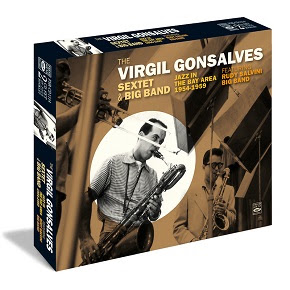
He
was born on September 5, 1931 in Monterey, where he grew up and
attended elementary and high school. He later enrolled at the San
Francisco State University. After graduating in 1952, he began touring
with the bands of Alvino Rey, Jack Fina and Tex Beneke. Between seasons,
Virgil introduced an artfully arranged sextet at concerts and club
dates, contributing to the development of a nascent modern jazz scene in
San Francisco, notably represented by the Dave Brubeck Trio.
Brubeck’s
trio was the hottest musical thing in town, since they began playing at
Ciro’s and at the Black Hawk in 1950. Disc jockey ace Jimmy Lyons, the
local high priest of modern jazz, in his “Lyons Busy” KNBC radio show,
said of Brubeck’s trio that “they’re the finest exponents of modern
music today...”
The newspaper coverage of jazz was more extensive
in the Bay Area than in any other metropolitan area in the U.S. The San
Francisco Chronicle inaugurated its full coverage of jazz and popular
music in 1950 with The Rhythm Section by Ralph Gleason in its Sunday
magazine.
Beginning in 1954, the night life in San Francisco came
out of the lethargic state in which it had been for awhile, and
jazz—Dixieland in particular—had a strong resurgence. In fact, jazz in
the city was big at the time, and the street scene boasted
record-breaking clubs like the Black Hawk, Downbeat, Hangover, Fack’s,
Tin Angel, and Macumba. For those who “digged” modern jazz, they had the
opportunity to listen throughout the year to the bands and combos of
such important touring artists as Woody Herman, Flip Phillips, Shorty
Rogers, Louis Armstrong, Art Pepper, Max Roach, Earl Hines, George
Shearing, and other nationally renowned bandleaders. Also local groups
with different sounds and rhythms were beginning to make a name for
themselves in the Bay area, such as Bob Scobey and Turk Murphy and their
Dixieland bands; Cal Tjader’s Afro-Cubans and, of course, Dave
Brubeck’s trio, whose modern
jazz concerts grossed more in Northern California than anywhere else.
In
June 1954 some 400 students crowded the Tamalpais High School
auditorium to dance to the beat of the Tam Dance Band. The featured
attraction of the date was the appearance of the Virgil Gonsalves Sextet
whose increasingly frequent and successful modern jazz performances
were beginning to attract the attention of concert promoters and owners
of the best clubs.
The work that the Virgil Gonsalves sextet had
been developing particularly impressed Monterey local disc jockey Johnny
Adams. In his eagerness to spread the word, Adams sent Gonsalves with
tapes to a few jazz record labels, including the local Fantasy, as well
as others in Los Angeles, such as Pacific Jazz and Nocturne Records.
After
several weeks and a couple of meetings in L.A., Gonsalves finally
struck a deal with Harry Babasin, producer and bassist for the newly
formed and up-and-coming Nocturne label —but on one condition: for the
recording session, instead of employing Gonsalves’s usual San Francisco
bandmates, Babasin would recruit a group of better known Los Angeles
based jazz musicians in order to include the album in their “Jazz in
Hollywood Series.”
Babasin arranged a recording session at
Western Recorders for September 29, 1954. With engineer John Neal on
board and producer Babasin on bass, the sextet was rounded out by leader
Gonsalves on baritone, the former Gene Krupa tenor saxophonist Buddy
Wise, valve trombonist Bob Enevoldsen, pianist Lou Levy, and drummer
Larry Bunker. The result was an excellent 10-inch album released in
February 1955. In his Down Beat review, Nat Hentoff said: “Date is very
close to five stars. Gonsalves blows with a strong beat and in clean,
unhackneyed solo patterns. (Listen to his pulsative sureness and
sensitive power in Yesterdays, his featured vehicle here). Elsewhere,
the blowing is fine and the ensemble interplay is particularly well
conceived.”
Virgil’s sextet first appeared at the Black Hawk in
March 1955, already a nationally known jazz club, which from 1954 was
sometimes referred to as the Jazz Corner of the West and was located at
200 Hyde St. The sextet began a series of challenging showcases, sharing
the stage with the Terry Gibbs Quartet in a daily sensational “Battle
of the Bands” that lasted two weeks. Gonsalves’ performances drew more
fans every day, and when Gibbs left in April, the sextet remained
employed as the house band. In June it was competing in a new battle,
this time with Buddy DeFranco’s quartet. Soon after, new discovery jazz
vocalist Chris Connor, on her first West Coast tour, was booked to
perform at the Black Hawk. She drew a huge crowd singing with strong
support from Virgil’s Sextet from July 26 until August 8. Something of
note happened during a Sunday afternoon jam session at the club. Virgil
invited his State College friend, the 19-year-old singer Johnny Mathis,
to sit in. Helen Noga, the tireless and energetic co-owner of the club,
was so impressed with Mathis that she decided to become his manager. In
1960, after Mathis got his first hit single “Wonderful, Wonderful,”
Virgil said, maybe unfairly: “Mathis has prostituted his great talent in
jazz to make it commercially. He could have been a great jazz singer,
but he’s making big money as a pops singer, and you can’t arguewith
that. That’s the way they judge success.”
The Black Hawk
continued to bring in artists from the East Coast as a policy. Thus,
after the success of Chris Connor, a new voice arrived on August 23.
Carmen McRae who was accompanied by the Virgil Gonsalves sextet for a
week, enjoyed a great reception by an enthusiastic audience. The club
was packed.
Gonsalves’ stay at the Black Hawk lasted for six
months, the longest period of time an artist appeared at the club in its
history.
Charles “Chinky” Naditz, was a local businessman, known
in the music scene for being the one who started the craze for small
jazz clubs in the Bay Area with Say When at 952 Bush St back in 1947. In
September 1955, Naditz opened a new club called Jumptown, dedicated to
rock ‘n’ roll, but only a few weeks later he changed his mind and
decided to adopt a modern jazz policy. On November 1st, Jumptown kicked
off with a one-week booking of a jazz star as featured soloist with the
Virgil Gonsalves Sextet. From November 1, 1955, Dizzy Gillespie, who was
already playing his —for some— still controversial bent trumpet that
had become his visual hallmark since 1953, was the first such soloist to
visit Jumptown. Dizzy and Virgil had a huge crowd kicking with joy and
excitement during their performances.
The next names drawn to
Jumptown for week long engagements in November came from Los Angeles.
The first was Dave Pell, followed by Bud Shank and Jimmy Giuffre, who
had recently been voted Down Beat’s “newclarinet star of ‘55,” and also
Maynard Ferguson and Dexter Gordon. They all played with the Gonsalves
Sextet, which in a few months had become the talk of the town and
somehow represented a San Francisco style, a hybrid response to the jazz
that had been brewing in Los Angeles and had already been labeled the
West Coast style. Gonsalves himself was a huge fan of Gerry Mulligan,
Shorty Rogers, and the fresh sound emanating from Southern California.
Also
in November, Gonsalves traveled to Los Angeles to record —again with
sound engineer John Neal— a 12” for Liberty Records, but this time he
did it with his original sextet, which by now had remained stable since
high school. Its members —and Virgil’s schoolmates for that matter— were
Bob Badgley, valve trombone; Dan Patiris, tenor sax; Clyde Pound, piano
(who also played with the Rudy Salvini big band); Max Hartstein, bass;
and Gus Gustafson, drums. The arrangements were provided by Jerry
Cournoyer and Bob Searle. After their first recording session, bassist
Max Harstein fell ill and had to be replaced by the excellent Ron
Crotty, who previously played with Brubeck. On this album, Gonsalves’
work comes off with inventiveness and flow, and he managed to
demonstrate his inherent rhythmas a soloist. The interplay between him
and Dan Patiris keeps the swinging level of this set of the so-called
San Francisco Jazz Style performances.
On November 10, 1955,
Gonsalves’ unit, Rudy Salvini’s big band, and tenorman Brew Moore —a
legend among the local jazz crowd since his arrival in San Francisco in
the early 1950s— performed at a jazz concert organized by San Francisco
State University.
Bandleader Rudy Salvini was another
indefatigable Bay Area musician who had begun playing trumpet when he
was eight years old and became interested in jazz in 1941 after hearing
Stan Kenton’s band at the Oakland Sweet Ballroom. “That was the most
exciting band I’ve ever heard,” said Rudy.
Originally from
Oakland, where he was born on March 22, 1925, Rudy Salvini attended
Clawson Elementary School and Hoover High School. At eighteen, during
his senior year at Tech, he put together his first band, a 10-piece
orchestra whose members included John Marabuto and Johnny Coppola. They
played anywhere they could, including USO dances. “Pretty soon the union
got to know who I was and said ‘hey, why don’t you join us?’” recalls
Rudy. “So I went down to see the business agent in Oakland and joined.”
Like most AFM locals at the time, Local 6 was racially segregated. Local
669, the black local, was a subsidiary of Local 6. It covered the same
territory as Local 6 although black musicians were not allowed to play
east of Van Ness. The two locals were finally merged by court order in
1960.”
He then went on to San Francisco State University, where
he belonged to the same student body as Virgil Gonsalves. In May 1945 he
was drafted and stationed at Wiesbaden, Germany with the 761st Army Air
Force band. Later, at the recommendation of friends, Rudy joined the
314th Army Forces Band, the top general’s band, which boasted the best
musicians from all over Europe. They played at the Wiesbaden Opera house
for the Army Air Force Radio Network. It was a big band with a full
string section and four singers, including a young Tony Benedetto (later
Tony Bennett, of course). Two years later, Rudy returned to San
Francisco State University and received his Bachelors in Music and
teaching credentials in 1953. After his graduation, Salvini started
doing substitute teaching at schools, instructing private pupils,
playing casual jobs —and trying to put big band jazz back in the picture
in Oakland.
In 1954, Rudy Salvini, the young trumpeter and
school-teacher, finally organized his 17-piece rehearsal band, mostly
with SF State grads. Each week they gathered on Saturday in a San
Francisco hall at 230 Jones Street to play long and arduous but
stimulating rehearsals just for the sheer joy of music. “People would
bring their music, and we would play it,” said Rudy, “That started me
off. During two years of just rehearsals,” Salvini remarked, “there were
some dreary moments —though not too many. There also were some changes
in personnel, but the nucleus of the band remains the same,” he said in
March 1956.
It was preeminently a jazz band, although it devoted a
considerable portion of its repertoire to dancing tempo numbers in an
attempt to interest whatever group of dancers existed in the Bay Area.
The Salvini band was a young, Kenton-Basie derived band which, however,
was extremely original in its arrangements, notably by Jerry Coker,
Jerry Mulvihill, and Jerry Cournoyer.
On January 14, 1956, Rudy
Salvini’s big band made its first public appearance, along with Virgil
Gonsalves’ sextet, at the Saturday afternoon dance concert sessions for
young people at Oakland Sweet’s Ballroom, organized by Pat Henry, the
best jazz disc jockey (at KROW) in the Bay area. They drew 250 patrons
for their first date. “I will forever be indebted to Pat,” Salvini said,
recalling that Mr. Henry had helped set up his band’s first Bay Area
gig. “He really gave us our start. He put himself out on a limb for us.”
Come
March, Pat Henry took his show to the Sands, another Oakland dance
hall, where he resumed latenight sessions, but this time as “Sunday at
the Sands.” Given that big band shows were not having much luck else
where in the country, it was encouraging that Henry’s display of
Salvini’s great team, along with the Virgil Gonsalves sextet, was being
met with great approval.
Meanwhile, the notoriety of the sextet
had spread throughout the country with their albums and articles in
national publications and also through musicians who had been able to
listen to them. Virgil began receiving requests to play outside the Bay
Area, and on May 5th he flew his sextet to the University of Colorado
for a one niter, and also got a booking for that summer at Lake Tahoe in
Nevada.
The famous veteran tenor saxophonist Vido Musso, after
years of playing in some of the best big bands (Benny Goodman, Harry
James, and Stan Kenton, among others), began his journey as a leader. On
May 25, 1956, he opened at San Francisco’s Avalon Ballroom with a
10-piece band scheduled for a series of weekend dances. Virgil formed
the band for Vido, which included the Gonsalves sextet plus altoist
Jerry Dodgion and other local musicians.
Meantime, Rudy Salvini’s
Oakland band had come a longway since its debut earlier that year, not
only succeeding musically, but drawing nearly 400 people on the night of
Sunday,October 14, 1956, during their first appearance that season at
the Sands Ballroom. Due to the enthusiastic response of the public, the
band was able to stay together. And although it was still playing only
casual engagements and its members had to support themselves with other
jobs, these casual events were becoming more andmore frequent.
Later,
in November ‘56 Salvini’s big band recorded five tunes for the new
label San Francisco Jazz Records, led by former disc jockey Alan Levitt.
Pat Henry, who produced the recording session, explained: “We rented
the Sands Ballroom in Oakland. First, it is a big hall, an old hall. We
used the smallest possible space to gain the effect of actually sitting
inside the band.Only one Telefunken microphone was used for all the
reeds, trumpets and trombones. An Altec M-30 microphone system was used
for the bassist and the pianist.” With this recording, Salvini’s big
band finally got the opportunity to be heard nation-wide. Along with
Jerry Coker’s quartet and vocalist Ree Brunell, the band was featured on
“Intro to Jazz,” the first LP issued by the label; itwas released in
February 1957. It had also been rumored at the time that the Virgil
Gonsalves Sextet would record an LP for San Francisco Jazz Records, but
this never happened because Levitt died suddenly, and that was the end
of the record label.
On the weekend of November 18, 1956, at the
Black Hawk, the Calvin Jackson Quartet was sharing the stand with the
new Virgil Gonsalves Sextet which included drummer Bob Fuhlrodt and
bassist Jerry Good of Oakland, tenor Lloyd Rice, pianist John Baker, and
trumpeter Mike Downs, another Oaklander.
Also in November, Rudy
Salvini left his orchestra for a spell and brought a quintet to the
Chi-Chi Club on 12th St. Clyde Pound was on piano, usually with Virgil
Gonsalves, Pete Dovino on tenor clarinet and vocals, Dean Reilly on
bass, and Forrest Elledge on drums. They played four nights a week for
two weeks.
In December, Virgil’s sextet reconvened for three
consecutive weekends at the Black Hawk with afterhours sessions at the
small Pond’s club. Then starting on January 11, 1957, they performed
four nights a week at the Cable Car Village at California and Hyde
streets. The group’s personnel included Mike Downs (tp), Dan Patiris
(ts), Clyde Pound (p); Jerry Goode (b), and Bob Fuhlrodt (d). On January
26 they began a series of Saturday afternoon concerts at the New
Fillmore theater.
At Berkeley’s Little Theater, the night of May
29, a near-capacity audience of more than 500 people, most of them
Berkeley High School students, gave an enthusiastic welcome to a 2 1/2
hour concert by Salvini’s big band with Virgil Gonsalves in the sax
section. The concert was amazing in several respects. It was the first,
at least in many years, in which a high school student body sponsored
big band jazz. The audience was notable for the close attention it paid
to the music and for the heart felt applause with which it rewarded the
various fine soloists as well as the band as a whole.
On Sunday
May 26, the first Annual San Francisco Jazz Festival took place at the
Civic Auditorium, presented by promoter Irving Granz and headlined by
Salvini’s band, along with Louis Armstrong, Dave Brubeck, The Four
Freshmen and Anita O’Day. The festival was a one-night affair and drew
crowd of over 3,000 people. According to the press, Salvini’s band
played well together and showed a good sense of dynamics. The band
opened with five hard picks, four of which were originals by San
Francisco songwriters, one of them dedicated to disc jockey Pat Henry
called “Wail for Patrick,” was composed by Jerry Coker.
In June
1957, Gonsalves took his sextet into the Moana Surf club —on 467
Broadway— with Eddie Kahn replacing Goode on bass. As for Rudy Salvini,
he ended his series of dances at the Sands ballroom on June 16 with the
idea to resume come fall.
In July, Gonsalves moved into Fack’s on
Market St. and booked it for a weekend, which was extended to four
nights a week as the club was running at a good pace. With the arrival
of autumn, the club reduced their engagement to three nights a week with
the Gonsalves sextet and the Cal Tjader trio.
On Sunday, October
27, 1957, the Eastbay jazz scene began to take off with Rudy Salvini’s
big band making their return of the season at the Sands Ballroom.
Although some of the individual members of the band —including tenor
Jerry Coker, trumpeter Allen Smith, pianist John Marabuto, Jerry
Dodgion, and Virgil Gonsalves— were well-known on their own merits, and,
despite the support of newspapers and of nationally acclaimed Oakland
disc jockey Pat Henry —they had at least $500 worth of plugs a week on
KROW— the band never really got off the ground, except on occasion.
In
July 1957, Jazz Workshop co-owner Dave Glickman opened the Jazz
Showcase (formerly Downtown) as a non-alcoholic nightclub, offering jazz
concerts in a European cabaret setting at popular prices for a teenage
audience. Glickman was an enterprising lawyer who for a time ran the
Jazz Showcase as a hobby, breaking precedent with his innovative
nightclub andweekend shows. However, just a few months later, the
experiment failed. In February 1958, the Jazz Showcase closed its doors
indefinitely on the deficit side of the ledger. The Bud Shank Quartet,
The Mastersounds, Chico Hamilton Quintet, Woody Herman’s New Third Herd,
and the Dick Mills-Brew Moore Quintet, were some of the notable names
that had performed there. Virgil Gonsalves’ sextet also played there on
November 3, 1957. The passage of the Jazz Showcase, Dave Glickman’s bold
experiment, left a huge gap in the Bay Area teen jazz scene and for
C.H. Garrigues of The San Francisco Examiner it posed a big question for
serious jazz fans. Garrigues in his “Chords and Changes” wrote: “There
is plenty of good jazz in the regular jazz clubs. But the youngsters
—they who should be growing up with this natural part of their cultural
heritage— have almost no access to serious jazz except by means of the
phonograph record, either on their own machines or on Pat Henry’s
nightly KROW program.
“Rudy Salvini, who had long been a leader
in the effort to bring jazz to people of his own generation, believed
that hope lay in the schools; As an SF State alumnus, Rudy had seen jazz
become the mode of expression at college after college in the Bay Area:
San Francisco, San Jose, College of the Pacific and others. He believed
that if jazz could be brought to the universities —as Dave Brubeck,
among others, had been— the problem of his future would be solved.”
February
16, 1958 was the last weekly appearance of the Salvini band at the
Sands. It was no secret that the band did not cover the expenses. The
music was wonderful, but the crowd was not and their sponsors no longer
wanted to continue their support. It was a sad blow to this association
of Bay Area musicians who were so devoted to big band jazz. Several of
themearned their living teaching.
Despite this set back, Rudy
Salvini’s big band continued to play casual concerts because the quality
of the orchestra and the enthusiasm of its members and leader were
unbeatable. In March 1958, baritone sax player Curtis Lowe, a veteran of
Lionel Hampton’s band, replaced Virgil Gonsalves in Salvini’s big band
while he went to play with the group backing Johnny Mathis at the
Fairmont Hotel.
By then, Virgil Gonsalves was perhaps the
hardest-working and busiest jazz musician in Northern California, but
his break wouldn’t arrive until the spring of 1958 when his sextet was
booked for a two week run starting May 13 at the Hollywood Jazz Cabaret,
formerly occupied by the famous Jazz City. At the end of June they were
hired at the Black Hawk for another two weeks.
The Gonsalves
line-up at the time included pianist Arthur Fletcher (replacing Merrill
Hoover, another Oakland resident who was hired as a sideman for Anita
O’Day), trumpeter Mike Downs, bassist Terry Hilliard, drummer Bobby
Fuhlrodt of Oakland, and tenor saxophonist Dan Patiris, who was from San
Francisco.
In July 1958, the Gonsalves sextet received much
praise while playing at the Blue Mirror, San Francisco’s newest jazz
club. C.H. Garrigues wrote in The San Francisco Examiner: “One of the
happiest changes to report in the Bay area jazz scene is the improvement
the Virgil Gonsalves Sextet showed in its recent engagement at the
Black Hawk late June 1958. Potentially, the group is much more complex,
much more capable of important serious music, than anything which has
yet come out of San Francisco.
“As a result of the improvement,
Virgil’s group has been booked into the Blue Mirror on Fillmore, now
returning to a four-night jazz policy after a considerable lapse. It was
formerly one of the top jazz spots of the area.”
Virgil himself
gave credit for the improvement to the almost stubborn persistence with
which the group kept rehearsing. “Man,” he said, “we haven’t worked much
in the last 12 months, but we sure did practice a lot together, I think
it’s starting to show.”
On Saturday, August 9, 1958, the
Gonsalves Sextet played a concert at the Booker T. Washington Community
Center. He was then invited to the first Monterey Jazz Festival,
organized by Jimmy Lyons, the first civic sponsored jazz event held on
the Pacific Coast. On the afternoon of Saturday, October 4, 1958, and
with Pat Henry as master of ceremonies, Virgil presented his impressive
sextet which was a great success, but he was a victim of the overlap.
His all-star jazz symphonic performance, scheduled to close the
afternoon of October 5, had to be removed from the overloaded schedule.
He had been scheduled to play Stravinsky’s Ebony Concerto, with Buddy
DeFranco as soloist.
Rudy Salvini’s big band continued to be
hailed by jazz critics as one of the most exciting on the Pacific Rim.
Salvini’s musicianship and training were most evident at the Monterey
Jazz Festival, where his team turned in amore exciting performance than
the other big bands of Harry James and Med Flory. His band played the
Monterey Festival Suite, written by pianist John Marabuto. Virgil showed
up again as the sax section’s anchorman in Salvini’s wailing band.
Early
in November 1958, the Virgil Gonsalves sextet appeared in the women’s
gymnasium at Humboldt Stale college, and on the 18th, they opened a
two-week run at the Jazz Workshop with a new rhythm section that
consisted of Merrill Hoover (p), Eddie Kahn (b), and Al Randall (d). At
the beginning of December, his successful performance was extended for
two more weeks during which he accompanied singer Dakota Staton on two
dates. As a result of the goodwork of the sextet, Dave Hubert, producer
and owner of Omegatape and Omega Records, proposed to record a
stereophonic album as soon as possible and Virgil accepted.
In
January 1959, Rudy Salvini joined the Laguna Salada elementary school
district of Pacifica, as one of the two music instructors for the
district and was just starting on his teaching career. Rudy taught
elementary music to kids in the 5th through 8th grade. The new teaching
job was not going to mean that Salvini would give up his big band jazz
work. The group continued its rehearsals once aweek and had a monthly
Sunday dance concert at Sands.
The Virgil Gonsalves sextet had
become one of the musical references in the world of jazz in Northern
California. But Virgil, always restless and enthusiastic, also organized
a big band with trumpeter Jerry Cournoyer that was made up of three
trumpets and a flugelhorn, two trombones, a tuba, five saxophones and
the rhythm section. They met weekly to rehearse the arrangements and
compositions that Cournoyer, Dan Patiris and Gonsalves himself had
written for the new band with the purpose of performing at the local AFM
Dance Band Contest.
On February 15, at Oakland’s Sands Ballroom,
the AFM Dance Band Competition was held, featuring the bands of Rudy
Castro, Buddy Hiles, Rudy Salvini, Steve Paul, Amando Paolini, Virgil
Gonsalves, Jerry Cournoyer, DC Pinkston, EddieWalker and Johnny Ingram.
The orchestras conducted by the trumpeters, Eddie Walker and Rudy
Salvini, ranked first and second respectively.
On Monday, May 25,
1959, Gonsalves, just after finishing a successful month at San
Francisco’s Mr. Smith club, recorded the LP for Omega. The album title
was “Jazz at Monterey by the Virgil Gonsalves Big Band Plus Six”. One
side of the disc consisted of five big band songs which included several
members of his sextet, such as Downs and Patiris, as well as other fine
sidemen including Leo Wright (the young altoist who joined Gillespie),
John Coppola, Jerry Cournoyer, Dickie Mills, Junior Mance, and Benny
Barth. The other side had four tracks from the sextet. The result of
these performances was a clear sign of the development of modern jazz in
the Bay Area. The excellent sound of these recordings was the work of
John Hall, chief engineer of Omega Records.
Virgil’s sextet then
moved into The Cabana club for a month-long engagement. Previously,
Virgil’s long-time trumpeter Mike Downs left with Philly Joe Jones for
Chicago and Philadelphia, so Stan Foster came in to replace him. Young
drummer Dick Berk also played on several Sundays with the Gonsalves
Sextet.
In January 1960, Hal Lederman and Peter Ekstein —a new
Hollywood promotion team, operating as Omega Enterprises— announced
their “Dimensions in Jazz.” It was a jazz weekend featuring Dave
Brubeck, Dinah Washington, and the Three Sounds, with one performance
Friday night at the Berkeley Community Theater and one on Saturday night
at the Masonic Temple in San Francisco. In addition Virgil Gonsalves
got the gigs for the standbys at both concerts, being heard in the
Berkeley show with his big band and in San Francisco with his sextet.
Thanks to the success, Lederman and Ekstein, invited the Gonsalves big
band to appear on at the Hollywood Jazz Festival in June.
On the
night of St. Valentine’s day, February 14, the Rudy Salvini big band
gave its long awaited first dance concert of the season at the Sands
Ballroom. He was also a regular attraction on the Monday and Tuesday
night bandstand at Castle’s Lucky XIII in San Leandro where Rudy headed a
Quintet with singer Ree Brunell, who would become his wife in August.
On
Friday night, March 4, 1960, Lederman and Ekstein presented a new
“Dimensions in Jazz” concert at the San Francisco Civic Auditorium.
Headlining the bill was the Miles Davis Quintet, and rounding out the
enticing lineup of the evening, were the Farmer-Golson-Fuller Jazztet,
the Paul Horn Quintet with Jimmy Witherspoon, and at the last minute
Nina Simone joined the event. Virgil Gonsalves’s big band opened the
show Friday night to praise from jazz critics.
Duke Ellington,
Sarah Vaughan and the new Virgil Gonsalves Sextet all performed to the
delight of the audience that filled the Civic Auditoriumon June 16. The
next day Gonsalves and his big band, which featured three trumpets and a
flugelhorn, two trombones, a tuba, five saxophones, and rhythm section,
appeared at the Hollywood Jazz Festival.
Late May, the Oscar
Peterson trio had to cancel their last three nights at the Black Hawk
when Oscar’s mother passed away unexpectedly. The Gonsalves sextet
filled in at the last minute with Ray Brown on bass.
After the summer, the Rudy Salvini and the Virgil Gonsalves-Jerry Cournoyer workshop bands stopped altogether.
In
November 1960, the Gonsalves sextet, including Stan Foster (tp), Dan
Patiris (ts), Kenny Elmore (p), Carl Brown (b) and Lee Russell (d), was
held over at San Francisco’s Hungry cellar nitery at 599 Jackson, a
bohemian North Beach club that also played a role in the rise of
comedians Mort Sahl and Lenny Bruce.
In March 1961, Virgil
organized a quartet that was booked for eight weeks Wednesdays through
Saturdays in the New Plush Room, a dining and dancing San Francisco
place located at 946 Sutter St. Then, early in April, Virgil with his
sextet, which included several new members, went to Las Vegas to back
singer Anita O’Day and in a subsequent Denver engagement. In June he was
back working with his sextet on Sundays at Suite 14, an Oakland club.
In
October 30, 1961, Gonsalves put together a tentet to appear at “Jazz
for Moderns,” a concert with a program ranging from traditional blues to
modern music, having two performances at Berkeley University in
California.
In the summer of 1962, at a time of little work,
Virgil found a foothold in New York in the new Woody Herman’s
“Thundering Herd” that worked at the Metropole as a replacement for
baritone-saxophonist Frank Hittner. Meanwhile the Rudy Salvini big band
continued to work casual dance dates at the Fairmont Hotel ballroom, as
well as some clubs.
In May 1963, after more than two years away
from the Bay Area, Virgil Gonsalves returned to the jazz circuit when he
was booked to play weekends at the Colony Club in Monterey. This time
Virgil was fronting a quintet featuring trumpeter Webster Young; Jerry
Coker (p); Terry Hilliard (b); and Kenny Shirlan (d). He later worked
with a quartet at Maida’s in Bamboo Village, Salinas (returning for New
Year’s Eve) and at the Outrigger in Monterey.
In October while
still at the Outrigger, Virgil unveiled a new sextet to play Wednesdays
through Sundays on a bill that included the great alto saxophonist Lee
Konitz, who was living in Carmel Valley. His sextet included pianist Bob
Dorough, guitarist Al Shackman from New York, bassist Boshko Vuko from
Yugoslavia; the great New Orleans drummer Art Lewis who was then working
in San Francisco, and singer Alicia Harby.
After a break of few
months, Virgil Gonsalves returned to the club circuit in May 1964,
leading a quartet with him doubling baritone sax and flute and joining
Don Alberts (p), Don Russo (b) and Art Lewis (d), playing on Wednesdays
through Sundays at the Charles Van Damme in Sausalito.
Back with
his sextet, Gonsalves played weekend night sessions at Monterey’s
Outrigger in September 1964. Shortly thereafter he appeared in a lengthy
engagement with pianist Don Alberts at Bustles and Beaus on Powell
Street in downtown San Francisco. At this stage, Gonsalves also led a
septet that played at the City Civic Center on September 25 at the
annual Arts Festival. Rudy Salvini’s big band also gave a free concert
the following day.
In October 27, Gonsalves’ quartet opened at
Music Cross Roads on Jack London Square. For this engagement, bassist
Norman McKay replaced Don Russo. According to Russ Wilson of the Oakland
Tribune: “The East bay jazz scene began broadening last night and
further expansion is imminent. Virgil Gonsalves has one of the Bay
Area’s best modern jazz combos. It iswell rehearsed and features a good
many original tunes by the leader and pianist Don Alberts.”
On
Sunday, May 16, 1965, Gonsalves played a benefit jazz concert organized
by the Children’s Home Society, titled “Capsule of Jazz History.” He was
there as a member of the John Coppola big band in the College of Nôtre
Dame Auditorium in Belmont. Coppola’s band included Rudy Salvini, Dan
Patiris, John Handy, Bill Perkins, and John Marabuto. The ensemble
imitated the styles of bigname bands from the previous 40 years. Coppola
was a popular trumpeter with 20 years of professional experience. He
had been with the bands of Stan Kenton and Woody Herman, as well as in
the shows of Judy Garland, Nat King Cole and Danny Kaye, among other
activities. He was born in Geneva, NY, a former resident of Oakland, and
a student at Technical High School. He also lived in San Francisco,
where he appeared in many night clubs and shows.
In March 1966,
Virgil again played in Coppola’s band at the Oakland Holiday Inn. He
then had a stint with Woody Herman’s band and shortly thereafter left
the jazz scene when he joined the horn section (on baritone, soprano
& flute), of Mike Bloomfield’s Electric Flag, a notable blues-rock
band. When his drummer Buddy Miles broke up with Mike after the 1967
Monterey Pop Festival, he organized a new Electric Flag-American Music
band, a nine-piece group directed by veteran bassist Harvey Brooke.
Also
in 1966, the Rudy Salvini Big Band had the honor of being the first big
band to play at the Stern Grove Festival appearing along with pianist
Vince Guaraldi, altoist John Handy, and Turk Murphy.
A new
experience for Gonsalves was writing the musical score for “Sons and
Daughters,” a powerful 1968 film directed by celebrated San Francisco
photographer Jerry Stroll. This low budget film was the story of the
young people’s protest against U.S. involvement in Vietnam. Jon
Hendricks composed and sang the title song and a second protest song
about the Negro ghetto titled “Fire In The City.” Musical accompaniment
was by The Grateful Dead.
In October 1968, Buddy Miles rounded up
some of his favorite musicians, including Virgil Gonsalves, Marcus
Doubleday (tp), Herbie Rich (org & ts), and Terry Clements (ts) and
he started his own band: the Buddy Miles Express. Rounding out the
eight-member group were Bill Rich (b), Jim McCarty (g), and Robert
McPherson (ts). Virgil recorded with the Express for Mercury and
continued with the band for over a year. Also during the fall of 1968,
Virgil played flute in jam sessions with Jimi Hendrix.
In the
fall of 1970 Virgil joined Bluesberry Jam, an all-star rock-jazz group
featuring musicians who had formerly been with name bands. The other
members were Al Walton (vocals & harmonica) who was formerly the
singer with the Pacific Gas and Electric, Al Gallegos (ts & fl) who
had toured with Ike & Tina Turner and played several years with
Perez Prado’s orchestra, Ken Klimak (lead guitarist for Mr. Stress),
Gerald Olds (b) who had played with Tom Rush and the Greenbriar Boys,
Brian Moffett (a top Chicago jazz drummer who had played concerts and
club dates with Roland Kirk), and young Hungarian trumpeter Frank Szabo
who later became a fixture in the Los Angeles jazz big bands of Louie
Bellson, Count Basie, Frank Capp/Nat Pierce, Pat Longo, Don Menza, Bill
Holman, Doc Severinsen, Charlie Shoemake, Stan Kenton 50th Celebration
band, Tom Talbert, Roger Neumann, and Gerald Wilson, among others. The
music of Bluesberry Jam was described as “American funk.”
At 41
years old, Virgil found a new home for a year when the rock-blues-soul
band Pacific Gas & Electric Company changed their name to PG&E.
In
1975 he was the baritone saxophonist and ensemble coordinator of the
Delta Wires, a very heavy group in the soul and funk Oakland style of
Tower of Power that also handled laidback growling blues and occasional
pure jazz lead lines over their rockish beat. Delta Wires was a
ten-piece group with two trumpets, two saxes and a pair of keyboards,
plus bass, guitar, drums, and harpist and leader Ernie Pinata.
After
the mid-1970s, Virgil Gonsalves continued working as a freelancer but
not much is known about his later activities. He passed away at 77 in
Salinas, CA on October 20, 2008.
Until his retirement in 1985,
Salvini taught music in Pacifica schools, a career he loved and of which
he was proud. He also continued working with an Octet in the 90s and
the early 2000s. In addition to Salvini on trumpet, the band included in
at various times, Bruce Wolff, Nael Van Valkenburgh or Van Hughes (tb),
Art Dougherty (as), Howard Dudne, Tom Hart or Jim Grantham (ts), Chuck
Peterson or Ted Thiele (bs), Michael Greensill or John Price (p), Dean
Reilly or Frank Pasantino (b), and Tom Duckworth or Eric Thompson (d).
Rudy also played with his big band once a month at the Boat House in San
Francisco with what Rudy called “the best cats in town.” In October
1996, Rudy’s Octet was chosen to play at the Duke Ellington Exhibit
which toured the United States featuring guitarist Kenny Burrell. In his
last years Rudy rehearsed once a month at the union with his band and
performed once a month at the Alameda Elks Ballroom. He died on June 7,
2011.
Virgil Gonsalves and Rudy Salvini were two very importance
driving forces of jazz in the Bay Area in the 50’s. With this
compilation CD, we want to pay tribute not only to their talent as
musicians and band leaders, but also to their perseverance and their
little-remembered musical accomplishments, a true labor of love for
jazz.
—Jordi Pujol (From the inside liner notes of FSRCD 1114)
https://www.freshsoundrecords.com/14290-virgil-gonsalves-albums
///////
Nació
el 5 de septiembre de 1931 en Monterey, donde creció y asistió a la
escuela primaria y secundaria. Más tarde se matriculó en la Universidad
Estatal de San Francisco. Después de graduarse en 1952, comenzó a hacer
giras con las bandas de Alvino Rey, Jack Fina y Tex Beneke. Entre
temporadas, Virgil presentó un sexteto ingeniosamente arreglado en
conciertos y fechas de clubes, contribuyendo al desarrollo de una
naciente escena de jazz moderno en San Francisco, representada
notablemente por el Dave Brubeck Trio.
El trío de Brubeck era la
cosa musical más candente de la ciudad, desde que comenzaron a tocar en
Ciro's y en Black Hawk en 1950. El as del disc jockey Jimmy Lyons, el
sumo sacerdote local del jazz moderno, en su programa de radio KNBC
"Lyons Busy", dijo del trío de Brubeck que "son los mejores exponentes
de la música moderna de hoy...”
La cobertura periodística del
jazz fue más extensa en el Área de la Bahía que en cualquier otra área
metropolitana de los EE.UU. El San Francisco Chronicle inauguró su
cobertura completa del jazz y la música popular en 1950 con la Sección
Rítmica de Ralph Gleason en su revista dominical.
A partir de
1954, la vida nocturna en San Francisco salió del estado letárgico en el
que había estado durante un tiempo, y el jazz, Dixieland en particular,
tuvo un fuerte resurgimiento. De hecho, el jazz en la ciudad era grande
en ese momento, y la escena callejera contaba con clubes que rompían
récords como Black Hawk, Downbeat, Hangover, Fack's, Tin Angel y
Macumba. Para aquellos que "cavaron" el jazz moderno, tuvieron la
oportunidad de escuchar durante todo el año las bandas y combos de
artistas de gira tan importantes como Woody Herman, Flip Phillips,
Shorty Rogers, Louis Armstrong, Art Pepper, Max Roach, Earl Hines,
George Shearing y otros líderes de bandas de renombre nacional. También
grupos locales con diferentes sonidos y ritmos comenzaban a hacerse un
nombre en el área de la Bahía, como Bob Scobey y Turk Murphy y sus
bandas de Dixieland; los afrocubanos de Cal Tjader y, por supuesto, el
trío de Dave Brubeck, cuyo moderno
los conciertos de jazz recaudaron más en el norte de California que en cualquier otro lugar.
En
junio de 1954, unos 400 estudiantes abarrotaron el auditorio de la
Escuela Secundaria Tamalpais para bailar al ritmo de la Banda de Baile
Tam. El atractivo destacado de la cita fue la aparición del Sexteto
Virgil Gonsalves cuyas actuaciones de jazz moderno, cada vez más
frecuentes y exitosas, comenzaban a llamar la atención de promotores de
conciertos y propietarios de los mejores clubes.
El trabajo que
el sexteto Virgil Gonsalves había estado desarrollando impresionó
particularmente al disc jockey local de Monterey, Johnny Adams. En su
afán por correr la voz, Adams envió cintas a Gonsalves a algunos sellos
discográficos de jazz, incluido el local Fantasy, así como a otros en
Los Ángeles, como Pacific Jazz y Nocturne Records.
Después de
varias semanas y un par de reuniones en Los Ángeles, Gonsalves
finalmente llegó a un acuerdo con Harry Babasin, productor y bajista del
recién formado y prometedor sello Nocturne, pero con una condición:
para la sesión de grabación, en lugar de emplear a los habituales
compañeros de banda de Gonsalves en San Francisco, Babasin reclutaría a
un grupo de músicos de jazz más conocidos de Los Ángeles para incluir el
álbum en su serie "Jazz en Hollywood".”
Babasin organizó una
sesión de grabación en Western Recorders para el 29 de septiembre de
1954. Con el ingeniero John Neal a bordo y el productor Babasin al bajo,
el sexteto se completó con el líder Gonsalves al barítono, el ex
saxofonista tenor Gene Krupa Buddy Wise, el trombonista de válvulas Bob
Enevoldsen, el pianista Lou Levy y el baterista Larry Bunker. El
resultado fue un excelente álbum de 10 pulgadas lanzado en febrero de
1955. En su reseña de Down Beat, Nat Hentoff dijo: "Date está muy cerca
de las cinco estrellas. Gonsalves sopla con un ritmo fuerte y en
patrones solistas limpios y poco trillados. (Escuche su seguridad
pulsátil y poder sensible en Yesterdays, su vehículo destacado aquí). En
otros lugares, el soplo está bien y la interacción del conjunto está
particularmente bien concebida.”
El sexteto de Virgil apareció
por primera vez en el Black Hawk en marzo de 1955, que ya era un club de
jazz conocido a nivel nacional, que a partir de 1954 a veces se llamaba
Jazz Corner of the West y estaba ubicado en 200 Hyde St.El sexteto
comenzó una serie de exhibiciones desafiantes, compartiendo el escenario
con Terry Gibbs Quartet en una sensacional "Batalla de bandas" diaria
que duró dos semanas. Las actuaciones de Gonsalves atrajeron a más
fanáticos cada día, y cuando Gibbs se fue en abril, el sexteto
permaneció empleado como banda de la casa. En junio competía en una
nueva batalla, esta vez con el cuarteto de Buddy DeFranco. Poco después,
la nueva vocalista de discovery jazz, Chris Connor, en su primera gira
por la Costa Oeste, fue contratada para actuar en el Black Hawk. Atrajo a
una gran multitud cantando con un fuerte apoyo del Sexteto de Virgil
desde el 26 de julio hasta el 8 de agosto. Algo notable sucedió durante
una sesión improvisada del domingo por la tarde en el club. Virgil
invitó a su amigo de la Universidad Estatal, el cantante Johnny Mathis,
de 19 años, a sentarse. Helen Noga, la incansable y enérgica
copropietaria del club, quedó tan impresionada con Mathis que decidió
convertirse en su gerente. En 1960, después de que Mathis obtuviera su
primer sencillo "Wonderful, Wonderful", Virgil dijo, quizás
injustamente: "Mathis ha prostituido su gran talento en el jazz para
hacerlo comercialmente. Podría haber sido un gran cantante de jazz, pero
está ganando mucho dinero como cantante pop, y no se puede argumentar
con eso. Así es como juzgan el éxito.”
El Halcón Negro continuó
trayendo artistas de la Costa Este como política. Así, tras el éxito de
Chris Connor, el 23 de agosto llegó una nueva voz. Carmen McRae quien
estuvo acompañada por el sexteto Virgil Gonsalves durante una semana,
disfrutó de una gran acogida por parte de un público entusiasta. El club
estaba lleno.
La estadía de Gonsalves en el Black Hawk duró seis
meses, el período más largo de tiempo que un artista apareció en el
club en su historia.
Charles "Chinky" Naditz, era un hombre de
negocios local, conocido en la escena musical por ser quien inició la
locura por los pequeños clubes de jazz en el Área de la Bahía, por
ejemplo, cuando estaba en 952 Bush St en 1947. En septiembre de 1955,
Naditz abrió un nuevo club llamado Jumptown, dedicado al rock and roll,
pero solo unas semanas después cambió de opinión y decidió adoptar una
política de jazz moderno. El 1 de noviembre, Jumptown comenzó con una
reserva de una semana de una estrella de jazz como solista destacado con
el Sexteto Virgil Gonsalves. Desde el 1 de noviembre de 1955, Dizzy
Gillespie, que ya tocaba su —para algunos— todavía controvertida
trompeta inclinada que se había convertido en su sello visual desde
1953, fue el primer solista de este tipo en visitar Jumptown. Dizzy y
Virgil tuvieron una gran multitud pateando de alegría y emoción durante
sus actuaciones.
Los siguientes nombres atraídos a Jumptown para
compromisos de una semana en noviembre vinieron de Los Ángeles. El
primero fue Dave Pell, seguido de Bud Shank y Jimmy Giuffre, quienes
recientemente habían sido rechazados como "newclarinet star of '55" de
Beat, y también Maynard Ferguson y Dexter Gordon. Todos tocaron con el
Sexteto Gonsalves, que en pocos meses se había convertido en la
comidilla de la ciudad y de alguna manera representaba un estilo de San
Francisco, una respuesta híbrida al jazz que se había estado gestando en
Los Ángeles y que ya había sido etiquetado como el estilo de la Costa
Oeste. El propio Gonsalves era un gran admirador de Gerry Mulligan,
Shorty Rogers y el sonido fresco que emanaba del sur de California.
También
en noviembre, Gonsalves viajó a Los Ángeles para grabar, nuevamente con
el ingeniero de sonido John Neal, un 12" para Liberty Records, pero
esta vez lo hizo con su sexteto original, que a estas alturas se había
mantenido estable desde la secundaria. Sus miembros, y compañeros de
escuela de Virgil, eran Bob Badgley, trombón de válvulas; Dan Patiris,
saxo tenor; Clyde Pound, piano (que también tocó con la big band de Rudy
Salvini); Max Hartstein, bajo; y Gus Gustafson, batería. Los arreglos
fueron proporcionados por Jerry Cournoyer y Bob Searle. Después de su
primera sesión de grabación, el bajista Max Harstein cayó enfermo y tuvo
que ser reemplazado por el excelente Ron Crotty, quien previamente tocó
con Brubeck. En este álbum, el trabajo de Gonsalves sale con inventiva y
fluidez, y logró demostrar sus ritmos inherentes como solista. La
interacción entre él y Dan Patiris mantiene el nivel oscilante de este
conjunto de las llamadas actuaciones al estilo Jazz de San Francisco.
El
10 de noviembre de 1955, la unidad de Gonsalves, la big band de Rudy
Salvini y el tenorista Brew Moore, una leyenda entre la multitud de jazz
local desde su llegada a San Francisco a principios de la década de
1950, actuaron en un concierto de jazz organizado por la Universidad
Estatal de San Francisco.
El líder de la banda Rudy Salvini era
otro músico infatigable del Área de la Bahía que había comenzado a tocar
la trompeta cuando tenía ocho años y se interesó por el jazz en 1941
después de escuchar a la banda de Stan Kenton en el Oakland Sweet
Ballroom. "Esa fue la banda más emocionante que he escuchado", dijo
Rudy.
Originario de Oakland, donde nació el 22 de marzo de 1925,
Rudy Salvini asistió a la Escuela Primaria Clawson y a la Escuela
Secundaria Hoover. A los dieciocho años, durante su último año en Tech,
formó su primera banda, una orquesta de 10 integrantes cuyos miembros
incluían a John Marabuto y Johnny Coppola. Tocaban en cualquier lugar
que podían, incluidos los bailes USO. "Muy pronto el sindicato supo
quién era yo y dijo: 'Oye, ¿por qué no te unes a nosotros?'"recuerda
Rudy. "Así que bajé a ver al agente comercial en Oakland y me uní ."Como
la mayoría de los locales de AFM en ese momento, el Local 6 estaba
segregado racialmente. El Local 669, el local negro, era una filial del
Local 6. Cubría el mismo territorio que el Local 6, aunque a los músicos
negros no se les permitía tocar al este de Van Ness. Los dos locales
finalmente se fusionaron por orden judicial en 1960.”
Luego pasó a
la Universidad Estatal de San Francisco, donde pertenecía al mismo
cuerpo estudiantil que Virgil Gonsalves. En mayo de 1945 fue reclutado y
destinado en Wiesbaden, Alemania, con la 761ª banda de la Fuerza Aérea
del Ejército. Más tarde, por recomendación de amigos, Rudy se unió a la
314th Army Forces Band, la banda del mejor general, que contaba con los
mejores músicos de toda Europa. Tocaron en la Ópera de Wiesbaden para la
Red de Radio de la Fuerza Aérea del Ejército. Era una big band con una
sección completa de cuerdas y cuatro cantantes, incluido un joven Tony
Benedetto(más tarde Tony Bennett, por supuesto). Dos años más tarde,
Rudy regresó a la Universidad Estatal de San Francisco y recibió su
Licenciatura en Música y credenciales docentes en 1953. Después de su
graduación, Salvini comenzó a dar clases sustitutas en las escuelas,
instruyendo a alumnos privados, desempeñando trabajos ocasionales y
tratando de volver a poner el jazz de big band en escena en Oakland.
En
1954, Rudy Salvini, el joven trompetista y maestro de escuela,
finalmente organizó su banda de ensayo de 17 músicos, principalmente con
graduados estatales de SF. Cada semana se reunían los sábados en una
sala de San Francisco en 230 Jones Street para tocar ensayos largos y
arduos pero estimulantes solo por el puro placer de la música. "La gente
traía su música y la tocábamos", dijo Rudy, " Eso me hizo empezar.
Durante dos años de ensayos justos", comentó Salvini, " hubo algunos
momentos tristes, aunque no demasiados. También hubo algunos cambios de
personal, pero el núcleo de la banda sigue siendo el mismo", dijo en
marzo de 1956.
Era predominantemente una banda de jazz, aunque
dedicó una parte considerable de su repertorio a números de tempo de
baile en un intento de interesar a cualquier grupo de bailarines que
existiera en el Área de la Bahía. The Salvini band era una banda joven
derivada de Kenton-Basie que, sin embargo, era extremadamente original
en sus arreglos, en particular de Jerry Coker, Jerry Mulvihill y Jerry
Cournoyer.
El 14 de enero de 1956, la big band de Rudy Salvini
hizo su primera aparición pública, junto con el sexteto de Virgil
Gonsalves, en las sesiones de conciertos de baile de los sábados por la
tarde para jóvenes en Oakland Sweet's Ballroom, organizadas por Pat
Henry, el mejor disc jockey de jazz (en KROW) en el área de la Bahía.
Atrajeron a 250 clientes para su primera cita. "Siempre estaré en deuda
con Pat", dijo Salvini, recordando que Henry había ayudado a establecer
el primer concierto de su banda en el Área de la Bahía. "Él realmente
nos dio nuestro comienzo. Él se arriesgó por nosotros.”
En marzo,
Pat Henry llevó su espectáculo a The Sands, otro salón de baile de
Oakland, donde reanudó las sesiones nocturnas, pero esta vez como "
Sunday at the Sands."Dado que los espectáculos de big band no estaban
teniendo mucha suerte en ningún otro lugar del país, fue alentador que
la exhibición de Henry del gran equipo de Salvini, junto con el sexteto
de Virgil Gonsalves, fuera recibida con gran aprobación.
Mientras
tanto, la notoriedad del sexteto se había extendido por todo el país
con sus discos y artículos en publicaciones nacionales y también a
través de músicos que habían podido escucharlos. Virgil comenzó a
recibir solicitudes para tocar fuera del Área de la Bahía, y el 5 de
mayo voló con su sexteto a la Universidad de Colorado por una noche, y
también consiguió una reserva para ese verano en Lake Tahoe en Nevada.
El
famoso saxofonista tenor veterano Vido Musso, tras años tocando en
algunas de las mejores big bands (Benny Goodman, Harry James y Stan
Kenton, entre otros), inició su andadura como líder. El 25 de mayo de
1956, abrió en el Avalon Ballroom de San Francisco con una banda de 10
integrantes programada para una serie de bailes de fin de semana. Virgil
formó la banda para Vido, que incluía al sexteto Gonsalves más el
altoista Jerry Dodgion y otros músicos locales.
Mientras tanto,
la banda de Oakland de Rudy Salvini había recorrido un largo camino
desde su debut a principios de ese año, no solo teniendo éxito
musicalmente,sino atrayendo a casi 400 personas la noche del domingo 14
de octubre de 1956, durante su primera aparición esa temporada en el
Sands Ballroom. Debido a la entusiasta respuesta del público, la banda
pudo permanecer unida. Y aunque todavía estaba jugando solo compromisos
casuales y sus miembros tenían que mantenerse con otros trabajos, estos
eventos casuales eran cada vez más frecuentes.
Más tarde, en
noviembre del 56, la big band de Salvini grabó cinco temas para el nuevo
sello San Francisco Jazz Records, liderado por el ex disc jockey Alan
Levitt. Pat Henry, quien produjo la sesión de grabación, explicó:
"Alquilamos el Sands Ballroom en Oakland. Primero, es un gran salón, un
viejo salón. Usamos el espacio más pequeño posible para obtener el
efecto de sentarnos realmente dentro de la banda.Solo se usó un
micrófono Telefunken para todas las lengüetas, trompetas y trombones. Se
utilizó un sistema de micrófono Altec M-30 para el bajista y el
pianista."Con esta grabación, la big band de Salvini finalmente tuvo la
oportunidad de ser escuchada en todo el país. Junto con el cuarteto de
Jerry Coker y la vocalista Ree Brunell, la banda apareció en "Intro to
Jazz", el primer LP publicado por el sello; fue lanzado en febrero de
1957. También se había rumoreado en ese momento que el Sexteto de Virgil
Gonsalves grabaría un LP para San Francisco Jazz Records, pero esto
nunca sucedió porque Levitt murió repentinamente, y ese fue el final del
sello discográfico.
El fin de semana del 18 de noviembre de
1956, en el Black Hawk, el Cuarteto de Calvin Jackson compartía el stand
con el nuevo Sexteto de Virgil Gonsalves que incluía al baterista Bob
Fuhlrodt y al bajista Jerry Good de Oakland, el tenor Lloyd Rice, el
pianista John Baker y el trompetista Mike Downs, otro oaklander.
También
en noviembre, Rudy Salvini dejó su orquesta por un tiempo y trajo un
quinteto al Chi-Chi Club en 12th St. Clyde Pound tocaba el piano,
generalmente con Virgil Gonsalves, Pete Dovino al clarinete tenor y voz,
Dean Reilly al bajo y Forrest Elledge a la batería. Tocaron cuatro
noches a la semana durante dos semanas.
En diciembre, el sexteto
de Virgil volvió a reunirse durante tres fines de semana consecutivos en
el Black Hawk con sesiones posteriores en el small Pond's club. Luego, a
partir del 11 de enero de 1957, actuaron cuatro noches a la semana en
el Teleférico Village en las calles California y Hyde. El personal del
grupo incluía a Mike Downs( tp), Dan Patiris (ts), Clyde Pound( p);
Jerry Goode (b) y Bob Fuhlrodt (d). El 26 de enero comenzaron una serie
de conciertos los sábados por la tarde en el teatro New Fillmore.
En
el Little Theatre de Berkeley, la noche del 29 de mayo, una audiencia
cercana a la capacidad de más de 500 personas, la mayoría de ellos
estudiantes de Berkeley High School, dio una entusiasta bienvenida a un
concierto de 2 1/2 horas de la big band de Salvini con Virgil Gonsalves
en la sección de saxo. El concierto fue increíble en varios aspectos.
Fue el primero, al menos en muchos años, en el que un cuerpo estudiantil
de secundaria patrocinó big band jazz. El público destacó por la gran
atención que prestó a la música y por los cordiales aplausos con los que
recompensó a los diversos excelentes solistas, así como a la banda en
su conjunto.
El domingo 26 de mayo, se llevó a cabo el primer
Festival Anual de Jazz de San Francisco en el Civic Auditorium,
presentado por el promotor Irving Granz y encabezado por la banda de
Salvini, junto con Louis Armstrong, Dave Brubeck, The Four Freshmen y
Anita O'Day. El festival fue un evento de una noche y atrajo a una
multitud de más de 3.000 personas. Según la prensa, la banda de Salvini
tocaba bien junta y mostraba un buen sentido de la dinámica. La banda
abrió con cinco selecciones difíciles, cuatro de las cuales eran
originales de compositores de San Francisco, una de ellas dedicada al
disc jockey Pat Henry llamada "Wail for Patrick", fue compuesta por
Jerry Coker.
En junio de 1957, Gonsalves llevó su sexteto al
Moana Surf club, en 467 Broadway— con Eddie Kahn reemplazando a Goode en
el bajo. En cuanto a Rudy Salvini, terminó su serie de bailes en el
Sands ballroom el 16 de junio con la idea de reanudarlos en otoño.
En
julio, Gonsalves se mudó a Fack's en Market St. y lo reservó para un
fin de semana, que se extendió a cuatro noches a la semana ya que el
club funcionaba a buen ritmo. Con la llegada del otoño, el club redujo
su compromiso a tres noches a la semana con el sexteto Gonsalves y el
trío Cal Tjader.
El domingo 27 de octubre de 1957, la escena del
jazz de Eastbay comenzó a despegar con la big band de Rudy Salvini
haciendo su regreso de la temporada en el Sands Ballroom. Aunque algunos
de los miembros individuales de la banda, incluidos el tenor Jerry
Coker, el trompetista Allen Smith, el pianista John Marabuto, Jerry
Dodgion y Virgil Gonsalves, eran conocidos por sus propios méritos y, a
pesar del apoyo de los periódicos y del disc jockey Pat Henry de
Oakland, aclamado a nivel nacional, tenían al menos 500 dólares en
enchufes a la semana en KROW, la banda nunca despegó realmente, excepto
en ocasiones.
En julio de 1957, Dave Glickman, copropietario de
Jazz Workshop, abrió Jazz Showcase (anteriormente Downtown) como un club
nocturno sin alcohol, que ofrecía conciertos de jazz en un entorno de
cabaret europeo a precios populares para un público adolescente.
Glickman era un abogado emprendedor que durante un tiempo dirigió la
Vitrina de Jazz como pasatiempo, rompiendo precedentes con su innovador
club nocturno y espectáculos de fin de semana. Sin embargo, solo unos
meses después, el experimento fracasó. En febrero de 1958, el Jazz
Showcase cerró sus puertas indefinidamente en el lado deficitario del
libro mayor. El Cuarteto Bud Shank, The Mastersounds, el Quinteto Chico
Hamilton, el Nuevo Tercer Rebaño de Woody Herman y el Quinteto Dick
Mills-Brew Moore, fueron algunos de los nombres notables que se
presentaron allí. El sexteto de Virgil Gonsalves también tocó allí el 3
de noviembre de 1957. El paso de The Jazz Showcase, el audaz experimento
de Dave Glickman, dejó un gran vacío en la escena del jazz adolescente
del Área de la Bahía y para C. H. Garrigues del San Francisco Examiner
planteó una gran pregunta para los fanáticos serios del jazz. Garrigues
en sus" Acordes y cambios "escribió:" Hay mucho buen jazz en los clubes
de jazz habituales. Pero los jóvenes, ellos que deberían estar creciendo
con esta parte natural de su herencia cultural, casi no tienen acceso
al jazz serio, excepto por medio del disco fonográfico, ya sea en sus
propias máquinas o en el programa nocturno KROW de Pat Henry.
"Rudy
Salvini, quien durante mucho tiempo había sido un líder en el esfuerzo
por llevar el jazz a las personas de su propia generación, creía que la
esperanza estaba en las escuelas; Como alumno de SF State, Rudy había
visto cómo el jazz se convertía en el modo de expresión en una
universidad tras otra en el Área de la Bahía: San Francisco, San José,
College of the Pacific y otros. Creía que si se podía llevar el jazz a
las universidades, como lo había hecho Dave Brubeck, entre otros, se
resolvería el problema de su futuro.”
El 16 de febrero de 1958
fue la última aparición semanal de la banda Salvini en las Arenas. No
era ningún secreto que la banda no cubría los gastos. La música era
maravillosa, pero la multitud no y sus patrocinadores ya no querían
continuar con su apoyo. Fue un golpe triste para esta asociación de
músicos del área de la Bahía que estaban tan dedicados al jazz de big
band. Varios de ellos aprendieron su enseñanza viviente.
A pesar
de este contratiempo, la big band de Rudy Salvini continuó dando
conciertos casuales porque la calidad de la orquesta y el entusiasmo de
sus integrantes y líder eran inmejorables. En marzo de 1958, el
saxofonista barítono Curtis Lowe, un veterano de la banda de Lionel
Hampton, reemplazó a Virgil Gonsalves en la big band de Salvini mientras
iba a tocar con el grupo respaldando a Johnny Mathis en el Hotel
Fairmont.
Para entonces, Virgil Gonsalves era quizás el músico de
jazz más trabajador y ocupado del norte de California, pero su descanso
no llegaría hasta la primavera de 1958, cuando su sexteto fue reservado
para una presentación de dos semanas a partir del 13 de mayo en el
Hollywood Jazz Cabaret, anteriormente ocupado por el famoso Jazz City. A
fines de junio fueron contratados en el Black Hawk por otras dos
semanas.
La formación de Gonsalves en ese momento incluía al
pianista Arthur Fletcher (reemplazando a Merrill Hoover, otro residente
de Oakland que fue contratado como acompañante de Anita O'Day), el
trompetista Mike Downs, el bajista Terry Hilliard, el baterista Bobby
Fuhlrodt de Oakland y el saxofonista tenor Dan Patiris, quien era de San
Francisco.
En julio de 1958, el sexteto Gonsalves recibió muchos
elogios mientras tocaba en Blue Mirror, el club de jazz más nuevo de
San Francisco. C. H. Garrigues escribió en el San Francisco Examiner:
"Uno de los cambios más felices para informar en la escena del jazz del
área de la Bahía es la mejora que mostró el Sexteto Virgil Gonsalves en
su reciente compromiso con el Black Hawk a fines de junio de 1958.
Potencialmente, el grupo es mucho más complejo, mucho más capaz de hacer
música seria importante, que cualquier cosa que haya salido de San
Francisco.
"Como resultado de la mejora, el grupo de Virgil ha
sido reservado en el Espejo Azul de Fillmore, ahora volviendo a una
política de jazz de cuatro noches después de un lapso considerable.
Antiguamente era uno de los mejores lugares de jazz de la zona.”
El
propio Virgilio atribuyó la mejora a la persistencia casi obstinada con
la que el grupo siguió ensayando. "Hombre", dijo, " no hemos trabajado
mucho en los últimos 12 meses, pero seguro que practicamos mucho juntos,
creo que está empezando a notarse.”
El sábado 9 de agosto de
1958, el Sexteto Gonsalves dio un concierto en el Centro Comunitario
Booker T. Washington. Luego fue invitado al primer Festival de Jazz de
Monterrey, organizado por Jimmy Lyons, el primer evento de jazz
patrocinado por Civic celebrado en la costa del Pacífico. En la tarde
del sábado 4 de octubre de 1958, y con Pat Henry como maestro de
ceremonias, Virgil presentó su impresionante sexteto que fue un gran
éxito, pero fue víctima de la superposición. Su actuación sinfónica de
jazz all-star, programada para cerrar la tarde del 5 de octubre, tuvo
que ser eliminada de la sobrecargada agenda. Estaba programado para
tocar el Concierto de Ébano de Stravinsky, con Buddy DeFranco como
solista.
La big band de Rudy Salvini continuó siendo aclamada por
los críticos de jazz como una de las más emocionantes de la Cuenca del
Pacífico. La maestría musical y la formación de Salvini fueron más
evidentes en el Festival de Jazz de Monterrey, donde su equipo ofreció
una actuación más emocionante que las otras grandes bandas de Harry
James y Med Flory. Su banda tocó la Suite del Festival de Monterrey,
escrita por el pianista John Marabuto. Virgil volvió a aparecer como
presentador de la sección sax en la banda de lamentos de Salvini.
A
principios de noviembre de 1958, el sexteto Virgil Gonsalves apareció
en el gimnasio femenino del Humboldt Stale college, y el día 18 abrieron
una presentación de dos semanas en el Taller de Jazz con una nueva
sección rítmica que consistía en Merrill Hoover (p), Eddie Kahn (b) y Al
Randall (d). A principios de diciembre, su exitosa actuación se
extendió por dos semanas más durante las cuales acompañó a la cantante
Dakota Staton en dos fechas. Como resultado del buen trabajo del
sexteto, Dave Hubert, productor y propietario de Omegatape y Omega
Records, propuso grabar un álbum estereofónico lo antes posible y Virgil
aceptó.
En enero de 1959, Rudy Salvini se unió al distrito
escolar primario Laguna Salada de Pacífica, como uno de los dos
instructores de música del distrito y recién comenzaba su carrera
docente. Rudy enseñó música de primaria a niños de 5to a 8vo grado. El
nuevo trabajo docente no iba a significar que Salvini renunciara a su
trabajo de big band jazz. El grupo continuó sus ensayos una vez a la
semana y tenía un concierto de baile dominical mensual en Sands.
El
sexteto de Virgil Gonsalves se había convertido en una de las
referencias musicales en el mundo del jazz en el norte de California.
Pero Virgil, siempre inquieto y entusiasta, también organizó una big
band con el trompetista Jerry Cournoyer que estaba formada por tres
trompetas y un fliscorno, dos trombones, una tuba, cinco saxofones y la
sección rítmica. Se reunían semanalmente para ensayar los arreglos y
composiciones que Cournoyer, Dan Patiris y el propio Gonsalves habían
escrito para la nueva banda con el propósito de presentarse en el
Concurso local de Bandas de Baile AFM.
El 15 de febrero, en el
Sands Ballroom de Oakland, se llevó a cabo la Competencia AFM Dance
Band, con las bandas de Rudy Castro, Buddy Hiles, Rudy Salvini, Steve
Paul, Amando Paolini, Virgil Gonsalves, Jerry Cournoyer, DC Pinkston,
EddieWalker y Johnny Ingram. Las orquestas dirigidas por los
trompetistas, Eddie Walker y Rudy Salvini, ocuparon el primer y segundo
lugar respectivamente.
El lunes 25 de mayo de 1959, Gonsalves,
justo después de terminar un mes exitoso en el Mr. Smith club de San
Francisco, grabó el LP para Omega. El título del álbum era "Jazz at
Monterey de Virgil Gonsalves Big Band Plus Six". Una cara del disco
consistía en cinco canciones de big band que incluían a varios miembros
de su sexteto, como Downs y Patiris, así como a otros excelentes
acompañantes, incluidos Leo Wright( el joven altoista que se unió a
Gillespie), John Coppola, Jerry Cournoyer, Dickie Mills, Junior Mance y
Benny Barth. El otro lado tenía cuatro temas del sexteto. El resultado
de estas actuaciones fue una clara señal del desarrollo del jazz moderno
en el Área de la Bahía. El excelente sonido de estas grabaciones fue
obra de John Hall, ingeniero jefe de Omega Records.
El sexteto de
Virgil luego se mudó al Cabana club para un compromiso de un mes.
Anteriormente, el trompetista Mike Downs, de Virgil, se fue con Philly
Joe Jones a Chicago y Filadelfia, por lo que Stan Foster entró para
reemplazarlo. El joven baterista Dick Berk también tocó varios domingos
con el Sexteto Gonsalves.
En enero de 1960, Hal Lederman y Peter
Ekstein, un nuevo equipo de promoción de Hollywood, que operaba como
Omega Enterprises, anunciaron sus " Dimensiones en el Jazz."Fue un fin
de semana de jazz con Dave Brubeck, Dinah Washington y Three Sounds, con
una presentación el viernes por la noche en el Berkeley Community
Theatre y otra el sábado por la noche en el Templo Masónico de San
Francisco. Además Virgil Gonsalves consiguió los bolos para los
suplentes en ambos conciertos, siendo escuchado en el show de Berkeley
con su big band y en San Francisco con su sexteto. Gracias al éxito,
Lederman y Ekstein invitaron a la big band de Gonsalves a presentarse en
el Festival de Jazz de Hollywood en junio.
En la noche del día
de San Valentín, el 14 de febrero, la Rudy Salvini big band dio su tan
esperado primer concierto de baile de la temporada en el Sands Ballroom.
También era una atracción habitual en el quiosco de música de los lunes
y martes por la noche en Castle Lucky XIII en San Leandro, donde Rudy
encabezaba un Quinteto con la cantante Ree Brunell, quien se convertiría
en su esposa en agosto.
La noche del viernes 4 de marzo de 1960,
Lederman y Ekstein presentaron un nuevo concierto "Dimensions in Jazz"
en el Auditorio Cívico de San Francisco. Encabezando el cartel estuvo el
Quinteto de Miles Davis, y completando la atractiva alineación de la
noche, estuvieron el Jazztet Farmer-Golson-Fuller, el Quinteto Paul Horn
con Jimmy Witherspoon y, en el último minuto, Nina Simone se unió al
evento. La big band de Virgil Gonsalves abrió el espectáculo el viernes
por la noche para recibir elogios de los críticos de jazz.
Duke
Ellington, Sarah Vaughan y el nuevo Sexteto de Virgil Gonsalves actuaron
para deleite de la audiencia que llenó el Auditorio Cívicoel 16 de
junio. Al día siguiente, Gonsalves y su big band, que incluía tres
trompetas y un fliscorno, dos trombones, una tuba, cinco saxofones y una
sección rítmica, aparecieron en el Festival de Jazz de Hollywood.
A
fines de mayo, el trío Oscar Peterson tuvo que cancelar sus últimas
tres noches en el Black Hawk cuando la madre de Oscar falleció
inesperadamente. El sexteto de Gonsalves entró en el último minuto con
Ray Brown en el bajo.
Después del verano, las bandas de talleres Rudy Salvini y Virgil Gonsalves-Jerry Cournoyer se detuvieron por completo.
En
noviembre de 1960, el sexteto de Gonsalves, incluidos Stan Foster (tp),
Dan Patiris( ts), Kenny Elmore (p), Carl Brown (b) y Lee Russell (d),
fue retenido en Hungry cellar nitery de San Francisco en 599 Jackson, un
bohemio club de playa del Norte que también jugó un papel en el ascenso
de los comediantes Mort Sahl y Lenny Bruce.
En marzo de 1961, Virgil
organizó un cuarteto que estuvo reservado durante ocho semanas de
miércoles a sábado en the New Plush Room, un lugar para cenar y bailar
en San Francisco ubicado en 946 Sutter St.Luego, a principios de abril,
Virgil con su sexteto, que incluía a varios miembros nuevos, fue a Las
Vegas para respaldar a la cantante Anita O'Day y en un compromiso
posterior en Denver. En junio regresó a trabajar con su sexteto los
domingos en Suite 14, un club de Oakland.
El 30 de octubre de
1961, Gonsalves armó una carpa para presentarse en "Jazz for Moderns",
un concierto con un programa que iba desde el blues tradicional hasta la
música moderna, con dos presentaciones en la Universidad de Berkeley en
California.
En el verano de 1962, en un momento de poco trabajo,
Virgil encontró un punto de apoyo en Nueva York en el nuevo "Thundering
Herd" de Woody Herman que trabajaba en el Metropole como reemplazo del
saxofonista barítono Frank Hittner. Mientras tanto, la Rudy Salvini big
band continuó trabajando en citas de baile informales en el salón de
baile del Hotel Fairmont, así como en algunos clubes.
En mayo de
1963, después de más de dos años alejado del Área de la Bahía, Virgil
Gonsalves regresó al circuito de jazz cuando fue contratado para tocar
los fines de semana en el Colony Club de Monterrey. Esta vez Virgil
estaba al frente de un quinteto con el trompetista Webster Young; Jerry
Coker (p); Terry Hilliard (b); y Kenny Shirlan (d). Más tarde trabajó
con un cuarteto en Maida's en Bamboo Village, Salinas (regresando para
Nochevieja) y en the Outrigger en Monterrey.
En octubre, mientras
aún estaba en el Outrigger, Virgil presentó un nuevo sexteto para tocar
de miércoles a domingo en un cartel que incluía al gran saxofonista
alto Lee Konitz, que vivía en Carmel Valley. Su sexteto incluía al
pianista Bob Dorough, el guitarrista Al Shackman de Nueva York, el
bajista Boshko Vuko de Yugoslavia; el gran baterista de Nueva Orleans,
Art Lewis, que entonces trabajaba en San Francisco, y la cantante Alicia
Harby.
Después de un descanso de unos meses, Virgil Gonsalves
regresó al circuito de clubes en mayo de 1964, liderando un cuarteto con
él doblando saxo barítono y flauta y uniéndose a Don Alberts (p), Don
Russo (b) y Art Lewis (d), tocando de miércoles a domingos en el Charles
Van Damme en Sausalito.
De regreso con su sexteto, Gonsalves
tocó en sesiones nocturnas de fin de semana en el Outrigger de Monterey
en septiembre de 1964. Poco después apareció en un largo compromiso con
el pianista Don Alberts en Bustles and Beaus en Powell Street, en el
centro de San Francisco. En esta etapa, Gonsalves también dirigió un
septeto que tocó en el Centro Cívico de la Ciudad el 25 de septiembre en
el Festival anual de las Artes. La big band de Rudy Salvini también dio
un concierto gratuito al día siguiente.
El 27 de octubre, el
cuarteto de Gonsalves abrió en Music Cross Roads en Jack London Square.
Para este compromiso, el bajista Norman McKay reemplazó a Don Russo.
Según Russ Wilson, del Oakland Tribune: "La escena del jazz del Este de
la bahía comenzó a ampliarse anoche y es inminente una mayor expansión.
Virgil Gonsalves tiene uno de los mejores combos de jazz moderno del
área de la Bahía. Está bien ensayado y presenta una buena cantidad de
melodías originales del líder y pianista Don Alberts.”
El domingo
16 de mayo de 1965, Gonsalves tocó en un concierto benéfico de jazz
organizado por Children's Home Society, titulado " Cápsula de la
Historia del Jazz."Estuvo allí como miembro de la big band de John
Coppola en el Auditorio College of Nôtre Dame en Belmont. La banda de
Coppola incluía a Rudy Salvini, Dan Patiris, John Handy, Bill Perkins y
John Marabuto. El conjunto imitó los estilos de las bandas bigname de
los 40 años anteriores. Coppola era un trompetista popular con 20 años
de experiencia profesional. Había estado con las bandas de Stan Kenton y
Woody Herman, así como en los shows de Judy Garland, Nat King Cole y
Danny Kaye, entre otras actividades. Nació en Geneva, Nueva York, ex
residente de Oakland y estudiante de Technical High School. También
vivió en San Francisco, donde apareció en muchos clubes nocturnos y
espectáculos.
En marzo de 1966, Virgil volvió a tocar en la banda
de Coppola en el Oakland Holiday Inn. Luego pasó un tiempo con la banda
de Woody Herman y poco después abandonó la escena del jazz cuando se
unió a la sección de vientos (barítono, soprano y flauta) de Electric
Flag de Mike Bloomfield, una notable banda de blues-rock. Cuando su
baterista Buddy Miles rompió con Mike después del Festival Pop de
Monterrey de 1967, organizó una nueva banda de música estadounidense de
Bandera Eléctrica, un grupo de nueve integrantes dirigido por el
veterano bajista Harvey Brooke.
También en 1966, la Rudy Salvini
Big Band tuvo el honor de ser la primera big band en tocar en el Stern
Grove Festival apareciendo junto con el pianista Vince Guaraldi, el
altoista John Handy y Turk Murphy.
Una nueva experiencia para
Gonsalves fue escribir la partitura musical de "Sons and Daughters", una
poderosa película de 1968 dirigida por el célebre fotógrafo de San
Francisco Jerry Stroll. Esta película de bajo presupuesto fue la
historia de la protesta de los jóvenes contra la participación de
Estados Unidos en Vietnam. Jon Hendricks compuso y cantó la canción
principal y una segunda canción de protesta sobre el gueto negro
titulada " Fire In The City."El acompañamiento musical fue de Grateful
Dead.
En octubre de 1968, Buddy Miles reunió a algunos de sus
músicos favoritos, incluidos Virgil Gonsalves, Marcus Doubleday (tp),
Herbie Rich (org & ts) y Terry Clements (ts) y fundó su propia
banda: Buddy Miles Express. Completando el grupo de ocho miembros
estaban Bill Rich (b), Jim McCarty (g) y Robert McPherson (ts). Virgil
grabó con The Express para Mercury y continuó con la banda durante más
de un año. También durante el otoño de 1968, Virgil tocó la flauta en
sesiones improvisadas con Jimi Hendrix.
En el otoño de 1970,
Virgil se unió a Bluesberry Jam, un grupo de rock-jazz de estrellas con
músicos que anteriormente habían estado en bandas de renombre. Los otros
miembros fueron Al Walton (voz y armónica), quien anteriormente era el
cantante de Pacific Gas and Electric, Al Gallegos (ts y fl), quien había
estado de gira con Ike y Tina Turner y tocó varios años con la orquesta
de Pérez Prado, Ken Klimak (guitarrista principal de Mr. Stress),
Gerald Olds (b) que había tocado con Tom Rush y los Greenbriar Boys,
Brian Moffett (un destacado baterista de jazz de Chicago que había
tocado en conciertos y clubes con Roland Kirk) y el joven trompetista
húngaro Frank Szabo, quien más tarde se convirtió en un elemento fijo en
las big bands de jazz de Los Ángeles de Louie Bellson, Count Basie,
Frank Capp/Nat Pierce, Pat Longo, Don Menza, Bill Holman, Doc
Severinsen, Charlie Shoemake, Stan Kenton 50th Celebration band, Tom
Talbert, Roger Neumann, y Gerald Wilson, entre otros. La música de
Bluesberry Jam fue descrita como " funk americano.”
A los 41
años, Virgil encontró un nuevo hogar durante un año cuando la banda de
rock, blues y soul Pacific Gas & Electric Company cambió su nombre a
PG&E.
En 1975 era el saxofonista barítono y coordinador de
conjunto de Delta Wires, un grupo muy pesado en el estilo soul y funk
Oakland de Tower of Power que también manejaba blues relajado y gruñidos
ocasionales de jazz puro sobre su ritmo rockero. Delta Wires era un
grupo de diez integrantes con dos trompetas, dos saxos y un par de
teclados, además de bajo, guitarra, batería y arpista y líder Ernie
Piñata.
Después de mediados de la década de 1970, Virgil
Gonsalves continuó trabajando como autónomo, pero no se sabe mucho sobre
sus actividades posteriores. Falleció a los 77 años en Salinas,
California, el 20 de octubre de 2008.
Hasta su jubilación en
1985, Salvini enseñó música en escuelas de Pacifica, una carrera que
amaba y de la que estaba orgulloso. También continuó trabajando con un
Octeto en los 90 y principios de los 2000. Además de Salvini a la
trompeta, la banda incluía en at various times, Bruce Wolff, Nael Van
Valkenburgh o Van Hughes (tb), Art Dougherty (as), Howard Dudne, Tom
Hart o Jim Grantham (ts), Chuck Peterson o Ted Thiele (bs), Michael
Greensill o John Price (p), Dean Reilly o Frank Pasantino (b), y Tom
Duckworth o Eric Thompson (d). Rudy también tocaba con su big band una
vez al mes en The Boat House en San Francisco con lo que Rudy llamaba
"los mejores gatos de la ciudad."En octubre de 1996, Rudy's Octet fue
elegido para tocar en la exhibición de Duke Ellington que recorrió los
Estados Unidos con el guitarrista Kenny Burrell. En sus últimos años
Rudy ensayaba una vez al mes en el union con su banda y actuaba una vez
al mes en el Alameda Elks Ballroom. Murió el 7 de junio de 2011.
Virgil
Gonsalves y Rudy Salvini fueron dos fuerzas impulsoras muy importantes
del jazz en el Área de la Bahía en los años 50. Con este CD
recopilatorio, queremos rendir homenaje no solo a su talento como
músicos y líderes de banda, sino también a su perseverancia y sus logros
musicales poco recordados, una verdadera labor de amor por el jazz.
- Jordi Pujol (De las notas internas del FSRCD 1114)
https://www.freshsoundrecords.com/14290-virgil-gonsalves-albums