Showing posts with label Jim Hall. Show all posts

Friday, May 8, 2026

Sonny Rollins • Sonny Rollins & Co. 1964


Review by Scott Yanow
This CD from the Bluebird reissue series fills a lot of gaps in Sonny Rollins' discography. The 13 selections are taken from six different sessions from 1964. The personnel changes from date to date, with either Ron Carter or Bob Cranshaw on bass and Roy McCurdy or Mickey Roker on drums, along with pianist Herbie Hancock on five songs and guitarist Jim Hall on three others. Some of the music comprises alternate takes, and in contrast to a rambling 16-minute version of "Now's the Time," a few of the briefer songs (seven are under four minutes) shut down prematurely. However, the great tenor's improvisations are consistently fascinating, as he reconciles his avant-garde flights to the standards he is performing. "Autumn Nocturne" is a high point.
https://www.allmusic.com/album/sonny-rollins-co-1964-mw0000124581

///////


Reseña de Scott Yanow
Este CD de la serie de reediciones de Bluebird llena muchos vacíos en la discografía de Sonny Rollins. Las 13 selecciones se toman de seis sesiones diferentes de 1964. El personal cambia de una fecha a otra, con Ron Carter o Bob Cranshaw en el bajo y Roy McCurdy o Mickey Roker en la batería, junto con el pianista Herbie Hancock en cinco canciones y el guitarrista Jim Hall en otras tres. Parte de la música comprende tomas alternativas, y en contraste con una versión laberíntica de 16 minutos de "Now's the Time", algunas de las canciones más breves (siete tienen menos de cuatro minutos) se apagan prematuramente. Sin embargo, las improvisaciones del gran tenor son siempre fascinantes, ya que concilia sus vuelos vanguardistas con los estándares que está interpretando. "Nocturno de otoño" es un punto culminante.
https://www.allmusic.com/album/sonny-rollins-co-1964-mw0000124581


sonnyrollins.com ...


Thursday, April 9, 2026

Paul Desmond • Take Ten


Review by Richard S. Ginell
Now listeners enter the heart of the Paul Desmond/Jim Hall sessions, a great quartet date with Gene Cherico manning the bass (Gene Wright deputizes on the title track) and MJQ drummer Connie Kay displaying other sides of his personality. Everyone wanted Desmond to come up with a sequel to the monster hit "Take Five"; and so he did, reworking the tune and playfully designating the meter as 10/8. Hence "Take Ten," a worthy sequel with a solo that has a Middle-Eastern feeling akin to Desmond's famous extemporaneous excursion with Brubeck in "Le Souk" back in 1954. It was here that Desmond also unveiled a spin-off of the then-red-hot bossa nova groove that he called "bossa antigua" (a sardonic play-on-words meaning "old thing", which laid the ground for Desmond's next album and a few more later in the decade. Two of the best examples are his own tunes, the samba-like "El Prince" (named after arranger Bob Prince), an infectious number with on-the-wing solo flights that you can't get out of your head, and the haunting "Embarcadero." Hall now gets plenty of room to stretch out, supported by Kay's gently dropped bombs, and he is the perfect understated swinging foil for the wistful altoist. There is not a single track here that isn't loaded with ingeniously worked out, always melodic ideas.

///////

Traducción Automática:
Revisión por Richard S. Ginell
Ahora los oyentes entran en el corazón de las sesiones de Paul Desmond / Jim Hall, una gran cita con Gene Cherico manejando el bajo (Gene Wright actúa en la pista del título) y la baterista de MJQ, Connie Kay, muestra otros aspectos de su personalidad. Todos querían que Desmond propusiera una secuela del monstruo "Take Five"; y así lo hizo, reelaborando la melodía y designando juguetonamente el medidor como 10/8. De ahí "Take Ten", una digna secuela con un solo que tiene un sentimiento de Medio Oriente similar a la famosa excursión extemporánea de Desmond con Brubeck en "Le Souk" en 1954. Fue aquí donde Desmond también dio a conocer un spin-off del entonces -dirigió el ritmo de bossa nova que él llamó "bossa antigua" (una sardónica palabra de juego que significa "cosa antigua", que sentó las bases para el próximo álbum de Desmond y algunos más más adelante en la década. Dos de los mejores ejemplos son sus propias melodías, el samba "El Prince" (llamado así por el arreglista Bob Prince), un número contagioso con vuelos en solitario en el ala que no puedes salir de tu cabeza, y el inquietante "Embarcadero". Hall ahora tiene un montón de espacio para estirarse, apoyado por las bombas caídas de Kay, y es el perfecto y discreto balanceo para el nostálgico altoista. No hay una sola pista aquí que no esté cargada de ideas ingeniosas, siempre melódicas. .


Sunday, March 8, 2026

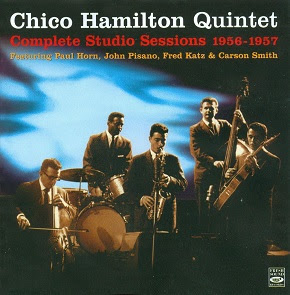
Chico Hamilton • Complete Studio Sessions [1956-1957]


Review by Michael G. Nastos  
This is the fourth Fresh Sound CD reissuing drummer Chico Hamilton's early ensembles to come out, and it is perhaps his most important grouping. The quintet played originals and standard covers that combined elements of Eastern and Western strains of mainstream and chamber jazz with instruments like flute, cello, and guitar. Hamilton created new music that some scratched their heads at, but most understood and enjoyed its softer tones and rounded edges. These studio works from four Los Angeles based sessions released on the Pacific Jazz, World Pacific, and Decca labels stem from the second version of Hamilton's quintet, which originally included Jim Hall and Buddy Collette. When Hall joined the Jimmy Giuffre trio, the tasteful guitarist John Pisano was recruited, then original woodwind player Buddy Collette left for greener pastures, and multi-instrumentalist Paul Horn was asked to join. Cellist Fred Katz and bassist Carson Smith remained, retaining the classical spirit of the group, but the addition of Pisano and Horn did nothing to diminish what the ensemble sound had attained, and would embellish. And it is their compositions that distinguish this music from any other group of the era, save that of Dave Brubeck. Smith's "Chanel #5" is a fluid, sprightly flute/cello waltz with Horn's Paul Desmond style alto sax added on. "Beanstalk" is an easy swinger merging melodies of "Love Me or Leave Me" and "Softly, As in a Morning Sunrise," while "Mr. Smith Goes to Town" takes off with Smith's witty bass leading the charge. Of the classically oriented compositions of Katz, the beautiful ballad "Lillian" is as romantic as can be with Horn's alto singing his heart out, while "Reflections" has Horn's evocative and pristine flute countering a pristine cello from the author. Hall's tunes remained in the repertoire, especially the extraordinary "Siete-Cuatro" in 7/8 with ostinato bass, Horn's wonderful textures on alto, repeat guitar lines, legato cello, and tambourine accents. There are three abbreviated versions of Hall's band theme "I Know," a classic read of "Satin Doll," an intriguing calypso infused "Soft Winds," an outstanding take of "September Song" where Horn's clarinet and the cello of Katz weep mournfully about the change of season and lost love, and a fine flute front loaded Latin snake charmer style identifying the classic "Caravan." Collette also left behind "Blue Sands" and "The Ghost," performed on the Stars of Jazz ABC television program on Christmas Eve of 1956. The former is an exotic discourse in mysterious notions, the latter using very clever interplay between the five instrumentalists. Hamilton plays brushes and little instruments for the most part, composed two tracks where he is the featured soloist, and co-composed another four with Katz that appeared in the film of Sweet Smell of Success. There is a full CD of that movie soundtrack available on a separate CD that is the fifth reissued Fresh Sound CD featuring this ensemble. While this is not absolutely the complete studio recordings of this legendary ensemble, it is ultimately substantive, representing a marvelous sound that is as appealing as any in the modern post-bop idiom, and ranks favorably with any chamber jazz attempts of any era.
https://www.allmusic.com/album/complete-studio-sessions-1956-57-mw0001685367

///////


Reseña de Michael G. Nastos  
Este es el cuarto CD de Fresh Sound que reedita los primeros conjuntos del baterista Chico Hamilton, y es quizás su agrupación más importante. El quinteto tocó versiones originales y estándar que combinaban elementos de las cepas orientales y occidentales del jazz convencional y de cámara con instrumentos como flauta, violonchelo y guitarra. Hamilton creó nueva música que algunos se rascaron la cabeza, pero la mayoría entendió y disfrutó de sus tonos más suaves y bordes redondeados. Estos trabajos de estudio de cuatro sesiones con sede en Los Ángeles lanzados en los sellos Pacific Jazz, World Pacific y Decca provienen de la segunda versión del quinteto de Hamilton, que originalmente incluía a Jim Hall y Buddy Collette. Cuando Hall se unió al Jimmy Giuffre trio, se reclutó al guitarrista de buen gusto John Pisano, luego el músico de viento de madera original Buddy Collette se fue a pastos más verdes, y se le pidió al multiinstrumentista Paul Horn que se uniera. El violonchelista Fred Katz y el bajista Carson Smith permanecieron, conservando el espíritu clásico del grupo, pero la adición de Pisano y Horn no hizo nada para disminuir lo que el sonido del conjunto había logrado, y embellecería. Y son sus composiciones las que distinguen a esta música de cualquier otro grupo de la época, salvo la de Dave Brubeck. "Chanel #5" de Smith es un vals fluido y vivaz para flauta/violonchelo con saxo alto estilo Paul Desmond de Horn agregado. "Beanstalk" es un intercambio de parejas fácil que fusiona melodías de "Love Me or Leave Me" y "Softly, As in a Morning Sunrise", mientras que " Mr. Smith Goes to Town " despega con el ingenioso bajo de Smith liderando la carga. De las composiciones de orientación clásica de Katz, la hermosa balada "Lillian" es tan romántica como puede serlo con el alto de Horn cantando con todo su corazón, mientras que "Reflections" tiene la flauta evocadora y prístina de Horn contrarrestando un violonchelo prístino del autor. Las melodías de Hall permanecieron en el repertorio, especialmente el extraordinario "Siete-Cuatro" en 7/8 con bajo ostinato, maravillosas texturas de Cuerno en alto, líneas de guitarra repetidas, violonchelo legato y acentos de pandereta. Hay tres versiones abreviadas del tema de la banda de Hall, "I Know", una lectura clásica de "Satin Doll", un intrigante calipso infundido con "Soft Winds", una toma sobresaliente de" September Song "donde el clarinete de Horn y el violonchelo de Katz lloran tristemente por el cambio de estación y el amor perdido, y una flauta fina cargada de estilo encantador de serpientes latinas que identifica el clásico "Caravan". Collette también dejó atrás "Blue Sands" y "The Ghost", interpretadas en el programa de televisión Stars of Jazz ABC en la víspera de Navidad de 1956 .  El primero es un discurso exótico en nociones misteriosas, el segundo utiliza una interacción muy inteligente entre los cinco instrumentistas. Hamilton toca pinceles y pequeños instrumentos en su mayor parte, compuso dos temas en los que es el solista destacado, y co-compuso otros cuatro con Katz que aparecieron en la película de Sweet Smell of Success. Hay un CD completo de la banda sonora de esa película disponible en un CD separado que es el quinto CD de Sonido fresco reeditado con este conjunto. Si bien estas no son absolutamente las grabaciones de estudio completas de este legendario conjunto, en última instancia son sustantivas, representan un sonido maravilloso que es tan atractivo como cualquier otro en el lenguaje moderno post-bop, y se clasifica favorablemente con cualquier intento de jazz de cámara de cualquier época.
https://www.allmusic.com/album/complete-studio-sessions-1956-57-mw0001685367


Sunday, November 16, 2025

Paul Desmond • Glad To Be Unhappy


Review by Richard S. Ginell
Even though Desmond was kidding when he described himself as the world's slowest alto player, this record bears out the kernel of truth within the jest. Here, Desmond set out to make a record of love songs and torch ballads, so the tempos are very slow to medium, the mood is of wistful relaxation, and the spaces between the notes grow longer. At first glance, Desmond may seem only peripherally involved with the music-making, keeping emotion at a cool, intellectual arms' length, yet his exceptionally pure tone and ruminative moods wear very well over the long haul. Again, Jim Hall is his commiserator and partner, and the guitarist gets practically as much space to unwind as the headliner; the solo on "Angel Eyes" is an encyclopedia of magnificent chording and single-string eloquence. Gene Wright returns on bass, spelled by Gene Cherico on "Poor Butterfly," and Connie Kay's brush-dominated drum work is pushed even further into the background. A lovely recording, though not the best album in the Desmond/Hall collaboration.

///////

Revisión por Richard S. Ginell
A pesar de que Desmond estaba bromeando cuando se describió a sí mismo como el jugador más lento del mundo, este registro soporta el núcleo de la verdad dentro de la broma. Aquí, Desmond se propuso hacer un registro de canciones de amor y baladas de antorchas, por lo que los tempos son muy lentos a medianos, el estado de ánimo es de relajación nebulosa y los espacios entre las notas se hacen más largos. A primera vista, Desmond puede parecer solo involucrado periféricamente con la creación de música, manteniendo la emoción a la altura de los brazos, intelectuales, pero su tono excepcionalmente puro y su humor rumiante se visten muy bien a largo plazo. Una vez más, Jim Hall es su compañero y compañero, y el guitarrista tiene prácticamente tanto espacio para relajarse como el jefe de cartel; El solo de "Angel Eyes" es una enciclopedia de magníficas frases y elocuencia de una sola cuerda. Gene Wright regresa al bajo, escrito por Gene Cherico en "Poor Butterfly", y el trabajo de batería dominado por el pincel de Connie Kay se empuja aún más al fondo. Una grabación encantadora, aunque no es el mejor álbum en la colaboración de Desmond / Hall.


Wednesday, July 30, 2025

Bob Brookmeyer • Traditionalism Revisited


 Review by Scott Yanow
This Pacific Jazz album is a bit unusual. Bob Brookmeyer (on valve trombone and piano), Jimmy Giuffre (switching between clarinet, baritone and tenor), guitarist Jim Hall, either Joe Benjamin or Ralph Pena on bass and drummer Dave Bailey perform eight songs from the 1920s and '30s including some obscurities. While these selections have occasionally been revived by Dixieland and swing bands, Brookmeyer and his group use harmonies that were modern for the 1950s to update such tunes as "Louiaiana," "Truckin'," "Honeysuckle Rose" and even "Santa Claus Blues." Because the musicians have a respect for the older styles, they extend rather than break the tradition; the results are quite enjoyable.
https://www.allmusic.com/album/traditionalism-revisited-mw0000040330

///////

 Reseña de Scott Yanow
Este álbum de Pacific Jazz es un poco inusual. Bob Brookmeyer (en el trombón de válvulas y el piano), Jimmy Giuffre (cambiando entre el clarinete, el barítono y el tenor), el guitarrista Jim Hall, Joe Benjamin o Ralph Pena en el bajo y el baterista Dave Bailey interpretan ocho canciones de los años 20 y 30 incluyendo algunas obscuridades. Aunque estas selecciones han sido revividas ocasionalmente por bandas de Dixieland y swing, Brookmeyer y su grupo utilizan armonías que eran modernas para los años 50 para actualizar melodías como "Louiaiana", "Truckin'", "Honeysuckle Rose" e incluso "Santa Claus Blues". Como los músicos respetan los estilos más antiguos, amplían la tradición en lugar de romperla; los resultados son bastante agradables.
https://www.allmusic.com/album/traditionalism-revisited-mw0000040330


Tuesday, June 24, 2025

Jim Hall, Ron Carter Duo • Alone Together


Review
Long considered a classic and a revelation to listeners who had taken guitarist Jim Hall for granted, this set of duets with bassist Ron Carter (reissued on CD) has near-telepathic communication between the two musicians and quiet music full of inner tension and fire. Hall and Carter brought in an original apiece and also collaborated on six standards, including "St. Thomas," "Softly As in a Morning Sunrise," "Autumn Leaves," and "Alone Together." Introspective and thought-provoking music.
by Scott Yanow
https://www.allmusic.com/album/alone-together-mw0000194060

///////

Reseña
Considerado durante mucho tiempo un clásico y una revelación para los oyentes que habían dado por sentado al guitarrista Jim Hall, este conjunto de dúos con el bajista Ron Carter (reeditado en CD) tiene una comunicación casi telepática entre los dos músicos y una música tranquila llena de tensión interior y fuego. Hall y Carter trajeron una pieza original y también colaboraron en seis estándares, incluyendo "St. Thomas", "Softly As in a Morning Sunrise", "Autumn Leaves" y "Alone Together". Música introspectiva y que invita a la reflexión.
por Scott Yanow
https://www.allmusic.com/album/alone-together-mw0000194060


Tuesday, April 29, 2025

Jimmy Raney • Two Jims And Zoot


Review by Scott Yanow
The slightly unusual date Two Jims and a Zoot features tenor saxophonist Zoot Sims interacting with two guitarists (Jimmy Raney and Jim Hall) while given subtle support by bassist Steve Swallow and drummer Osie Johnson. Although the eight selections (none of which caught on as standards) had all been written recently and sometimes display the influence of bossa nova, the quiet performances could pass for 1954 rather than 1964. The cool-toned improvisations and boppish playing have a timeless quality about them although for the time period aspects of this music already sounded a bit old-fashioned.
https://www.allmusic.com/album/two-jims-and-zoot-mw0000859903

///////


Reseña de Scott Yanow
La ligeramente inusual cita Two Jims and a Zoot presenta al saxofonista tenor Zoot Sims interactuando con dos guitarristas (Jimmy Raney y Jim Hall) mientras recibe el sutil apoyo del bajista Steve Swallow y el batería Osie Johnson. Aunque las ocho selecciones (ninguna de las cuales se convirtió en estándar) habían sido escritas recientemente y a veces muestran la influencia de la bossa nova, las tranquilas interpretaciones podrían parecer de 1954 y no de 1964. Las improvisaciones de tono fresco y la interpretación boppish tienen una cualidad atemporal, aunque para la época algunos aspectos de esta música ya sonaban un poco anticuados.
https://www.allmusic.com/album/two-jims-and-zoot-mw0000859903


Sunday, April 20, 2025

Jimmy Giuffre & Jim Hall • The Way It is


An excellent introduction to Jimmy Giuffre's unique music.
With guitarist Jim Hall, Giuffre is heard on clarinet, tenor, and baritone. The generally introverted music is wistful, has a fair amount of variety, and is melodic while still sounding advanced.
The thought-provoking and generally relaxed works feature a wide variety of instrumentation. Giuffre plays a fairly free "Fascinatin' Rhythm" in a Benny Goodman-type trio with pianist Rowles and drummer Shelly Manne, performs with a couple of other trios, uses three woodwinds plus bassist Ralph Pena on an atmospheric "My Funny Valentine“.
A very interesting album.
Review by Scott Yanow

///////


Una excelente introducción a la música única de Jimmy Giuffre.
Junto al guitarrista Jim Hall, Giuffre toca el clarinete, el tenor y el barítono. La música, en general introvertida, es melancólica, tiene bastante variedad y es melódica sin dejar de sonar avanzada.
Las obras, generalmente relajadas y que invitan a la reflexión, presentan una amplia variedad de instrumentación. Giuffre interpreta un «Fascinatin' Rhythm» bastante libre en un trío tipo Benny Goodman con el pianista Rowles y el batería Shelly Manne, actúa con un par de tríos más, utiliza tres vientos de madera más el bajista Ralph Pena en un atmosférico «My Funny Valentine».
Un álbum muy interesante.
Reseña de Scott Yanow


Friday, March 21, 2025

Bill Evans • Loose Blues


Review by Scott Yanow
This long-lost session, not released initially until 1982, features pianist Bill Evans, tenor saxophonist Zoot Sims, guitarist Jim Hall, bassist Ron Carter, and drummer Philly Joe Jones interpreting seven of the pianist's recent originals. Due to some difficulties during the recording process (none of the sidemen were familiar with the often complex numbers), the results were originally shelved and lost for a couple of decades. This CD reissue shows that the music was actually much better than originally thought. While "Time Remembered," "Funkallero," and "My Bells" would become Evans standards, it is quite interesting to hear such forgotten obscurities as "Loose Bloose" (heard in two versions), "There Came You," "Fun Ride," and "Fudgesickle Built for Four"; a couple of the songs could stand to be revived. It is a pity that Evans and Sims (a logical combination) never did record together again.

///////

Traducción Automática:
Revisión por Scott Yanow
Esta sesión perdida, que no se lanzó inicialmente hasta 1982, cuenta con el pianista Bill Evans, el saxofonista Zoot Sims, el guitarrista Jim Hall, el bajista Ron Carter y el baterista Philly Joe Jones interpretando siete de los originales originales del pianista. Debido a algunas dificultades durante el proceso de grabación (ninguno de los sidemen estaba familiarizado con los números a menudo complejos), los resultados originalmente se archivaron y se perdieron durante un par de décadas. Esta reedición de CD muestra que la música era en realidad mucho mejor de lo que se pensaba originalmente. Mientras que "Time Remembered", "Funkallero" y "My Bells" se convertirían en estándares de Evans, es muy interesante escuchar obscuridades olvidadas como "Loose Bloose" (escuchado en dos versiones), "There Came You", "Fun Ride , "y" Fudgesickle Built for Four "; Un par de canciones podrían ser revividas. Es una pena que Evans y Sims (una combinación lógica) nunca volvieran a grabar juntos.


Thursday, February 27, 2025

Bob Brookmeyer • Trombone Jazz Samba-Samba Para Dos


Review by Ken Dryden
Bob Brookmeyer was in the studio just a few months after Stan Getz and Charlie Byrd helped to launch the bossa nova craze in the United States with their hit LP Jazz Samba, but this extremely enjoyable LP didn't come close to matching the success of the earlier album; it may be because the valve trombone is not envisioned as a lush melodic instrument by the average jazz listener in comparison to the tenor sax. Brookmeyer's mellow solos are complemented by the presence of guitarists Jim Hall (who plays all of the solos) and Jimmy Raney, along with vibraphonist Gary McFarland and a trio of Latin percussionists, including Willie Bobo. Luiz Bonfá's "Samba de Orfeu" and "Manha de Carnaval" as well as Antonio Carlos Jobim's "A Felicidade" (all three of which have become standards within the genre) are given imaginative arrangements, but there are a few twists thrown in by the leader. Brookmeyer's catchy "Blues Bossa Nova" works very well, as do his loping bossa nova treatment of Bronislaw Kaper's theme from Mutiny on the Bounty and a hilarious brisk chart called "Colonel Bogey Bossa Nova," a reworking of the well-known song made famous by the film The Bridge on the River Kwai. Long out of print, this album deserves to be reissued by Verve -- although there are hopefully some unissued tracks, as its brevity (under 28 minutes) is a handicap.


Review by Ken Dryden
This long unavailable record pairs valve trombonist Bob Brookmeyer with pianist Lalo Schifrin in a light but swinging Latin-flavored studio session. Although there is a formidable supporting cast, which includes Phil Woods, Al Cohn, Zoot Sims, and Jimmy Raney, the solos are primarily by the co-leaders and Leo Wright, heard on several flute solos. Following Schifrin's extended but lively "Samba Para Dos," the remainder of the date focuses on very familiar standards. Raney's solos are a highlight of "I Get a Kick Out of You" and "My Funny Valentine." The full reed section fleshes out a potent interpretation of "Just One of Those Things," which features an impressive and often humorous solo by Brookmeyer. Although this may not be considered an essential LP by the average jazz fan, it is well worth acquiring.

///////

Revisión por Ken Dryden
Bob Brookmeyer estuvo en el estudio pocos meses después de que Stan Getz y Charlie Byrd ayudaron a lanzar la locura de la bossa nova en los Estados Unidos con su exitoso LP Jazz Samba, pero este LP extremadamente agradable no estuvo a la altura del éxito del álbum anterior; puede deberse a que el trombón de la válvula no se concibe como un instrumento melódico exuberante por el oyente de jazz promedio en comparación con el saxo tenor. Los solos suaves de Brookmeyer se complementan con la presencia de los guitarristas Jim Hall (que toca todos los solos) y Jimmy Raney, junto con el vibrafonista Gary McFarland y un trío de percusionistas latinos, incluido Willie Bobo. "Samba de Orfeu" de Luiz Bonfá y "Manha de Carnaval", así como "A Felicidade" de Antonio Carlos Jobim (las tres de las cuales se han convertido en estándares dentro del género) reciben arreglos imaginativos, pero hay algunos giros introducidos por el líder. El pegajoso "Blues Bossa Nova" de Brookmeyer funciona muy bien, al igual que su tratamiento de bossa bossa nova del tema de Bronislaw Kaper de Mutiny on the Bounty y un gráfico hilarante llamado "Coronel Bogey Bossa Nova", una reelaboración de la famosa canción que se hizo famosa. Por la película El puente sobre el río Kwai. Durante mucho tiempo fuera de impresión, este álbum merece ser reeditado por Verve, aunque es de esperar que haya algunos temas no publicados, ya que su brevedad (menos de 28 minutos) es un hándicap.


Revisión por Ken Dryden
Este largo no disponible hace un par de trombonistas de válvulas Bob Brookmeyer con el pianista Lalo Schifrin en una sesión de estudio ligera pero con sabor latino. Aunque hay un formidable reparto de apoyo, que incluye a Phil Woods, Al Cohn, Zoot Sims y Jimmy Raney, los solos son principalmente de los co-líderes y Leo Wright, escuchados en varios solos de flauta. Siguiendo el extenso pero animado "Samba Para Dos" de Schifrin, el resto de la fecha se enfoca en estándares muy familiares. Los solos de Raney son un punto culminante de "Me saco de ti" y "Mi gracioso San Valentín". La sección completa de lengüetas presenta una potente interpretación de "Just One of That Things", que presenta un solo impresionante y, a menudo, humorístico de Brookmeyer. Si bien esto puede no ser considerado un LP esencial por un fanático del jazz promedio, vale la pena adquirirlo.


Friday, February 21, 2025

Jim Hall Trio • The Complete 'Jazz Guitar'


The Jim Hall Trio LP "Jazz Guitar" recorded in 1957 with pianist Carl Perkins and bassist Red Mitchell has appeared in various forms (including a re-issue with drums dubbed on) but this is the first time that all the tracks cut at the session have been put together unabridged on one CD.

This outstanding early album was made when Hall was attracting attention on the West Coast scene playing with Jimmy Guiffre.The disc also contains five bonus tracks made at various times with pianist John Lewis.
https://www.freshsoundrecords.com/jim-hall-albums/4603-the-complete.html


Biography:
A harmonically advanced cool-toned and subtle guitarist, Jim Hall was an inspiration to many guitarists, including some (such as Bill Frisell) who sound nothing like him. Hall attended the Cleveland Institute of Music and studied classical guitar in Los Angeles with Vicente Gómez. He was an original member of the Chico Hamilton Quintet (1955-1956), and during 1956-1959 was with the Jimmy Giuffre Three. After touring with Ella Fitzgerald (1960-1961) and sometimes forming duos with Lee Konitz, Hall was with Sonny Rollins' dynamic quartet in 1961-1962, recording The Bridge. He co-led a quartet with Art Farmer (1962-1964), recorded on an occasional basis with Paul Desmond during 1959-1965 (all of their quartet performances are collected on a Mosaic box set), and then became a New York studio musician. He was mostly a leader during the following years and, in addition to his own projects for World Pacific/Pacific Jazz, MPS, Milestone, CTI, Horizon, Artist House, Concord, MusicMasters, and Telarc, Jim Hall recorded two classic duet albums with Bill Evans. A self-titled collaboration with Pat Metheny followed in 1999. A flurry of studio albums, reissues, and compilations followed throughout the next few years, with the exceptional Jim Hall & Basses standing out for its bass/guitar duet format. Jim Hall died at his apartment in Manhattan on December 10, 2013; he was 83 years old.

///////


El LP "Jazz Guitar" de Jim Hall Trio, grabado en 1957 con el pianista Carl Perkins y el bajista Red Mitchell, ha aparecido en diversas formas (incluida una reedición con la batería doblada), pero ésta es la primera vez que todas las pistas grabadas en la sesión se reúnen íntegramente en un CD.

El disco contiene también cinco temas extra grabados en varias ocasiones con el pianista John Lewis.
https://www.freshsoundrecords.com/jim-hall-albums/4603-the-complete.html


Biografía:
Un guitarrista armónicamente avanzado de tono frío y sutil, Jim Hall fue una inspiración para muchos guitarristas, incluyendo algunos (como Bill Frisell) que no se parecen en nada a él. Hall asistió al Instituto de Música de Cleveland y estudió guitarra clásica en Los Ángeles con Vicente Gómez. Fue miembro original del Quinteto Chico Hamilton (1955-1956), y durante 1956-1959 estuvo con los Tres de Jimmy Giuffre. Después de ir de gira con Ella Fitzgerald (1960-1961) y a veces formando dúos con Lee Konitz, Hall estuvo con el dinámico cuarteto de Sonny Rollins en 1961-1962, grabando The Bridge. Dirigió un cuarteto con Art Farmer (1962-1964), grabó ocasionalmente con Paul Desmond durante 1959-1965 (todas sus actuaciones en cuarteto se recogen en una caja de Mosaico), y luego se convirtió en un músico de estudio de Nueva York. Fue principalmente un líder durante los años siguientes y, además de sus propios proyectos para World Pacific/Pacific Jazz, MPS, Milestone, CTI, Horizon, Artist House, Concord, MusicMasters y Telarc, Jim Hall grabó dos álbumes clásicos a dúo con Bill Evans. En 1999 se produjo una colaboración autotitulada con Pat Metheny. Una ráfaga de álbumes de estudio, reediciones y compilaciones siguieron a lo largo de los siguientes años, con el excepcional Jim Hall & Basses destacándose por su formato de dúo bajo/guitarra. Jim Hall murió en su apartamento de Manhattan el 10 de diciembre de 2013; tenía 83 años. 


Wednesday, February 5, 2025

Quincy Jones • Golden Boy


Review
by Scott Yanow
This Quincy Jones big-band LP finds him exploring a wide variety of material in hopes of finding a hit. Among the selections are "Django," the Beatles' "A Hard Day's Night," "The Sidewinder," a remake of "The Midnight Sun Will Never Set" and three versions of the "Theme From Golden Boy." There are some spots for trumpeters Freddie Hubbard and Joe Newman, altoist Phil Woods, guitarist Jim Hall, and the tough tenor of Eddie "Lockjaw" Davis, but the brevity of the selections (all but "Django" are between two and four minutes) and the conservative nature of many of the charts keep the music from taking any real chances.
https://www.allmusic.com/album/golden-boy-mw0000458859

///////


Reseña
por Scott Yanow
En este LP para big band Quincy Jones explora una amplia variedad de material con la esperanza de encontrar un éxito. Entre las selecciones están "Django", "A Hard Day's Night" de los Beatles, "The Sidewinder", una nueva versión de "The Midnight Sun Will Never Set" y tres versiones del "Theme From Golden Boy". Hay algunos momentos para los trompetistas Freddie Hubbard y Joe Newman, el contralto Phil Woods, el guitarrista Jim Hall y el tenor de Eddie "Lockjaw" Davis, pero la brevedad de las selecciones (todas menos "Django" duran entre dos y cuatro minutos) y la naturaleza conservadora de muchas de las listas impiden que la música se arriesgue.
https://www.allmusic.com/album/golden-boy-mw0000458859


www.quincyjones.com ...