egroj world: Gerald Wiggins
Showing posts with label Gerald Wiggins. Show all posts

Tuesday, April 8, 2025

Gerald Wiggins • The Loveliness Of You


Artist Biography by Scott Yanow
Gerald Wiggins was a highly flexible pianist quite comfortable in swing or bop settings, but he was at his best when performing with his longtime trio, a group that also included bassist Andy Simpkins and drummer Paul Humphrey. Wiggins' swinging and consistently witty style, typically filled with catchy riffs, was at times reminiscent of Erroll Garner and Art Tatum, but generally quite distinctive.

"The Wig" started with piano lessons when he was four, switching from classical music to jazz as a teenager. He doubled on bass while attending New York City's High School of Music & Art and worked for a time in the early '40s as a piano accompanist for Stepin Fetchit. Wiggins played with Les Hite, and in 1943 toured with the big bands of Louis Armstrong and Benny Carter. While in the military (1944-1946), he often played in local jazz clubs in Seattle. After his discharge, he settled permanently in the Los Angeles area. A popular accompanist for singers, Wiggins worked with Lena Horne (touring with her from 1950-1951), Helen Humes, Ella Mae Morse, Eartha Kitt, Nat King Cole, Kay Starr, Lou Rawls, Ernie Andrews, Linda Hopkins, and Joe Williams, among others. Wiggins was also employed as a vocal coach at Hollywood film studios and had the opportunity to work with Marilyn Monroe.

In the Los Angeles area, Wiggins led trios from the 1950s onward, becoming a consistent fixture in local clubs. He also played piano with the Frank Capp Juggernaut and worked with fellow Concord artists like Scott Hamilton. Through the years, Wiggins led sessions for Swing and Vogue (both in 1950), Ember, Crown, Tampa, Specialty, Motif, Mode, Challenge, Hi-Fi, Contemporary (1961), Black & Blue, and, in the 1990s, Concord. His son J.J. Wiggins is a fine bassist. Gerald Wiggins died in Los Angeles in July of 2008; he was 86 years old.

///////

Biografía del artista por Scott Yanow
Gerald Wiggins era un pianista muy flexible, bastante cómodo en el swing o el bop, pero estaba en su mejor momento cuando tocaba con su trío de muchos años, un grupo que también incluía al bajista Andy Simpkins y al baterista Paul Humphrey. El swing de Wiggins y su estilo consistentemente ingenioso, típicamente lleno de riffs pegadizos, a veces recordaba a Erroll Garner y Art Tatum, pero en general era bastante distintivo.

"The Wig" comenzó con clases de piano cuando tenía cuatro años, pasando de la música clásica al jazz cuando era adolescente. Dobló el bajo mientras asistía a la High School of Music & Art de la ciudad de Nueva York y trabajó durante un tiempo a principios de los años 40 como pianista acompañante para Stepin Fetchit. Wiggins tocó con Les Hite, y en 1943 hizo una gira con las big bands de Louis Armstrong y Benny Carter. Mientras estuvo en el ejército (1944-1946), a menudo tocaba en clubes de jazz locales en Seattle. Después de ser dado de alta, se estableció permanentemente en el área de Los Ángeles. Un acompañante popular para cantantes, Wiggins trabajó con Lena Horne (de gira con ella de 1950 a 1951), Helen Humes, Ella Mae Morse, Eartha Kitt, Nat King Cole, Kay Starr, Lou Rawls, Ernie Andrews, Linda Hopkins y Joe Williams, entre otros. Wiggins también trabajó como profesor de canto en estudios de cine de Hollywood y tuvo la oportunidad de trabajar con Marilyn Monroe.

En el área de Los Ángeles, Wiggins lideró a los tríos a partir de la década de 1950, convirtiéndose en un fijo constante en los clubes locales. También tocó el piano con el Frank Capp Juggernaut y trabajó con otros artistas de la Concordia como Scott Hamilton. A través de los años, Wiggins dirigió sesiones para Swing y Vogue (ambos en 1950), Ember, Crown, Tampa, Specialty, Motif, Mode, Challenge, Hi-Fi, Contemporary (1961), Black & Blue y, en los años 90, Concord. Su hijo J.J. Wiggins es un buen bajista. Gerald Wiggins murió en Los Ángeles en julio de 2008; tenía 86 años.


Monday, September 30, 2024

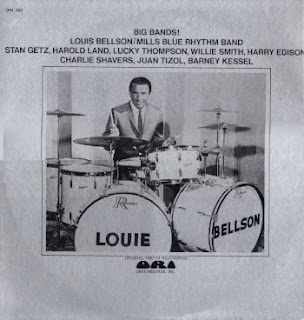
Louis Bellson-Mills Blue Rhythm Band • Big Bands!


One of the world’s greatest drummers, Louie Bellson has been an exciting crowd pleaser for over 60 years. A well-respected educator and one of the nicest people in the music business, the still-active Louie Bellson is a class act.

Born Luigi Paolino Balassoni, Bellson won a nationwide Gene Krupa drum contest in 1940 and was heard by Tommy Dorsey, who was quite impressed. The drummer started at the top in 1941, playing with Benny Goodman; after serving in the military, he worked with the big bands of Goodman, Tommy Dorsey, and Harry James. His trademark was using two bass drums in his set. From the start, Bellson was able to construct fascinating solos that could hold one’s interest for as long as 15 minutes, yet he also enjoyed playing quietly with combos.

Performing regularly with Duke Ellington during 1951-1953 made Bellson world-famous and he also gained good reviews for his writing, which included “Skin Deep” and “The Hawk Talks.” After marrying Pearl Bailey, he left Ellington to work as his wife’s musical director but he also performed in many different settings, including with Jazz At The Philharmonic, Art Tatum, Oscar Peterson, the Dorsey Brothers Orchestra, Count Basie, and special projects with Ellington. In addition Bellson led his own big band and small groups, recording regularly as a leader.

Since the 1960s, Bellson has been involved in educational work, teaching young musicians his dynamic drumming technique. In the 1970s and 1980s, he could frequently be found on recordings from impresario Norman Granz's Pablo label, as well as the Concord label. He has published many of his scores, including his jazz ballet The Marriage Vows. For more than thirty years he has led big bands internationally, and continued to tour, often with a quintet.

Bellson has performed on more than 200 albums with such greats as Duke Ellington, Count Basie, Benny Goodman, Tommy Dorsey, Harry James, Woody Herman, Sarah Vaughan, Ella Fitzgerald, Oscar Peterson, Dizzy Gillespie, Louie Armstrong, Lionel Hampton, James Brown, Sammy Davis Jr., Tony Bennett, Mel Torme, Joe Williams, Wayne Newton and Bellson's late wife Pearl Bailey.

Composer and author, he has written more than 1,000 compositions and more than a dozen books on drums and percussion. He received the prestigious American Jazz Masters Award from the National Endowment for the Arts in 1994. Also, he is a six-time Grammy nominee.

In 1998, Louie Bellson was hailed (along with Roy Haynes, Elvin Jones and Max Roach) as one of four "Living Legends of Music" when he received the American Drummers Achievement Award from the Zildjian Company.

Bellson holds four honorary doctorates, the latest from DePaul University in 2001. In 2003, a historical land-marker was dedicated at his July 6, 1924 birth house in Rock Falls, Illinois, thus inaugurating their annual 4-day celebration in his honor.

The 2006 CD release of "The Sacred Music of Louie Bellson and the Jazz Ballet" amply showcased his mastery and breadth as both composer and performer. This "magnum opus" is well attested to by the highest accolades of colleagues Tony Bennett, Della Reese, Dave Brubeck, Lalo Schifrin, and others

In March 2007, Bellson and 35 other jazz greats received the Living Jazz Legends Award from the Kennedy Center for the Performing Arts in Washington, DC.

Jazz drumming legend Louie Bellson passed on Feb.14, 2009.
https://www.allaboutjazz.com/musicians/louie-bellson/


///////


Louie Bellson, uno de los mejores bateristas del mundo, ha complacido al público durante más de 60 años. Louie Bellson, un educador muy respetado y una de las personas más agradables en el negocio de la música, aún activo, es un acto de clase.

Nacido como Luigi Paolino Balassoni, Bellson ganó un concurso nacional de batería Gene Krupa en 1940 y fue escuchado por Tommy Dorsey, quien quedó bastante impresionado. El baterista comenzó en la cima en 1941, tocando con Benny Goodman; después de servir en el ejército, trabajó con las grandes bandas de Goodman, Tommy Dorsey y Harry James. Su marca registrada fue usar dos bombos en su set. Desde el principio, Bellson pudo construir solos fascinantes que podían mantener el interés de uno durante hasta 15 minutos, pero también disfrutaba tocar en silencio con combos.

Actuar regularmente con Duke Ellington durante 1951-1953 hizo a Bellson mundialmente famoso y también obtuvo buenas críticas por sus escritos, que incluyeron "Skin Deep" y "The Hawk Talks."Después de casarse con Pearl Bailey, dejó Ellington para trabajar como director musical de su esposa, pero también actuó en muchos entornos diferentes, incluso con Jazz En la Filarmónica, Art Tatum, Oscar Peterson, la Orquesta de los Hermanos Dorsey, Count Basie y proyectos especiales con Ellington. Además Bellson lideró su propia big band y pequeños grupos, grabando regularmente como líder.

Desde la década de 1960, Bellson ha estado involucrado en el trabajo educativo, enseñando a jóvenes músicos su técnica dinámica de batería. En las décadas de 1970 y 1980, se lo podía encontrar con frecuencia en grabaciones del sello Pablo del empresario Norman Granz, así como en el sello Concord. Ha publicado muchas de sus partituras, incluido su ballet de jazz The Marriage Vows. Durante más de treinta años ha liderado grandes bandas a nivel internacional y ha continuado de gira, a menudo con un quinteto.

Bellson ha actuado en más de 200 álbumes con grandes como Duke Ellington, Count Basie, Benny Goodman, Tommy Dorsey, Harry James, Woody Herman, Sarah Vaughan, Ella Fitzgerald, Oscar Peterson, Dizzy Gillespie, Louie Armstrong, Lionel Hampton, James Brown, Sammy Davis Jr., Tony Bennett, Mel Torme, Joe Williams, Wayne Newton y la difunta esposa de Bellson, Pearl Bailey.

Compositor y autor, ha escrito más de 1.000 composiciones y más de una docena de libros sobre batería y percusión. Recibió el prestigioso premio American Jazz Masters de la Fundación Nacional de las Artes en 1994. Además, ha sido nominado seis veces al Grammy.

En 1998, Louie Bellson fue aclamado (junto con Roy Haynes, Elvin Jones y Max Roach) como una de las cuatro "Leyendas vivas de la música" cuando recibió el premio American Drummers Achievement Award de Zildjian Company.

Bellson tiene cuatro doctorados honorarios, el último de la Universidad DePaul en 2001. En 2003, se dedicó un hito histórico en su casa natal del 6 de julio de 1924 en Rock Falls, Illinois, inaugurando así su celebración anual de 4 días en su honor.

El lanzamiento en CD de 2006 de "The Sacred Music of Louie Bellson and the Jazz Ballet" mostró ampliamente su maestría y amplitud como compositor e intérprete. Esta "obra maestra" está bien atestiguada por los más altos elogios de sus colegas Tony Bennett, Della Reese, Dave Brubeck, Lalo Schifrin y otros

En marzo de 2007, Bellson y otros 35 grandes del jazz recibieron el premio Living Jazz Legends Award del Kennedy Center for the Performing Arts en Washington, DC.

La leyenda de la batería de jazz Louie Bellson falleció en febrero.14, 2009.
https://www.allaboutjazz.com/musicians/louie-bellson/


Thursday, September 5, 2024

Rusty Bryant • Original Quintet Complete Recordings


This unprecedented release features twenty-six tracks of the powerful groove-oriented tenor saxophonist playing a rare straight-ahead set accompanied by such outstandings figures as Gerald Wiggins on the piano chair, Howard Roberts or John Collins on guitar, Red Callender on bass and Alvin Stoller or Shelly Manne on drums. The various formations swing with precision, providing Rusty with the perfect backdrop to demonstrate his ample saxophone skills and impecable taste.
The repertoire contains a lot of Standards as well as seven own compositions. As a Bonus Tracks appeared two tracks of his first LP recorded in NYC, 1954.

///////

Este lanzamiento sin precedentes incluye veintiséis temas del poderoso saxofonista tenor orientado al groove, tocando un raro set de cabeza recta acompañado de figuras tan destacadas como Gerald Wiggins en la silla del piano, Howard Roberts o John Collins en la guitarra, Red Callender en el bajo y Alvin Stoller o Shelly Manne en la batería. Las diversas formaciones se balancean con precisión, proporcionando a Rusty el telón de fondo perfecto para demostrar sus amplias habilidades como saxofonista y su impecable gusto.
El repertorio contiene muchos Estándares así como siete composiciones propias. Como un Bonus Tracks aparecieron dos temas de su primer LP grabado en NYC, 1954.


Monday, April 1, 2024

Gerald Wiggins Trio • Wigging With Wig


Review by Michael G. Nastos
Gerald Wiggins, a quintessential sideman figure on the West Coast jazz scene, played piano with a dexterity and facile skill that easily rivaled the witty speed of Oscar Peterson and the soulful playfulness of Erroll Garner. This was readily acknowledged by his peers in California, but not heard by the jazz world at large until this, his debut U.S. recording, originally for the Dig label owned by the legendary Johnny Otis. With former Nat King Cole bassist Joe Comfort and then emerging jazz drummer Bill Douglas, Wiggins did this session in 1956, and it is a straight reissue of those tracks, with no extra material, at the LP length of just under 40 minutes. Wiggins generally goes back and forth from upbeat post-bop to mellow and sweet easy swingers -- there's little middle ground. The tunes that fly by very quickly include standards "Love for Sale," "Surrey with the Fringe on Top," the quick, popping "Three Little Words" and the Wiggins original "DeSilva Wig" for jazz DJ Walt DeSilva. On these, the trio is, well, wiggin' out! The slower numbers are also done with a taste and refinement exclusive of much older players, but Wiggins has selected some numbers off the beaten path. Duke Ellington's lovable "I Don't Know What Kind of Blues I Got," is somewhat obscure, a delicate read of "The Man That Got Away" is not the best known Harold Arlen tune, and the warhorse "Dinah" is taken at an unusually slow pace, with Wiggins inserting stride references astutely reminiscent of Garner. "Laura" is nice and elegant, but shows the lounge side of Wiggins in a less typical or rote fashion. Comfort and Douglas sound great together, as their finely crafted and in-tune collaboration supporting Wiggins cannot be overlooked. The shortness of this program might be an issue for bargain hunters, but this is an historical document marking the emergence of one of the true unsung heroes in modern mainstream small group piano jazz, and is an item all should find easy to love.

///////

Revisión por Michael G. Nastos
Gerald Wiggins, una figura sideman por excelencia en la escena del jazz de la Costa Oeste, tocaba el piano con destreza y habilidad que fácilmente rivalizaba con la ingeniosa velocidad de Oscar Peterson y la alegría juguetona de Erroll Garner. Esto fue reconocido fácilmente por sus colegas en California, pero no fue escuchado por el mundo del jazz en general hasta que se realizó esta grabación en Estados Unidos, originalmente para el sello Dig, propiedad del legendario Johnny Otis. Con el ex bajista de Nat King Cole Joe Comfort y el emergente baterista de jazz Bill Douglas, Wiggins realizó esta sesión en 1956, y es una reedición directa de esas pistas, sin material adicional, con una duración de LP de poco menos de 40 minutos. Por lo general, Wiggins va de un lado a otro después del bop optimista a los swingers suaves y dulces: hay poco terreno intermedio. Las melodías que vuelan muy rápidamente incluyen los estándares "Love for Sale", "Surrey con la franja en la parte superior", "el rápido y emergente" Three Little Words "y el original de Wiggins" DeSilva Wig "para el DJ de jazz Walt DeSilva. Sobre estos, el trío está, bueno, ¡luchando! Los números más lentos también se hacen con un gusto y refinamiento exclusivos de jugadores mucho mayores, pero Wiggins ha seleccionado algunos números fuera de lo común. El adorable "No sé qué tipo de blues que recibí" de Duke Ellington es algo oscuro, una lectura delicada de "El hombre que se fue" no es la canción más conocida de Harold Arlen, y el caballo de guerra "Dinah" se toma en un ritmo inusualmente lento, con Wiggins insertando referencias de zancada que recuerdan astutamente a Garner. "Laura" es agradable y elegante, pero muestra el lado del salón de Wiggins de una manera menos típica o de memoria. Comfort y Douglas suenan muy bien juntos, ya que su colaboración finamente diseñada y sintonizada que apoya a Wiggins no se puede pasar por alto. La brevedad de este programa puede ser un problema para los cazadores de gangas, pero este es un documento histórico que marca el surgimiento de uno de los verdaderos héroes desconocidos en el piano de grupo moderno, y es un elemento que todos deberían encontrar fácil de amar.